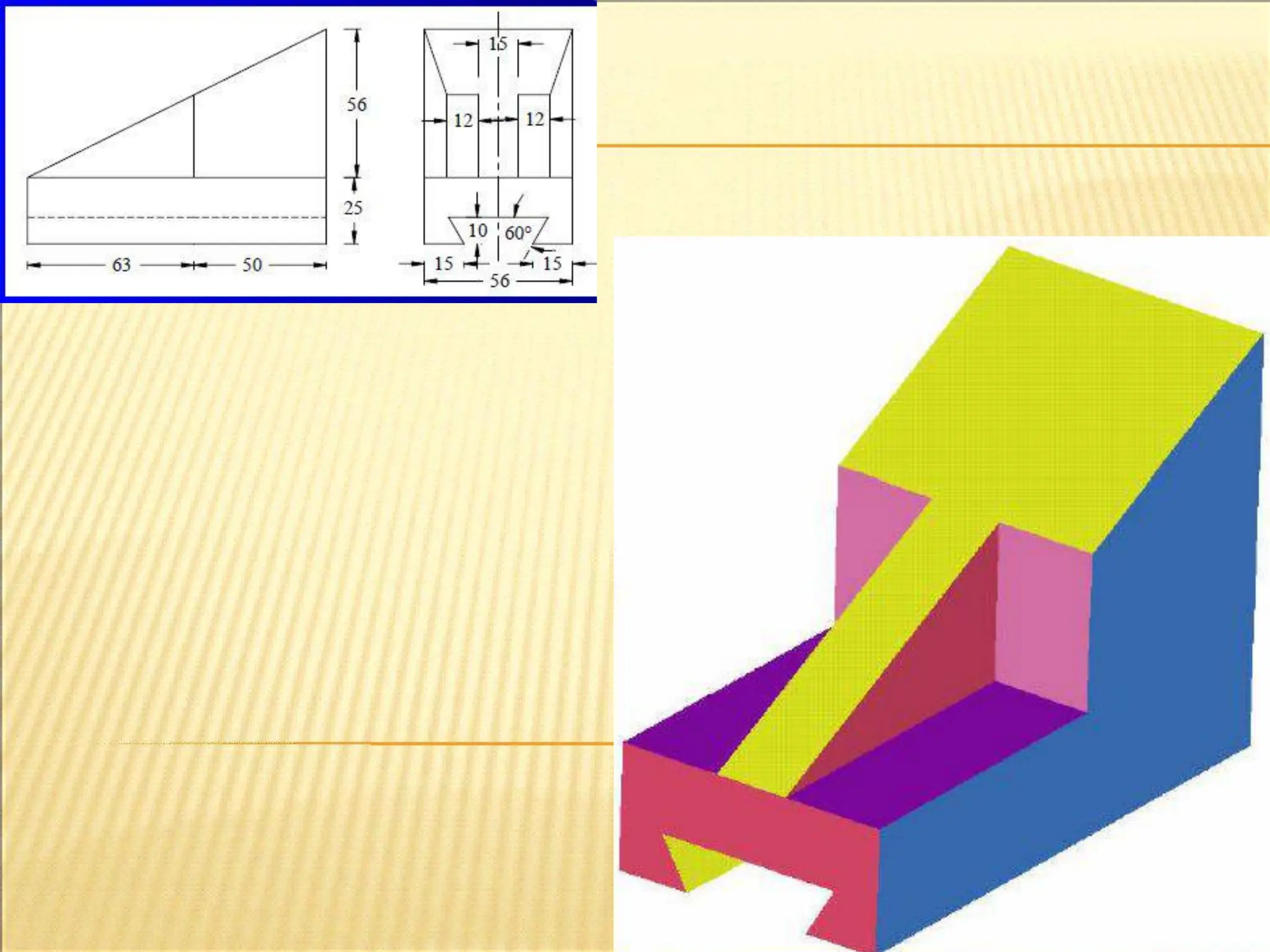
ENGINEERING GRAPHICS
PREPARED BY
PROF. MRS. S.G.BAWANE
DEPT. OF MECHANICAL ENGINEERING
KDK COLLEGE OF ENGINEERING,
NAGPUR
Topics
1. Engineering Scales
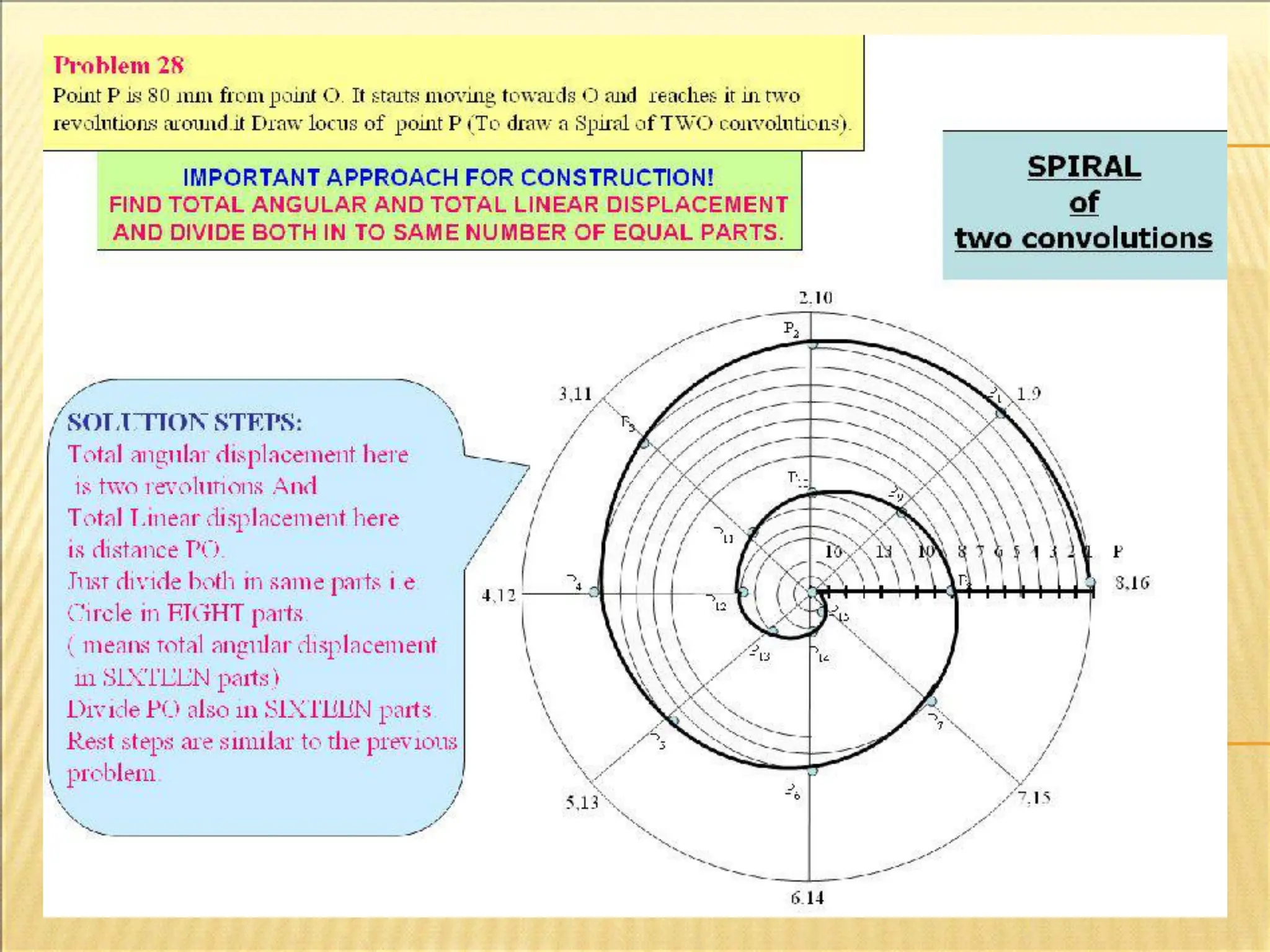
2. Engineering Curves
3. Orthographic Projections
4. Projections of Straight Lines
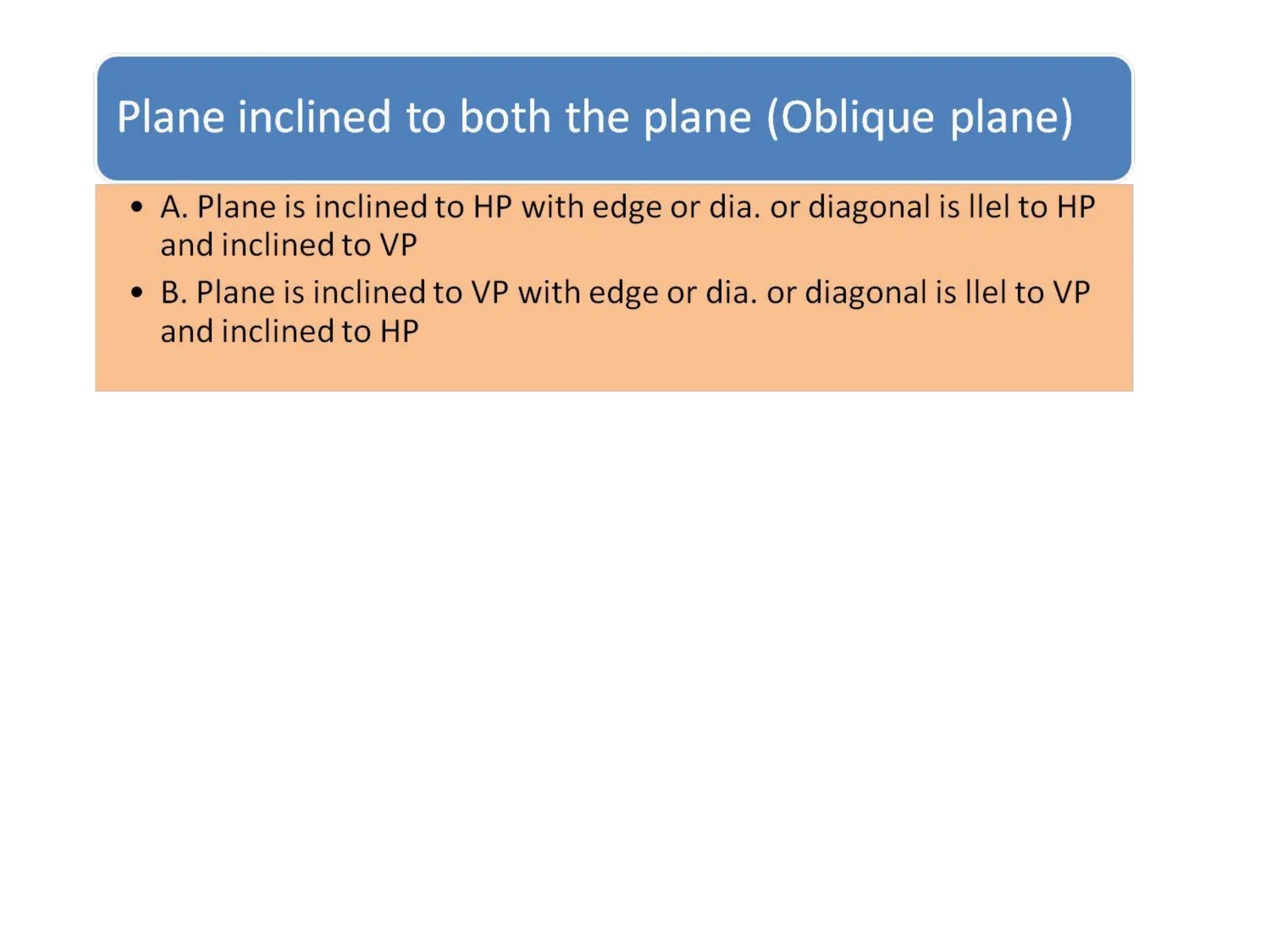
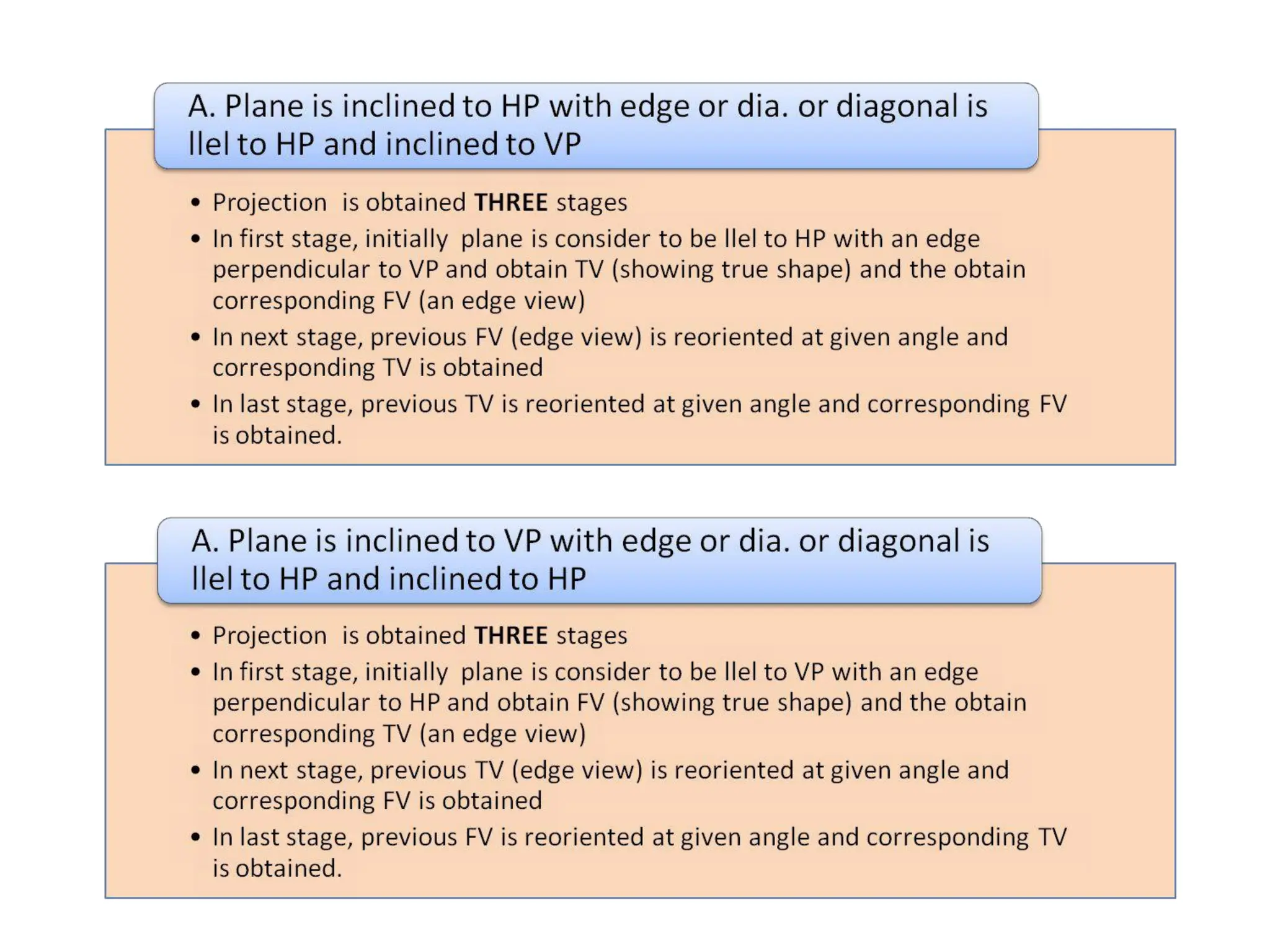
5. Projections of Planes
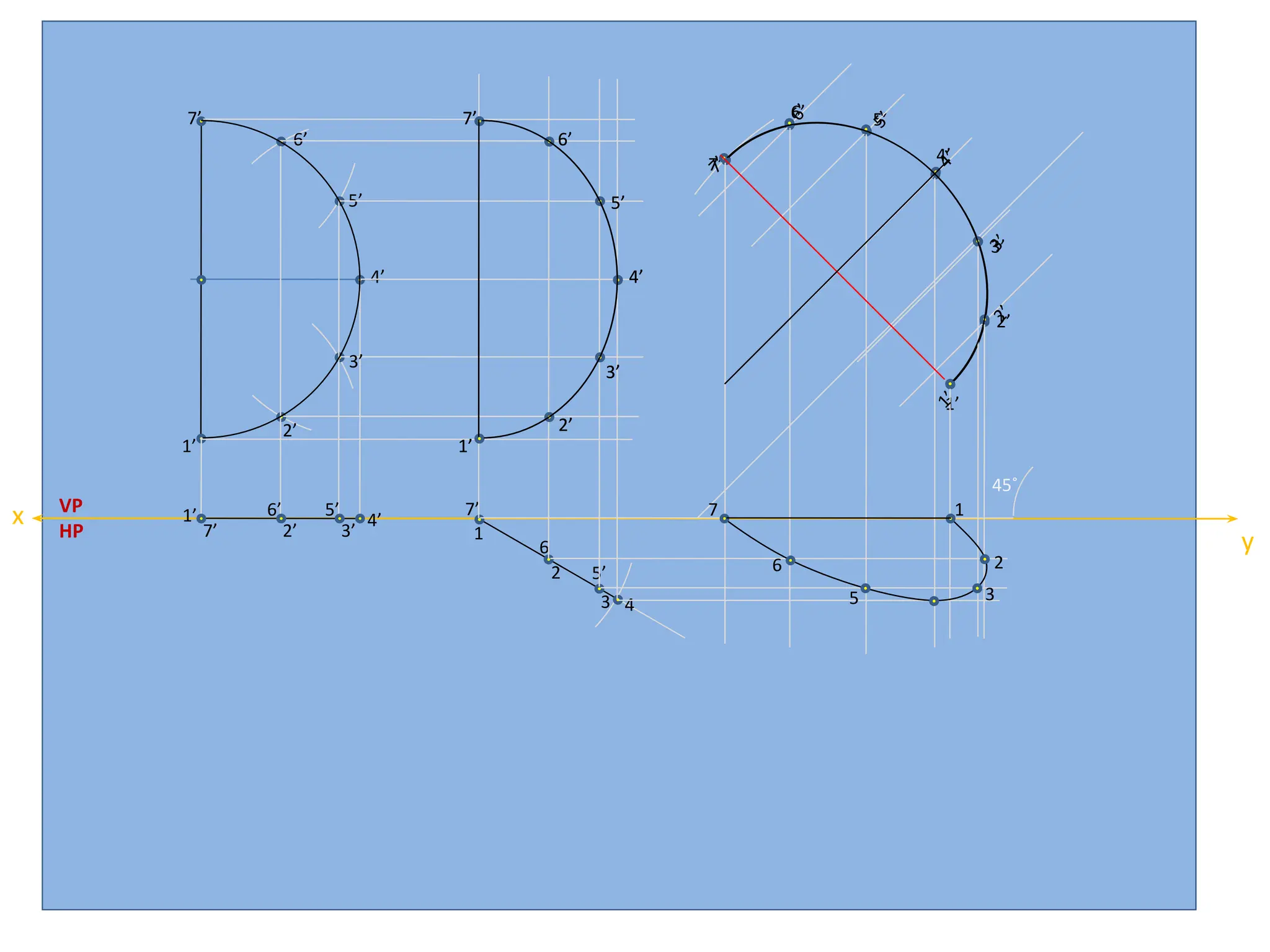
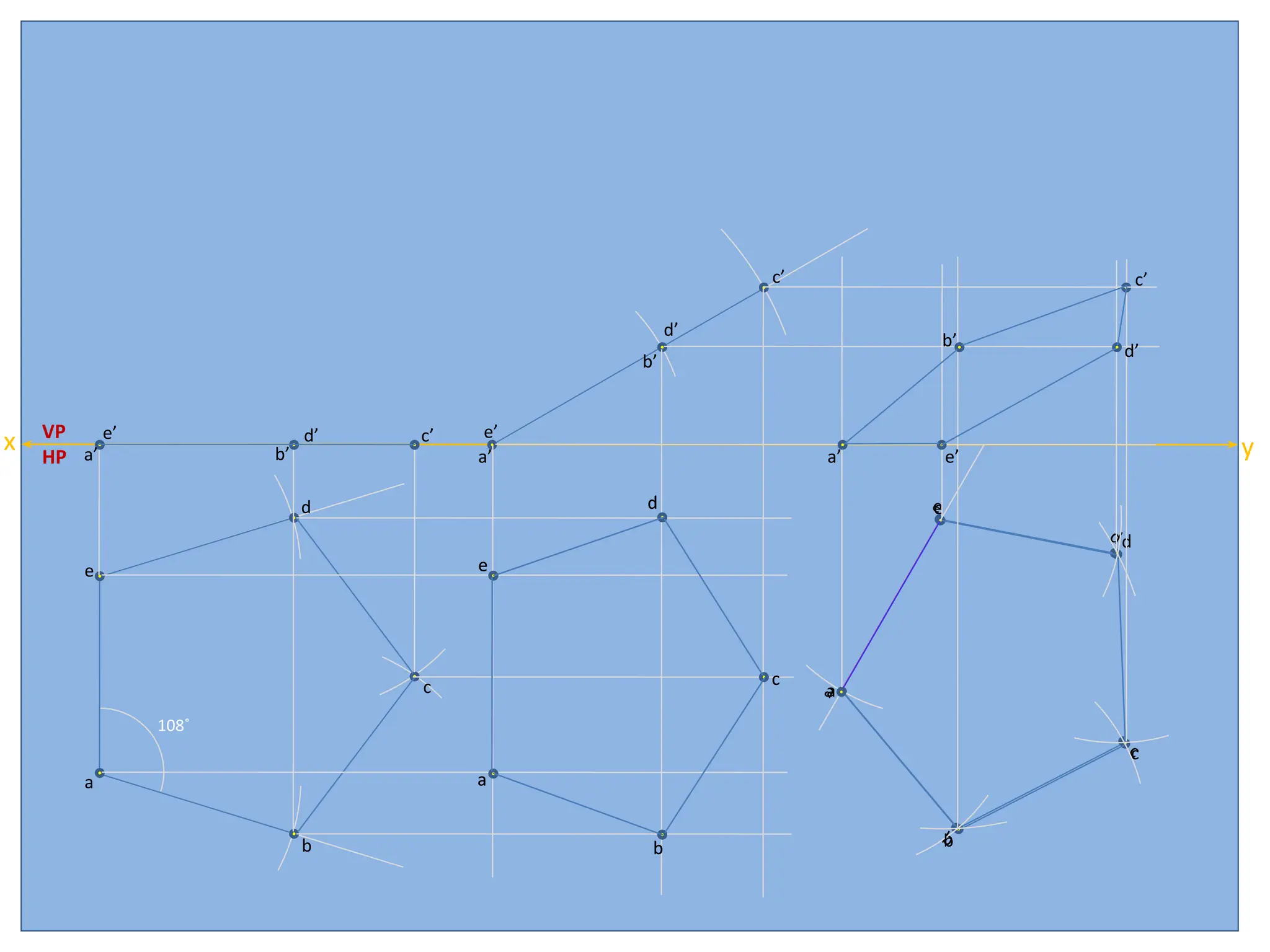
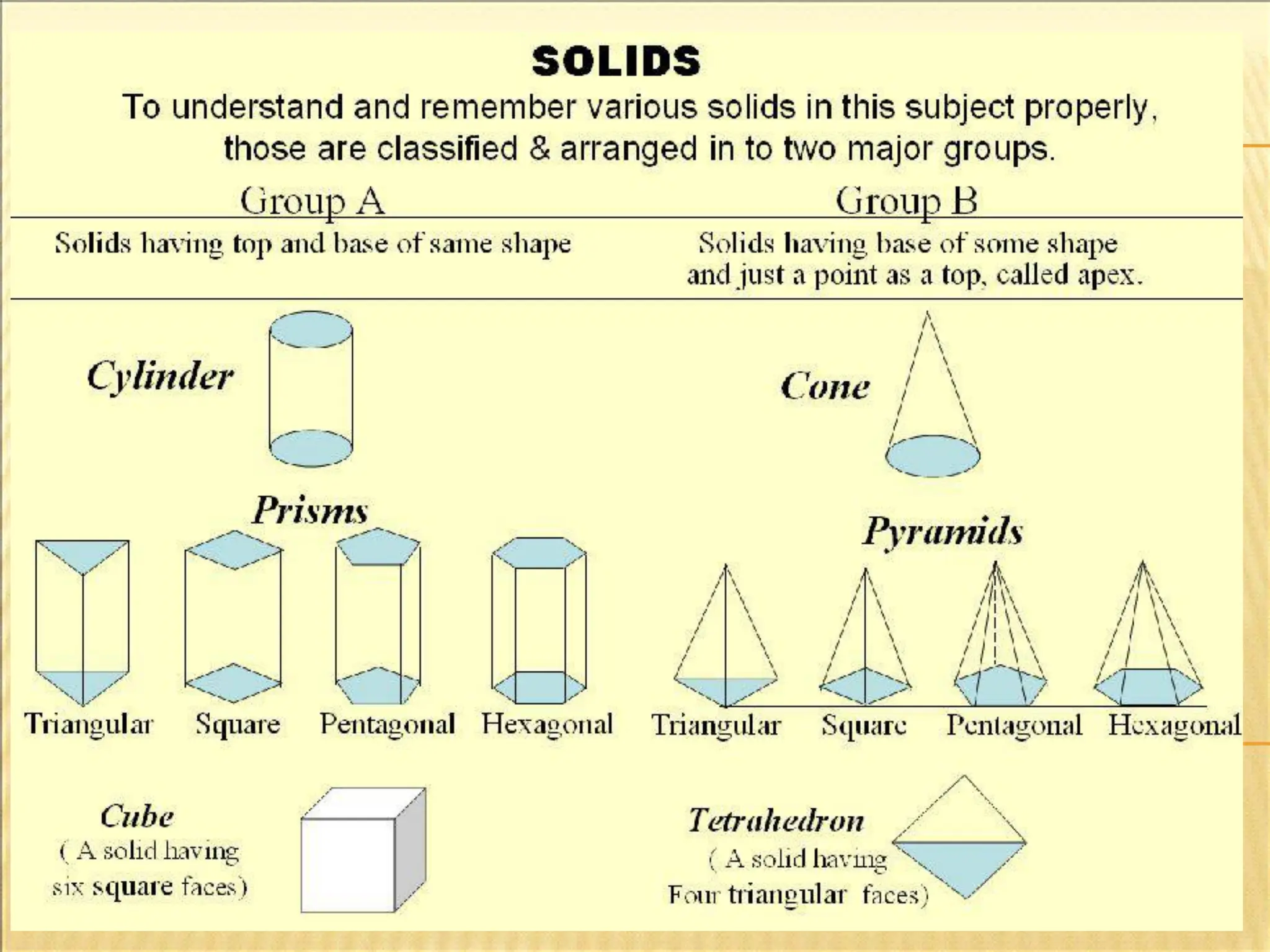
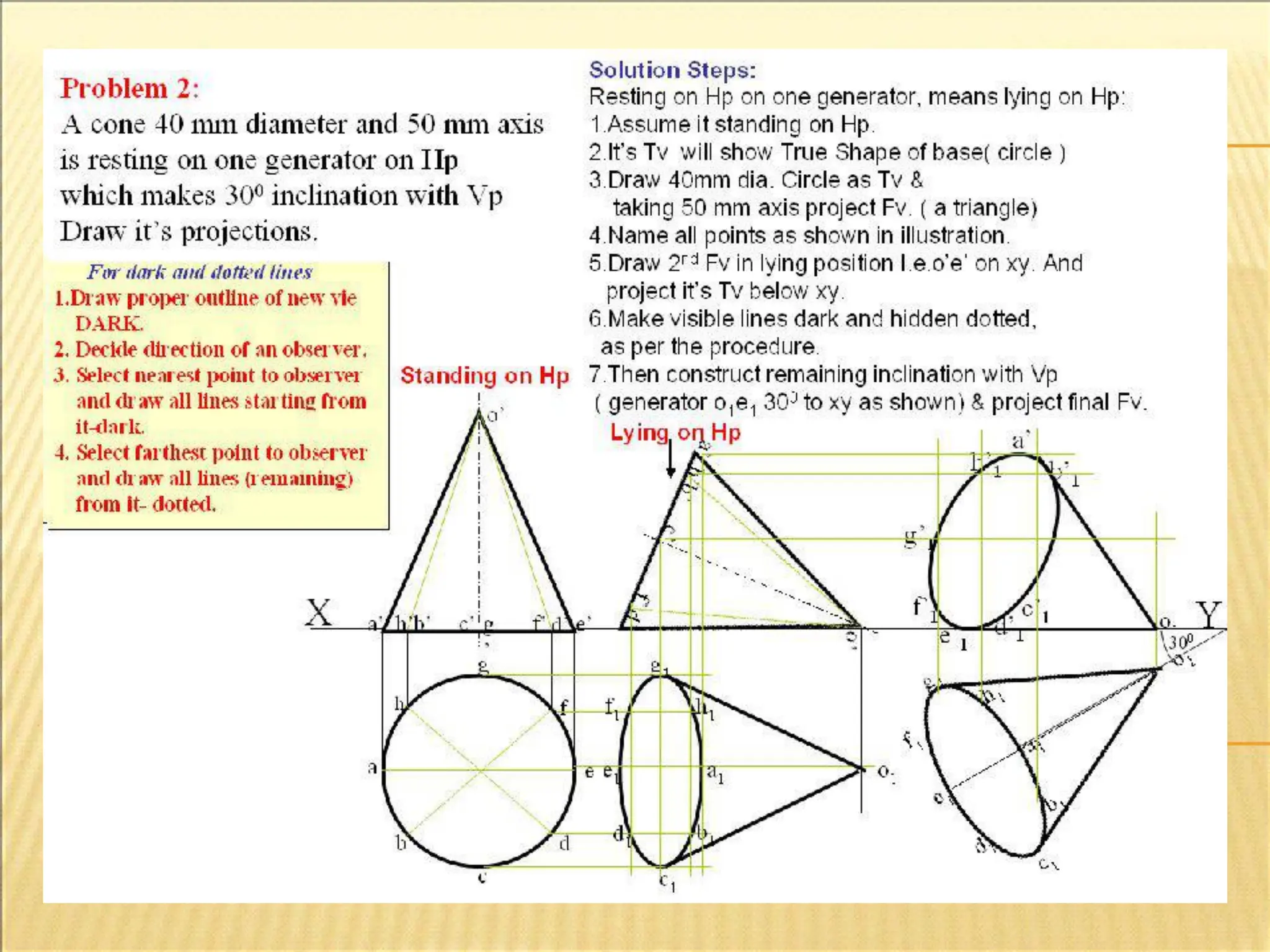
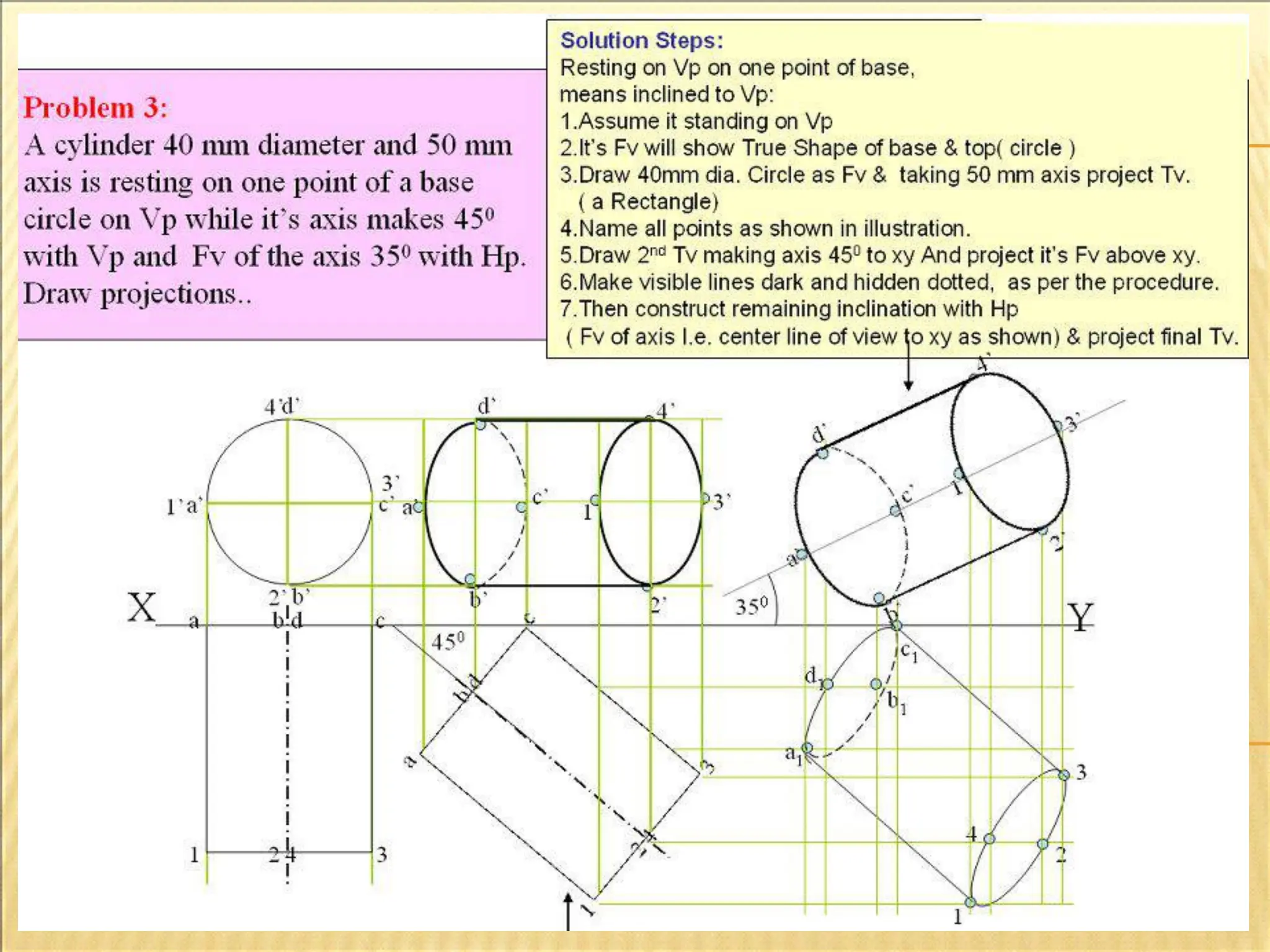
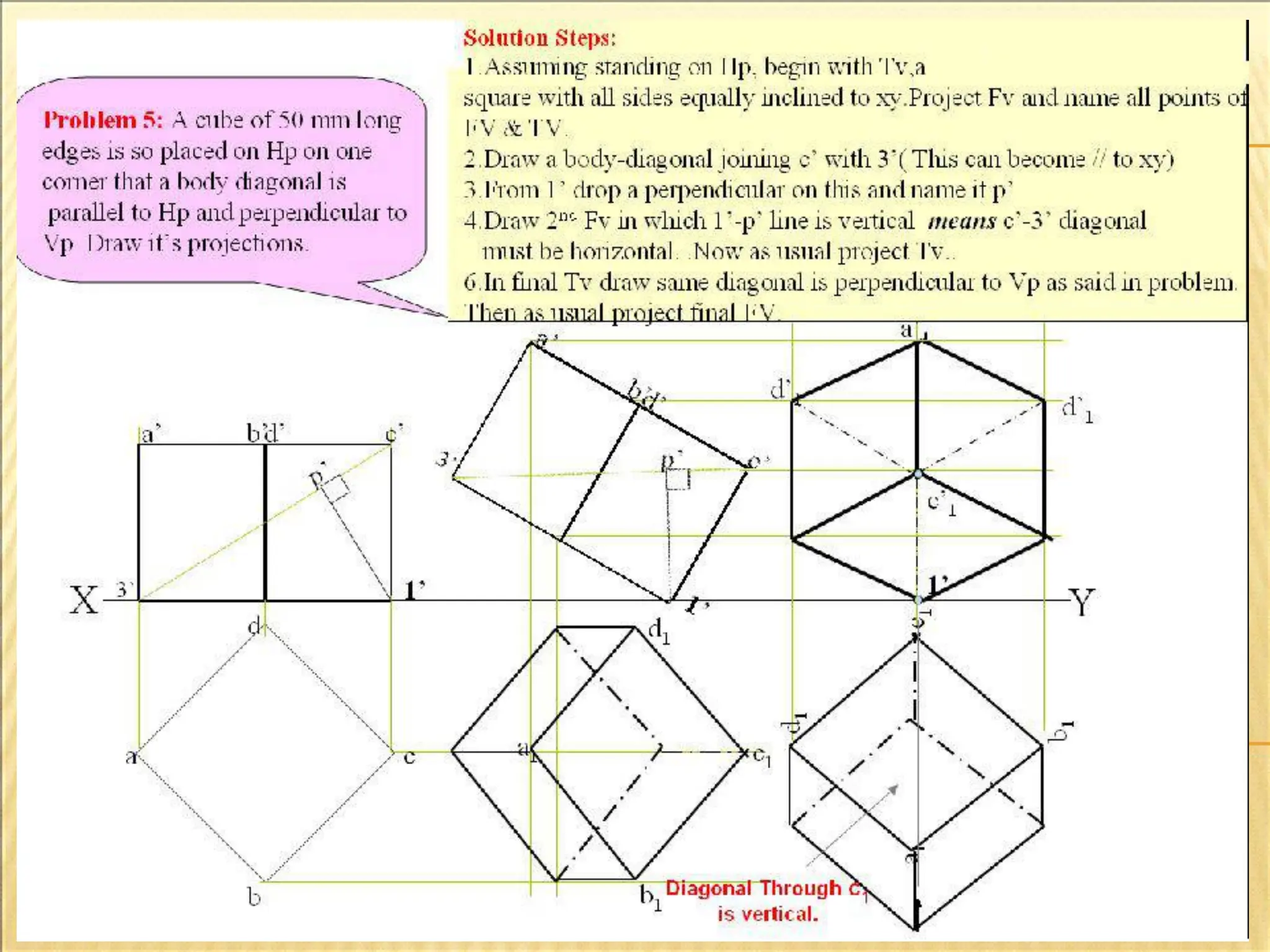
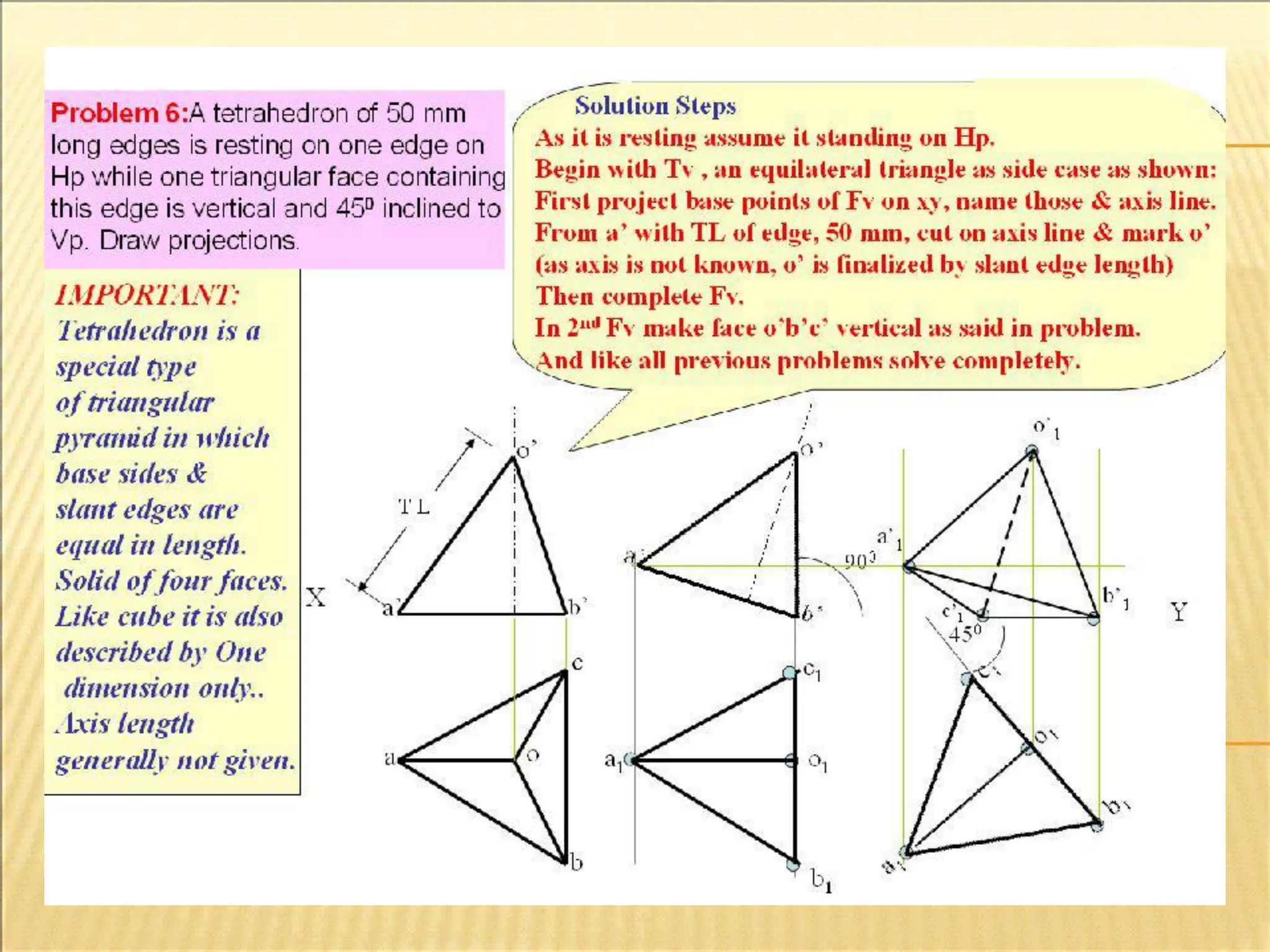
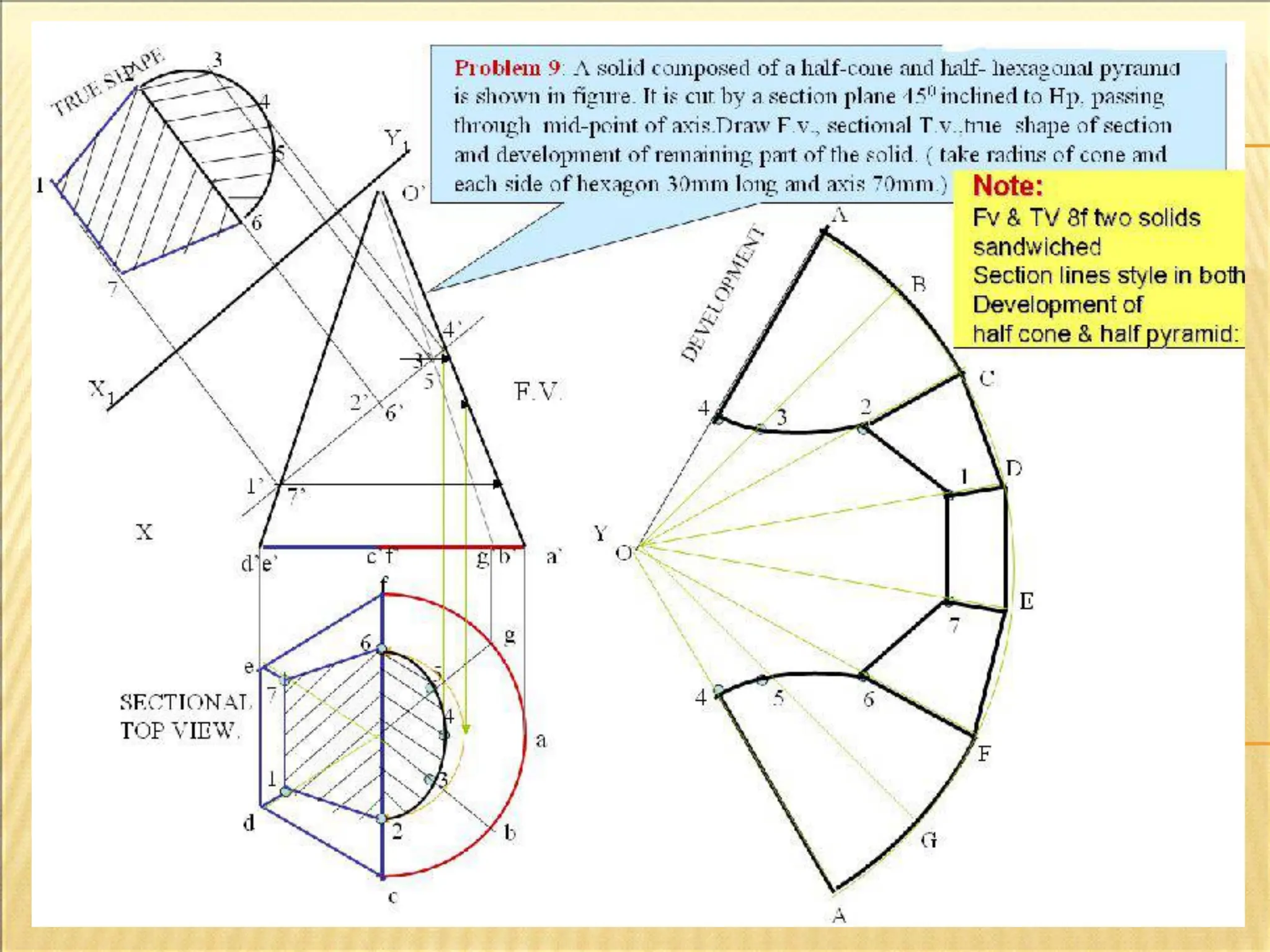
6. Projections of Solids
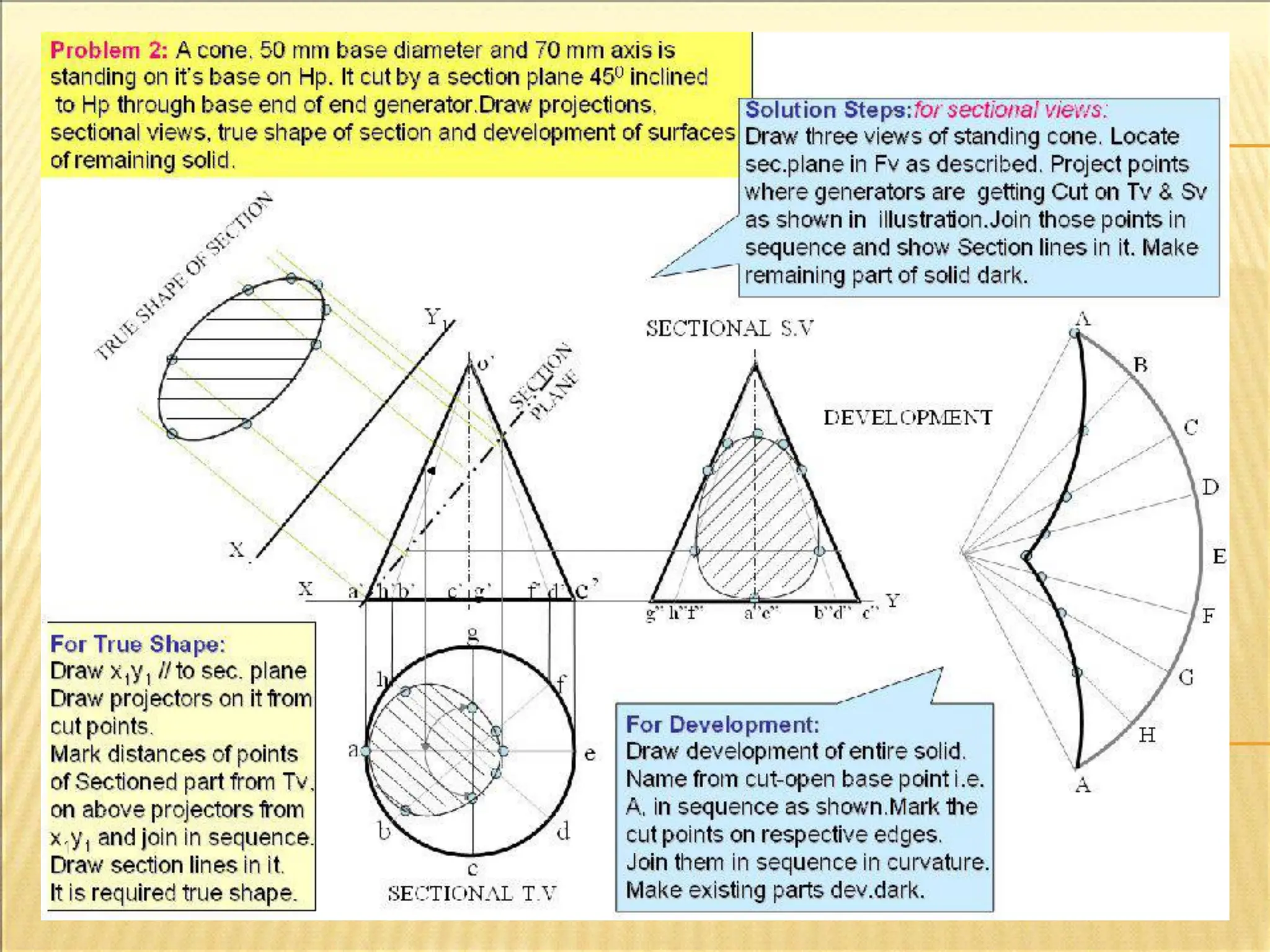
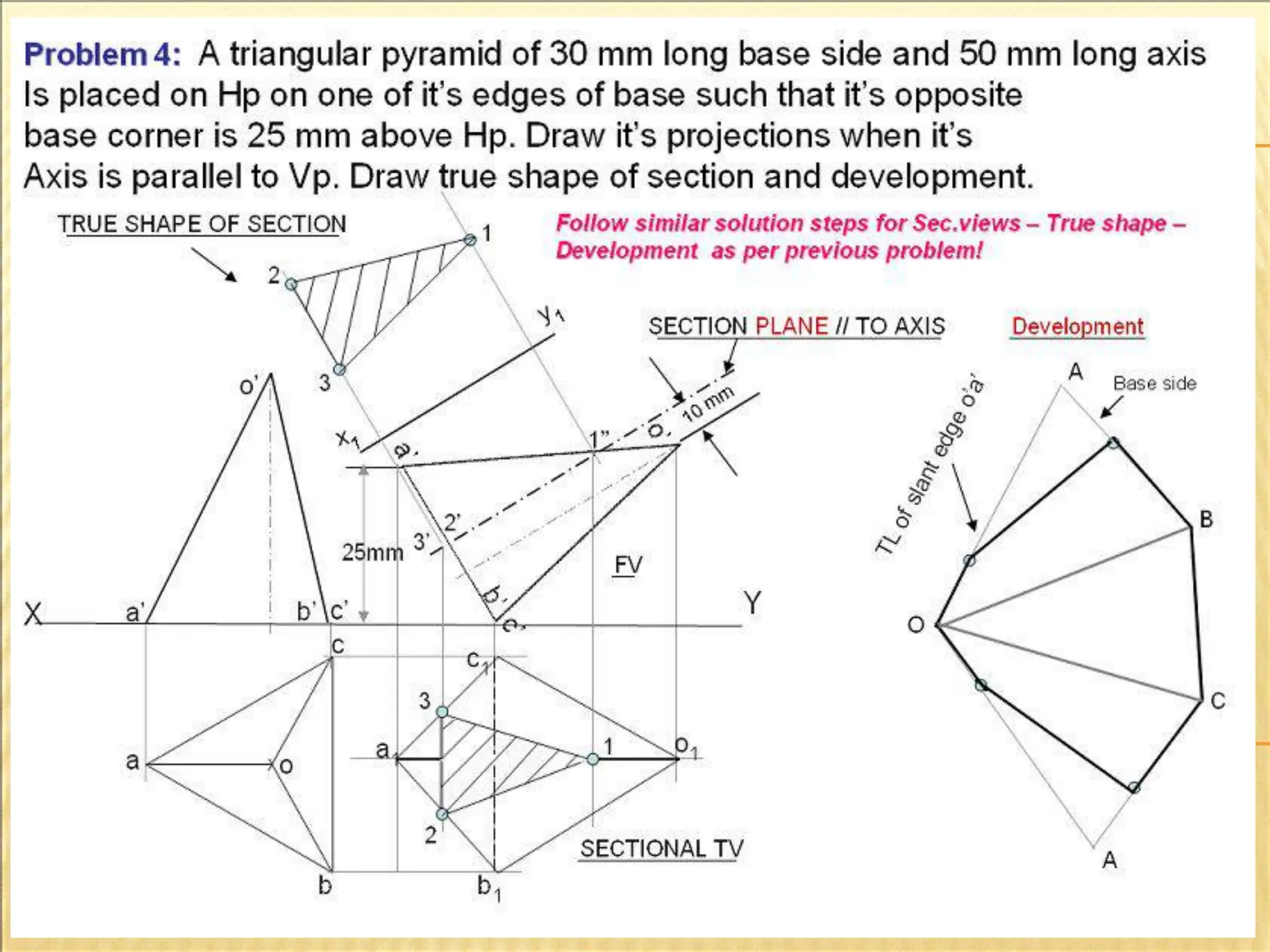
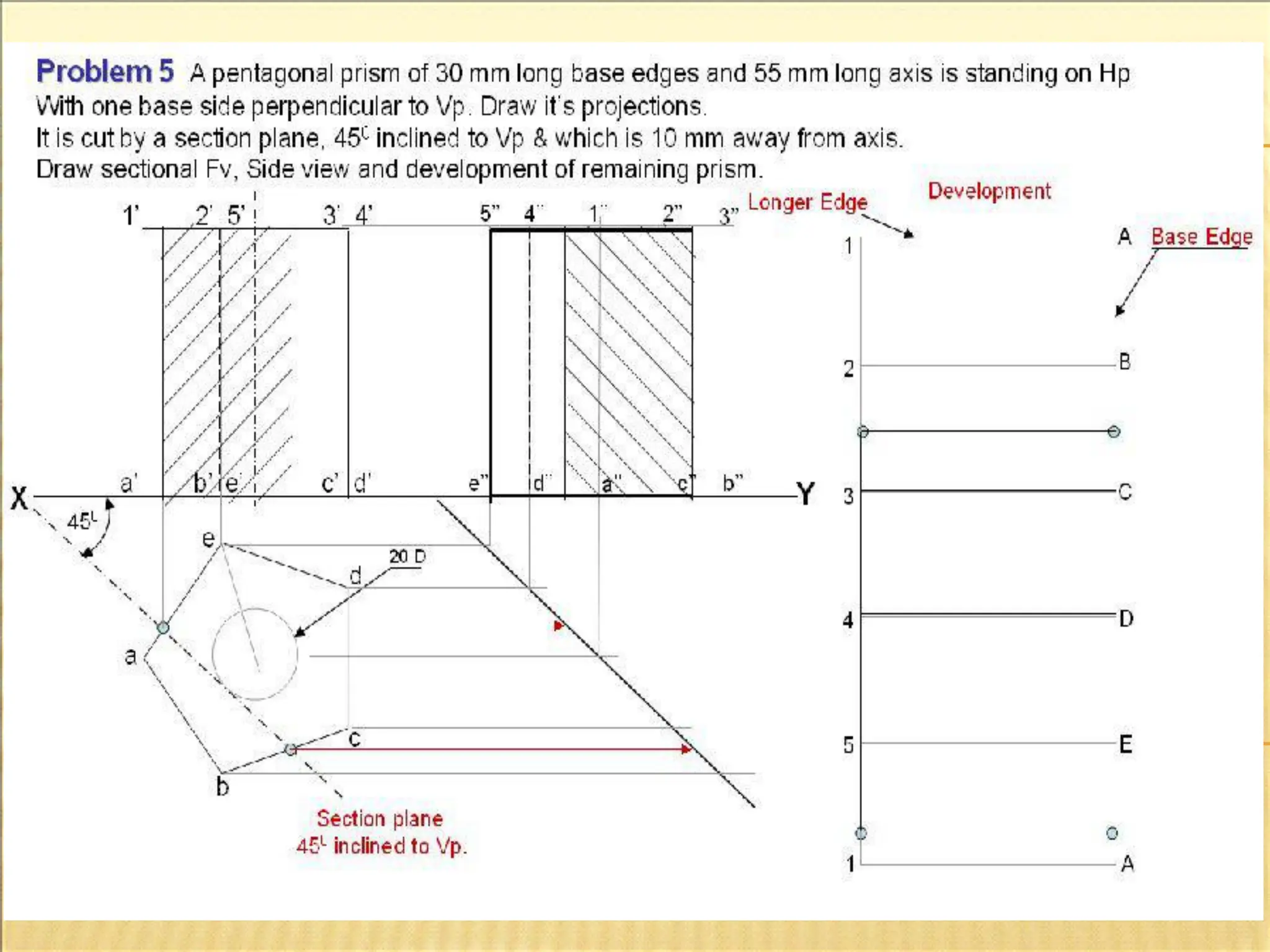
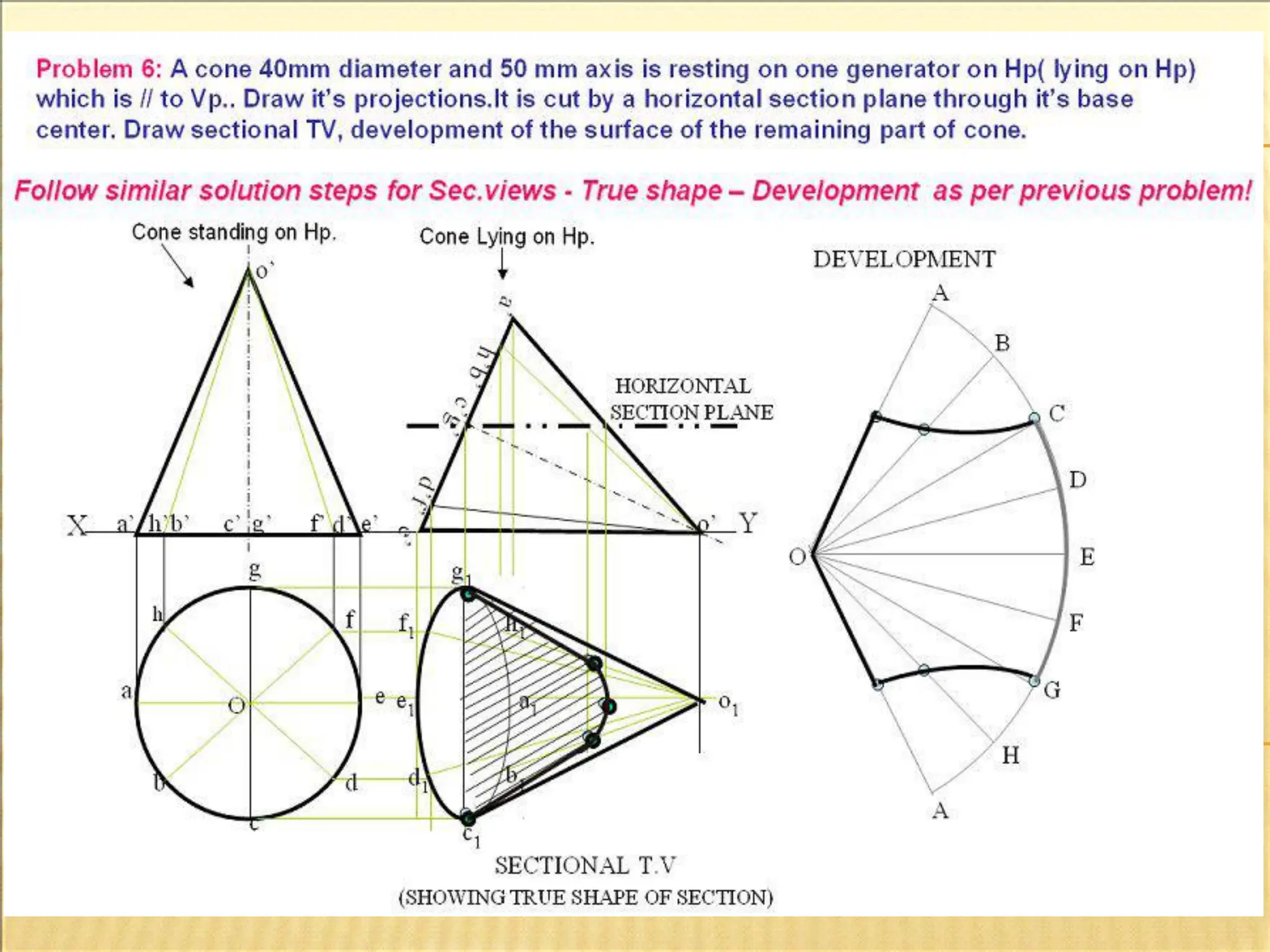
7. Sections of Solids
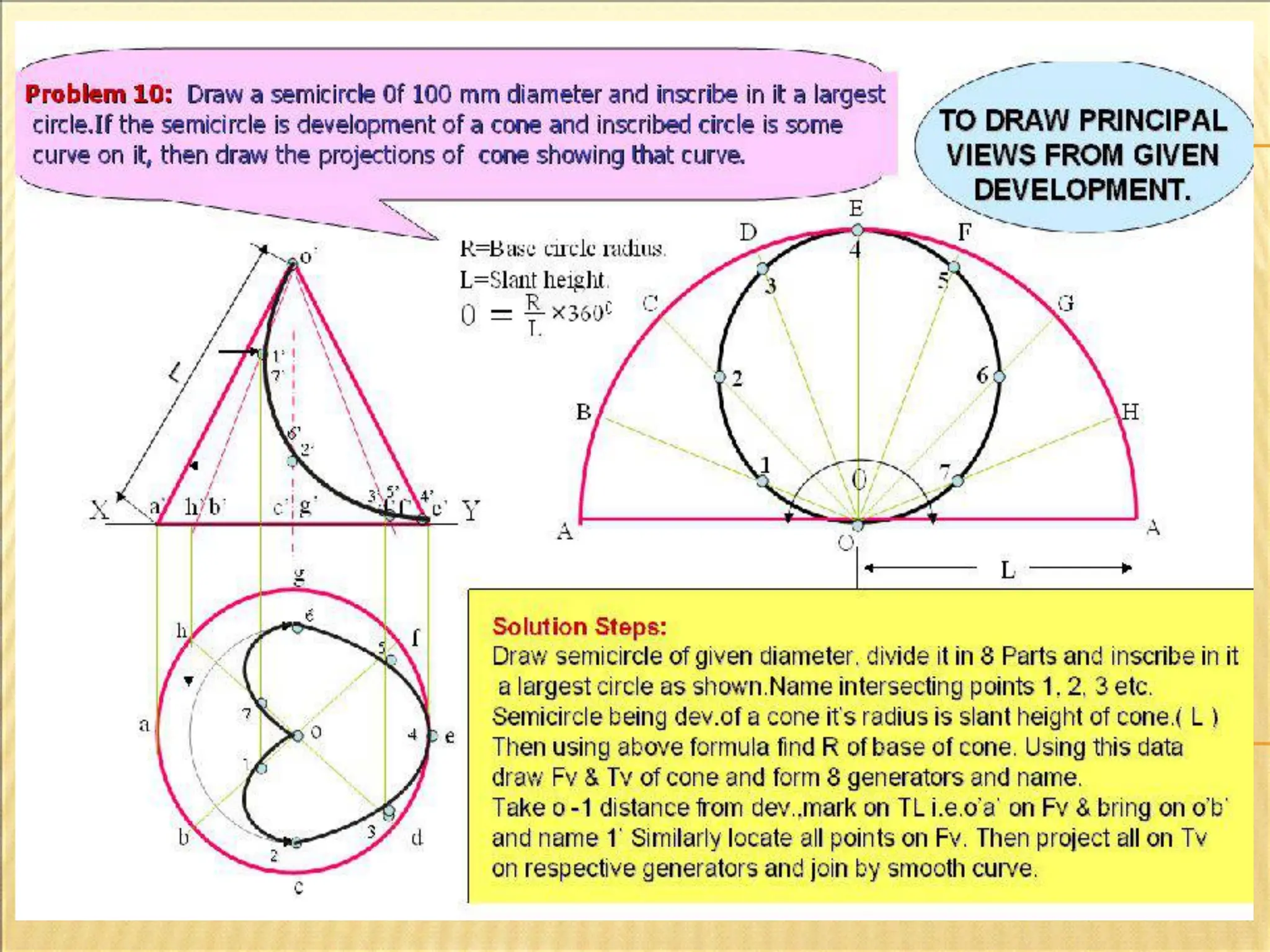
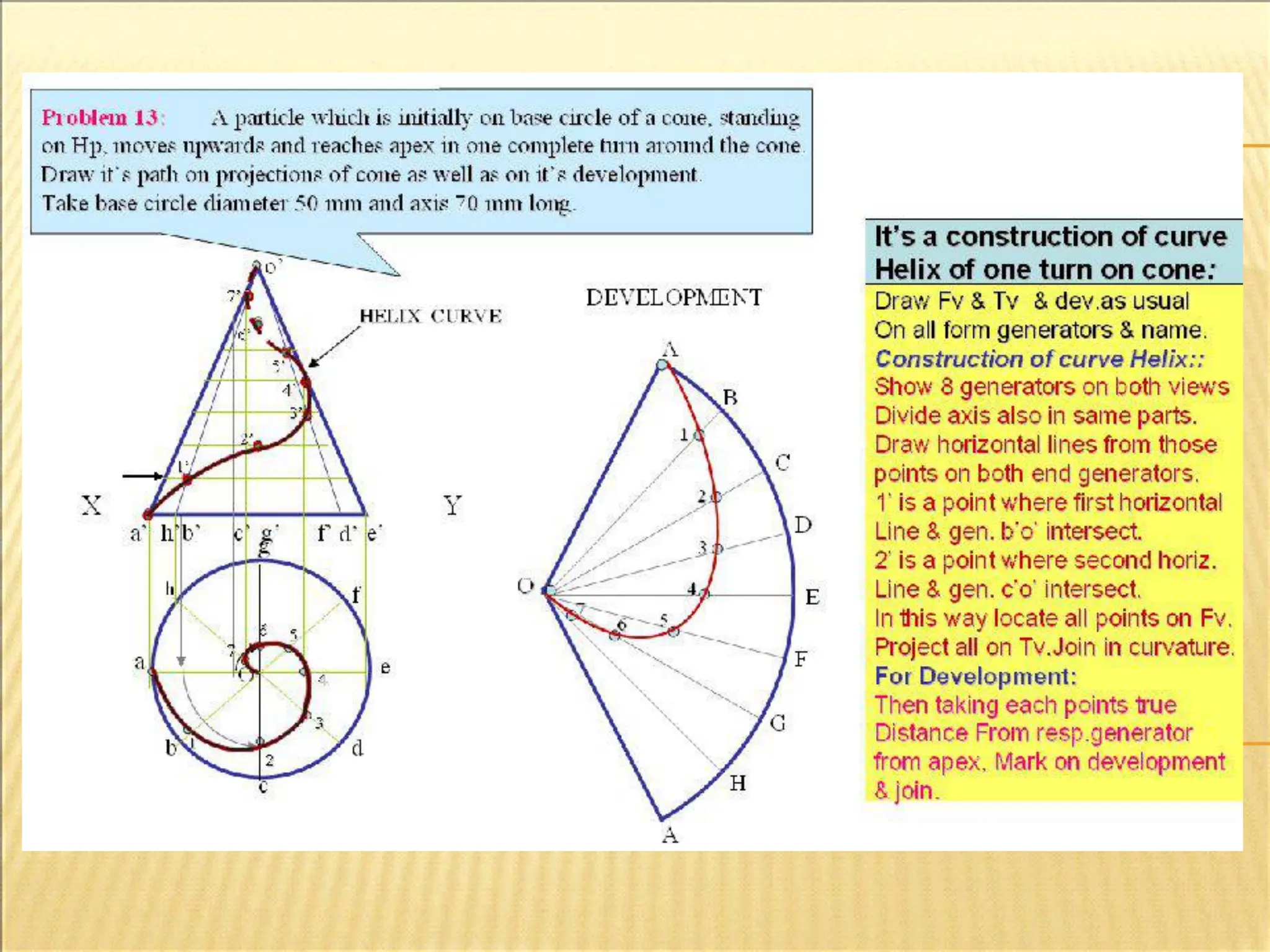
8. Deelopment of Solids
9. Isometric Projections
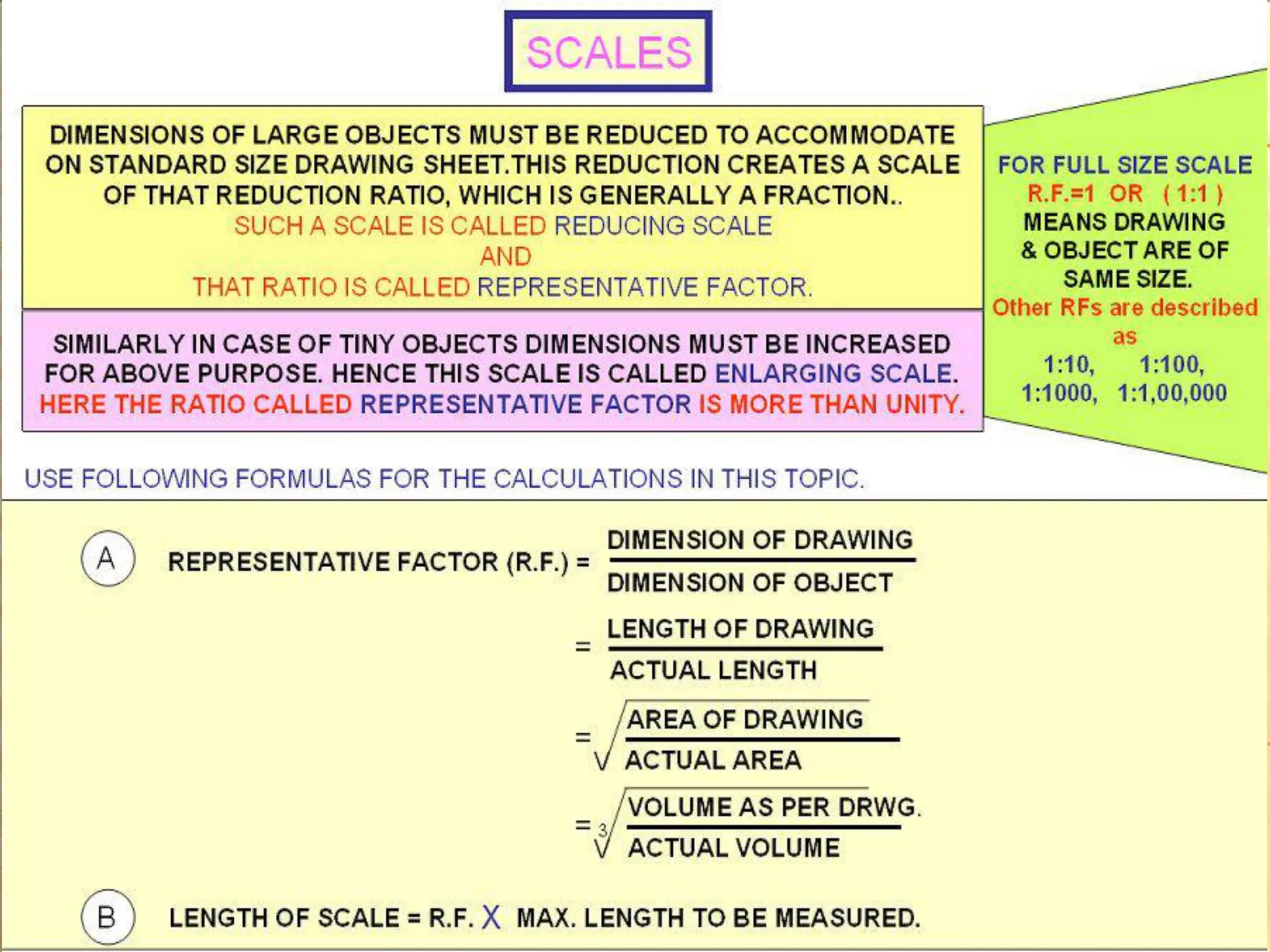
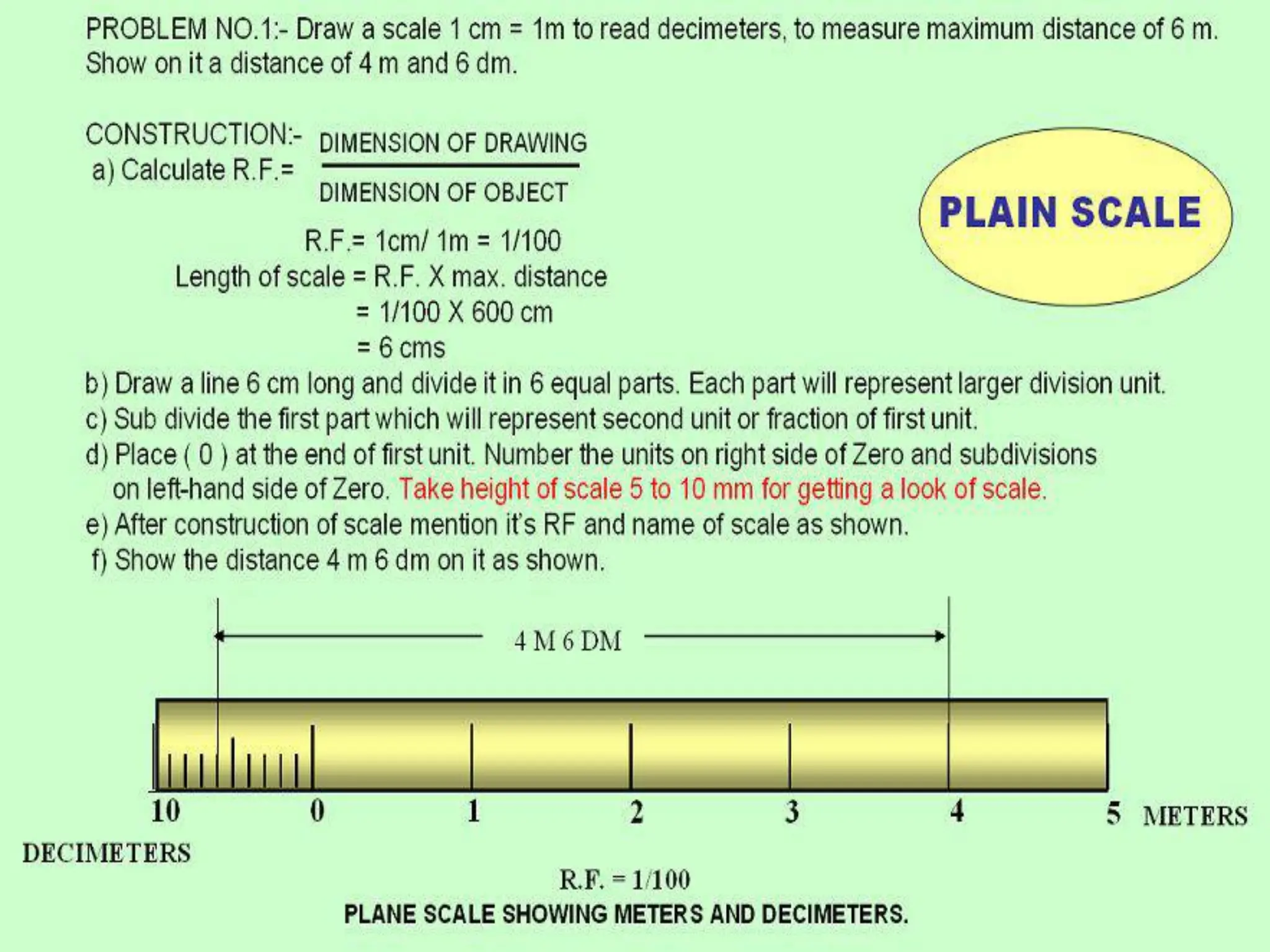
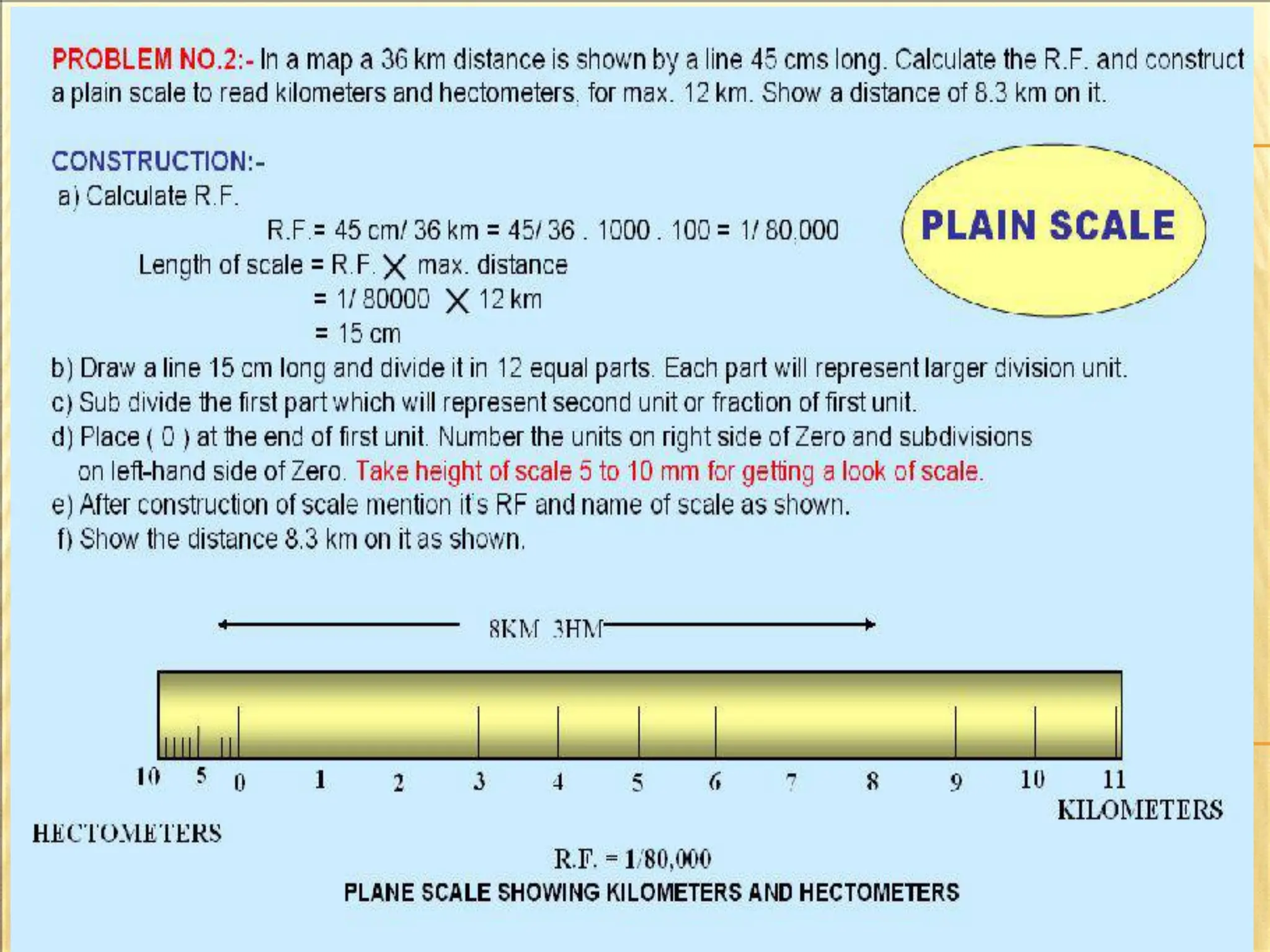
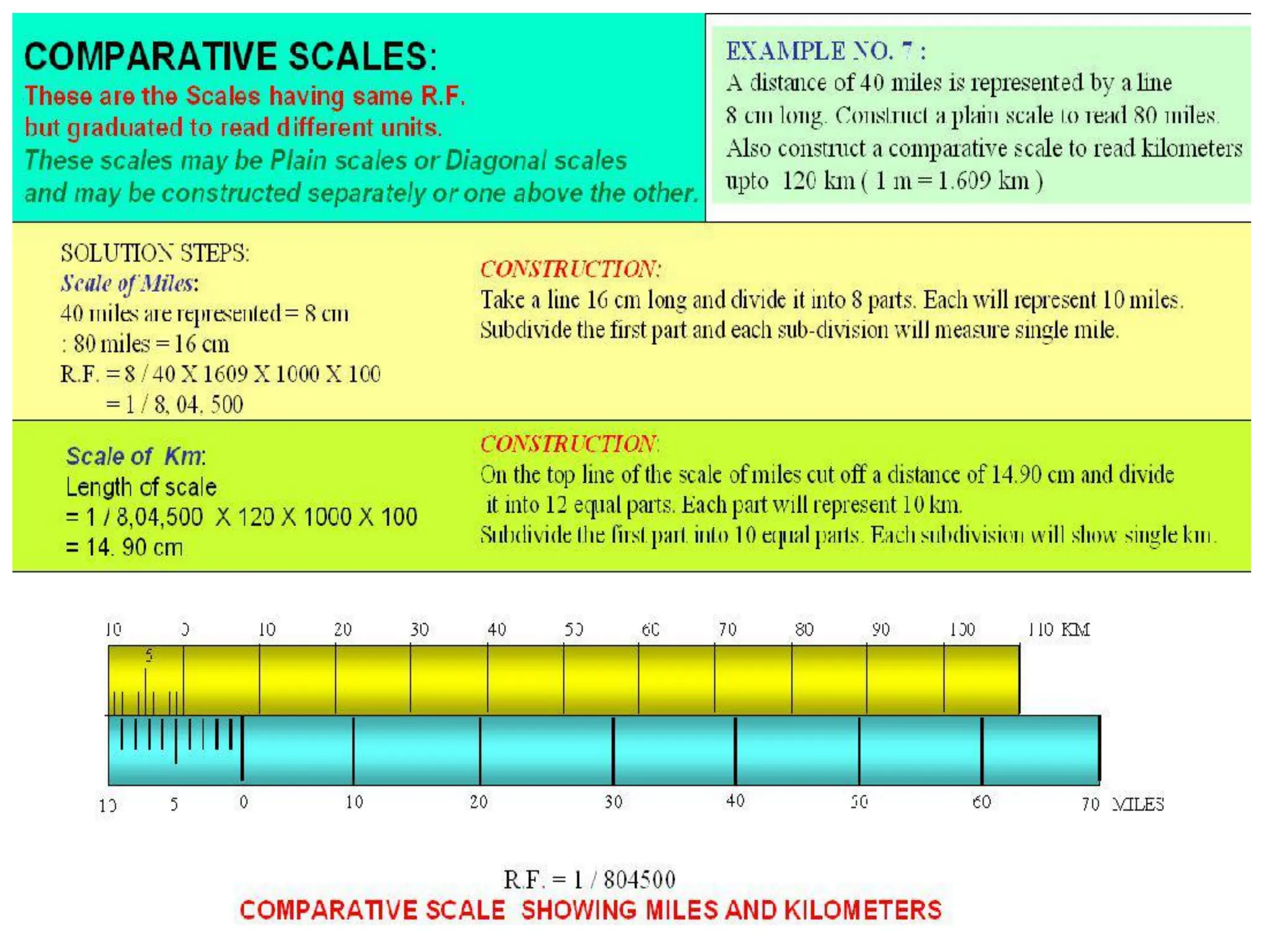
Engineering Scales
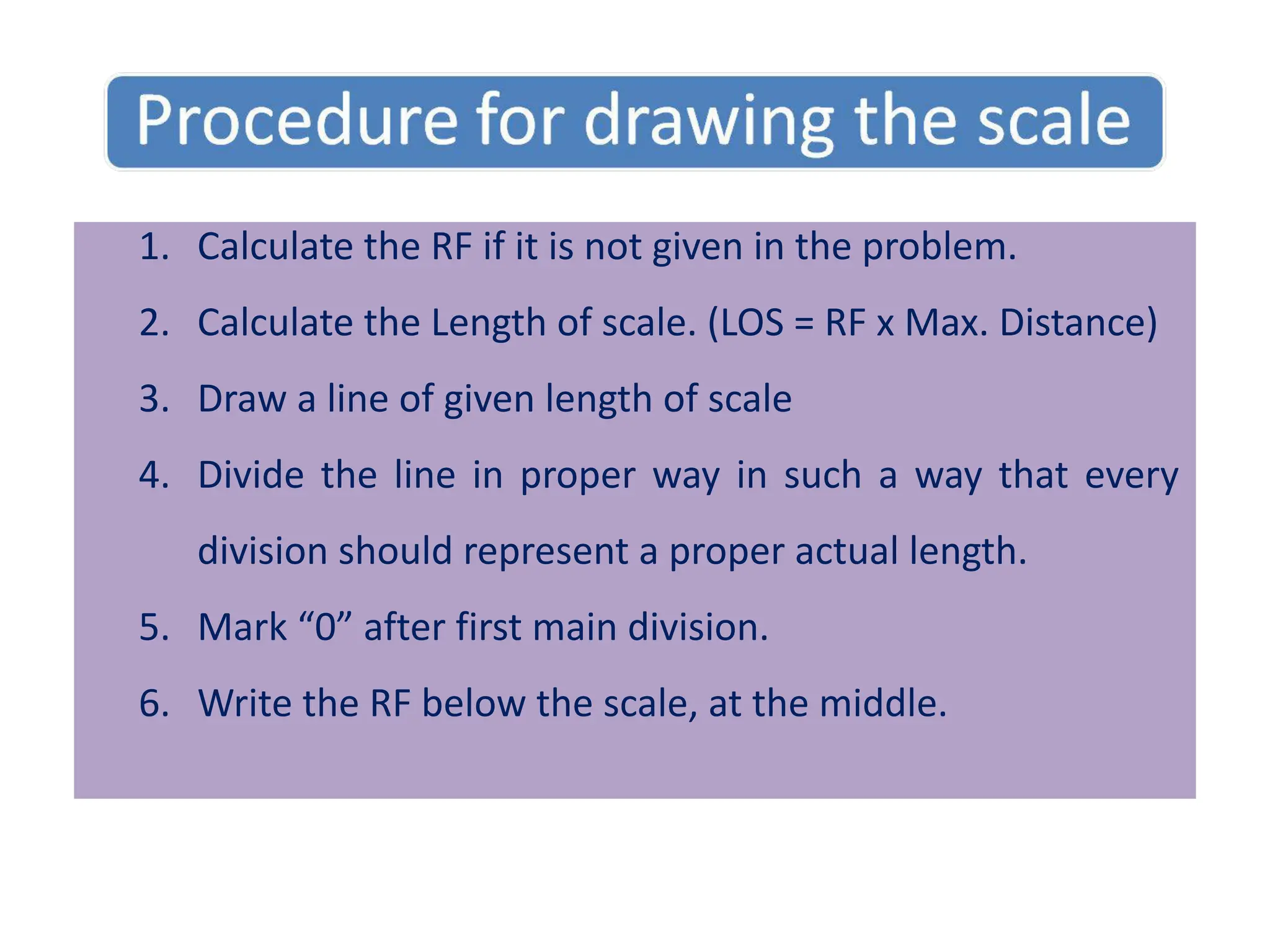
1. Calculate the RF if it is not given in the problem.
2. Calculate the Length of scale. (LOS = RF x Max. Distance)
3. Draw a line of given length of scale
4. Divide the line in proper way in such a way that every
division should represent a proper actual length.
5. Mark “0” after first main division.
6. Write the RF below the scale, at the middle.
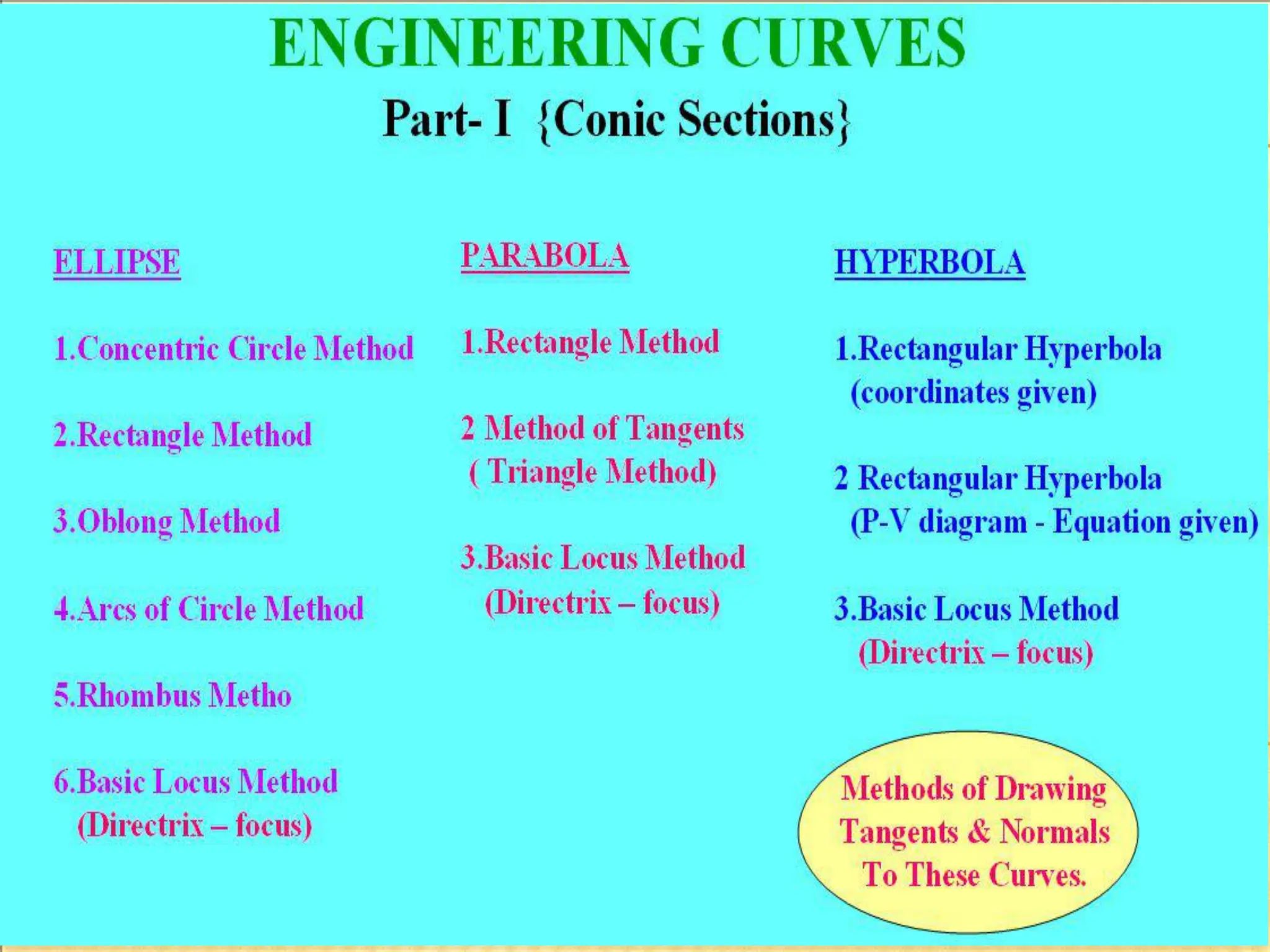
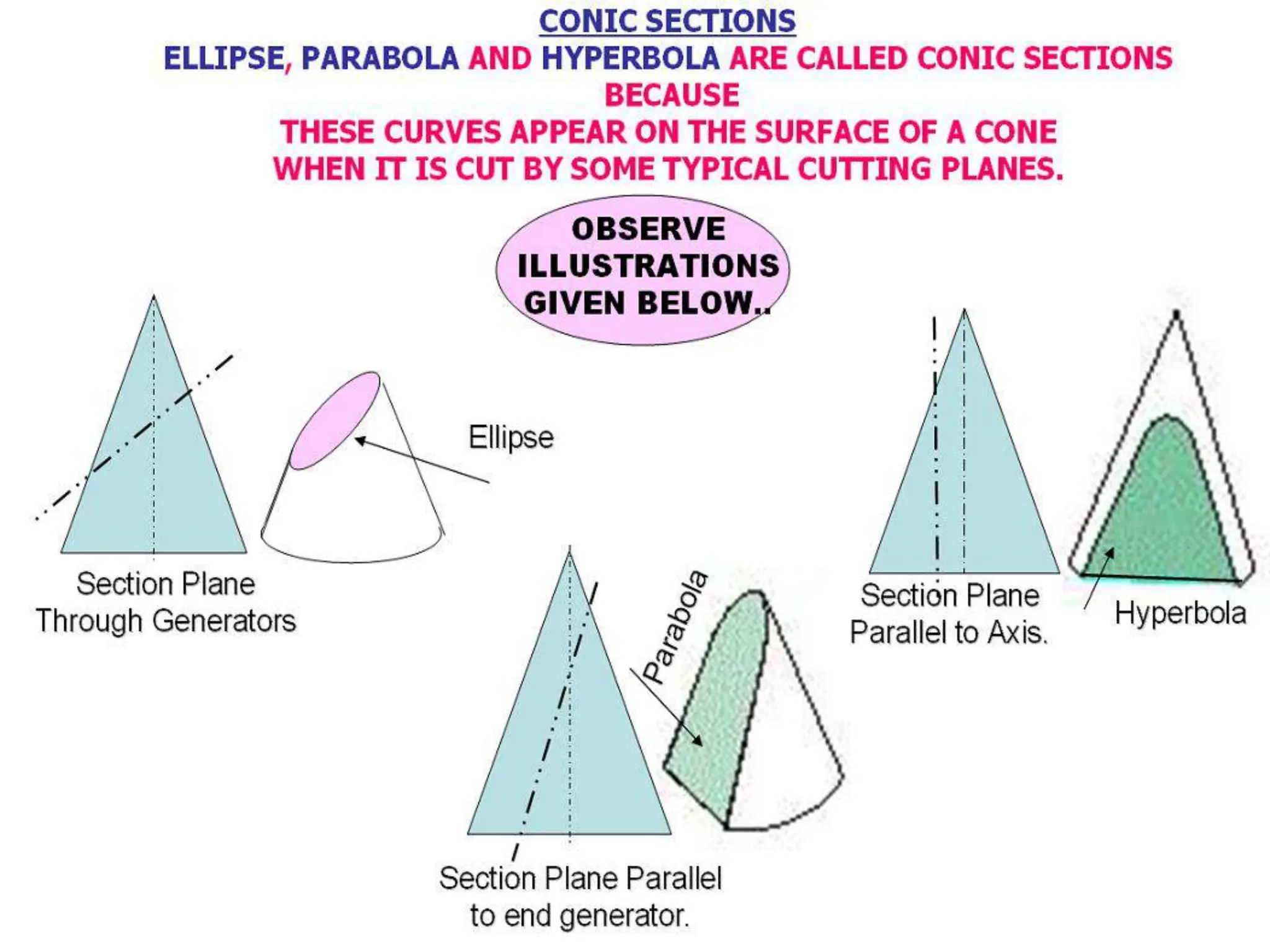
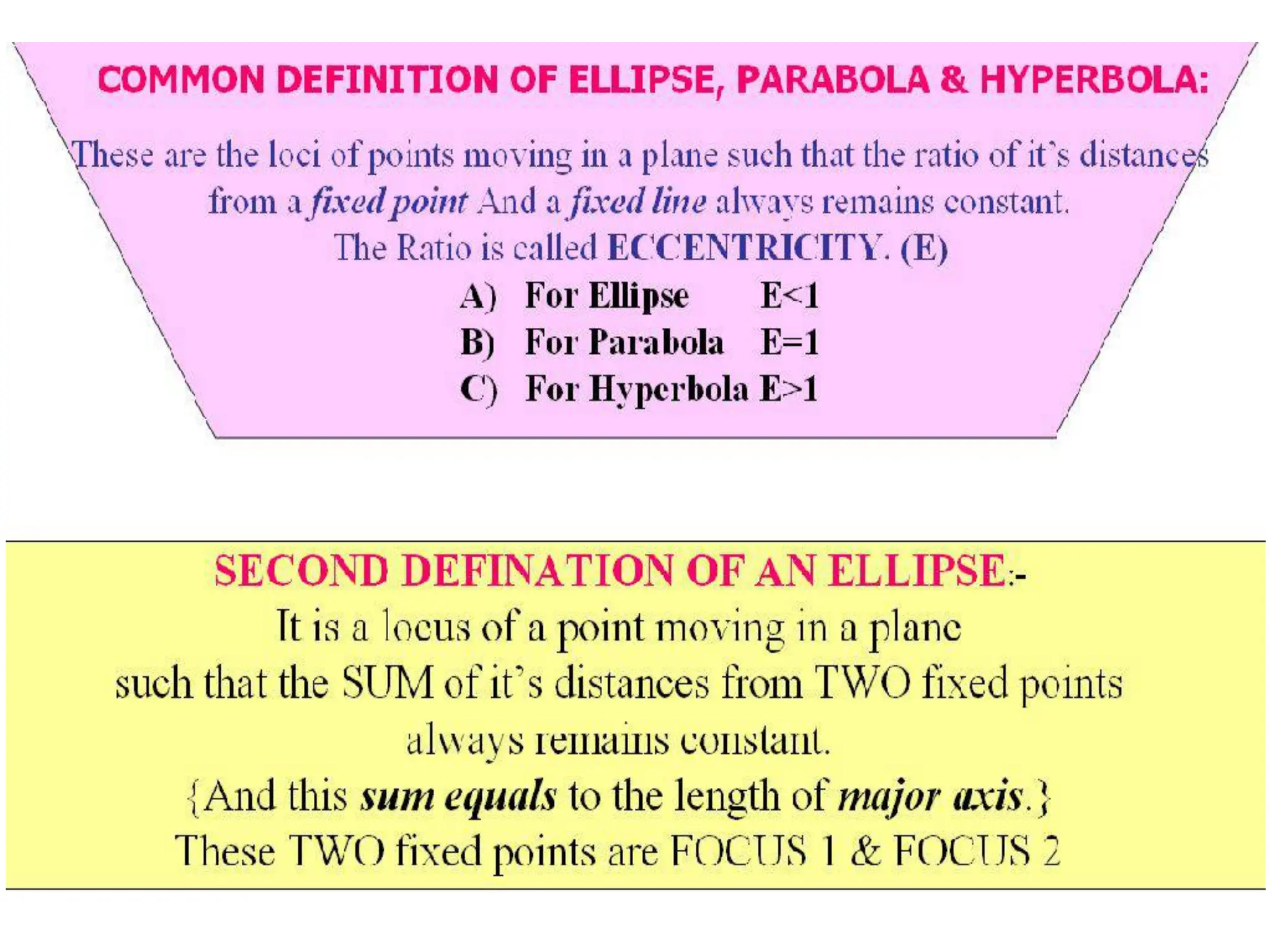
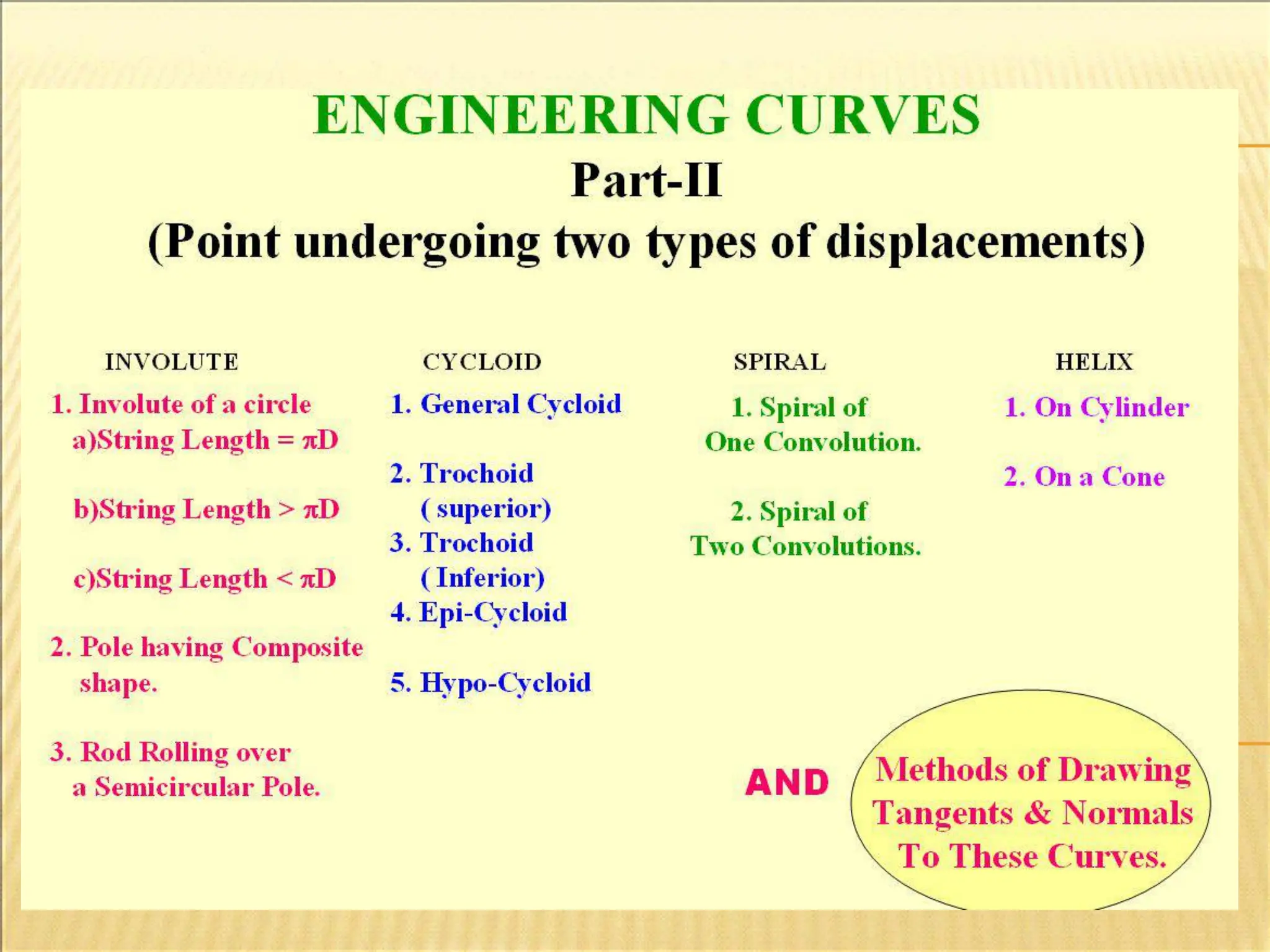
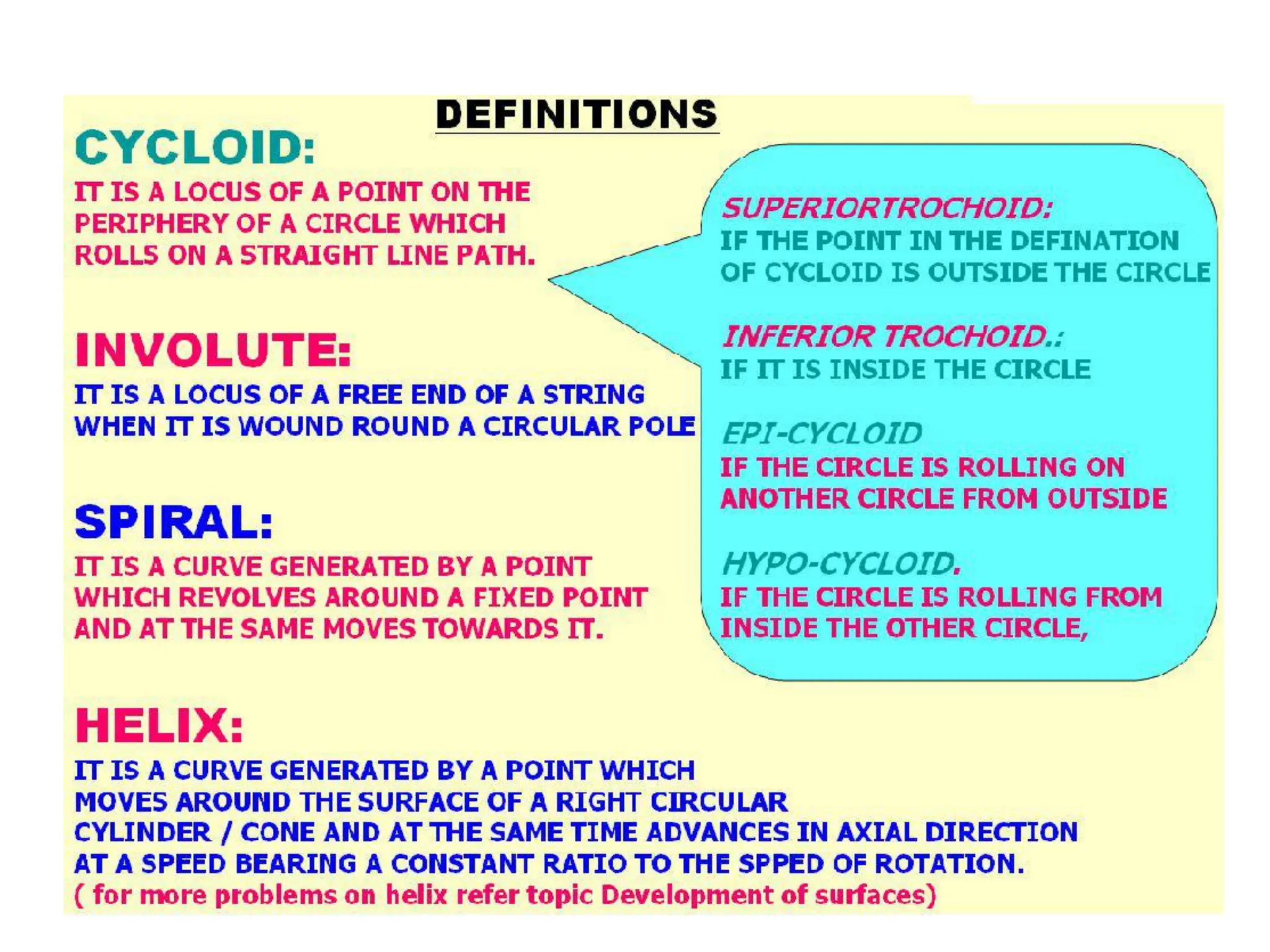
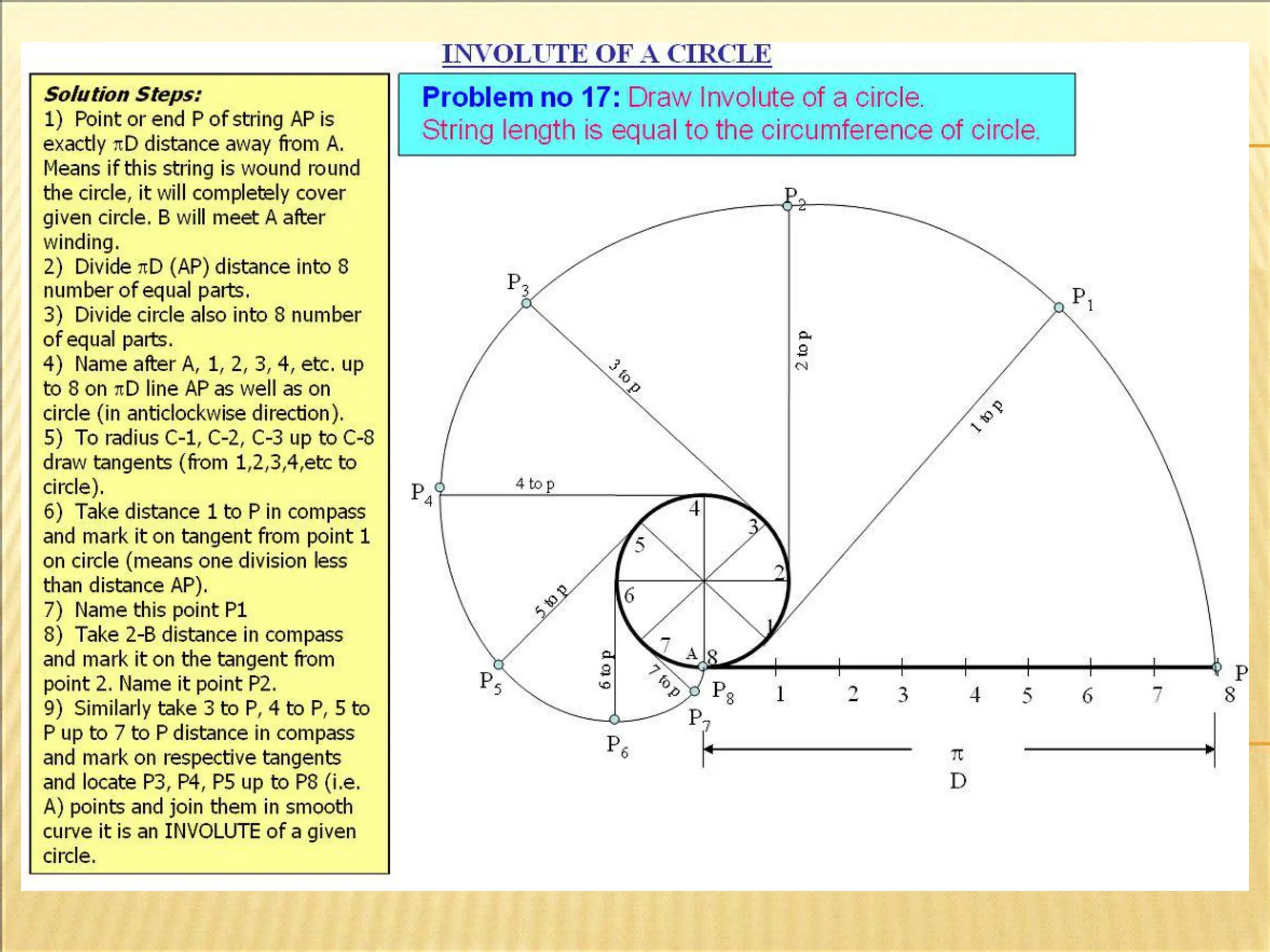
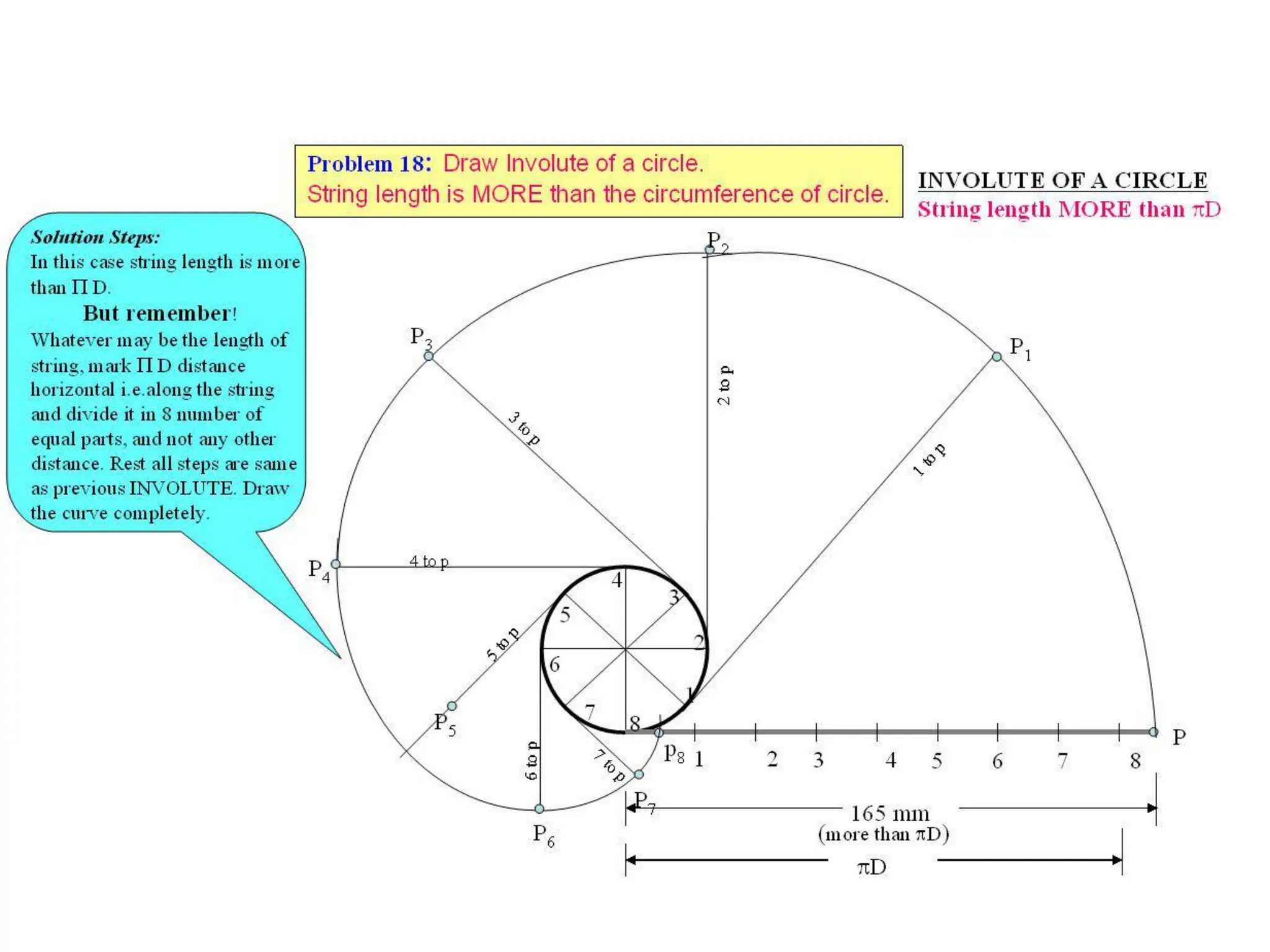
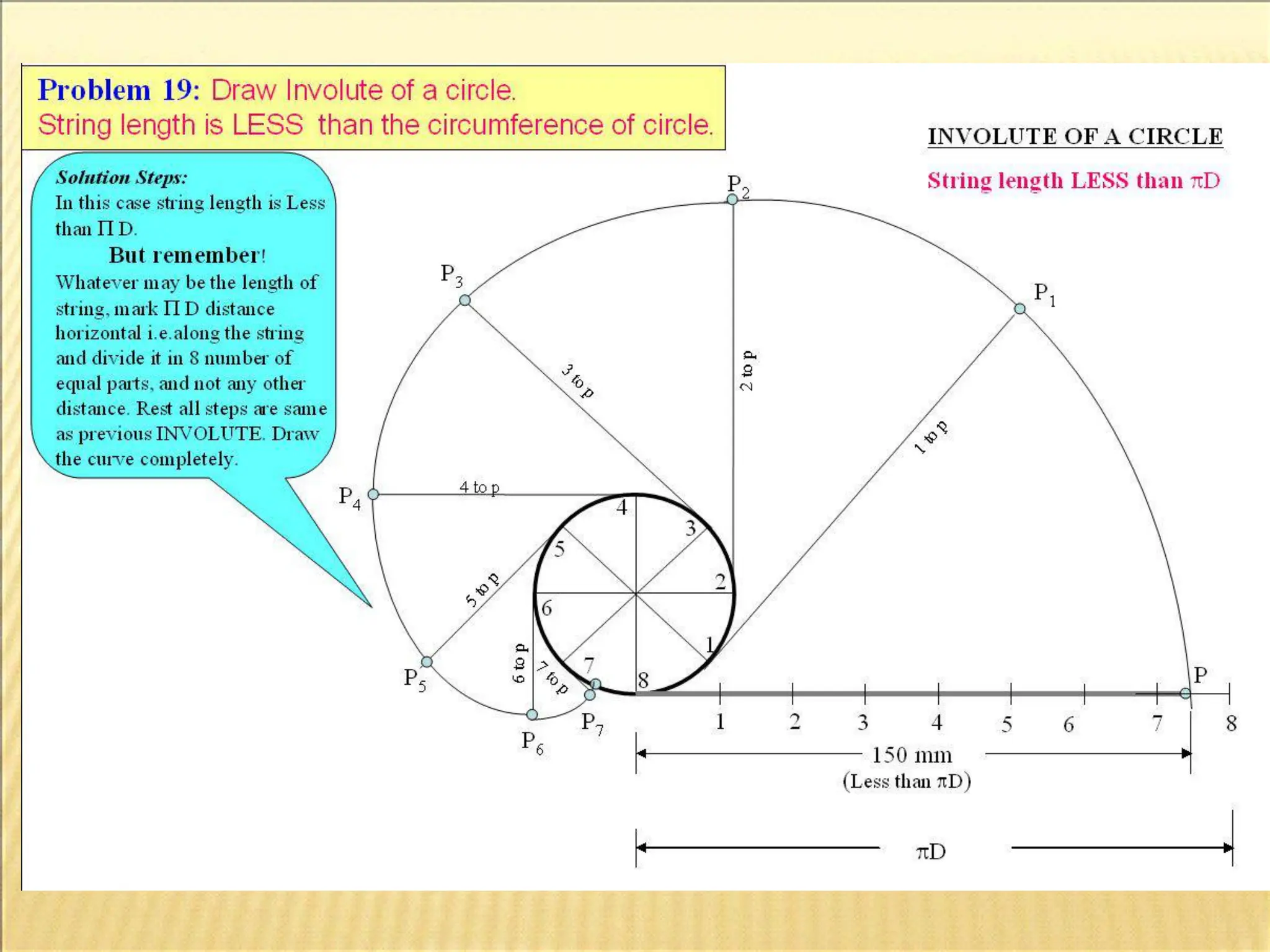
Engineering Curves
Orthographic Projections
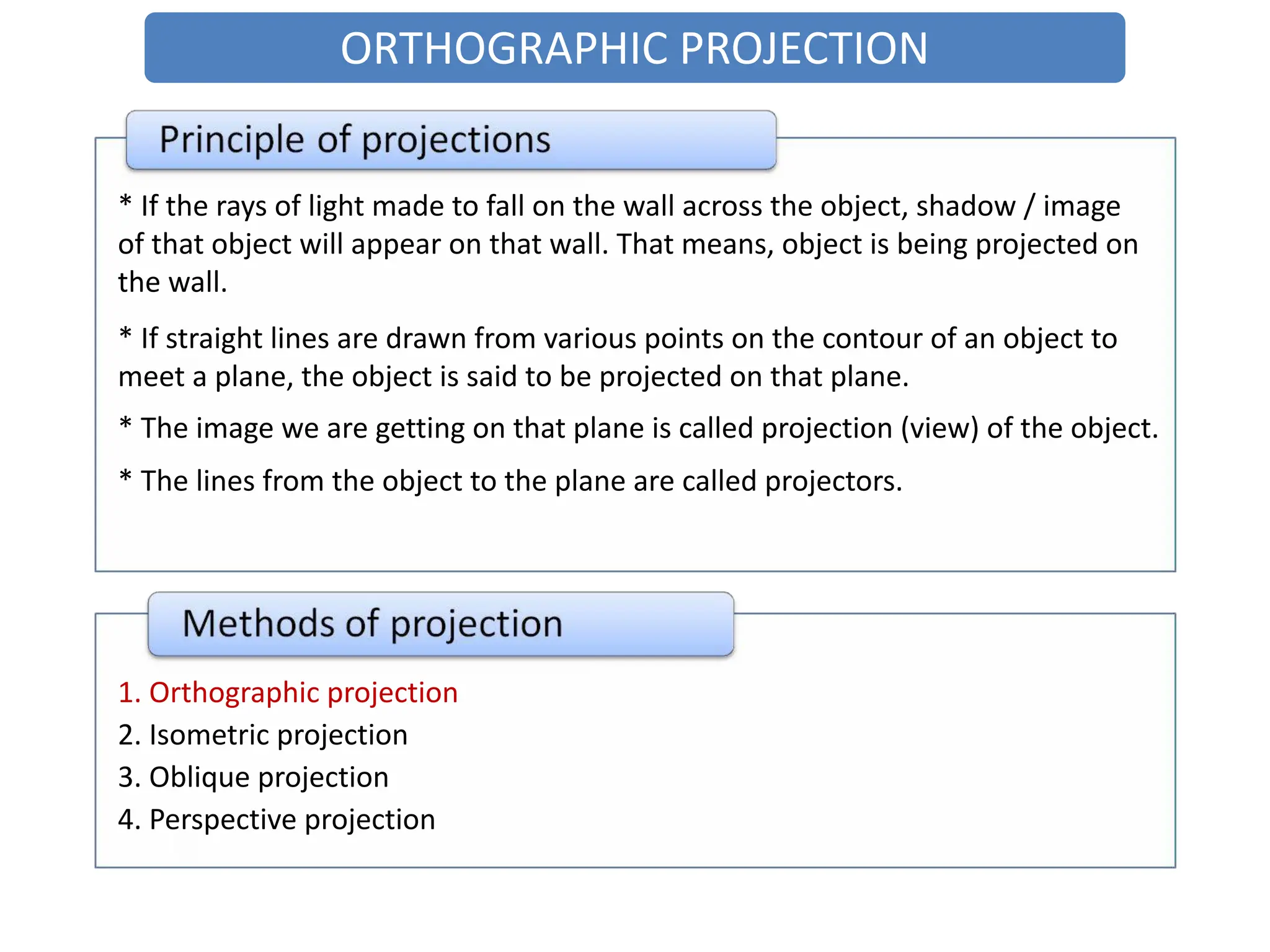
ORTHOGRAPHIC PROJECTION
* If the rays of light made to fall on the wall across the object, shadow / image
of that object will appear on that wall. That means, object is being projected on
the wall.
* If straight lines are drawn from various points on the contour of an object to
meet a plane, the object is said to be projected on that plane.
* The image we are getting on that plane is called projection (view) of the object.
* The lines from the object to the plane are called projectors.
1. Orthographic projection
2. Isometric projection
3. Oblique projection
4. Perspective projection
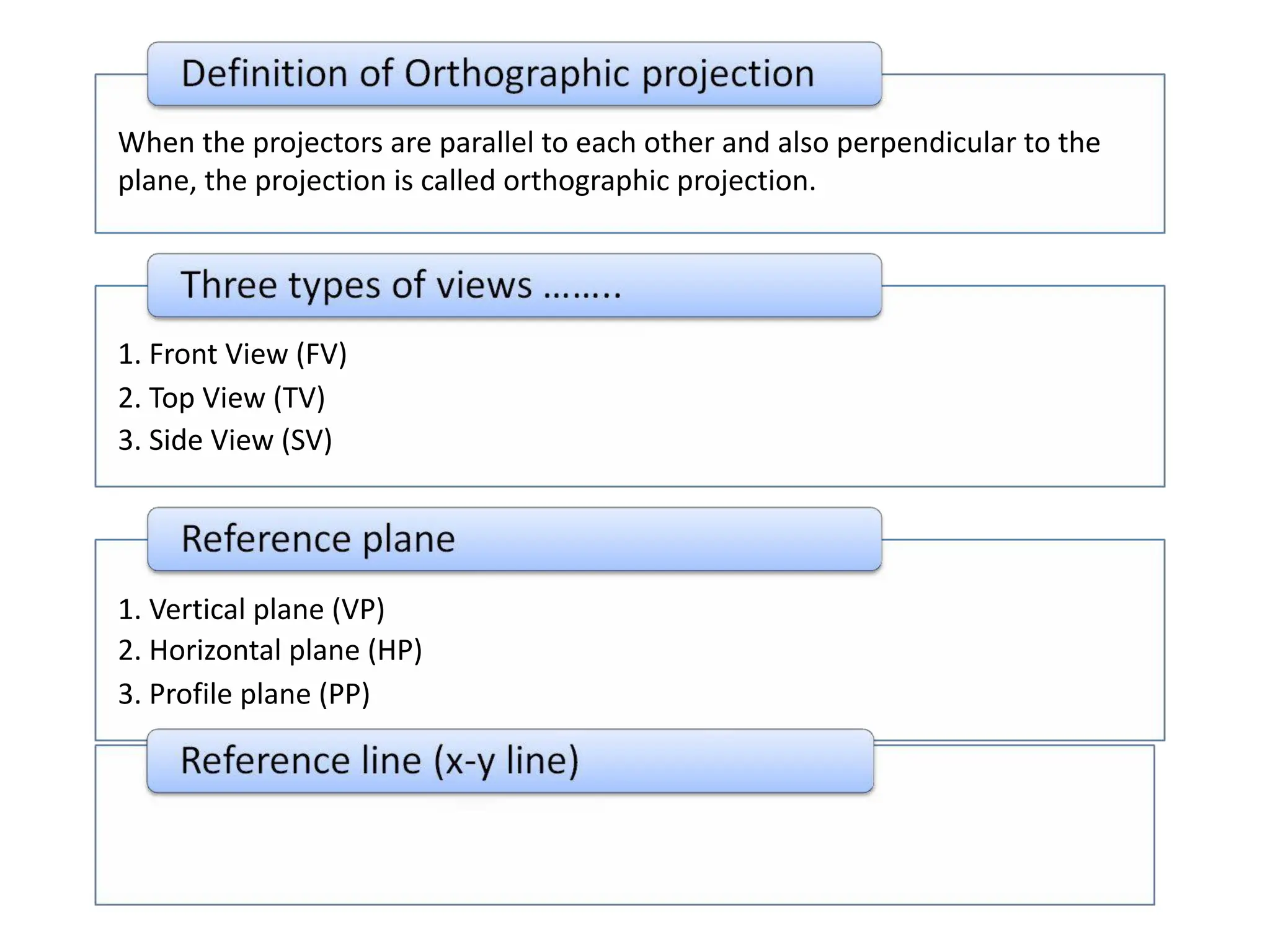
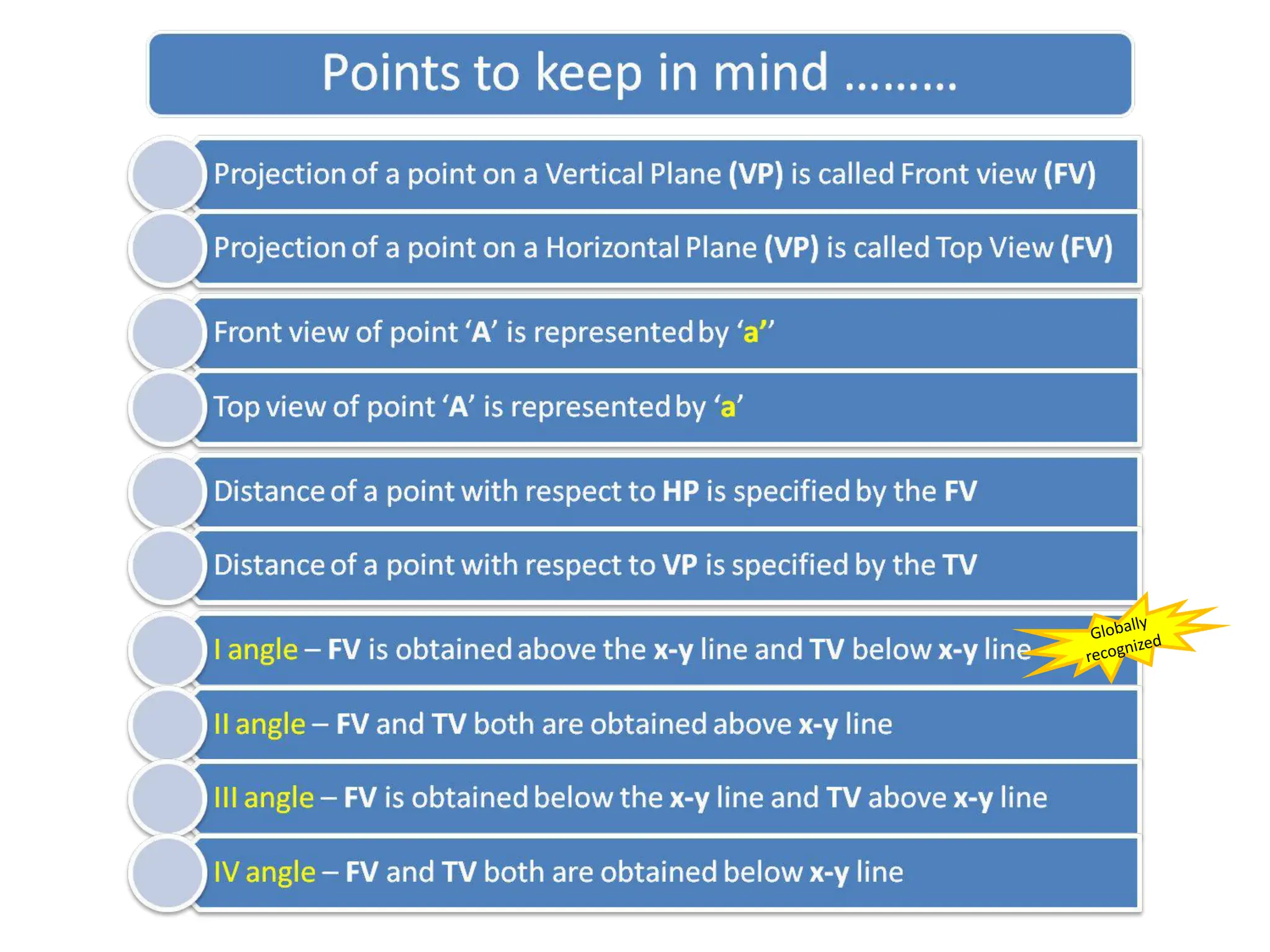
When the projectors are parallel to each other and also perpendicular to the
plane, the projection is called orthographic projection.
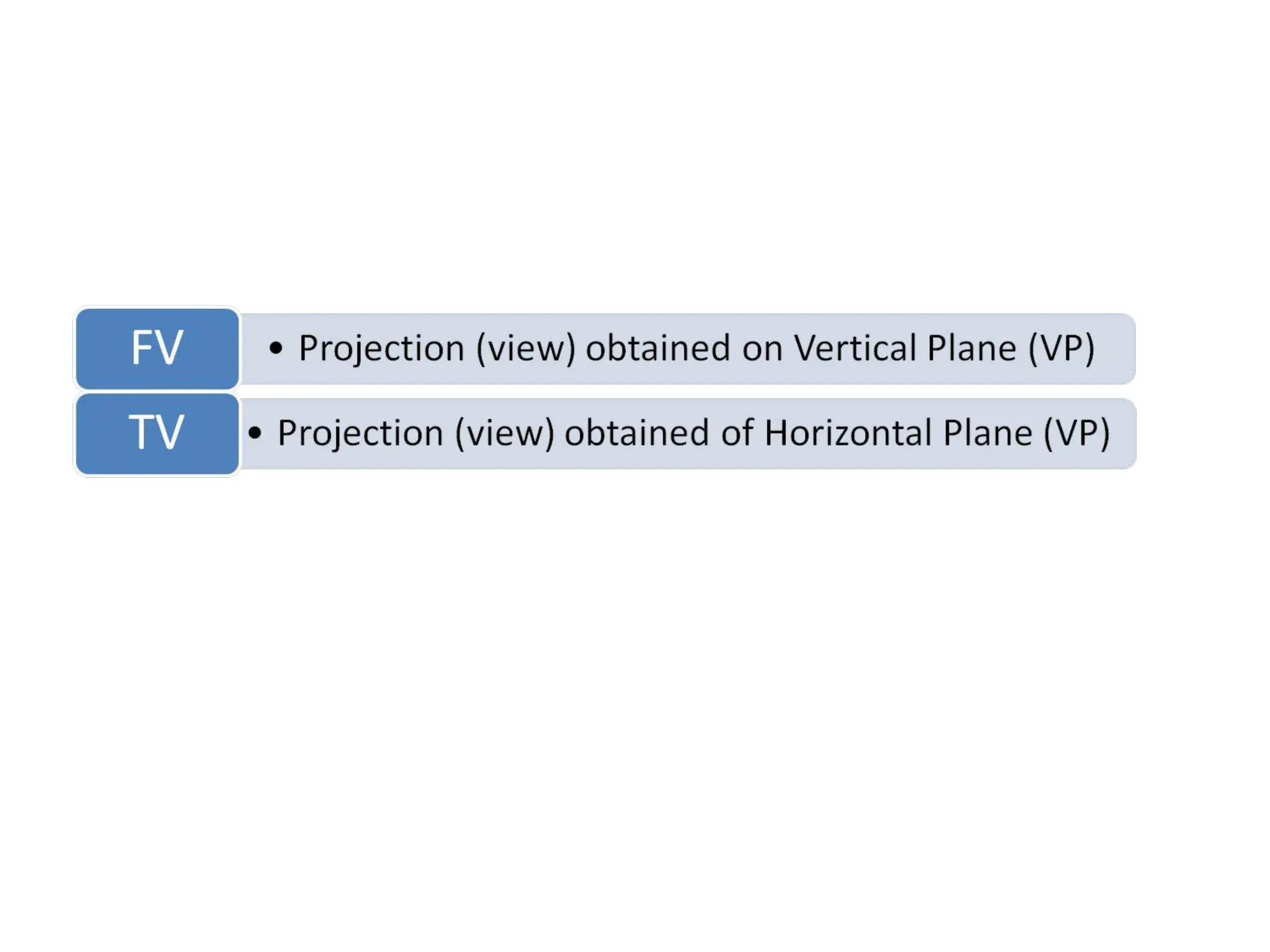
1. Front View (FV)
2. Top View (TV)
3. Side View (SV)
1. Vertical plane (VP)
2. Horizontal plane (HP)
3. Profile plane (PP)
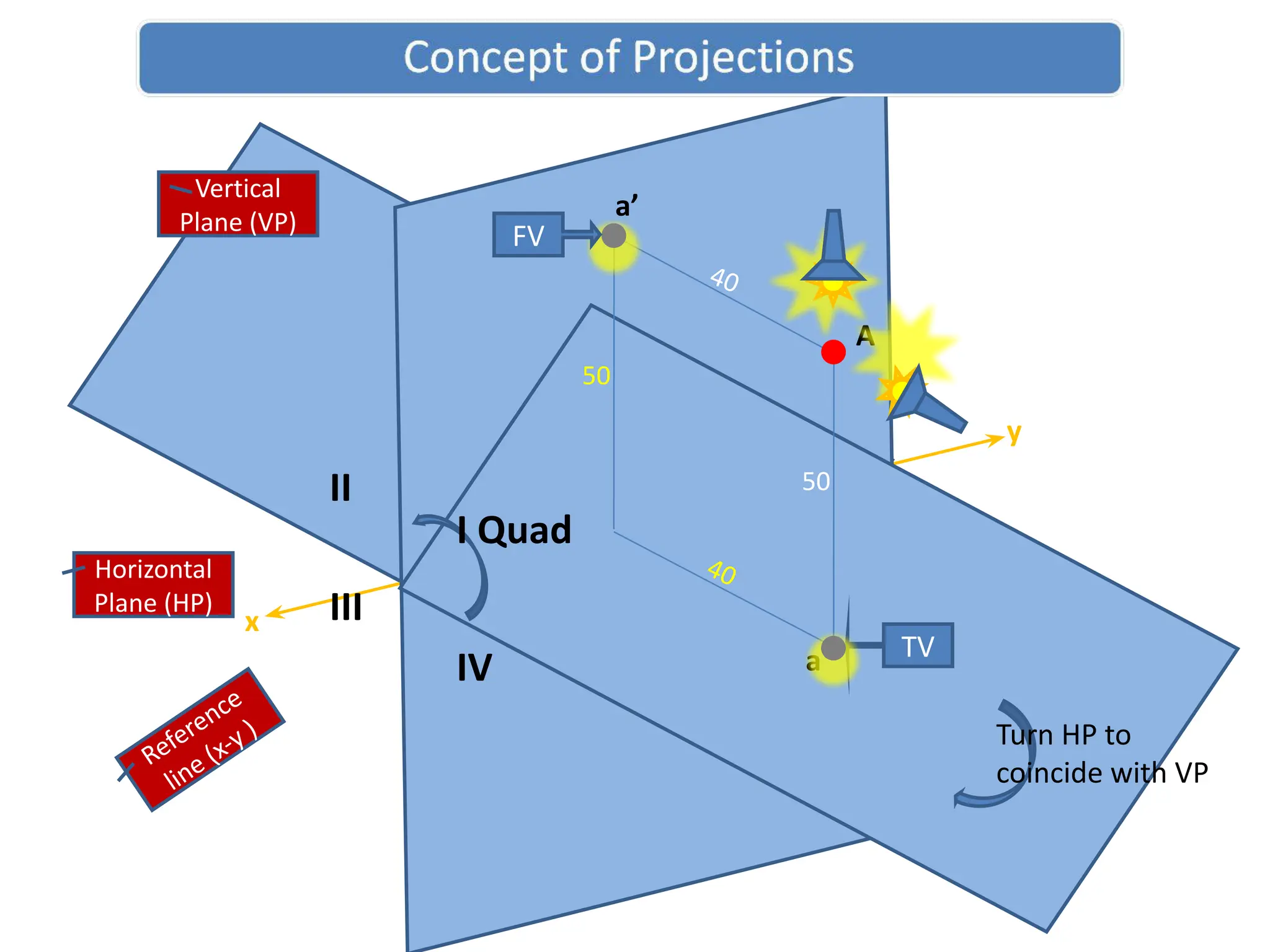
40
A
a’
Horizontal
Plane (HP)
Vertical
Plane (VP)
I Quad
II
III
IV
50
50
40
TV
Reference
line (x-y ) Turn HP to
coincide with VP
x
y
40
a
FV
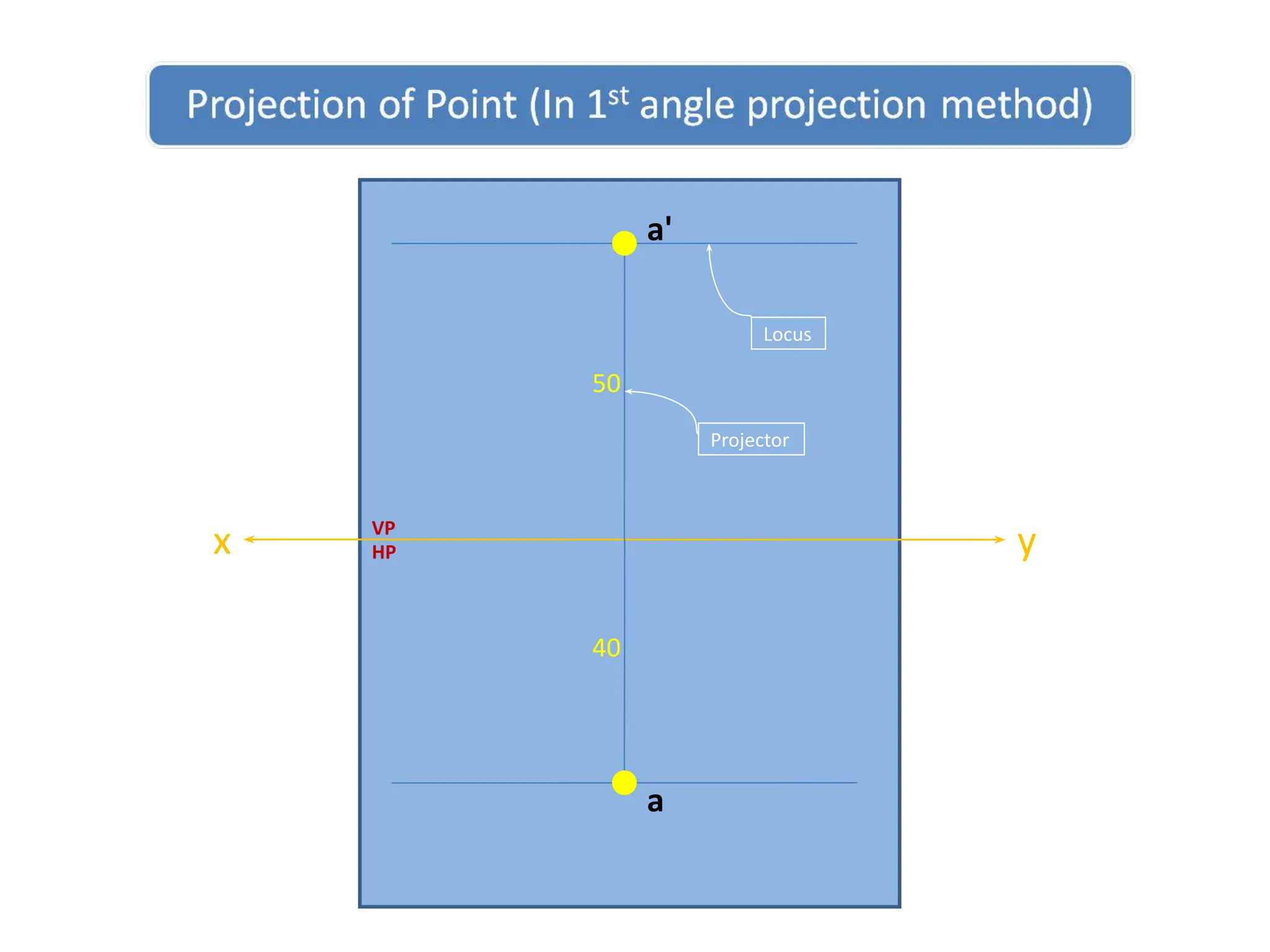
x y
50
40
a
a'
VP
HP
Projector
Locus
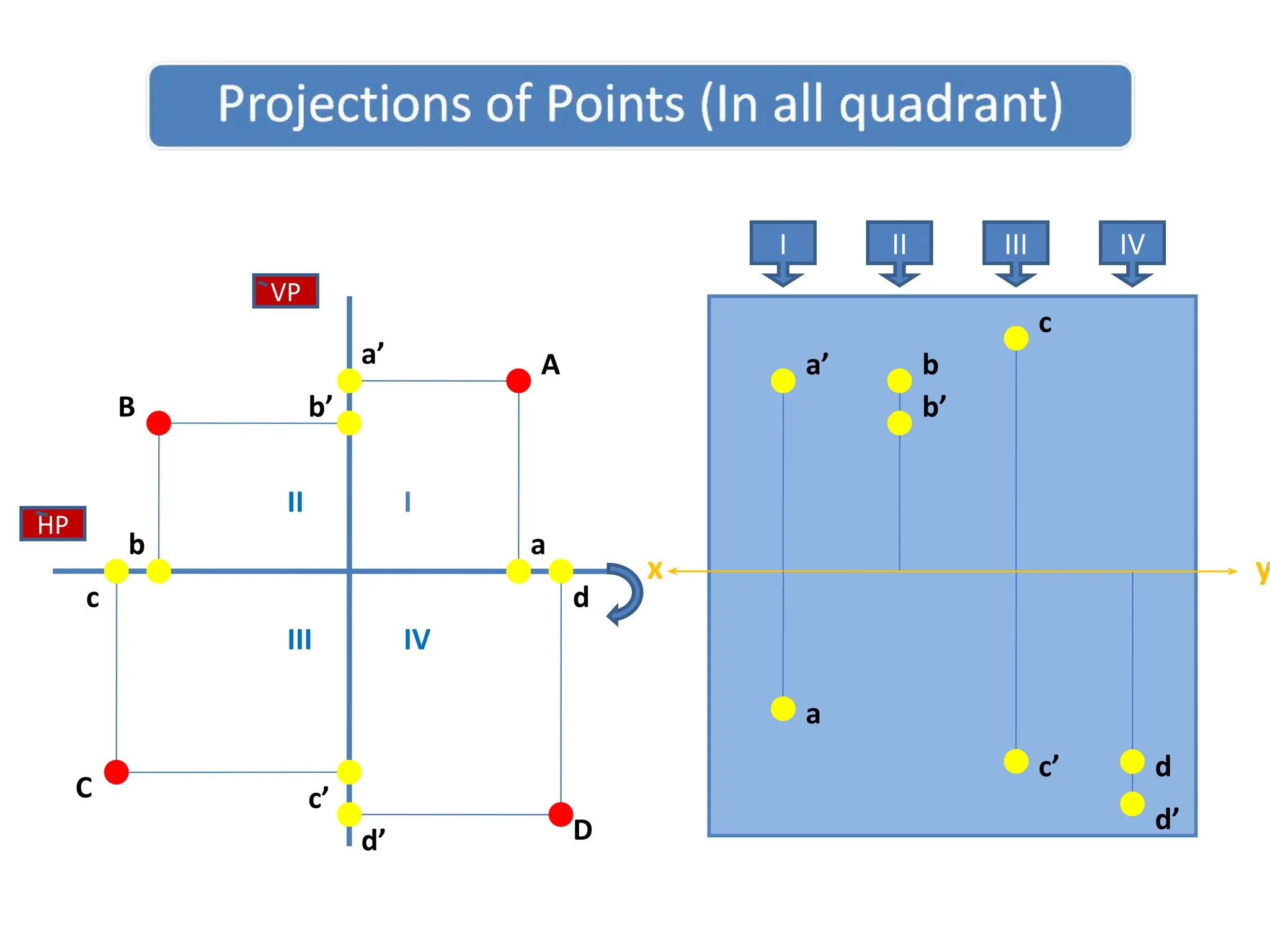
VP
HP
I II III IV
A
B
C
D
a’
a
d
d’
b’
b
c
c’
a’
a
b
b’
c
c’ d
d’
I
II
III IV
x y
Globally
recognized
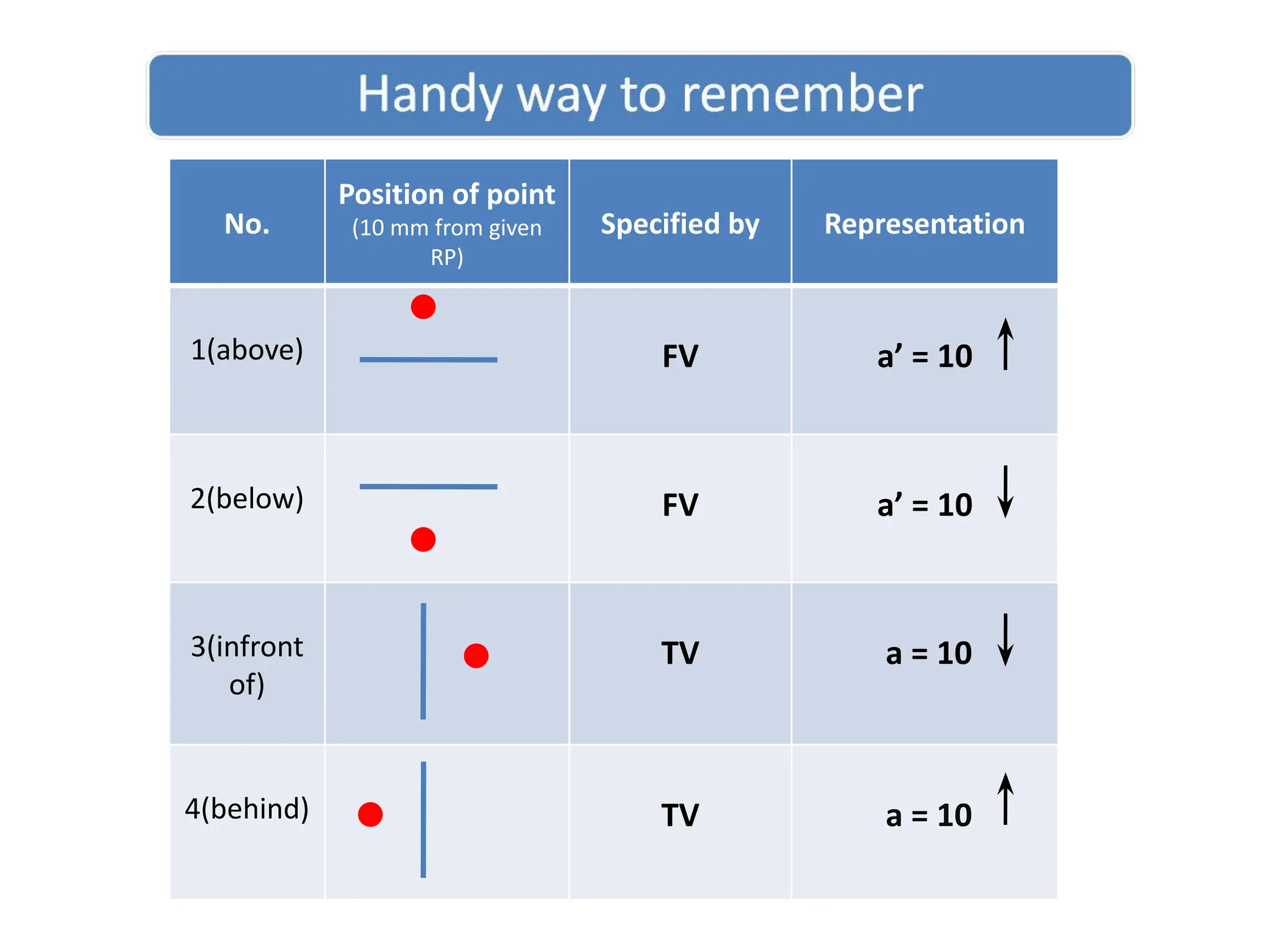
No.
Position of point
(10 mm from given
RP)
Specified by Representation
1(above) FV a’ = 10
2(below) FV a’ = 10
3(infront
of)
TV a = 10
4(behind) TV a = 10
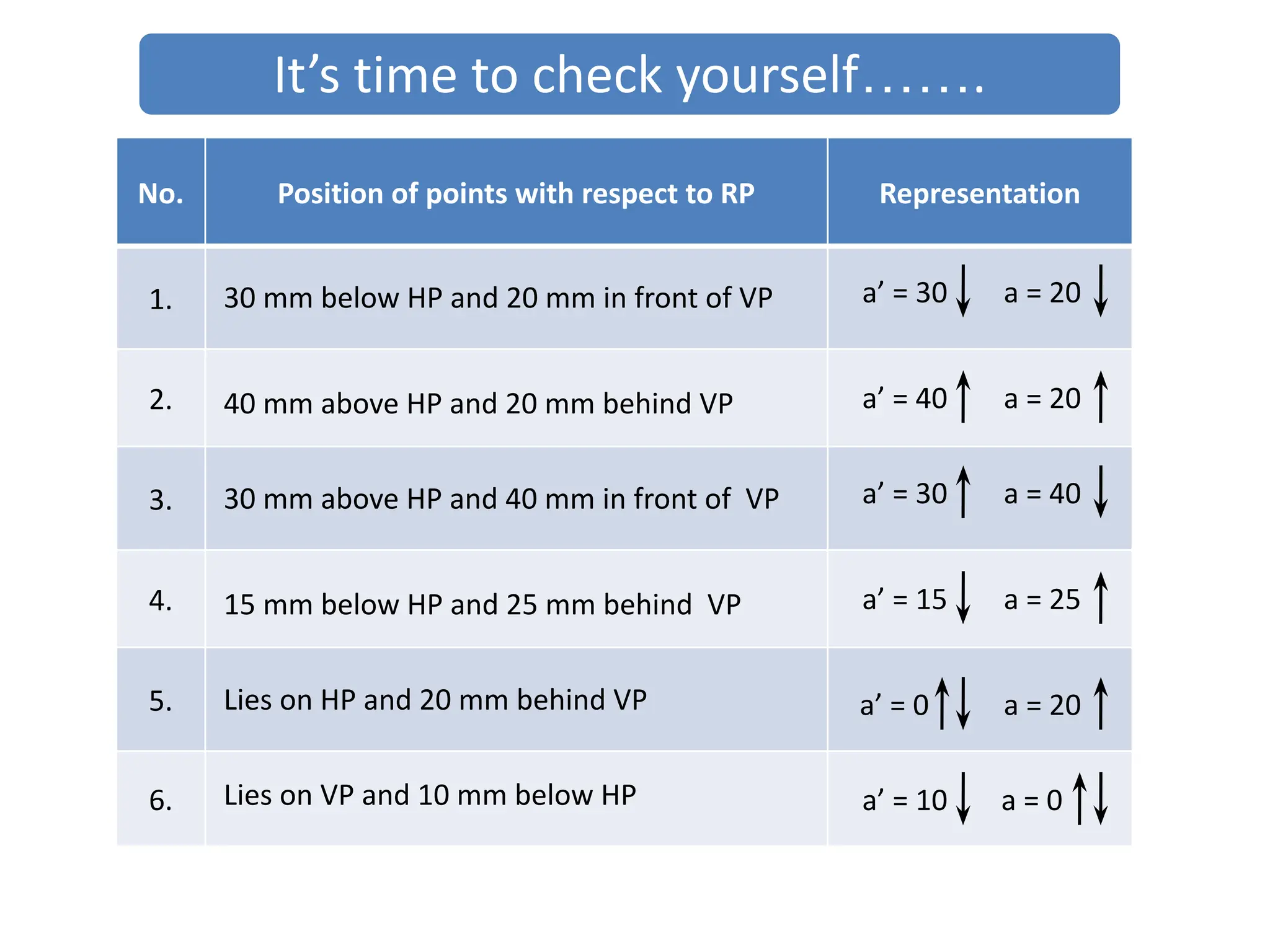
No. Position of points with respect to RP Representation
1.
2.
3.
4.
5.
6.
30 mm below HP and 20 mm in front of VP a’ = 30 a = 20
40 mm above HP and 20 mm behind VP a’ = 40 a = 20
30 mm above HP and 40 mm in front of VP a’ = 30 a = 40
15 mm below HP and 25 mm behind VP a’ = 15 a = 25
Lies on HP and 20 mm behind VP a’ = 0 a = 20
Lies on VP and 10 mm below HP a’ = 10 a = 0
It’s time to check yourself…….
Projections of Straight Lines
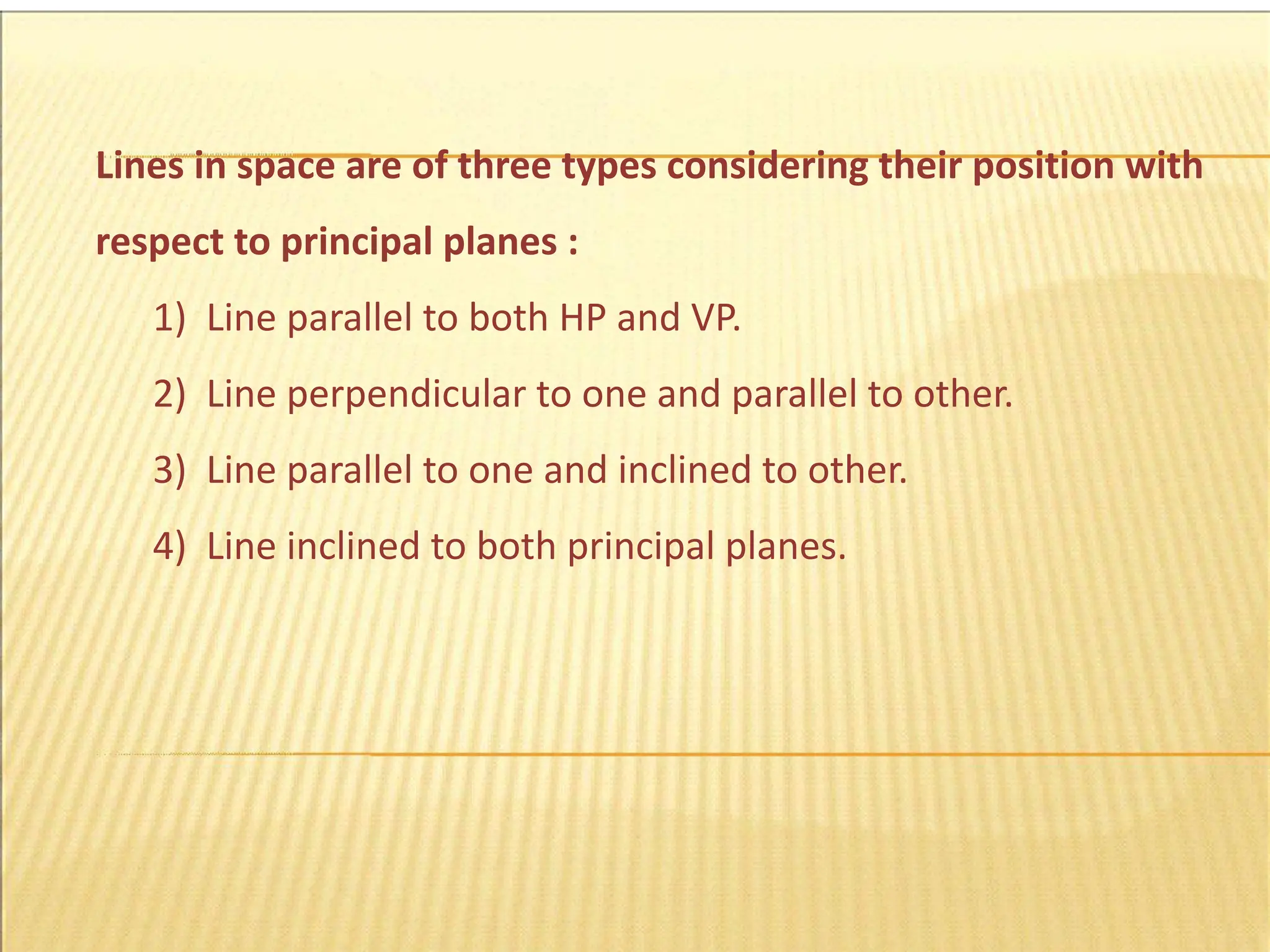
Lines in space are of three types considering their position with
respect to principal planes :
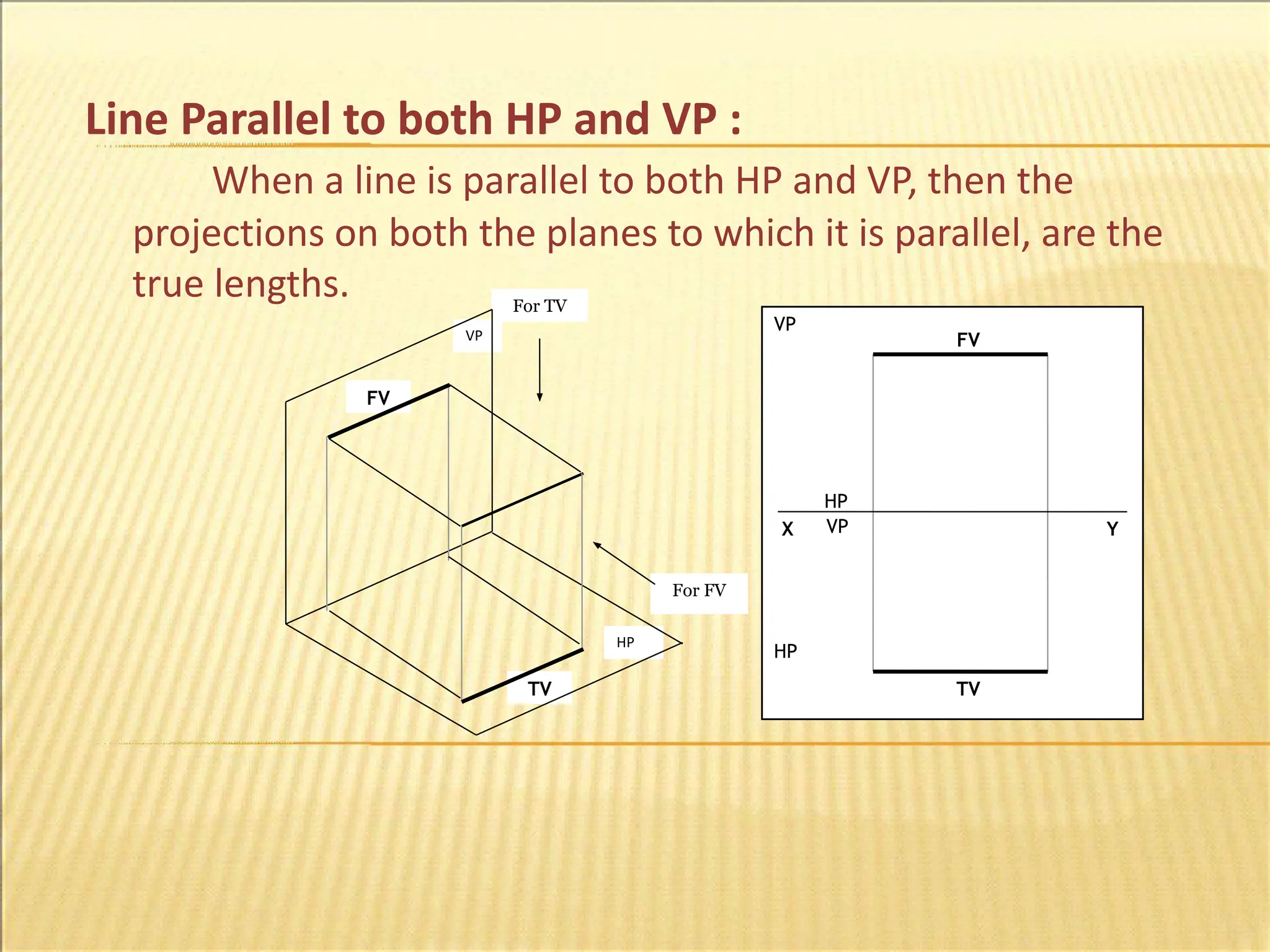
1) Line parallel to both HP and VP.
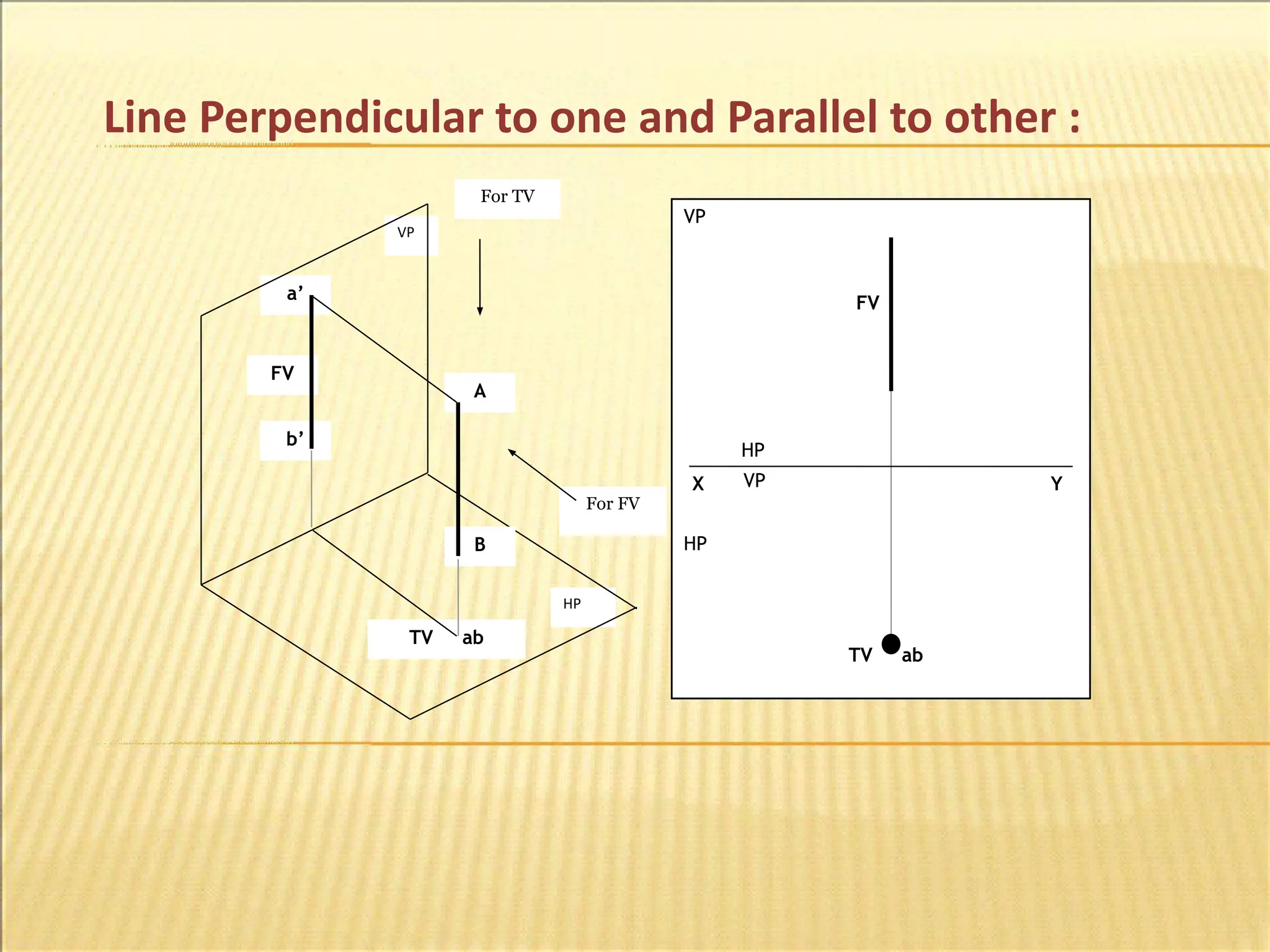
2) Line perpendicular to one and parallel to other.
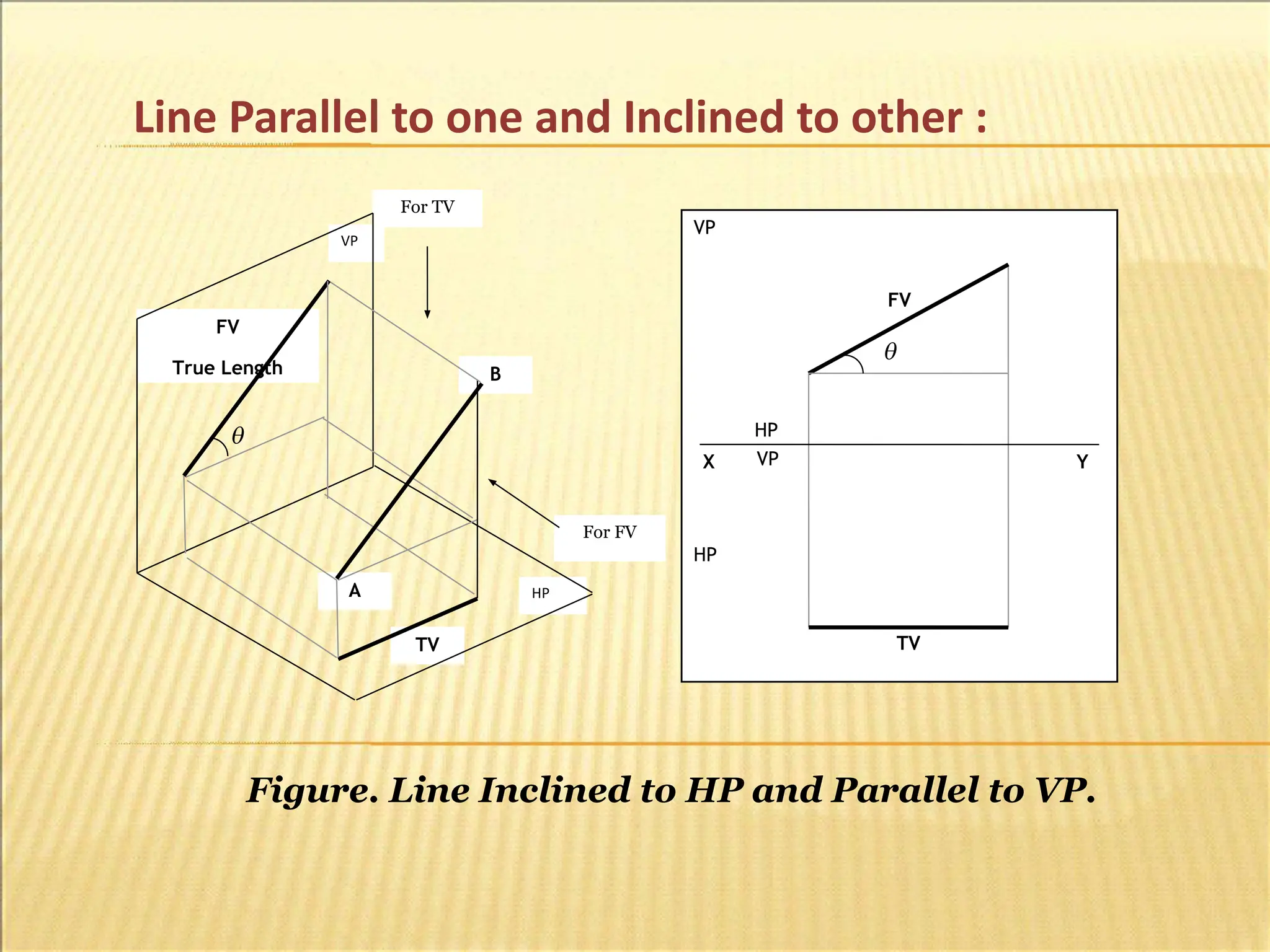
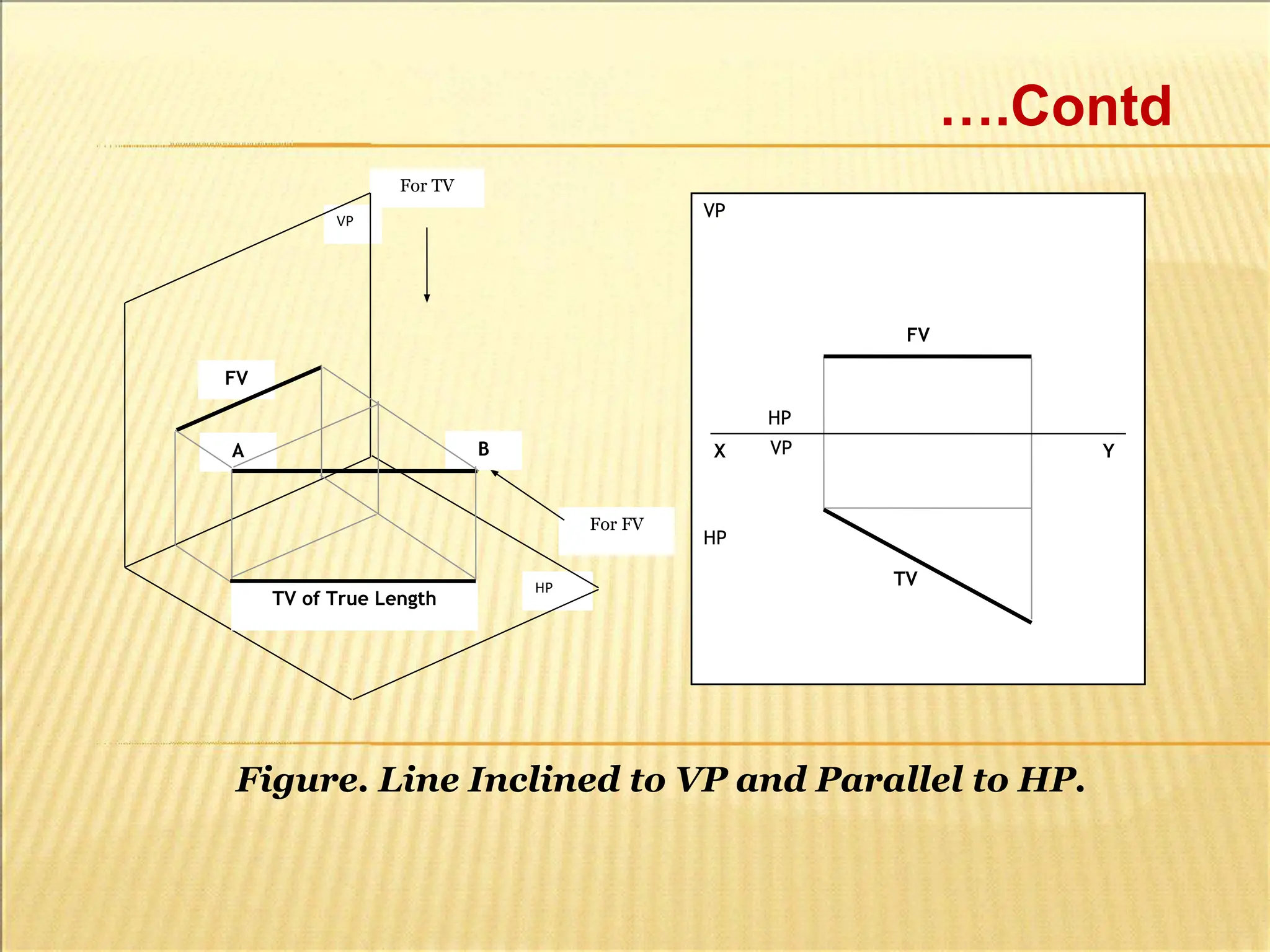
3) Line parallel to one and inclined to other.
4) Line inclined to both principal planes.
Line Parallel to both HP and VP :
When a line is parallel to both HP and VP, then the
projections on both the planes to which it is parallel, are the
true lengths.
VP
HP
HP
VP
For FV
For TV
FV
TV
FV
TV
X Y
HP
VP
Line Perpendicular to one and Parallel to other :
VP
HP
HP
VP
For FV
For TV
A
B
a’
b’
TV ab
FV
FV
TV ab
X Y
HP
VP
Line Parallel to one and Inclined to other :
VP
HP
HP
VP
For FV
For TV
FV
True Length
TV
FV
TV
X Y
HP
VP
A
B
Figure. Line Inclined to HP and Parallel to VP.
….Contd
VP
HP
HP
VP
For FV
For TV
FV
TV of True Length
FV
TV
X Y
HP
VP
A B
Figure. Line Inclined to VP and Parallel to HP.
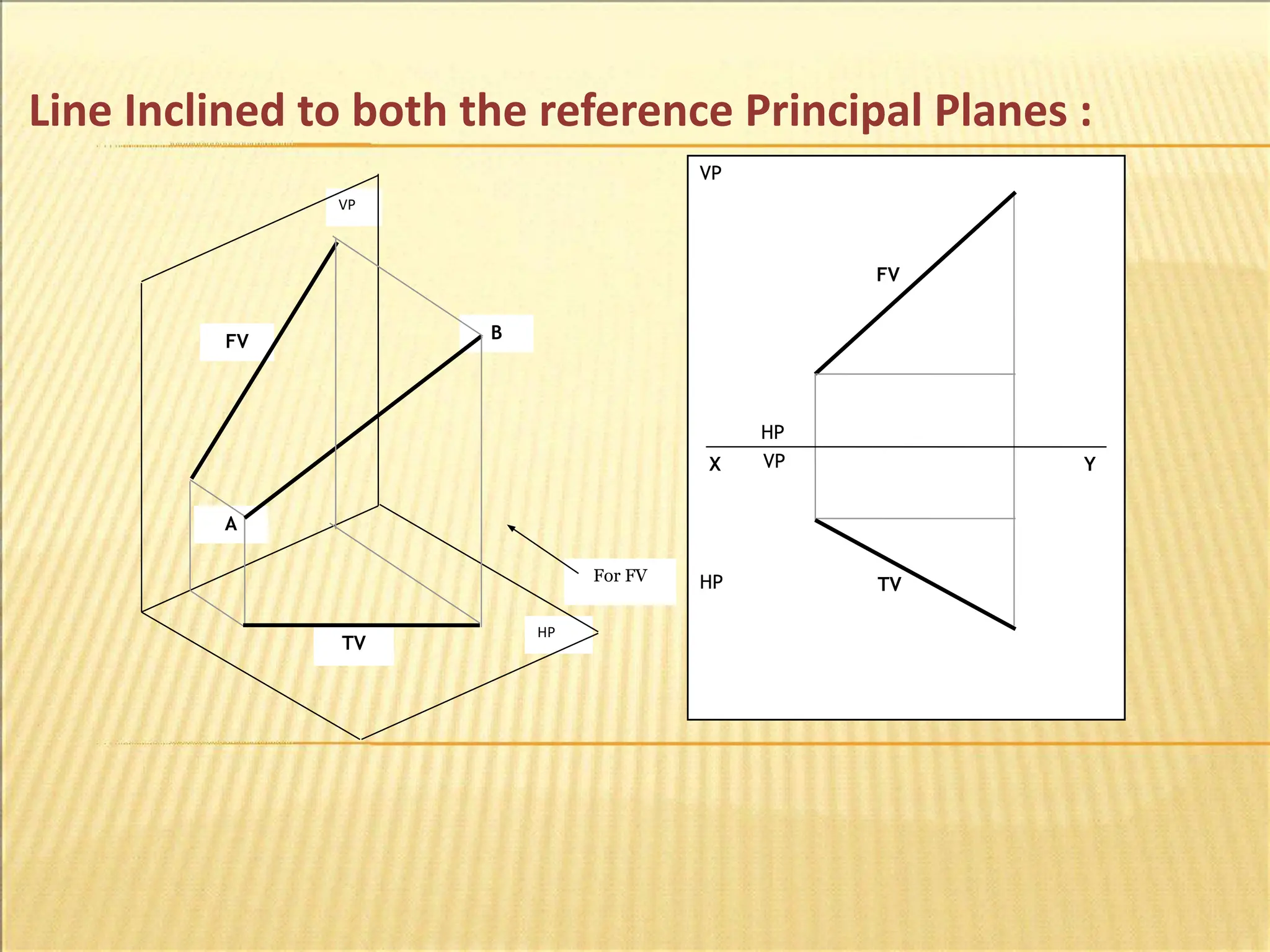
Line Inclined to both the reference Principal Planes :
VP
HP
HP
VP
For FV
FV
TV
FV
TV
X Y
HP
VP
A
B
Projections of Planes
IMP
VP
HP
Square
plate x y
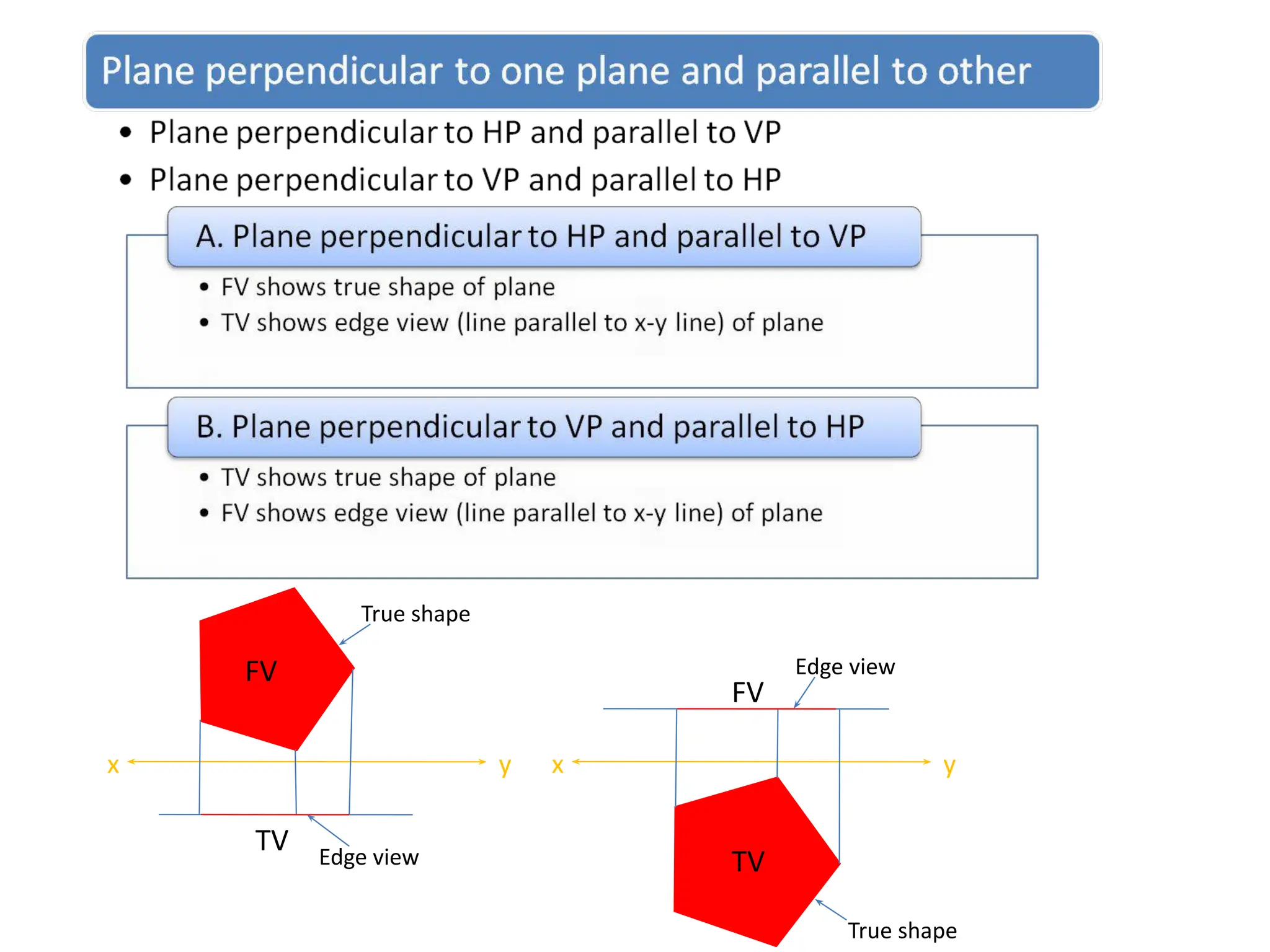
FV
TV
x x
y y
FV
TV
Edge view
Edge view
FV
TV
True shape
True shape
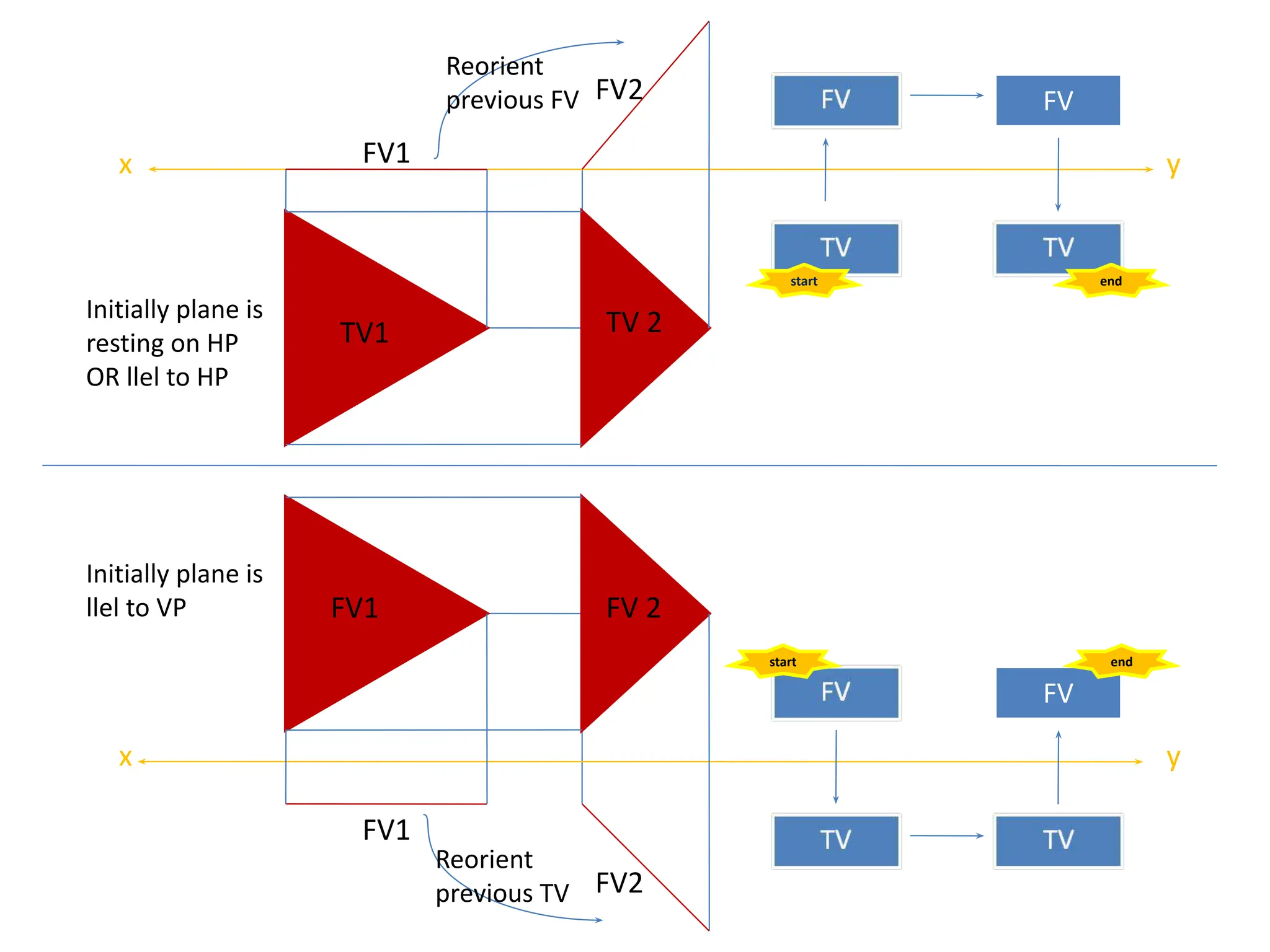
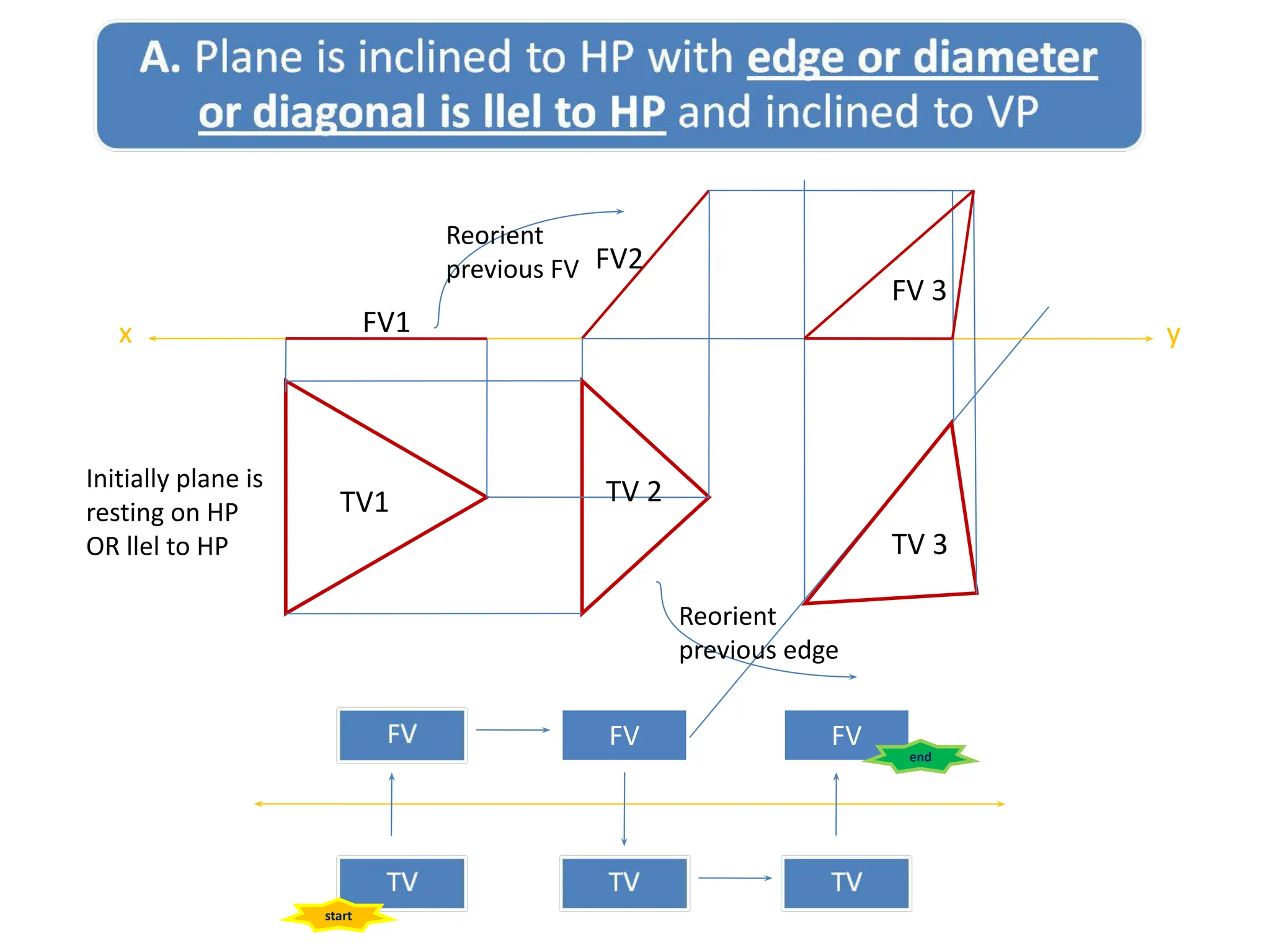
Initially plane is
resting on HP
OR llel to HP
TV1
FV1
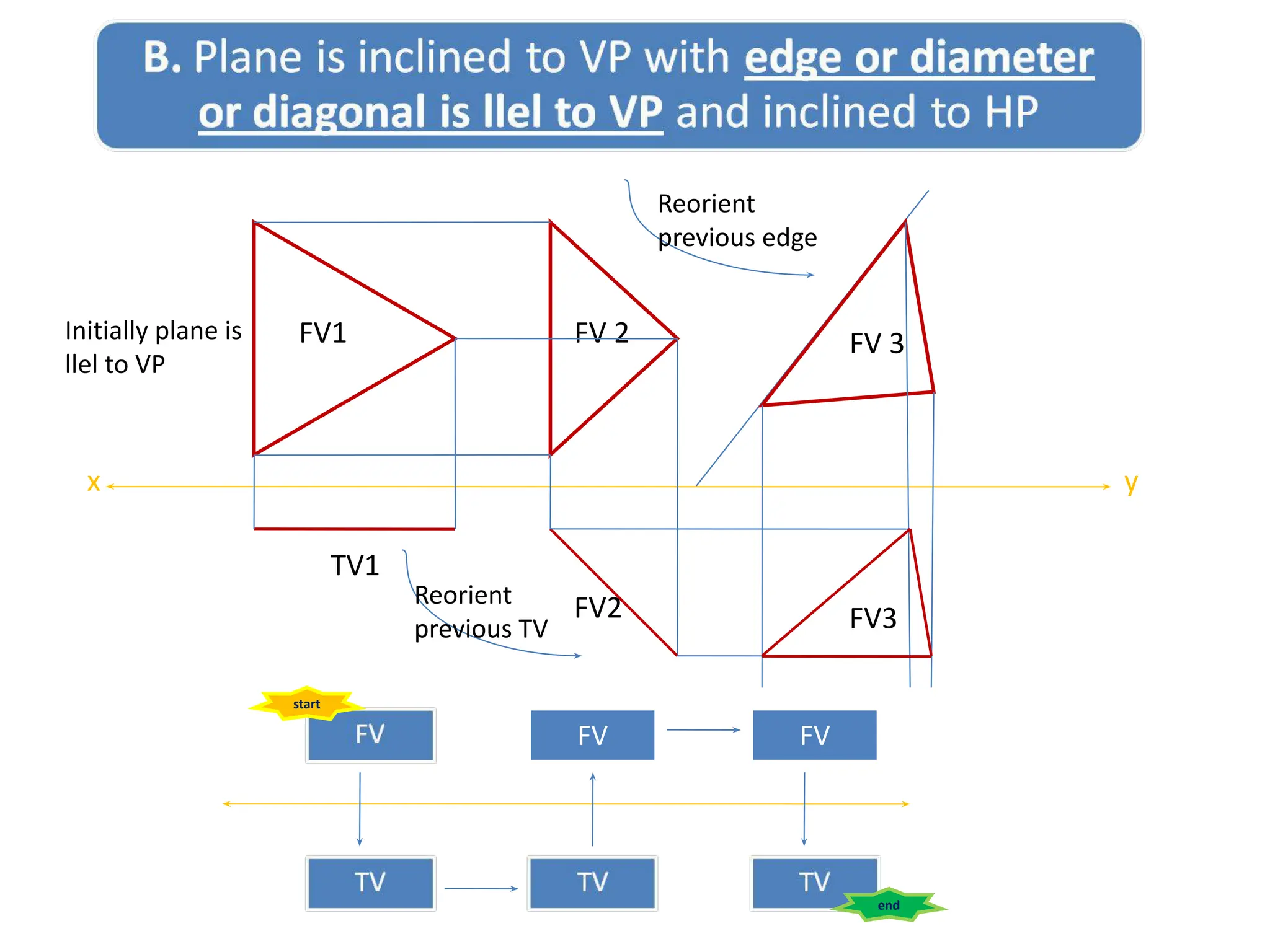
Initially plane is
llel to VP
FV
FV
FV1
FV1
FV2
FV2
x y
x y
Reorient
previous FV
Reorient
previous TV
FV 2
TV 2
start
start end
end
Initially plane is
resting on HP
OR llel to HP
TV1
FV1
FV2
x y
Reorient
previous FV
TV 2
Reorient
previous edge
TV 3
FV 3
FV
start
FV
end
FV1
x y
FV 2
Initially plane is
llel to VP
Reorient
previous TV
Reorient
previous edge
FV 3
FV2 FV3
FV
start
FV
end
TV1
Step by Step
or
Procedure for Solving the Problem
x y
1
2
3
4
5
6
8
10
11
12
HP
VP 1’
2’ 3’ 4’ 5’ 6’
7’
8’
9’
10’
11’
12’
1’
7
9
7’
10’
4’
11’
12’
9’
5’
6’
8’
3’
2’
10
11 9
12 8
1 7
2 6
3 5
4
45˚
1
7
4
10
2
6
12
8
11
9
3
5
1’
2’ 12’
3’
11’
4’
10’
5’
9’
6’
8’
7’
60˚
30˚
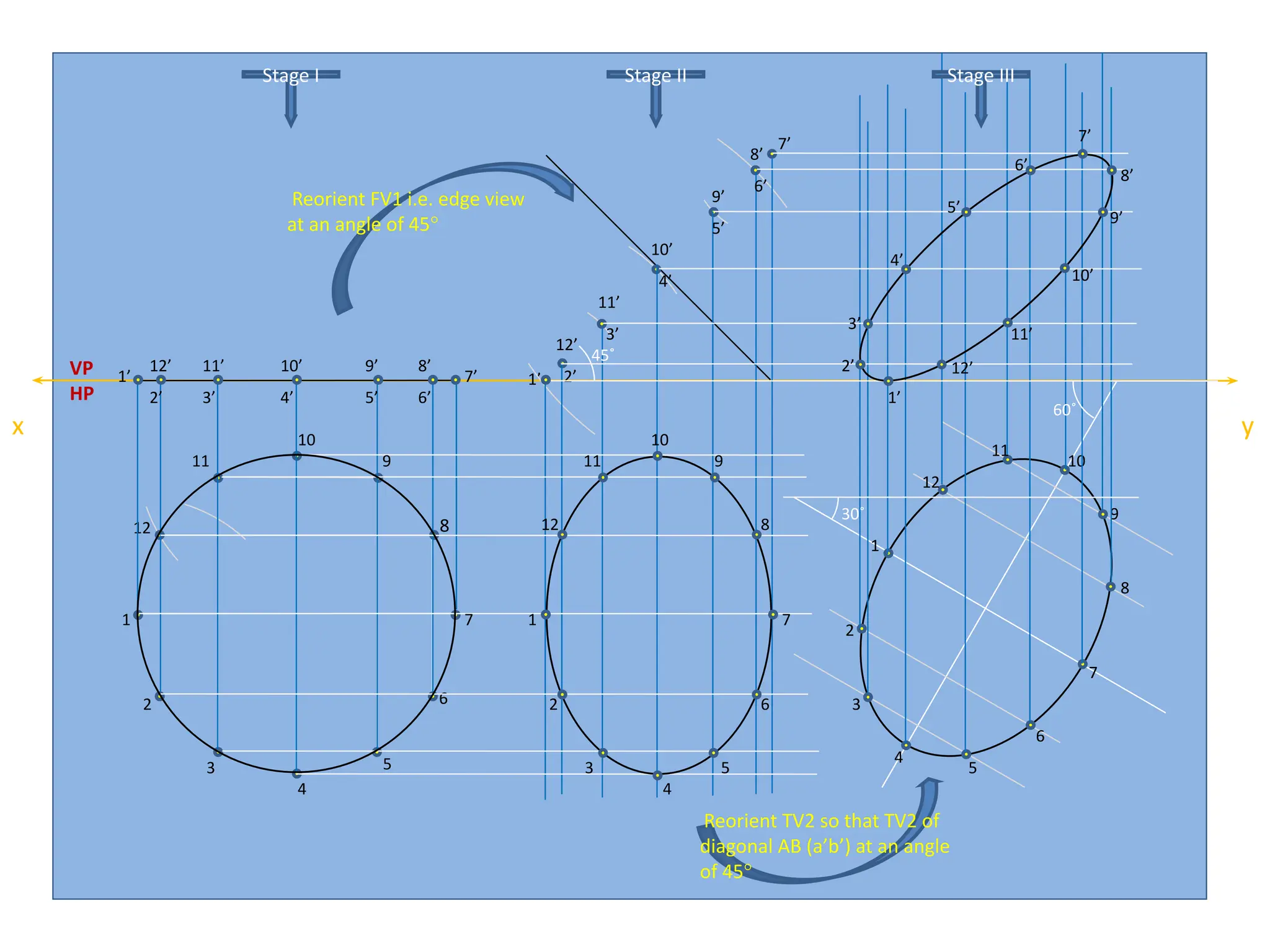
Reorient FV1 i.e. edge view
at an angle of 45°
Reorient TV2 so that TV2 of
diagonal AB (a’b’) at an angle
of 45°
Stage I Stage II Stage III
x y
1
2
3
4
5
6
8
10
11
12
HP
VP 1’
2’ 3’ 4’ 5’ 6’
7’
8’
9’
10’
11’
12’
1’
7
9
7’
10’
4’
11’
12’
9’
5’
6’
8’
3’
2’
10
11 9
12 8
1 7
2 6
3 5
4
45˚
30˚
a
b
b1
β˚
1
7
4
10
3
5
11
9
2
6
12
8
1’
2’ 12’
3’
4’
5’
6’
7’
8’
9’
10’
11’
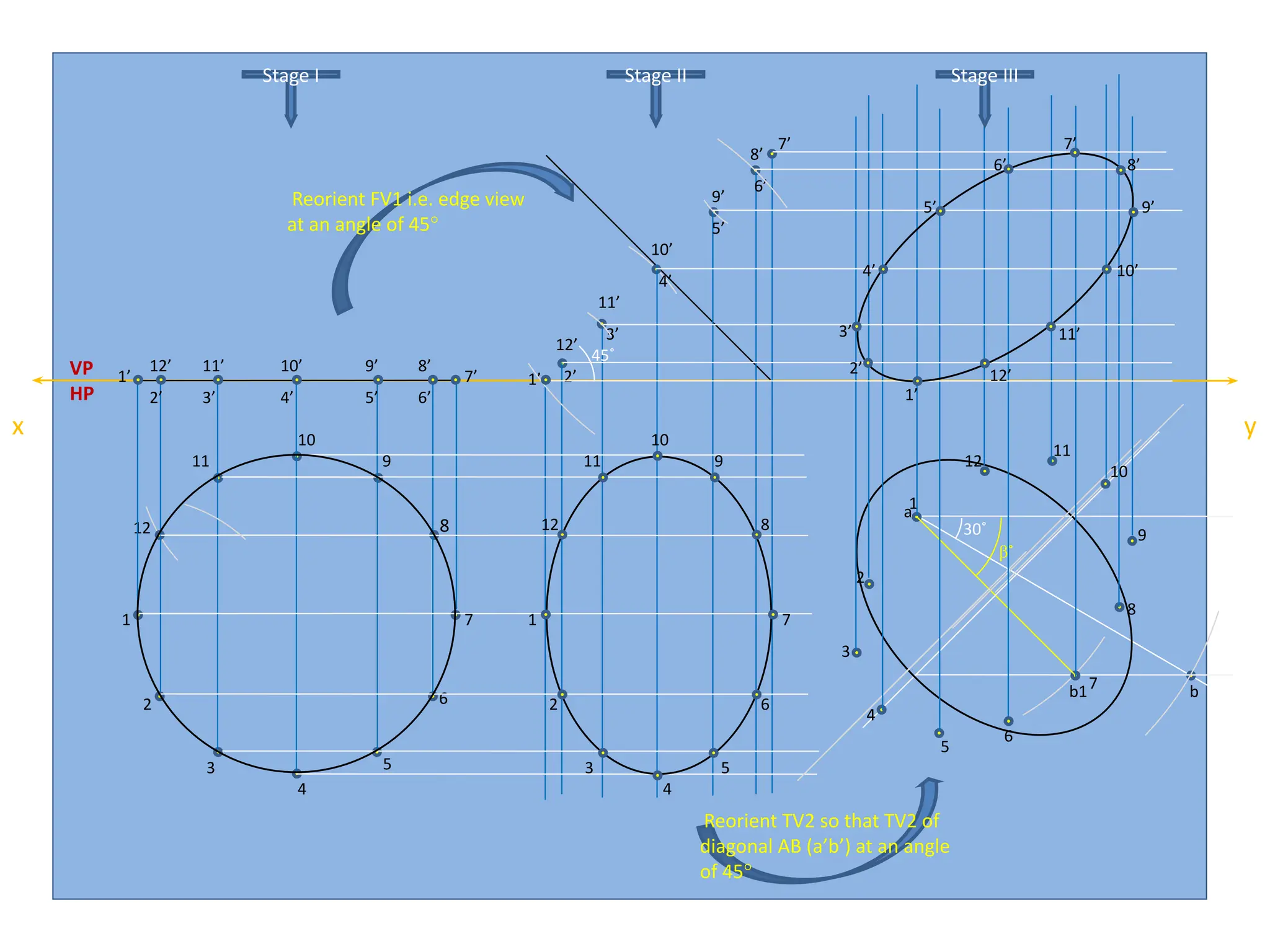
Reorient FV1 i.e. edge view
at an angle of 45°
Reorient TV2 so that TV2 of
diagonal AB (a’b’) at an angle
of 45°
Stage I Stage II Stage III
x
y
HP
VP
1’
2’
4’
5’
6’
7’
1’
7’
6’
2’
5’
3’
4’
7’
1
6
3
5’
2
4
7’
6’
5’
4’
3’
2’
3’
1’
7’
6’ 5’
4’
3’
2’
1’
45˚
7 1
6 2
5 3
7’
6’
5’
4’
3’
2’
1’
7
’
6
’
5
’
4
’
3
’
2
’
1
’
x y
HP
VP
a
b
c
d
e
108˚
a’
e’
b’
d’ c’
a’
e’
c’
b’
d’
a
b
c
d
e
a
b
c
d
e
a
b
c
d
e
a
d
e
c
b
a’ e’
b’
d’
c’
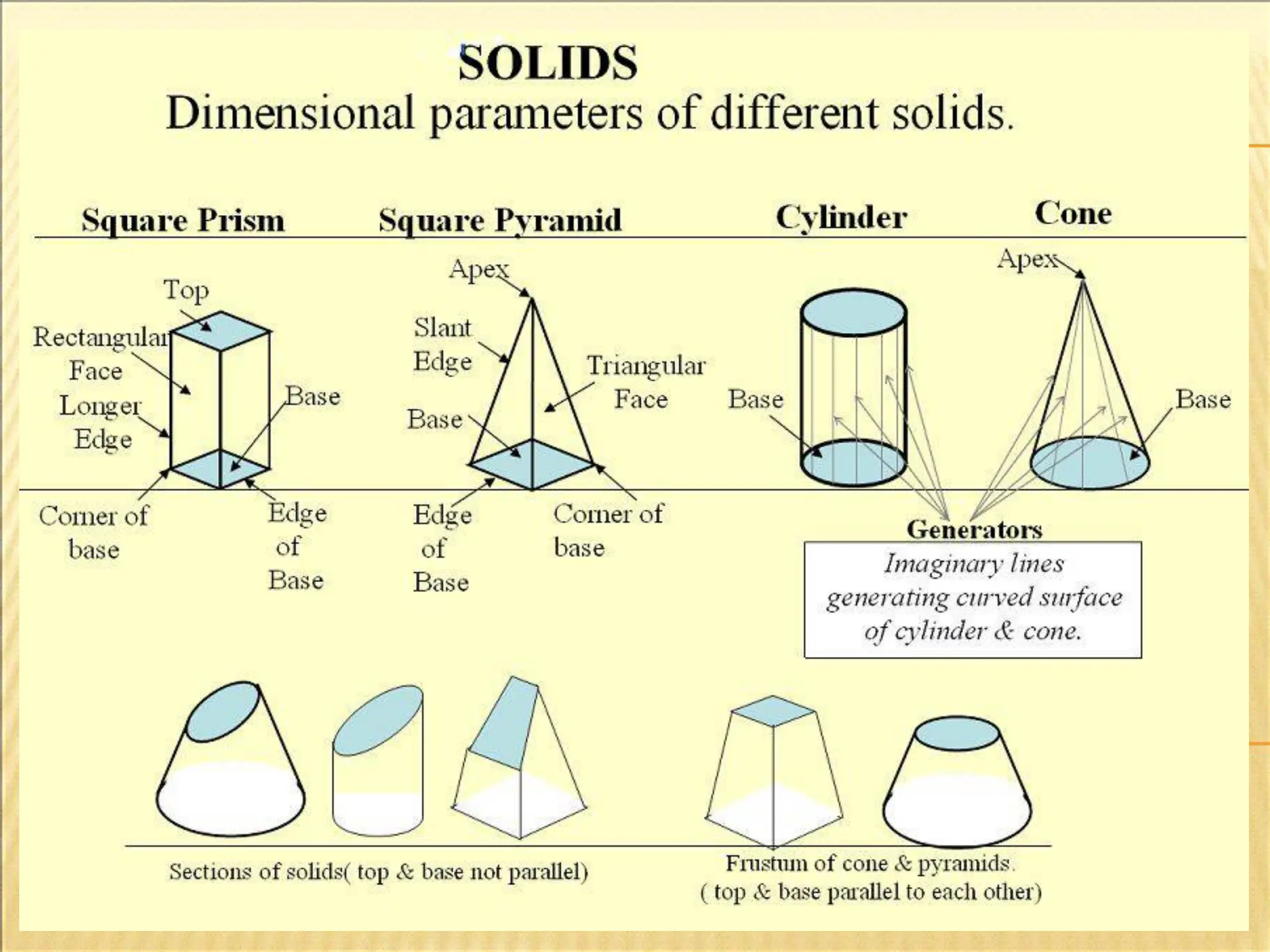
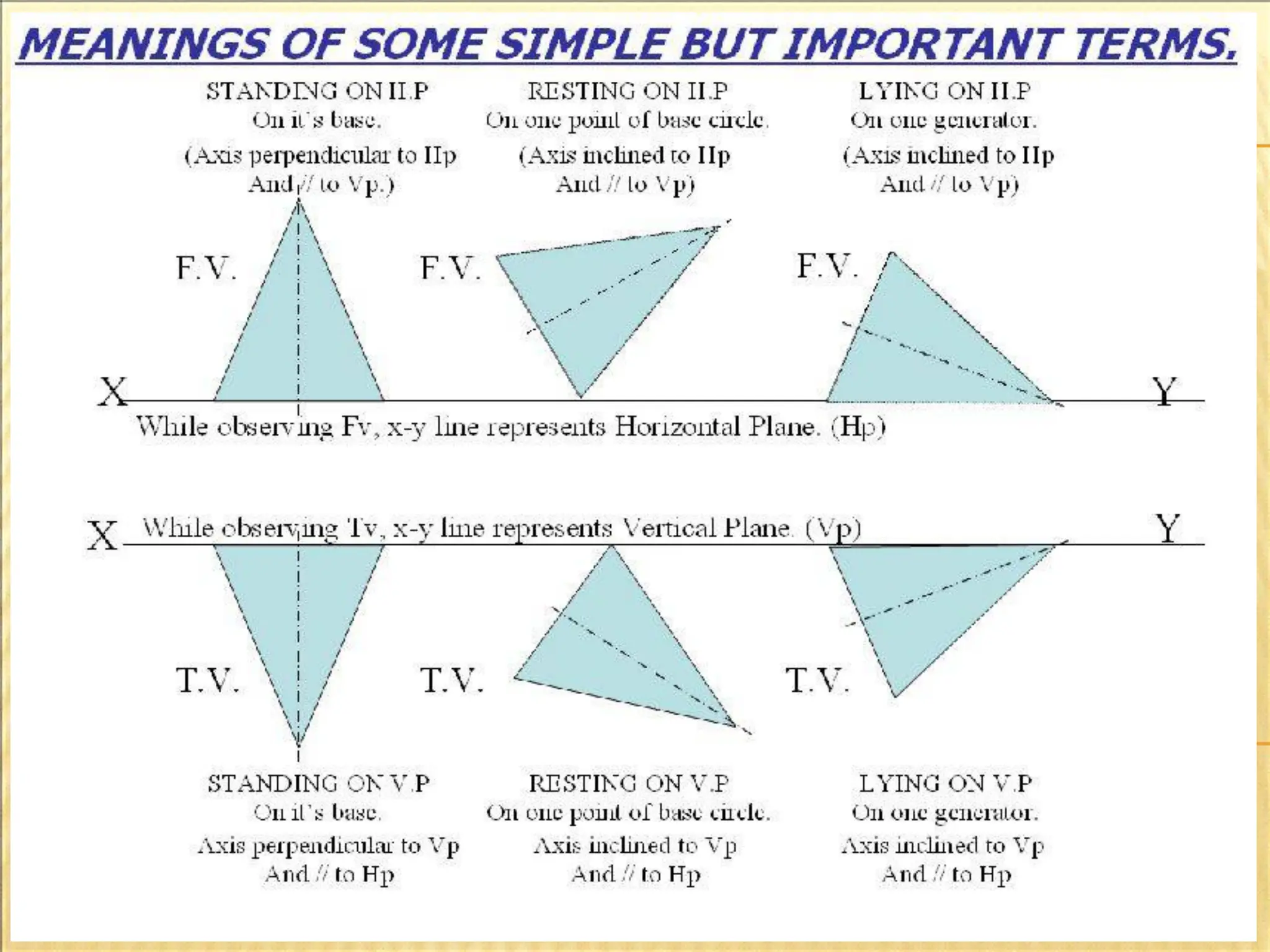
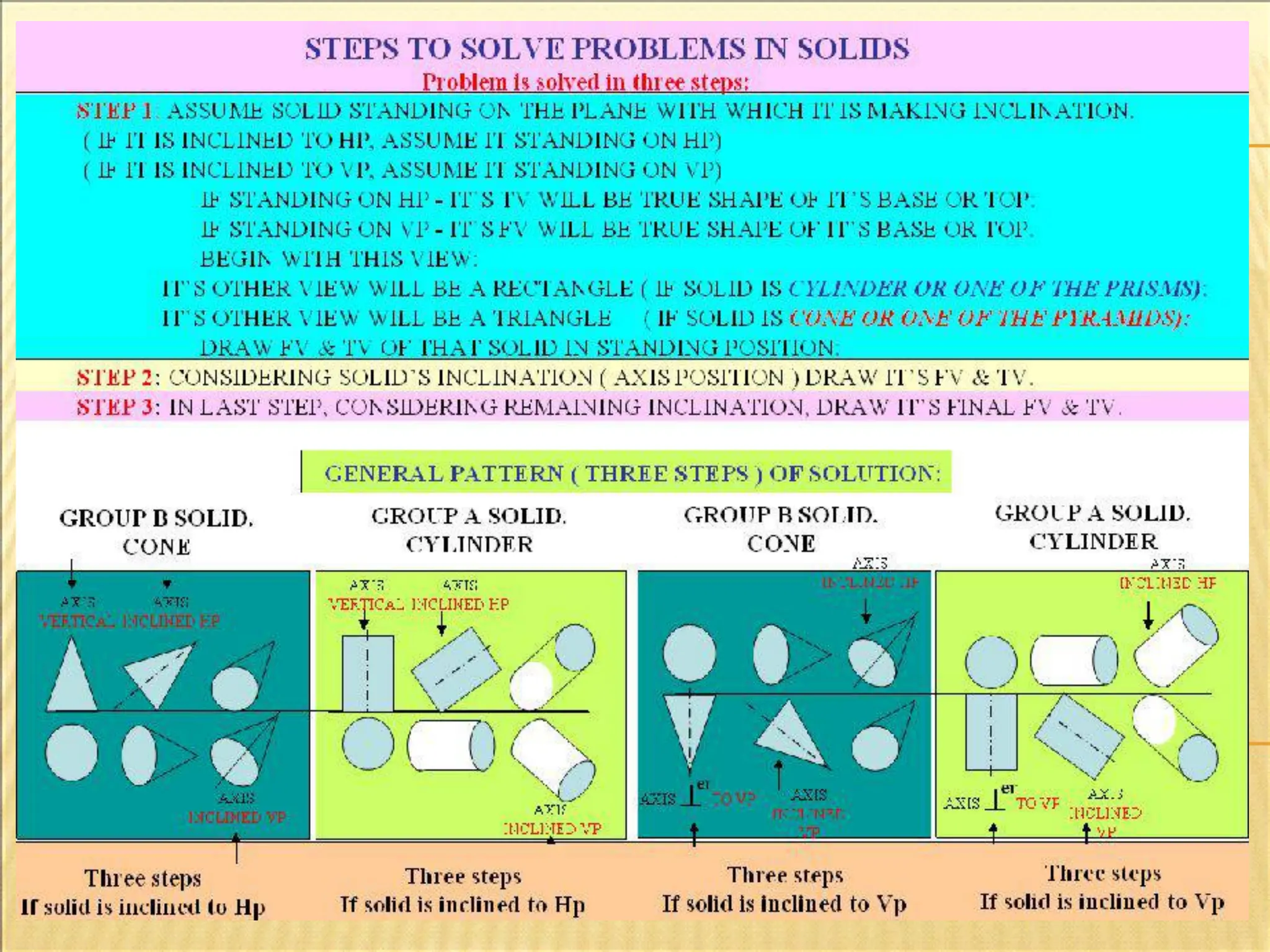
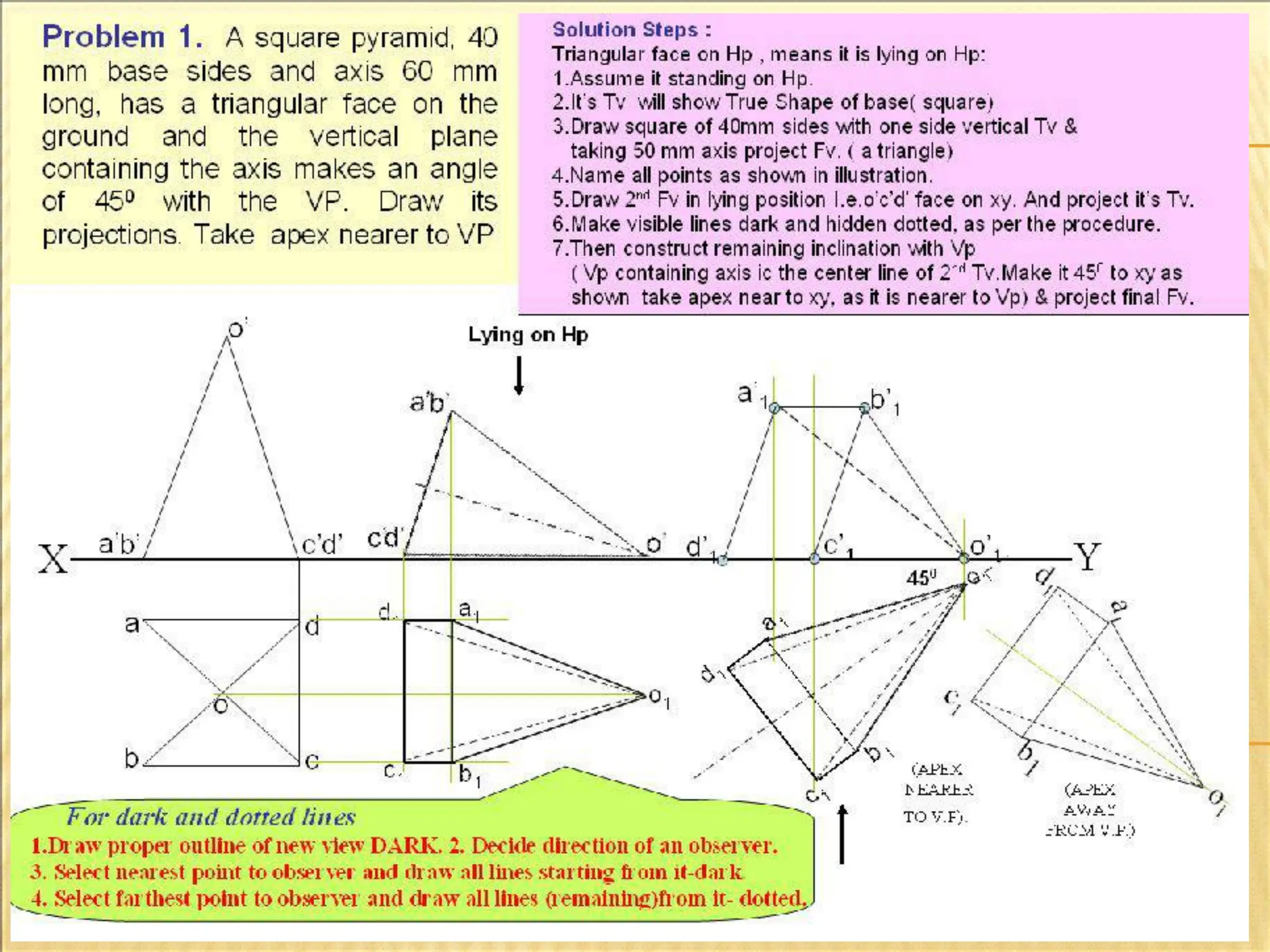
Projections of Solids
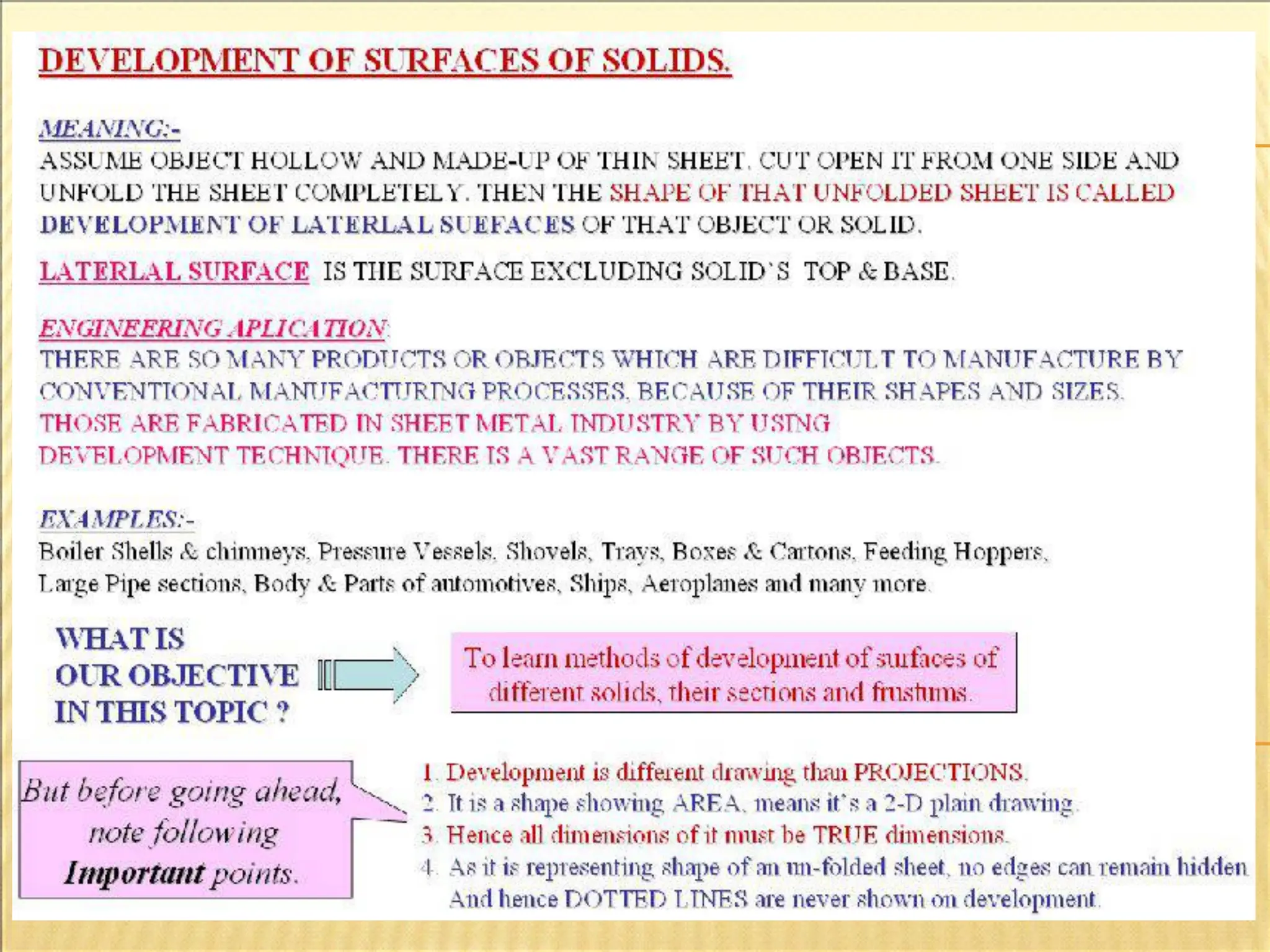
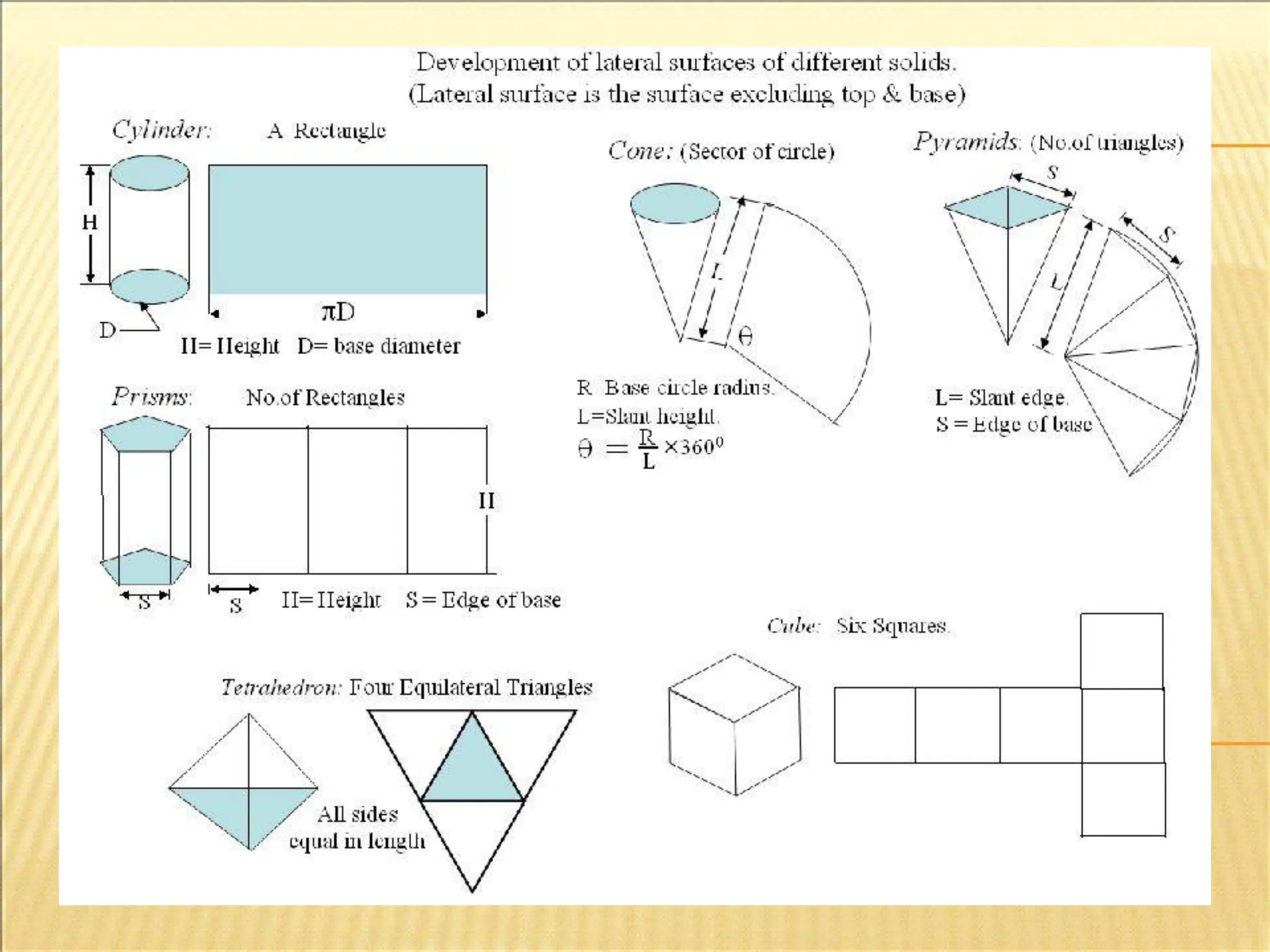
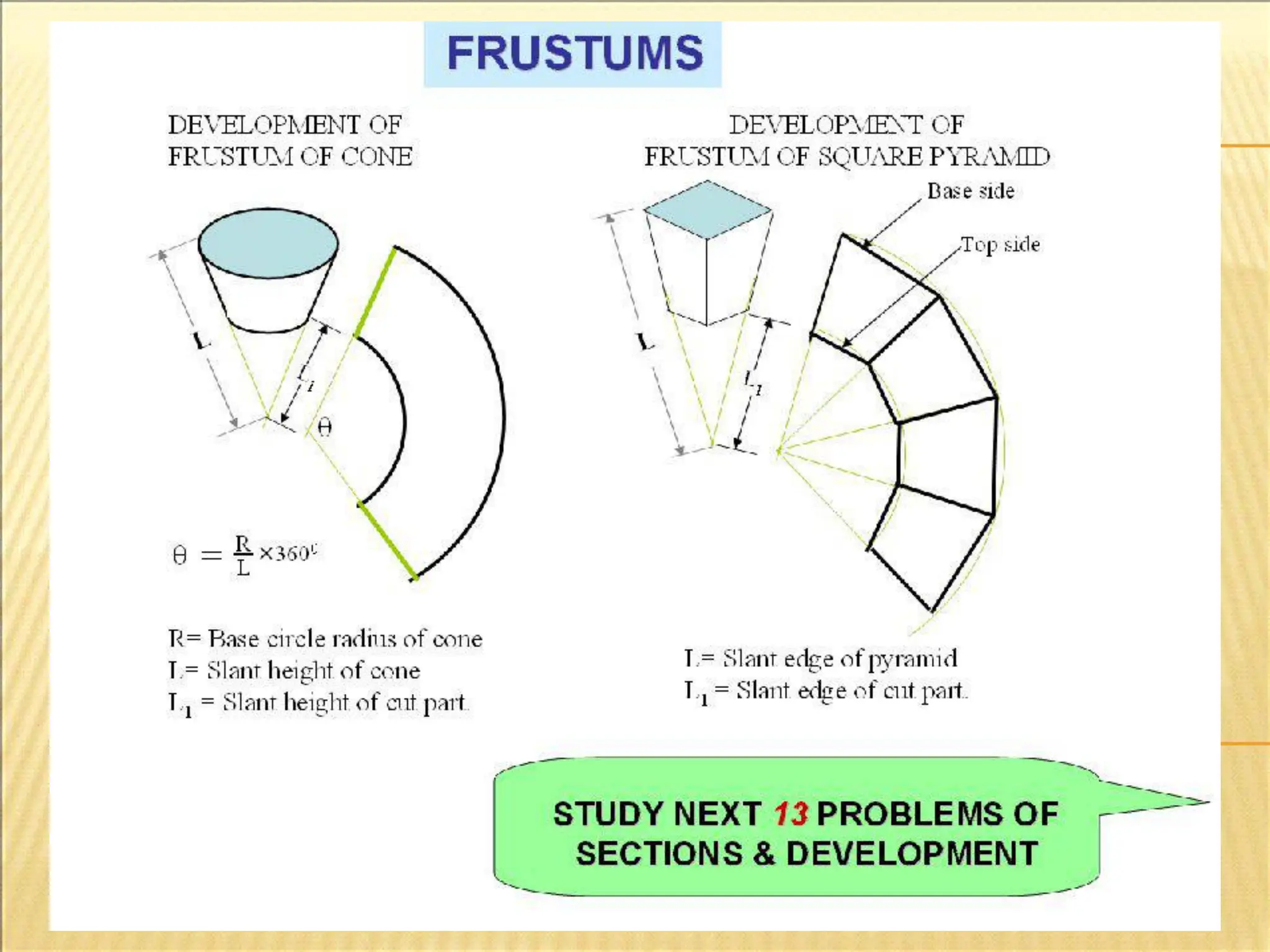
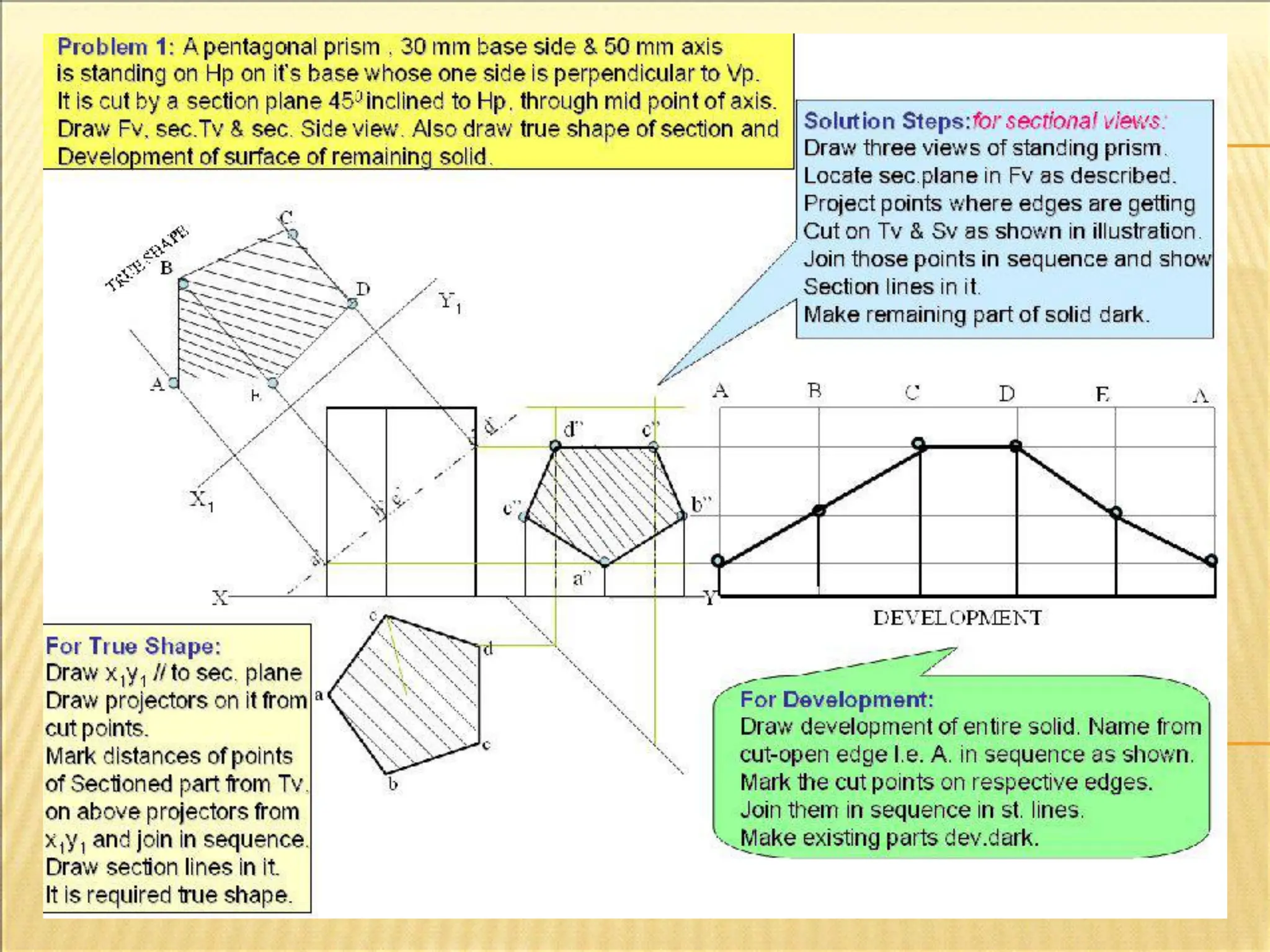
Development of Surfaces
of Solids
Isometric Projections
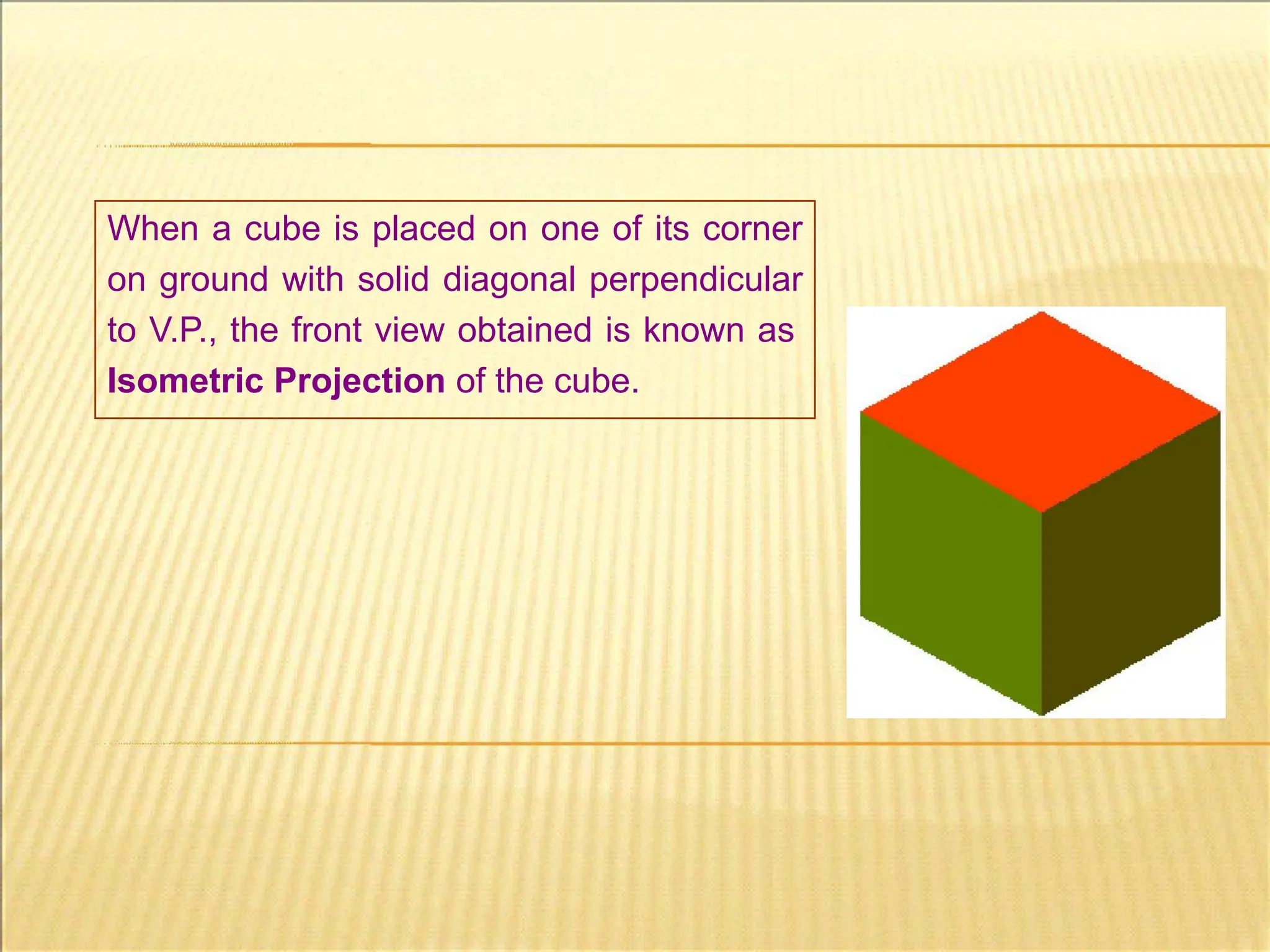
When a cube is placed on one of its corner
on ground with solid diagonal perpendicular
to V.P., the front view obtained is known as
Isometric Projection of the cube.
Isometric Axes, Lines & Planes:
Iso. View: For simplicity actual/True lengths are considered
and the radius of sphere is taken as 11/9*radius.
The ratio, Isometric Length / True Length = 9/11 approx.
It is necessary that while drawing Iso. Projections, true
lengths should be converted toIso. Length.
Iso. Projection: All lengths should be converted to Iso.
Length i.e. 9/11*True Length, except the radius of the
sphere.
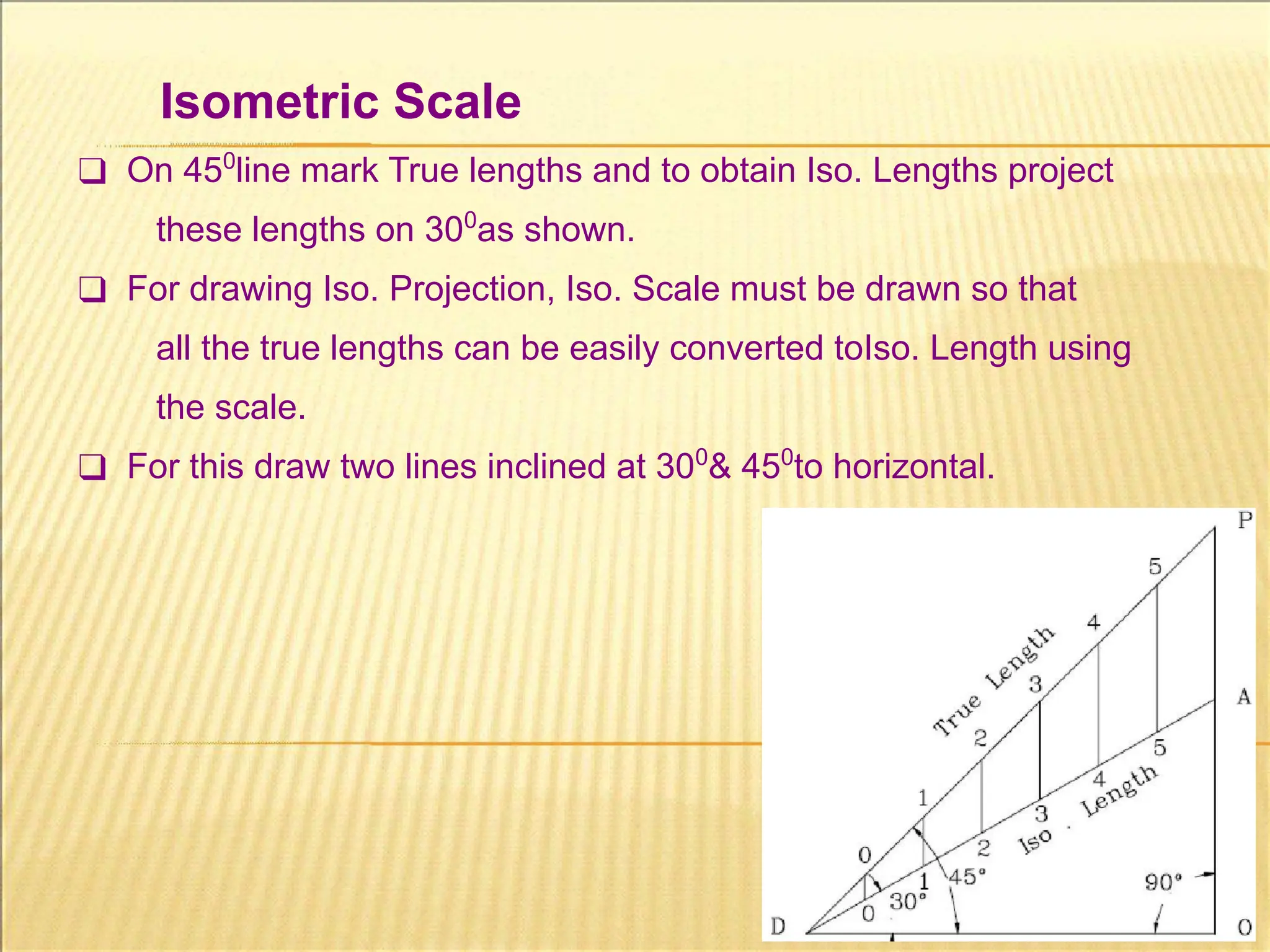
Isometric Scale
❑ On 450
line mark True lengths and to obtain Iso. Lengths project
these lengths on 300
as shown.
❑ For drawing Iso. Projection, Iso. Scale must be drawn so that
all the true lengths can be easily converted toIso. Length using
the scale.
❑ For this draw two lines inclined at 300
& 450
to horizontal.
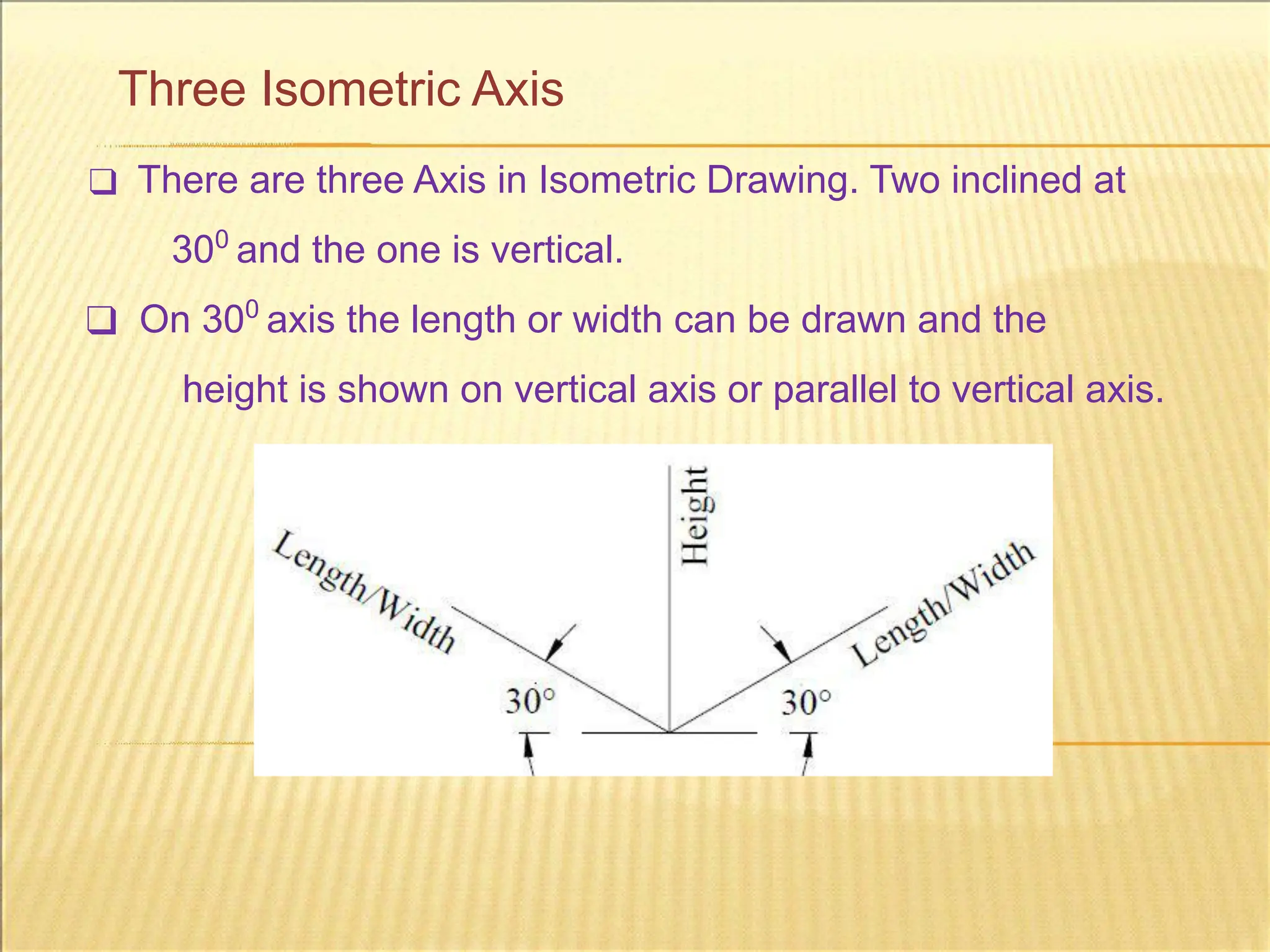
Three Isometric Axis
❑ There are three Axis in Isometric Drawing. Two inclined at
300
and the one is vertical.
❑ On 300
axis the length or width can be drawn and the
height is shown on vertical axis or parallel to vertical axis.
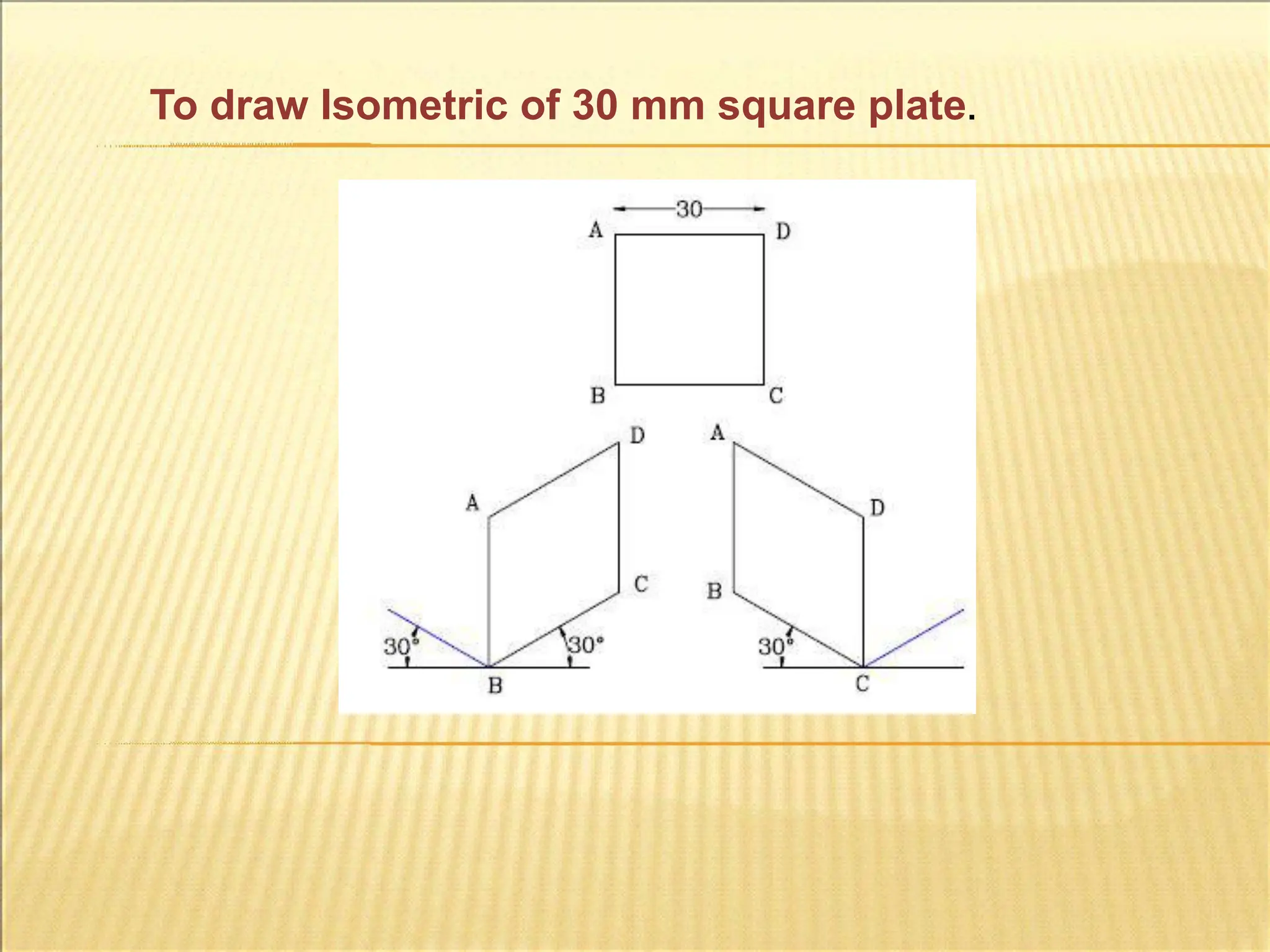
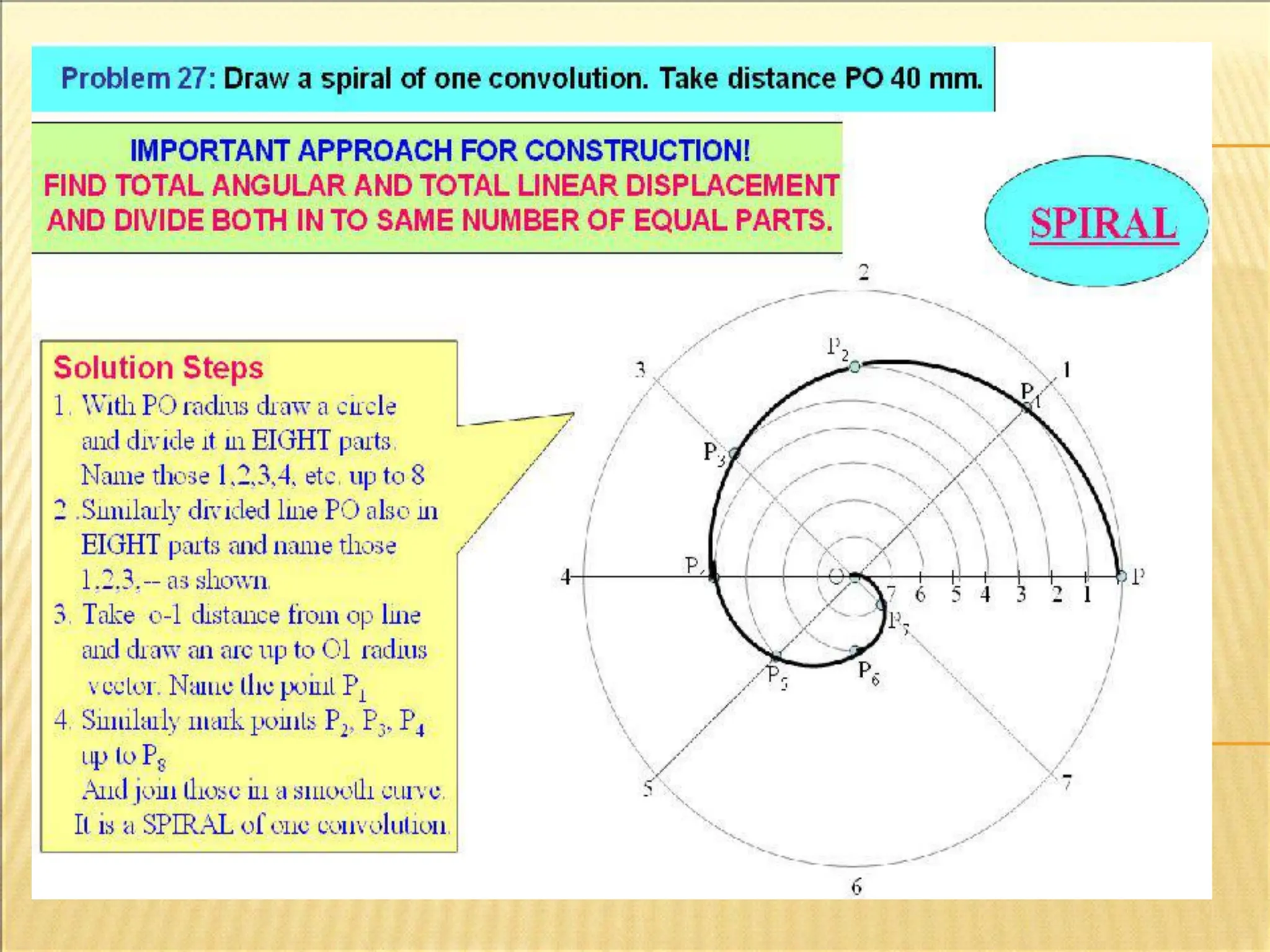
To draw Isometric of 30 mm square plate.
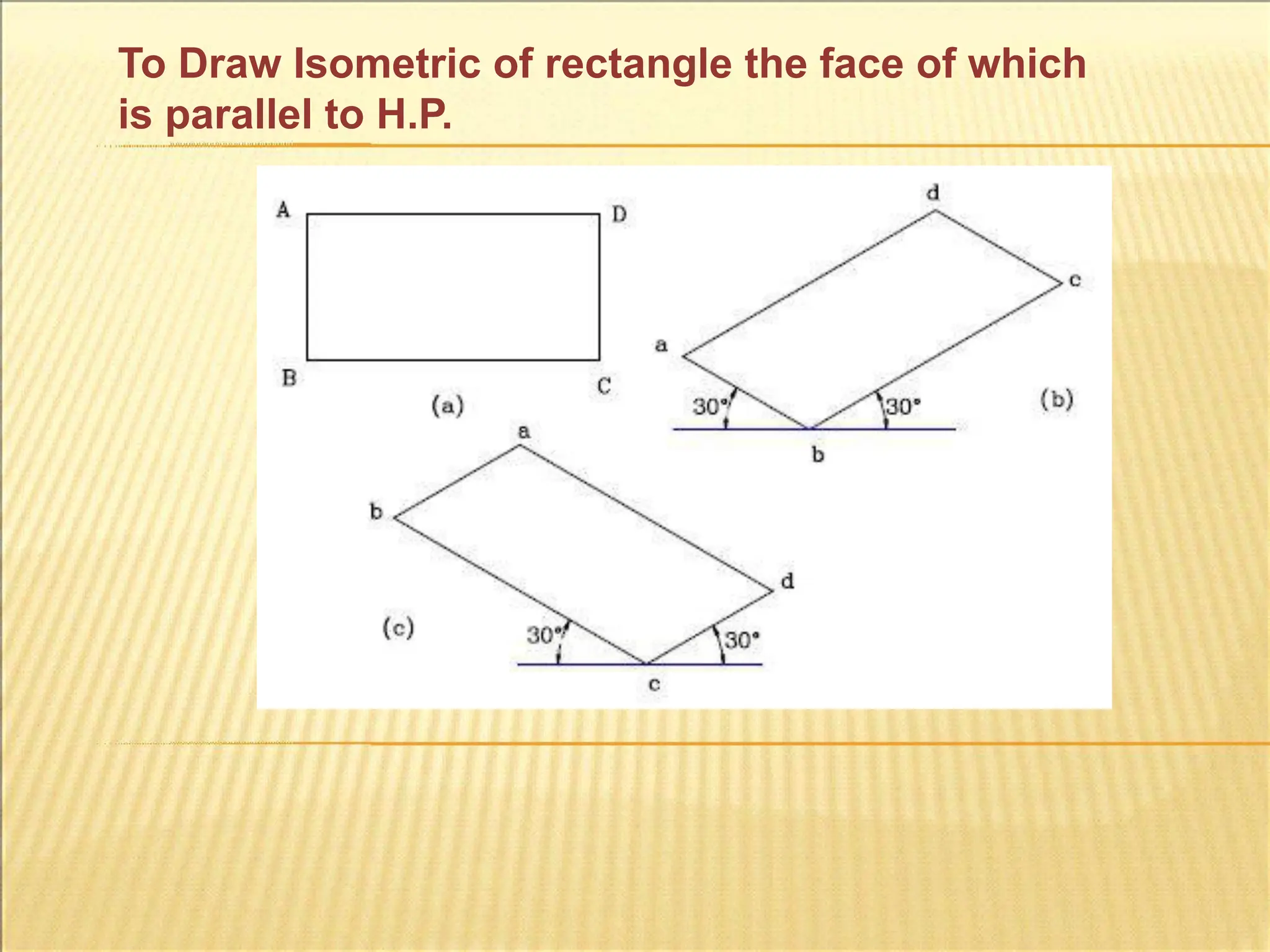
To Draw Isometric of rectangle the face of which
is parallel to H.P.
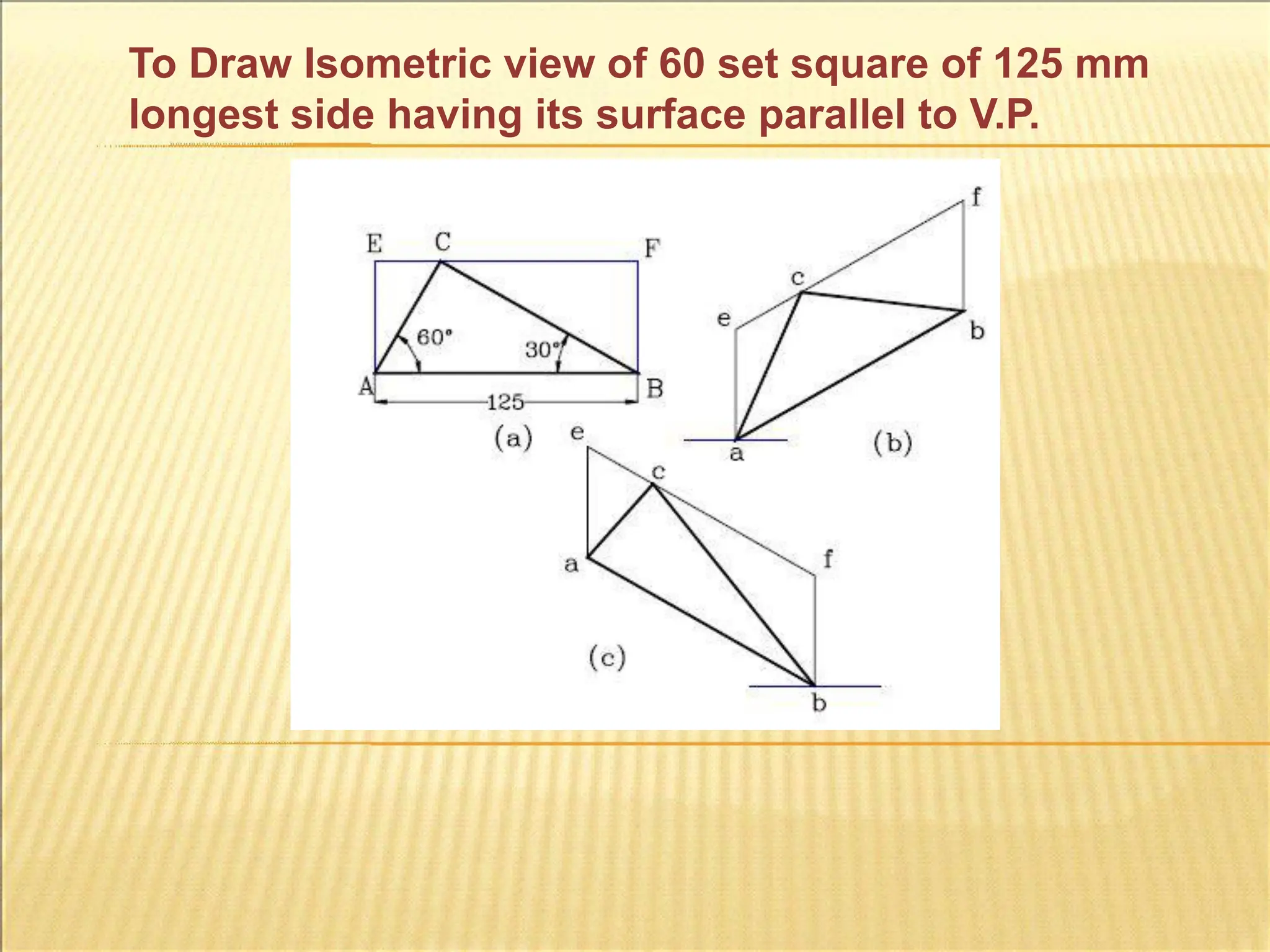
To Draw Isometric view of 60 set square of 125 mm
longest side having its surface parallel to V.P.
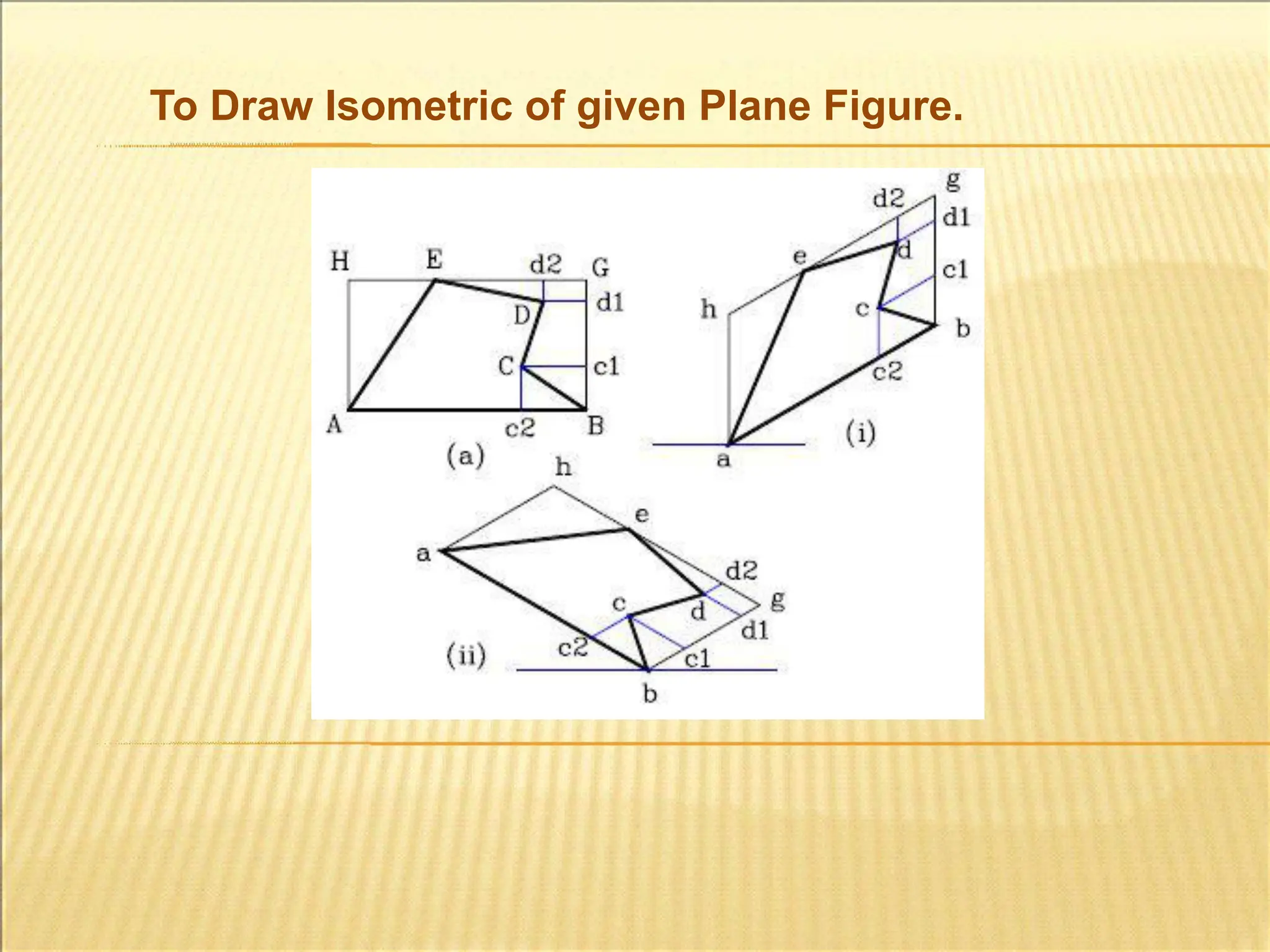
To Draw Isometric of given Plane Figure.
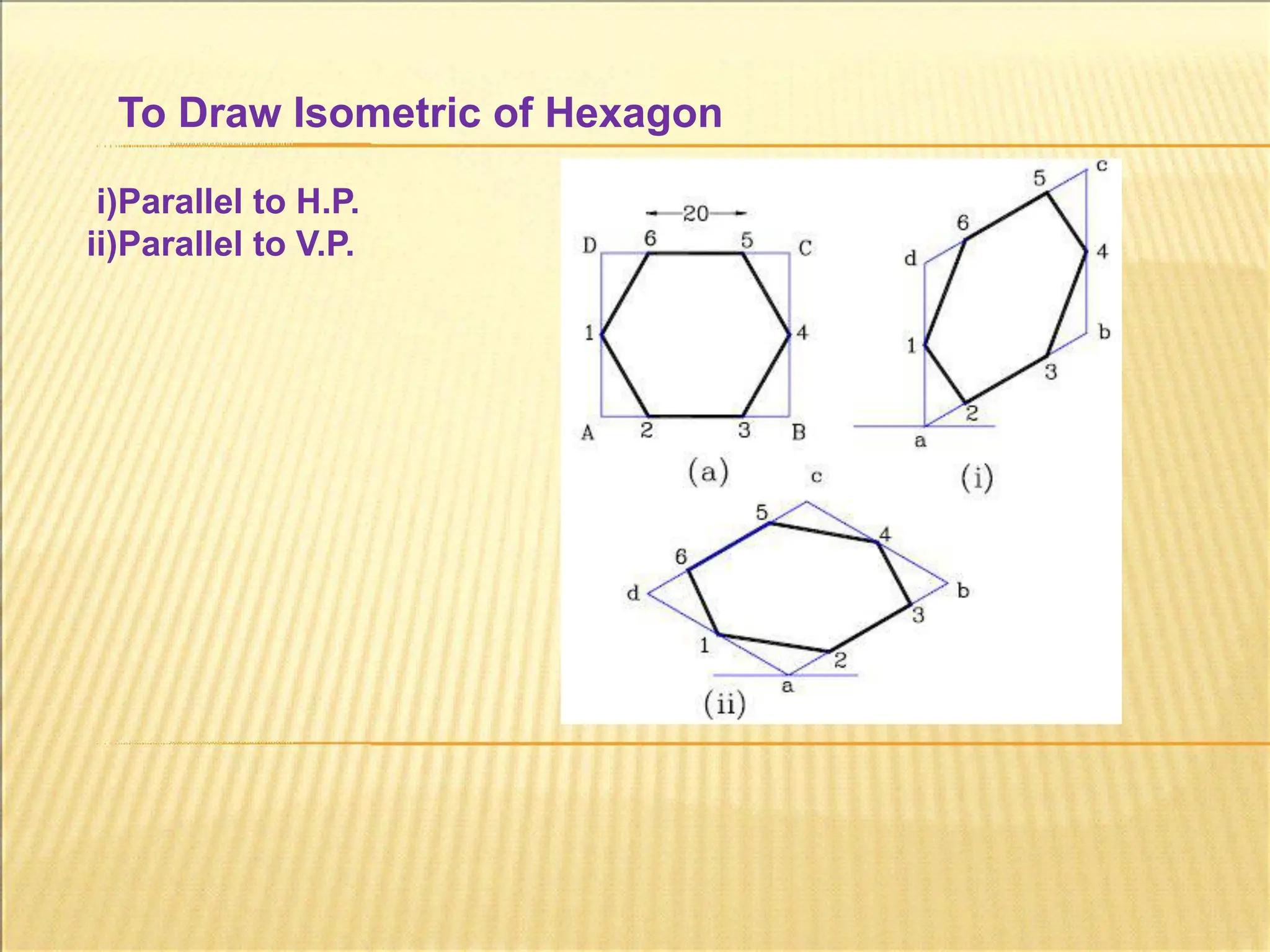
To Draw Isometric of Hexagon
i)Parallel to H.P.
ii)Parallel to V.P.
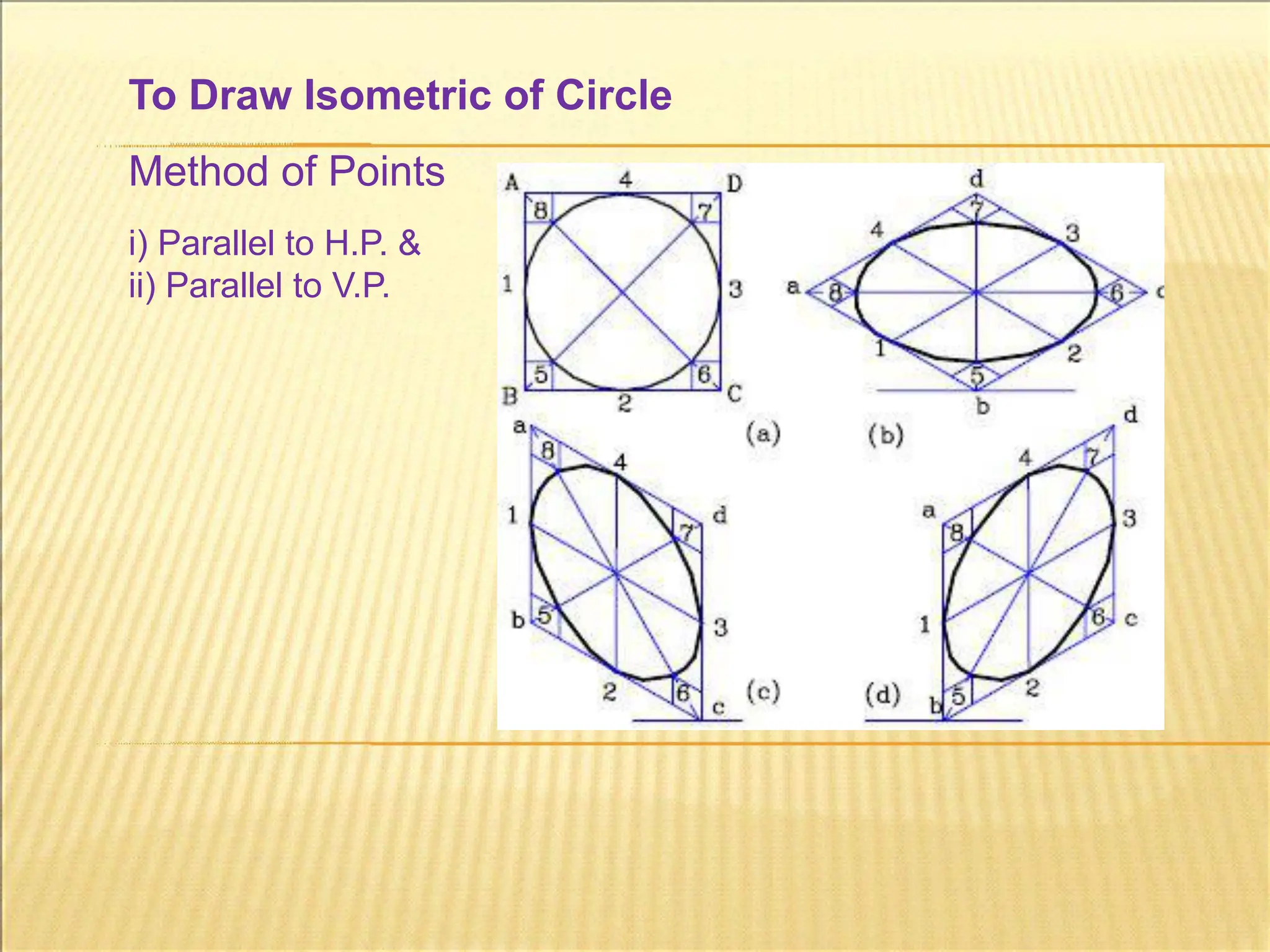
To Draw Isometric of Circle
Method of Points
i) Parallel to H.P. &
ii) Parallel to V.P.
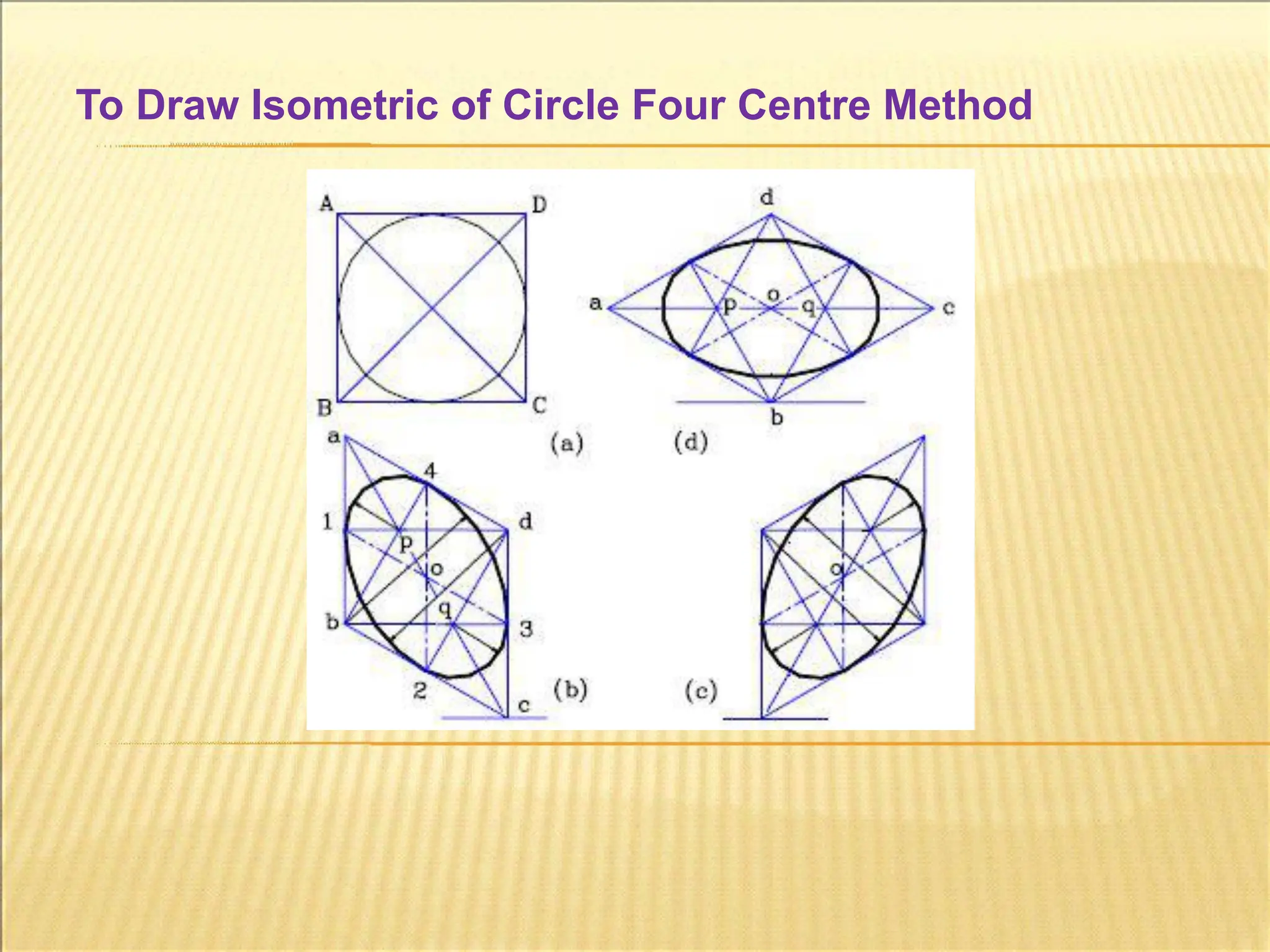
To Draw Isometric of Circle Four Centre Method
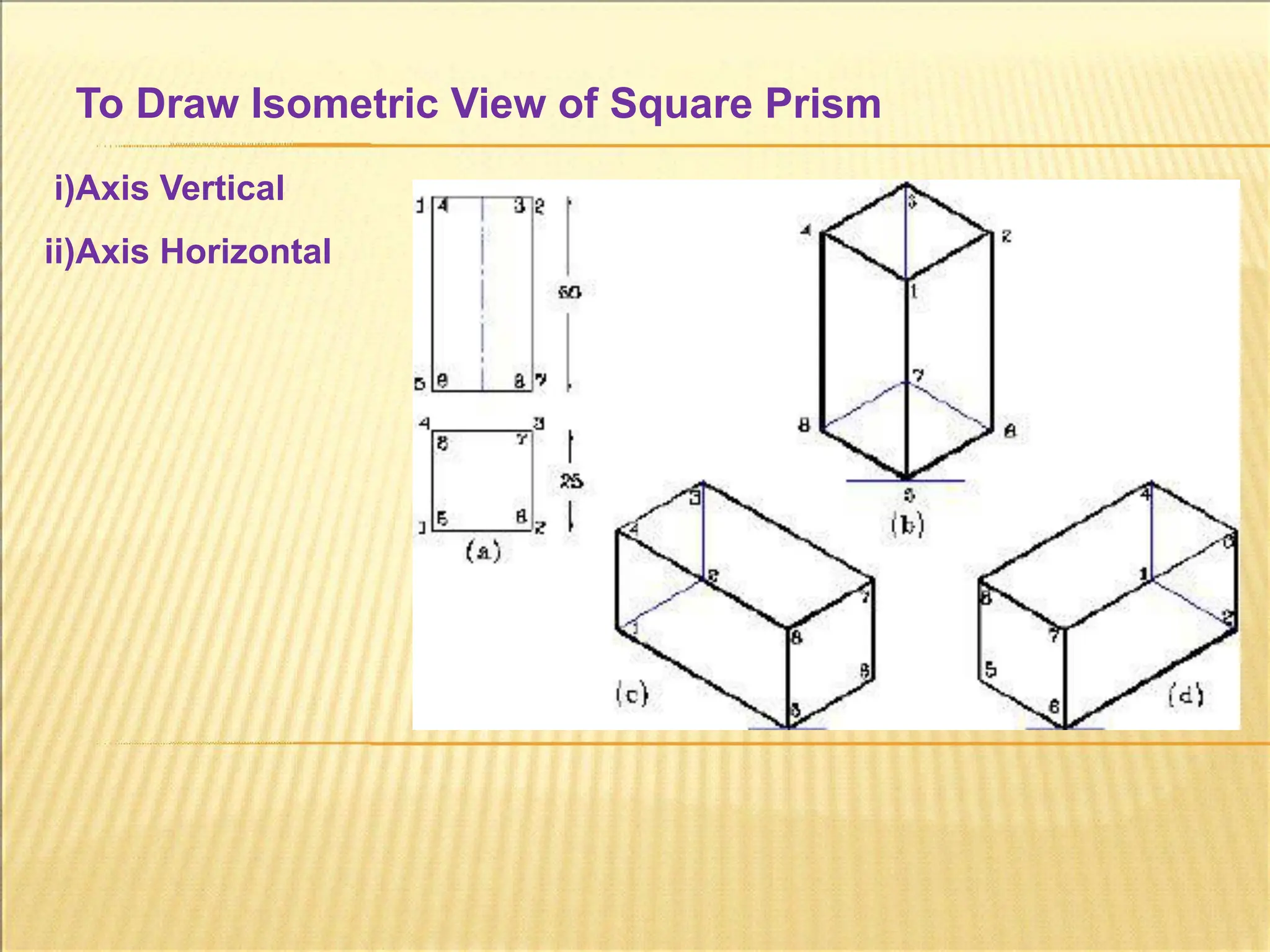
To Draw Isometric View of Square Prism
i)Axis Vertical
ii)Axis Horizontal
Thank you
….

Engineering Drawing lessons for beginners by Prof Bwanae of KDK Engg college Nagpur

  • 1.
    ENGINEERING GRAPHICS PREPARED BY PROF.MRS. S.G.BAWANE DEPT. OF MECHANICAL ENGINEERING KDK COLLEGE OF ENGINEERING, NAGPUR
  • 2.
    Topics 1. Engineering Scales 2.Engineering Curves 3. Orthographic Projections 4. Projections of Straight Lines 5. Projections of Planes 6. Projections of Solids 7. Sections of Solids 8. Deelopment of Solids 9. Isometric Projections
  • 3.
  • 6.
    1. Calculate theRF if it is not given in the problem. 2. Calculate the Length of scale. (LOS = RF x Max. Distance) 3. Draw a line of given length of scale 4. Divide the line in proper way in such a way that every division should represent a proper actual length. 5. Mark “0” after first main division. 6. Write the RF below the scale, at the middle.
  • 15.
  • 41.
  • 42.
    ORTHOGRAPHIC PROJECTION * Ifthe rays of light made to fall on the wall across the object, shadow / image of that object will appear on that wall. That means, object is being projected on the wall. * If straight lines are drawn from various points on the contour of an object to meet a plane, the object is said to be projected on that plane. * The image we are getting on that plane is called projection (view) of the object. * The lines from the object to the plane are called projectors. 1. Orthographic projection 2. Isometric projection 3. Oblique projection 4. Perspective projection
  • 43.
    When the projectorsare parallel to each other and also perpendicular to the plane, the projection is called orthographic projection. 1. Front View (FV) 2. Top View (TV) 3. Side View (SV) 1. Vertical plane (VP) 2. Horizontal plane (HP) 3. Profile plane (PP)
  • 45.
    40 A a’ Horizontal Plane (HP) Vertical Plane (VP) IQuad II III IV 50 50 40 TV Reference line (x-y ) Turn HP to coincide with VP x y 40 a FV
  • 46.
  • 47.
    VP HP I II IIIIV A B C D a’ a d d’ b’ b c c’ a’ a b b’ c c’ d d’ I II III IV x y
  • 48.
  • 49.
    No. Position of point (10mm from given RP) Specified by Representation 1(above) FV a’ = 10 2(below) FV a’ = 10 3(infront of) TV a = 10 4(behind) TV a = 10
  • 50.
    No. Position ofpoints with respect to RP Representation 1. 2. 3. 4. 5. 6. 30 mm below HP and 20 mm in front of VP a’ = 30 a = 20 40 mm above HP and 20 mm behind VP a’ = 40 a = 20 30 mm above HP and 40 mm in front of VP a’ = 30 a = 40 15 mm below HP and 25 mm behind VP a’ = 15 a = 25 Lies on HP and 20 mm behind VP a’ = 0 a = 20 Lies on VP and 10 mm below HP a’ = 10 a = 0 It’s time to check yourself…….
  • 51.
  • 52.
    Lines in spaceare of three types considering their position with respect to principal planes : 1) Line parallel to both HP and VP. 2) Line perpendicular to one and parallel to other. 3) Line parallel to one and inclined to other. 4) Line inclined to both principal planes.
  • 53.
    Line Parallel toboth HP and VP : When a line is parallel to both HP and VP, then the projections on both the planes to which it is parallel, are the true lengths. VP HP HP VP For FV For TV FV TV FV TV X Y HP VP
  • 54.
    Line Perpendicular toone and Parallel to other : VP HP HP VP For FV For TV A B a’ b’ TV ab FV FV TV ab X Y HP VP
  • 55.
    Line Parallel toone and Inclined to other : VP HP HP VP For FV For TV FV True Length TV FV TV X Y HP VP A B Figure. Line Inclined to HP and Parallel to VP.
  • 56.
    ….Contd VP HP HP VP For FV For TV FV TVof True Length FV TV X Y HP VP A B Figure. Line Inclined to VP and Parallel to HP.
  • 57.
    Line Inclined toboth the reference Principal Planes : VP HP HP VP For FV FV TV FV TV X Y HP VP A B
  • 58.
  • 59.
  • 60.
  • 61.
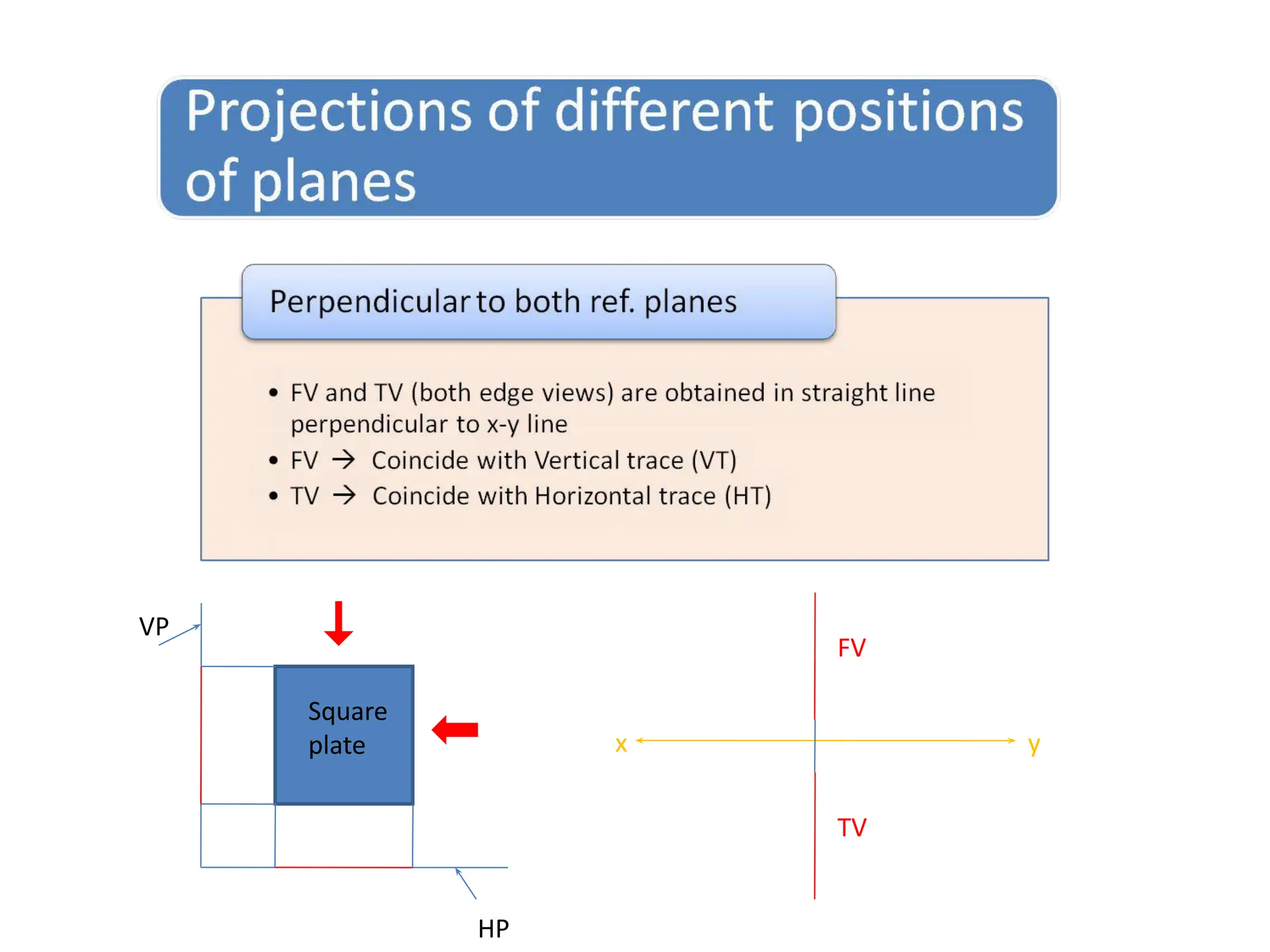
    x x y y FV TV Edgeview Edge view FV TV True shape True shape
  • 63.
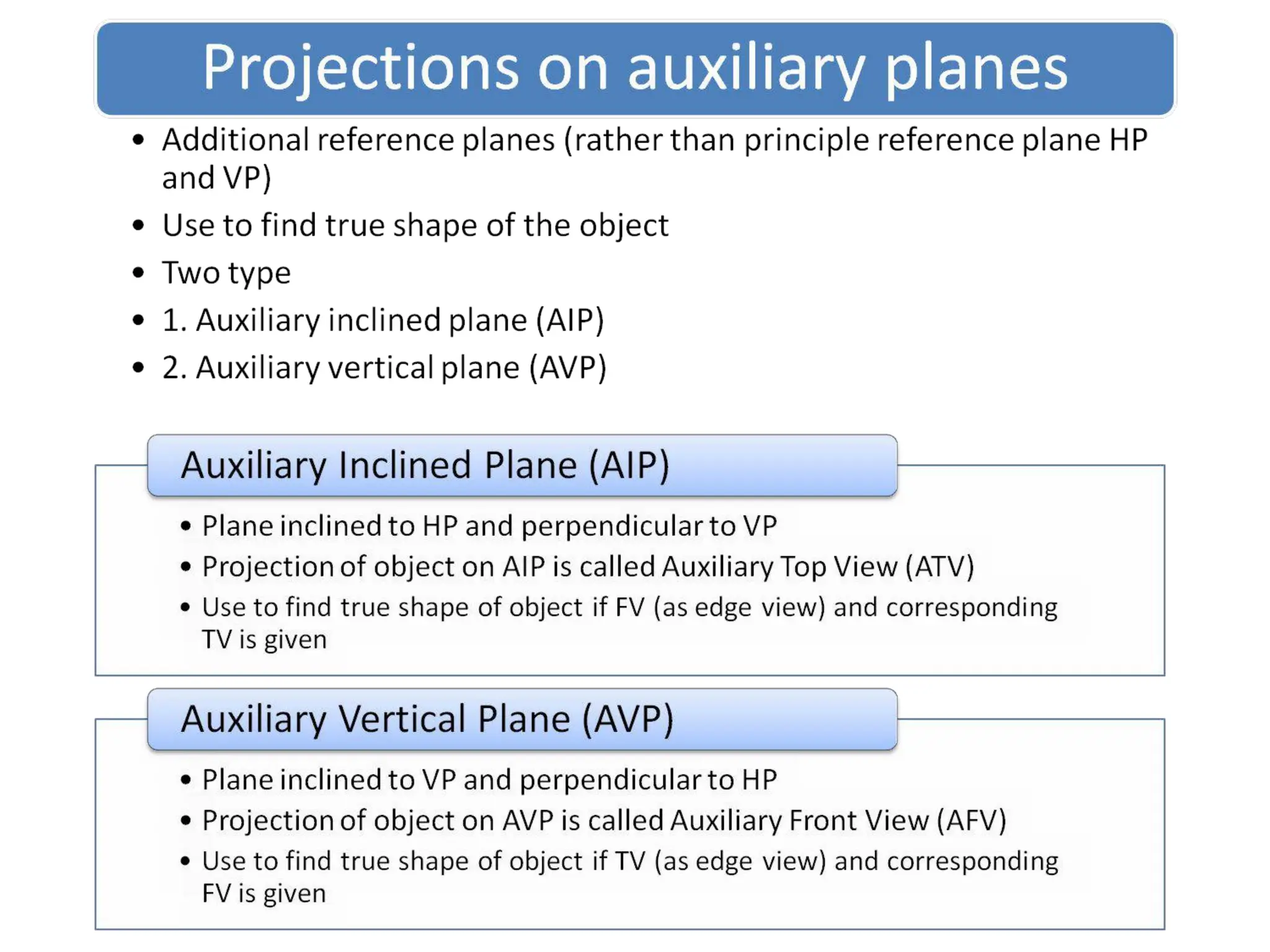
    Initially plane is restingon HP OR llel to HP TV1 FV1 Initially plane is llel to VP FV FV FV1 FV1 FV2 FV2 x y x y Reorient previous FV Reorient previous TV FV 2 TV 2 start start end end
  • 66.
    Initially plane is restingon HP OR llel to HP TV1 FV1 FV2 x y Reorient previous FV TV 2 Reorient previous edge TV 3 FV 3 FV start FV end
  • 67.
    FV1 x y FV 2 Initiallyplane is llel to VP Reorient previous TV Reorient previous edge FV 3 FV2 FV3 FV start FV end TV1
  • 70.
    Step by Step or Procedurefor Solving the Problem
  • 71.
    x y 1 2 3 4 5 6 8 10 11 12 HP VP 1’ 2’3’ 4’ 5’ 6’ 7’ 8’ 9’ 10’ 11’ 12’ 1’ 7 9 7’ 10’ 4’ 11’ 12’ 9’ 5’ 6’ 8’ 3’ 2’ 10 11 9 12 8 1 7 2 6 3 5 4 45˚ 1 7 4 10 2 6 12 8 11 9 3 5 1’ 2’ 12’ 3’ 11’ 4’ 10’ 5’ 9’ 6’ 8’ 7’ 60˚ 30˚ Reorient FV1 i.e. edge view at an angle of 45° Reorient TV2 so that TV2 of diagonal AB (a’b’) at an angle of 45° Stage I Stage II Stage III
  • 72.
    x y 1 2 3 4 5 6 8 10 11 12 HP VP 1’ 2’3’ 4’ 5’ 6’ 7’ 8’ 9’ 10’ 11’ 12’ 1’ 7 9 7’ 10’ 4’ 11’ 12’ 9’ 5’ 6’ 8’ 3’ 2’ 10 11 9 12 8 1 7 2 6 3 5 4 45˚ 30˚ a b b1 β˚ 1 7 4 10 3 5 11 9 2 6 12 8 1’ 2’ 12’ 3’ 4’ 5’ 6’ 7’ 8’ 9’ 10’ 11’ Reorient FV1 i.e. edge view at an angle of 45° Reorient TV2 so that TV2 of diagonal AB (a’b’) at an angle of 45° Stage I Stage II Stage III
  • 73.
  • 74.
  • 75.
  • 93.
  • 106.
  • 107.
    When a cubeis placed on one of its corner on ground with solid diagonal perpendicular to V.P., the front view obtained is known as Isometric Projection of the cube.
  • 108.
    Isometric Axes, Lines& Planes: Iso. View: For simplicity actual/True lengths are considered and the radius of sphere is taken as 11/9*radius. The ratio, Isometric Length / True Length = 9/11 approx. It is necessary that while drawing Iso. Projections, true lengths should be converted toIso. Length. Iso. Projection: All lengths should be converted to Iso. Length i.e. 9/11*True Length, except the radius of the sphere.
  • 109.
    Isometric Scale ❑ On450 line mark True lengths and to obtain Iso. Lengths project these lengths on 300 as shown. ❑ For drawing Iso. Projection, Iso. Scale must be drawn so that all the true lengths can be easily converted toIso. Length using the scale. ❑ For this draw two lines inclined at 300 & 450 to horizontal.
  • 110.
    Three Isometric Axis ❑There are three Axis in Isometric Drawing. Two inclined at 300 and the one is vertical. ❑ On 300 axis the length or width can be drawn and the height is shown on vertical axis or parallel to vertical axis.
  • 111.
    To draw Isometricof 30 mm square plate.
  • 112.
    To Draw Isometricof rectangle the face of which is parallel to H.P.
  • 113.
    To Draw Isometricview of 60 set square of 125 mm longest side having its surface parallel to V.P.
  • 114.
    To Draw Isometricof given Plane Figure.
  • 115.
    To Draw Isometricof Hexagon i)Parallel to H.P. ii)Parallel to V.P.
  • 116.
    To Draw Isometricof Circle Method of Points i) Parallel to H.P. & ii) Parallel to V.P.
  • 117.
    To Draw Isometricof Circle Four Centre Method
  • 118.
    To Draw IsometricView of Square Prism i)Axis Vertical ii)Axis Horizontal
  • 144.