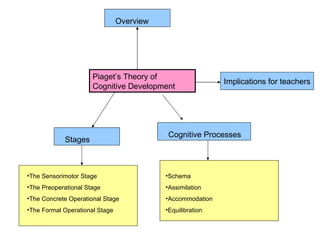
Piaget’s Theory of Cognitive Development Stages Cognitive Processes Overview Implications for teachers The Sensorimotor Stage The Preoperational Stage The Concrete Operational Stage The Formal Operational Stage Schema Assimilation Accommodation Equilibration
Overview Processes  that children use to construct their knowledge of the world.
Cognitive Processes Schema Assimilation Accommodation Organization Equilibration
Cognitive Processes 1. Schema – As child seeks to construct an understanding of the world the developing brain creates schemas (actions or mental representations that organize knowledge) E.g.: Classifying object by size, shape and color, how to drive a car and how to balance a budget.
Cognitive Processes 2. Assimilation - Process of integrating new perceptual, conceptual materials or experiences into an existing schemata 3. Accommodation - When existing  schemas  is not possible, new schemas will have to be developed in order to adapt to new and unique experiences Both processes are used simultaneously and alternately throughout life.
Cognitive Processes 4. Organization – The g rouping of isolated behaviors and thoughts into a higher order system; children organizing their experiences.  5. Equilibration State of balance between accommodation and assimilation State of cognitive conflict (child trying to understand the world) being resolved and reaching an balance/equilibrium of thought
Piaget’s 4 stages of Cognitive Development The Sensorimotor stage(Birth-2yrs) The Preoperational Stage(2-7yrs) The Concrete Operational Stage(7-11yrs) The Formal Operational Stage(>11yrs)
1.The Sensorimotor stage Infants construct an understanding of the world by coordinating  sensory  experiences (seeing, hearing) with  motor  actions (reaching, touching) Develop object permanence ( memory ) - Realize that objects exist even if they are out of sight Infants progress from reflexive, instinctual action at birth to the beginning of problem solving ( intellectual ) & symbolic abilities ( language ) towards the end of the stage.
2.The Preoperational Stage Development of Symbolic function  - Ability to represent objects and events using  words and images  Development of Intuitive thought  - Children begin to use primitive reasoning and want to know the answer to all sorts if questions Egocentrism – Inability to  distinguish between one’s own perspective and some one else’s perspective  Centration - Focusing attention on one characteristic in exclusion of others. Lack of conservation. E.g. volume of liquid in different shapes of containers Animism  – Belief that inanimate objects have ‘lifelike’ qualities
3.The Concrete Operational Stage Children’s ability to think logically but only about concrete problems and objects, able to reverse thinking Seriation - Ability to reason relationships between classes; to arrange objects in sequential order according to one aspect, such as size, weight or volume. Transitivity - Ability to reason and logically combine relationships.
4.The Formal Operational Stage Thought is more abstract, idealistic and logical in this stage – Ability to  solve abstract problems. Hypothetical-deductive reasoning  - Ability to formulate many alternate hypotheses in dealing with a problem deductive. Deduce by drawing conclusions through applying rules or principles Possess reflective abilities to systematically generate all possible solutions to problems Use of  analogical reasoning  in which one limits the search for solutions to solutions that are similar to the one on hand
Implications for teachers Depending on the abilities of children, provide opportunities for students to engage in state of cognitive disequilibrium to motivate students to learn Provide a learning environment that is customized to the abilities of children to facilitate them to move through the stages of cognitive development Teaching strategies should be built on students’ own experiences due to the fact that formal operational thinking is developed gradually and is task dependent
Source; http://www.pearsonhighered.com/

Piaget Theory

  • 1.
    Piaget’s Theory ofCognitive Development Stages Cognitive Processes Overview Implications for teachers The Sensorimotor Stage The Preoperational Stage The Concrete Operational Stage The Formal Operational Stage Schema Assimilation Accommodation Equilibration
  • 2.
    Overview Processes that children use to construct their knowledge of the world.
  • 3.
    Cognitive Processes SchemaAssimilation Accommodation Organization Equilibration
  • 4.
    Cognitive Processes 1.Schema – As child seeks to construct an understanding of the world the developing brain creates schemas (actions or mental representations that organize knowledge) E.g.: Classifying object by size, shape and color, how to drive a car and how to balance a budget.
  • 5.
    Cognitive Processes 2.Assimilation - Process of integrating new perceptual, conceptual materials or experiences into an existing schemata 3. Accommodation - When existing schemas is not possible, new schemas will have to be developed in order to adapt to new and unique experiences Both processes are used simultaneously and alternately throughout life.
  • 6.
    Cognitive Processes 4.Organization – The g rouping of isolated behaviors and thoughts into a higher order system; children organizing their experiences. 5. Equilibration State of balance between accommodation and assimilation State of cognitive conflict (child trying to understand the world) being resolved and reaching an balance/equilibrium of thought
  • 7.
    Piaget’s 4 stagesof Cognitive Development The Sensorimotor stage(Birth-2yrs) The Preoperational Stage(2-7yrs) The Concrete Operational Stage(7-11yrs) The Formal Operational Stage(>11yrs)
  • 8.
    1.The Sensorimotor stageInfants construct an understanding of the world by coordinating sensory experiences (seeing, hearing) with motor actions (reaching, touching) Develop object permanence ( memory ) - Realize that objects exist even if they are out of sight Infants progress from reflexive, instinctual action at birth to the beginning of problem solving ( intellectual ) & symbolic abilities ( language ) towards the end of the stage.
  • 9.
    2.The Preoperational StageDevelopment of Symbolic function - Ability to represent objects and events using words and images Development of Intuitive thought - Children begin to use primitive reasoning and want to know the answer to all sorts if questions Egocentrism – Inability to distinguish between one’s own perspective and some one else’s perspective Centration - Focusing attention on one characteristic in exclusion of others. Lack of conservation. E.g. volume of liquid in different shapes of containers Animism – Belief that inanimate objects have ‘lifelike’ qualities
  • 10.
    3.The Concrete OperationalStage Children’s ability to think logically but only about concrete problems and objects, able to reverse thinking Seriation - Ability to reason relationships between classes; to arrange objects in sequential order according to one aspect, such as size, weight or volume. Transitivity - Ability to reason and logically combine relationships.
  • 11.
    4.The Formal OperationalStage Thought is more abstract, idealistic and logical in this stage – Ability to solve abstract problems. Hypothetical-deductive reasoning - Ability to formulate many alternate hypotheses in dealing with a problem deductive. Deduce by drawing conclusions through applying rules or principles Possess reflective abilities to systematically generate all possible solutions to problems Use of analogical reasoning in which one limits the search for solutions to solutions that are similar to the one on hand
  • 12.
    Implications for teachersDepending on the abilities of children, provide opportunities for students to engage in state of cognitive disequilibrium to motivate students to learn Provide a learning environment that is customized to the abilities of children to facilitate them to move through the stages of cognitive development Teaching strategies should be built on students’ own experiences due to the fact that formal operational thinking is developed gradually and is task dependent
  • 13.