Piaget’s Theory ofPiaget’s Theory of
Cognitive DevelopmentCognitive Development
In ChildrenIn Children
Presentation By:Presentation By:
Miriam AndersonMiriam Anderson
Peggy BelgravePeggy Belgrave
Penny LanePenny Lane
Richard MichalekRichard Michalek
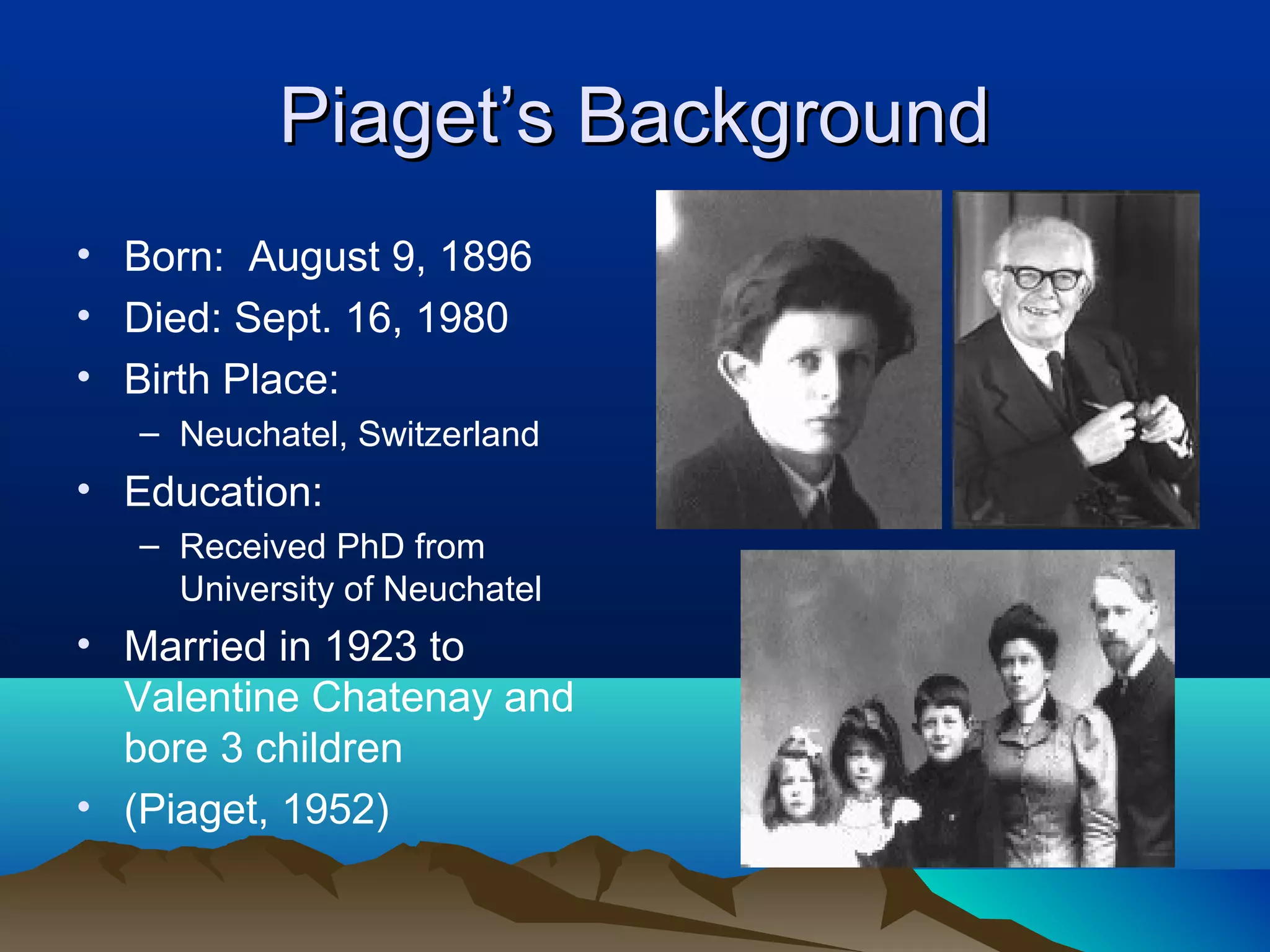
Piaget’s BackgroundPiaget’s Background
• Born: August 9, 1896
• Died: Sept. 16, 1980
• Birth Place:
– Neuchatel, Switzerland
• Education:
– Received PhD from
University of Neuchatel
• Married in 1923 to
Valentine Chatenay and
bore 3 children
• (Piaget, 1952)
The BeginningThe Beginning
• Piaget was interested in
the study of knowledge in
children.
• He administered Binet’s
IQ test in Paris and
observed that children’s
answers were
qualitatively different.
• Piaget’s theory is based on the
idea that the developing child
builds cognitive structures
(schemes used to understand
and respond to physical
environment).
• He believed the child’s
cognitive structure increased
with development
(Brainerd,1978).
Genetic EpistemologyGenetic Epistemology
• Epistemology is the
study of knowledge
• Genetic is
development
• Definition of Genetic
Epistemology
– Study of
developmental
changes in the
process of knowing
and in the organization
of knowledge.
• Piaget wanted to know
how children learned
through their
development in the
study of knowledge.
• He was considered a
structuralist
– Structuralism: the
relationship between the
parts and the whole
(Brainerd,1978; Piaget,
1952).
MethodologyMethodology
• Clinical
– Interviews
– Interaction with the child
• Behavioral Observations
– Watched kids in their
natural environment.
– Put down what represented
his idea, he was biased
(Brainerd, 1978).
Characteristics of Piaget’s StagesCharacteristics of Piaget’s Stages
1. Each stage is a structured whole and in
a state of equilibrium
 The stages are qualitative within the
structures and quantitative between
structures
1. Each stage derives from the previous
stage and incorporate and transform to
prepare for the next
 No going back
Characteristics ContinuedCharacteristics Continued
3. The stages follow an invariant sequence.
 There is no skipping stages.
4. The stages are universal.
 Culture does not impact the stages.
Children everywhere go through the same
stages no matter what their cultural
background is.
Characteristics ContinuedCharacteristics Continued
5. Each stage is a
coming into being.
 There is a gradual
progression from
stage to stage
(Brainerd, 1978).
Stages of DevelopmentStages of Development
• Piaget’s theory identifies four
developmental stages and the processes
by which children progress through them.
• The four stages are:
1. Sensorimotor Stage (birth to 24 months)
2. Preoperational Stage (2-7 years old)
3. Concrete Operational Stage (7-11 years old)
4. Formal Operational Stage (11-15 years old)
(Brainerd, 1978).
Sensorimotor StageSensorimotor Stage
• In this period, intelligence is demonstrated
through motor activity without the use of
symbols.
• Knowledge of the world is limited (but
developing) because it is based on
physical interactions and experiences.
• Some symbolic abilities are developed at
the end of this stage.
6 Stages of Sensorimotor Stage6 Stages of Sensorimotor Stage
1. Modification of
reflexes (0-1months)
 Strengthens and
differentiates reflexes
1. Primary Circular
Reaction (1-4 months)
 Circular pattern of
having a stimulus and
responding
 Focus is on own body
3. Secondary Circular
Reaction (4-8 months)
Focus is on the outside
world
4. Coordination of
Secondary Schema (8-
12 months)
Goal oriented behavior
Apply ability to other
things
6 Stages Continued6 Stages Continued
5. Tertiary Circular Reaction
(12-18 months)
Active potential
Explore object’s potential
6. Invention of New Means
through Mental Combinations
(18-24 months)
Child moves from overt to
covert thoughts
The child can use mental
representation instead of
physical objects (Piaget, 1952;
Brainerd, 1978).
Preoperational StagePreoperational Stage
(2-7 years old)(2-7 years old)
• In this period, intelligence is demonstrated
through the use of symbols.
• Language use matures.
• Memory and imagination are developed.
• Thinking is done in a non-logically
nonreversible manner
• Ego centric thinking predominates
Pre-Operational Stage ContinuedPre-Operational Stage Continued
• Semiotic Function
– Language develops
– Uses symbols to
represent ideas
– Verbal and written
language develops
• Egocentrism
– It is all about them
– They can not
differentiate between
themselves and the
world
• Rigidity of Thought
– Centration: focus on
one aspect of an
object
• Semi-logical
Reasoning
– They get the general
idea
• Limited social
cognition
Preoperational Stage ContinuedPreoperational Stage Continued
• Morality of Constraint
– No bending of the
rules
• Morality of Co-
Operation
– They bend the rules a
little bit
Concrete Operational StageConcrete Operational Stage
(7-11 years)(7-11 years)
• Operation: internalized action part of
organized structure.
• Mentally carried out actions
• Intelligence is demonstrated through
logical and systematic manipulation of
symbols related to concrete objects.
• Egocentric thought diminishes.
• Operational thinking develops.
Concrete Operational Stage Cont’dConcrete Operational Stage Cont’d
• Piaget’s Water
Conservation Task
• Consist of two
beakers of different
sizes, one with water
• Demonstrates the
following:
– Reversibility-pour
water in beaker of
different size and
realize that it is still the
same amount.
– Compensation- even
though one beaker is
taller than the other,
water is higher
because the glass is
thinner
– Addition and
subtraction
– Starts out with liquid,
then mass, then space
Formal Operational StageFormal Operational Stage
(11-15 years old)(11-15 years old)
• Intelligence is demonstrated through the
logical use of symbols related to abstract
concepts.
• There could be a return to egocentric
thought early in the period.
• Many people do not think formally during
adulthood.
• Many people do not make it to this stage.
Formal Operations ContinuedFormal Operations Continued
• Children formulate
hypothesis by taking
concrete operations
and generate
hypothesis about
logical relations
• Pendulum Swing
– The process is more
important than the
solution (Piaget, 1952;
Brainerd, 1978).
Cognitive EquilibriumCognitive Equilibrium
• Balance between
organization and
adaptation
– Always organized can
lead to little or no
growth
– Always adapting can
lead to little or no
knowledge (Piaget,
1952; Brainerd, 1978).
Cognitive AdaptationCognitive Adaptation
• Allows the child to erect more and more
cognitive structures through either
– Assimilation: fit reality into current cognitive
organization
– Accommodation: adjust cognitive organization
to fit reality (Piaget, 1952; Brainerd, 1978).
How Piaget’s TheoryHow Piaget’s Theory
Impacts LearningImpacts Learning
• Curriculum: Educators must plan a
developmentally appropriate curriculum
that enhances their student’s logical and
conceptual growth.
• Instruction: Teachers must emphasize the
critical role that experiences, or
interactions with the surrounding
environment play in student learning
(Bybee & Sund, 1982).
ReferencesReferences
• Brainerd, C. (1978). Piaget’s theory of
intelligence. Englewood Cliffs: Prentice
Hall.
• Bybee, R. & Sund, R. (1982). Piaget for
educators (2nd
Ed.). Columbus, OH:
Charles Merrill.
• Piaget, J. (1952). Autobiography. In E.
Boring (ed) history of psychology in
autobiography (4). Worcester, MA: Clark
University Press.

Piaget

  • 1.
    Piaget’s Theory ofPiaget’sTheory of Cognitive DevelopmentCognitive Development In ChildrenIn Children Presentation By:Presentation By: Miriam AndersonMiriam Anderson Peggy BelgravePeggy Belgrave Penny LanePenny Lane Richard MichalekRichard Michalek
  • 2.
    Piaget’s BackgroundPiaget’s Background •Born: August 9, 1896 • Died: Sept. 16, 1980 • Birth Place: – Neuchatel, Switzerland • Education: – Received PhD from University of Neuchatel • Married in 1923 to Valentine Chatenay and bore 3 children • (Piaget, 1952)
  • 3.
    The BeginningThe Beginning •Piaget was interested in the study of knowledge in children. • He administered Binet’s IQ test in Paris and observed that children’s answers were qualitatively different. • Piaget’s theory is based on the idea that the developing child builds cognitive structures (schemes used to understand and respond to physical environment). • He believed the child’s cognitive structure increased with development (Brainerd,1978).
  • 4.
    Genetic EpistemologyGenetic Epistemology •Epistemology is the study of knowledge • Genetic is development • Definition of Genetic Epistemology – Study of developmental changes in the process of knowing and in the organization of knowledge. • Piaget wanted to know how children learned through their development in the study of knowledge. • He was considered a structuralist – Structuralism: the relationship between the parts and the whole (Brainerd,1978; Piaget, 1952).
  • 5.
    MethodologyMethodology • Clinical – Interviews –Interaction with the child • Behavioral Observations – Watched kids in their natural environment. – Put down what represented his idea, he was biased (Brainerd, 1978).
  • 6.
    Characteristics of Piaget’sStagesCharacteristics of Piaget’s Stages 1. Each stage is a structured whole and in a state of equilibrium  The stages are qualitative within the structures and quantitative between structures 1. Each stage derives from the previous stage and incorporate and transform to prepare for the next  No going back
  • 7.
    Characteristics ContinuedCharacteristics Continued 3.The stages follow an invariant sequence.  There is no skipping stages. 4. The stages are universal.  Culture does not impact the stages. Children everywhere go through the same stages no matter what their cultural background is.
  • 8.
    Characteristics ContinuedCharacteristics Continued 5.Each stage is a coming into being.  There is a gradual progression from stage to stage (Brainerd, 1978).
  • 9.
    Stages of DevelopmentStagesof Development • Piaget’s theory identifies four developmental stages and the processes by which children progress through them. • The four stages are: 1. Sensorimotor Stage (birth to 24 months) 2. Preoperational Stage (2-7 years old) 3. Concrete Operational Stage (7-11 years old) 4. Formal Operational Stage (11-15 years old) (Brainerd, 1978).
  • 10.
    Sensorimotor StageSensorimotor Stage •In this period, intelligence is demonstrated through motor activity without the use of symbols. • Knowledge of the world is limited (but developing) because it is based on physical interactions and experiences. • Some symbolic abilities are developed at the end of this stage.
  • 11.
    6 Stages ofSensorimotor Stage6 Stages of Sensorimotor Stage 1. Modification of reflexes (0-1months)  Strengthens and differentiates reflexes 1. Primary Circular Reaction (1-4 months)  Circular pattern of having a stimulus and responding  Focus is on own body 3. Secondary Circular Reaction (4-8 months) Focus is on the outside world 4. Coordination of Secondary Schema (8- 12 months) Goal oriented behavior Apply ability to other things
  • 12.
    6 Stages Continued6Stages Continued 5. Tertiary Circular Reaction (12-18 months) Active potential Explore object’s potential 6. Invention of New Means through Mental Combinations (18-24 months) Child moves from overt to covert thoughts The child can use mental representation instead of physical objects (Piaget, 1952; Brainerd, 1978).
  • 13.
    Preoperational StagePreoperational Stage (2-7years old)(2-7 years old) • In this period, intelligence is demonstrated through the use of symbols. • Language use matures. • Memory and imagination are developed. • Thinking is done in a non-logically nonreversible manner • Ego centric thinking predominates
  • 14.
    Pre-Operational Stage ContinuedPre-OperationalStage Continued • Semiotic Function – Language develops – Uses symbols to represent ideas – Verbal and written language develops • Egocentrism – It is all about them – They can not differentiate between themselves and the world • Rigidity of Thought – Centration: focus on one aspect of an object • Semi-logical Reasoning – They get the general idea • Limited social cognition
  • 15.
    Preoperational Stage ContinuedPreoperationalStage Continued • Morality of Constraint – No bending of the rules • Morality of Co- Operation – They bend the rules a little bit
  • 16.
    Concrete Operational StageConcreteOperational Stage (7-11 years)(7-11 years) • Operation: internalized action part of organized structure. • Mentally carried out actions • Intelligence is demonstrated through logical and systematic manipulation of symbols related to concrete objects. • Egocentric thought diminishes. • Operational thinking develops.
  • 17.
    Concrete Operational StageCont’dConcrete Operational Stage Cont’d • Piaget’s Water Conservation Task • Consist of two beakers of different sizes, one with water • Demonstrates the following: – Reversibility-pour water in beaker of different size and realize that it is still the same amount. – Compensation- even though one beaker is taller than the other, water is higher because the glass is thinner – Addition and subtraction – Starts out with liquid, then mass, then space
  • 18.
    Formal Operational StageFormalOperational Stage (11-15 years old)(11-15 years old) • Intelligence is demonstrated through the logical use of symbols related to abstract concepts. • There could be a return to egocentric thought early in the period. • Many people do not think formally during adulthood. • Many people do not make it to this stage.
  • 19.
    Formal Operations ContinuedFormalOperations Continued • Children formulate hypothesis by taking concrete operations and generate hypothesis about logical relations • Pendulum Swing – The process is more important than the solution (Piaget, 1952; Brainerd, 1978).
  • 20.
    Cognitive EquilibriumCognitive Equilibrium •Balance between organization and adaptation – Always organized can lead to little or no growth – Always adapting can lead to little or no knowledge (Piaget, 1952; Brainerd, 1978).
  • 21.
    Cognitive AdaptationCognitive Adaptation •Allows the child to erect more and more cognitive structures through either – Assimilation: fit reality into current cognitive organization – Accommodation: adjust cognitive organization to fit reality (Piaget, 1952; Brainerd, 1978).
  • 22.
    How Piaget’s TheoryHowPiaget’s Theory Impacts LearningImpacts Learning • Curriculum: Educators must plan a developmentally appropriate curriculum that enhances their student’s logical and conceptual growth. • Instruction: Teachers must emphasize the critical role that experiences, or interactions with the surrounding environment play in student learning (Bybee & Sund, 1982).
  • 23.
    ReferencesReferences • Brainerd, C.(1978). Piaget’s theory of intelligence. Englewood Cliffs: Prentice Hall. • Bybee, R. & Sund, R. (1982). Piaget for educators (2nd Ed.). Columbus, OH: Charles Merrill. • Piaget, J. (1952). Autobiography. In E. Boring (ed) history of psychology in autobiography (4). Worcester, MA: Clark University Press.