Cognitive approach
Name : Makwana Daksha D
M.A { English }
Sem : 3 , Roll no : 5
Enrollment no : 2069108420180034
Paper : 12 – English Language Teaching -1
Submitted to : Smt. S.B . Gardi Department
of English MKBU
makwanadaksha9@gmail.com
Theory Presented By Jean Piaget
Cognitive Approach
•The cognitive approach began to revolutionize
psychology in the late 1950’s and early 1960’s , to
become dominant approach.
•The cognitive approach is a relatively modern approach
to human behavior.
•Cognitive approach is the study of mental processes
such as “ attention , language use, memory , problem
solving, creativity and thinking. “
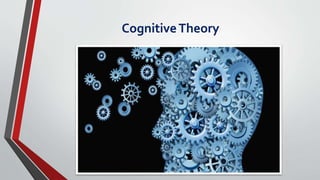
CognitiveTheory
Continued..
• A cognitive theory of learning sees
second language acquisition as a
conscious and reasoned thinking
process , involving the deliberate
use of learning strategies.
• Cognitive psychology- the thought
process according to different
moods and our experience that
impact our respond to
circumstances.
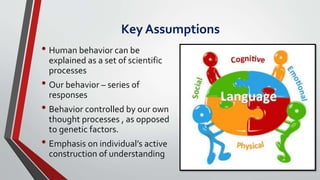
Key Assumptions
• Human behavior can be
explained as a set of scientific
processes
• Our behavior – series of
responses
• Behavior controlled by our own
thought processes , as opposed
to genetic factors.
• Emphasis on individual’s active
construction of understanding
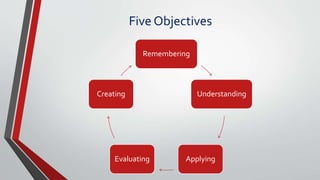
Five Objectives
Remembering
Understanding
ApplyingEvaluating
Creating
Three Idiots
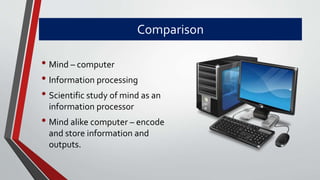
Comparison
• Mind – computer
• Information processing
• Scientific study of mind as an
information processor
• Mind alike computer – encode
and store information and
outputs.
Learning strategies
•Asking student to reflect on their experience
•Helping students find new solutions to problem
•Asking students to justify and explain their thinking
•Helping students explore and understand how ideas are
connected
Teacher’s role
• A pivotal role
• Complete understanding of
the task
• Knowledge of an approach
• Advanced proficiency in
language
Activities
•Remembering and applying information
•Constructing sentences and paragraphs
•Editing written work
•Paraphrasing
•Using both text and picture /sound : encoding
information
Activities
•Making mind maps
•Visualization
•Using clues in reading comprehension
•Scanning
•Self testing
Limitations
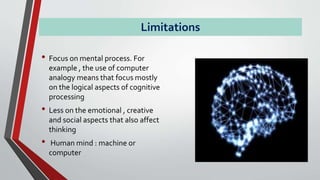
• Focus on mental process. For
example , the use of computer
analogy means that focus mostly
on the logical aspects of cognitive
processing
• Less on the emotional , creative
and social aspects that also affect
thinking
• Human mind : machine or
computer
Conclusion
“You never really understand a person until you
consider things from his point of view- until you
climb into his skin and walk around it. “
Cognitive approach Paper 12

Cognitive approach Paper 12

  • 1.
    Cognitive approach Name :Makwana Daksha D M.A { English } Sem : 3 , Roll no : 5 Enrollment no : 2069108420180034 Paper : 12 – English Language Teaching -1 Submitted to : Smt. S.B . Gardi Department of English MKBU makwanadaksha9@gmail.com
  • 2.
  • 3.
    Cognitive Approach •The cognitiveapproach began to revolutionize psychology in the late 1950’s and early 1960’s , to become dominant approach. •The cognitive approach is a relatively modern approach to human behavior. •Cognitive approach is the study of mental processes such as “ attention , language use, memory , problem solving, creativity and thinking. “
  • 4.
  • 5.
    Continued.. • A cognitivetheory of learning sees second language acquisition as a conscious and reasoned thinking process , involving the deliberate use of learning strategies. • Cognitive psychology- the thought process according to different moods and our experience that impact our respond to circumstances.
  • 6.
    Key Assumptions • Humanbehavior can be explained as a set of scientific processes • Our behavior – series of responses • Behavior controlled by our own thought processes , as opposed to genetic factors. • Emphasis on individual’s active construction of understanding
  • 7.
  • 8.
  • 9.
    Comparison • Mind –computer • Information processing • Scientific study of mind as an information processor • Mind alike computer – encode and store information and outputs.
  • 10.
    Learning strategies •Asking studentto reflect on their experience •Helping students find new solutions to problem •Asking students to justify and explain their thinking •Helping students explore and understand how ideas are connected
  • 11.
    Teacher’s role • Apivotal role • Complete understanding of the task • Knowledge of an approach • Advanced proficiency in language
  • 12.
    Activities •Remembering and applyinginformation •Constructing sentences and paragraphs •Editing written work •Paraphrasing •Using both text and picture /sound : encoding information
  • 13.
    Activities •Making mind maps •Visualization •Usingclues in reading comprehension •Scanning •Self testing
  • 14.
    Limitations • Focus onmental process. For example , the use of computer analogy means that focus mostly on the logical aspects of cognitive processing • Less on the emotional , creative and social aspects that also affect thinking • Human mind : machine or computer
  • 15.
    Conclusion “You never reallyunderstand a person until you consider things from his point of view- until you climb into his skin and walk around it. “