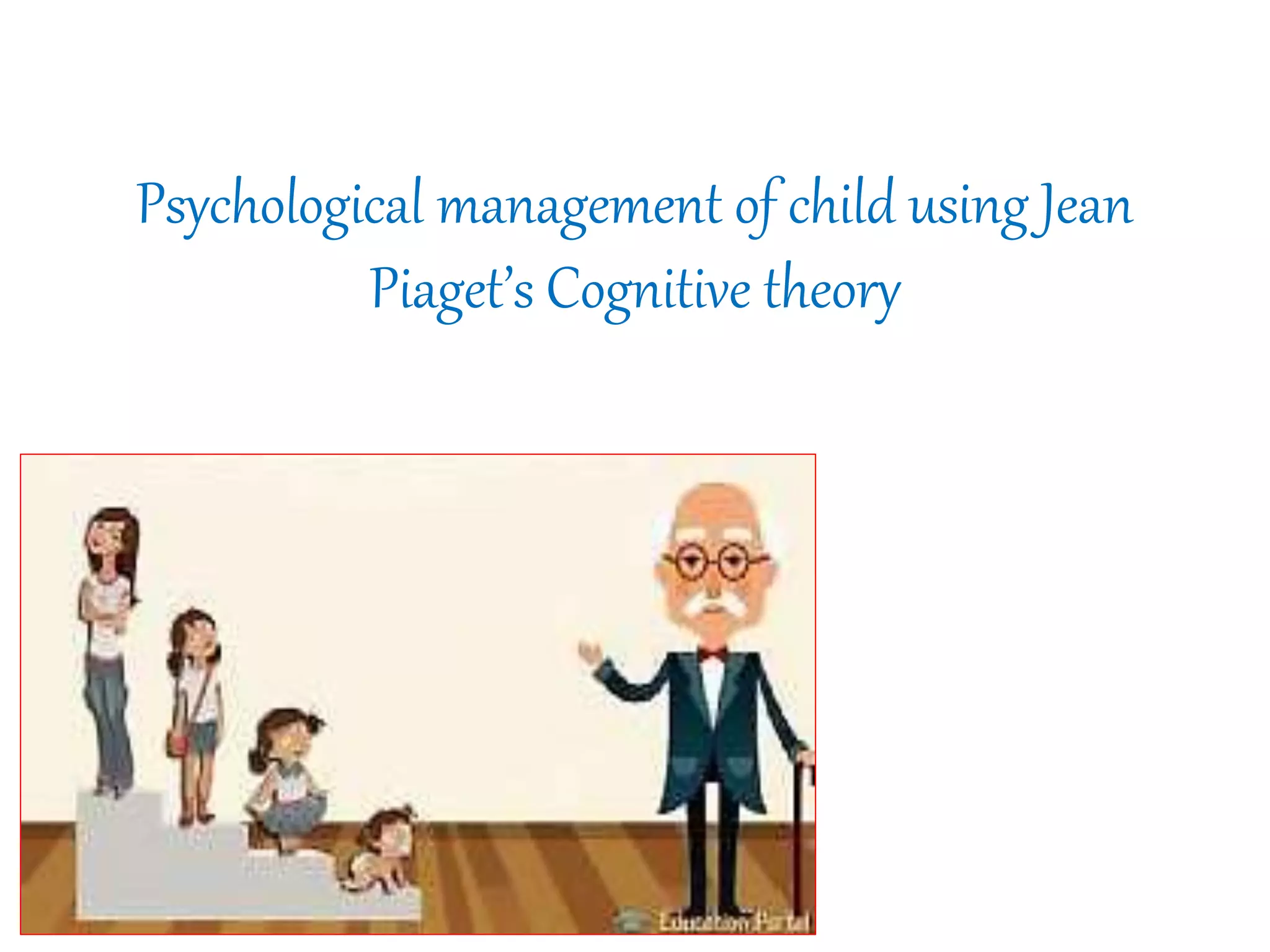
Psychological management of child using Jean
Piaget’s Cognitive theory
WHY CHILD PSYCHOLOGY
“Although the operative dentistry may be perfect the appointment is a failure if
the child departs in tears” - Mc Elroy (1895)
• Child psychology is the heart and soul of paediatric dentistry
as it is directly related to dental fear, the primitive response
present universally.
• Dental setup is always considered as a threat either due to
objective or subjective conditioning of patients towards
dentistry and dental pain being one of the worst pains of
human kind makes the matter worse.
• Invasive procedures like injections aggravate the fear. Despite
all the behaviour management techniques available there is
dearth of a sincere effort from the dentist’s side to understand a
child’s perspective about the dental appointment.
• It’s very important because the dentist is handling a cognitively, physically
mentally and emotionally maturingchild
• To lay the foundation of grooming the child in to a perfect patient with positive
attitude towards dentistry on thewhole
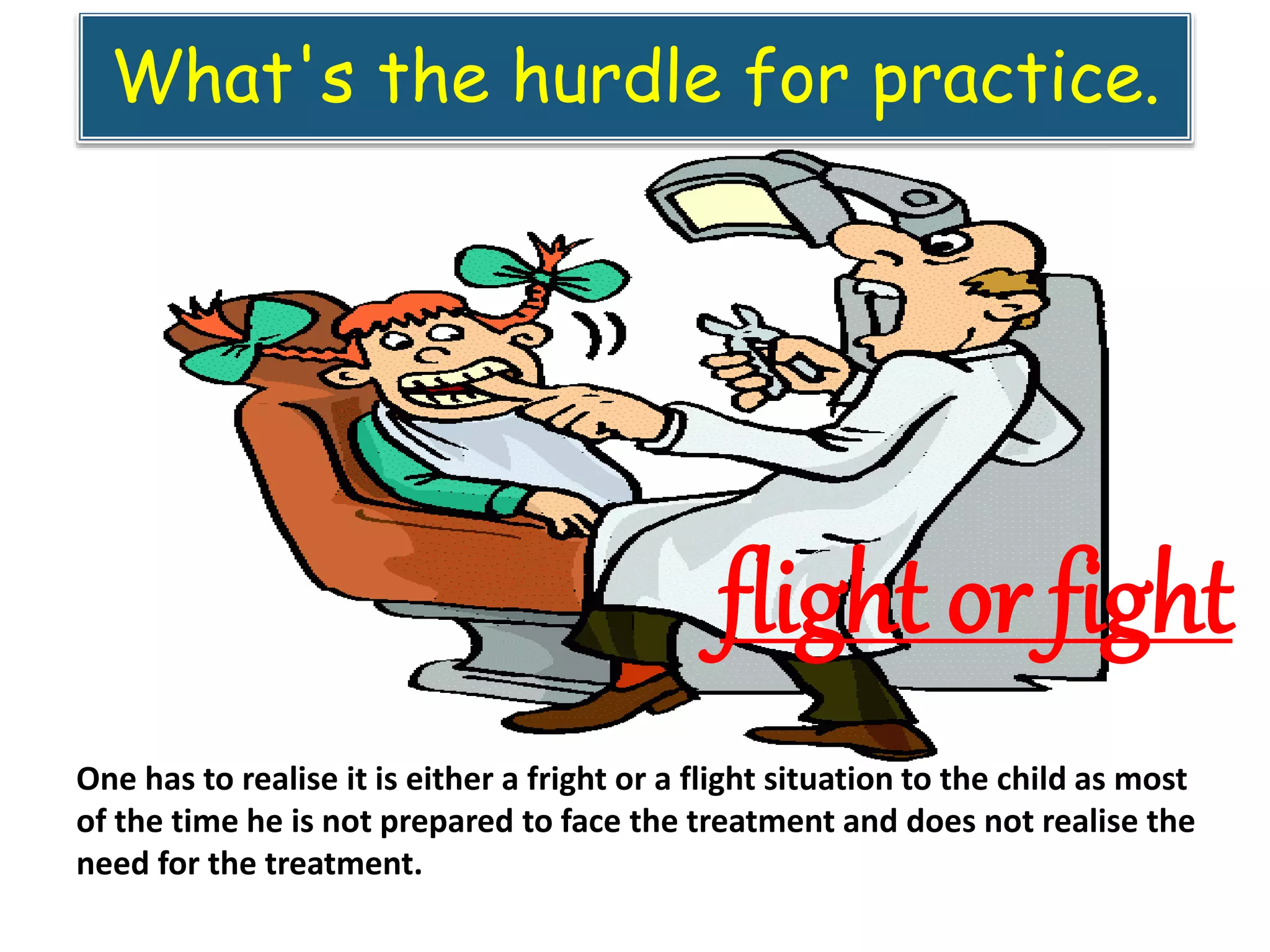
What's the hurdle for practice.
flight or fight
One has to realise it is either a fright or a flight situation to the child as most
of the time he is not prepared to face the treatment and does not realise the
need for the treatment.
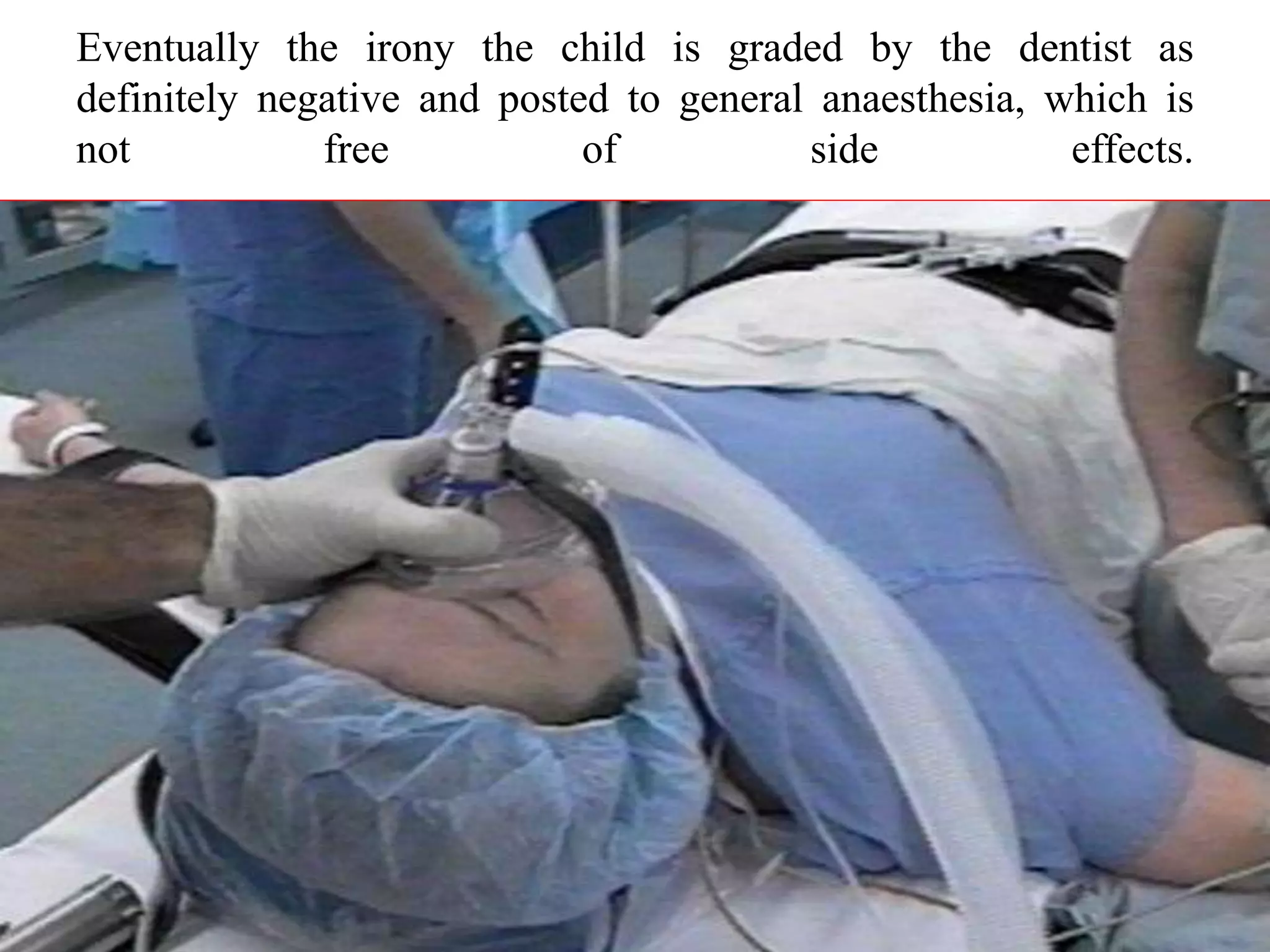
Eventually the irony the child is graded by the dentist as
definitely negative and posted to general anaesthesia, which is
not free of side effects.
The child is compromised due to the lack of knowledge of dentist on
child psychology……. So we end up doing General Anesthesia
"Don't become a mere recorder of facts, but try to
penetrate the mystery of their origin." Ivan
Pavlov (1849-1936)
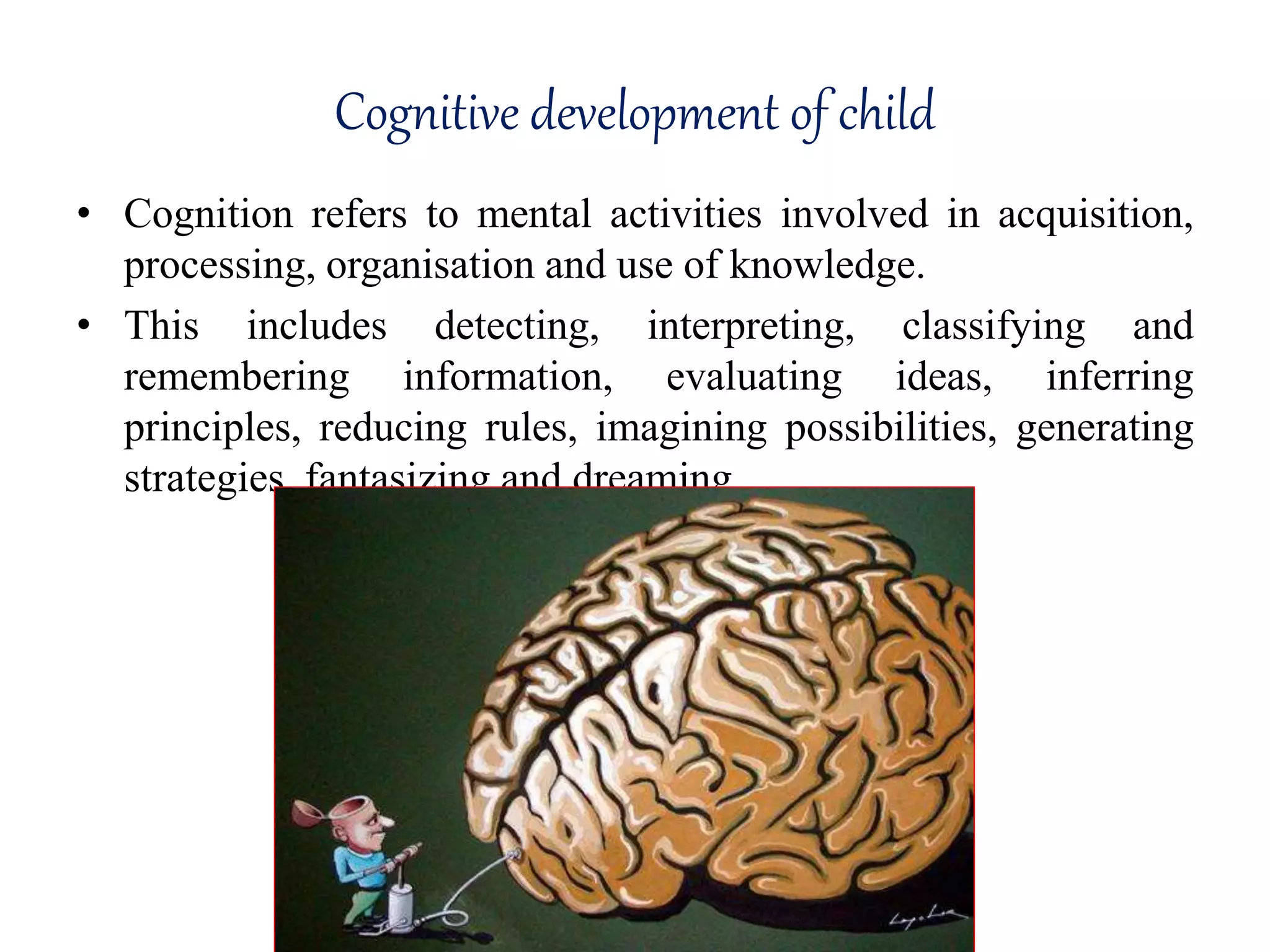
Cognitive development of child
• Cognition refers to mental activities involved in acquisition,
processing, organisation and use of knowledge.
• This includes detecting, interpreting, classifying and
remembering information, evaluating ideas, inferring
principles, reducing rules, imagining possibilities, generating
strategies, fantasizing and dreaming
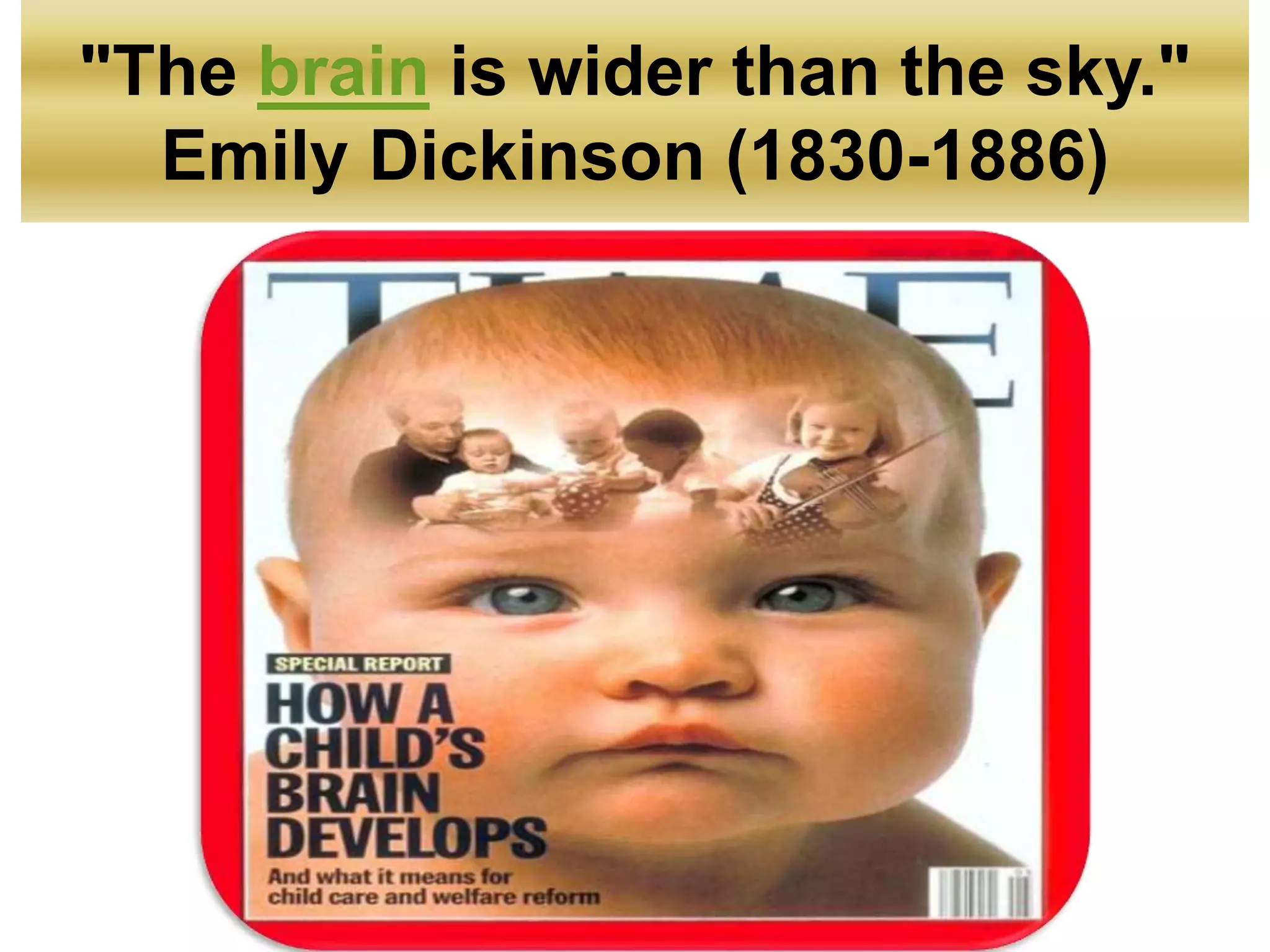
"The brain is wider than the sky."
Emily Dickinson (1830-1886)
Cognitive theory
• Cognition refers to mental activities involved inacquistion,
processing, organisation and use of knowledge.
• Cognition include detecting ,interpreting, classifying and
remembering information, evaluating ideas, inferring principles
and reducing rules, imagining possibilities, generating
strategies, fantasying and dreaming.
Processes of
cognition
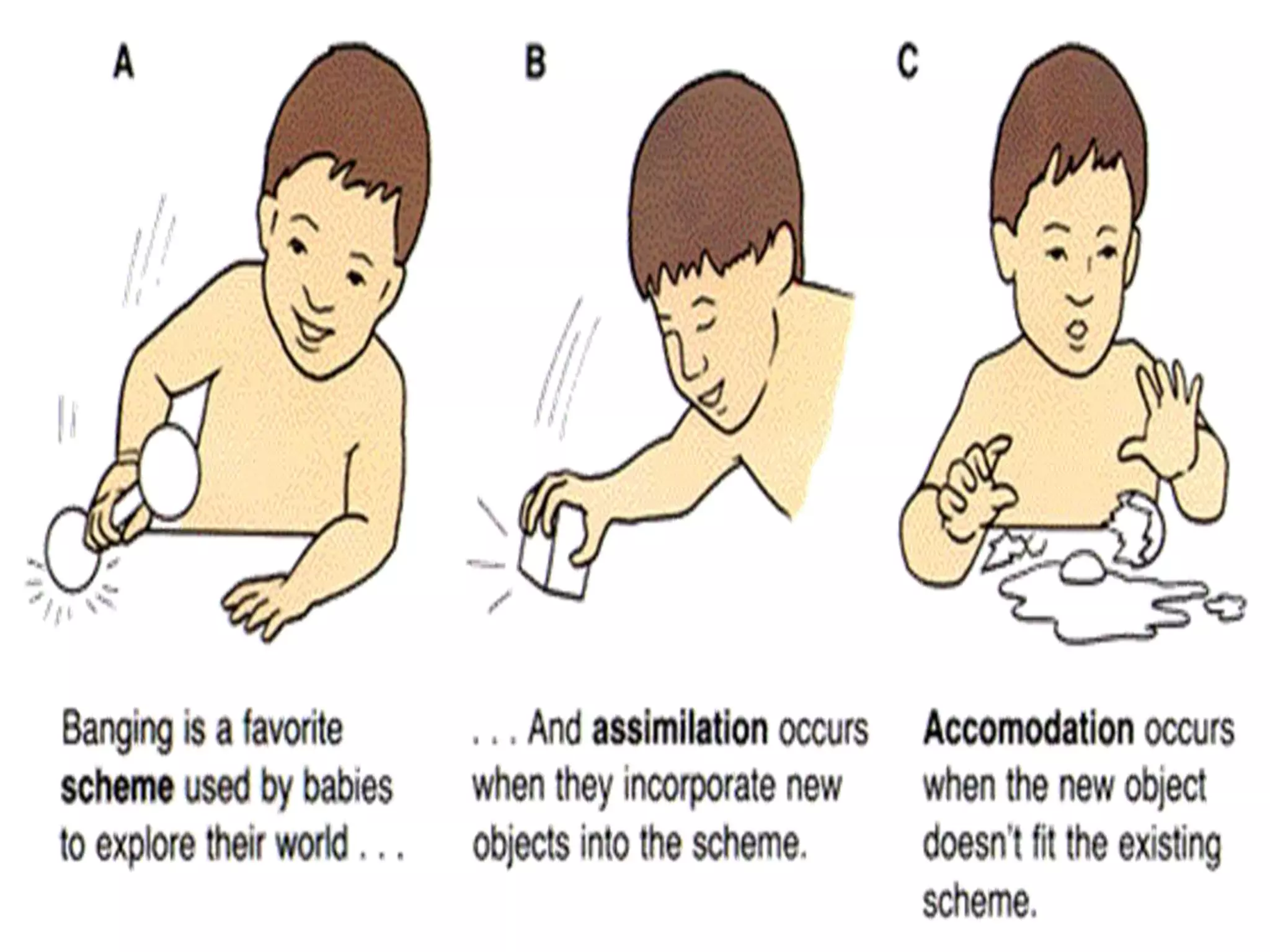
Developing a mental schemata–child take in new
experiences through their own system of
knowledge.
It is now known that infants can from the first day
of life smell, see, and hear.
Even very young infants have the ability of
perceiving movement, facial relationships, and
colour.
Cognitive competence explains how and why an
infant explores a nursing mother’s fingers
MODIFYING ONE’S ENVIRONMENT
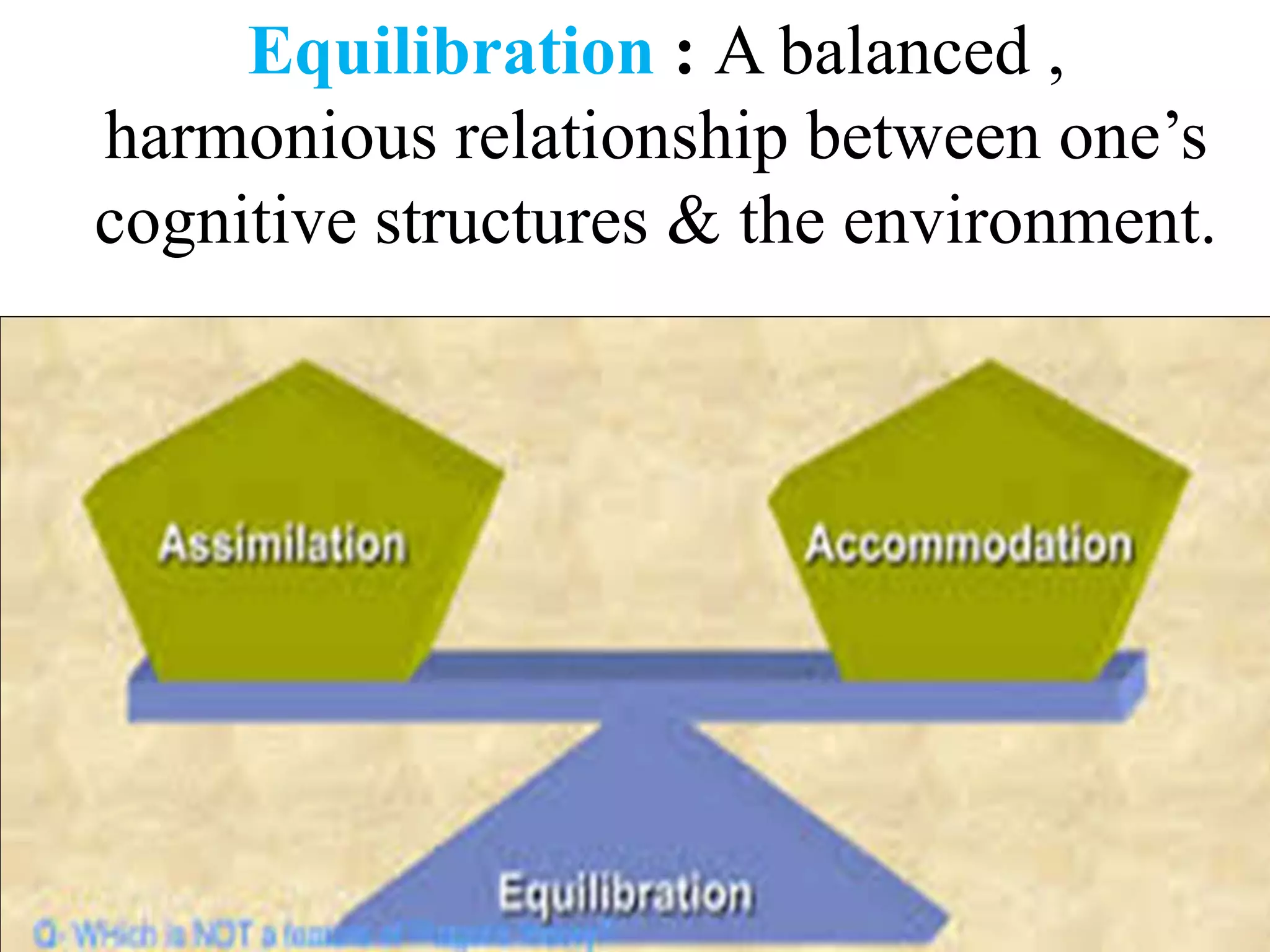
• Complementary process for intelligence to develop
child goes on adding newer information to the
original schemata
MODIFYING SCHEMA
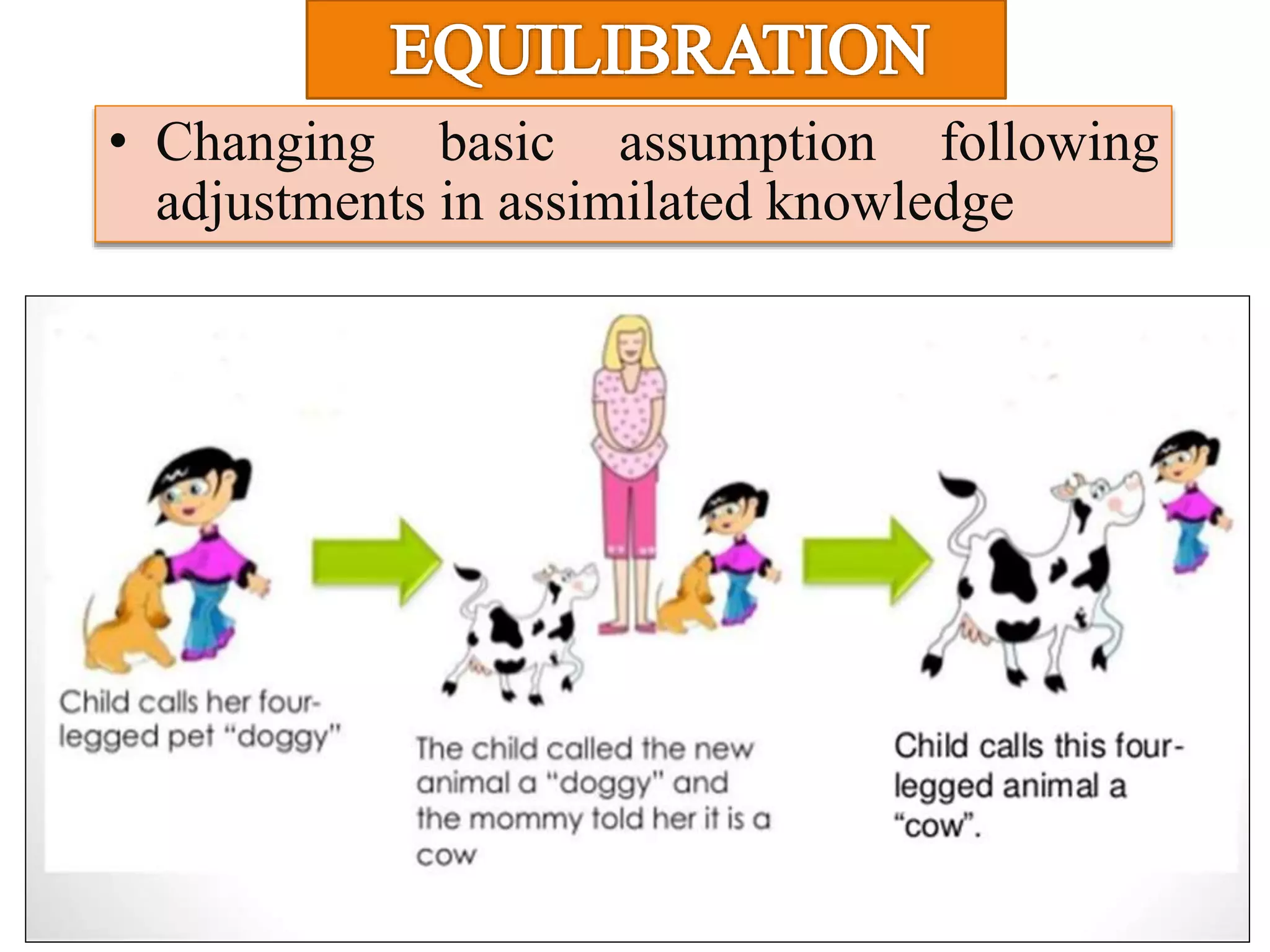
• Changing basic assumption following
adjustments in assimilated knowledge
Equilibration : A balanced ,
harmonious relationship between one’s
cognitive structures & the environment.
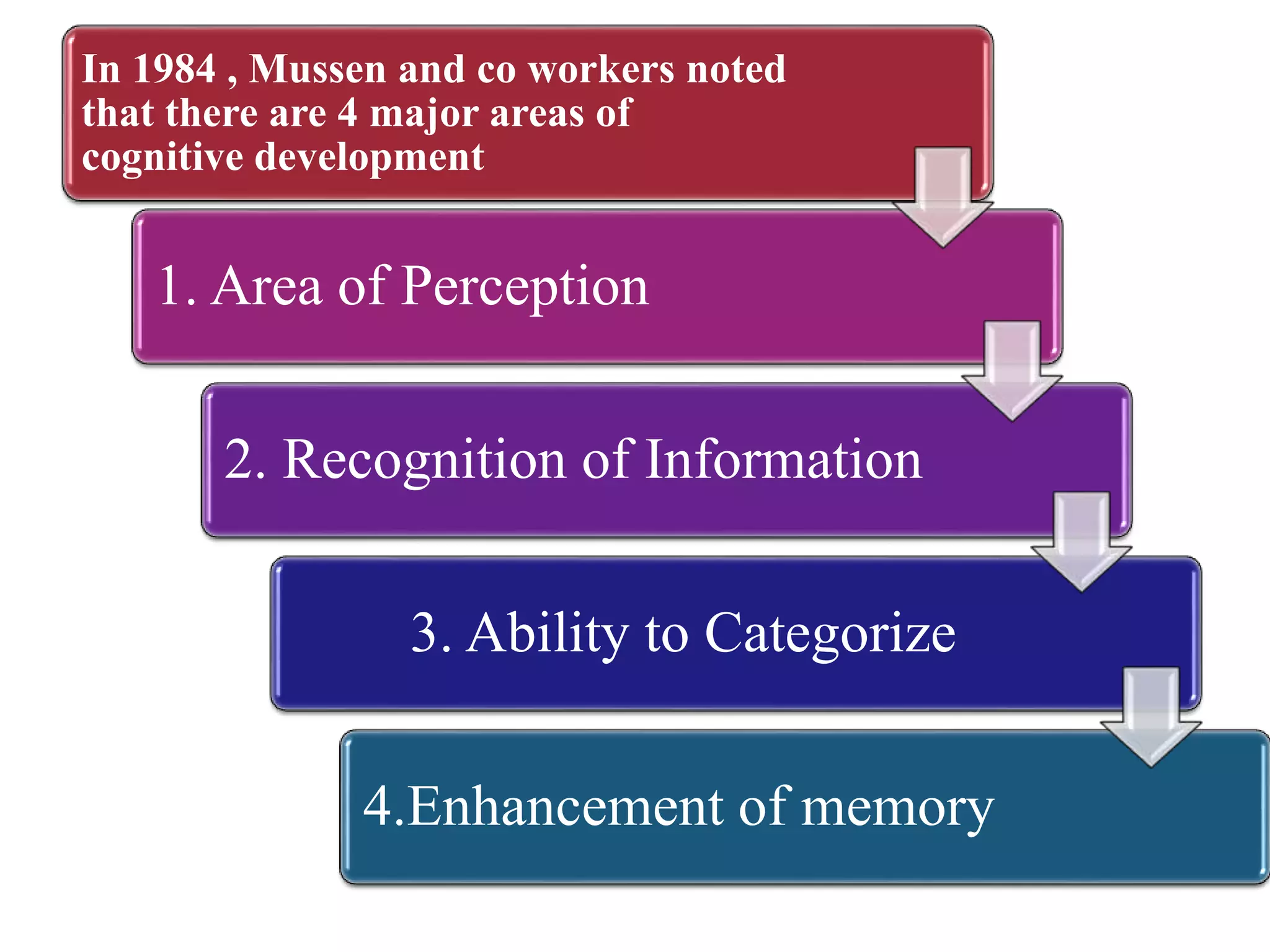
In 1984 , Mussen and co workers noted
that there are 4 major areas of
cognitive development
1. Area of Perception
2. Recognition of Information
3. Ability to Categorize
4.Enhancement of memory
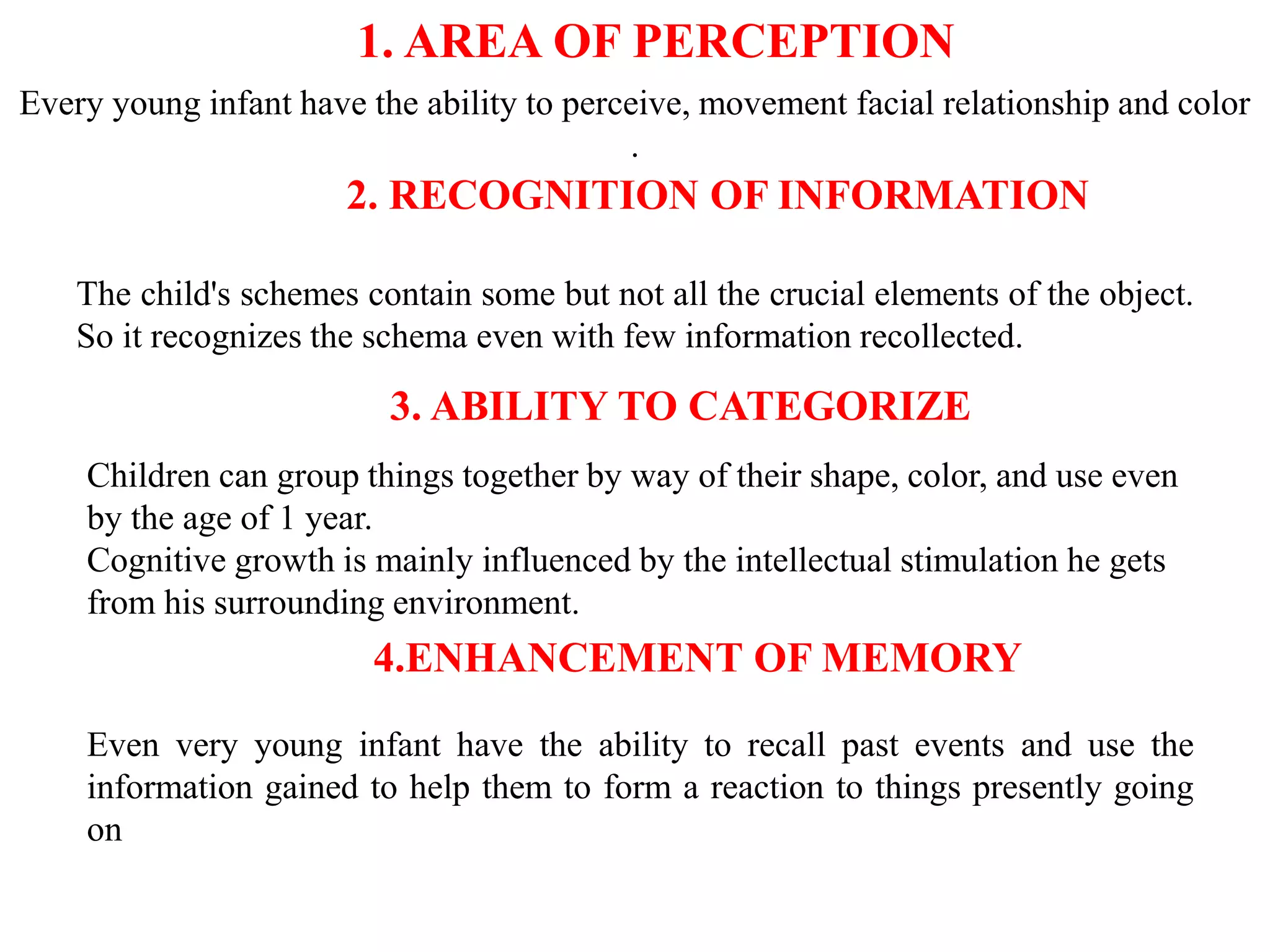
1. AREA OF PERCEPTION
Every young infant have the ability to perceive, movement facial relationship and color
.
2. RECOGNITION OF INFORMATION
The child's schemes contain some but not all the crucial elements of the object.
So it recognizes the schema even with few information recollected.
3. ABILITY TO CATEGORIZE
Children can group things together by way of their shape, color, and use even
by the age of 1 year.
Cognitive growth is mainly influenced by the intellectual stimulation he gets
from his surrounding environment.
4.ENHANCEMENT OF MEMORY
Even very young infant have the ability to recall past events and use the
information gained to help them to form a reaction to things presently going
on
SENSORIMOTO
R STAGE
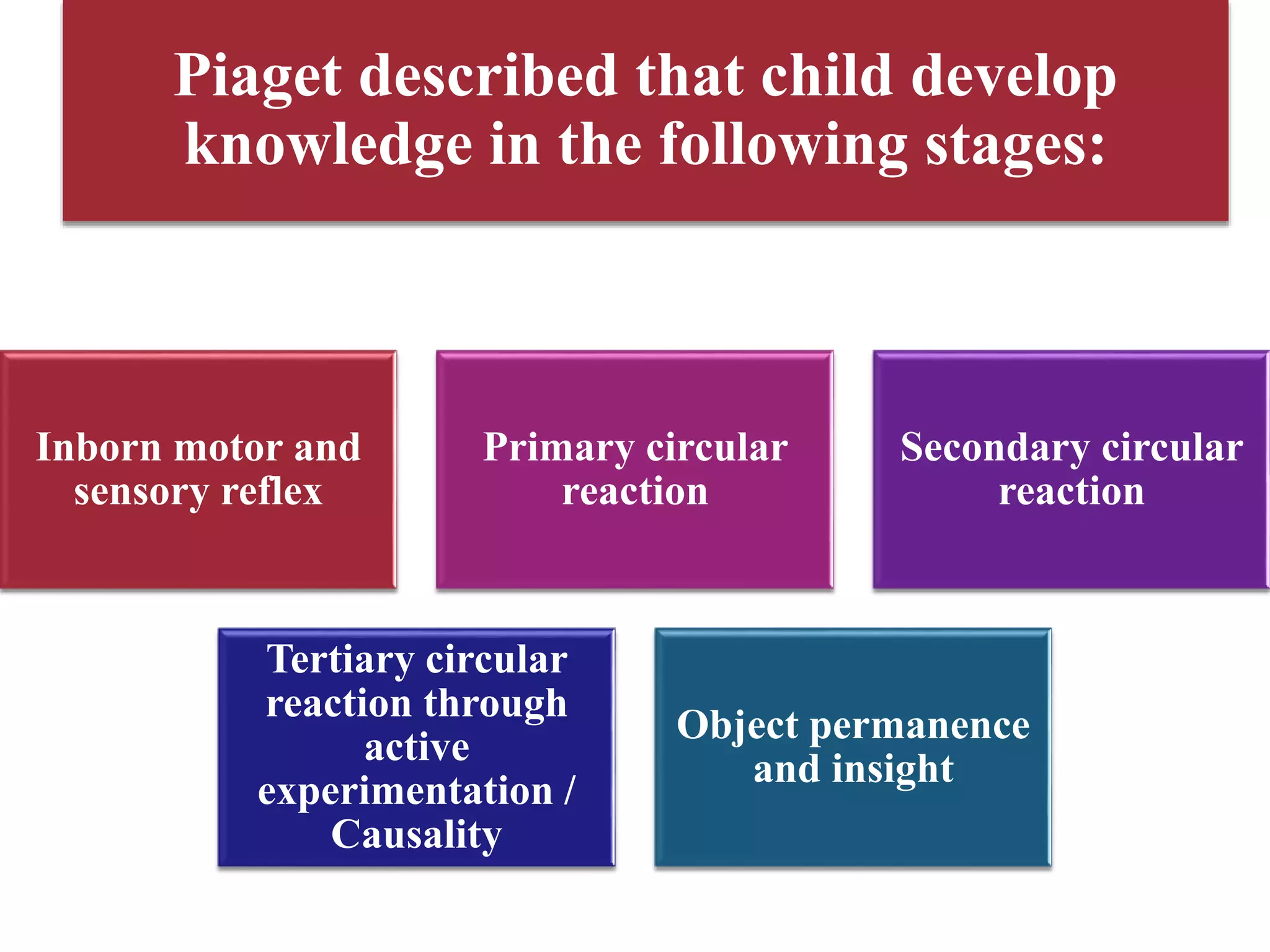
Inborn motor and
sensory reflex
Primary circular
reaction
Secondary circular
reaction
Tertiary circular
reaction through
active
experimentation /
Causality
Object permanence
and insight
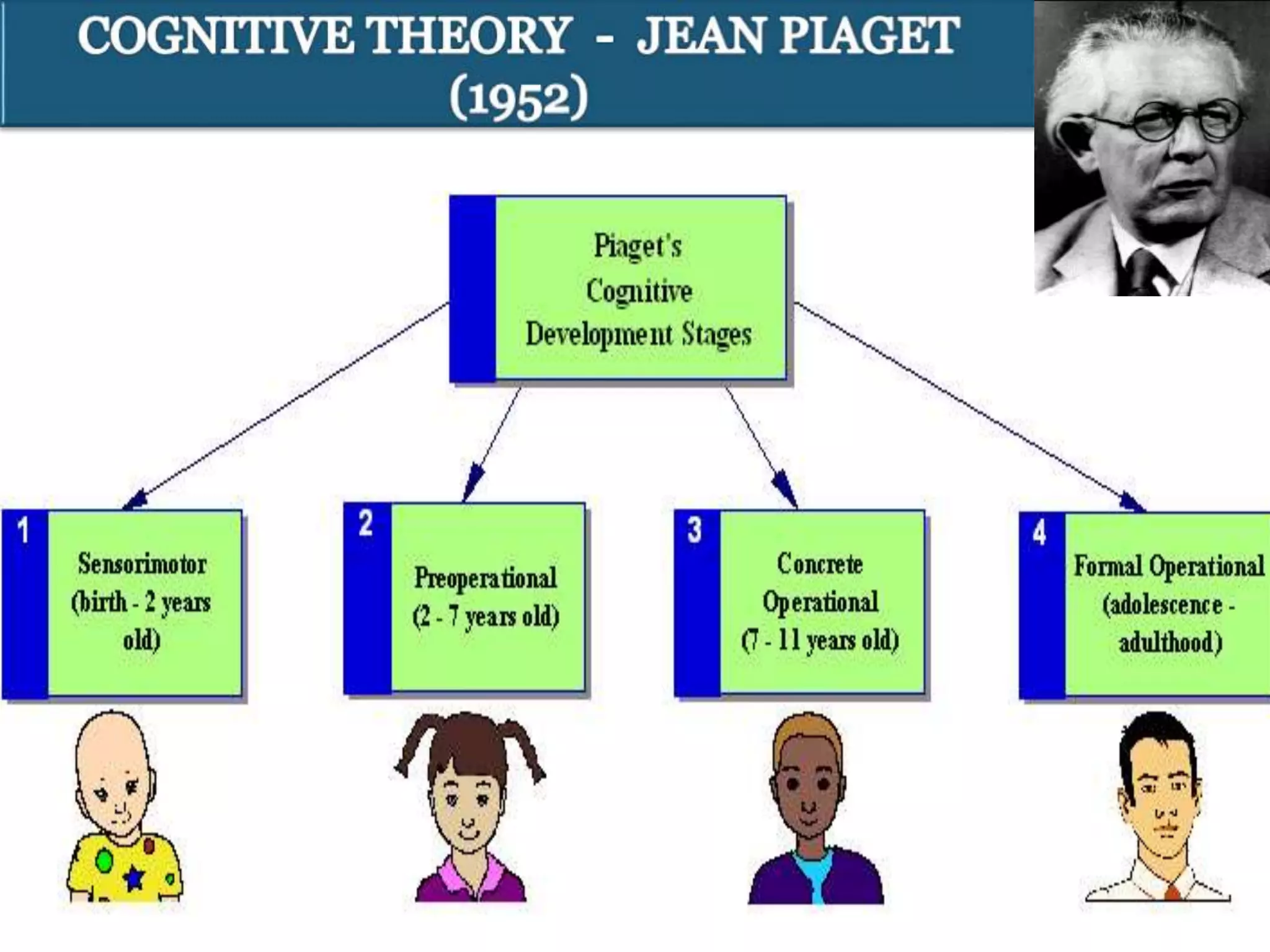
Piaget described that child develop
knowledge in the following stages:
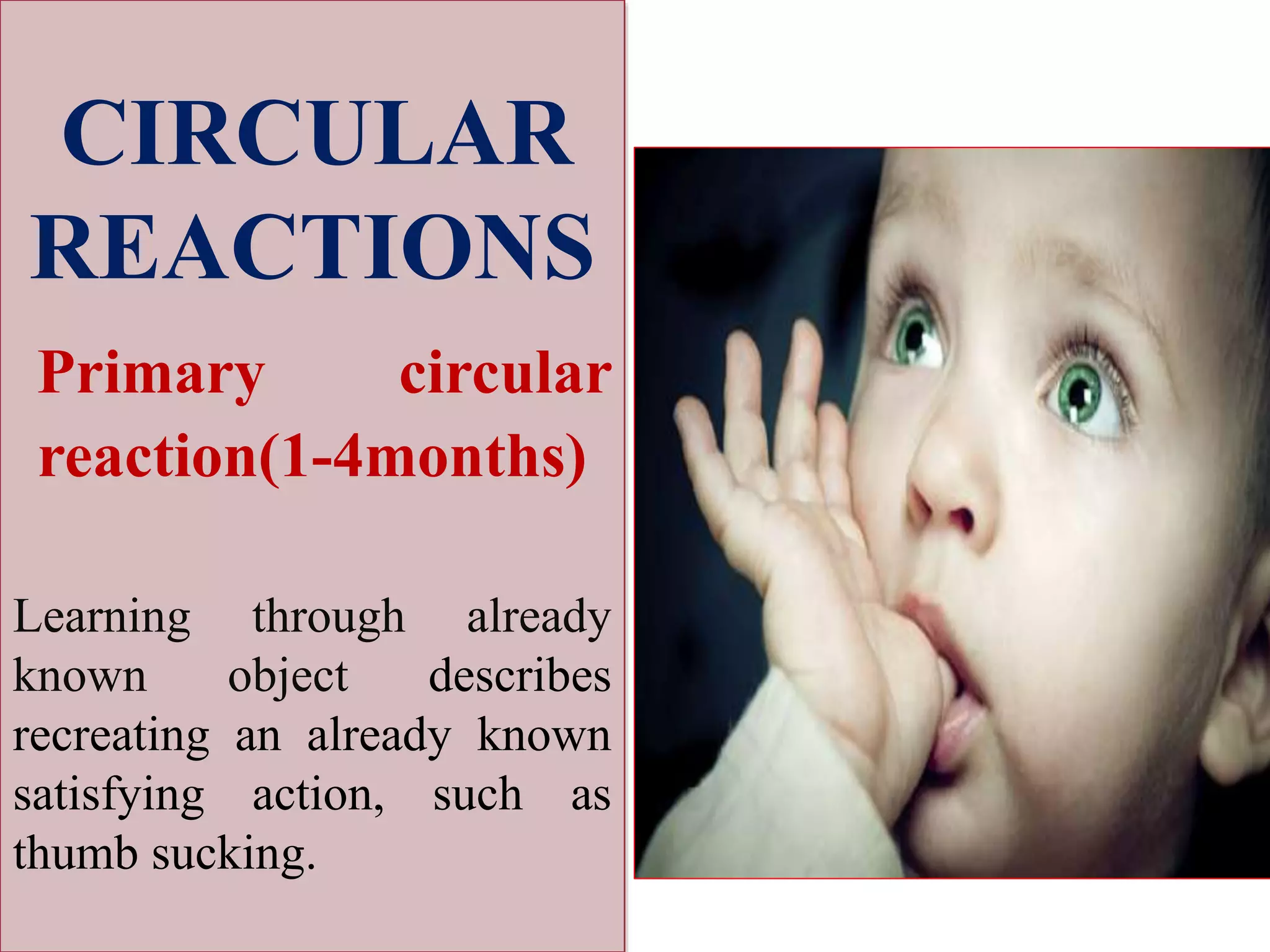
CIRCULAR
REACTIONS
Primary circular
reaction(1-4months)
Learning through already
known object describes
recreating an already known
satisfying action, such as
thumb sucking.
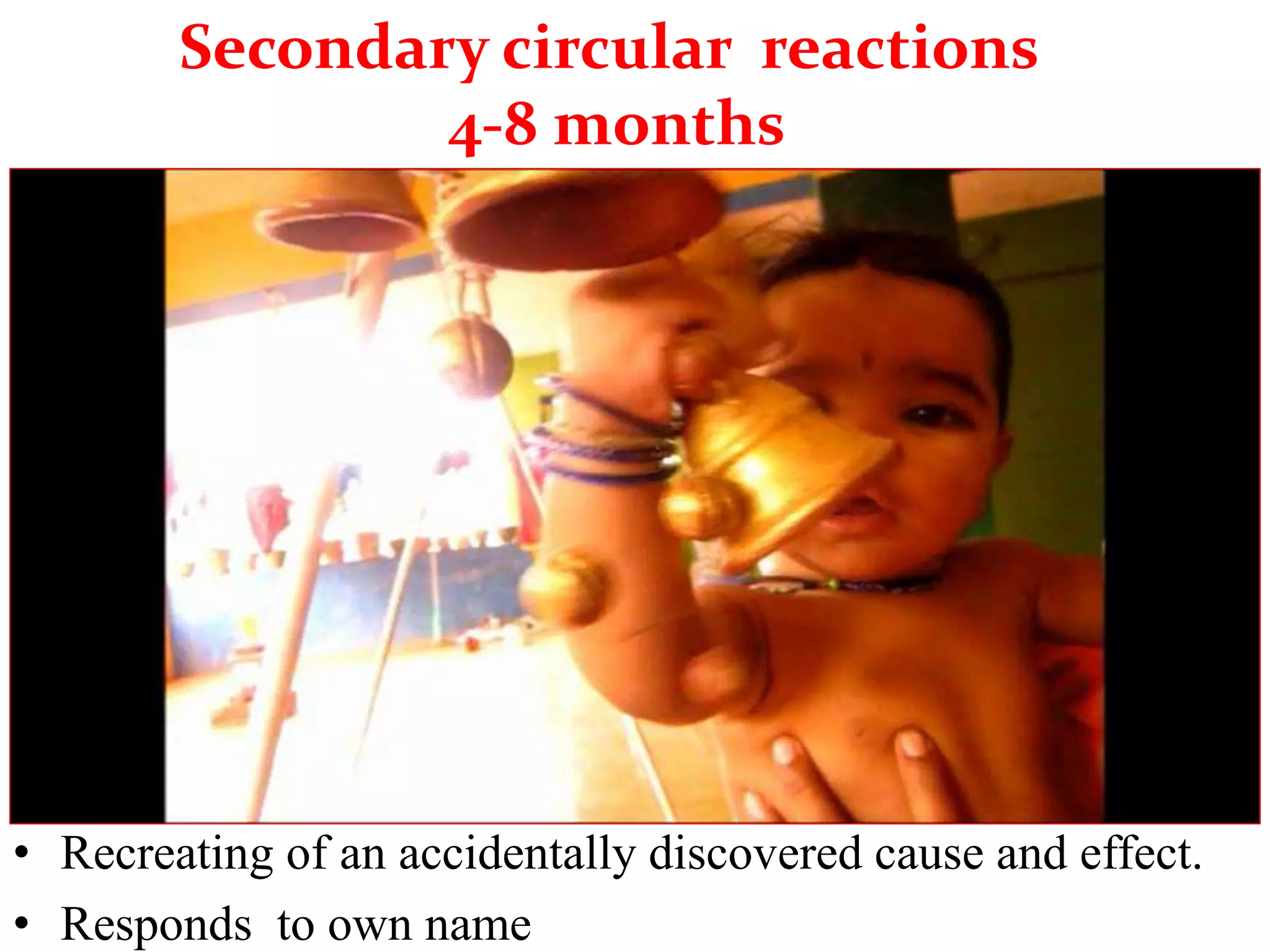
Secondary circular reactions
4-8 months
• Recreating of an accidentally discovered cause and effect.
• Responds to own name
TERTIARY CIRCULAR REACTIONS
12-18 MONTHS
Deliberately varies behaviour to create novel effect.
Reactions involve experimentation
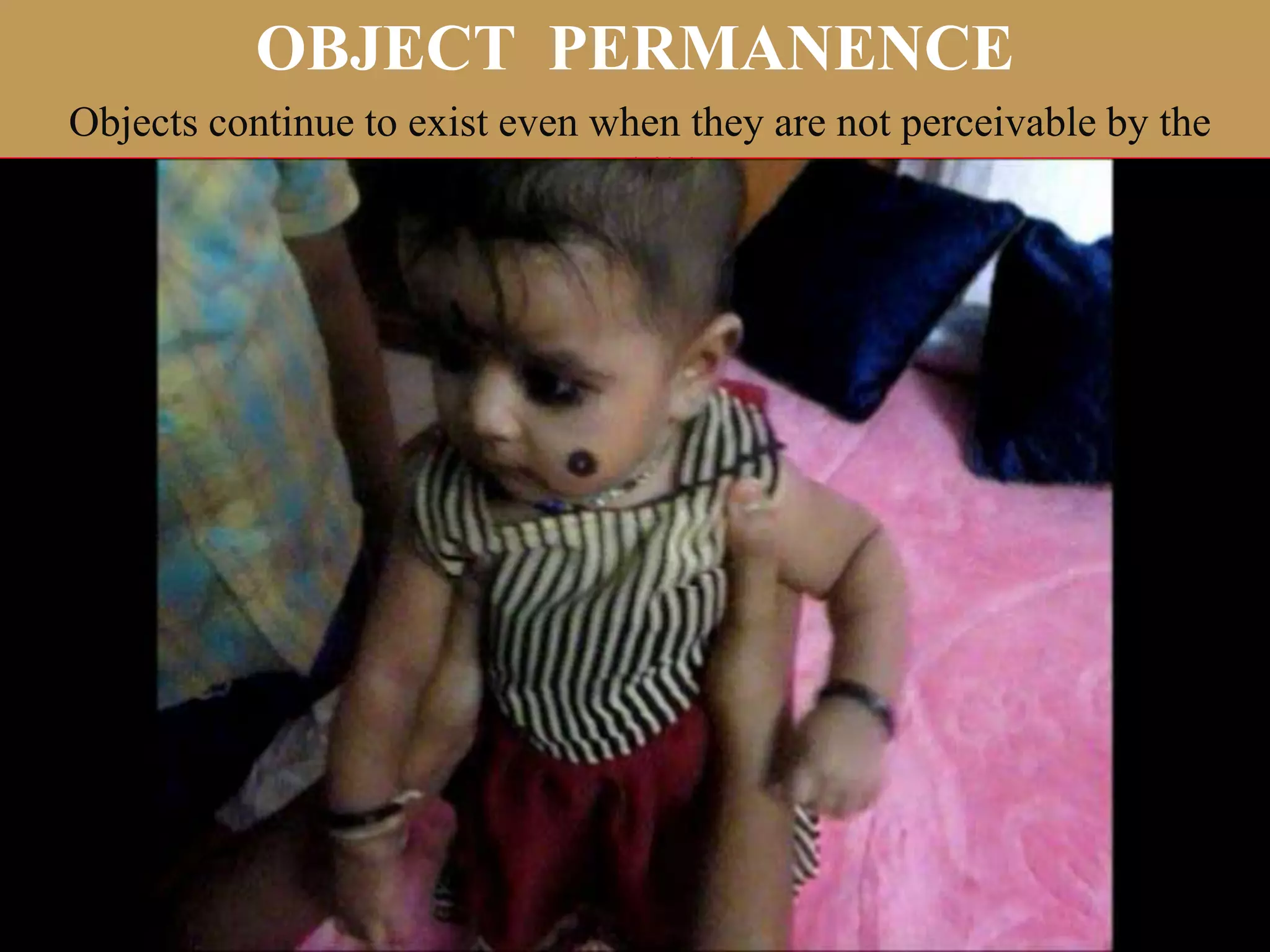
OBJECT PERMANENCE
Objects continue to exist even when they are not perceivable by the
child.
Clinical implications of Sensorimotor
stage
• The dental home concept says treat the child as soon
as the first tooth erupts in the oral cavity ie at 6
months so if the mother brings the child very
frequently along with her the child learns about the
setup and gets to feed information in brain through
circular reactions also the stranger anxiety which
peaks if not seen the stranger can be minimised.
• This can be done by taking advantages of exemplary
modeling by mother or sibling in procedures like
scaling done on them.
• Those being treated should display courage and smile
throughout the procedure, giving an impression to the child
that dentistry is not a place of threat instead can be enjoyable,
as cognitive growth is mainly influenced by the intellectual
stimulation he gets from his surrounding environment.
• So, appropriate conduct of pediatric dentists is extremely
important during the treatment of children in situations that
can lead to fear, helping to avoid dental fear and contributing
to improvements in health care promotion.
PRE OPERATIONAL STAGE
• Preschool children are considered as not having
acquired the cognitive ability to think logically
• Acquire the ability to form mental images of objects
and events
• Language develops to the point at which they begin to
think in terms of verbal symbols – words.
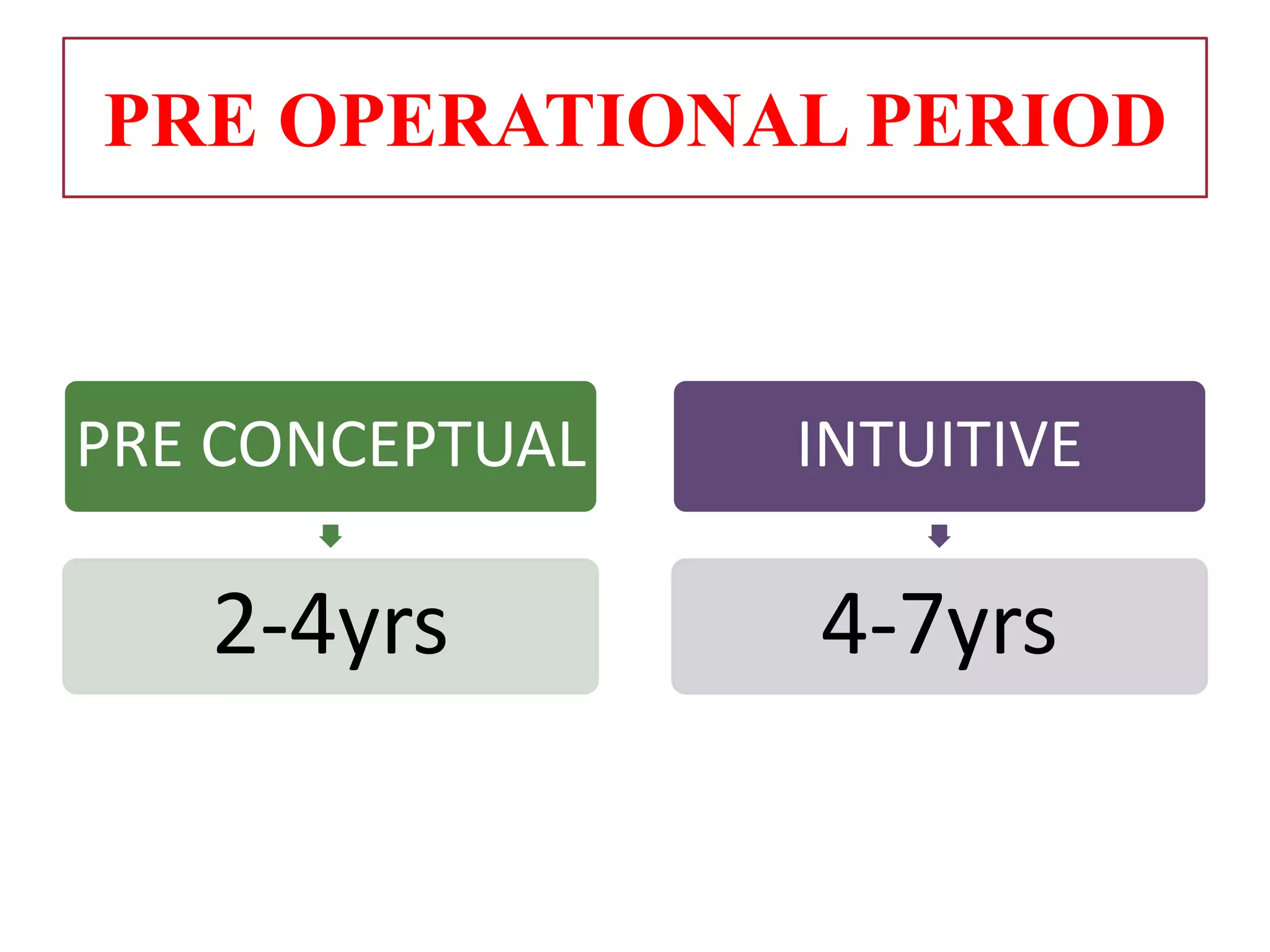
PRE OPERATIONAL PERIOD
PRE CONCEPTUAL
2-4yrs
INTUITIVE
4-7yrs
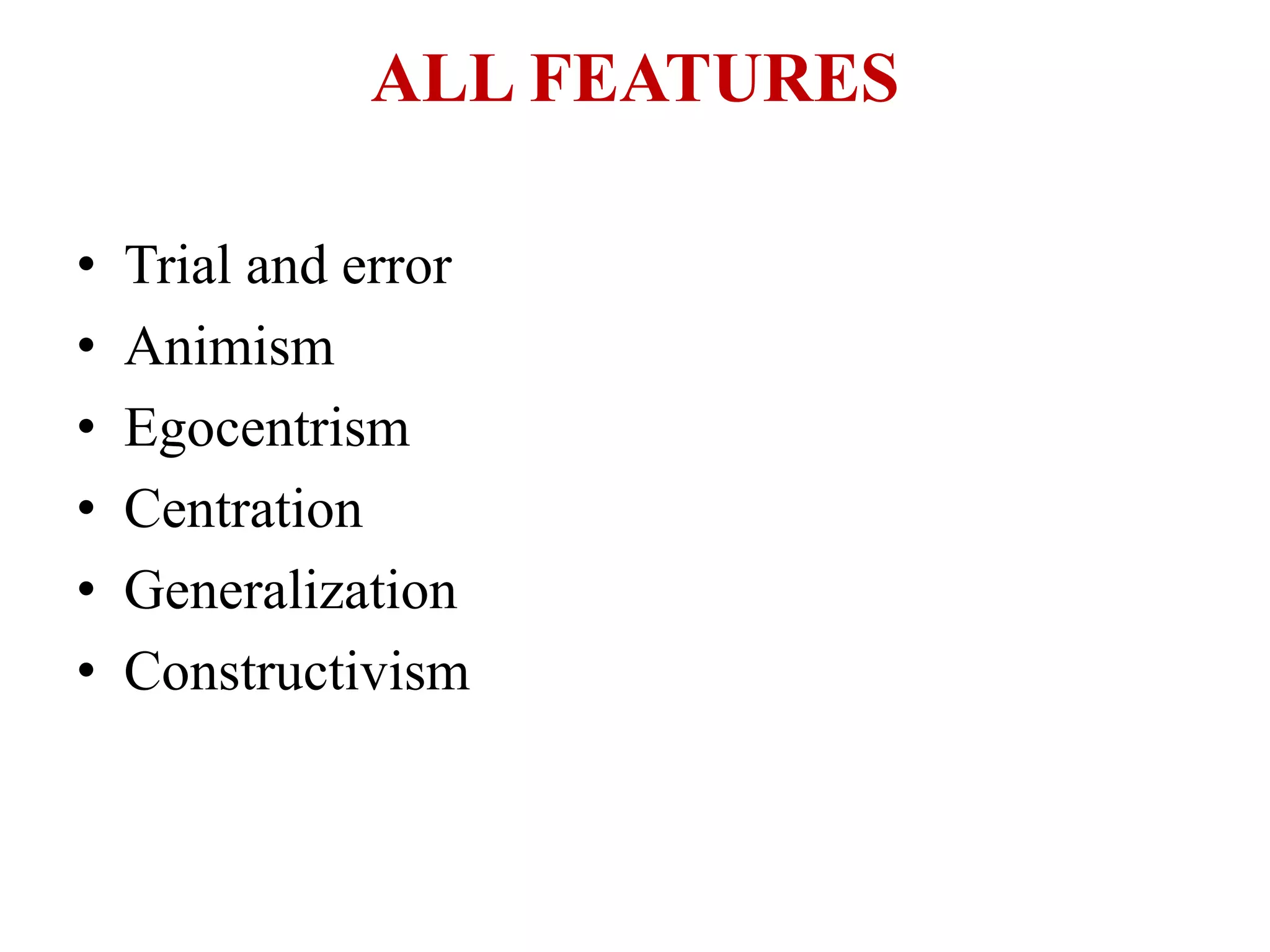
ALL FEATURES
• Trial and error
• Animism
• Egocentrism
• Centration
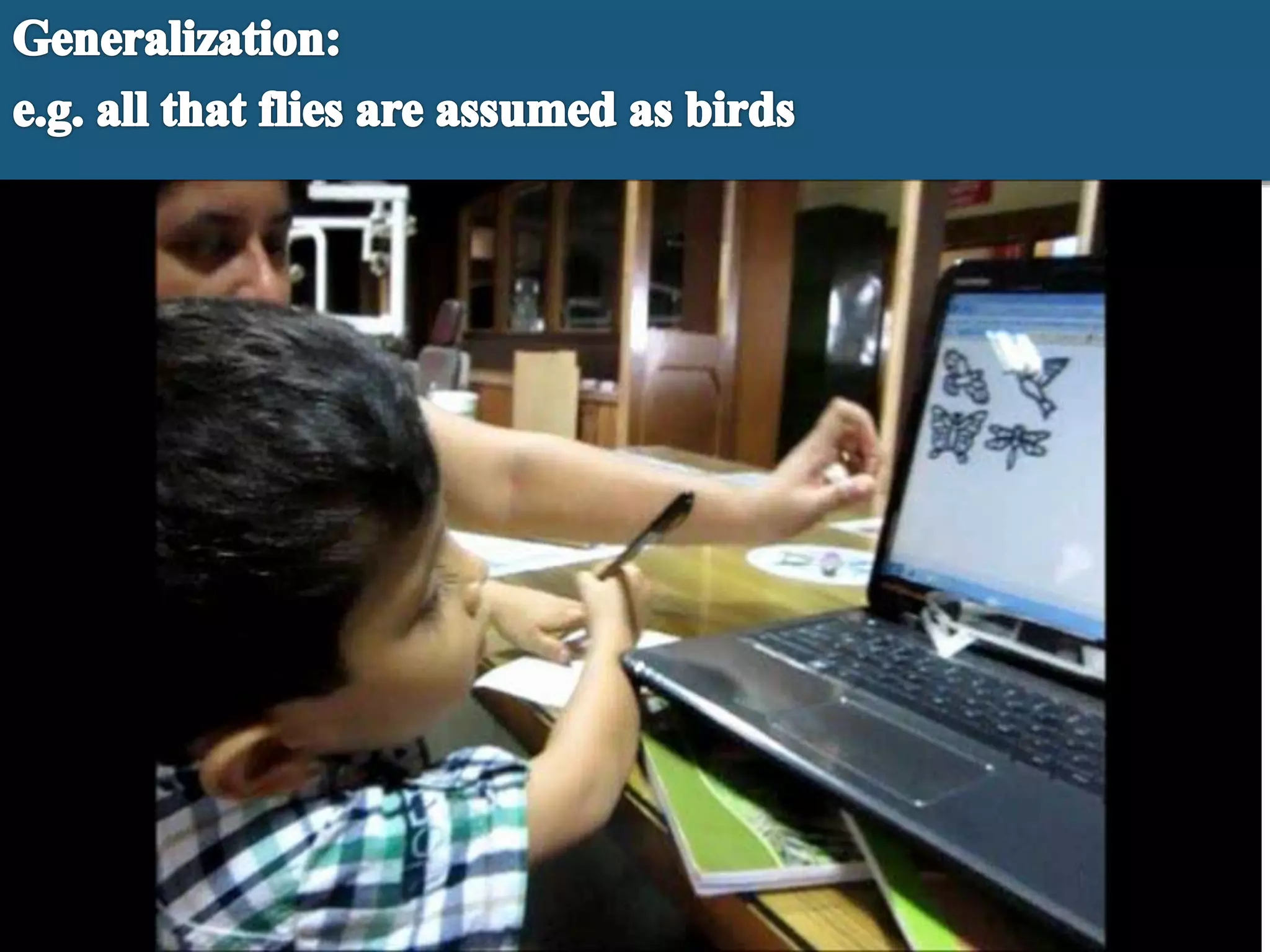
• Generalization
• Constructivism
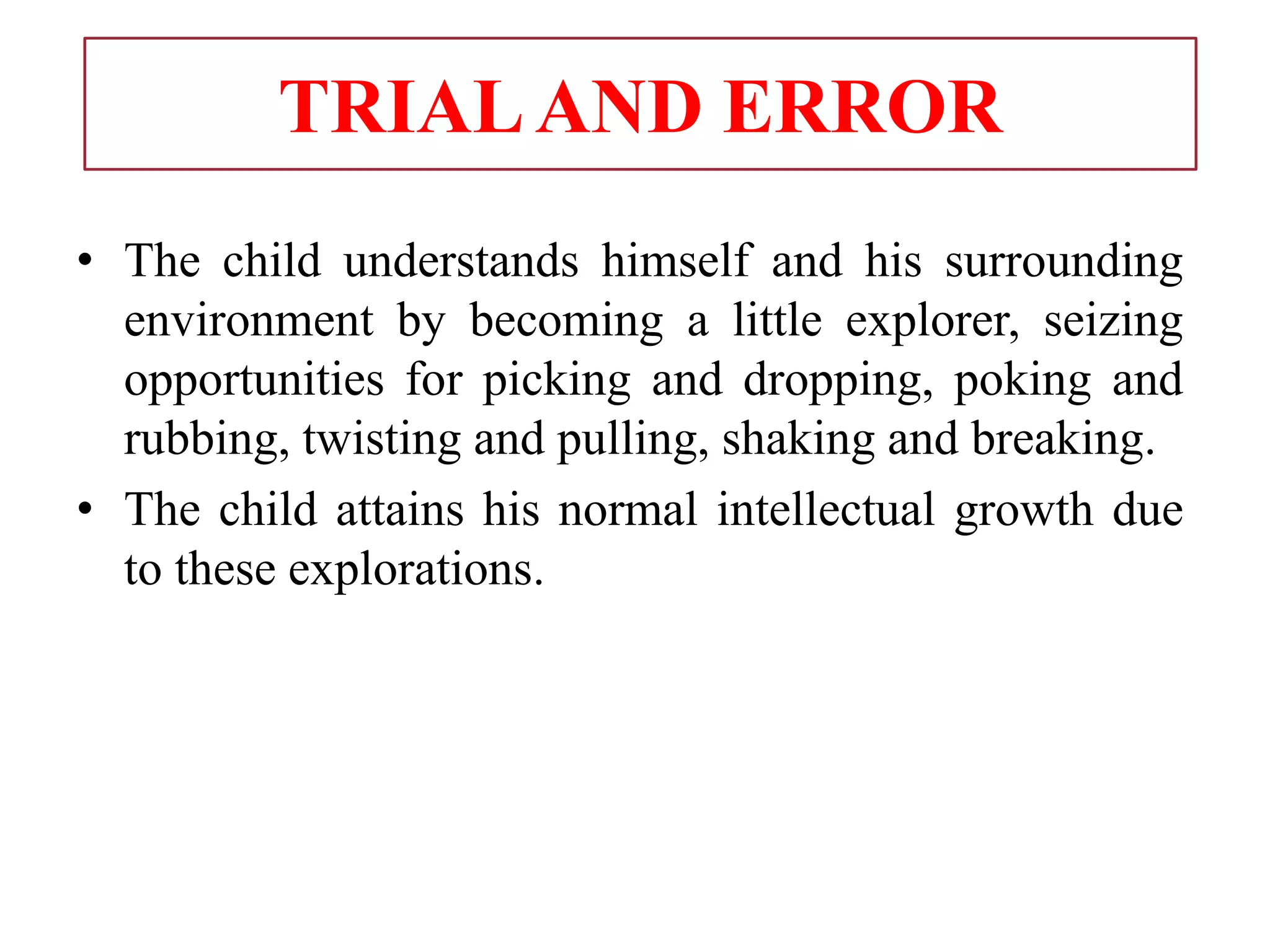
TRIALAND ERROR
• The child understands himself and his surrounding
environment by becoming a little explorer, seizing
opportunities for picking and dropping, poking and
rubbing, twisting and pulling, shaking and breaking.
• The child attains his normal intellectual growth due
to these explorations.
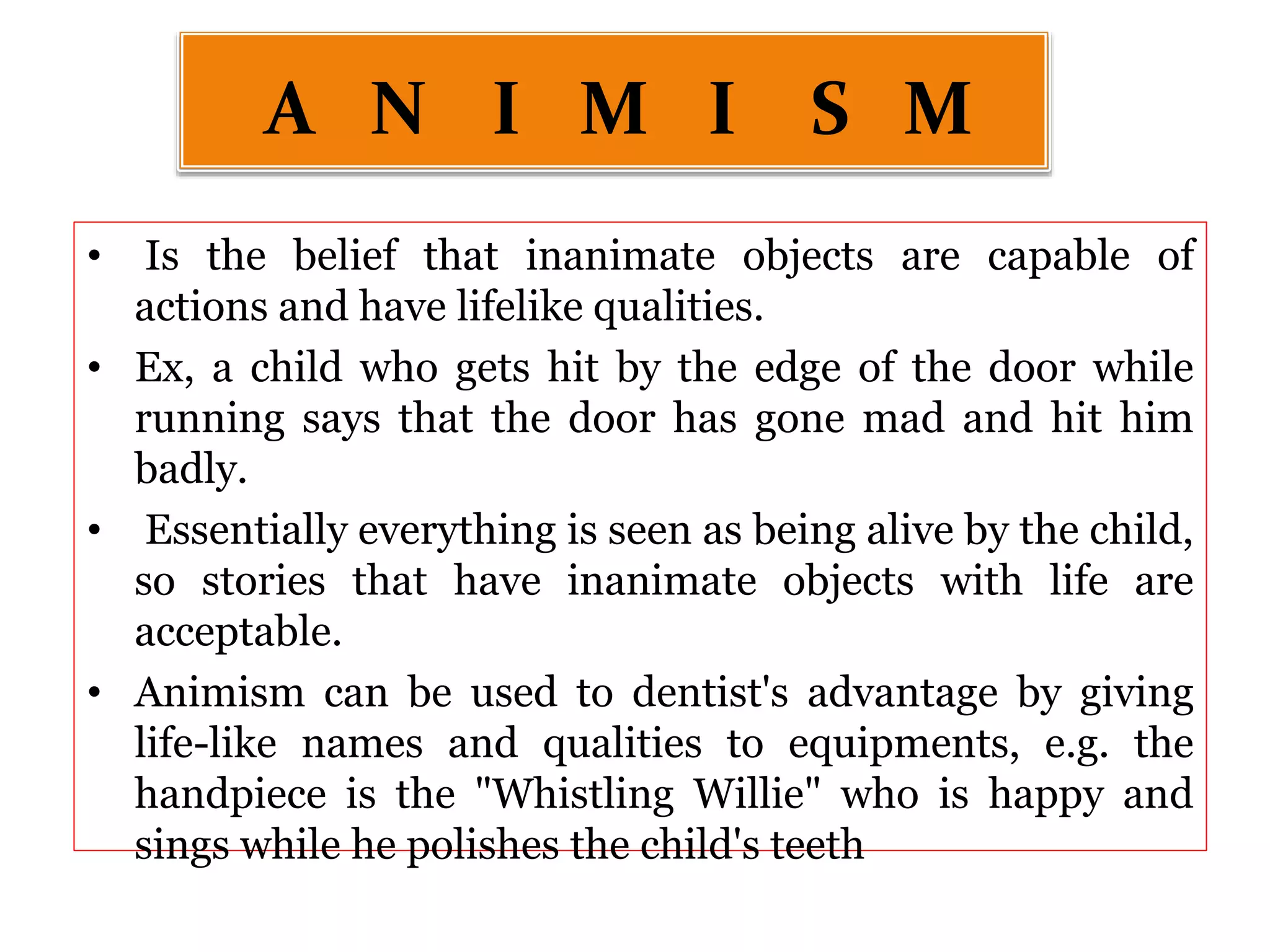
• Is the belief that inanimate objects are capable of
actions and have lifelike qualities.
• Ex, a child who gets hit by the edge of the door while
running says that the door has gone mad and hit him
badly.
• Essentially everything is seen as being alive by the child,
so stories that have inanimate objects with life are
acceptable.
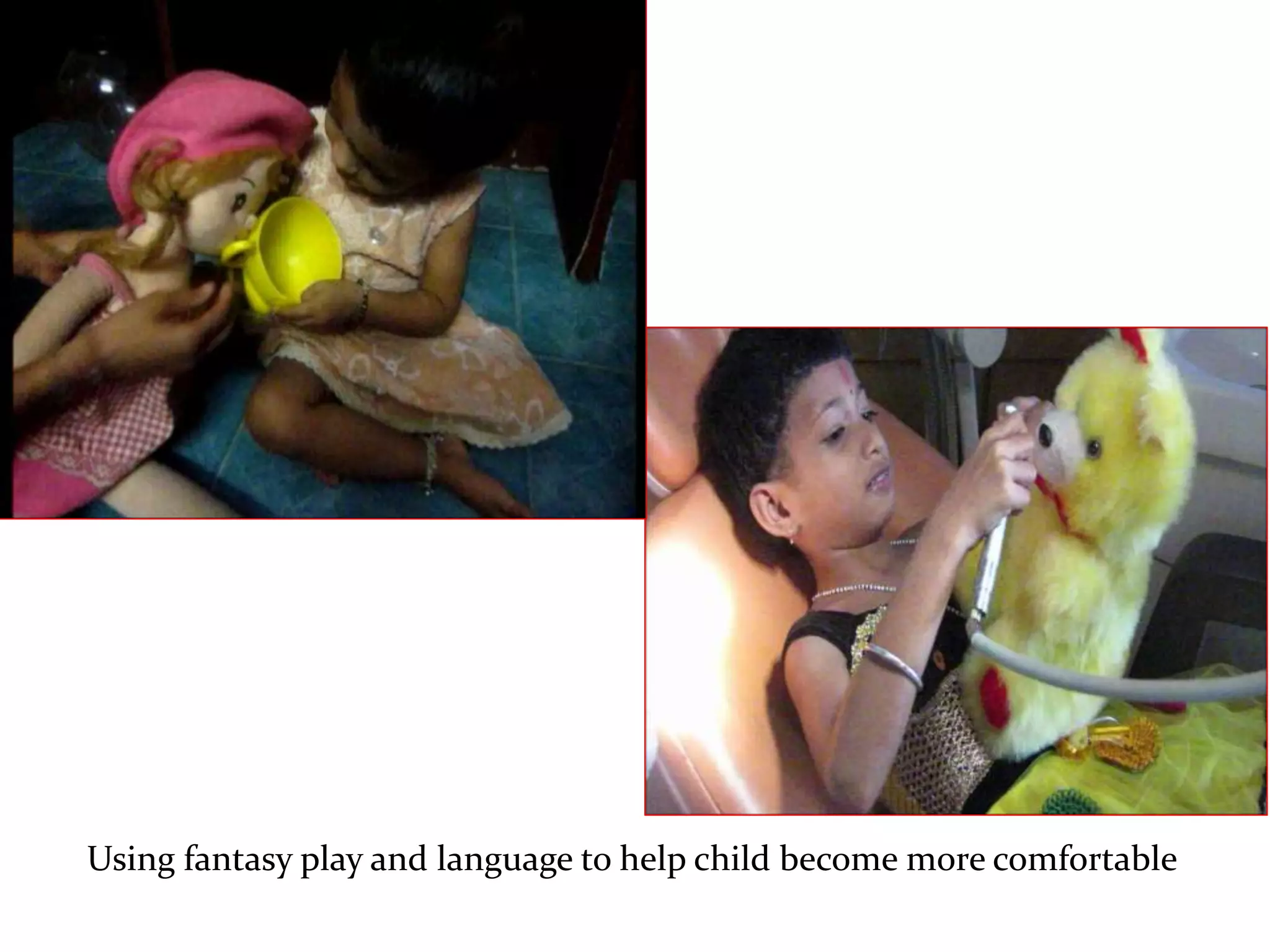
• Animism can be used to dentist's advantage by giving
life-like names and qualities to equipments, e.g. the
handpiece is the "Whistling Willie" who is happy and
sings while he polishes the child's teeth
A N I M I S M
Using fantasy play and language to help child become more comfortable
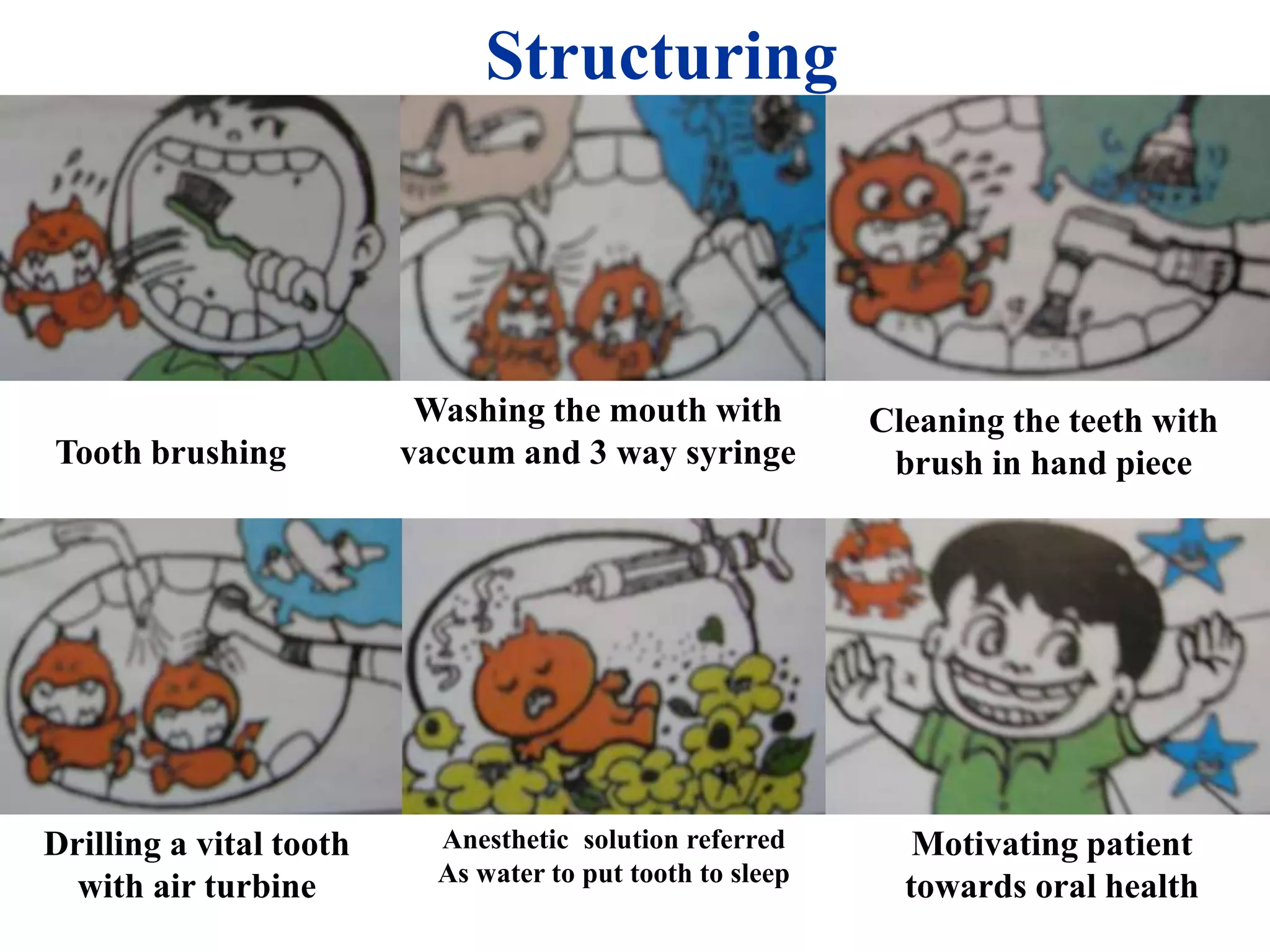
Tooth brushing
Washing the mouth with
vaccum and 3 way syringe
Cleaning the teeth with
brush in hand piece
Drilling a vital tooth
with air turbine
Anesthetic solution referred
As water to put tooth to sleep
Motivating patient
towards oral health
Structuring
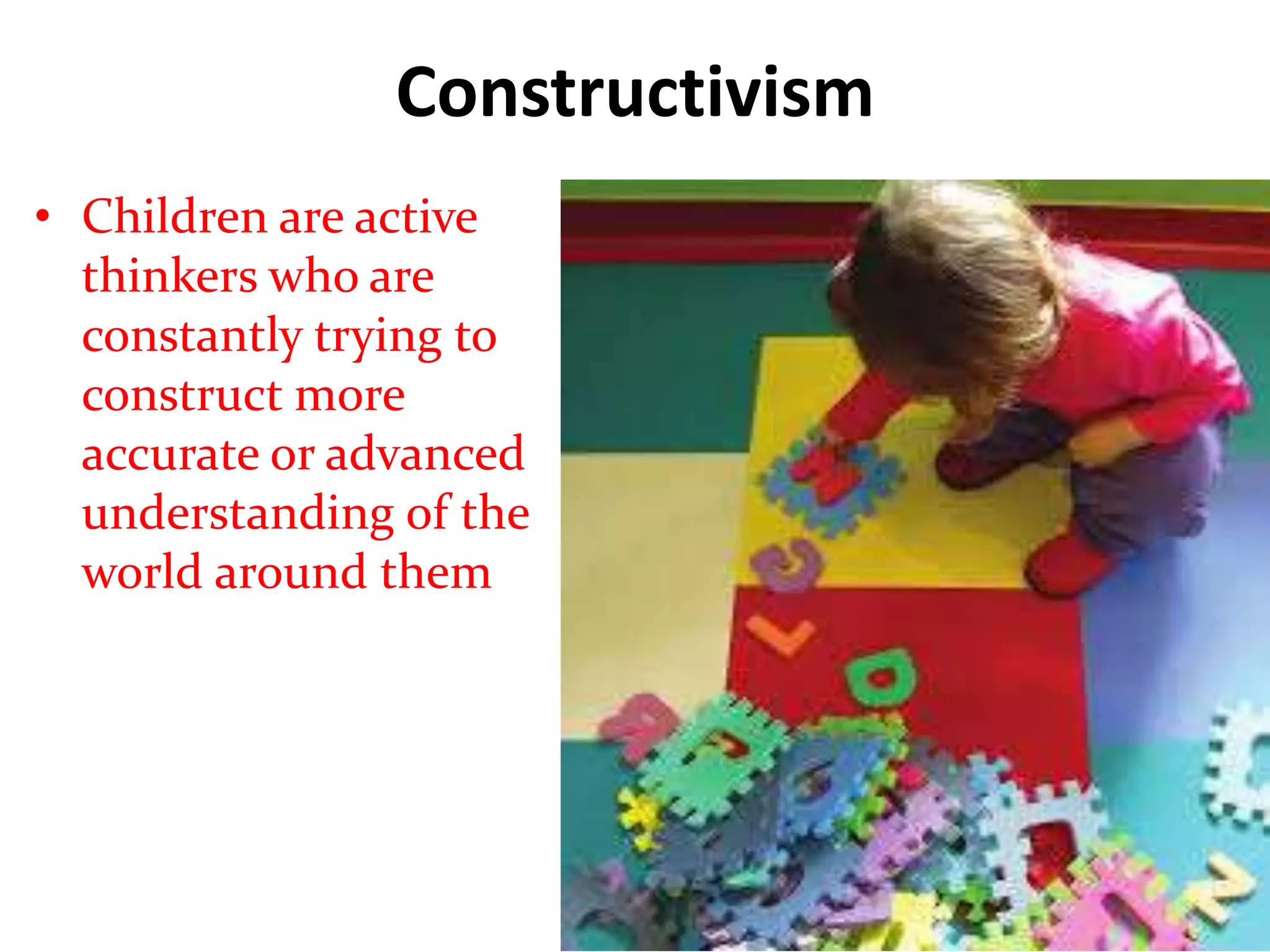
Constructivism
• Children are active
thinkers who are
constantly trying to
construct more
accurate or advanced
understanding of the
world around them
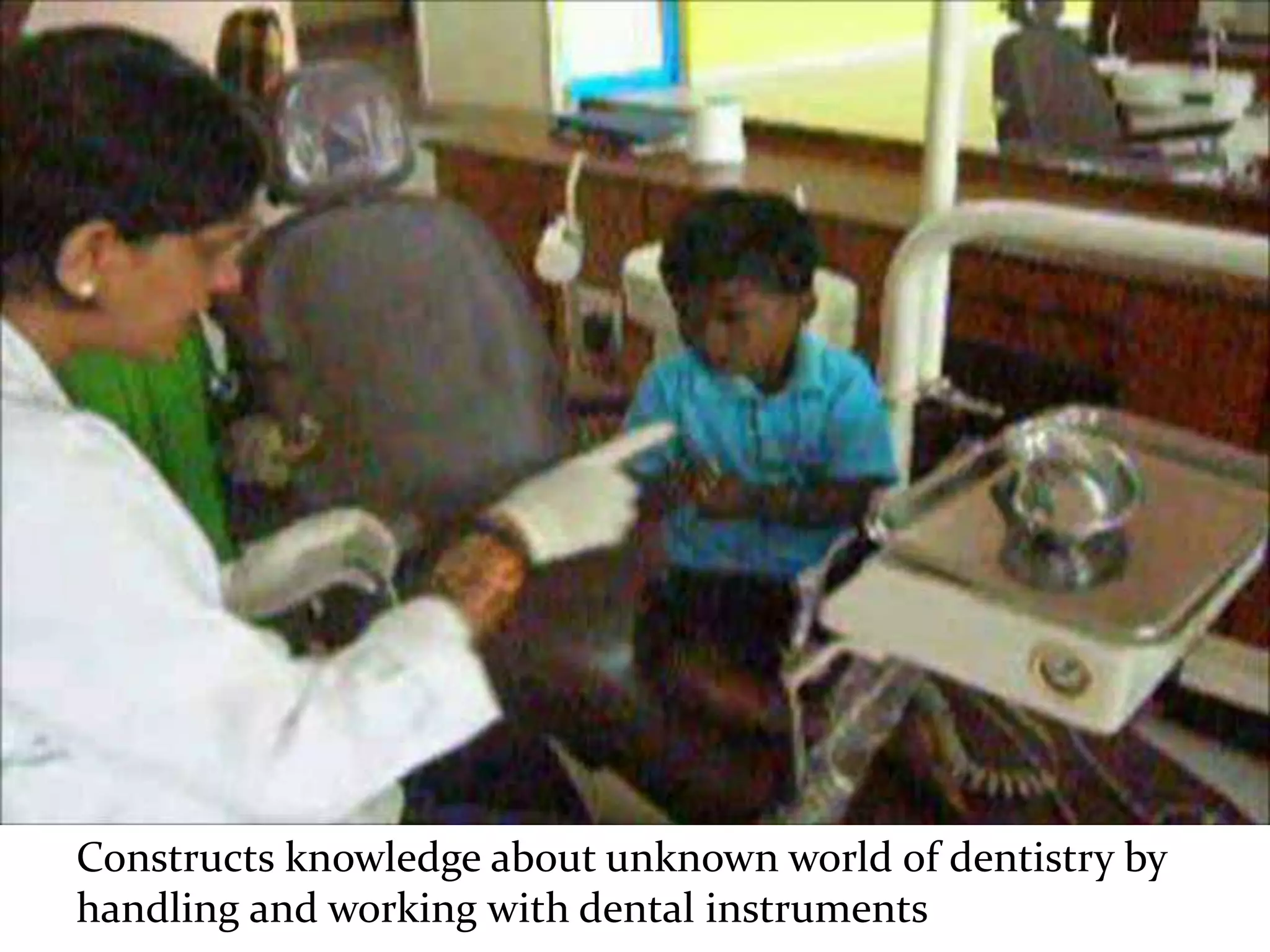
Constructs knowledge about unknown world of dentistry by
handling and working with dental instruments
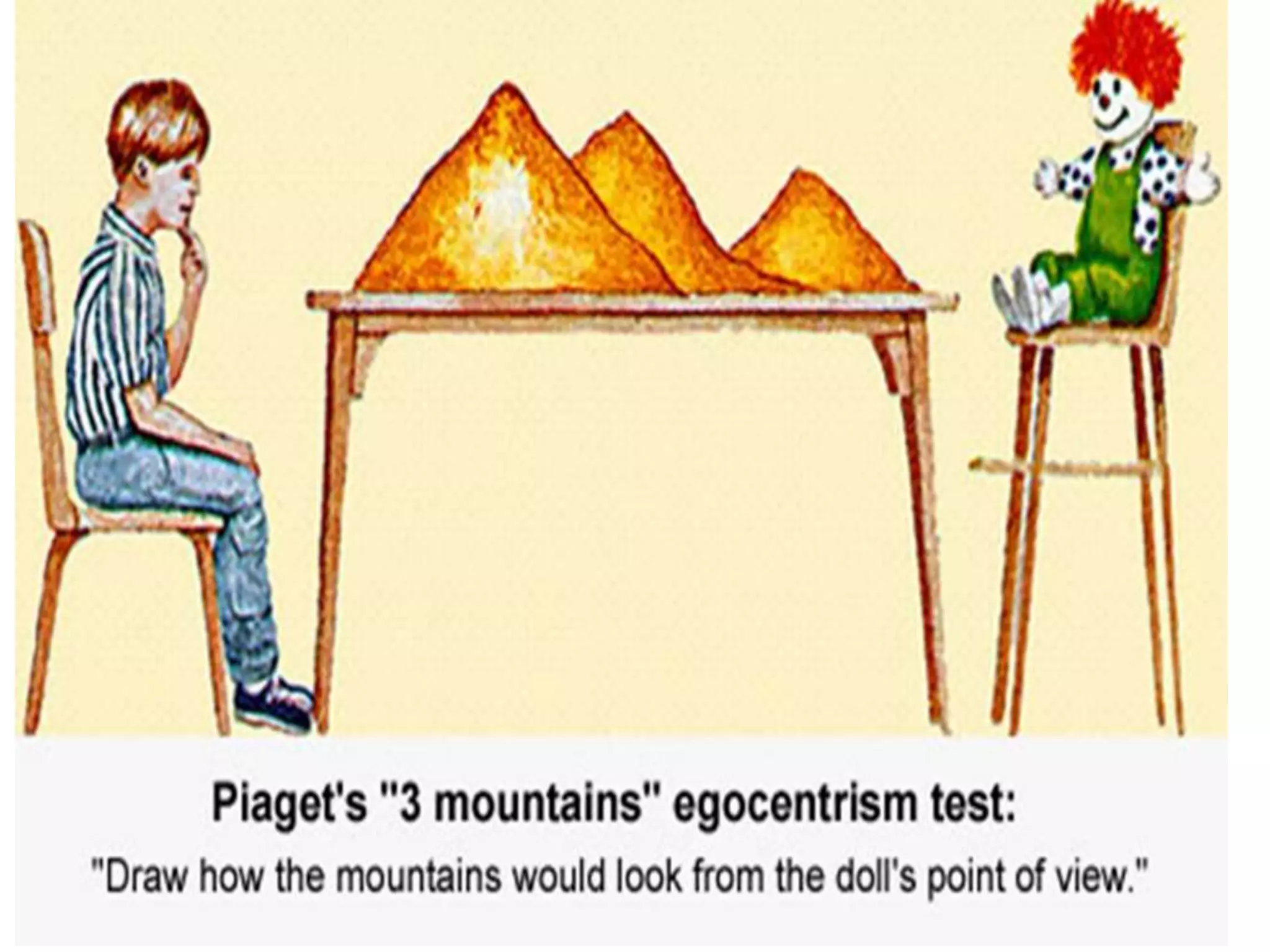
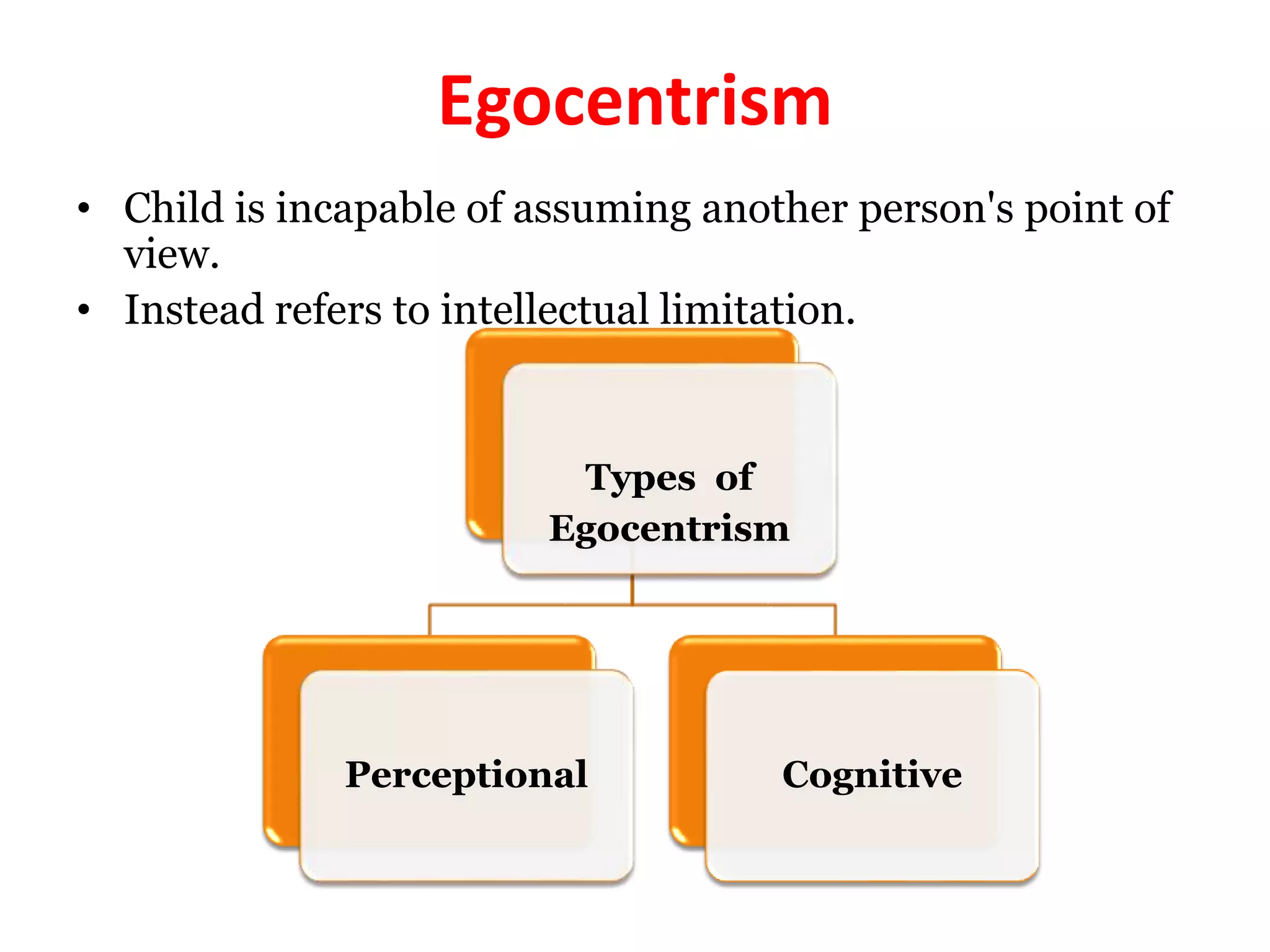
Egocentrism
• Child is incapable of assuming another person's point of
view.
• Instead refers to intellectual limitation.
Types of
Egocentrism
Perceptional Cognitive
Cognitive egocentrism
• Children find it difficult that other people do not know
their thoughts. In communicating with others children
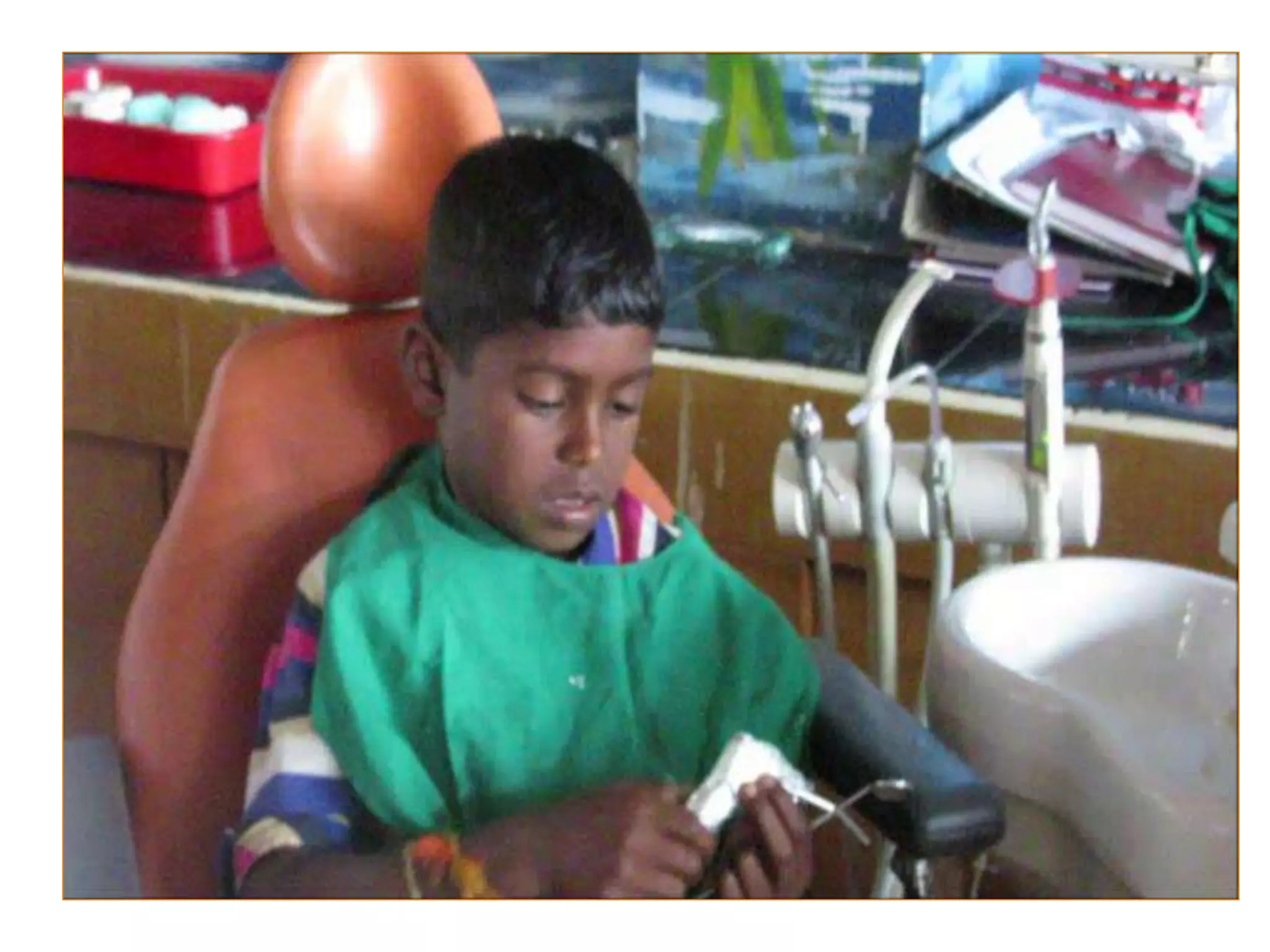
often forget themselves in the role of listener and to
adapt their message to that person.
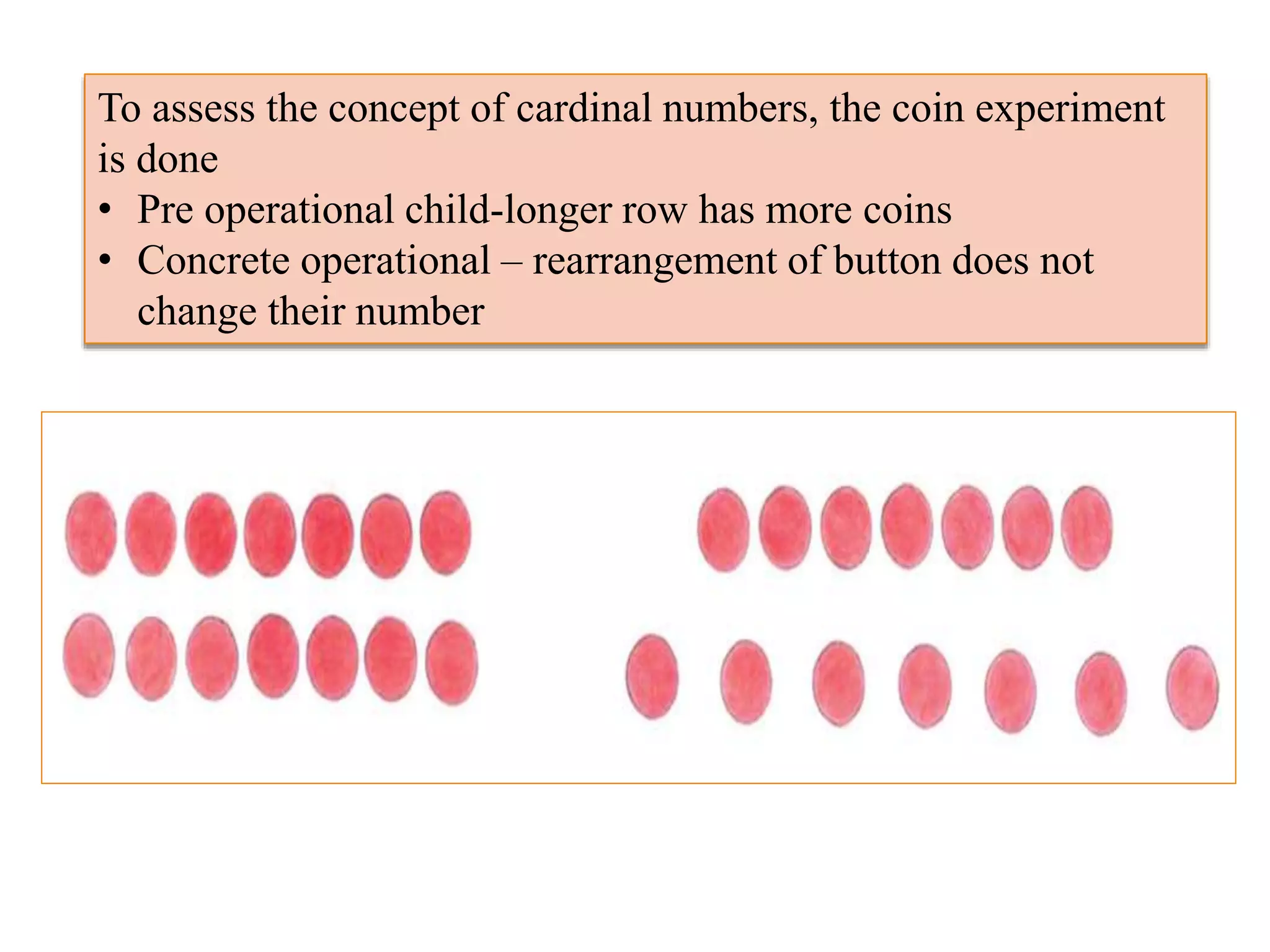
To assess the concept of cardinal numbers, the coin experiment
is done
• Pre operational child-longer row has more coins
• Concrete operational – rearrangement of button does not
change their number
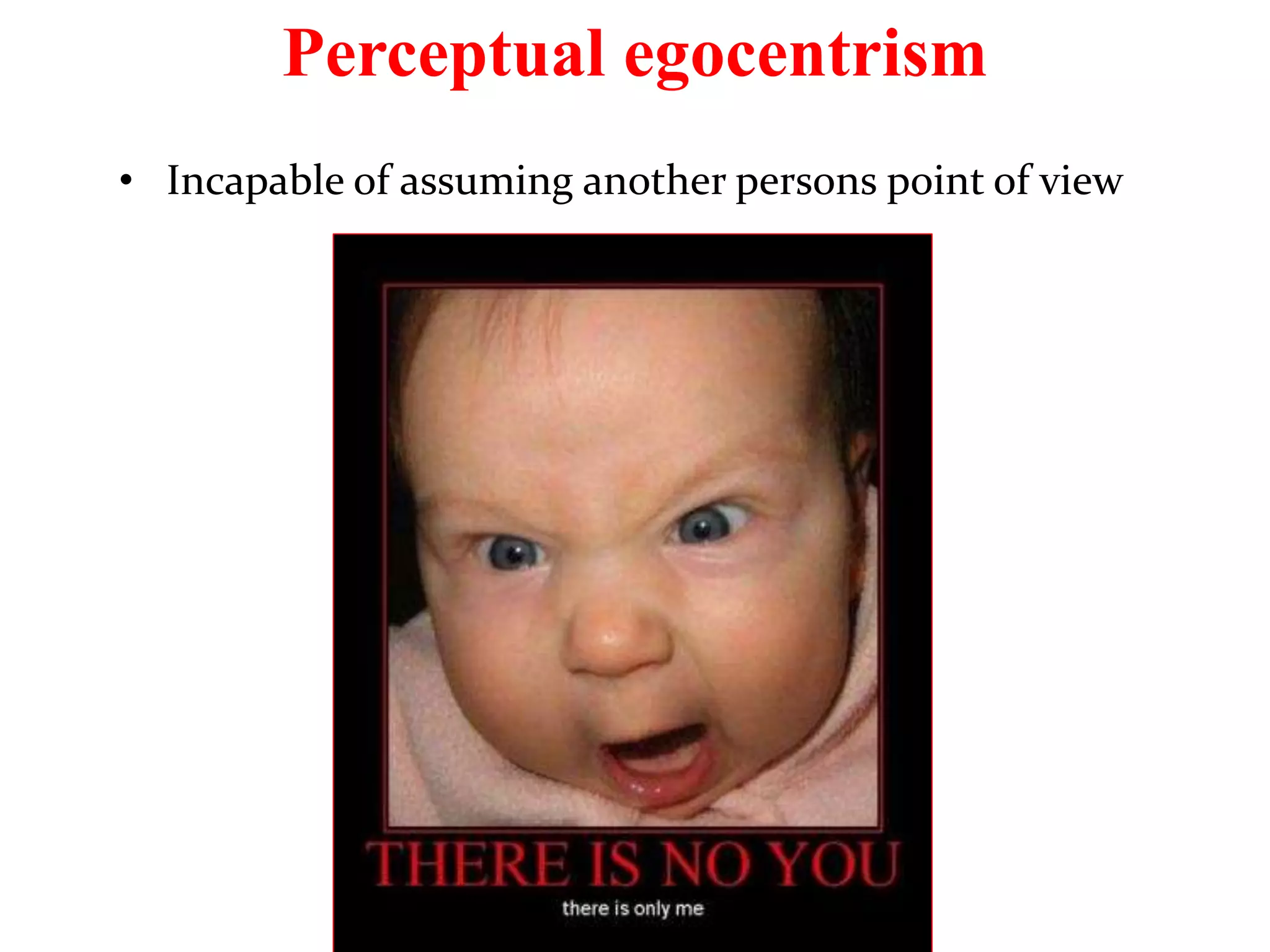
Perceptual egocentrism
• Incapable of assuming another persons point of view
Reasoning
• They are capable of transductive reasoning from particular
to particular. They can understand cause-effect
relationship but is limited to a particular event or object.
• They are NOT capable of inductive reasoning (from
particular to general) or deductive reasoning (from general
to particular).
• As result a volley of questions may be asked to the adult
such as "How" and "Why".
Clinical implication of egocentrism
• It will be useless to point out how proud his parents will be if he
cooperated for the dental treatment as the child can't see the parent's
point of view.
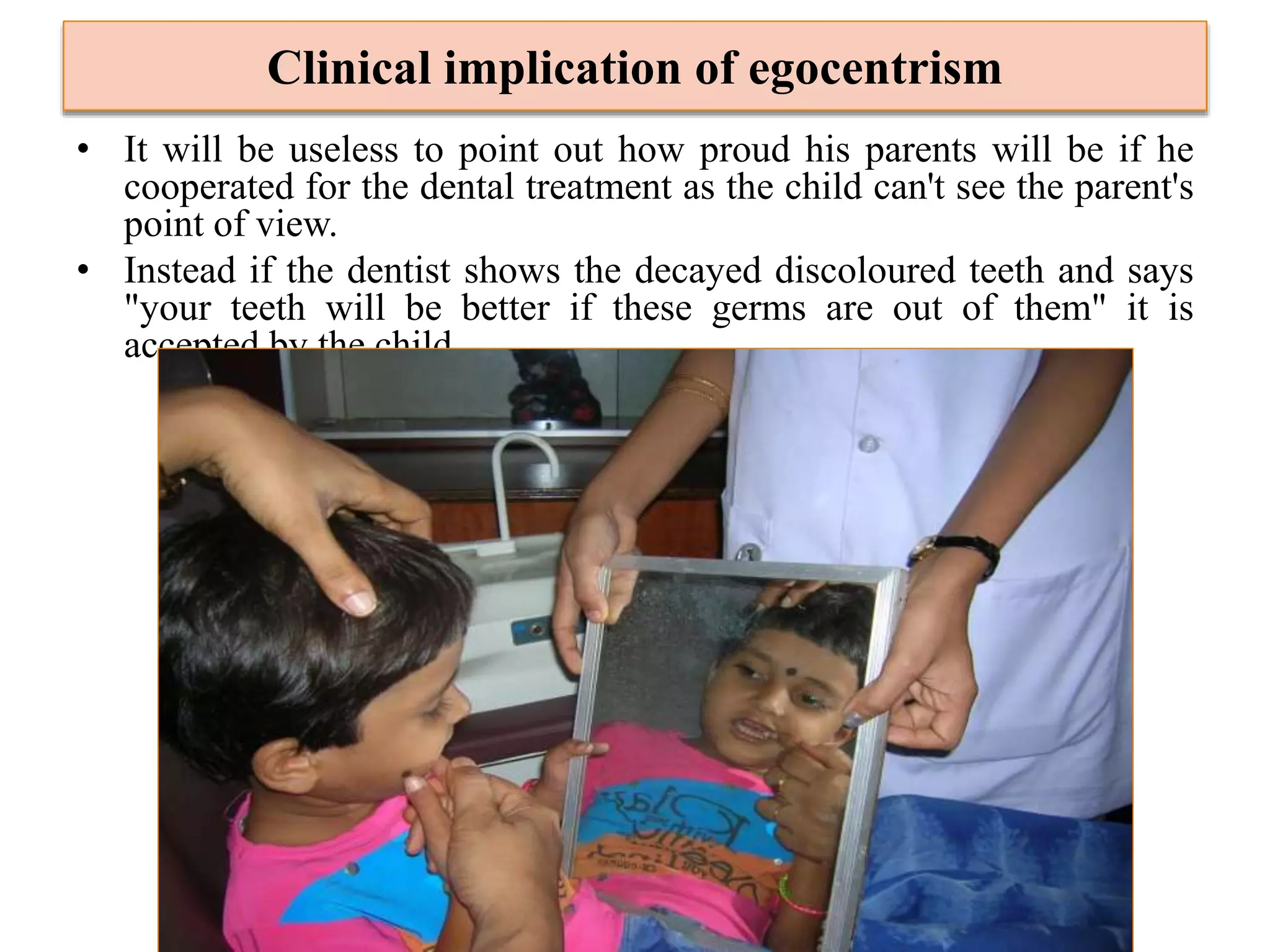
• Instead if the dentist shows the decayed discoloured teeth and says
"your teeth will be better if these germs are out of them" it is
accepted by the child.
• This is structuring, a procedure of behavior management,
where the child is explained the need for the procedure with
proof.
• An Early childhood caries patient is given a face mirror and
explained that all anterior teeth are broken and they need to be
repaired to look like his friends, make the child realize the
need for treatment and he will cooperate through out.
• Also allowing him to watch what is done and witnessing
improvement in the appearance of decayed teeth will form a
foundation for future procedures
Period of Concrete Operations. (6-12
years)
• An improved ability to reason
emerges during this period.
• The thinking process becomes
logical.
• He develops the ability to use
complex mental operations
such as additions and
subtraction
• The child is able to
understand others point of
view and animism declines.
FEATURES
• Conservation
• Decentration
• Elimination of egocentrism
• Seriation
• Transitivity
• Reversibility
Decentration:
• To focus their attention on several attributes of an
object or event simultaneously & to understand the
relation between dimensions.
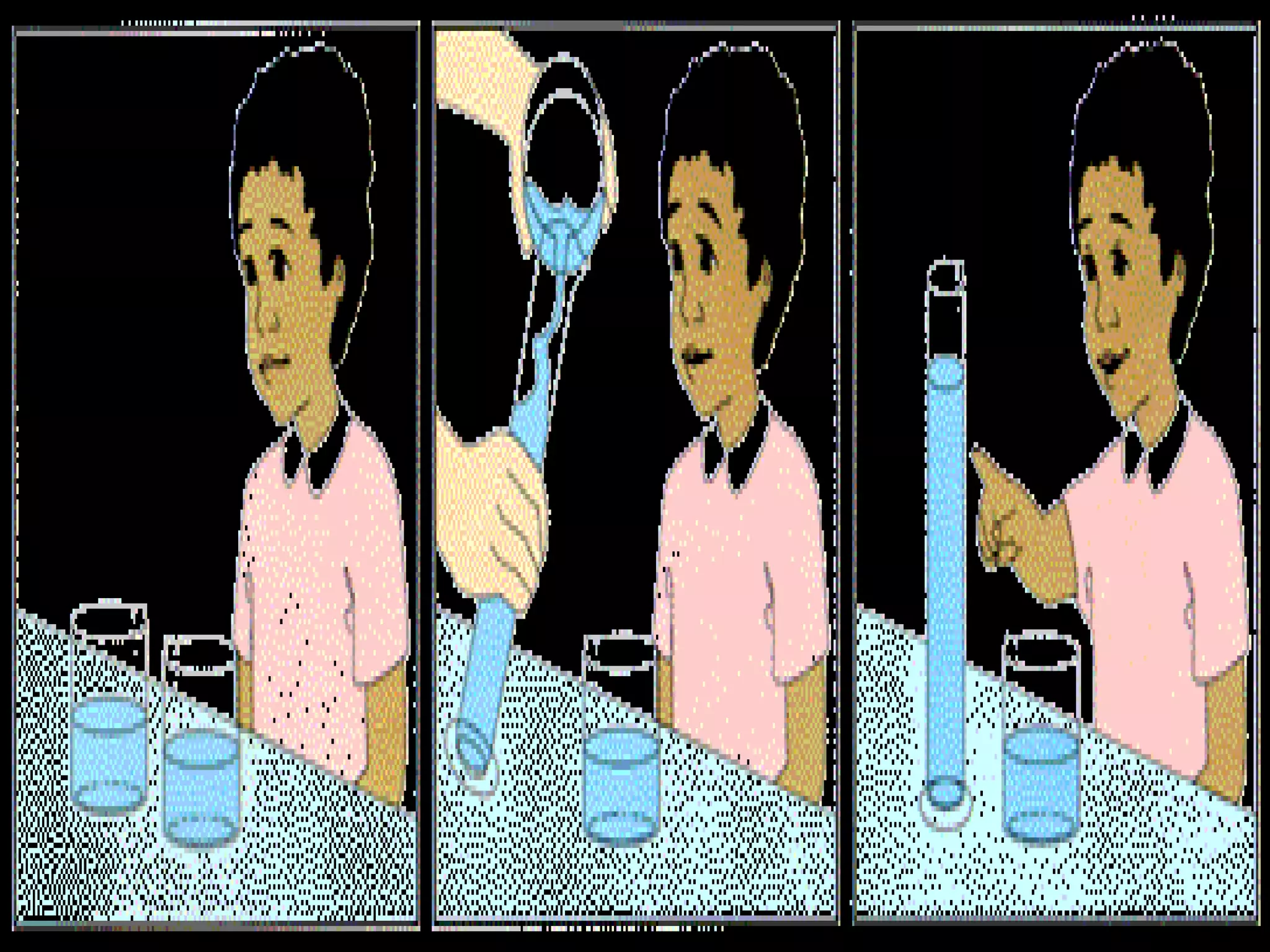
Conservation :
• Understanding that quantity, length or no. of items is
unrelated to the arrangement or appearance of the object
object or items. the child can successfully pass through
through the conservative experiments.
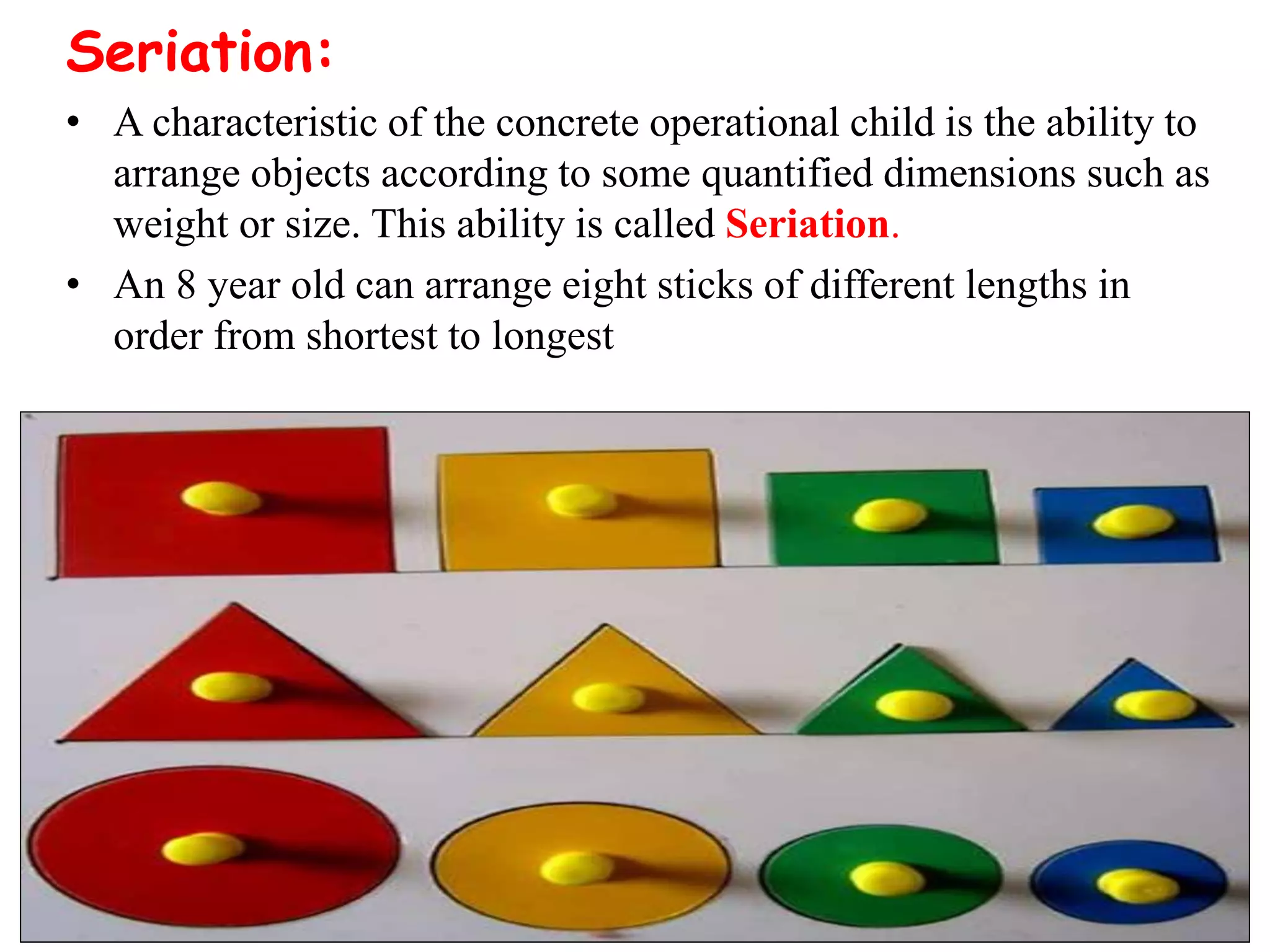
Seriation:
• A characteristic of the concrete operational child is the ability to
arrange objects according to some quantified dimensions such as
weight or size. This ability is called Seriation.
• An 8 year old can arrange eight sticks of different lengths in
order from shortest to longest
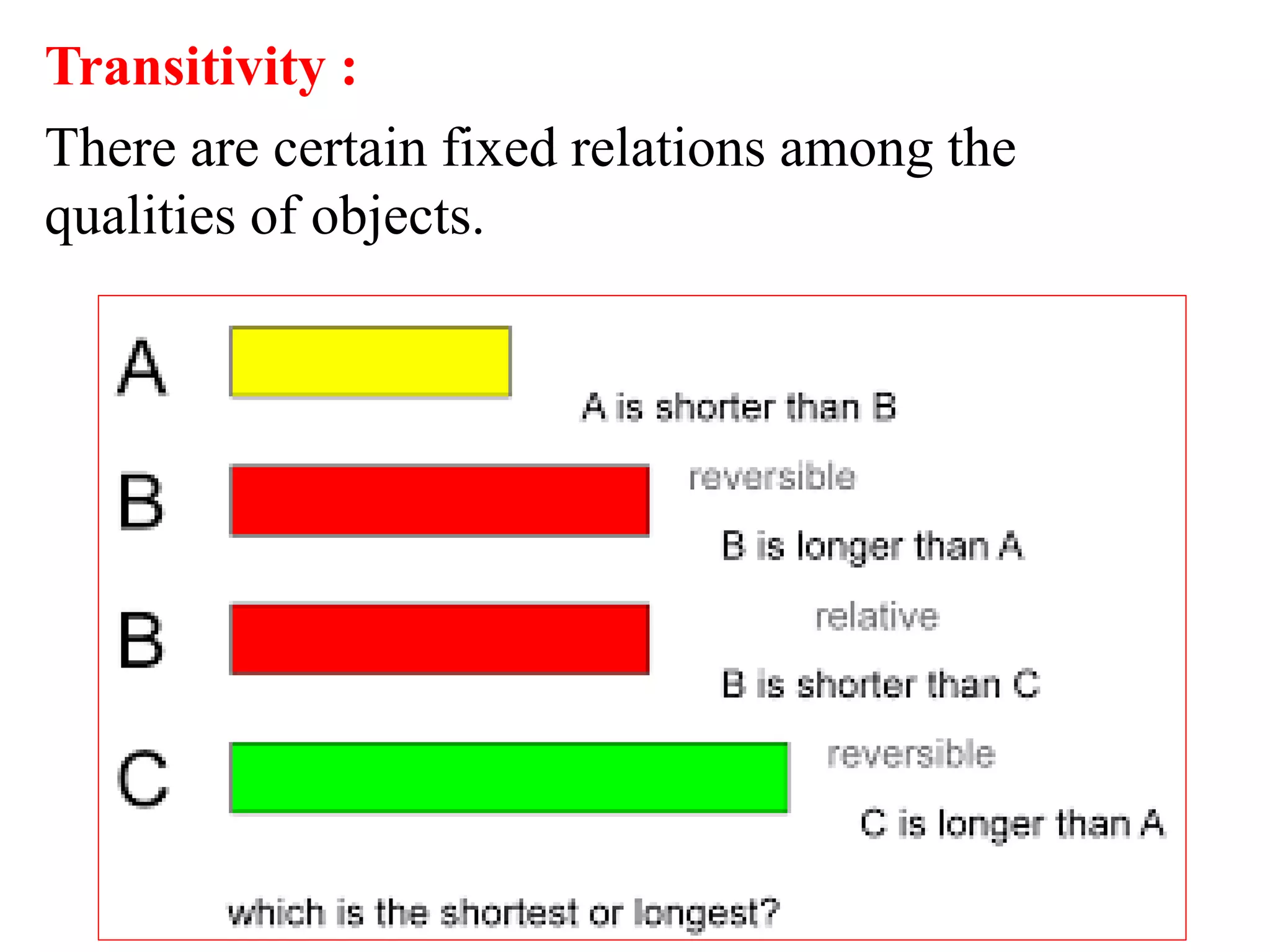
Transitivity :
There are certain fixed relations among the
qualities of objects.
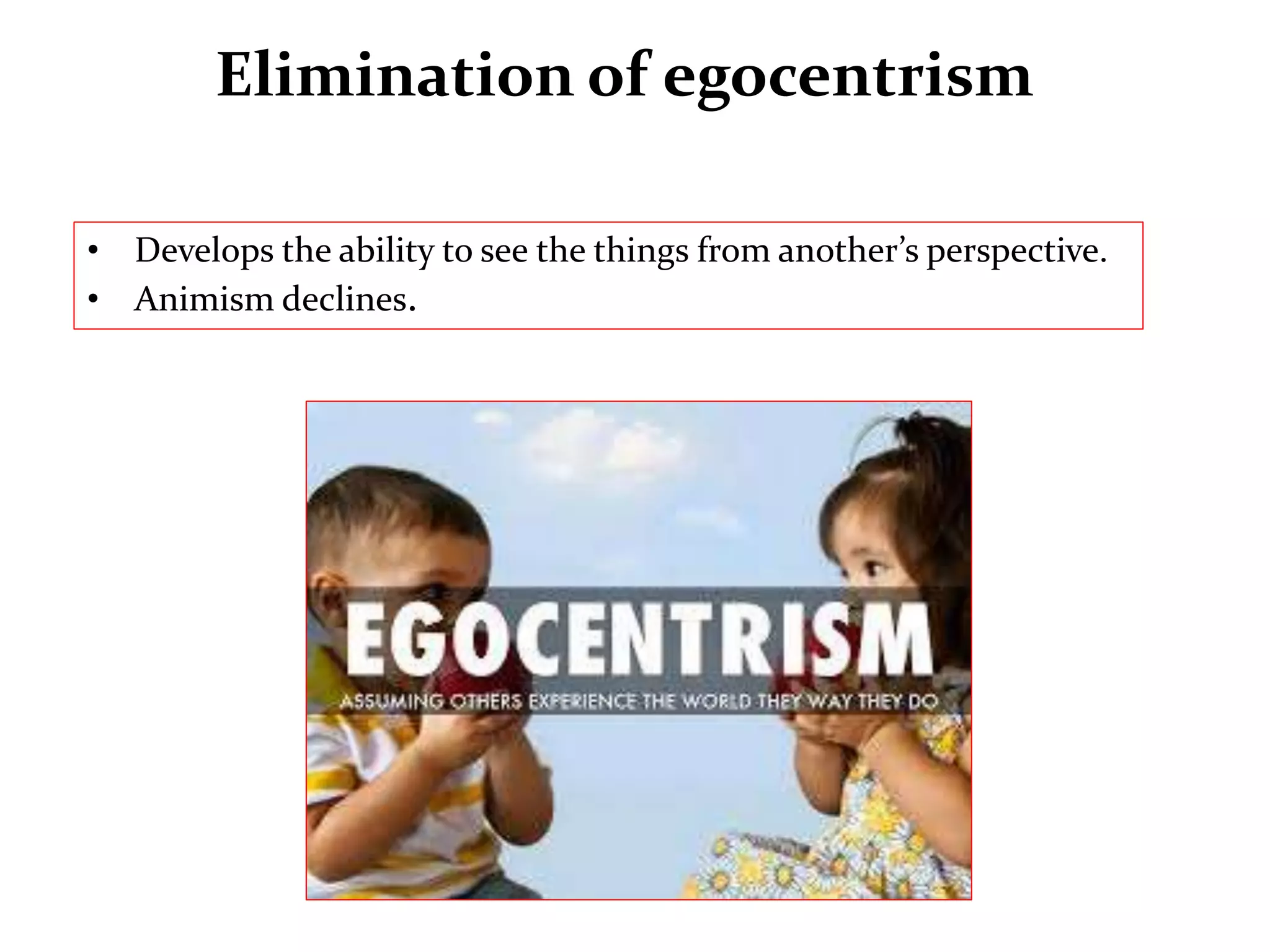
Elimination of egocentrism
• Develops the ability to see the things from another’s perspective.
• Animism declines.
REVERSIBILITY
 The child understands that numbers or objects
can be changed then returned to their original
state.
 For this reason child will be able to rapidly
determine that if 4+4 equals 8, 8-4 will equal 4
, the original quantity.
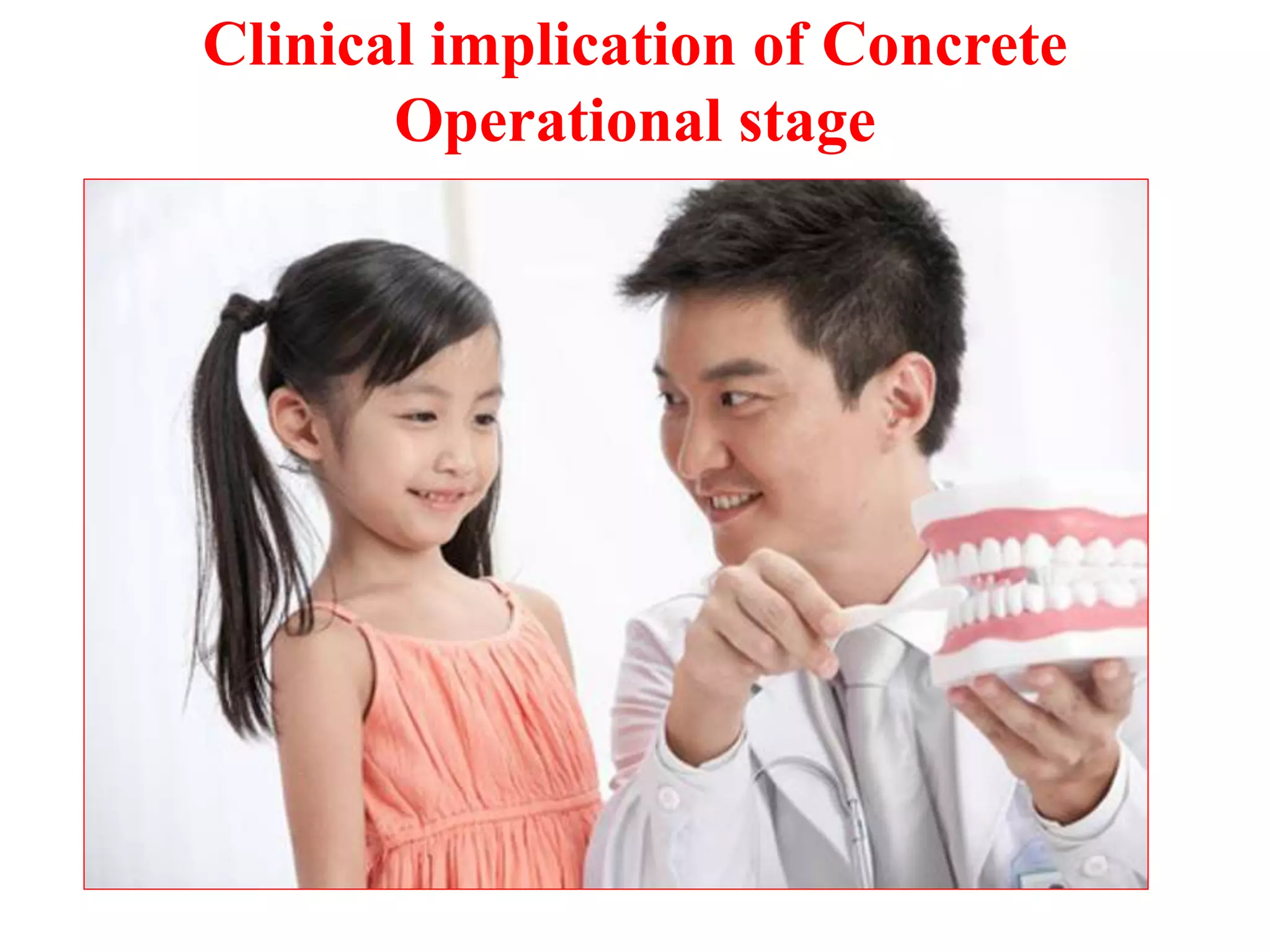
Clinical implication
• During dental treatment, instructions should
be based on concrete objects. " Brush your
teeth in up and down strokes for front teeth;
back and forth strokes for back teeth, twice a
day" may be less understood than saying and
demonstrating" This a model of your teeth.
• The brush should be held in this way for
front teeth and moved in up and down
direction, in this manner."
Clinical implication of Concrete
Operational stage
Period of Formal Operations (11 –
Adolescence)
• At this stage, the child's thought process has become similar to that of an
adult, and the child is capable of understanding concepts like health, disease,
and preventive treatment.
• He will begin to think abstractly, reason logically and draw conclusions from
the information available, as well as apply all these processes to hypothetical
situations.
• Adolescent egocentrism can be dissected into two types of social thinking,
imaginary audience and personal fable.
• This makes them susceptible to peer influence but, in the latter adolescents
sense of personal uniqueness and invincibility makes them think "because I
am unique, I am not subject to consequences others will experience”.
Period of Formal Operations: 11-18
Years
• In this stage, individuals move beyond concrete experiences
and begin to think abstractly, reason logically and draw
conclusions from the information available, as well as apply all
these processes to hypothetical situations.
• During this stage the young adult is able to understand such
things as love, "shades of gray", logical proofs and values. The
young adult begins to entertain possibilities for the future and is
fascinated with what they can be. The adolescent's thought
process is similar to adults and can understand concepts like
health, disease and prevention. Hence he should be treated like
an adult.
Adolescent Egocentrism
Can be dissected into two types of social thinking:
• Imaginary audience involves attention getting
behaviour and heightened self-consciousness. This
makes them susceptible to peer influence.
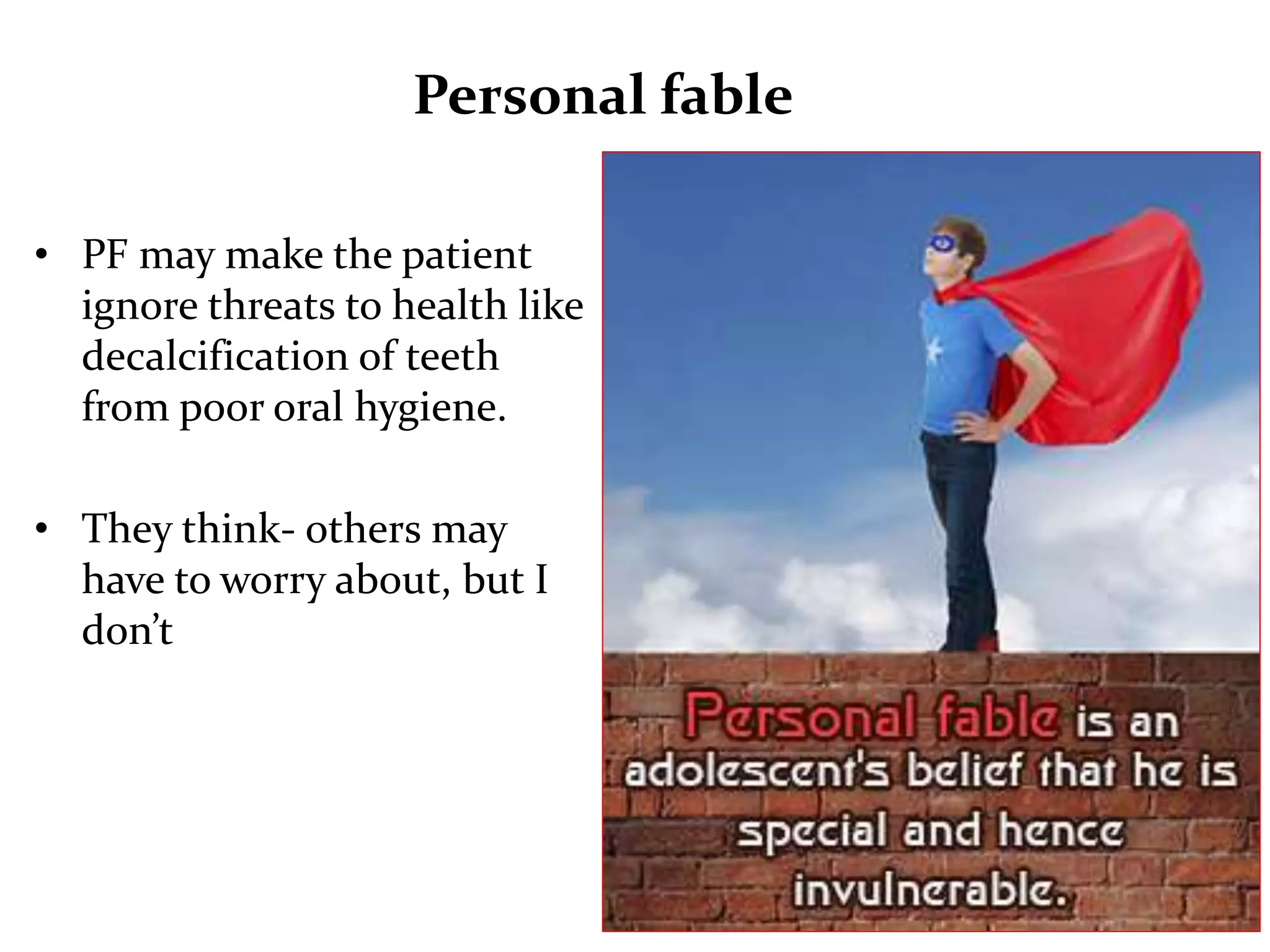
• Personal fable: Adolescents sense of personal
uniqueness and invincibility which makes them think
"because I am unique, I am not subject to
consequences other will experience".
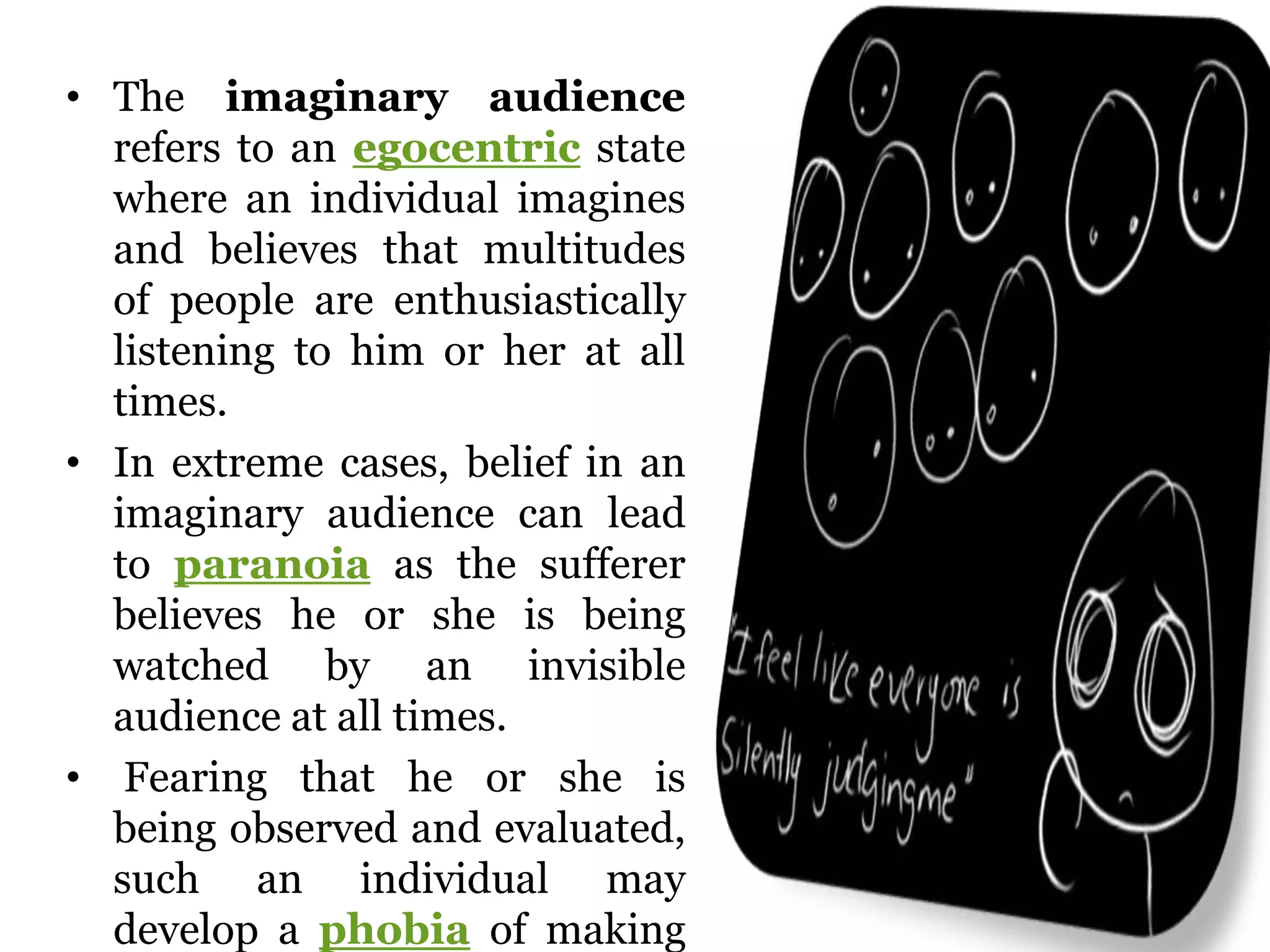
• The imaginary audience
refers to an egocentric state
where an individual imagines
and believes that multitudes
of people are enthusiastically
listening to him or her at all
times.
• In extreme cases, belief in an
imaginary audience can lead
to paranoia as the sufferer
believes he or she is being
watched by an invisible
audience at all times.
• Fearing that he or she is
being observed and evaluated,
such an individual may
develop a phobia of making
Personal fable
• PF may make the patient
ignore threats to health like
decalcification of teeth
from poor oral hygiene.
• They think- others may
have to worry about, but I
don’t
Psychological management of child in dentistry using Jean Piagets Cognitive Theory

Psychological management of child in dentistry using Jean Piagets Cognitive Theory

  • 1.
    Psychological management ofchild using Jean Piaget’s Cognitive theory
  • 2.
    WHY CHILD PSYCHOLOGY “Althoughthe operative dentistry may be perfect the appointment is a failure if the child departs in tears” - Mc Elroy (1895)
  • 3.
    • Child psychologyis the heart and soul of paediatric dentistry as it is directly related to dental fear, the primitive response present universally. • Dental setup is always considered as a threat either due to objective or subjective conditioning of patients towards dentistry and dental pain being one of the worst pains of human kind makes the matter worse. • Invasive procedures like injections aggravate the fear. Despite all the behaviour management techniques available there is dearth of a sincere effort from the dentist’s side to understand a child’s perspective about the dental appointment.
  • 4.
    • It’s veryimportant because the dentist is handling a cognitively, physically mentally and emotionally maturingchild • To lay the foundation of grooming the child in to a perfect patient with positive attitude towards dentistry on thewhole
  • 5.
    What's the hurdlefor practice. flight or fight One has to realise it is either a fright or a flight situation to the child as most of the time he is not prepared to face the treatment and does not realise the need for the treatment.
  • 6.
    Eventually the ironythe child is graded by the dentist as definitely negative and posted to general anaesthesia, which is not free of side effects.
  • 7.
    The child iscompromised due to the lack of knowledge of dentist on child psychology……. So we end up doing General Anesthesia
  • 8.
    "Don't become amere recorder of facts, but try to penetrate the mystery of their origin." Ivan Pavlov (1849-1936)
  • 9.
    Cognitive development ofchild • Cognition refers to mental activities involved in acquisition, processing, organisation and use of knowledge. • This includes detecting, interpreting, classifying and remembering information, evaluating ideas, inferring principles, reducing rules, imagining possibilities, generating strategies, fantasizing and dreaming
  • 10.
    "The brain iswider than the sky." Emily Dickinson (1830-1886)
  • 11.
    Cognitive theory • Cognitionrefers to mental activities involved inacquistion, processing, organisation and use of knowledge. • Cognition include detecting ,interpreting, classifying and remembering information, evaluating ideas, inferring principles and reducing rules, imagining possibilities, generating strategies, fantasying and dreaming.
  • 13.
  • 14.
    Developing a mentalschemata–child take in new experiences through their own system of knowledge. It is now known that infants can from the first day of life smell, see, and hear. Even very young infants have the ability of perceiving movement, facial relationships, and colour. Cognitive competence explains how and why an infant explores a nursing mother’s fingers MODIFYING ONE’S ENVIRONMENT
  • 15.
    • Complementary processfor intelligence to develop child goes on adding newer information to the original schemata MODIFYING SCHEMA
  • 16.
    • Changing basicassumption following adjustments in assimilated knowledge
  • 17.
    Equilibration : Abalanced , harmonious relationship between one’s cognitive structures & the environment.
  • 19.
    In 1984 ,Mussen and co workers noted that there are 4 major areas of cognitive development 1. Area of Perception 2. Recognition of Information 3. Ability to Categorize 4.Enhancement of memory
  • 20.
    1. AREA OFPERCEPTION Every young infant have the ability to perceive, movement facial relationship and color . 2. RECOGNITION OF INFORMATION The child's schemes contain some but not all the crucial elements of the object. So it recognizes the schema even with few information recollected. 3. ABILITY TO CATEGORIZE Children can group things together by way of their shape, color, and use even by the age of 1 year. Cognitive growth is mainly influenced by the intellectual stimulation he gets from his surrounding environment. 4.ENHANCEMENT OF MEMORY Even very young infant have the ability to recall past events and use the information gained to help them to form a reaction to things presently going on
  • 21.
  • 22.
    Inborn motor and sensoryreflex Primary circular reaction Secondary circular reaction Tertiary circular reaction through active experimentation / Causality Object permanence and insight Piaget described that child develop knowledge in the following stages:
  • 23.
    CIRCULAR REACTIONS Primary circular reaction(1-4months) Learning throughalready known object describes recreating an already known satisfying action, such as thumb sucking.
  • 24.
    Secondary circular reactions 4-8months • Recreating of an accidentally discovered cause and effect. • Responds to own name
  • 25.
    TERTIARY CIRCULAR REACTIONS 12-18MONTHS Deliberately varies behaviour to create novel effect. Reactions involve experimentation
  • 26.
    OBJECT PERMANENCE Objects continueto exist even when they are not perceivable by the child.
  • 27.
    Clinical implications ofSensorimotor stage • The dental home concept says treat the child as soon as the first tooth erupts in the oral cavity ie at 6 months so if the mother brings the child very frequently along with her the child learns about the setup and gets to feed information in brain through circular reactions also the stranger anxiety which peaks if not seen the stranger can be minimised. • This can be done by taking advantages of exemplary modeling by mother or sibling in procedures like scaling done on them.
  • 28.
    • Those beingtreated should display courage and smile throughout the procedure, giving an impression to the child that dentistry is not a place of threat instead can be enjoyable, as cognitive growth is mainly influenced by the intellectual stimulation he gets from his surrounding environment. • So, appropriate conduct of pediatric dentists is extremely important during the treatment of children in situations that can lead to fear, helping to avoid dental fear and contributing to improvements in health care promotion.
  • 29.
    PRE OPERATIONAL STAGE •Preschool children are considered as not having acquired the cognitive ability to think logically • Acquire the ability to form mental images of objects and events • Language develops to the point at which they begin to think in terms of verbal symbols – words.
  • 30.
    PRE OPERATIONAL PERIOD PRECONCEPTUAL 2-4yrs INTUITIVE 4-7yrs
  • 31.
    ALL FEATURES • Trialand error • Animism • Egocentrism • Centration • Generalization • Constructivism
  • 32.
    TRIALAND ERROR • Thechild understands himself and his surrounding environment by becoming a little explorer, seizing opportunities for picking and dropping, poking and rubbing, twisting and pulling, shaking and breaking. • The child attains his normal intellectual growth due to these explorations.
  • 33.
    • Is thebelief that inanimate objects are capable of actions and have lifelike qualities. • Ex, a child who gets hit by the edge of the door while running says that the door has gone mad and hit him badly. • Essentially everything is seen as being alive by the child, so stories that have inanimate objects with life are acceptable. • Animism can be used to dentist's advantage by giving life-like names and qualities to equipments, e.g. the handpiece is the "Whistling Willie" who is happy and sings while he polishes the child's teeth A N I M I S M
  • 34.
    Using fantasy playand language to help child become more comfortable
  • 35.
    Tooth brushing Washing themouth with vaccum and 3 way syringe Cleaning the teeth with brush in hand piece Drilling a vital tooth with air turbine Anesthetic solution referred As water to put tooth to sleep Motivating patient towards oral health Structuring
  • 36.
    Constructivism • Children areactive thinkers who are constantly trying to construct more accurate or advanced understanding of the world around them
  • 37.
    Constructs knowledge aboutunknown world of dentistry by handling and working with dental instruments
  • 39.
    Egocentrism • Child isincapable of assuming another person's point of view. • Instead refers to intellectual limitation. Types of Egocentrism Perceptional Cognitive
  • 40.
    Cognitive egocentrism • Childrenfind it difficult that other people do not know their thoughts. In communicating with others children often forget themselves in the role of listener and to adapt their message to that person.
  • 42.
    To assess theconcept of cardinal numbers, the coin experiment is done • Pre operational child-longer row has more coins • Concrete operational – rearrangement of button does not change their number
  • 44.
    Perceptual egocentrism • Incapableof assuming another persons point of view
  • 45.
    Reasoning • They arecapable of transductive reasoning from particular to particular. They can understand cause-effect relationship but is limited to a particular event or object. • They are NOT capable of inductive reasoning (from particular to general) or deductive reasoning (from general to particular). • As result a volley of questions may be asked to the adult such as "How" and "Why".
  • 47.
    Clinical implication ofegocentrism • It will be useless to point out how proud his parents will be if he cooperated for the dental treatment as the child can't see the parent's point of view. • Instead if the dentist shows the decayed discoloured teeth and says "your teeth will be better if these germs are out of them" it is accepted by the child.
  • 48.
    • This isstructuring, a procedure of behavior management, where the child is explained the need for the procedure with proof. • An Early childhood caries patient is given a face mirror and explained that all anterior teeth are broken and they need to be repaired to look like his friends, make the child realize the need for treatment and he will cooperate through out. • Also allowing him to watch what is done and witnessing improvement in the appearance of decayed teeth will form a foundation for future procedures
  • 49.
    Period of ConcreteOperations. (6-12 years) • An improved ability to reason emerges during this period. • The thinking process becomes logical. • He develops the ability to use complex mental operations such as additions and subtraction • The child is able to understand others point of view and animism declines.
  • 50.
    FEATURES • Conservation • Decentration •Elimination of egocentrism • Seriation • Transitivity • Reversibility
  • 51.
    Decentration: • To focustheir attention on several attributes of an object or event simultaneously & to understand the relation between dimensions. Conservation : • Understanding that quantity, length or no. of items is unrelated to the arrangement or appearance of the object object or items. the child can successfully pass through through the conservative experiments.
  • 52.
    Seriation: • A characteristicof the concrete operational child is the ability to arrange objects according to some quantified dimensions such as weight or size. This ability is called Seriation. • An 8 year old can arrange eight sticks of different lengths in order from shortest to longest
  • 53.
    Transitivity : There arecertain fixed relations among the qualities of objects.
  • 54.
    Elimination of egocentrism •Develops the ability to see the things from another’s perspective. • Animism declines.
  • 55.
    REVERSIBILITY  The childunderstands that numbers or objects can be changed then returned to their original state.  For this reason child will be able to rapidly determine that if 4+4 equals 8, 8-4 will equal 4 , the original quantity.
  • 56.
    Clinical implication • Duringdental treatment, instructions should be based on concrete objects. " Brush your teeth in up and down strokes for front teeth; back and forth strokes for back teeth, twice a day" may be less understood than saying and demonstrating" This a model of your teeth. • The brush should be held in this way for front teeth and moved in up and down direction, in this manner."
  • 57.
    Clinical implication ofConcrete Operational stage
  • 58.
    Period of FormalOperations (11 – Adolescence) • At this stage, the child's thought process has become similar to that of an adult, and the child is capable of understanding concepts like health, disease, and preventive treatment. • He will begin to think abstractly, reason logically and draw conclusions from the information available, as well as apply all these processes to hypothetical situations. • Adolescent egocentrism can be dissected into two types of social thinking, imaginary audience and personal fable. • This makes them susceptible to peer influence but, in the latter adolescents sense of personal uniqueness and invincibility makes them think "because I am unique, I am not subject to consequences others will experience”.
  • 59.
    Period of FormalOperations: 11-18 Years • In this stage, individuals move beyond concrete experiences and begin to think abstractly, reason logically and draw conclusions from the information available, as well as apply all these processes to hypothetical situations. • During this stage the young adult is able to understand such things as love, "shades of gray", logical proofs and values. The young adult begins to entertain possibilities for the future and is fascinated with what they can be. The adolescent's thought process is similar to adults and can understand concepts like health, disease and prevention. Hence he should be treated like an adult.
  • 60.
    Adolescent Egocentrism Can bedissected into two types of social thinking: • Imaginary audience involves attention getting behaviour and heightened self-consciousness. This makes them susceptible to peer influence. • Personal fable: Adolescents sense of personal uniqueness and invincibility which makes them think "because I am unique, I am not subject to consequences other will experience".
  • 61.
    • The imaginaryaudience refers to an egocentric state where an individual imagines and believes that multitudes of people are enthusiastically listening to him or her at all times. • In extreme cases, belief in an imaginary audience can lead to paranoia as the sufferer believes he or she is being watched by an invisible audience at all times. • Fearing that he or she is being observed and evaluated, such an individual may develop a phobia of making
  • 62.
    Personal fable • PFmay make the patient ignore threats to health like decalcification of teeth from poor oral hygiene. • They think- others may have to worry about, but I don’t