Prepared by:
Nikul pithva
(151080119021)
Guided by:-
Medha shah
X-ray physicsX-ray physics
ContentContent
 Introduction, history and basic physics.Introduction, history and basic physics.
 How radiograph produce.How radiograph produce.
 Interaction of x-ray with patient.Interaction of x-ray with patient.
 Formation of the image.Formation of the image.
 Processing the film.Processing the film.
Discovery of x-raysDiscovery of x-rays
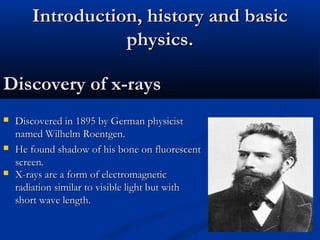
 Discovered in 1895 by German physicistDiscovered in 1895 by German physicist
named Wilhelm Roentgen.named Wilhelm Roentgen.
 He found shadow of his bone on fluorescentHe found shadow of his bone on fluorescent
screen.screen.
Introduction, history and basicIntroduction, history and basic
physics.physics.
 X-rays are a form of electromagneticX-rays are a form of electromagnetic
radiation similar to visible light but withradiation similar to visible light but with
short wave length.short wave length.
Properties of x-raysProperties of x-rays
 Are electromagneticAre electromagnetic
radiations composed ofradiations composed of
small packets of energysmall packets of energy
called photons.called photons.
 Travel at speed of light.Travel at speed of light.
 Travel in straight lines.Travel in straight lines.
 Highly penetrating.Highly penetrating.
 Invisible.Invisible.
 Blacken radiographicBlacken radiographic
films.films.
 Produce scatter.Produce scatter.
Production of radiographProduction of radiograph
 X-ray are produced in the machine.X-ray are produced in the machine.
 X-ray interact with the patient.X-ray interact with the patient.
 Image is recorded in the x-ray plate.Image is recorded in the x-ray plate.
How radiographs are producedHow radiographs are produced
Production of the x-ray radiationsProduction of the x-ray radiations
on the machine.on the machine.
Steps in x-ray production:-Steps in x-ray production:-
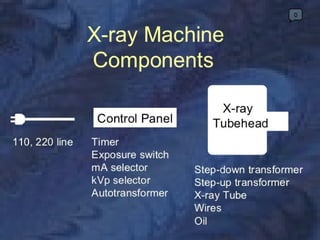
Filament is heated and gives off cloud of electrons.Filament is heated and gives off cloud of electrons.
A large electrical charge is placed in the cathode/anode spaceA large electrical charge is placed in the cathode/anode space
causing the electrons to race toward the anode.causing the electrons to race toward the anode.
When they crush into the anode it causes x-ray to be given off.When they crush into the anode it causes x-ray to be given off.
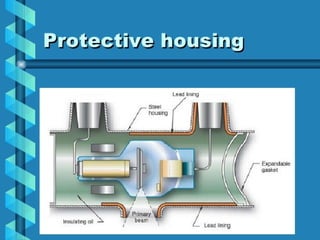
X-ray tube headX-ray tube head
Stationary anode.Stationary anode.
 Found in smallerFound in smaller
machines.machines.
 The target is fixed inThe target is fixed in
block of copper.block of copper.
 Only capable of lowOnly capable of low
output.output.
 mA to 30mA to 30
Rotating anode.Rotating anode.
 Found in large machines.Found in large machines.
 The target is rotate inThe target is rotate in
tungsten disc.tungsten disc.
 Higher outputHigher output
producing.producing.
 mA up to 300mA up to 300
Control panelControl panel
 Higher kv attract the electrons toward the anode byHigher kv attract the electrons toward the anode by
greater force.greater force.
 They smash the anode harder and produce x-ray withThey smash the anode harder and produce x-ray with
higher energy and greater tissue penetrating power.higher energy and greater tissue penetrating power.
 Increasing mA increase the number of electrons cloudIncreasing mA increase the number of electrons cloud
around the filament. Result in higher number of x-rayaround the filament. Result in higher number of x-ray
produced per second.produced per second.
How x-ray interact with patients.How x-ray interact with patients.
Three things occurred:Three things occurred:
Some x-rays absorbed.Some x-rays absorbed.
Some pass straight through the patient.Some pass straight through the patient.
Some scattered.Some scattered.
Depend on three things:Depend on three things:
X-ray energy. In high kv most of x-rays pass to the film throughX-ray energy. In high kv most of x-rays pass to the film through
the patient.the patient.
Atomic number of the absorber.Atomic number of the absorber.
Thickness and density of the object.Thickness and density of the object.
How image is formedHow image is formed
As an x-ray beam leave the tube head, it fans out andAs an x-ray beam leave the tube head, it fans out and
become weaker.become weaker.
As the distance double, the strength is reduced.As the distance double, the strength is reduced.
Formation of the image:Formation of the image:
The distance from the anode target to the film is calledThe distance from the anode target to the film is called
the film focal distance.the film focal distance.
Changing the distance affect the quantity of the x-rayChanging the distance affect the quantity of the x-ray
reaching the film.reaching the film.
Increasing the distance means that less x-rays reachesIncreasing the distance means that less x-rays reaches
the film.the film.
Processing filmsProcessing films
There are five steps:There are five steps:
Developing.Developing.
Rinsing,Rinsing,
Fixing.Fixing.
Washing.Washing.
Drying.Drying.
Development:Development:
Chemical convert the exposed AgBr in to metallic silver.Chemical convert the exposed AgBr in to metallic silver.
The bromine goes into solution.The bromine goes into solution.
Unexposed AgBr is less affected.Unexposed AgBr is less affected.
Rinsing:Rinsing:
 Essential to rinse of the developer solution so that the fixerEssential to rinse of the developer solution so that the fixer
solution is not contaminated.solution is not contaminated.
 Contamination ::leads to faster exhaustion of the fixer.Contamination ::leads to faster exhaustion of the fixer.
Fixing:Fixing:
 Stops development.Stops development.
 Washes away unexposed and undeveloped silver halide crystals.Washes away unexposed and undeveloped silver halide crystals.
 Hardens the emulsion.Hardens the emulsion.
Washing:Washing: To wash all traces of fixer from emulsionTo wash all traces of fixer from emulsion..
Draying:Draying:
Hang up in dust free area to dry.
Automatic processors by it by using hot air.
Physics(x rays)

Physics(x rays)

  • 1.
    Prepared by: Nikul pithva (151080119021) Guidedby:- Medha shah X-ray physicsX-ray physics
  • 2.
    ContentContent  Introduction, historyand basic physics.Introduction, history and basic physics.  How radiograph produce.How radiograph produce.  Interaction of x-ray with patient.Interaction of x-ray with patient.  Formation of the image.Formation of the image.  Processing the film.Processing the film.
  • 3.
    Discovery of x-raysDiscoveryof x-rays  Discovered in 1895 by German physicistDiscovered in 1895 by German physicist named Wilhelm Roentgen.named Wilhelm Roentgen.  He found shadow of his bone on fluorescentHe found shadow of his bone on fluorescent screen.screen. Introduction, history and basicIntroduction, history and basic physics.physics.  X-rays are a form of electromagneticX-rays are a form of electromagnetic radiation similar to visible light but withradiation similar to visible light but with short wave length.short wave length.
  • 4.
    Properties of x-raysPropertiesof x-rays  Are electromagneticAre electromagnetic radiations composed ofradiations composed of small packets of energysmall packets of energy called photons.called photons.  Travel at speed of light.Travel at speed of light.  Travel in straight lines.Travel in straight lines.  Highly penetrating.Highly penetrating.  Invisible.Invisible.  Blacken radiographicBlacken radiographic films.films.  Produce scatter.Produce scatter.
  • 5.
    Production of radiographProductionof radiograph  X-ray are produced in the machine.X-ray are produced in the machine.  X-ray interact with the patient.X-ray interact with the patient.  Image is recorded in the x-ray plate.Image is recorded in the x-ray plate. How radiographs are producedHow radiographs are produced
  • 6.
    Production of thex-ray radiationsProduction of the x-ray radiations on the machine.on the machine. Steps in x-ray production:-Steps in x-ray production:- Filament is heated and gives off cloud of electrons.Filament is heated and gives off cloud of electrons. A large electrical charge is placed in the cathode/anode spaceA large electrical charge is placed in the cathode/anode space causing the electrons to race toward the anode.causing the electrons to race toward the anode. When they crush into the anode it causes x-ray to be given off.When they crush into the anode it causes x-ray to be given off.
  • 9.
    X-ray tube headX-raytube head Stationary anode.Stationary anode.  Found in smallerFound in smaller machines.machines.  The target is fixed inThe target is fixed in block of copper.block of copper.  Only capable of lowOnly capable of low output.output.  mA to 30mA to 30 Rotating anode.Rotating anode.  Found in large machines.Found in large machines.  The target is rotate inThe target is rotate in tungsten disc.tungsten disc.  Higher outputHigher output producing.producing.  mA up to 300mA up to 300
  • 10.
    Control panelControl panel Higher kv attract the electrons toward the anode byHigher kv attract the electrons toward the anode by greater force.greater force.  They smash the anode harder and produce x-ray withThey smash the anode harder and produce x-ray with higher energy and greater tissue penetrating power.higher energy and greater tissue penetrating power.  Increasing mA increase the number of electrons cloudIncreasing mA increase the number of electrons cloud around the filament. Result in higher number of x-rayaround the filament. Result in higher number of x-ray produced per second.produced per second.
  • 11.
    How x-ray interactwith patients.How x-ray interact with patients. Three things occurred:Three things occurred: Some x-rays absorbed.Some x-rays absorbed. Some pass straight through the patient.Some pass straight through the patient. Some scattered.Some scattered. Depend on three things:Depend on three things: X-ray energy. In high kv most of x-rays pass to the film throughX-ray energy. In high kv most of x-rays pass to the film through the patient.the patient. Atomic number of the absorber.Atomic number of the absorber. Thickness and density of the object.Thickness and density of the object.
  • 12.
    How image isformedHow image is formed As an x-ray beam leave the tube head, it fans out andAs an x-ray beam leave the tube head, it fans out and become weaker.become weaker. As the distance double, the strength is reduced.As the distance double, the strength is reduced. Formation of the image:Formation of the image: The distance from the anode target to the film is calledThe distance from the anode target to the film is called the film focal distance.the film focal distance. Changing the distance affect the quantity of the x-rayChanging the distance affect the quantity of the x-ray reaching the film.reaching the film. Increasing the distance means that less x-rays reachesIncreasing the distance means that less x-rays reaches the film.the film.
  • 13.
    Processing filmsProcessing films Thereare five steps:There are five steps: Developing.Developing. Rinsing,Rinsing, Fixing.Fixing. Washing.Washing. Drying.Drying. Development:Development: Chemical convert the exposed AgBr in to metallic silver.Chemical convert the exposed AgBr in to metallic silver. The bromine goes into solution.The bromine goes into solution. Unexposed AgBr is less affected.Unexposed AgBr is less affected.
  • 14.
    Rinsing:Rinsing:  Essential torinse of the developer solution so that the fixerEssential to rinse of the developer solution so that the fixer solution is not contaminated.solution is not contaminated.  Contamination ::leads to faster exhaustion of the fixer.Contamination ::leads to faster exhaustion of the fixer. Fixing:Fixing:  Stops development.Stops development.  Washes away unexposed and undeveloped silver halide crystals.Washes away unexposed and undeveloped silver halide crystals.  Hardens the emulsion.Hardens the emulsion. Washing:Washing: To wash all traces of fixer from emulsionTo wash all traces of fixer from emulsion.. Draying:Draying: Hang up in dust free area to dry. Automatic processors by it by using hot air.