A.KUMAR
PG STUDENT
ORAL MEDICINE AND RADIOLOGY
RADIATION PHYSICS
CONTENTS
• ENERGY
• HISTORY OF X-RAY
• X-RAY MACHINE
• PRODUCTION OF X-RADIATION
• PROPERTIES OF X-RAY
• USES OF X-RAYS
• FACTORS CONTROLLING THE X-RAY BEAM
ATOM
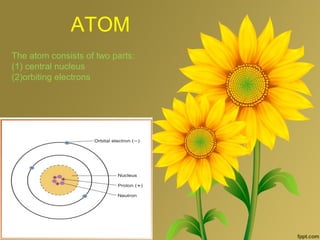
The atom consists of two parts:
(1) central nucleus
(2)orbiting electrons
ATOM
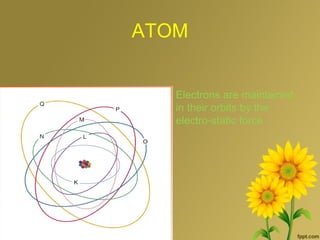
Electrons are maintained
in their orbits by the
electro-static force
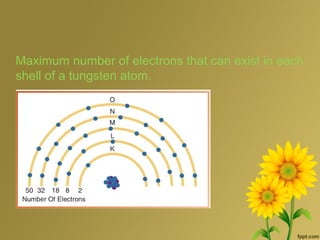
Maximum number of electrons that can exist in each
shell of a tungsten atom.
BINDING ENERGY
• Electrons are maintained in their orbits by the electro-
static force, or attraction, between the positive nucleus
and the negative electrons. This is known as the
binding energy, or binding force, of an electron.
• For example, in the tungsten atom, the binding
energies are as follows:
• 70 keV K-shell electrons
• 12 keV L-shell electrons
• 3 keV M-shell electrons
ENERGY
• In physics, energy is a property of objects, transferable
among them via fundamental interactions, which can be
converted into different forms but not created or destroyed
• the capacity for doing work
• Some examples of different kinds of energy
• Kinetic
• Electric
• Heat
• Potential
• Chemical
• Atomic
• Radiation
RADIATION
• Radiation, as defined as the emission and
propagation of energy through space or a
substance in the form of waves or
particles.
• IONIZING RADIATION
• NON-IONIZING RADIATION
Ionization
• A neutral atom contains an equal number of protons
(positive charges) and electrons (negative charges).
• An atom that gains or loses an electron and becomes
electrically unbalanced is known as an ion.
• Ionization is the production of ions, or the process of
converting an atom into ions.
Ionizing Radiation
• Ionizing radiation can be defined as radiation that is
capable of producing ions by removing or adding an
electron to an atom.
• Ionizing radiation can be classified into two groups:
• (1) particulate radiation
• (2) electromagnetic radiation.
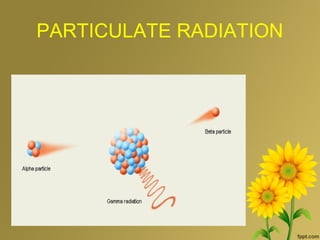
PARTICULATE RADIATION
ELECTROMAGNETIC
RADIATION
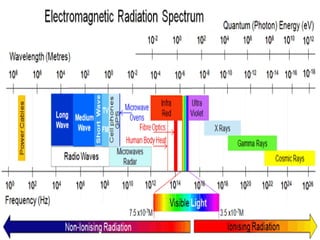
• Electromagnetic radiation can be defined
as the propagation of wave like energy
(without mass) through space or matter.
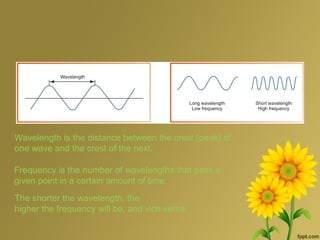
Wavelength is the distance between the crest (peak) of
one wave and the crest of the next.
Frequency is the number of wavelengths that pass a
given point in a certain amount of time.
The shorter the wavelength, the
higher the frequency will be, and vice versa.
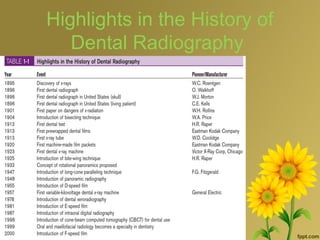
RADIAION HISTORY
The history of dental radiography begins
with the discovery of the x-ray.
Wilhelm Conrad Roentgen discovered the
x-ray on November 8, 1895.
Highlights in the History of
Dental Radiography
• An x-ray is a beam of energy that has the power to
penetrate substances and record image shadows
on photographic film.
• Radiation: A form of energy carried by waves or a
stream of particles
• Radiograph: A two-dimensional representation of a
three-dimensional object. In practice, often called
an “x-ray”; this is not correct. X-ray (also x ray) is a
term that refers to a beam of energy
• Radiography: The art and science of making
radiographs by the exposure of film to x-rays
• Dental radiography: The production of radiographs
of the teeth and adjacent structures by the
exposure of an image receptor to x-rays
X-RAY MACHINE
The dental x-ray machine can be divided into three study areas:
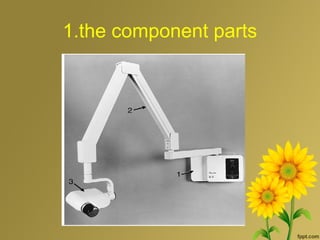
1.The component parts
 control panel
 extension arm
 tube head
2.The x-ray tube
Leaded-glass housing
Negative cathode
Positive anode
3.The x-ray generating apparatus.
Electricity and Electrical Currents
Circuits
Transformers
1.the component parts
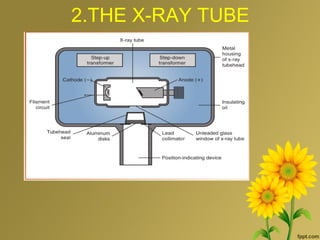
2.THE X-RAY TUBE
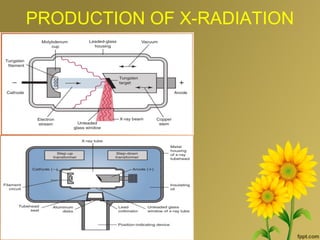
The x-ray tube is the heart of the x-ray
generating system
The component parts of the x-ray tube
include a
Leaded-glass housing
Negative cathode
Positive anode
The leaded-glass housing
leaded-glass vacuum tube that prevents x-rays from escaping in all directions. One
central area of the leaded-glass tube has a “window” that permits the x-ray beam to exit
the tube and directs the x-ray beam toward the aluminum disks, lead collimator
Filtration:
The sheets of 0.5 mm thick aluminum is placed in the path of the X-ray beam.
They filter out the non-penetrating, longer wave-length X-rays.
Inherent filtration.
 Added filtration.
 Total filtration (inherent + added filtration)
•At or below 70 kVp require a minimum total filtration of 1.5 mm of aluminum thickness.
• Above 70 kVp require a minimum total filtration of 2.5 mm of aluminum thickness.
collimator
 It is a lead plate with a central hole that fit directly over the
opening of the metal housing where the X-rays exit.
 Collimation is used to restrict the size and shape of the X-ray
beam and thus reduce exposure to the patient.
 Collimators are of two types:
a. Fixed.b. Adjustable.
 In the dental X-ray machine usually the fixed collimators are
used, they may either have a round or rectangular opening.
The cathode
• The tungsten filament, or coiled wire made of tungsten,
which produces electrons when heated.
• The molybdenum cup,which focuses the electrons into a
narrow beam and directs the beam across the tube toward
the tungsten target of the anode.
Tungsten is target ,
High atomic number-74
High melting point: 3380°C
Low vapor pressure:
The anode
• A tungsten target, or plate of tungsten, which serves as a
focal spot and converts bombarding electrons into x-ray
photons.
• The copper stem, which functions to dissipate the heat
away from the tungsten target.
Tungsten is a poor conductor of heat.
The methods of heat dissipation are:
i. Conduction: through the copper stem.
ii. Convection: through the oil surrounding the tube.
iii. Radiation: through the radiator device attached
to the copper stem.
iv. Rotating anode.
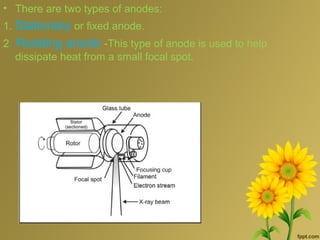
• There are two types of anodes:
1. Stationary or fixed anode.
2. Rotating anode -This type of anode is used to help
dissipate heat from a small focal spot.
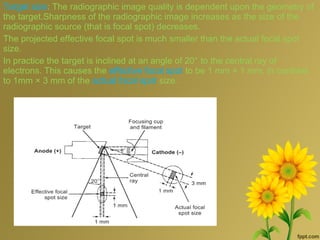
Target size: The radiographic image quality is dependent upon the geometry of
the target.Sharpness of the radiographic image increases as the size of the
radiographic source (that is focal spot) decreases.
The projected effective focal spot is much smaller than the actual focal spot
size.
In practice the target is inclined at an angle of 20° to the central ray of
electrons. This causes the effective focal spot to be 1 mm × 1 mm, in contrast
to 1mm × 3 mm of the actual focal spot size.
3.X-RAY GENERATING APPARATUS
Electricity and Electrical Currents
Circuits
Transformers
Electricity and Electrical Currents
Amperage is the measurement of the number of electrons
moving through a conductor. Current is measured in
amperes (A) or milliamperes (mA).
Voltage is the measurement of electrical force that causes
electrons to move from a negative pole to a positive one. Voltage
is measured in volts (V) or kilovolts (kV).
Circuits
• A circuit is a path of electrical current. Two electrical circuits
are used in the production of x-rays:
• (1) A low-voltage, or filament circuit
• (2) A high-voltage circuit.
• The filament circuit uses 3 to 5 volts, regulates the flow of
electrical current to the filament of the x-ray tube, and is
controlled by the milliampere settings.
• The high-voltage circuit uses 65,000 to 100,000 volts,
provides the high voltage required to accelerate electrons
and to generate x-rays in the x-ray tube, and is controlled by
the kilovoltage settings.
TRANSFORMERS
• A step-down transformer is used to decrease the voltage from
the incoming 220-line voltage to the 3 to 5 volts used by the
filament circuit
• A step-up transformer is used to increase the voltage from the
incoming 220-line voltage to the 65,000 to 100,000 volts used
by the high-voltage circuit
• An autotransformer serves as a voltage compensator that
corrects for minor fluctuations in the current.
PRODUCTION OF X-RADIATION
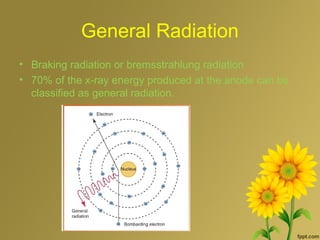
General Radiation
• Braking radiation or bremsstrahlung radiation
• 70% of the x-ray energy produced at the anode can be
classified as general radiation.
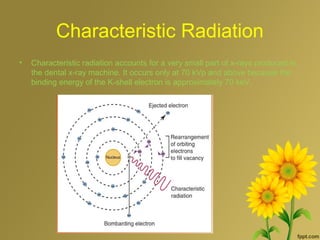
Characteristic Radiation
• Characteristic radiation accounts for a very small part of x-rays produced in
the dental x-ray machine. It occurs only at 70 kVp and above because the
binding energy of the K-shell electron is approximately 70 keV.
PROPERTIES OF X-RAY
PROPERTIES OF X-RAY
• The properties of X-rays may be classified into three
broad categories:
• A. Physical
• B. Biological
• C. Physiochemical.
PHYSICAL PROPERTIES
• 1. X-rays belong to a family of electromagnetic radiations having a
wavelength between 10 Å and 0.01 Å.
• 2. They travel through space in a wave motion.
• 3. In free space they travel in a straight line.
• 4. They travel with the same speed as that of visible light
• 5.They are invisible to the eye and cannot be seen, heard or smell
(they remain undetected by the human senses).
• 6. They cannot be focused by a lens.
• 7.They cannot be reflected, refracted or deflected by a magnet or
electricfield as they do not possess any charge.
• 8. X-rays are pure energy, no mass and they transfer energy from place to
place in the form of quanta (photons).
• Property of attenuation, absorption and scatter; when passing through
matter the intensity of radiation is reduced (attenuation) . Radiation energy
is taken up by the material (absorption) and some is deflected from the
original path, to travel in a new direction (scattering).
• Fluorescence: When X-rays fall upon certain materials, visible
light is emitted called fluorescence, and it was this very
property which led to the discovery of X-rays.
• a. Phosphorescent materials: These materials continue to emit
light for a period of time after the X-ray absorption has taken
place. This is called 'after glow' and it is used in the
advertisement lightings.
• b. Fluorescent materials: Here the emission of light is
instantaneous, quickly completed following X-ray irradiation.
This property is used in Intensifying screens and Mass
Miniature Radiography (photo fluorography).
• Ionization: This is a process of converting atoms into ions
• Various devices that work on the principle of ionization are:
• i. Ionization chamber.
• ii. Thimble chamber.
• iii. Condenser chamber.
• iv. Geiger Muller counter.
Effect of Interaction of
X-rays with Matter (or) Tissues
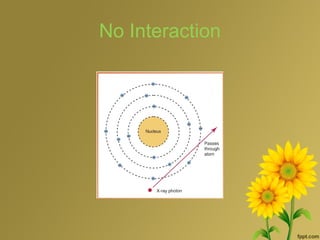
 No interaction
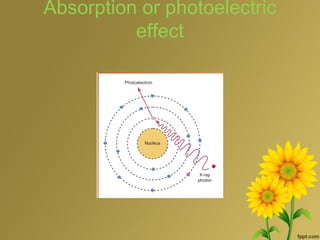
 Absorption or photoelectric effect
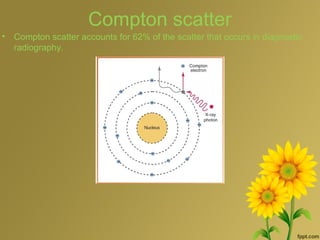
 Compton scatter
 Coherent scatter.
 Pair production
No Interaction
Absorption or photoelectric
effect
Compton scatter
• Compton scatter accounts for 62% of the scatter that occurs in diagnostic
radiography.
Coherent scatter
PAIR PRODUCTION
• Pair production: When a photon having excess energy
(equal to or more than 1.02 MeV) passes close to the
nucleus of an atom, the photon may completely
disappear and in its place positive and negative
electrons appear.
 Somatic effect: This ranges from a simple
sun burn to severe dermatitis, to changes in
the blood supply and/or malignancy.
 Genetic effect: This effect is due to
radiation induced mutation of genes and
chromosomes.These effects are usually
seen in the off-springs of the irradiated
parents.
DIAGNOSTIC PROPERTIES
•1. X-rays travel in a straight line.
•2. Penetration: X-rays can penetrate liquids, solids and gases. The composition of the
substance determines whether the X-rays penetrate or are absorbed.
•3. Absorption: X-rays are absorbed by matter, the absorption depends on the atomic
structure of the matter and the wavelength of the X-ray.
•4. Ionizing capability: X-rays interact with materials they penetrate and cause ionization,
dissociate silver ions in film emulsions.
•5. Fluorescence: X-rays can cause substances to fluorescence or emit light radiation in
longer wavelengths. (e.g. visible light or ultra-violet light ).
•6. Effect on films: X-rays can produce an image on a photographic film.
•7. Effect on living tissues: X-rays cause biological changes in living cells.
USES OF X-RAYS
1. Radiology:
Diagnostic use in dentistry and medicine, helps to
diagnose various pathological lesions.
2. Radiotherapy:
X-rays are used to destroy malignant tumors and to
cure skin diseases.
3. Industry:
i. Used to detect defect in radio valves, tennis balls, tyres.
ii. Used to detect presence of pearls in oysters.
iii. Used to test the uniformity of insulating material.
iv. Used to test the quality of oil paintings.
• 4. Engineering:
• i. For examination of gross structures.
• ii. Used to detect cracks in structures and blow holes in metals.
• iii. To test quality of welding, moulds and metal castings.
• iv. To detect cracks in the body of airplanes,motor cars and
vans.
• 5. Spectroscopy: Identification of elements and their atomic
numbers and structures.
• 6. Photochemistry: Ionization of chemicals producing
oxidation reduction, etc.
• 7. Radiobiology: Alteration of cells and tissues for
experimental purposes.
• 8. Crystallography: Analysis of molecular structures.
• 9. Sterilization: Preservation of food.
• 10. Detective department:
i. To detect smuggling of precious metals and other
contrabrand goods like opium in sealed parcels and
leather pouches.
ii. Used for checking personal while entering and
leaving restricted areas for security purposes.
FACTORS CONTROLLING THE X-
RAY BEAM
• EXPOSURE TIME
• TUBE CURRENT (mA)
• TUBE VOLTAGE (kVp)
• FILTRATION
• COLLIMATION
• INVERSE SQUARE LAW
EXPOSURE TIME
Increase the time duration of the exposure,
the number of photons generated is
increased
TUBE CURRENT (mA)
• The quantity of radiation produced by an
x-ray tube is directly proportional to the
tube current (mA) and the time the tube is
operated
TUBE VOLTAGE (kVp)
• Increasing the kVp increases the potential difference
between the cathode and the anode, thus increasing
the energy of each electron when it strikes the target.
X-RAY BEAM INTENSITY
• Intensity is defined as the product of the quantity (number of x-ray
photons) and quality (energy of each photon) per unit of area per
unit of time of exposure.
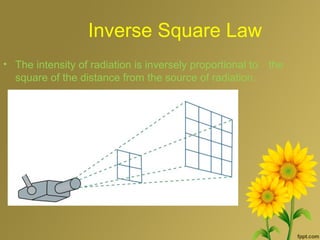
Inverse Square Law
• The intensity of radiation is inversely proportional to the 
square of the distance from the source of radiation.
Half-Value Layer
 To reduce the intensity of the x-ray beam, aluminum filters are
placed in the path of the beam inside the dental x-ray
tubehead.
 When placed in the path of the x-ray beam, the thickness of a
specified material (e.g., aluminum) that reduces the intensity by
half is termed the half-value layer (HVL).
REFERENCES
1.Dental radiography-
principles and techniques-Joen
M. Iannucci, DDS, MS, Laura
Jansen Howerton, RDH, MS.
2.Textbook of Dental and
Maxillofacial Radiology-2E-
Freny R Karjodkar MDS
3. Oral Radiology principles and
interpretation-6E-WHITE AND
PHAROAH, DDS

Radiation physics

  • 1.
    A.KUMAR PG STUDENT ORAL MEDICINEAND RADIOLOGY RADIATION PHYSICS
  • 2.
    CONTENTS • ENERGY • HISTORYOF X-RAY • X-RAY MACHINE • PRODUCTION OF X-RADIATION • PROPERTIES OF X-RAY • USES OF X-RAYS • FACTORS CONTROLLING THE X-RAY BEAM
  • 3.
    ATOM The atom consistsof two parts: (1) central nucleus (2)orbiting electrons
  • 4.
    ATOM Electrons are maintained intheir orbits by the electro-static force
  • 5.
    Maximum number ofelectrons that can exist in each shell of a tungsten atom.
  • 6.
    BINDING ENERGY • Electronsare maintained in their orbits by the electro- static force, or attraction, between the positive nucleus and the negative electrons. This is known as the binding energy, or binding force, of an electron. • For example, in the tungsten atom, the binding energies are as follows: • 70 keV K-shell electrons • 12 keV L-shell electrons • 3 keV M-shell electrons
  • 7.
    ENERGY • In physics,energy is a property of objects, transferable among them via fundamental interactions, which can be converted into different forms but not created or destroyed • the capacity for doing work • Some examples of different kinds of energy • Kinetic • Electric • Heat • Potential • Chemical • Atomic • Radiation
  • 8.
    RADIATION • Radiation, asdefined as the emission and propagation of energy through space or a substance in the form of waves or particles. • IONIZING RADIATION • NON-IONIZING RADIATION
  • 9.
    Ionization • A neutralatom contains an equal number of protons (positive charges) and electrons (negative charges). • An atom that gains or loses an electron and becomes electrically unbalanced is known as an ion. • Ionization is the production of ions, or the process of converting an atom into ions.
  • 10.
    Ionizing Radiation • Ionizingradiation can be defined as radiation that is capable of producing ions by removing or adding an electron to an atom. • Ionizing radiation can be classified into two groups: • (1) particulate radiation • (2) electromagnetic radiation.
  • 11.
  • 13.
    ELECTROMAGNETIC RADIATION • Electromagnetic radiationcan be defined as the propagation of wave like energy (without mass) through space or matter.
  • 14.
    Wavelength is thedistance between the crest (peak) of one wave and the crest of the next. Frequency is the number of wavelengths that pass a given point in a certain amount of time. The shorter the wavelength, the higher the frequency will be, and vice versa.
  • 16.
    RADIAION HISTORY The historyof dental radiography begins with the discovery of the x-ray. Wilhelm Conrad Roentgen discovered the x-ray on November 8, 1895.
  • 17.
    Highlights in theHistory of Dental Radiography
  • 18.
    • An x-rayis a beam of energy that has the power to penetrate substances and record image shadows on photographic film. • Radiation: A form of energy carried by waves or a stream of particles • Radiograph: A two-dimensional representation of a three-dimensional object. In practice, often called an “x-ray”; this is not correct. X-ray (also x ray) is a term that refers to a beam of energy • Radiography: The art and science of making radiographs by the exposure of film to x-rays • Dental radiography: The production of radiographs of the teeth and adjacent structures by the exposure of an image receptor to x-rays
  • 19.
    X-RAY MACHINE The dentalx-ray machine can be divided into three study areas: 1.The component parts  control panel  extension arm  tube head 2.The x-ray tube Leaded-glass housing Negative cathode Positive anode 3.The x-ray generating apparatus. Electricity and Electrical Currents Circuits Transformers
  • 20.
  • 21.
  • 22.
    The x-ray tubeis the heart of the x-ray generating system The component parts of the x-ray tube include a Leaded-glass housing Negative cathode Positive anode
  • 23.
    The leaded-glass housing leaded-glassvacuum tube that prevents x-rays from escaping in all directions. One central area of the leaded-glass tube has a “window” that permits the x-ray beam to exit the tube and directs the x-ray beam toward the aluminum disks, lead collimator Filtration: The sheets of 0.5 mm thick aluminum is placed in the path of the X-ray beam. They filter out the non-penetrating, longer wave-length X-rays. Inherent filtration.  Added filtration.  Total filtration (inherent + added filtration) •At or below 70 kVp require a minimum total filtration of 1.5 mm of aluminum thickness. • Above 70 kVp require a minimum total filtration of 2.5 mm of aluminum thickness.
  • 24.
    collimator  It isa lead plate with a central hole that fit directly over the opening of the metal housing where the X-rays exit.  Collimation is used to restrict the size and shape of the X-ray beam and thus reduce exposure to the patient.  Collimators are of two types: a. Fixed.b. Adjustable.  In the dental X-ray machine usually the fixed collimators are used, they may either have a round or rectangular opening.
  • 25.
    The cathode • Thetungsten filament, or coiled wire made of tungsten, which produces electrons when heated. • The molybdenum cup,which focuses the electrons into a narrow beam and directs the beam across the tube toward the tungsten target of the anode. Tungsten is target , High atomic number-74 High melting point: 3380°C Low vapor pressure:
  • 26.
    The anode • Atungsten target, or plate of tungsten, which serves as a focal spot and converts bombarding electrons into x-ray photons. • The copper stem, which functions to dissipate the heat away from the tungsten target. Tungsten is a poor conductor of heat. The methods of heat dissipation are: i. Conduction: through the copper stem. ii. Convection: through the oil surrounding the tube. iii. Radiation: through the radiator device attached to the copper stem. iv. Rotating anode.
  • 27.
    • There aretwo types of anodes: 1. Stationary or fixed anode. 2. Rotating anode -This type of anode is used to help dissipate heat from a small focal spot.
  • 28.
    Target size: Theradiographic image quality is dependent upon the geometry of the target.Sharpness of the radiographic image increases as the size of the radiographic source (that is focal spot) decreases. The projected effective focal spot is much smaller than the actual focal spot size. In practice the target is inclined at an angle of 20° to the central ray of electrons. This causes the effective focal spot to be 1 mm × 1 mm, in contrast to 1mm × 3 mm of the actual focal spot size.
  • 29.
    3.X-RAY GENERATING APPARATUS Electricityand Electrical Currents Circuits Transformers
  • 30.
    Electricity and ElectricalCurrents Amperage is the measurement of the number of electrons moving through a conductor. Current is measured in amperes (A) or milliamperes (mA). Voltage is the measurement of electrical force that causes electrons to move from a negative pole to a positive one. Voltage is measured in volts (V) or kilovolts (kV).
  • 31.
    Circuits • A circuitis a path of electrical current. Two electrical circuits are used in the production of x-rays: • (1) A low-voltage, or filament circuit • (2) A high-voltage circuit. • The filament circuit uses 3 to 5 volts, regulates the flow of electrical current to the filament of the x-ray tube, and is controlled by the milliampere settings. • The high-voltage circuit uses 65,000 to 100,000 volts, provides the high voltage required to accelerate electrons and to generate x-rays in the x-ray tube, and is controlled by the kilovoltage settings.
  • 32.
    TRANSFORMERS • A step-downtransformer is used to decrease the voltage from the incoming 220-line voltage to the 3 to 5 volts used by the filament circuit • A step-up transformer is used to increase the voltage from the incoming 220-line voltage to the 65,000 to 100,000 volts used by the high-voltage circuit • An autotransformer serves as a voltage compensator that corrects for minor fluctuations in the current.
  • 33.
  • 34.
    General Radiation • Brakingradiation or bremsstrahlung radiation • 70% of the x-ray energy produced at the anode can be classified as general radiation.
  • 35.
    Characteristic Radiation • Characteristicradiation accounts for a very small part of x-rays produced in the dental x-ray machine. It occurs only at 70 kVp and above because the binding energy of the K-shell electron is approximately 70 keV.
  • 36.
  • 37.
    PROPERTIES OF X-RAY •The properties of X-rays may be classified into three broad categories: • A. Physical • B. Biological • C. Physiochemical.
  • 38.
    PHYSICAL PROPERTIES • 1.X-rays belong to a family of electromagnetic radiations having a wavelength between 10 Å and 0.01 Å. • 2. They travel through space in a wave motion. • 3. In free space they travel in a straight line. • 4. They travel with the same speed as that of visible light • 5.They are invisible to the eye and cannot be seen, heard or smell (they remain undetected by the human senses). • 6. They cannot be focused by a lens. • 7.They cannot be reflected, refracted or deflected by a magnet or electricfield as they do not possess any charge. • 8. X-rays are pure energy, no mass and they transfer energy from place to place in the form of quanta (photons). • Property of attenuation, absorption and scatter; when passing through matter the intensity of radiation is reduced (attenuation) . Radiation energy is taken up by the material (absorption) and some is deflected from the original path, to travel in a new direction (scattering).
  • 39.
    • Fluorescence: WhenX-rays fall upon certain materials, visible light is emitted called fluorescence, and it was this very property which led to the discovery of X-rays. • a. Phosphorescent materials: These materials continue to emit light for a period of time after the X-ray absorption has taken place. This is called 'after glow' and it is used in the advertisement lightings. • b. Fluorescent materials: Here the emission of light is instantaneous, quickly completed following X-ray irradiation. This property is used in Intensifying screens and Mass Miniature Radiography (photo fluorography). • Ionization: This is a process of converting atoms into ions • Various devices that work on the principle of ionization are: • i. Ionization chamber. • ii. Thimble chamber. • iii. Condenser chamber. • iv. Geiger Muller counter.
  • 40.
    Effect of Interactionof X-rays with Matter (or) Tissues  No interaction  Absorption or photoelectric effect  Compton scatter  Coherent scatter.  Pair production
  • 41.
  • 42.
  • 43.
    Compton scatter • Comptonscatter accounts for 62% of the scatter that occurs in diagnostic radiography.
  • 44.
  • 45.
    PAIR PRODUCTION • Pairproduction: When a photon having excess energy (equal to or more than 1.02 MeV) passes close to the nucleus of an atom, the photon may completely disappear and in its place positive and negative electrons appear.
  • 46.
     Somatic effect:This ranges from a simple sun burn to severe dermatitis, to changes in the blood supply and/or malignancy.  Genetic effect: This effect is due to radiation induced mutation of genes and chromosomes.These effects are usually seen in the off-springs of the irradiated parents.
  • 47.
    DIAGNOSTIC PROPERTIES •1. X-raystravel in a straight line. •2. Penetration: X-rays can penetrate liquids, solids and gases. The composition of the substance determines whether the X-rays penetrate or are absorbed. •3. Absorption: X-rays are absorbed by matter, the absorption depends on the atomic structure of the matter and the wavelength of the X-ray. •4. Ionizing capability: X-rays interact with materials they penetrate and cause ionization, dissociate silver ions in film emulsions. •5. Fluorescence: X-rays can cause substances to fluorescence or emit light radiation in longer wavelengths. (e.g. visible light or ultra-violet light ). •6. Effect on films: X-rays can produce an image on a photographic film. •7. Effect on living tissues: X-rays cause biological changes in living cells.
  • 48.
    USES OF X-RAYS 1.Radiology: Diagnostic use in dentistry and medicine, helps to diagnose various pathological lesions. 2. Radiotherapy: X-rays are used to destroy malignant tumors and to cure skin diseases. 3. Industry: i. Used to detect defect in radio valves, tennis balls, tyres. ii. Used to detect presence of pearls in oysters. iii. Used to test the uniformity of insulating material. iv. Used to test the quality of oil paintings.
  • 49.
    • 4. Engineering: •i. For examination of gross structures. • ii. Used to detect cracks in structures and blow holes in metals. • iii. To test quality of welding, moulds and metal castings. • iv. To detect cracks in the body of airplanes,motor cars and vans. • 5. Spectroscopy: Identification of elements and their atomic numbers and structures. • 6. Photochemistry: Ionization of chemicals producing oxidation reduction, etc. • 7. Radiobiology: Alteration of cells and tissues for experimental purposes. • 8. Crystallography: Analysis of molecular structures.
  • 50.
    • 9. Sterilization:Preservation of food. • 10. Detective department: i. To detect smuggling of precious metals and other contrabrand goods like opium in sealed parcels and leather pouches. ii. Used for checking personal while entering and leaving restricted areas for security purposes.
  • 51.
    FACTORS CONTROLLING THEX- RAY BEAM • EXPOSURE TIME • TUBE CURRENT (mA) • TUBE VOLTAGE (kVp) • FILTRATION • COLLIMATION • INVERSE SQUARE LAW
  • 52.
    EXPOSURE TIME Increase thetime duration of the exposure, the number of photons generated is increased
  • 53.
    TUBE CURRENT (mA) •The quantity of radiation produced by an x-ray tube is directly proportional to the tube current (mA) and the time the tube is operated
  • 54.
    TUBE VOLTAGE (kVp) •Increasing the kVp increases the potential difference between the cathode and the anode, thus increasing the energy of each electron when it strikes the target.
  • 55.
    X-RAY BEAM INTENSITY •Intensity is defined as the product of the quantity (number of x-ray photons) and quality (energy of each photon) per unit of area per unit of time of exposure.
  • 56.
    Inverse Square Law •The intensity of radiation is inversely proportional to the  square of the distance from the source of radiation.
  • 57.
    Half-Value Layer  Toreduce the intensity of the x-ray beam, aluminum filters are placed in the path of the beam inside the dental x-ray tubehead.  When placed in the path of the x-ray beam, the thickness of a specified material (e.g., aluminum) that reduces the intensity by half is termed the half-value layer (HVL).
  • 58.
    REFERENCES 1.Dental radiography- principles andtechniques-Joen M. Iannucci, DDS, MS, Laura Jansen Howerton, RDH, MS. 2.Textbook of Dental and Maxillofacial Radiology-2E- Freny R Karjodkar MDS 3. Oral Radiology principles and interpretation-6E-WHITE AND PHAROAH, DDS