MAAJID MOHI UD DIN MALIK
LECTURER COPMS ADESH UNIVERSITY
BATHINDA,PUNJAB
MAAJIDMALIKOFFICIAL@GMAIL.COM 1

 Theater radiography is a type of radiography that is done in operation theatre.
Surgical radiology is a dynamic experience. The challenges a radiographer
encounters in the surgical suite are unique. Knowing the machinery and its
capabilities and limitations is most important; in that regard, the radiographer
can enter any operating room (OR) case, whether routine or extraordinary, and,
with good communication, be able to perform all tasks well. An understanding of
common procedures and familiarity with equipment enables the radiographer to
perform most mobile examinations ordered by the physician.
THEATRE RADIOGRAPH
MAAJIDMALIKOFFICIAL@GMAIL.COM 2

 Surgical radiography can be a challenging and exciting environment for the radiographer
but can also be intimidating and stressful. Surgical radiology requires educated personnel
familiar with specific equipment routinely used during common surgical procedures. It
requires expertise in teamwork. Preparedness and familiarity with equipment are key.
Standard health and safety protocols must be followed to avoid contamination and to
ensure patient safety. These are the basics, and the pieces come together in surgical
radiology in distinctive ways.
CONTINUE
MAAJIDMALIKOFFICIAL@GMAIL.COM 3

 This chapter focuses on the most common procedures performed
in the surgical area. The basic principles of mobile imaging are
detailed, and helpful suggestions are provided for successful
completion of the examinations. This chapter is not intended to
cover every possible combination of examinations or situations
that a radiographer may encounter, but rather provides an
overview of the surgical setting and a summary of common
examinations.
CONTINUE
MAAJIDMALIKOFFICIAL@GMAIL.COM 4

 The scope of radiologic examinations in a surgical setting is vast
and may differ greatly among health care facilities. The goals of
this chapter are to
1. provide an overview of the surgical setting and explain the role
of the radiographer as a vital member of the surgical team,
2. Assist the radiographer in developing an understanding of the
imaging equipment used in surgical situations, and
3. Present common radiographic procedures performed in the OR.
The radiographer should review the surgery department
protocols because they vary from institution to institution.
CONTINUE
MAAJIDMALIKOFFICIAL@GMAIL.COM 5

 At no other time is a patient so well attended as during a surgical procedure. A surgeon,
one or two assistants, a surgical technologist, an anesthesia provider, a circulating nurse,
and various support staff surround the patient. These individuals, each with specific
functions to perform, form the OR team. This team literally has the patient’s life in its
hands. The OR team has been described as a symphony orchestra, with each person an
integral entity in unison and harmony with his or her colleagues for the successful
accomplishment of the expected outcomes. The OR team is subdivided, according to the
functions of its members, into sterile and nonsterile teams.
SURGICAL TEAM
MAAJIDMALIKOFFICIAL@GMAIL.COM 6

 At no other time is a patient so well attended as during a surgical procedure. A surgeon,
one or two assistants, a surgical technologist, an anesthesia provider, a circulating nurse,
and various support staff surround the patient. These individuals, each with specific
functions to perform, form the OR team. This team literally has the patient’s life in its
hands. The OR team has been described as a symphony orchestra, with each person an
integral entity in unison and harmony with his or her colleagues for the successful
accomplishment of the expected outcomes. The OR team is subdivided, according to the
functions of its members, into sterile and nonsterile teams.
CONTINUE
MAAJIDMALIKOFFICIAL@GMAIL.COM 7

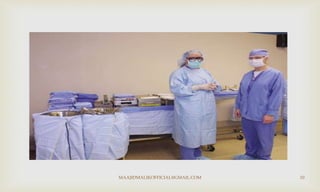
 Sterile team members scrub their hands and arms, don a sterile gown and gloves over
proper surgical attire, and enter the sterile field. The sterile field is the area of the OR that
immediately surrounds and is specially prepared for the patient. To establish a sterile field,
all items necessary for the surgical procedure are sterilized. After this process, the
scrubbed and sterile team members function within this limited area and handle only
sterile items . The sterile team consists of the following members:
STERILE TEAM MEMBERS
MAAJIDMALIKOFFICIAL@GMAIL.COM 8

 Surgeon
 Surgical assistant
 Physician assistant
 Scrub nurse:
 Certified surgical technologist (CST)
STERILE TEAM MEMBERS
MAAJIDMALIKOFFICIAL@GMAIL.COM 9

MAAJIDMALIKOFFICIAL@GMAIL.COM 10

 Nonsterile team members do not enter the sterile field; they function outside and
around it. They assume responsibility for maintaining sterile techniques during
the surgical procedure, but they handle supplies and equipment that are not
considered sterile. Following the principles of aseptic technique, they keep the
sterile team supplied, provide direct patient care, and respond to any requests that
may arise during the surgical procedure.
NONSTERILE TEAM MEMBERS
MAAJIDMALIKOFFICIAL@GMAIL.COM 11

 Anesthesia provider
 Circulator
 Radiographers
 Others
NONSTERILE TEAM MEMBERS
MAAJIDMALIKOFFICIAL@GMAIL.COM 12

 Surgical attire protocols may change from institution to institution but should be available for review,
understood, and followed by all staff members. Although some small variances in protocol exist among
institutions, there are common standards.
 Large amounts of bacteria are present in the nose and mouth, on the skin, and on the attire of
personnel who enter the restricted areas of the surgical setting. Proper facility design and surgical
attire regulations are important ways of preventing transportation of microorganisms into surgical
settings, where they may infect patients’ open wounds. Infection control practices also involve personal
measures, including personal fitness for work, skin disinfection (patient and personnel), preparation of
personnel hands, surgical attire, and personal technique (surgical conscience). Daily body cleanliness
and clean, dandruff-free hair help prevent superficial wound infections.
PROPER SURGICAL ATTIRE
MAAJIDMALIKOFFICIAL@GMAIL.COM 13

 The OR should have specific written policies and procedures for proper attire to be worn within the semi restricted
and restricted areas of the OR suite. The dress code should include aspects of personal hygiene important to
environmental control. Protocol is strictly monitored so that everyone conforms to established policy.
 Street clothes should never be worn within semi restricted or restricted areas of the surgical suite . Clean, fresh attire
should be donned at the beginning of each shift in the OR suite and as needed if the attire becomes wet or grossly
soiled. Soiled surgical attire should be changed to reduce the potential of cross-infection. Blood-stained or soiled attire
including shoe covers is unattractive and can also be a source of cross-infection or contamination. Soiled attire is not
worn outside of the OR suite, and steps should be taken to remove soiled clothing immediately on exiting. OR attire
should not be hung in a locker for wearing a second time. Underclothing should be clean and totally covered by the
scrub suit.
OPERATING ROOM ATTIRE
MAAJIDMALIKOFFICIAL@GMAIL.COM 14

 Protective eyewear: Occupational Safety and Health Administration
(OSHA) regulations require eyewear to be worn when
contamination from blood or body fluids is possible.
 Masks: Masks should be worn at all times in the OR but are not
necessary in all semi restricted areas.
 Shoe covers: Shoe covers should be worn when contamination from
blood or body fluids can be reasonably anticipated. Shoe covers
should be changed whenever they become torn, soiled, or wet and
should be removed before leaving the surgical area
CONTINUE
MAAJIDMALIKOFFICIAL@GMAIL.COM 15

 Caps: Caps should be worn to cover and contain hair at all times in
the restricted and semi restricted areas of the OR suite. Hoods are
also available to cover hair, such as facial hair, that cannot be
contained by a cap and mask.
 Gloves: Gloves should be worn when contact with blood or body
substances is anticipated.
 Radiation badge and identification: Radiation badge and proper
identification should be worn at all times.
CONTINUE
MAAJIDMALIKOFFICIAL@GMAIL.COM 16

 A person with an acute infection, such as a cold, open cold sore, or
sore throat, is known to be a carrier of transmittable conditions and
should not be permitted within the OR suite. Daily body cleanliness
and clean hair are also important because good personal hygiene
helps to prevent transportation of microbial fallout that can cause
open wound infections.
PERSONAL HYGIENE
MAAJIDMALIKOFFICIAL@GMAIL.COM 17

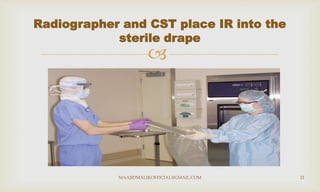
To maintain proper universal precautions, the radiographer must
follow specific steps when handling an IR in the OR.
 Surgical technologist (CST) taking the IR: The CST holds a sterile IR
cover open toward the radiographer. The radiographer should hold
one end of the IR while placing the other end of the IR into the
sterile IR cover. The CST grasps the IR and wraps the protective
cover securely
PROPER IMAGE RECEPTOR HANDLING IN THE STERILE
FIELD
MAAJIDMALIKOFFICIAL@GMAIL.COM 18

 Radiographer accepting the IR after exposure: After the exposure is made, the
radiographer needs to retrieve the IR. The radiographer must be wearing gloves to
accept a covered IR that has been in the sterile field or under an open incision. The
protective cover is possibly contaminated with blood or body fluids and should be
treated accordingly. The radiographer should grasp the IR, open the protective cover
carefully away from himself or herself or others so as not to spread blood or body
fluids, and then slide the IR out of the cover .
CONTINUE
MAAJIDMALIKOFFICIAL@GMAIL.COM 19

 The radiographer should dispose of the IR cover in a proper
receptacle and remember to remove gloves before handling the IR
or any other equipment because the gloves are now considered
contaminated. If contamination of the IR occurs, the radiographer
should use hospital-approved disinfectant for cleaning before
leaving the OR
CONTINUE
MAAJIDMALIKOFFICIAL@GMAIL.COM 20

Radiographer and CST place IR into the
sterile drape
MAAJIDMALIKOFFICIAL@GMAIL.COM 21

 The radiographer must be well acquainted with the radiologic equipment. Some procedures may
seldom occur. The radiographer need not fear a rare procedure if good communication and
equipment knowledge are in place. IR holders enable the radiographer to perform cross-table
projections on numerous cases and eliminate the unnecessary exposure of personnel who may
volunteer to hold the IR. In mobile radiography, exposure times may increase for larger patients,
and a holder eliminates the chance of motion from hand-held situations.
 Some OR suites, such as those used for stereotactic or urologic cases, have dedicated radiologic
equipment . Most radiographic examinations in the OR are performed with mobile equipment,
however.
EQUIPMENT
MAAJIDMALIKOFFICIAL@GMAIL.COM 22

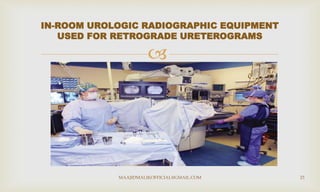
IN-ROOM UROLOGIC RADIOGRAPHIC EQUIPMENT
USED FOR RETROGRADE URETEROGRAMS
MAAJIDMALIKOFFICIAL@GMAIL.COM 23

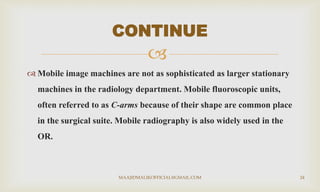
 Mobile image machines are not as sophisticated as larger stationary
machines in the radiology department. Mobile fluoroscopic units,
often referred to as C-arms because of their shape are common place
in the surgical suite. Mobile radiography is also widely used in the
OR.
CONTINUE
MAAJIDMALIKOFFICIAL@GMAIL.COM 24

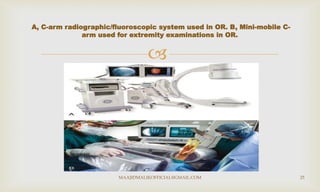
A, C-arm radiographic/fluoroscopic system used in OR. B, Mini-mobile C-
arm used for extremity examinations in OR.
MAAJIDMALIKOFFICIAL@GMAIL.COM 25

 The x-ray equipment should be cleaned after each surgical case. If possible, the
radiographer should clean the mobile image machine, including the base, in the
OR suite, especially when the equipment is obviously contaminated with blood or
surgical scrub solution. Cleaning within the OR helps reduce the possibility of
cross-contamination. The x-ray equipment must be cleaned with a hospital
approved cleaning solution. Cleaning solutions should not be sprayed in the OR
suite during the surgical procedure.
CLEANING OF EQUIPMENT
MAAJIDMALIKOFFICIAL@GMAIL.COM 26

 If cleaning is necessary during the surgical procedure, opening the cleaning container and
pouring the solution on a rag for use prevents possible contamination from scattered spray.
Gloves should always be worn during cleaning. The underside of the image machine should
be checked to ensure contaminants that might have splashed up from the floor are
removed. Cleaning the equipment after an isolation case is necessary to prevent the spread
of contaminants. All equipment that is used less frequently should undergo a thorough
cleaning at least once a week and just before being taken into the OR.
CONTINUE
MAAJIDMALIKOFFICIAL@GMAIL.COM 27

 Radiation protection for the radiographer, others in the immediate area,
and the patient is of paramount importance when mobile fluoroscopic
examinations are performed. The radiographer should wear a lead apron
and stand as far away from the patient, x-ray tube, and useful beam as the
procedure, OR, and exposure cable allow. The most effective means of
radiation protection is distance.
Radiation Exposure Considerations
MAAJIDMALIKOFFICIAL@GMAIL.COM 28

 The recommended minimal distance is 6 ft. (2 m). When possible, the radiographer
should stand at a right angle (90 degrees) to the primary beam and the object being
radiographed. The least amount of scatter radiation occurs at this position. The
greatest amount of scatter radiation occurs on the tube side of the fluoroscopic
machine. It is recommended that the x-ray tube always be placed under the patient .
Because of the significant amount of exposure to the facial and neck region, the x-ray
tube should never be placed above the patient unless absolutely necessary.
CONTINUE
MAAJIDMALIKOFFICIAL@GMAIL.COM 29

 Many people have a chest X-ray before they have surgery. This is called a
“pre-op” chest X-ray. “Pre-op” stands for preoperative, which means that
it is before an operation, or surgery.
 If you have a heart or lung disease, you may want to get a pre-op chest X-
ray. It can show medical problems, like an enlarged heart, congestive
heart failure, or fluid around the lungs. These could mean that your
surgery should be delayed or cancelled.
 However, if you don’t have signs or symptoms of a heart or lung disease,
you should think twice about having a chest X-ray before surgery. Here’s
why:
PRE-OPERATIVE CHEST
MAAJIDMALIKOFFICIAL@GMAIL.COM 30

 Many people are given a chest X-ray to “clear” them before surgery.
Some hospitals require a chest X-ray for almost every patient.
 But, if you do not have symptoms of a heart or lung disease, and
your risk is low, an X-ray probably will not help. It is not likely to
show a serious problem that would change your treatment plan.
 And a chest X-ray does not help the surgeon or the anesthesiologist
manage your care. Most of the time, a careful medical history and
physical exam are all you need.
A CHEST X-RAY USUALLY DOESN’T HELP
MAAJIDMALIKOFFICIAL@GMAIL.COM 31

MAAJIDMALIKOFFICIAL@GMAIL.COM 32

OPERATION THEATRE RADIOGRAPHY (3)-1.pptx

  • 1.
    MAAJID MOHI UDDIN MALIK LECTURER COPMS ADESH UNIVERSITY BATHINDA,PUNJAB MAAJIDMALIKOFFICIAL@GMAIL.COM 1
  • 2.
      Theater radiographyis a type of radiography that is done in operation theatre. Surgical radiology is a dynamic experience. The challenges a radiographer encounters in the surgical suite are unique. Knowing the machinery and its capabilities and limitations is most important; in that regard, the radiographer can enter any operating room (OR) case, whether routine or extraordinary, and, with good communication, be able to perform all tasks well. An understanding of common procedures and familiarity with equipment enables the radiographer to perform most mobile examinations ordered by the physician. THEATRE RADIOGRAPH MAAJIDMALIKOFFICIAL@GMAIL.COM 2
  • 3.
      Surgical radiographycan be a challenging and exciting environment for the radiographer but can also be intimidating and stressful. Surgical radiology requires educated personnel familiar with specific equipment routinely used during common surgical procedures. It requires expertise in teamwork. Preparedness and familiarity with equipment are key. Standard health and safety protocols must be followed to avoid contamination and to ensure patient safety. These are the basics, and the pieces come together in surgical radiology in distinctive ways. CONTINUE MAAJIDMALIKOFFICIAL@GMAIL.COM 3

  • 4.
      This chapterfocuses on the most common procedures performed in the surgical area. The basic principles of mobile imaging are detailed, and helpful suggestions are provided for successful completion of the examinations. This chapter is not intended to cover every possible combination of examinations or situations that a radiographer may encounter, but rather provides an overview of the surgical setting and a summary of common examinations. CONTINUE MAAJIDMALIKOFFICIAL@GMAIL.COM 4
  • 5.
      The scopeof radiologic examinations in a surgical setting is vast and may differ greatly among health care facilities. The goals of this chapter are to 1. provide an overview of the surgical setting and explain the role of the radiographer as a vital member of the surgical team, 2. Assist the radiographer in developing an understanding of the imaging equipment used in surgical situations, and 3. Present common radiographic procedures performed in the OR. The radiographer should review the surgery department protocols because they vary from institution to institution. CONTINUE MAAJIDMALIKOFFICIAL@GMAIL.COM 5
  • 6.
      At noother time is a patient so well attended as during a surgical procedure. A surgeon, one or two assistants, a surgical technologist, an anesthesia provider, a circulating nurse, and various support staff surround the patient. These individuals, each with specific functions to perform, form the OR team. This team literally has the patient’s life in its hands. The OR team has been described as a symphony orchestra, with each person an integral entity in unison and harmony with his or her colleagues for the successful accomplishment of the expected outcomes. The OR team is subdivided, according to the functions of its members, into sterile and nonsterile teams. SURGICAL TEAM MAAJIDMALIKOFFICIAL@GMAIL.COM 6
  • 7.
      At noother time is a patient so well attended as during a surgical procedure. A surgeon, one or two assistants, a surgical technologist, an anesthesia provider, a circulating nurse, and various support staff surround the patient. These individuals, each with specific functions to perform, form the OR team. This team literally has the patient’s life in its hands. The OR team has been described as a symphony orchestra, with each person an integral entity in unison and harmony with his or her colleagues for the successful accomplishment of the expected outcomes. The OR team is subdivided, according to the functions of its members, into sterile and nonsterile teams. CONTINUE MAAJIDMALIKOFFICIAL@GMAIL.COM 7
  • 8.
      Sterile teammembers scrub their hands and arms, don a sterile gown and gloves over proper surgical attire, and enter the sterile field. The sterile field is the area of the OR that immediately surrounds and is specially prepared for the patient. To establish a sterile field, all items necessary for the surgical procedure are sterilized. After this process, the scrubbed and sterile team members function within this limited area and handle only sterile items . The sterile team consists of the following members: STERILE TEAM MEMBERS MAAJIDMALIKOFFICIAL@GMAIL.COM 8
  • 9.
      Surgeon  Surgicalassistant  Physician assistant  Scrub nurse:  Certified surgical technologist (CST) STERILE TEAM MEMBERS MAAJIDMALIKOFFICIAL@GMAIL.COM 9
  • 10.
  • 11.
      Nonsterile teammembers do not enter the sterile field; they function outside and around it. They assume responsibility for maintaining sterile techniques during the surgical procedure, but they handle supplies and equipment that are not considered sterile. Following the principles of aseptic technique, they keep the sterile team supplied, provide direct patient care, and respond to any requests that may arise during the surgical procedure. NONSTERILE TEAM MEMBERS MAAJIDMALIKOFFICIAL@GMAIL.COM 11
  • 12.
      Anesthesia provider Circulator  Radiographers  Others NONSTERILE TEAM MEMBERS MAAJIDMALIKOFFICIAL@GMAIL.COM 12
  • 13.
      Surgical attireprotocols may change from institution to institution but should be available for review, understood, and followed by all staff members. Although some small variances in protocol exist among institutions, there are common standards.  Large amounts of bacteria are present in the nose and mouth, on the skin, and on the attire of personnel who enter the restricted areas of the surgical setting. Proper facility design and surgical attire regulations are important ways of preventing transportation of microorganisms into surgical settings, where they may infect patients’ open wounds. Infection control practices also involve personal measures, including personal fitness for work, skin disinfection (patient and personnel), preparation of personnel hands, surgical attire, and personal technique (surgical conscience). Daily body cleanliness and clean, dandruff-free hair help prevent superficial wound infections. PROPER SURGICAL ATTIRE MAAJIDMALIKOFFICIAL@GMAIL.COM 13
  • 14.
      The ORshould have specific written policies and procedures for proper attire to be worn within the semi restricted and restricted areas of the OR suite. The dress code should include aspects of personal hygiene important to environmental control. Protocol is strictly monitored so that everyone conforms to established policy.  Street clothes should never be worn within semi restricted or restricted areas of the surgical suite . Clean, fresh attire should be donned at the beginning of each shift in the OR suite and as needed if the attire becomes wet or grossly soiled. Soiled surgical attire should be changed to reduce the potential of cross-infection. Blood-stained or soiled attire including shoe covers is unattractive and can also be a source of cross-infection or contamination. Soiled attire is not worn outside of the OR suite, and steps should be taken to remove soiled clothing immediately on exiting. OR attire should not be hung in a locker for wearing a second time. Underclothing should be clean and totally covered by the scrub suit. OPERATING ROOM ATTIRE MAAJIDMALIKOFFICIAL@GMAIL.COM 14
  • 15.
      Protective eyewear:Occupational Safety and Health Administration (OSHA) regulations require eyewear to be worn when contamination from blood or body fluids is possible.  Masks: Masks should be worn at all times in the OR but are not necessary in all semi restricted areas.  Shoe covers: Shoe covers should be worn when contamination from blood or body fluids can be reasonably anticipated. Shoe covers should be changed whenever they become torn, soiled, or wet and should be removed before leaving the surgical area CONTINUE MAAJIDMALIKOFFICIAL@GMAIL.COM 15
  • 16.
      Caps: Capsshould be worn to cover and contain hair at all times in the restricted and semi restricted areas of the OR suite. Hoods are also available to cover hair, such as facial hair, that cannot be contained by a cap and mask.  Gloves: Gloves should be worn when contact with blood or body substances is anticipated.  Radiation badge and identification: Radiation badge and proper identification should be worn at all times. CONTINUE MAAJIDMALIKOFFICIAL@GMAIL.COM 16
  • 17.
      A personwith an acute infection, such as a cold, open cold sore, or sore throat, is known to be a carrier of transmittable conditions and should not be permitted within the OR suite. Daily body cleanliness and clean hair are also important because good personal hygiene helps to prevent transportation of microbial fallout that can cause open wound infections. PERSONAL HYGIENE MAAJIDMALIKOFFICIAL@GMAIL.COM 17
  • 18.
     To maintain properuniversal precautions, the radiographer must follow specific steps when handling an IR in the OR.  Surgical technologist (CST) taking the IR: The CST holds a sterile IR cover open toward the radiographer. The radiographer should hold one end of the IR while placing the other end of the IR into the sterile IR cover. The CST grasps the IR and wraps the protective cover securely PROPER IMAGE RECEPTOR HANDLING IN THE STERILE FIELD MAAJIDMALIKOFFICIAL@GMAIL.COM 18
  • 19.
      Radiographer acceptingthe IR after exposure: After the exposure is made, the radiographer needs to retrieve the IR. The radiographer must be wearing gloves to accept a covered IR that has been in the sterile field or under an open incision. The protective cover is possibly contaminated with blood or body fluids and should be treated accordingly. The radiographer should grasp the IR, open the protective cover carefully away from himself or herself or others so as not to spread blood or body fluids, and then slide the IR out of the cover . CONTINUE MAAJIDMALIKOFFICIAL@GMAIL.COM 19
  • 20.
      The radiographershould dispose of the IR cover in a proper receptacle and remember to remove gloves before handling the IR or any other equipment because the gloves are now considered contaminated. If contamination of the IR occurs, the radiographer should use hospital-approved disinfectant for cleaning before leaving the OR CONTINUE MAAJIDMALIKOFFICIAL@GMAIL.COM 20
  • 21.
     Radiographer and CSTplace IR into the sterile drape MAAJIDMALIKOFFICIAL@GMAIL.COM 21
  • 22.
      The radiographermust be well acquainted with the radiologic equipment. Some procedures may seldom occur. The radiographer need not fear a rare procedure if good communication and equipment knowledge are in place. IR holders enable the radiographer to perform cross-table projections on numerous cases and eliminate the unnecessary exposure of personnel who may volunteer to hold the IR. In mobile radiography, exposure times may increase for larger patients, and a holder eliminates the chance of motion from hand-held situations.  Some OR suites, such as those used for stereotactic or urologic cases, have dedicated radiologic equipment . Most radiographic examinations in the OR are performed with mobile equipment, however. EQUIPMENT MAAJIDMALIKOFFICIAL@GMAIL.COM 22
  • 23.
     IN-ROOM UROLOGIC RADIOGRAPHICEQUIPMENT USED FOR RETROGRADE URETEROGRAMS MAAJIDMALIKOFFICIAL@GMAIL.COM 23
  • 24.
      Mobile imagemachines are not as sophisticated as larger stationary machines in the radiology department. Mobile fluoroscopic units, often referred to as C-arms because of their shape are common place in the surgical suite. Mobile radiography is also widely used in the OR. CONTINUE MAAJIDMALIKOFFICIAL@GMAIL.COM 24
  • 25.
     A, C-arm radiographic/fluoroscopicsystem used in OR. B, Mini-mobile C- arm used for extremity examinations in OR. MAAJIDMALIKOFFICIAL@GMAIL.COM 25
  • 26.
      The x-rayequipment should be cleaned after each surgical case. If possible, the radiographer should clean the mobile image machine, including the base, in the OR suite, especially when the equipment is obviously contaminated with blood or surgical scrub solution. Cleaning within the OR helps reduce the possibility of cross-contamination. The x-ray equipment must be cleaned with a hospital approved cleaning solution. Cleaning solutions should not be sprayed in the OR suite during the surgical procedure. CLEANING OF EQUIPMENT MAAJIDMALIKOFFICIAL@GMAIL.COM 26
  • 27.
      If cleaningis necessary during the surgical procedure, opening the cleaning container and pouring the solution on a rag for use prevents possible contamination from scattered spray. Gloves should always be worn during cleaning. The underside of the image machine should be checked to ensure contaminants that might have splashed up from the floor are removed. Cleaning the equipment after an isolation case is necessary to prevent the spread of contaminants. All equipment that is used less frequently should undergo a thorough cleaning at least once a week and just before being taken into the OR. CONTINUE MAAJIDMALIKOFFICIAL@GMAIL.COM 27
  • 28.
      Radiation protectionfor the radiographer, others in the immediate area, and the patient is of paramount importance when mobile fluoroscopic examinations are performed. The radiographer should wear a lead apron and stand as far away from the patient, x-ray tube, and useful beam as the procedure, OR, and exposure cable allow. The most effective means of radiation protection is distance. Radiation Exposure Considerations MAAJIDMALIKOFFICIAL@GMAIL.COM 28
  • 29.
      The recommendedminimal distance is 6 ft. (2 m). When possible, the radiographer should stand at a right angle (90 degrees) to the primary beam and the object being radiographed. The least amount of scatter radiation occurs at this position. The greatest amount of scatter radiation occurs on the tube side of the fluoroscopic machine. It is recommended that the x-ray tube always be placed under the patient . Because of the significant amount of exposure to the facial and neck region, the x-ray tube should never be placed above the patient unless absolutely necessary. CONTINUE MAAJIDMALIKOFFICIAL@GMAIL.COM 29
  • 30.
      Many peoplehave a chest X-ray before they have surgery. This is called a “pre-op” chest X-ray. “Pre-op” stands for preoperative, which means that it is before an operation, or surgery.  If you have a heart or lung disease, you may want to get a pre-op chest X- ray. It can show medical problems, like an enlarged heart, congestive heart failure, or fluid around the lungs. These could mean that your surgery should be delayed or cancelled.  However, if you don’t have signs or symptoms of a heart or lung disease, you should think twice about having a chest X-ray before surgery. Here’s why: PRE-OPERATIVE CHEST MAAJIDMALIKOFFICIAL@GMAIL.COM 30
  • 31.
      Many peopleare given a chest X-ray to “clear” them before surgery. Some hospitals require a chest X-ray for almost every patient.  But, if you do not have symptoms of a heart or lung disease, and your risk is low, an X-ray probably will not help. It is not likely to show a serious problem that would change your treatment plan.  And a chest X-ray does not help the surgeon or the anesthesiologist manage your care. Most of the time, a careful medical history and physical exam are all you need. A CHEST X-RAY USUALLY DOESN’T HELP MAAJIDMALIKOFFICIAL@GMAIL.COM 31
  • 32.