Physics 1 Energy PPT. by, Robin D. Seamon
MOTION Position:   the location of an object Direction :  N, S, E, W Speed :  distance over time (tells how fast it moved) EXAMPLE:  the soccer ball moved  20m east.  Did it move 20m in 2 sec?  OR Did it move 20m in 2 min? Which is the slower speed?
How do you measure motion? Stopwatch Divide:  distance    time
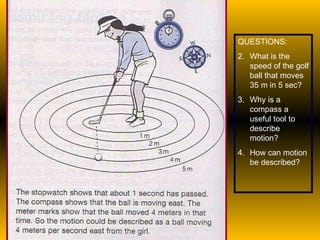
QUESTIONS: What is the speed of the golf ball that moves 35 m in 5 sec? Why is a compass a useful tool to describe motion? How can motion be described?
FORCE & MOTION Force : a push or pull on an object The amount of force you apply, determines how fast the object will move If an object stops, speeds up, slows down, or changes direction, a force has been applied to it! EXAMPLES: gravity, lift, thrust, friction
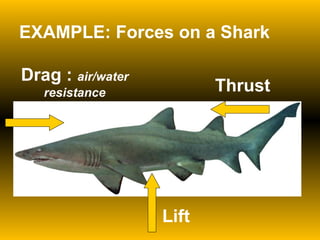
EXAMPLE: Forces on a Shark Thrust Lift Drag :  air/water resistance
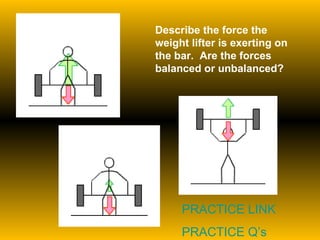
Describe the force the weight lifter is exerting on the bar.  Are the forces balanced or unbalanced? PRACTICE LINK PRACTICE Q’s
Hydraulic Lift  simulation Activity 1 Quiz 2
Energy & Machines Energy:  the ability to do work (joules) (amt. of E to lift an apple 1m) Machine : something that replaces human effort Friction : the force that slows down or stops motion Gravity : the fore that pulls all objects on Earth toward the center of Earth  (All objects have gravity; the larger the object, the stronger the gravitational pull)
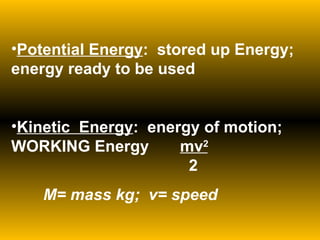
Potential Energy :  stored up Energy; energy ready to be used Kinetic  Energy :  energy of motion; WORKING Energy   mv 2     2 M= mass kg;  v= speed
FORMS of ENERGY: Thermal energy : energy from the rapid movement of molecules, causing heat- high temp to low temp -moves faster at high temp Mechanical energy : Energy of motion & position -stays the same unless transfers to another object
Electrical energy : energy from moving electrons in atoms  (negative charge around atoms) Gravitational potential energy : potential energy an object has if it falls Elastic Potential energy :  potential energy of an object as it is forced to change shape, but has the ability to return to its normal shape.
Chemical energy : energy from the interaction of molecules photosynthesis  sugar forms by work of joining different atoms together in certain patterns:  C 6  H 10  O 2 burning wood  releases E as heat explosion  rapid release of E Examples
Nuclear energy:   energy that comes from changes in the nucleus of an atom Fission  break apart (power plants) Fusion  put together (sun) 100,000,000 °C:  H  joins to form  He
Light energy : energy from light; vibrations of electrically charged particles  (NOTE:  do not need air to transmit… can transmit through a vacuum as photons) Sound energy : energy from sound waves;  objects vibrate, transmitting some of the kinetic E to air around it, air particles vibrate & transmit E to your ear… YOU HEAR!
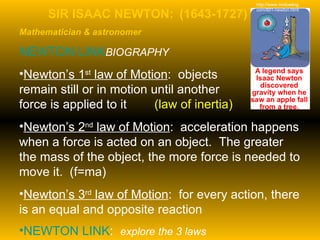
SIR ISAAC NEWTON:  (1643-1727)  Mathematician & astronomer NEWTON LINK	 BIOGRAPHY Newton’s 1 st  law of Motion :  objects  remain still or in motion until another  force is applied to it  (law of inertia) Newton’s 2 nd  law of Motion :  acceleration happens when a force is acted on an object.  The greater the mass of the object, the more force is needed to move it.  (f=ma) Newton’s 3 rd  law of Motion :  for every action, there is an equal and opposite reaction NEWTON LINK :  explore the 3 laws http://www.mrdowling.com/601-newton.html
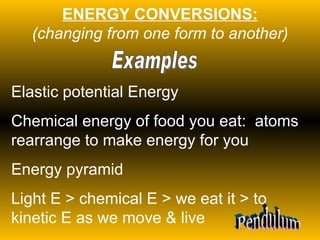
ENERGY CONVERSIONS: (changing from one form to another) Elastic potential Energy Chemical energy of food you eat:  atoms rearrange to make energy for you Energy pyramid Light E > chemical E > we eat it > to kinetic E as we move & live Examples Pendulum
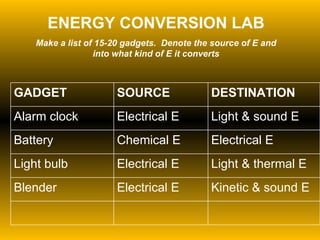
ENERGY CONVERSION LAB Make a list of 15-20 gadgets.  Denote the source of E and into what kind of E it converts Kinetic & sound E Electrical E Blender Light & thermal E Electrical E Light bulb Electrical E Chemical E Battery Light & sound E Electrical E Alarm clock DESTINATION SOURCE GADGET
ENERGY CONVERSION LAB Make a list of 15-20 gadgets.  Denote the source of E and into what kind of E it converts
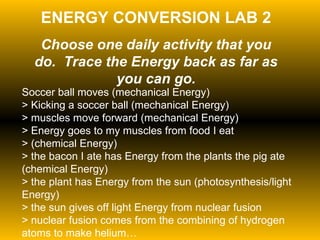
ENERGY CONVERSION LAB 2 Choose one daily activity that you do.  Trace the Energy back as far as you can go. Soccer ball moves (mechanical Energy)  > Kicking a soccer ball (mechanical Energy)  > muscles move forward (mechanical Energy)  > Energy goes to my muscles from food I eat  > (chemical Energy)  > the bacon I ate has Energy from the plants the pig ate (chemical Energy)  > the plant has Energy from the sun (photosynthesis/light Energy)  > the sun gives off light Energy from nuclear fusion  > nuclear fusion comes from the combining of hydrogen atoms to make helium…
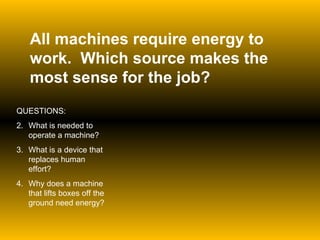
All machines require energy to work.  Which source makes the most sense for the job? QUESTIONS: What is needed to operate a machine? What is a device that replaces human effort? Why does a machine that lifts boxes off the ground need energy?
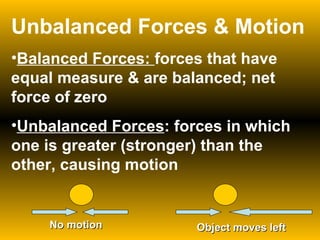
Unbalanced Forces & Motion Balanced Forces:  forces that have equal measure & are balanced; net force of zero Unbalanced Forces : forces in which one is greater (stronger) than the other, causing motion No motion Object moves left
What affects Motion? Friction : a force that acts on an object to STOP the motion: ground, air, bumps Inertia : the tendency of an object to remain still or in motion unless acted on by a force Momentum :  product of the mass and velocity of an object
MODELS: Design : imagining and creating a best way to solve a problem What are the limits? What materials make sense? Is space a limit? Model : testing your design; replica; computer simulations Communicating: report your designs, drawings, & findings
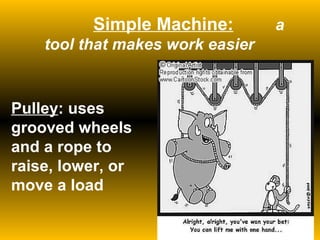
Pulley : uses grooved wheels and a rope to raise, lower, or move a load   Simple Machine:       a tool that makes work easier
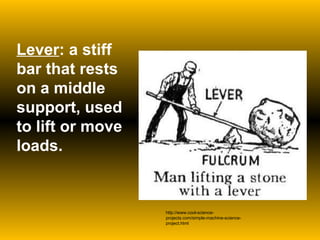
Lever : a stiff bar that rests on a middle support, used to lift or move loads. http://www.cool-science-projects.com/simple-machine-science-project.html
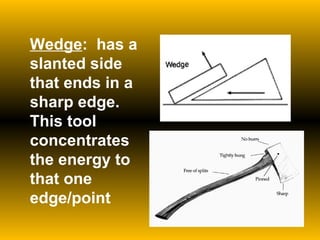
Wedge :  has a slanted side that ends in a sharp edge.  This tool concentrates the energy to that one edge/point
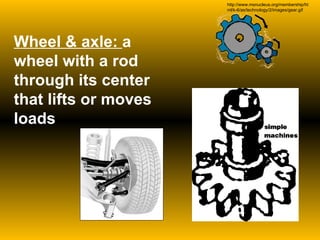
Wheel & axle:  a wheel with a rod through its center that lifts or moves loads http://www.msnucleus.org/membership/html/k-6/as/technology/2/images/gear.gif
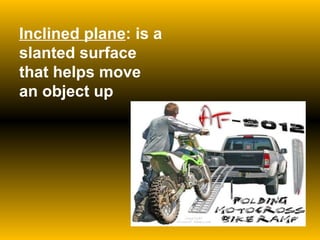
Inclined plane : is a slanted surface that helps move an object up
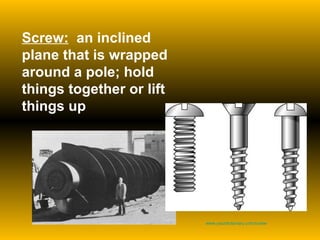
Screw:   an inclined plane that is wrapped around a pole; hold things together or lift things up www.yourdictionary.com/screw
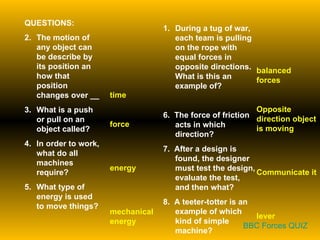
QUESTIONS: The motion of any object can be describe by its position an how that position changes over __ What is a push or pull on an object called? In order to work, what do all machines require? What type of energy is used to move things? During a tug of war, each team is pulling on the rope with equal forces in opposite directions.  What is this an example of? 6.  The force of friction acts in which direction? 7.  After a design is found, the designer must test the design, evaluate the test, and then what? 8.  A teeter-totter is an example of which kind of simple machine? time force energy mechanical energy balanced forces Opposite direction object is moving Communicate it lever BBC Forces QUIZ
Energy Efficiency: Closed system :   group of objects that only transfer E to each other.  (not everything is a closed system) *In Conversion of E, some ALWAYS gets converted to thermal E (not lost!) Energy efficiency:   comparison of the amount of E before conversion, with the amount after conversion
How can you make machines more Energy Efficient?  (more useful) Oiling mechanical parts reduces friction & heat loss Aerodynamic shapes use less E to overcome friction
LAB:  Energy Trace Pick a daily activity & trace it back to its source of E
Energy Resources
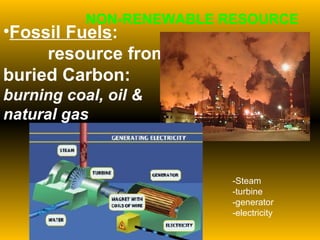
Fossil Fuels :  resource from buried Carbon: burning coal, oil & natural gas NON-RENEWABLE RESOURCE -Steam -turbine -generator -electricity
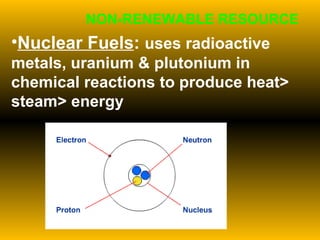
Nuclear Fuels :  uses radioactive metals, uranium & plutonium in chemical reactions to produce heat> steam> energy NON-RENEWABLE RESOURCE
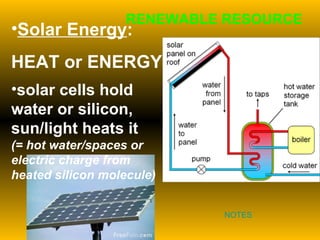
Solar Energy :  HEAT or ENERGY  solar cells hold water or silicon, sun/light heats it  (= hot water/spaces or electric charge from heated silicon molecule) RENEWABLE RESOURCE NOTES
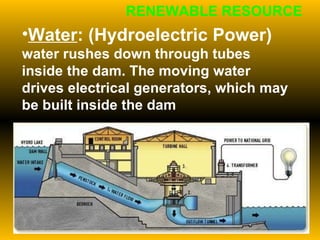
Water : (Hydroelectric Power)  water rushes down through tubes inside the dam. The moving water drives electrical generators, which may be built inside the dam   RENEWABLE RESOURCE
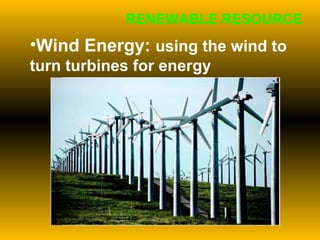
Wind Energy:  using the wind to turn turbines for energy RENEWABLE RESOURCE
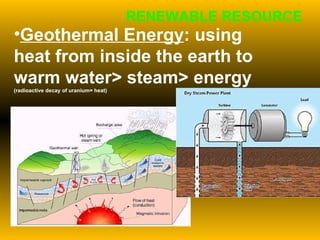
Geothermal Energy : using heat from inside the earth to warm water> steam> energy  (radioactive decay of uranium= heat) RENEWABLE RESOURCE
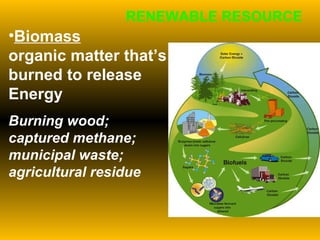
Biomass organic matter that’s burned to release Energy Burning wood;  captured methane;  municipal waste; agricultural residue RENEWABLE RESOURCE
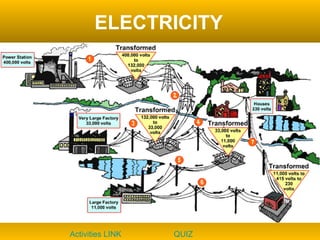
ELECTRICITY Activities LINK QUIZ
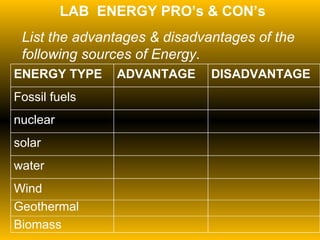
LAB  ENERGY PRO’s & CON’s List the advantages & disadvantages of the following sources of Energy. Wind Geothermal Biomass water solar nuclear Fossil fuels DISADVANTAGE ADVANTAGE ENERGY TYPE
BBC Energy Links HOW STUFF WORKS: Telephone system Wii Radio Helicopters Toilets Microwaves LCD & Plasma  tv Light bulbs Air & refrigeration Electricity  1 Electricity  2 Water Treatment Plants QUIZ

Physics1 notesNotes on basic physics forces, forms of Energy, Energy conversions, and Energy resources with video links

  • 1.
    Physics 1 EnergyPPT. by, Robin D. Seamon
  • 2.
    MOTION Position: the location of an object Direction : N, S, E, W Speed : distance over time (tells how fast it moved) EXAMPLE: the soccer ball moved 20m east. Did it move 20m in 2 sec? OR Did it move 20m in 2 min? Which is the slower speed?
  • 3.
    How do youmeasure motion? Stopwatch Divide: distance time
  • 4.
    QUESTIONS: What isthe speed of the golf ball that moves 35 m in 5 sec? Why is a compass a useful tool to describe motion? How can motion be described?
  • 5.
    FORCE & MOTIONForce : a push or pull on an object The amount of force you apply, determines how fast the object will move If an object stops, speeds up, slows down, or changes direction, a force has been applied to it! EXAMPLES: gravity, lift, thrust, friction
  • 6.
    EXAMPLE: Forces ona Shark Thrust Lift Drag : air/water resistance
  • 7.
    Describe the forcethe weight lifter is exerting on the bar. Are the forces balanced or unbalanced? PRACTICE LINK PRACTICE Q’s
  • 8.
    Hydraulic Lift simulation Activity 1 Quiz 2
  • 9.
    Energy & MachinesEnergy: the ability to do work (joules) (amt. of E to lift an apple 1m) Machine : something that replaces human effort Friction : the force that slows down or stops motion Gravity : the fore that pulls all objects on Earth toward the center of Earth (All objects have gravity; the larger the object, the stronger the gravitational pull)
  • 10.
    Potential Energy : stored up Energy; energy ready to be used Kinetic Energy : energy of motion; WORKING Energy mv 2 2 M= mass kg; v= speed
  • 11.
    FORMS of ENERGY:Thermal energy : energy from the rapid movement of molecules, causing heat- high temp to low temp -moves faster at high temp Mechanical energy : Energy of motion & position -stays the same unless transfers to another object
  • 12.
    Electrical energy :energy from moving electrons in atoms (negative charge around atoms) Gravitational potential energy : potential energy an object has if it falls Elastic Potential energy : potential energy of an object as it is forced to change shape, but has the ability to return to its normal shape.
  • 13.
    Chemical energy :energy from the interaction of molecules photosynthesis sugar forms by work of joining different atoms together in certain patterns: C 6 H 10 O 2 burning wood releases E as heat explosion rapid release of E Examples
  • 14.
    Nuclear energy: energy that comes from changes in the nucleus of an atom Fission break apart (power plants) Fusion put together (sun) 100,000,000 °C: H joins to form He
  • 15.
    Light energy :energy from light; vibrations of electrically charged particles (NOTE: do not need air to transmit… can transmit through a vacuum as photons) Sound energy : energy from sound waves; objects vibrate, transmitting some of the kinetic E to air around it, air particles vibrate & transmit E to your ear… YOU HEAR!
  • 16.
    SIR ISAAC NEWTON: (1643-1727) Mathematician & astronomer NEWTON LINK BIOGRAPHY Newton’s 1 st law of Motion : objects remain still or in motion until another force is applied to it (law of inertia) Newton’s 2 nd law of Motion : acceleration happens when a force is acted on an object. The greater the mass of the object, the more force is needed to move it. (f=ma) Newton’s 3 rd law of Motion : for every action, there is an equal and opposite reaction NEWTON LINK : explore the 3 laws http://www.mrdowling.com/601-newton.html
  • 17.
    ENERGY CONVERSIONS: (changingfrom one form to another) Elastic potential Energy Chemical energy of food you eat: atoms rearrange to make energy for you Energy pyramid Light E > chemical E > we eat it > to kinetic E as we move & live Examples Pendulum
  • 18.
    ENERGY CONVERSION LABMake a list of 15-20 gadgets. Denote the source of E and into what kind of E it converts Kinetic & sound E Electrical E Blender Light & thermal E Electrical E Light bulb Electrical E Chemical E Battery Light & sound E Electrical E Alarm clock DESTINATION SOURCE GADGET
  • 19.
    ENERGY CONVERSION LABMake a list of 15-20 gadgets. Denote the source of E and into what kind of E it converts
  • 20.
    ENERGY CONVERSION LABMake a list of 15-20 gadgets. Denote the source of E and into what kind of E it converts
  • 21.
    ENERGY CONVERSION LABMake a list of 15-20 gadgets. Denote the source of E and into what kind of E it converts
  • 22.
    ENERGY CONVERSION LABMake a list of 15-20 gadgets. Denote the source of E and into what kind of E it converts
  • 23.
    ENERGY CONVERSION LAB2 Choose one daily activity that you do. Trace the Energy back as far as you can go. Soccer ball moves (mechanical Energy) > Kicking a soccer ball (mechanical Energy) > muscles move forward (mechanical Energy) > Energy goes to my muscles from food I eat > (chemical Energy) > the bacon I ate has Energy from the plants the pig ate (chemical Energy) > the plant has Energy from the sun (photosynthesis/light Energy) > the sun gives off light Energy from nuclear fusion > nuclear fusion comes from the combining of hydrogen atoms to make helium…
  • 24.
    All machines requireenergy to work. Which source makes the most sense for the job? QUESTIONS: What is needed to operate a machine? What is a device that replaces human effort? Why does a machine that lifts boxes off the ground need energy?
  • 25.
    Unbalanced Forces &Motion Balanced Forces: forces that have equal measure & are balanced; net force of zero Unbalanced Forces : forces in which one is greater (stronger) than the other, causing motion No motion Object moves left
  • 26.
    What affects Motion?Friction : a force that acts on an object to STOP the motion: ground, air, bumps Inertia : the tendency of an object to remain still or in motion unless acted on by a force Momentum : product of the mass and velocity of an object
  • 27.
    MODELS: Design :imagining and creating a best way to solve a problem What are the limits? What materials make sense? Is space a limit? Model : testing your design; replica; computer simulations Communicating: report your designs, drawings, & findings
  • 28.
    Pulley : usesgrooved wheels and a rope to raise, lower, or move a load Simple Machine: a tool that makes work easier
  • 29.
    Lever : astiff bar that rests on a middle support, used to lift or move loads. http://www.cool-science-projects.com/simple-machine-science-project.html
  • 30.
    Wedge : has a slanted side that ends in a sharp edge. This tool concentrates the energy to that one edge/point
  • 31.
    Wheel & axle: a wheel with a rod through its center that lifts or moves loads http://www.msnucleus.org/membership/html/k-6/as/technology/2/images/gear.gif
  • 32.
    Inclined plane :is a slanted surface that helps move an object up
  • 33.
    Screw: an inclined plane that is wrapped around a pole; hold things together or lift things up www.yourdictionary.com/screw
  • 34.
    QUESTIONS: The motionof any object can be describe by its position an how that position changes over __ What is a push or pull on an object called? In order to work, what do all machines require? What type of energy is used to move things? During a tug of war, each team is pulling on the rope with equal forces in opposite directions. What is this an example of? 6. The force of friction acts in which direction? 7. After a design is found, the designer must test the design, evaluate the test, and then what? 8. A teeter-totter is an example of which kind of simple machine? time force energy mechanical energy balanced forces Opposite direction object is moving Communicate it lever BBC Forces QUIZ
  • 35.
    Energy Efficiency: Closedsystem : group of objects that only transfer E to each other. (not everything is a closed system) *In Conversion of E, some ALWAYS gets converted to thermal E (not lost!) Energy efficiency: comparison of the amount of E before conversion, with the amount after conversion
  • 36.
    How can youmake machines more Energy Efficient? (more useful) Oiling mechanical parts reduces friction & heat loss Aerodynamic shapes use less E to overcome friction
  • 37.
    LAB: EnergyTrace Pick a daily activity & trace it back to its source of E
  • 38.
  • 39.
    Fossil Fuels : resource from buried Carbon: burning coal, oil & natural gas NON-RENEWABLE RESOURCE -Steam -turbine -generator -electricity
  • 40.
    Nuclear Fuels : uses radioactive metals, uranium & plutonium in chemical reactions to produce heat> steam> energy NON-RENEWABLE RESOURCE
  • 41.
    Solar Energy : HEAT or ENERGY solar cells hold water or silicon, sun/light heats it (= hot water/spaces or electric charge from heated silicon molecule) RENEWABLE RESOURCE NOTES
  • 42.
    Water : (HydroelectricPower) water rushes down through tubes inside the dam. The moving water drives electrical generators, which may be built inside the dam RENEWABLE RESOURCE
  • 43.
    Wind Energy: using the wind to turn turbines for energy RENEWABLE RESOURCE
  • 44.
    Geothermal Energy :using heat from inside the earth to warm water> steam> energy (radioactive decay of uranium= heat) RENEWABLE RESOURCE
  • 45.
    Biomass organic matterthat’s burned to release Energy Burning wood; captured methane; municipal waste; agricultural residue RENEWABLE RESOURCE
  • 46.
  • 47.
    LAB ENERGYPRO’s & CON’s List the advantages & disadvantages of the following sources of Energy. Wind Geothermal Biomass water solar nuclear Fossil fuels DISADVANTAGE ADVANTAGE ENERGY TYPE
  • 48.
    BBC Energy LinksHOW STUFF WORKS: Telephone system Wii Radio Helicopters Toilets Microwaves LCD & Plasma tv Light bulbs Air & refrigeration Electricity 1 Electricity 2 Water Treatment Plants QUIZ