Force, Work & Energy


Marie Jessica B. Alumaga
Objectives:

• To cite examples of forces encountered in day
  to day activities
• To describe and discuss the four fundamental
  forces
• To state the scientific definition of work and
  solve work problems
• To describe the different forms and
  transformations of energy
• To explain how energy is related to work
Force

Force - push or pull
     contact forces – exerted between objects
          that are in close contact
     noncontact forces – can be exerted
          between objects that are not even
          touching
Fundamental forces
• Gravitational force - affects anything that has mass
• Electromagnetic forces – exerted on charged objects
  or magnetic objects
      Like charges repel, unlike charges attract.
      Like poles repel, unlike poles attract.
• Weak force – exerted between leptons and hadrons;
  active only at distances less than 10-18 m
• Strong forces – acts only on hadrons; strongest of
  the four but effective only at very short separations
  (10-15m)
Work
Work - product of the force and displacement
    (displacement – distance moved by an
         object as a result of the force’s action)
     - being done when all of the following
       conditions are satisfied
          a. A force is exerted on the object.
          b. The object moves.
          c. The motion is in the direction of
             the force.
Work
Sample problem 1:
How much work is done when a 100-N cart is
pulled over a distance of 1 meter?
Given: F = 100N d = 1m
Find: W
Solution: W = Fd
          W = 100N(1m)
            = 100Nm or 100J
Work
To get the maximum amount of work , the
force must be parallel to the motion.
Work
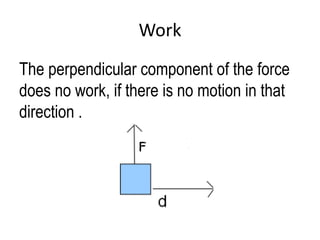
The perpendicular component of the force
does no work, if there is no motion in that
direction .
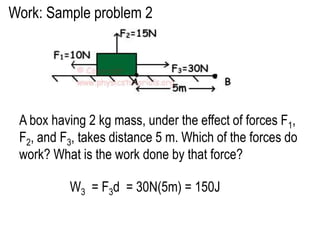
Work: Sample problem 2


 A box having 2 kg mass, under the effect of forces F1,
 F2, and F3, takes distance 5 m. Which of the forces do
 work? What is the work done by that force?

          W3 = F3d = 30N(5m) = 150J
Power
Power – refers to the rate at which work is done
            P = Wdone/time
Unit of power:
• joule/second (J/s)        1J/s = 1 watt (W)
• Horsepower (hp)           1hp = 746 W
  - used to specify the power output of motors
    and engine
Machine

Machine – a device that transfers a force from
          its point of application to some other
          point to where it is used
        - may multiply force or distance or
          simply change the direction of the
          force
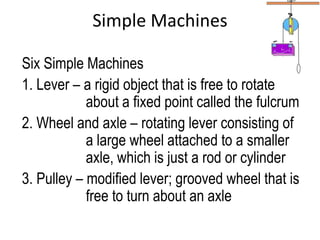
Simple Machines

Six Simple Machines
1. Lever – a rigid object that is free to rotate
            about a fixed point called the fulcrum
2. Wheel and axle – rotating lever consisting of
            a large wheel attached to a smaller
            axle, which is just a rod or cylinder
3. Pulley – modified lever; grooved wheel that is
            free to turn about an axle
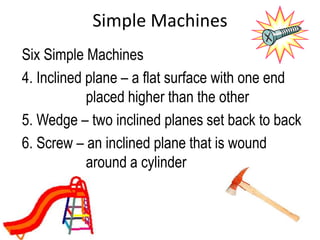
Simple Machines
Six Simple Machines
4. Inclined plane – a flat surface with one end
            placed higher than the other
5. Wedge – two inclined planes set back to back
6. Screw – an inclined plane that is wound
            around a cylinder
Concept of Energy
Energy - capacity to do work
• If something has energy it can do work.
• If something can do work, then it has energy.
• Work and energy have the same unit, (joule,J)
• It cannot be seen but evidences prove its
  existence.
Different Forms of Energy
Potential Energy (PE)
- stored energy due to the object’s position or
  internal arrangement of molecules
Kinetic Energy (KE)
- energy of moving object
Different Forms of Potential Energy
1. Gravitational potential energy
   - energy is due to the object’s position or height
     from the earth
   The higher the position, the greater is the
     gravitational PE
2. Magnetic potential energy
   - energy from magnets
3. Chemical energy
   - energy due to the arrangement of the atoms and
     molecules in matter
Different Forms of Kinetic Energy
1. Electrical Energy – due to the motion of charged
      particles through conducting wires
2. Nuclear Energy – energy derived from the nuclear
      reaction
   nuclear fusion – nuclei join to form a nucleus
   nuclear fission – nucleus is broken into smaller nuclei
3. Radiant Energy – energy transported by
      electromagnetic waves
4. Thermal Energy - sum of the KE’s of the molecules
      due to their linear motion
Energy Transfer

Heat can be transferred through
• Radiation – transfer by rays or
           electromagnetic waves
• Conduction – transfer by direct contact
• Convection - transfer involving difference in
           density
Energy transformation

Energy cannot be created nor destroyed, it
can only be transformed from one form to
another. (Law of Conservation of Energy)
• Electrical energy chemical energy
• Chemical energy electrical energy
• Radiant energy chemical energy
Sources of Energy
• Renewable sources
- energy sources that can be replenished
• Nonrenewable sources
- energy sources that has undergone long
  process of formation
Sources of Energy – Renewable Sources

• Geothermal energy - heat energy from deep
     within the earth
• Hydropower - energy from moving water
• Tidal energy - energy from the regular rise and
     fall of sea water
• Wind energy - energy from wind mills
• Solar energy - energy rom the sun
• Biomass – energy resource that is derived from
     plant or animal matter
Sources of Energy – Nonrenewable Sources
• Fossil fuels - derived from the remains of plants
  and animals that died millions of years ago
    petroleum – also called crude oil; complex
            mixture of hydrogen and carbon
            compounds
    coal – most abundant and dirtiest fossil fuel
    natural gas – mainly methane and the
            cleanest of all the fossil fuels
• Nuclear energy – energy from fission or fusion
    reaction
Problems Related to Energy
1. Combustion of fossil fuels release gases and solid
   pollutants that are harmful to living and non-living things.
2. Nuclear energy production
    a) release radioactive substances harmful to living things
    b) waste disposal
    c) poses risk of reactor accidents
    d) causes thermal pollution
3. Tidal and hydroelectric dams create ecological froblems.
4. geothermal energy emits H2S
Energy Utilization and Consumption
• All people are users of energy.
• Energy sources are popularly used for the
  generation of electricity
• Factors that will affect the selection of energy for
  electricity include
      - availability in the country
      - cost of production
      - availability of local manpower to make and
        repair the plant
      - ecological impact during extraction, utilization
        and waste disposal
Energy conservation

- refers to the practice of extending the useful
  life of the earth’s energy resources
- should be taught early in life
- influenced by the people’s attitudes, mores and
  beliefs
Small things make a big difference.


                            MJBA
References

• McLaughlin, Charles W., Thompson, Marilyn, and
  Zike, Dinah. (2012). Glencoe Physical Science.
  McGraw-Hill Education

• Serway, Raymond A., Vuille, Chris and Faugnn,
  Jerry S.(2009). College Physics (Volume 2) 8th ed.
  Brooks/Cole Cengage Learning

• Tillery, Bill W. (2011). Physical Science McGraw-
  Hill Publishing Co.

(NSCO13) Work, Force, Energy

  • 1.
    Force, Work &Energy Marie Jessica B. Alumaga
  • 2.
    Objectives: • To citeexamples of forces encountered in day to day activities • To describe and discuss the four fundamental forces • To state the scientific definition of work and solve work problems • To describe the different forms and transformations of energy • To explain how energy is related to work
  • 3.
    Force Force - pushor pull contact forces – exerted between objects that are in close contact noncontact forces – can be exerted between objects that are not even touching
  • 4.
    Fundamental forces • Gravitationalforce - affects anything that has mass • Electromagnetic forces – exerted on charged objects or magnetic objects Like charges repel, unlike charges attract. Like poles repel, unlike poles attract. • Weak force – exerted between leptons and hadrons; active only at distances less than 10-18 m • Strong forces – acts only on hadrons; strongest of the four but effective only at very short separations (10-15m)
  • 5.
    Work Work - productof the force and displacement (displacement – distance moved by an object as a result of the force’s action) - being done when all of the following conditions are satisfied a. A force is exerted on the object. b. The object moves. c. The motion is in the direction of the force.
  • 6.
    Work Sample problem 1: Howmuch work is done when a 100-N cart is pulled over a distance of 1 meter? Given: F = 100N d = 1m Find: W Solution: W = Fd W = 100N(1m) = 100Nm or 100J
  • 7.
    Work To get themaximum amount of work , the force must be parallel to the motion.
  • 8.
    Work The perpendicular componentof the force does no work, if there is no motion in that direction .
  • 9.
    Work: Sample problem2 A box having 2 kg mass, under the effect of forces F1, F2, and F3, takes distance 5 m. Which of the forces do work? What is the work done by that force? W3 = F3d = 30N(5m) = 150J
  • 10.
    Power Power – refersto the rate at which work is done P = Wdone/time Unit of power: • joule/second (J/s) 1J/s = 1 watt (W) • Horsepower (hp) 1hp = 746 W - used to specify the power output of motors and engine
  • 11.
    Machine Machine – adevice that transfers a force from its point of application to some other point to where it is used - may multiply force or distance or simply change the direction of the force
  • 12.
    Simple Machines Six SimpleMachines 1. Lever – a rigid object that is free to rotate about a fixed point called the fulcrum 2. Wheel and axle – rotating lever consisting of a large wheel attached to a smaller axle, which is just a rod or cylinder 3. Pulley – modified lever; grooved wheel that is free to turn about an axle
  • 13.
    Simple Machines Six SimpleMachines 4. Inclined plane – a flat surface with one end placed higher than the other 5. Wedge – two inclined planes set back to back 6. Screw – an inclined plane that is wound around a cylinder
  • 14.
    Concept of Energy Energy- capacity to do work • If something has energy it can do work. • If something can do work, then it has energy. • Work and energy have the same unit, (joule,J) • It cannot be seen but evidences prove its existence.
  • 15.
    Different Forms ofEnergy Potential Energy (PE) - stored energy due to the object’s position or internal arrangement of molecules Kinetic Energy (KE) - energy of moving object
  • 16.
    Different Forms ofPotential Energy 1. Gravitational potential energy - energy is due to the object’s position or height from the earth The higher the position, the greater is the gravitational PE 2. Magnetic potential energy - energy from magnets 3. Chemical energy - energy due to the arrangement of the atoms and molecules in matter
  • 17.
    Different Forms ofKinetic Energy 1. Electrical Energy – due to the motion of charged particles through conducting wires 2. Nuclear Energy – energy derived from the nuclear reaction nuclear fusion – nuclei join to form a nucleus nuclear fission – nucleus is broken into smaller nuclei 3. Radiant Energy – energy transported by electromagnetic waves 4. Thermal Energy - sum of the KE’s of the molecules due to their linear motion
  • 18.
    Energy Transfer Heat canbe transferred through • Radiation – transfer by rays or electromagnetic waves • Conduction – transfer by direct contact • Convection - transfer involving difference in density
  • 19.
    Energy transformation Energy cannotbe created nor destroyed, it can only be transformed from one form to another. (Law of Conservation of Energy) • Electrical energy chemical energy • Chemical energy electrical energy • Radiant energy chemical energy
  • 20.
    Sources of Energy •Renewable sources - energy sources that can be replenished • Nonrenewable sources - energy sources that has undergone long process of formation
  • 21.
    Sources of Energy– Renewable Sources • Geothermal energy - heat energy from deep within the earth • Hydropower - energy from moving water • Tidal energy - energy from the regular rise and fall of sea water • Wind energy - energy from wind mills • Solar energy - energy rom the sun • Biomass – energy resource that is derived from plant or animal matter
  • 22.
    Sources of Energy– Nonrenewable Sources • Fossil fuels - derived from the remains of plants and animals that died millions of years ago petroleum – also called crude oil; complex mixture of hydrogen and carbon compounds coal – most abundant and dirtiest fossil fuel natural gas – mainly methane and the cleanest of all the fossil fuels • Nuclear energy – energy from fission or fusion reaction
  • 23.
    Problems Related toEnergy 1. Combustion of fossil fuels release gases and solid pollutants that are harmful to living and non-living things. 2. Nuclear energy production a) release radioactive substances harmful to living things b) waste disposal c) poses risk of reactor accidents d) causes thermal pollution 3. Tidal and hydroelectric dams create ecological froblems. 4. geothermal energy emits H2S
  • 24.
    Energy Utilization andConsumption • All people are users of energy. • Energy sources are popularly used for the generation of electricity • Factors that will affect the selection of energy for electricity include - availability in the country - cost of production - availability of local manpower to make and repair the plant - ecological impact during extraction, utilization and waste disposal
  • 25.
    Energy conservation - refersto the practice of extending the useful life of the earth’s energy resources - should be taught early in life - influenced by the people’s attitudes, mores and beliefs
  • 26.
    Small things makea big difference. MJBA
  • 27.
    References • McLaughlin, CharlesW., Thompson, Marilyn, and Zike, Dinah. (2012). Glencoe Physical Science. McGraw-Hill Education • Serway, Raymond A., Vuille, Chris and Faugnn, Jerry S.(2009). College Physics (Volume 2) 8th ed. Brooks/Cole Cengage Learning • Tillery, Bill W. (2011). Physical Science McGraw- Hill Publishing Co.