How to Use This Presentation To View the presentation as a slideshow with effects  select  “View”  on the menu bar and click on  “Slide Show.” To advance through the presentation, click the right-arrow key or the space bar. From the resources slide, click on any resource to see a presentation for that resource. From the Chapter menu screen click on any lesson to go directly to that lesson’s presentation. You may exit the slide show at any time by pressing  the  Esc  key.
Chapter Presentation Transparencies Standardized Test Prep Sample Problems Visual Concepts Resources
Table of Contents Section 1  Work Section 2  Energy Section 3  Conservation of Energy Section 4  Power Work and Energy Chapter  5
Objectives Recognize   the difference between the scientific and ordinary definitions of work. Define   work by relating it to force and displacement. Identify   where work is being performed in a variety of situations. Calculate   the net work done when many forces are applied to an object. Section 1  Work Chapter  5
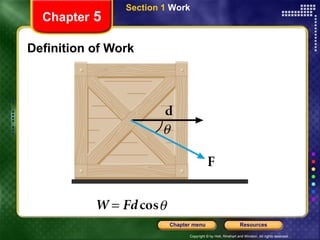
Definition of Work Work  is done on an object when a force causes a displacement of the object. Work   is done only when components of a force are parallel to a displacement. Section 1  Work Chapter  5
Definition of Work Chapter  5 Section 1  Work
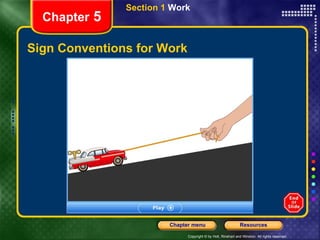
Sign Conventions for Work Chapter  5 Section 1  Work
Objectives Identify   several forms of energy. Calculate   kinetic energy for an object. Apply   the work–kinetic energy theorem to solve problems. Distinguish   between kinetic and potential energy. Classify   different types of potential energy. Calculate   the potential energy associated with an object’s position. Section 2  Energy Chapter  5
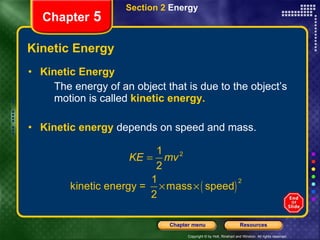
Kinetic Energy Kinetic Energy The energy of an object that is due to the object’s motion is called  kinetic energy. Kinetic energy  depends on speed and mass. Section 2  Energy Chapter  5
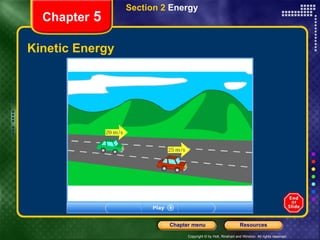
Kinetic Energy Chapter  5 Section 2  Energy
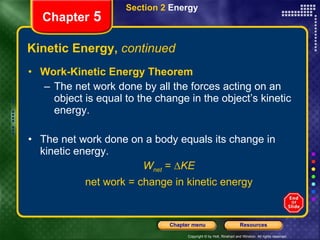
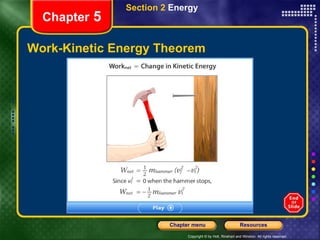
Kinetic Energy,  continued Work-Kinetic Energy Theorem The net work done by all the forces acting on an object is equal to the change in the object’s kinetic energy. The net work done on a body equals its change in kinetic energy. W net   = ∆ KE net work = change in kinetic energy Section 2  Energy Chapter  5
Work-Kinetic Energy Theorem Chapter  5 Section 2  Energy
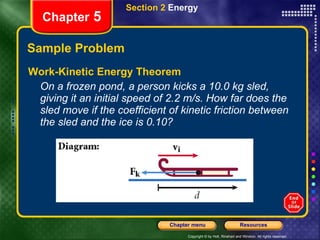
Sample Problem Work-Kinetic Energy Theorem On a frozen pond, a person kicks a 10.0 kg sled, giving it an initial speed of 2.2 m/s. How far does the sled move if the coefficient of kinetic friction between the sled and the ice is 0.10? Section 2  Energy Chapter  5
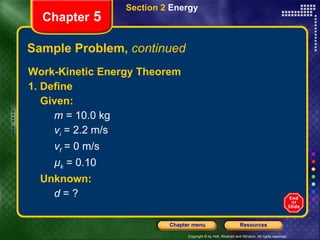
Sample Problem,  continued Work-Kinetic Energy Theorem 1. Define Given:   m  = 10.0 kg  v i  = 2.2 m/s  v f  = 0 m/s  µ k  = 0.10 Unknown:   d  = ? Section 2  Energy Chapter  5
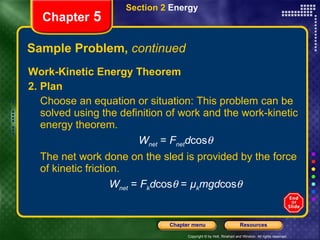
Sample Problem,  continued Work-Kinetic Energy Theorem 2. Plan Choose an equation or situation: This problem can be solved using the definition of work and the work-kinetic energy theorem. W net  =  F net d cos  The net work done on the sled is provided by the force of kinetic friction. W net  =  F k d cos   =  µ k mgd cos  Section 2  Energy Chapter  5
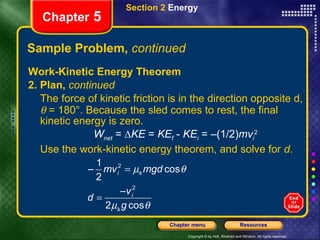
Sample Problem,  continued Work-Kinetic Energy Theorem 2. Plan,  continued The force of kinetic friction is in the direction opposite d,    = 180°. Because the sled comes to rest, the final kinetic energy is zero. W net  = ∆ KE  =  KE f  -  KE i  = –(1/2) mv i 2 Use the work-kinetic energy theorem, and solve for  d . Section 2  Energy Chapter  5
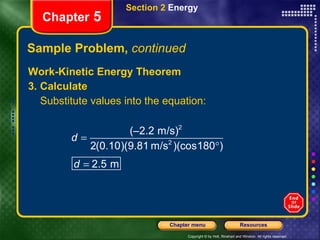
Sample Problem,  continued Work-Kinetic Energy Theorem 3. Calculate Substitute values into the equation: Section 2  Energy Chapter  5
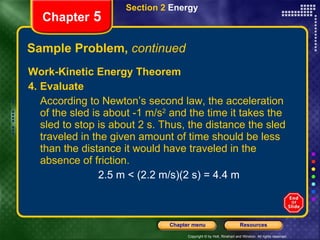
Sample Problem,  continued Work-Kinetic Energy Theorem 4. Evaluate According to Newton’s second law, the acceleration of the sled is about -1 m/s 2  and the time it takes the sled to stop is about 2 s. Thus, the distance the sled traveled in the given amount of time should be less than the distance it would have traveled in the absence of friction. 2.5 m < (2.2 m/s)(2 s) = 4.4 m Section 2  Energy Chapter  5
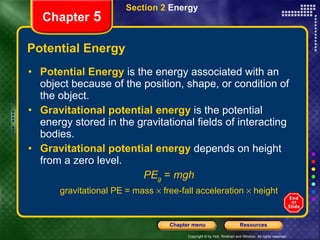
Potential Energy Potential Energy  is the energy associated with an object because of the position, shape, or condition of the object. Gravitational potential energy  is the potential energy stored in the gravitational fields of interacting bodies. Gravitational potential energy  depends on height from a zero level. PE g   =  mgh gravitational PE = mass    free-fall acceleration    height Section 2  Energy Chapter  5
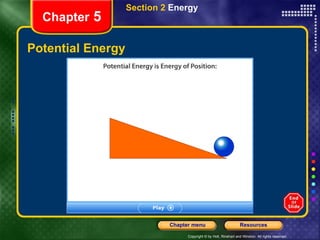
Potential Energy Chapter  5 Section 2  Energy
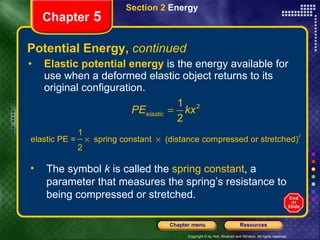
Potential Energy,  continued Elastic potential energy  is the energy available for use when a deformed elastic object returns to its original configuration. Section 2  Energy Chapter  5 The symbol  k  is called the  spring constant , a parameter that measures the spring’s resistance to being compressed or stretched.
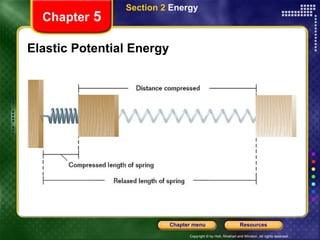
Elastic Potential Energy Chapter  5 Section 2  Energy
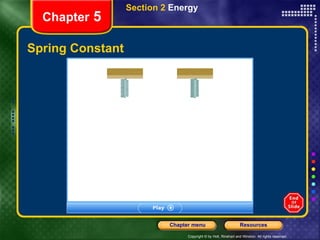
Spring Constant Chapter  5 Section 2  Energy
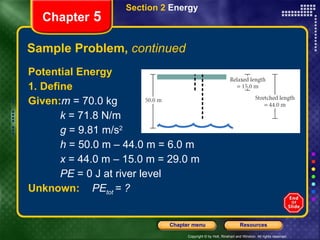
Sample Problem Potential Energy A 70.0 kg stuntman is attached to a bungee cord with an unstretched length of 15.0 m. He jumps off a bridge spanning a river from a height of 50.0 m. When he finally stops, the cord has a stretched length of 44.0 m. Treat the stuntman as a point mass, and disregard the weight of the bungee cord. Assuming the spring constant of the bungee cord is 71.8 N/m, what is the total potential energy relative to the water when the man stops falling? Section 2  Energy Chapter  5
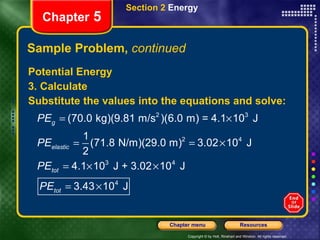
Sample Problem,  continued Potential Energy 1. Define Given: m  = 70.0 kg k  = 71.8 N/m g  = 9.81 m/s 2 h  = 50.0 m – 44.0 m = 6.0 m x  = 44.0 m – 15.0 m = 29.0 m PE  = 0 J at river level Unknown: PE tot   = ?   Section 2  Energy Chapter  5
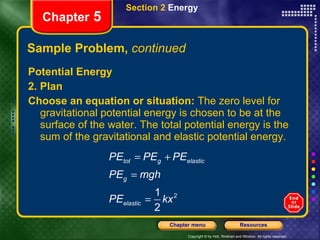
Sample Problem,  continued Potential Energy 2. Plan  Choose an equation or situation:  The zero level for gravitational potential energy is chosen to be at the surface of the water. The total potential energy is the sum of the gravitational and elastic potential energy. Section 2  Energy Chapter  5
Sample Problem,  continued Potential Energy 3. Calculate  Substitute the values into the equations and solve: Section 2  Energy Chapter  5
Sample Problem,  continued Potential Energy 4. Evaluate  One way to evaluate the answer is to make an order-of-magnitude estimate. The gravitational potential energy is on the order of 10 2  kg    10 m/s 2     10 m = 10 4  J. The elastic potential energy is on the order of 1    10 2  N/m    10 2  m 2  = 10 4  J. Thus, the total potential energy should be on the order of 2    10 4  J. This number is close to the actual answer. Section 2  Energy Chapter  5
Objectives Identify   situations in which conservation of mechanical energy is valid. Recognize   the forms that conserved energy can take. Solve   problems using conservation of mechanical energy. Section 3  Conservation of Energy Chapter  5
Conserved Quantities When we say that something is   conserved,   we mean that it remains constant. Section 3  Conservation of   Energy Chapter  5
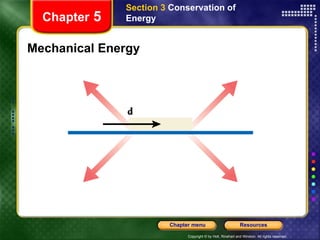
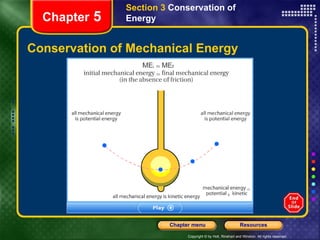
Mechanical Energy Mechanical energy   is the sum of kinetic energy and all forms of potential energy associated with an object or group of objects. ME  =  KE  + ∑ PE Mechanical energy  is often conserved. ME i  =  ME f initial mechanical energy = final mechanical energy (in the absence of friction) Section 3  Conservation of   Energy Chapter  5
Conservation of Mechanical Energy Chapter  5 Section 3  Conservation of Energy
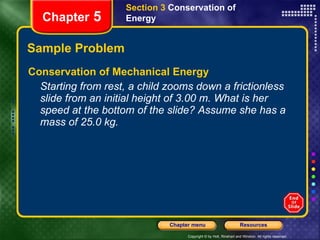
Sample Problem Conservation of Mechanical Energy Starting from rest, a child zooms down a frictionless slide from an initial height of 3.00 m. What is her speed at the bottom of the slide? Assume she has a mass of 25.0 kg. Section 3  Conservation of   Energy Chapter  5
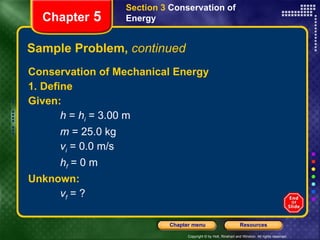
Sample Problem,  continued Conservation of Mechanical Energy 1. Define Given:   h  =  h i  = 3.00 m  m  = 25.0 kg  v i  = 0.0 m/s h f  = 0 m Unknown:   v f  = ? Section 3  Conservation of   Energy Chapter  5
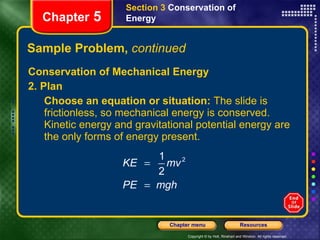
Sample Problem,  continued Conservation of Mechanical Energy 2. Plan Choose an equation or situation:  The slide is frictionless, so mechanical energy is conserved. Kinetic energy and gravitational potential energy are the only forms of energy present. Section 3  Conservation of   Energy Chapter  5
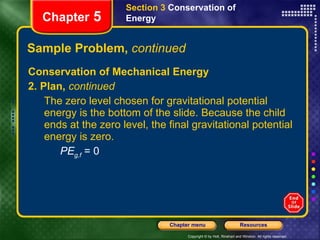
Sample Problem,  continued Conservation of Mechanical Energy 2. Plan,  continued The zero level chosen for gravitational potential energy is the bottom of the slide. Because the child ends at the zero level, the final gravitational potential energy is zero. PE g,f  = 0 Section 3  Conservation of   Energy Chapter  5
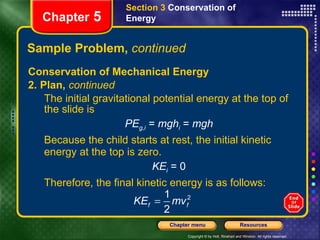
Sample Problem,  continued Conservation of Mechanical Energy 2. Plan,  continued The initial gravitational potential energy at the top of the slide is PE g,i  =  mgh i  =  mgh Because the child starts at rest, the initial kinetic energy at the top is zero. KE i  = 0 Therefore, the final kinetic energy is as follows: Section 3  Conservation of   Energy Chapter  5
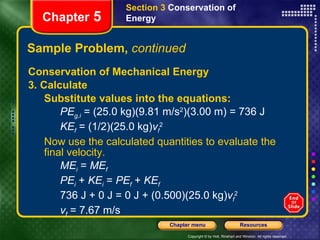
Conservation of Mechanical Energy 3. Calculate Substitute values into the equations: PE g,i  = (25.0 kg)(9.81 m/s 2 )(3.00 m) = 736 J KE f  = (1/2)(25.0 kg) v f 2 Now use the calculated quantities to evaluate the final velocity. ME i  =  ME f PE i  +  KE i  =  PE f  +  KE f 736 J + 0 J = 0 J + (0.500)(25.0 kg) v f 2 v f  = 7.67 m/s Sample Problem,  continued Section 3  Conservation of   Energy Chapter  5
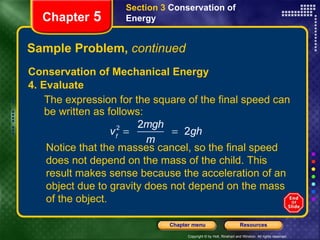
Sample Problem,  continued Conservation of Mechanical Energy 4. Evaluate The expression for the square of the final speed can be written as follows: Section 3  Conservation of   Energy Chapter  5 Notice that the masses cancel, so the final speed does not depend on the mass of the child. This result makes sense because the acceleration of an object due to gravity does not depend on the mass of the object.
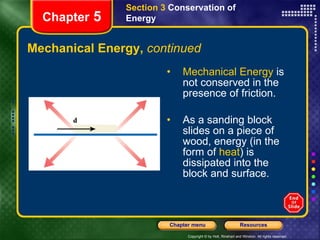
Mechanical Energy,  continued Mechanical Energy  is not conserved in the presence of friction. As a sanding block slides on a piece of wood, energy (in the form of  heat ) is dissipated into the block and surface. Section 3  Conservation of   Energy Chapter  5
Objectives Relate   the concepts of energy, time, and power. Calculate   power in two different ways. Explain   the effect of machines on work and power. Section 4  Power Chapter  5
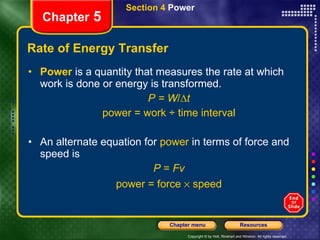
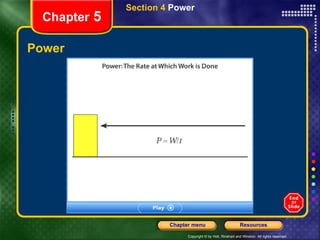
Rate of Energy Transfer Power   is a quantity that measures the rate at which work is done or energy is transformed. P = W /∆ t power = work ÷ time interval An alternate equation for  power  in terms of force and speed is P  =  Fv power = force    speed Section 4  Power Chapter  5
Power Chapter  5 Section 4  Power
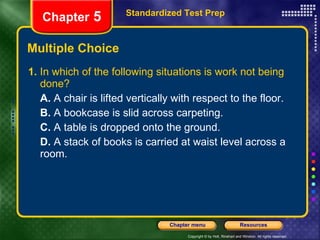
Multiple Choice 1.  In which of the following situations is work not being done? A.  A chair is lifted vertically with respect to the floor. B.  A bookcase is slid across carpeting. C.  A table is dropped onto the ground. D.  A stack of books is carried at waist level across a room. Standardized Test Prep Chapter  5
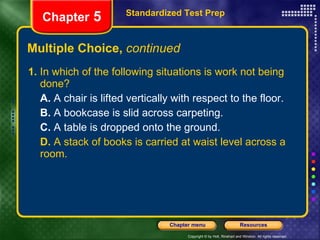
Multiple Choice,  continued 1.  In which of the following situations is work not being done? A.  A chair is lifted vertically with respect to the floor. B.  A bookcase is slid across carpeting. C.  A table is dropped onto the ground. D.  A stack of books is carried at waist level across a room. Standardized Test Prep Chapter  5
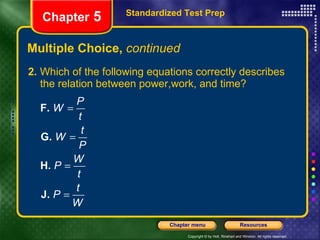
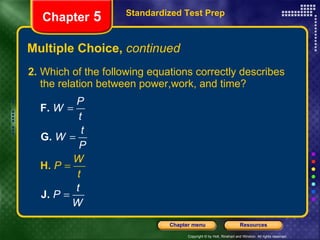
Multiple Choice,  continued 2.  Which of the following equations correctly describes the relation between power,work, and time? Standardized Test Prep Chapter  5
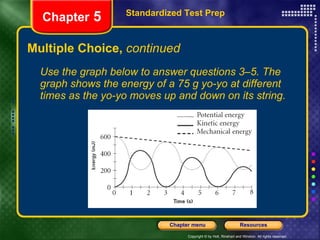
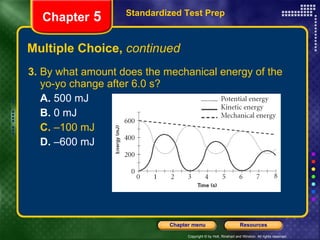
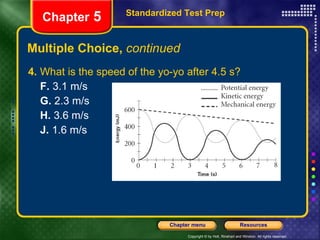
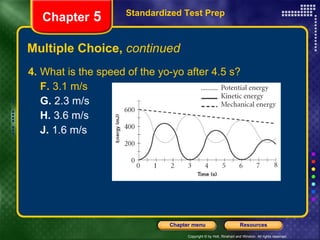
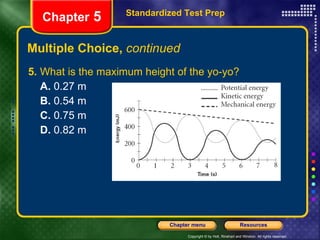
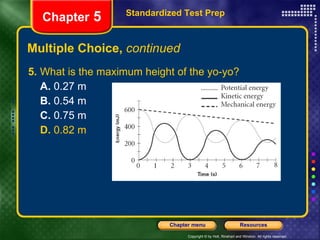
Multiple Choice,  continued Use the graph below to answer questions 3–5. The graph shows the energy of a 75 g yo-yo at different times as the yo-yo moves up and down on its string. Standardized Test Prep Chapter  5
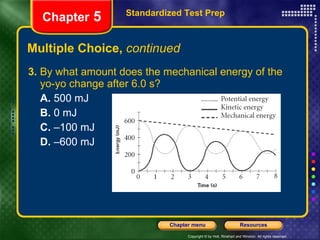
Multiple Choice,  continued 3.  By what amount does the mechanical energy of the yo-yo change after 6.0 s? A.  500 mJ B.  0 mJ C.  –100 mJ D.  –600 mJ Standardized Test Prep Chapter  5
Multiple Choice,  continued 4.  What is the speed of the yo-yo after 4.5 s? F.  3.1 m/s G.  2.3 m/s H.  3.6 m/s J.  1.6 m/s Standardized Test Prep Chapter  5
Multiple Choice,  continued 5.  What is the maximum height of the yo-yo? A.  0.27 m B.  0.54 m C.  0.75 m D.  0.82 m Standardized Test Prep Chapter  5
Multiple Choice,  continued 6. A car with mass m requires 5.0 kJ of work to move from rest to a final speed v. If this same amount of work is performed during the same amount of time on a car with a mass of 2m, what is the final speed of the second car? Standardized Test Prep Chapter  5
Multiple Choice,  continued 6.  A car with mass m requires 5.0 kJ of work to move from rest to a final speed v. If this same amount of work is performed during the same amount of time on a car with a mass of 2m, what is the final speed of the second car? Standardized Test Prep Chapter  5
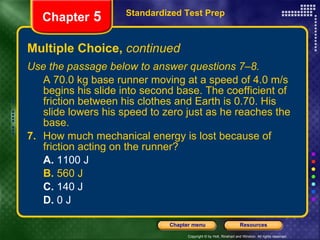
Multiple Choice,  continued Use the passage below to answer questions 7–8. A 70.0 kg base runner moving at a speed of 4.0 m/s begins his slide into second base. The coefficient of friction between his clothes and Earth is 0.70. His slide lowers his speed to zero just as he reaches the base. 7.   How much mechanical energy is lost because of friction acting on the runner? A.  1100 J B.  560 J C.  140 J D.  0 J Standardized Test Prep Chapter  5
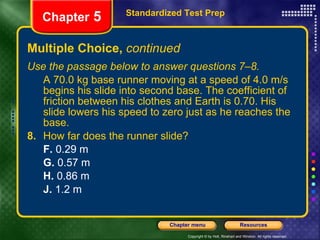
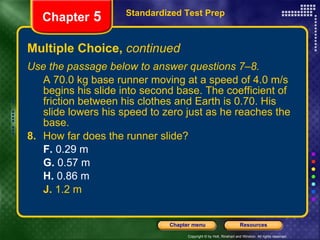
Multiple Choice,  continued Use the passage below to answer questions 7–8. A 70.0 kg base runner moving at a speed of 4.0 m/s begins his slide into second base. The coefficient of friction between his clothes and Earth is 0.70. His slide lowers his speed to zero just as he reaches the base. 8.   How far does the runner slide? F.  0.29 m G.  0.57 m H.  0.86 m J.  1.2 m Standardized Test Prep Chapter  5
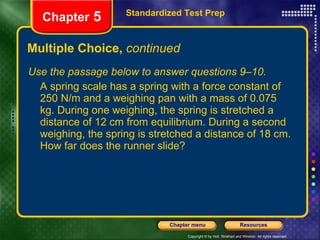
Multiple Choice,  continued Use the passage below to answer questions 9–10. A spring scale has a spring with a force constant of 250 N/m and a weighing pan with a mass of 0.075 kg. During one weighing, the spring is stretched a distance of 12 cm from equilibrium. During a second weighing, the spring is stretched a distance of 18 cm. How far does the runner slide? Standardized Test Prep Chapter  5
Multiple Choice,  continued 9.  How much greater is the elastic potential energy of the stretched spring during the second weighing than during the first weighing? Standardized Test Prep Chapter  5
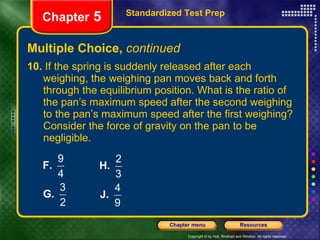
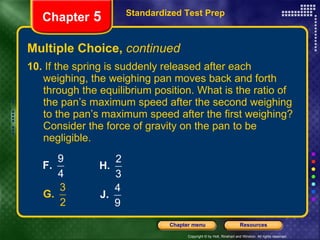
Multiple Choice,  continued 10.  If the spring is suddenly released after each weighing, the weighing pan moves back and forth through the equilibrium position. What is the ratio of the pan’s maximum speed after the second weighing to the pan’s maximum speed after the first weighing? Consider the force of gravity on the pan to be negligible. Standardized Test Prep Chapter  5
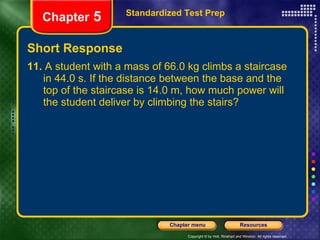
Short Response 11.  A student with a mass of 66.0 kg climbs a staircase in 44.0 s. If the distance between the base and the top of the staircase is 14.0 m, how much power will the student deliver by climbing the stairs? Standardized Test Prep Chapter  5
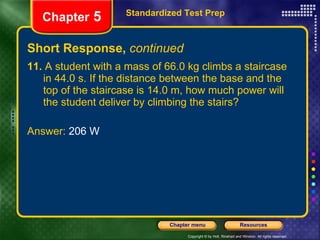
Short Response,  continued 11.  A student with a mass of 66.0 kg climbs a staircase in 44.0 s. If the distance between the base and the top of the staircase is 14.0 m, how much power will the student deliver by climbing the stairs? Answer:  206 W Standardized Test Prep Chapter  5
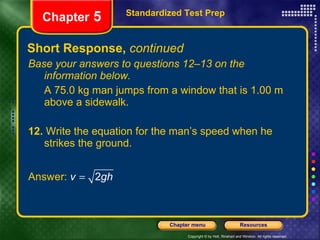
Short Response,  continued Base your answers to questions 12–13 on the information below. A 75.0 kg man jumps from a window that is 1.00 m above a sidewalk. 12.  Write the equation for the man’s speed when he strikes the ground. Standardized Test Prep Chapter  5
Short Response,  continued Base your answers to questions 12–13 on the information below. A 75.0 kg man jumps from a window that is 1.00 m above a sidewalk. 13.  Calculate the man’s speed when he strikes the ground. Standardized Test Prep Chapter  5
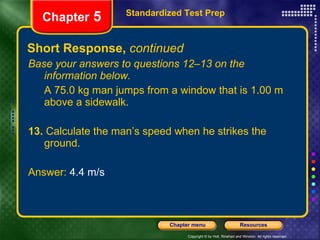
Short Response,  continued Base your answers to questions 12–13 on the information below. A 75.0 kg man jumps from a window that is 1.00 m above a sidewalk. 13.  Calculate the man’s speed when he strikes the ground. Answer:  4.4 m/s Standardized Test Prep Chapter  5
Extended Response Base your answers to questions 14–16 on the information below. A projectile with a mass of 5.0 kg is shot horizontally from a height of 25.0 m above a flat desert surface. The projectile’s initial speed is 17 m/s. Calculate the following for the instant before the projectile hits the surface: 14.  The work done on the projectile by gravity. Standardized Test Prep Chapter  5
Extended Response,  continued Base your answers to questions 14–16 on the information below. A projectile with a mass of 5.0 kg is shot horizontally from a height of 25.0 m above a flat desert surface. The projectile’s initial speed is 17 m/s. Calculate the following for the instant before the projectile hits the surface: 14.  The work done on the projectile by gravity. Answer:  1200 J Standardized Test Prep Chapter  5
Extended Response,  continued Base your answers to questions 14–16 on the information below. A projectile with a mass of 5.0 kg is shot horizontally from a height of 25.0 m above a flat desert surface. The projectile’s initial speed is 17 m/s. Calculate the following for the instant before the projectile hits the surface: 15.  The change in kinetic energy since the projectile was fired. Standardized Test Prep Chapter  5
Extended Response,  continued Base your answers to questions 14–16 on the information below. A projectile with a mass of 5.0 kg is shot horizontally from a height of 25.0 m above a flat desert surface. The projectile’s initial speed is 17 m/s. Calculate the following for the instant before the projectile hits the surface: 15.  The change in kinetic energy since the projectile was fired. Answer:  1200 J Standardized Test Prep Chapter  5
Extended Response,  continued Base your answers to questions 14–16 on the information below. A projectile with a mass of 5.0 kg is shot horizontally from a height of 25.0 m above a flat desert surface. The projectile’s initial speed is 17 m/s. Calculate the following for the instant before the projectile hits the surface: 16.  The final kinetic energy of the projectile. Standardized Test Prep Chapter  5
Extended Response,  continued Base your answers to questions 14–16 on the information below. A projectile with a mass of 5.0 kg is shot horizontally from a height of 25.0 m above a flat desert surface. The projectile’s initial speed is 17 m/s. Calculate the following for the instant before the projectile hits the surface: 16.  The final kinetic energy of the projectile. Answer:  1900 J Standardized Test Prep Chapter  5
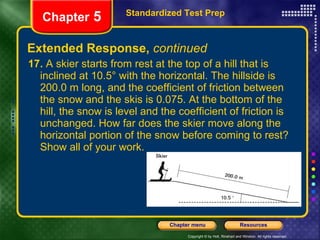
Extended Response,  continued 17.  A skier starts from rest at the top of a hill that is inclined at 10.5° with the horizontal. The hillside is 200.0 m long, and the coefficient of friction between the snow and the skis is 0.075. At the bottom of the hill, the snow is level and the coefficient of friction is unchanged. How far does the skier move along the horizontal portion of the snow before coming to rest? Show all of your work. Standardized Test Prep Chapter  5
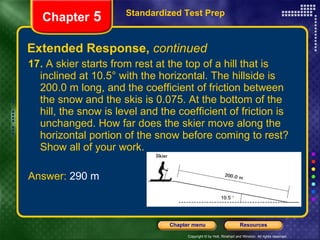
Extended Response,  continued 17.  A skier starts from rest at the top of a hill that is inclined at 10.5° with the horizontal. The hillside is 200.0 m long, and the coefficient of friction between the snow and the skis is 0.075. At the bottom of the hill, the snow is level and the coefficient of friction is unchanged. How far does the skier move along the horizontal portion of the snow before coming to rest? Show all of your work. Answer:  290 m Standardized Test Prep Chapter  5
Mechanical Energy Section 3  Conservation of   Energy Chapter  5

Physics Chapter 5 Pp Presentation

  • 1.
    How to UseThis Presentation To View the presentation as a slideshow with effects select “View” on the menu bar and click on “Slide Show.” To advance through the presentation, click the right-arrow key or the space bar. From the resources slide, click on any resource to see a presentation for that resource. From the Chapter menu screen click on any lesson to go directly to that lesson’s presentation. You may exit the slide show at any time by pressing the Esc key.
  • 2.
    Chapter Presentation TransparenciesStandardized Test Prep Sample Problems Visual Concepts Resources
  • 3.
    Table of ContentsSection 1 Work Section 2 Energy Section 3 Conservation of Energy Section 4 Power Work and Energy Chapter 5
  • 4.
    Objectives Recognize the difference between the scientific and ordinary definitions of work. Define work by relating it to force and displacement. Identify where work is being performed in a variety of situations. Calculate the net work done when many forces are applied to an object. Section 1 Work Chapter 5
  • 5.
    Definition of WorkWork is done on an object when a force causes a displacement of the object. Work is done only when components of a force are parallel to a displacement. Section 1 Work Chapter 5
  • 6.
    Definition of WorkChapter 5 Section 1 Work
  • 7.
    Sign Conventions forWork Chapter 5 Section 1 Work
  • 8.
    Objectives Identify several forms of energy. Calculate kinetic energy for an object. Apply the work–kinetic energy theorem to solve problems. Distinguish between kinetic and potential energy. Classify different types of potential energy. Calculate the potential energy associated with an object’s position. Section 2 Energy Chapter 5
  • 9.
    Kinetic Energy KineticEnergy The energy of an object that is due to the object’s motion is called kinetic energy. Kinetic energy depends on speed and mass. Section 2 Energy Chapter 5
  • 10.
    Kinetic Energy Chapter 5 Section 2 Energy
  • 11.
    Kinetic Energy, continued Work-Kinetic Energy Theorem The net work done by all the forces acting on an object is equal to the change in the object’s kinetic energy. The net work done on a body equals its change in kinetic energy. W net = ∆ KE net work = change in kinetic energy Section 2 Energy Chapter 5
  • 12.
    Work-Kinetic Energy TheoremChapter 5 Section 2 Energy
  • 13.
    Sample Problem Work-KineticEnergy Theorem On a frozen pond, a person kicks a 10.0 kg sled, giving it an initial speed of 2.2 m/s. How far does the sled move if the coefficient of kinetic friction between the sled and the ice is 0.10? Section 2 Energy Chapter 5
  • 14.
    Sample Problem, continued Work-Kinetic Energy Theorem 1. Define Given: m = 10.0 kg v i = 2.2 m/s v f = 0 m/s µ k = 0.10 Unknown: d = ? Section 2 Energy Chapter 5
  • 15.
    Sample Problem, continued Work-Kinetic Energy Theorem 2. Plan Choose an equation or situation: This problem can be solved using the definition of work and the work-kinetic energy theorem. W net = F net d cos  The net work done on the sled is provided by the force of kinetic friction. W net = F k d cos  = µ k mgd cos  Section 2 Energy Chapter 5
  • 16.
    Sample Problem, continued Work-Kinetic Energy Theorem 2. Plan, continued The force of kinetic friction is in the direction opposite d,  = 180°. Because the sled comes to rest, the final kinetic energy is zero. W net = ∆ KE = KE f - KE i = –(1/2) mv i 2 Use the work-kinetic energy theorem, and solve for d . Section 2 Energy Chapter 5
  • 17.
    Sample Problem, continued Work-Kinetic Energy Theorem 3. Calculate Substitute values into the equation: Section 2 Energy Chapter 5
  • 18.
    Sample Problem, continued Work-Kinetic Energy Theorem 4. Evaluate According to Newton’s second law, the acceleration of the sled is about -1 m/s 2 and the time it takes the sled to stop is about 2 s. Thus, the distance the sled traveled in the given amount of time should be less than the distance it would have traveled in the absence of friction. 2.5 m < (2.2 m/s)(2 s) = 4.4 m Section 2 Energy Chapter 5
  • 19.
    Potential Energy PotentialEnergy is the energy associated with an object because of the position, shape, or condition of the object. Gravitational potential energy is the potential energy stored in the gravitational fields of interacting bodies. Gravitational potential energy depends on height from a zero level. PE g = mgh gravitational PE = mass  free-fall acceleration  height Section 2 Energy Chapter 5
  • 20.
    Potential Energy Chapter 5 Section 2 Energy
  • 21.
    Potential Energy, continued Elastic potential energy is the energy available for use when a deformed elastic object returns to its original configuration. Section 2 Energy Chapter 5 The symbol k is called the spring constant , a parameter that measures the spring’s resistance to being compressed or stretched.
  • 22.
    Elastic Potential EnergyChapter 5 Section 2 Energy
  • 23.
    Spring Constant Chapter 5 Section 2 Energy
  • 24.
    Sample Problem PotentialEnergy A 70.0 kg stuntman is attached to a bungee cord with an unstretched length of 15.0 m. He jumps off a bridge spanning a river from a height of 50.0 m. When he finally stops, the cord has a stretched length of 44.0 m. Treat the stuntman as a point mass, and disregard the weight of the bungee cord. Assuming the spring constant of the bungee cord is 71.8 N/m, what is the total potential energy relative to the water when the man stops falling? Section 2 Energy Chapter 5
  • 25.
    Sample Problem, continued Potential Energy 1. Define Given: m = 70.0 kg k = 71.8 N/m g = 9.81 m/s 2 h = 50.0 m – 44.0 m = 6.0 m x = 44.0 m – 15.0 m = 29.0 m PE = 0 J at river level Unknown: PE tot = ? Section 2 Energy Chapter 5
  • 26.
    Sample Problem, continued Potential Energy 2. Plan Choose an equation or situation: The zero level for gravitational potential energy is chosen to be at the surface of the water. The total potential energy is the sum of the gravitational and elastic potential energy. Section 2 Energy Chapter 5
  • 27.
    Sample Problem, continued Potential Energy 3. Calculate Substitute the values into the equations and solve: Section 2 Energy Chapter 5
  • 28.
    Sample Problem, continued Potential Energy 4. Evaluate One way to evaluate the answer is to make an order-of-magnitude estimate. The gravitational potential energy is on the order of 10 2 kg  10 m/s 2  10 m = 10 4 J. The elastic potential energy is on the order of 1  10 2 N/m  10 2 m 2 = 10 4 J. Thus, the total potential energy should be on the order of 2  10 4 J. This number is close to the actual answer. Section 2 Energy Chapter 5
  • 29.
    Objectives Identify situations in which conservation of mechanical energy is valid. Recognize the forms that conserved energy can take. Solve problems using conservation of mechanical energy. Section 3 Conservation of Energy Chapter 5
  • 30.
    Conserved Quantities Whenwe say that something is conserved, we mean that it remains constant. Section 3 Conservation of Energy Chapter 5
  • 31.
    Mechanical Energy Mechanicalenergy is the sum of kinetic energy and all forms of potential energy associated with an object or group of objects. ME = KE + ∑ PE Mechanical energy is often conserved. ME i = ME f initial mechanical energy = final mechanical energy (in the absence of friction) Section 3 Conservation of Energy Chapter 5
  • 32.
    Conservation of MechanicalEnergy Chapter 5 Section 3 Conservation of Energy
  • 33.
    Sample Problem Conservationof Mechanical Energy Starting from rest, a child zooms down a frictionless slide from an initial height of 3.00 m. What is her speed at the bottom of the slide? Assume she has a mass of 25.0 kg. Section 3 Conservation of Energy Chapter 5
  • 34.
    Sample Problem, continued Conservation of Mechanical Energy 1. Define Given: h = h i = 3.00 m m = 25.0 kg v i = 0.0 m/s h f = 0 m Unknown: v f = ? Section 3 Conservation of Energy Chapter 5
  • 35.
    Sample Problem, continued Conservation of Mechanical Energy 2. Plan Choose an equation or situation: The slide is frictionless, so mechanical energy is conserved. Kinetic energy and gravitational potential energy are the only forms of energy present. Section 3 Conservation of Energy Chapter 5
  • 36.
    Sample Problem, continued Conservation of Mechanical Energy 2. Plan, continued The zero level chosen for gravitational potential energy is the bottom of the slide. Because the child ends at the zero level, the final gravitational potential energy is zero. PE g,f = 0 Section 3 Conservation of Energy Chapter 5
  • 37.
    Sample Problem, continued Conservation of Mechanical Energy 2. Plan, continued The initial gravitational potential energy at the top of the slide is PE g,i = mgh i = mgh Because the child starts at rest, the initial kinetic energy at the top is zero. KE i = 0 Therefore, the final kinetic energy is as follows: Section 3 Conservation of Energy Chapter 5
  • 38.
    Conservation of MechanicalEnergy 3. Calculate Substitute values into the equations: PE g,i = (25.0 kg)(9.81 m/s 2 )(3.00 m) = 736 J KE f = (1/2)(25.0 kg) v f 2 Now use the calculated quantities to evaluate the final velocity. ME i = ME f PE i + KE i = PE f + KE f 736 J + 0 J = 0 J + (0.500)(25.0 kg) v f 2 v f = 7.67 m/s Sample Problem, continued Section 3 Conservation of Energy Chapter 5
  • 39.
    Sample Problem, continued Conservation of Mechanical Energy 4. Evaluate The expression for the square of the final speed can be written as follows: Section 3 Conservation of Energy Chapter 5 Notice that the masses cancel, so the final speed does not depend on the mass of the child. This result makes sense because the acceleration of an object due to gravity does not depend on the mass of the object.
  • 40.
    Mechanical Energy, continued Mechanical Energy is not conserved in the presence of friction. As a sanding block slides on a piece of wood, energy (in the form of heat ) is dissipated into the block and surface. Section 3 Conservation of Energy Chapter 5
  • 41.
    Objectives Relate the concepts of energy, time, and power. Calculate power in two different ways. Explain the effect of machines on work and power. Section 4 Power Chapter 5
  • 42.
    Rate of EnergyTransfer Power is a quantity that measures the rate at which work is done or energy is transformed. P = W /∆ t power = work ÷ time interval An alternate equation for power in terms of force and speed is P = Fv power = force  speed Section 4 Power Chapter 5
  • 43.
    Power Chapter 5 Section 4 Power
  • 44.
    Multiple Choice 1. In which of the following situations is work not being done? A. A chair is lifted vertically with respect to the floor. B. A bookcase is slid across carpeting. C. A table is dropped onto the ground. D. A stack of books is carried at waist level across a room. Standardized Test Prep Chapter 5
  • 45.
    Multiple Choice, continued 1. In which of the following situations is work not being done? A. A chair is lifted vertically with respect to the floor. B. A bookcase is slid across carpeting. C. A table is dropped onto the ground. D. A stack of books is carried at waist level across a room. Standardized Test Prep Chapter 5
  • 46.
    Multiple Choice, continued 2. Which of the following equations correctly describes the relation between power,work, and time? Standardized Test Prep Chapter 5
  • 47.
    Multiple Choice, continued 2. Which of the following equations correctly describes the relation between power,work, and time? Standardized Test Prep Chapter 5
  • 48.
    Multiple Choice, continued Use the graph below to answer questions 3–5. The graph shows the energy of a 75 g yo-yo at different times as the yo-yo moves up and down on its string. Standardized Test Prep Chapter 5
  • 49.
    Multiple Choice, continued 3. By what amount does the mechanical energy of the yo-yo change after 6.0 s? A. 500 mJ B. 0 mJ C. –100 mJ D. –600 mJ Standardized Test Prep Chapter 5
  • 50.
    Multiple Choice, continued 3. By what amount does the mechanical energy of the yo-yo change after 6.0 s? A. 500 mJ B. 0 mJ C. –100 mJ D. –600 mJ Standardized Test Prep Chapter 5
  • 51.
    Multiple Choice, continued 4. What is the speed of the yo-yo after 4.5 s? F. 3.1 m/s G. 2.3 m/s H. 3.6 m/s J. 1.6 m/s Standardized Test Prep Chapter 5
  • 52.
    Multiple Choice, continued 4. What is the speed of the yo-yo after 4.5 s? F. 3.1 m/s G. 2.3 m/s H. 3.6 m/s J. 1.6 m/s Standardized Test Prep Chapter 5
  • 53.
    Multiple Choice, continued 5. What is the maximum height of the yo-yo? A. 0.27 m B. 0.54 m C. 0.75 m D. 0.82 m Standardized Test Prep Chapter 5
  • 54.
    Multiple Choice, continued 5. What is the maximum height of the yo-yo? A. 0.27 m B. 0.54 m C. 0.75 m D. 0.82 m Standardized Test Prep Chapter 5
  • 55.
    Multiple Choice, continued 6. A car with mass m requires 5.0 kJ of work to move from rest to a final speed v. If this same amount of work is performed during the same amount of time on a car with a mass of 2m, what is the final speed of the second car? Standardized Test Prep Chapter 5
  • 56.
    Multiple Choice, continued 6. A car with mass m requires 5.0 kJ of work to move from rest to a final speed v. If this same amount of work is performed during the same amount of time on a car with a mass of 2m, what is the final speed of the second car? Standardized Test Prep Chapter 5
  • 57.
    Multiple Choice, continued Use the passage below to answer questions 7–8. A 70.0 kg base runner moving at a speed of 4.0 m/s begins his slide into second base. The coefficient of friction between his clothes and Earth is 0.70. His slide lowers his speed to zero just as he reaches the base. 7. How much mechanical energy is lost because of friction acting on the runner? A. 1100 J B. 560 J C. 140 J D. 0 J Standardized Test Prep Chapter 5
  • 58.
    Multiple Choice, continued Use the passage below to answer questions 7–8. A 70.0 kg base runner moving at a speed of 4.0 m/s begins his slide into second base. The coefficient of friction between his clothes and Earth is 0.70. His slide lowers his speed to zero just as he reaches the base. 7. How much mechanical energy is lost because of friction acting on the runner? A. 1100 J B. 560 J C. 140 J D. 0 J Standardized Test Prep Chapter 5
  • 59.
    Multiple Choice, continued Use the passage below to answer questions 7–8. A 70.0 kg base runner moving at a speed of 4.0 m/s begins his slide into second base. The coefficient of friction between his clothes and Earth is 0.70. His slide lowers his speed to zero just as he reaches the base. 8. How far does the runner slide? F. 0.29 m G. 0.57 m H. 0.86 m J. 1.2 m Standardized Test Prep Chapter 5
  • 60.
    Multiple Choice, continued Use the passage below to answer questions 7–8. A 70.0 kg base runner moving at a speed of 4.0 m/s begins his slide into second base. The coefficient of friction between his clothes and Earth is 0.70. His slide lowers his speed to zero just as he reaches the base. 8. How far does the runner slide? F. 0.29 m G. 0.57 m H. 0.86 m J. 1.2 m Standardized Test Prep Chapter 5
  • 61.
    Multiple Choice, continued Use the passage below to answer questions 9–10. A spring scale has a spring with a force constant of 250 N/m and a weighing pan with a mass of 0.075 kg. During one weighing, the spring is stretched a distance of 12 cm from equilibrium. During a second weighing, the spring is stretched a distance of 18 cm. How far does the runner slide? Standardized Test Prep Chapter 5
  • 62.
    Multiple Choice, continued 9. How much greater is the elastic potential energy of the stretched spring during the second weighing than during the first weighing? Standardized Test Prep Chapter 5
  • 63.
    Multiple Choice, continued 9. How much greater is the elastic potential energy of the stretched spring during the second weighing than during the first weighing? Standardized Test Prep Chapter 5
  • 64.
    Multiple Choice, continued 10. If the spring is suddenly released after each weighing, the weighing pan moves back and forth through the equilibrium position. What is the ratio of the pan’s maximum speed after the second weighing to the pan’s maximum speed after the first weighing? Consider the force of gravity on the pan to be negligible. Standardized Test Prep Chapter 5
  • 65.
    Multiple Choice, continued 10. If the spring is suddenly released after each weighing, the weighing pan moves back and forth through the equilibrium position. What is the ratio of the pan’s maximum speed after the second weighing to the pan’s maximum speed after the first weighing? Consider the force of gravity on the pan to be negligible. Standardized Test Prep Chapter 5
  • 66.
    Short Response 11. A student with a mass of 66.0 kg climbs a staircase in 44.0 s. If the distance between the base and the top of the staircase is 14.0 m, how much power will the student deliver by climbing the stairs? Standardized Test Prep Chapter 5
  • 67.
    Short Response, continued 11. A student with a mass of 66.0 kg climbs a staircase in 44.0 s. If the distance between the base and the top of the staircase is 14.0 m, how much power will the student deliver by climbing the stairs? Answer: 206 W Standardized Test Prep Chapter 5
  • 68.
    Short Response, continued Base your answers to questions 12–13 on the information below. A 75.0 kg man jumps from a window that is 1.00 m above a sidewalk. 12. Write the equation for the man’s speed when he strikes the ground. Standardized Test Prep Chapter 5
  • 69.
    Short Response, continued Base your answers to questions 12–13 on the information below. A 75.0 kg man jumps from a window that is 1.00 m above a sidewalk. 12. Write the equation for the man’s speed when he strikes the ground. Standardized Test Prep Chapter 5
  • 70.
    Short Response, continued Base your answers to questions 12–13 on the information below. A 75.0 kg man jumps from a window that is 1.00 m above a sidewalk. 13. Calculate the man’s speed when he strikes the ground. Standardized Test Prep Chapter 5
  • 71.
    Short Response, continued Base your answers to questions 12–13 on the information below. A 75.0 kg man jumps from a window that is 1.00 m above a sidewalk. 13. Calculate the man’s speed when he strikes the ground. Answer: 4.4 m/s Standardized Test Prep Chapter 5
  • 72.
    Extended Response Baseyour answers to questions 14–16 on the information below. A projectile with a mass of 5.0 kg is shot horizontally from a height of 25.0 m above a flat desert surface. The projectile’s initial speed is 17 m/s. Calculate the following for the instant before the projectile hits the surface: 14. The work done on the projectile by gravity. Standardized Test Prep Chapter 5
  • 73.
    Extended Response, continued Base your answers to questions 14–16 on the information below. A projectile with a mass of 5.0 kg is shot horizontally from a height of 25.0 m above a flat desert surface. The projectile’s initial speed is 17 m/s. Calculate the following for the instant before the projectile hits the surface: 14. The work done on the projectile by gravity. Answer: 1200 J Standardized Test Prep Chapter 5
  • 74.
    Extended Response, continued Base your answers to questions 14–16 on the information below. A projectile with a mass of 5.0 kg is shot horizontally from a height of 25.0 m above a flat desert surface. The projectile’s initial speed is 17 m/s. Calculate the following for the instant before the projectile hits the surface: 15. The change in kinetic energy since the projectile was fired. Standardized Test Prep Chapter 5
  • 75.
    Extended Response, continued Base your answers to questions 14–16 on the information below. A projectile with a mass of 5.0 kg is shot horizontally from a height of 25.0 m above a flat desert surface. The projectile’s initial speed is 17 m/s. Calculate the following for the instant before the projectile hits the surface: 15. The change in kinetic energy since the projectile was fired. Answer: 1200 J Standardized Test Prep Chapter 5
  • 76.
    Extended Response, continued Base your answers to questions 14–16 on the information below. A projectile with a mass of 5.0 kg is shot horizontally from a height of 25.0 m above a flat desert surface. The projectile’s initial speed is 17 m/s. Calculate the following for the instant before the projectile hits the surface: 16. The final kinetic energy of the projectile. Standardized Test Prep Chapter 5
  • 77.
    Extended Response, continued Base your answers to questions 14–16 on the information below. A projectile with a mass of 5.0 kg is shot horizontally from a height of 25.0 m above a flat desert surface. The projectile’s initial speed is 17 m/s. Calculate the following for the instant before the projectile hits the surface: 16. The final kinetic energy of the projectile. Answer: 1900 J Standardized Test Prep Chapter 5
  • 78.
    Extended Response, continued 17. A skier starts from rest at the top of a hill that is inclined at 10.5° with the horizontal. The hillside is 200.0 m long, and the coefficient of friction between the snow and the skis is 0.075. At the bottom of the hill, the snow is level and the coefficient of friction is unchanged. How far does the skier move along the horizontal portion of the snow before coming to rest? Show all of your work. Standardized Test Prep Chapter 5
  • 79.
    Extended Response, continued 17. A skier starts from rest at the top of a hill that is inclined at 10.5° with the horizontal. The hillside is 200.0 m long, and the coefficient of friction between the snow and the skis is 0.075. At the bottom of the hill, the snow is level and the coefficient of friction is unchanged. How far does the skier move along the horizontal portion of the snow before coming to rest? Show all of your work. Answer: 290 m Standardized Test Prep Chapter 5
  • 80.
    Mechanical Energy Section3 Conservation of Energy Chapter 5