Particles

                             Classification of Particles
                               Hadrons and Quarks
                                      Leptons

Thursday, 08 December 2011
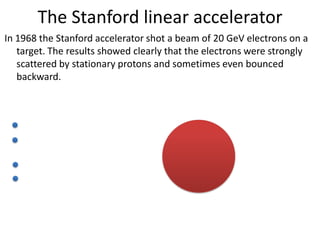
The Stanford linear accelerator
In 1968 the Stanford accelerator shot a beam of 20 GeV electrons on a
   target. The results showed clearly that the electrons were strongly
   scattered by stationary protons and sometimes even bounced
   backward.


                                          q
                                                q

                                          q
The Stanford linear accelerator
Does that remind you of another famous experiment? What can be
  deduced about the internal structure of the proton?
The outcomes of the experiment resemble Rutherford’s experiment that
  led to the discovery of the nucleus.
The proton must be made up of sub-nuclear particles, some of which
  carry negative charge. This provides proof for the existence of quarks.
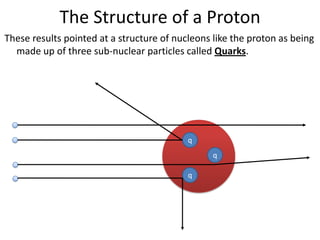
The Structure of a Proton
These results pointed at a structure of nucleons like the proton as being
  made up of three sub-nuclear particles called Quarks.


                                           q
                                                 q

                                           q
Classifying Particles
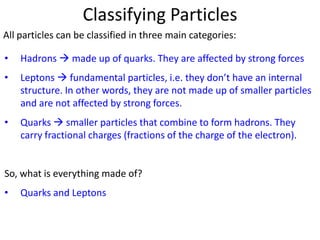
All particles can be classified in three main categories:

•   Hadrons  made up of quarks. They are affected by strong forces
•   Leptons  fundamental particles, i.e. they don’t have an internal
    structure. In other words, they are not made up of smaller particles
    and are not affected by strong forces.
•   Quarks  smaller particles that combine to form hadrons. They
    carry fractional charges (fractions of the charge of the electron).


So, what is everything made of?
•   Quarks and Leptons
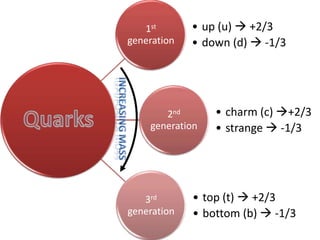
1st       • up (u)  +2/3
generation   • down (d)  -1/3


       2nd       • charm (c) +2/3
    generation   • strange  -1/3


   3rd       • top (t)  +2/3
generation   • bottom (b)  -1/3
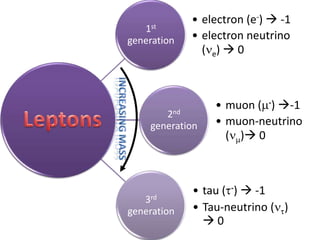
• electron (e-)  -1
   1st
generation   • electron neutrino
               ( e)  0


                 • muon ( -) -1
       2nd
    generation   • muon-neutrino
                   ( ) 0


             • tau ( -)  -1
   3rd
generation   • Tau-neutrino ( )
               0
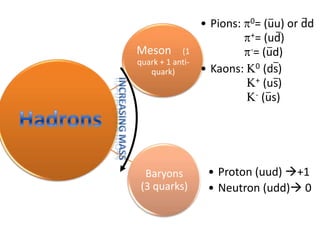
• Pions:   0=(uu) or dd
                           += (ud)
Meson       (1             -= (ud)
quark + 1 anti-
   quark)         • Kaons: 0 (ds)
                            + (us)
                            - (us)


  Baryons          • Proton (uud) +1
 (3 quarks)        • Neutron (udd) 0
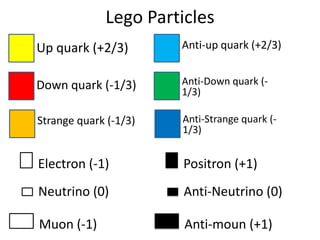
Lego Particles
Up quark (+2/3)        Anti-up quark (+2/3)


Down quark (-1/3)      Anti-Down quark (-
                       1/3)

Strange quark (-1/3)   Anti-Strange quark (-
                       1/3)


Electron (-1)          Positron (+1)
Neutrino (0)           Anti-Neutrino (0)

Muon (-1)              Anti-moun (+1)
Fundamental particles
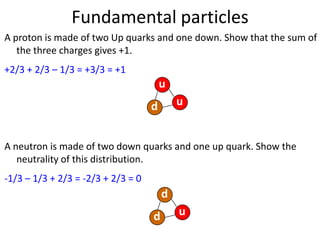
A proton is made of two Up quarks and one down. Show that the sum of
   the three charges gives +1.
+2/3 + 2/3 – 1/3 = +3/3 = +1
                                        u
                                    d       u


A neutron is made of two down quarks and one up quark. Show the
   neutrality of this distribution.
-1/3 – 1/3 + 2/3 = -2/3 + 2/3 = 0
                                        d
                                    d       u
Lepton Number
All leptons have an additional property called Lepton Number. The
   lepton number is always conserved.


                 Particle               Lepton Number

         All leptons                           +1

         All anti-leptons                       -1

         Hadrons
                                                0
         (baryons and mesons)
-   Decay and lepton number
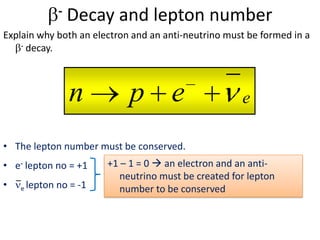
Explain why both an electron and an anti-neutrino must be formed in a
    - decay.


                   n          p e                      e

• The lepton number must be conserved.
• e- lepton no = +1      +1 – 1 = 0  an electron and an anti-
                            neutrino must be created for lepton
•   e lepton   no = -1      number to be conserved
Properties of quarks
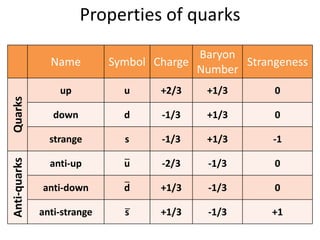
Quarks and anti-quarks have some properties that you might not have
  encountered before:
• Relative Charge  all quarks and anti-quarks carry a charge which is
  a fraction of the charge of the electron, i.e. 1.6 x 10⁻¹⁹ C. In all
  interactions charge must be conserved.
• Baryon Number  all quarks and anti-quarks have a baryon number.
  The baryon number is +1/3 for quarks and -1/3 for all anti-quarks. In
  all interactions baryon number must be conserved.
• Strangeness  all quarks and anti-quarks have strangeness = 0 apart
  from the strange quark (strangeness = -1) and the anti-strange quark
  (strangeness = +1). In all interactions involving the STRONG FORCE
  strangeness must be conserved, but in weak interactions strangeness
  can be conserved, or change by ±1.
Properties of quarks
                                           Baryon
                Name         Symbol Charge        Strangeness
                                           Number
                  up           u     +2/3   +1/3       0
Quarks


                 down          d     -1/3   +1/3       0

                strange        s     -1/3   +1/3       -1
Anti-quarks


                anti-up        u     -2/3   -1/3       0

              anti-down        d     +1/3   -1/3       0

              anti-strange     s     +1/3   -1/3       +1
Mesons and Quarks
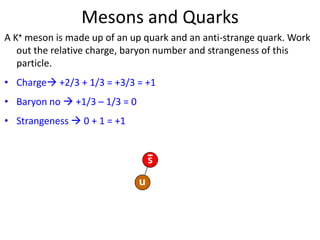
A K+ meson is made up of an up quark and an anti-strange quark. Work
   out the relative charge, baryon number and strangeness of this
   particle.
• Charge +2/3 + 1/3 = +3/3 = +1
• Baryon no  +1/3 – 1/3 = 0
• Strangeness  0 + 1 = +1


                                   s
                               u
Mesons and Quarks
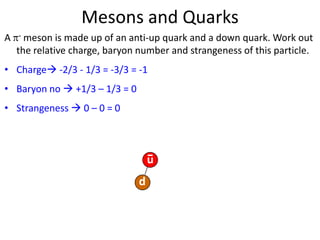
A   - meson is made up of an anti-up quark and a down quark. Work out
    the relative charge, baryon number and strangeness of this particle.
• Charge -2/3 - 1/3 = -3/3 = -1
• Baryon no  +1/3 – 1/3 = 0
• Strangeness  0 – 0 = 0


                                    u
                                d
Change of Quarks in                     -   Decay
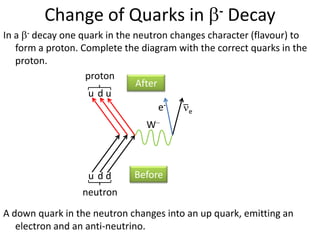
In a - decay one quark in the neutron changes character (flavour) to
   form a proton. Complete the diagram with the correct quarks in the
   proton.
                   proton
                              After
                    u du
                                    e-    e

                                W


                   u dd      Before
                  neutron
A down quark in the neutron changes into an up quark, emitting an
   electron and an anti-neutrino.
Stable and Unstable Baryons
In a - decay one quark in the neutron changes character (flavour) to
   form a proton. But why does that happen?
• The proton is the only stable Baryon.
• All other Baryons eventually decay into a proton.
• So, it is not surprising that in “nature” the neutron decays into a
  proton releasing an electron and an anti-neutrino.
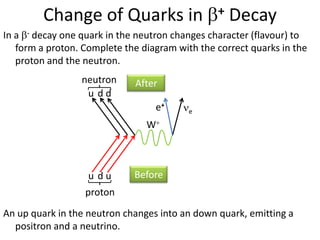
Change of Quarks in                    +   Decay
In a - decay one quark in the neutron changes character (flavour) to
   form a proton. Complete the diagram with the correct quarks in the
   proton and the neutron.
                 neutron     After
                  u dd
                                  e+      e

                                W


                   u du      Before
                  proton
An up quark in the neutron changes into an down quark, emitting a
  positron and a neutrino.
Conservation Laws
In all particle interactions these conservation laws apply and must be
   fulfilled for the interaction to happen:
• Conservation of Charge  In all interactions charge must be
  conserved. So, Sum of Charges before = Sum of Charges after
• Conservation of Baryon Number  In all interactions baryon
  number must be conserved.
• Conservation of Strangeness  In all interactions involving the
  STRONG FORCE strangeness must be conserved, but in weak
  interactions strangeness can be conserved, or change by ±1.
• Conservation of Lepton Number  In all interactions the lepton
  number must be conserved.
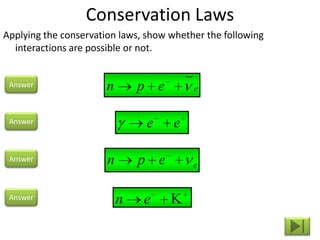
Conservation Laws
Applying the conservation laws, show whether the following
  interactions are possible or not.


 Answer                n       p e        e


 Answer                         e    e

 Answer                n       p e        e


 Answer                    n   e
Answer
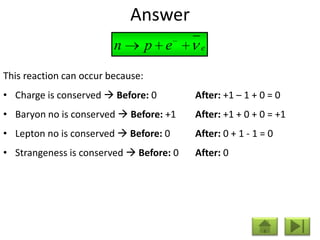
                         n         p e    e


This reaction can occur because:
• Charge is conserved  Before: 0        After: +1 – 1 + 0 = 0
• Baryon no is conserved  Before: +1    After: +1 + 0 + 0 = +1
• Lepton no is conserved  Before: 0     After: 0 + 1 - 1 = 0
• Strangeness is conserved  Before: 0   After: 0
Answer
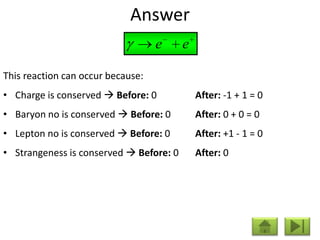
                                   e     e

This reaction can occur because:
• Charge is conserved  Before: 0            After: -1 + 1 = 0
• Baryon no is conserved  Before: 0         After: 0 + 0 = 0
• Lepton no is conserved  Before: 0         After: +1 - 1 = 0
• Strangeness is conserved  Before: 0       After: 0
Answer
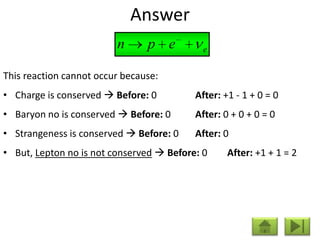
                         n      p e         e


This reaction cannot occur because:
• Charge is conserved  Before: 0         After: +1 - 1 + 0 = 0
• Baryon no is conserved  Before: 0      After: 0 + 0 + 0 = 0
• Strangeness is conserved  Before: 0    After: 0
• But, Lepton no is not conserved  Before: 0     After: +1 + 1 = 2
Answer
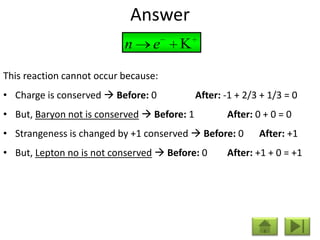
                           n     e

This reaction cannot occur because:
• Charge is conserved  Before: 0            After: -1 + 2/3 + 1/3 = 0
• But, Baryon not is conserved  Before: 1          After: 0 + 0 = 0
• Strangeness is changed by +1 conserved  Before: 0        After: +1
• But, Lepton no is not conserved  Before: 0       After: +1 + 0 = +1

Classifying particles

  • 1.
    Particles Classification of Particles Hadrons and Quarks Leptons Thursday, 08 December 2011
  • 2.
    The Stanford linearaccelerator In 1968 the Stanford accelerator shot a beam of 20 GeV electrons on a target. The results showed clearly that the electrons were strongly scattered by stationary protons and sometimes even bounced backward. q q q
  • 3.
    The Stanford linearaccelerator Does that remind you of another famous experiment? What can be deduced about the internal structure of the proton? The outcomes of the experiment resemble Rutherford’s experiment that led to the discovery of the nucleus. The proton must be made up of sub-nuclear particles, some of which carry negative charge. This provides proof for the existence of quarks.
  • 4.
    The Structure ofa Proton These results pointed at a structure of nucleons like the proton as being made up of three sub-nuclear particles called Quarks. q q q
  • 5.
    Classifying Particles All particlescan be classified in three main categories: • Hadrons  made up of quarks. They are affected by strong forces • Leptons  fundamental particles, i.e. they don’t have an internal structure. In other words, they are not made up of smaller particles and are not affected by strong forces. • Quarks  smaller particles that combine to form hadrons. They carry fractional charges (fractions of the charge of the electron). So, what is everything made of? • Quarks and Leptons
  • 6.
    1st • up (u)  +2/3 generation • down (d)  -1/3 2nd • charm (c) +2/3 generation • strange  -1/3 3rd • top (t)  +2/3 generation • bottom (b)  -1/3
  • 7.
    • electron (e-) -1 1st generation • electron neutrino ( e)  0 • muon ( -) -1 2nd generation • muon-neutrino ( ) 0 • tau ( -)  -1 3rd generation • Tau-neutrino ( ) 0
  • 8.
    • Pions: 0=(uu) or dd += (ud) Meson (1 -= (ud) quark + 1 anti- quark) • Kaons: 0 (ds) + (us) - (us) Baryons • Proton (uud) +1 (3 quarks) • Neutron (udd) 0
  • 9.
    Lego Particles Up quark(+2/3) Anti-up quark (+2/3) Down quark (-1/3) Anti-Down quark (- 1/3) Strange quark (-1/3) Anti-Strange quark (- 1/3) Electron (-1) Positron (+1) Neutrino (0) Anti-Neutrino (0) Muon (-1) Anti-moun (+1)
  • 10.
    Fundamental particles A protonis made of two Up quarks and one down. Show that the sum of the three charges gives +1. +2/3 + 2/3 – 1/3 = +3/3 = +1 u d u A neutron is made of two down quarks and one up quark. Show the neutrality of this distribution. -1/3 – 1/3 + 2/3 = -2/3 + 2/3 = 0 d d u
  • 11.
    Lepton Number All leptonshave an additional property called Lepton Number. The lepton number is always conserved. Particle Lepton Number All leptons +1 All anti-leptons -1 Hadrons 0 (baryons and mesons)
  • 12.
    - Decay and lepton number Explain why both an electron and an anti-neutrino must be formed in a - decay. n p e e • The lepton number must be conserved. • e- lepton no = +1 +1 – 1 = 0  an electron and an anti- neutrino must be created for lepton • e lepton no = -1 number to be conserved
  • 13.
    Properties of quarks Quarksand anti-quarks have some properties that you might not have encountered before: • Relative Charge  all quarks and anti-quarks carry a charge which is a fraction of the charge of the electron, i.e. 1.6 x 10⁻¹⁹ C. In all interactions charge must be conserved. • Baryon Number  all quarks and anti-quarks have a baryon number. The baryon number is +1/3 for quarks and -1/3 for all anti-quarks. In all interactions baryon number must be conserved. • Strangeness  all quarks and anti-quarks have strangeness = 0 apart from the strange quark (strangeness = -1) and the anti-strange quark (strangeness = +1). In all interactions involving the STRONG FORCE strangeness must be conserved, but in weak interactions strangeness can be conserved, or change by ±1.
  • 14.
    Properties of quarks Baryon Name Symbol Charge Strangeness Number up u +2/3 +1/3 0 Quarks down d -1/3 +1/3 0 strange s -1/3 +1/3 -1 Anti-quarks anti-up u -2/3 -1/3 0 anti-down d +1/3 -1/3 0 anti-strange s +1/3 -1/3 +1
  • 15.
    Mesons and Quarks AK+ meson is made up of an up quark and an anti-strange quark. Work out the relative charge, baryon number and strangeness of this particle. • Charge +2/3 + 1/3 = +3/3 = +1 • Baryon no  +1/3 – 1/3 = 0 • Strangeness  0 + 1 = +1 s u
  • 16.
    Mesons and Quarks A - meson is made up of an anti-up quark and a down quark. Work out the relative charge, baryon number and strangeness of this particle. • Charge -2/3 - 1/3 = -3/3 = -1 • Baryon no  +1/3 – 1/3 = 0 • Strangeness  0 – 0 = 0 u d
  • 17.
    Change of Quarksin - Decay In a - decay one quark in the neutron changes character (flavour) to form a proton. Complete the diagram with the correct quarks in the proton. proton After u du e- e W u dd Before neutron A down quark in the neutron changes into an up quark, emitting an electron and an anti-neutrino.
  • 18.
    Stable and UnstableBaryons In a - decay one quark in the neutron changes character (flavour) to form a proton. But why does that happen? • The proton is the only stable Baryon. • All other Baryons eventually decay into a proton. • So, it is not surprising that in “nature” the neutron decays into a proton releasing an electron and an anti-neutrino.
  • 19.
    Change of Quarksin + Decay In a - decay one quark in the neutron changes character (flavour) to form a proton. Complete the diagram with the correct quarks in the proton and the neutron. neutron After u dd e+ e W u du Before proton An up quark in the neutron changes into an down quark, emitting a positron and a neutrino.
  • 20.
    Conservation Laws In allparticle interactions these conservation laws apply and must be fulfilled for the interaction to happen: • Conservation of Charge  In all interactions charge must be conserved. So, Sum of Charges before = Sum of Charges after • Conservation of Baryon Number  In all interactions baryon number must be conserved. • Conservation of Strangeness  In all interactions involving the STRONG FORCE strangeness must be conserved, but in weak interactions strangeness can be conserved, or change by ±1. • Conservation of Lepton Number  In all interactions the lepton number must be conserved.
  • 21.
    Conservation Laws Applying theconservation laws, show whether the following interactions are possible or not. Answer n p e e Answer e e Answer n p e e Answer n e
  • 22.
    Answer n p e e This reaction can occur because: • Charge is conserved  Before: 0 After: +1 – 1 + 0 = 0 • Baryon no is conserved  Before: +1 After: +1 + 0 + 0 = +1 • Lepton no is conserved  Before: 0 After: 0 + 1 - 1 = 0 • Strangeness is conserved  Before: 0 After: 0
  • 23.
    Answer e e This reaction can occur because: • Charge is conserved  Before: 0 After: -1 + 1 = 0 • Baryon no is conserved  Before: 0 After: 0 + 0 = 0 • Lepton no is conserved  Before: 0 After: +1 - 1 = 0 • Strangeness is conserved  Before: 0 After: 0
  • 24.
    Answer n p e e This reaction cannot occur because: • Charge is conserved  Before: 0 After: +1 - 1 + 0 = 0 • Baryon no is conserved  Before: 0 After: 0 + 0 + 0 = 0 • Strangeness is conserved  Before: 0 After: 0 • But, Lepton no is not conserved  Before: 0 After: +1 + 1 = 2
  • 25.
    Answer n e This reaction cannot occur because: • Charge is conserved  Before: 0 After: -1 + 2/3 + 1/3 = 0 • But, Baryon not is conserved  Before: 1 After: 0 + 0 = 0 • Strangeness is changed by +1 conserved  Before: 0 After: +1 • But, Lepton no is not conserved  Before: 0 After: +1 + 0 = +1