Section 3.1
Exploring Physical Science
Table of Contents:
1. Section 1 : Exploring Physical Science
2. Section 2 : Scientific Method
3. Section 3 : Scientific Models
4. Section 4 : Tools, Measurement, and
Safety
Objectives:
1. Explain that science involves asking
questions.
2. Describe the relationship of matter and
energy to physical science.
3. Describe the two branches of physical
science.
4. Identify three areas of science that use
physical science.
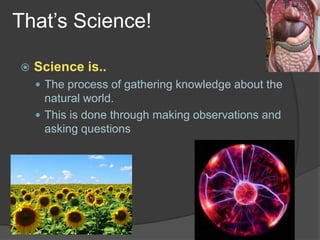
That’s Science!
 Science is..
 The process of gathering knowledge about the
natural world.
 This is done through making observations and
asking questions
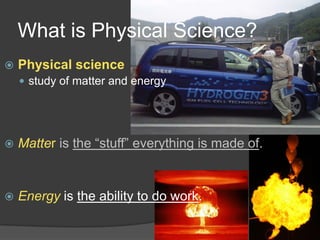
 Physical science
 study of matter and energy
 Matter is the “stuff” everything is made of.
 Energy is the ability to do work.
What is Physical Science?
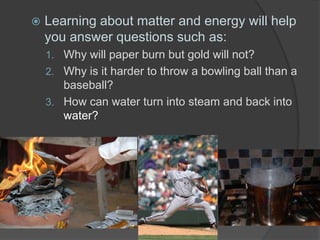
 Learning about matter and energy will help
you answer questions such as:
1. Why will paper burn but gold will not?
2. Why is it harder to throw a bowling ball than a
baseball?
3. How can water turn into steam and back into
water?
Branches of Physical
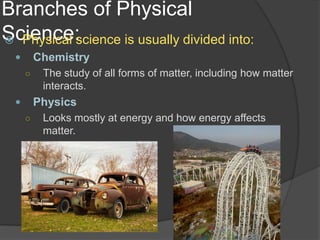
Science: Physical science is usually divided into:
 Chemistry
○ The study of all forms of matter, including how matter
interacts.
 Physics
○ Looks mostly at energy and how energy affects
matter.
Other related sciences:
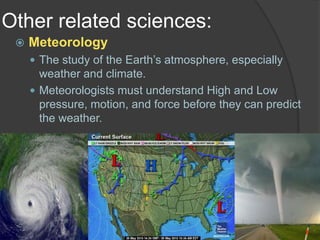
 Meteorology
 The study of the Earth’s atmosphere, especially
weather and climate.
 Meteorologists must understand High and Low
pressure, motion, and force before they can predict
the weather.
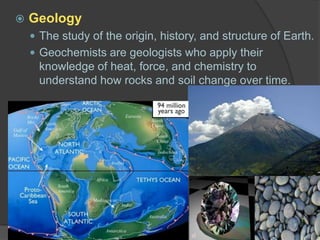
 Geology
 The study of the origin, history, and structure of Earth.
 Geochemists are geologists who apply their
knowledge of heat, force, and chemistry to
understand how rocks and soil change over time.
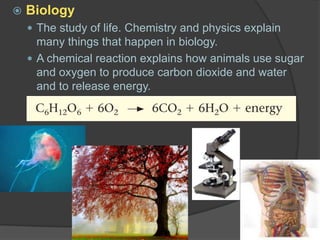
 Biology
 The study of life. Chemistry and physics explain
many things that happen in biology.
 A chemical reaction explains how animals use sugar
and oxygen to produce carbon dioxide and water
and to release energy.

P3.1 Exploring Physical Science

  • 1.
  • 2.
    Table of Contents: 1.Section 1 : Exploring Physical Science 2. Section 2 : Scientific Method 3. Section 3 : Scientific Models 4. Section 4 : Tools, Measurement, and Safety
  • 3.
    Objectives: 1. Explain thatscience involves asking questions. 2. Describe the relationship of matter and energy to physical science. 3. Describe the two branches of physical science. 4. Identify three areas of science that use physical science.
  • 4.
    That’s Science!  Scienceis..  The process of gathering knowledge about the natural world.  This is done through making observations and asking questions
  • 5.
     Physical science study of matter and energy  Matter is the “stuff” everything is made of.  Energy is the ability to do work. What is Physical Science?
  • 6.
     Learning aboutmatter and energy will help you answer questions such as: 1. Why will paper burn but gold will not? 2. Why is it harder to throw a bowling ball than a baseball? 3. How can water turn into steam and back into water?
  • 7.
    Branches of Physical Science:Physical science is usually divided into:  Chemistry ○ The study of all forms of matter, including how matter interacts.  Physics ○ Looks mostly at energy and how energy affects matter.
  • 8.
    Other related sciences: Meteorology  The study of the Earth’s atmosphere, especially weather and climate.  Meteorologists must understand High and Low pressure, motion, and force before they can predict the weather.
  • 9.
     Geology  Thestudy of the origin, history, and structure of Earth.  Geochemists are geologists who apply their knowledge of heat, force, and chemistry to understand how rocks and soil change over time.
  • 10.
     Biology  Thestudy of life. Chemistry and physics explain many things that happen in biology.  A chemical reaction explains how animals use sugar and oxygen to produce carbon dioxide and water and to release energy.