Topic for senior secondary or A-level physics students
~Lalit Kishore
Historical perspective
 Till 19th centaury atom was considered to the fundamental
particle (ultimate: not formed by any other particles or sub-
atomic prticles)
 In 20th centaury, Chadwick discovered independent neutrons
and protons...protons were found in solar flares...some stars
behaved as if they were neutron stars. Studies of cosmic rays led
to discovery of new fundamental particles
 Nuclear force was – the strongest force that can could bind like
charges – studied
 With high power / energy particle accelerators, very many new
particles and their anti-particles were discovered and are still
being discovered
 Families / classifications/ series have created to find the missing
particles including the God particle
Hadrons particles
Hadrons as new fundamental particles
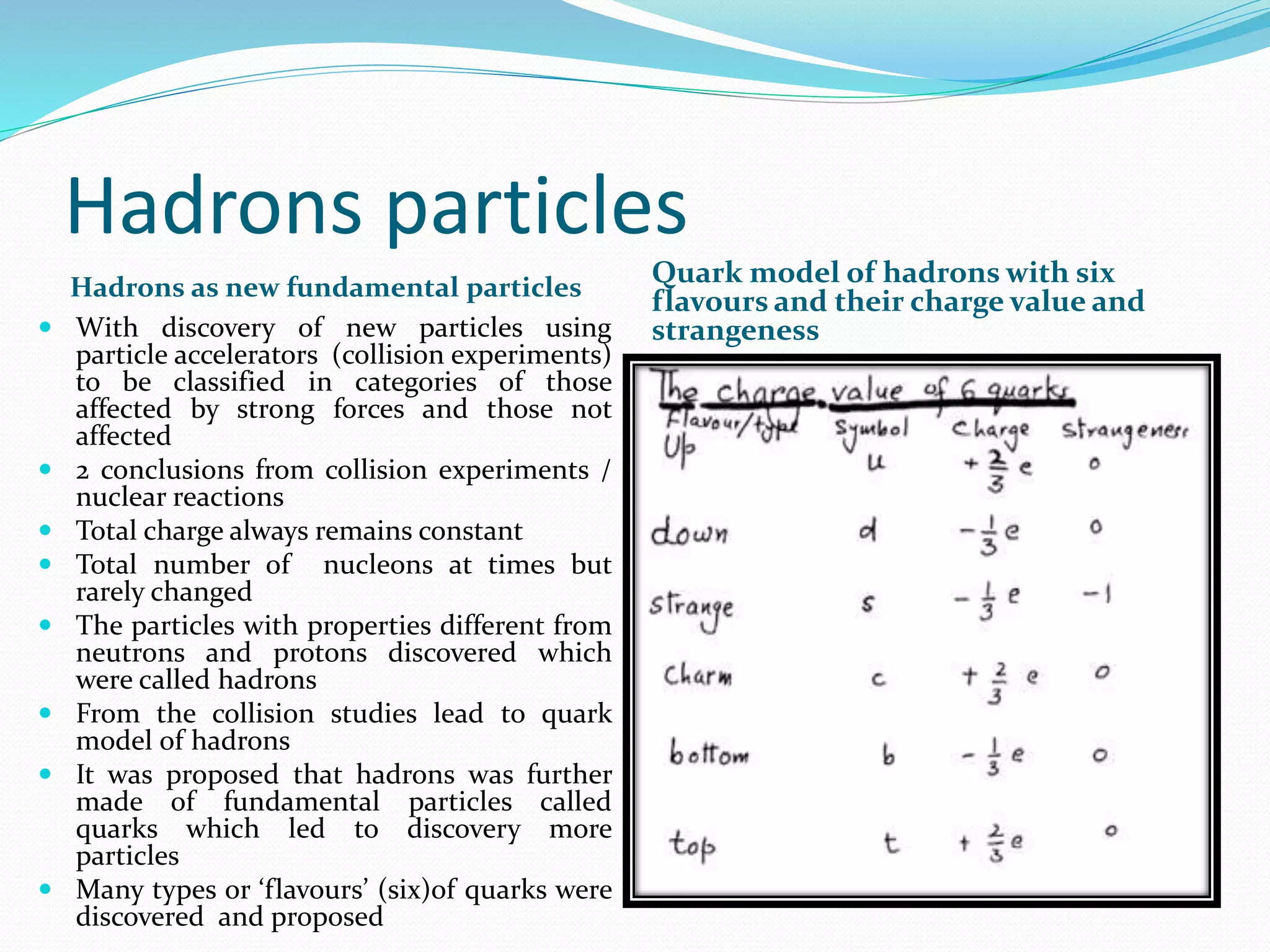
Quark model of hadrons with six
flavours and their charge value and
strangeness
 With discovery of new particles using
particle accelerators (collision experiments)
to be classified in categories of those
affected by strong forces and those not
affected
 2 conclusions from collision experiments /
nuclear reactions
 Total charge always remains constant
 Total number of nucleons at times but
rarely changed
 The particles with properties different from
neutrons and protons discovered which
were called hadrons
 From the collision studies lead to quark
model of hadrons
 It was proposed that hadrons was further
made of fundamental particles called
quarks which led to discovery more
particles
 Many types or ‘flavours’ (six)of quarks were
discovered and proposed
Hadrons’ classification as baryons
and mesons
 With discovery of anti-quarks and various
combination with quarks led to new
classification of hadrons called baryons
and mesons
 Baryon family : protons, Neutrons and
their anti-particles, they consist of 3
quarks
 Meson family (consisting of quarks / anti-
quarks): Pions and kappas
Leptons
Definition and neutron
decay
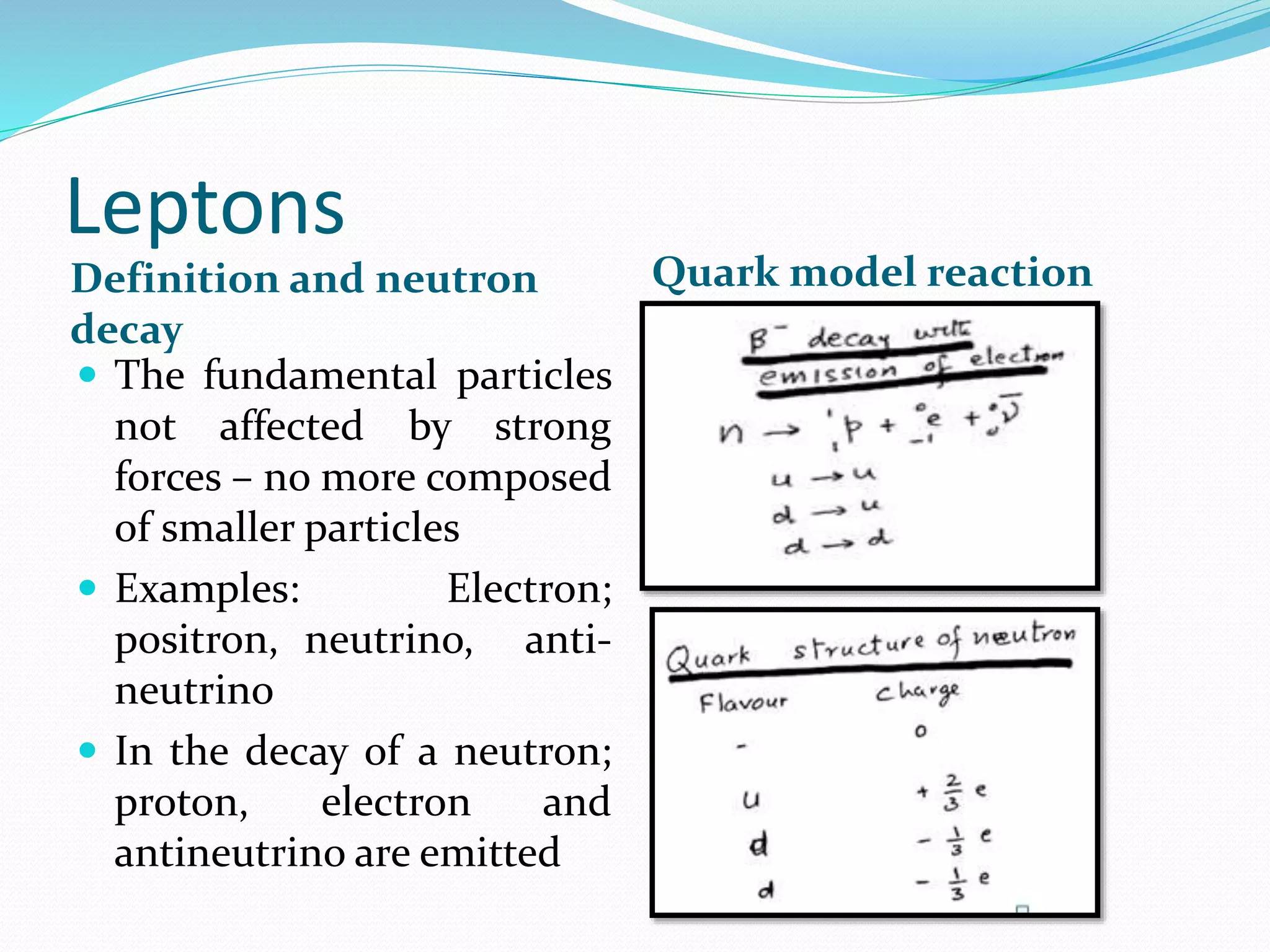
Quark model reaction
 The fundamental particles
not affected by strong
forces – no more composed
of smaller particles
 Examples: Electron;
positron, neutrino, anti-
neutrino
 In the decay of a neutron;
proton, electron and
antineutrino are emitted
Beta decay explanation in terms of
quarks and leptons
Weak force presence Proton decay quark model reaction
 Beta decay is not due strong
force and, therefore, must be
due to another force called
‘weak force’ or ‘weak
interaction’
 In beta decay, the lepton
number before and after
decay remains the same
 During the decay of a proton
in the nucleus, a neutron is
formed and a neutrino is
emitted
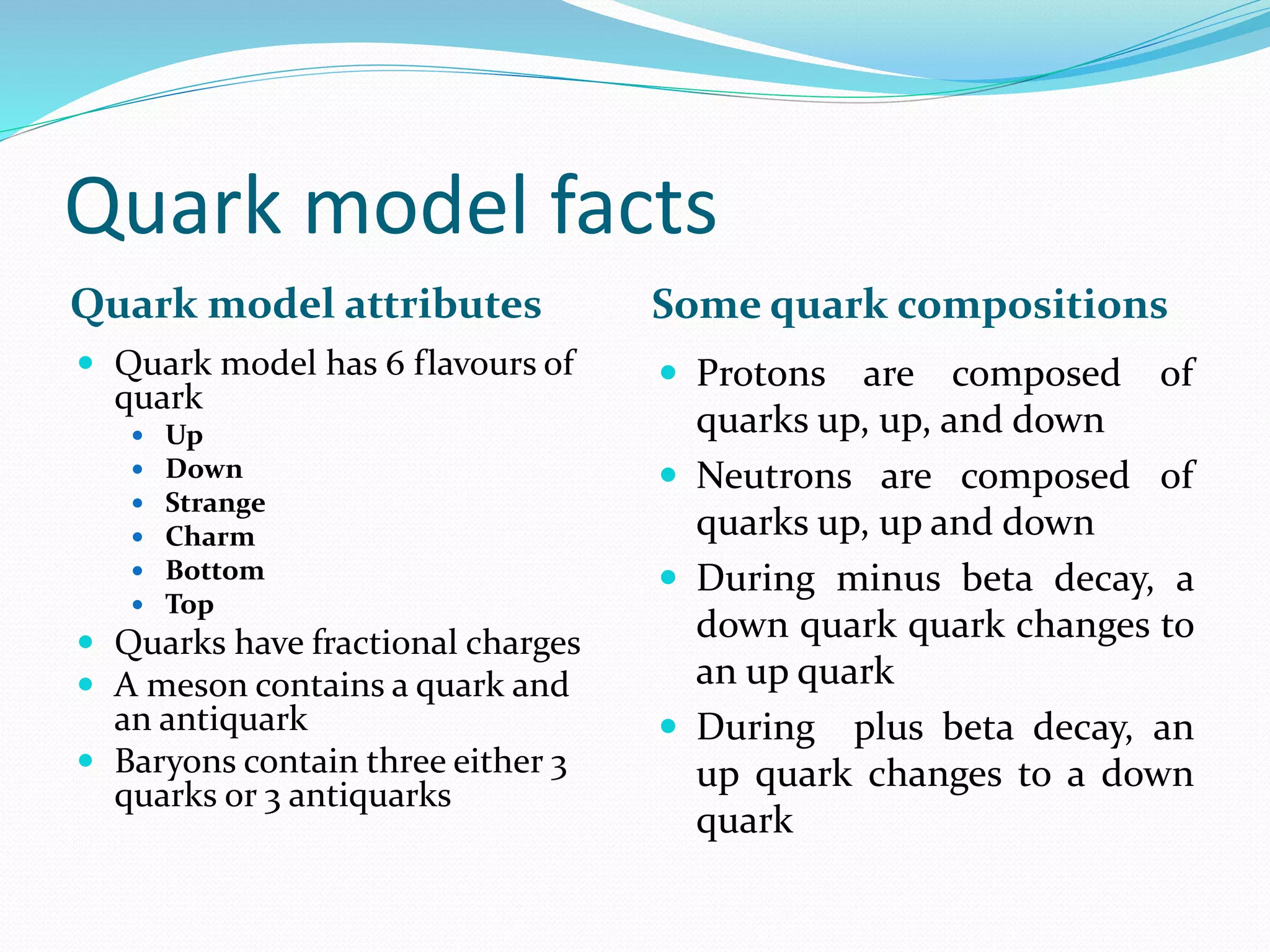
Quark model facts
Quark model attributes Some quark compositions
 Quark model has 6 flavours of
quark
 Up
 Down
 Strange
 Charm
 Bottom
 Top
 Quarks have fractional charges
 A meson contains a quark and
an antiquark
 Baryons contain three either 3
quarks or 3 antiquarks
 Protons are composed of
quarks up, up, and down
 Neutrons are composed of
quarks up, up and down
 During minus beta decay, a
down quark quark changes to
an up quark
 During plus beta decay, an
up quark changes to a down
quark

Fundamental particles.pptx

  • 1.
    Topic for seniorsecondary or A-level physics students ~Lalit Kishore
  • 2.
    Historical perspective  Till19th centaury atom was considered to the fundamental particle (ultimate: not formed by any other particles or sub- atomic prticles)  In 20th centaury, Chadwick discovered independent neutrons and protons...protons were found in solar flares...some stars behaved as if they were neutron stars. Studies of cosmic rays led to discovery of new fundamental particles  Nuclear force was – the strongest force that can could bind like charges – studied  With high power / energy particle accelerators, very many new particles and their anti-particles were discovered and are still being discovered  Families / classifications/ series have created to find the missing particles including the God particle
  • 3.
    Hadrons particles Hadrons asnew fundamental particles Quark model of hadrons with six flavours and their charge value and strangeness  With discovery of new particles using particle accelerators (collision experiments) to be classified in categories of those affected by strong forces and those not affected  2 conclusions from collision experiments / nuclear reactions  Total charge always remains constant  Total number of nucleons at times but rarely changed  The particles with properties different from neutrons and protons discovered which were called hadrons  From the collision studies lead to quark model of hadrons  It was proposed that hadrons was further made of fundamental particles called quarks which led to discovery more particles  Many types or ‘flavours’ (six)of quarks were discovered and proposed
  • 4.
    Hadrons’ classification asbaryons and mesons  With discovery of anti-quarks and various combination with quarks led to new classification of hadrons called baryons and mesons  Baryon family : protons, Neutrons and their anti-particles, they consist of 3 quarks  Meson family (consisting of quarks / anti- quarks): Pions and kappas
  • 5.
    Leptons Definition and neutron decay Quarkmodel reaction  The fundamental particles not affected by strong forces – no more composed of smaller particles  Examples: Electron; positron, neutrino, anti- neutrino  In the decay of a neutron; proton, electron and antineutrino are emitted
  • 6.
    Beta decay explanationin terms of quarks and leptons Weak force presence Proton decay quark model reaction  Beta decay is not due strong force and, therefore, must be due to another force called ‘weak force’ or ‘weak interaction’  In beta decay, the lepton number before and after decay remains the same  During the decay of a proton in the nucleus, a neutron is formed and a neutrino is emitted
  • 7.
    Quark model facts Quarkmodel attributes Some quark compositions  Quark model has 6 flavours of quark  Up  Down  Strange  Charm  Bottom  Top  Quarks have fractional charges  A meson contains a quark and an antiquark  Baryons contain three either 3 quarks or 3 antiquarks  Protons are composed of quarks up, up, and down  Neutrons are composed of quarks up, up and down  During minus beta decay, a down quark quark changes to an up quark  During plus beta decay, an up quark changes to a down quark