Physical Science 101 
Introducing to Physical Science
Welcome to PS 101, Introducing Physical Science! 
This class is an introduction To the fundamental physical science concepts of 
chemistry, physics, astronomy, Geology, and oceanography and how 
they apply to everyday life.
• Physics is the search for laws that describe the 
most fundamental aspects of nature: 
– Matter 
– Energy 
– Forces 
– Motion 
– Heat 
– Light 
– Other phenomena 
• All natural systems, including planets, stars, cells, and people 
display these basic phenomena, so physics is the starting 
point for almost any study of how nature works.
• Chemistry is the 
study of atoms in 
combination. 
– Chemicals form every 
material object of our 
world, while chemical 
reactions initiate vital 
changes in our 
environment and our 
bodies. 
– Chemistry is thus an 
immensely practical 
and profitable science.
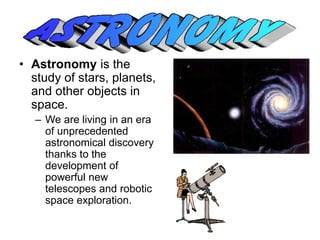
• Astronomy is the 
study of stars, planets, 
and other objects in 
space. 
– We are living in an era 
of unprecedented 
astronomical discovery 
thanks to the 
development of 
powerful new 
telescopes and robotic 
space exploration.
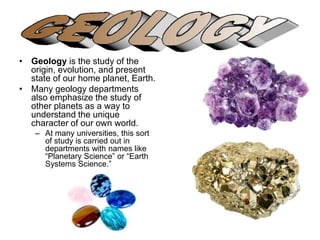
• Geology is the study of the 
origin, evolution, and present 
state of our home planet, Earth. 
• Many geology departments 
also emphasize the study of 
other planets as a way to 
understand the unique 
character of our own world. 
– At many universities, this sort 
of study is carried out in 
departments with names like 
“Planetary Science” or “Earth 
Systems Science.”
• Biology is the study of living systems. 
• Biologists document life at many scales, 
from individual microscopic molecules and 
cells to expansive ecosystems.
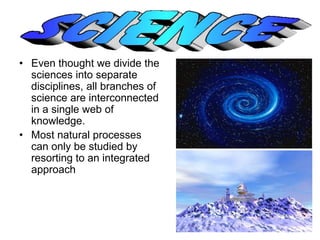
• Even thought we divide the 
sciences into separate 
disciplines, all branches of 
science are interconnected 
in a single web of 
knowledge. 
• Most natural processes 
can only be studied by 
resorting to an integrated 
approach
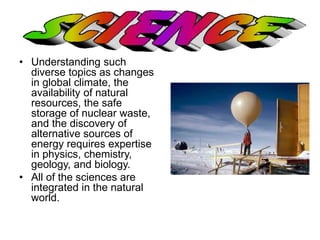
• Understanding such 
diverse topics as changes 
in global climate, the 
availability of natural 
resources, the safe 
storage of nuclear waste, 
and the discovery of 
alternative sources of 
energy requires expertise 
in physics, chemistry, 
geology, and biology. 
• All of the sciences are 
integrated in the natural 
world.
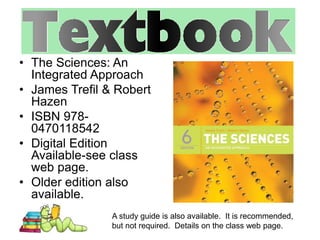
• The Sciences: An 
Integrated Approach 
• James Trefil & Robert 
Hazen 
• ISBN 978- 
0470118542 
• Digital Edition 
Available-see class 
web page. 
• Older edition also 
available. 
A study guide is also available. It is recommended, 
but not required. Details on the class web page.
• The college-wide core skill sets 
applicable to this course are: 
– 1.1 Read and retain information. 
– 1.4 Employ vocabulary of the 
subject studied. 
– 3.5 Apply principles of scientific 
reasoning to solve problems. 
– 3.6 Defend a logical hypothesis to 
explain observed phenomenon.
• After completion of this course, students will be able to: 
– Apply the unifying principles that underlie the various 
branches of scientific endeavor to situations encountered 
in everyday life. 
– Identify the basic physical concepts necessary for an 
understanding of the science and technology of the natural 
environment. 
– Appraise each person’s role as a member of a society that 
is increasingly dependent on scientific and technological 
development. 
– Diagram and describe the structure of matter and its 
interactions . 
– Explain the relationship between microscopic activity and 
macroscopic phenomena. 
– Describe the structure of the Earth and its relationship to 
the cosmos.
• Given a list of observations, students 
will develop a hypothesis to explain 
natural phenomena, and outline the 
scientific process by which the 
hypothesis can be evaluated. 
• Students will demonstrate an 
understanding of atomic and 
molecular properties as evidence of 
the structure of matter.
• You will have a quiz on each chapter that 
we cover in your textbook. 
– Quizzes will be given using Blackboard. 
– When a quiz is posted, you will have one 
week to complete it. 
– Quizzes are timed, you have 30 minutes to 
finish the quiz once you begin it. 
– Quizzes must be submitted by 1:30 PM on 
their due dates. 
– You get two chances to do your quizzes.
• Quizzes will be multiple choice, 
true/false, fill in the blank, and/or 
matching. 
• It is recommended that you 
completely read your chapter 
before attempting quizzes. 
• It is also recommended that you 
make notes while you read and 
use them for your quizzes. 
– 30 minutes goes by very quickly!
• Exams will also be given 
online using Blackboard. 
– Exams will be based on quiz 
questions. 
– You will have one week to 
complete exams when posted. 
– Exams will be timed, 60 
minutes. 
– Exams must be submitted by 
1:30 PM on their due dates.
• The final exam will also be given using 
Blackboard. 
• The final exam will be cumulative.
• You are required to write a 5-page paper 
for this course and give a presentation. 
– We will discuss topics at a later date. 
– You may receive extra credit for seeking help 
from the writing center.
• You are required to 
give a 5-minute 
presentation. 
• Your presentation will 
be about your paper. 
– Think about what you 
want to do now, sign 
ups will be soon, get 
the time slot you want!
• There will be (approx.) 21 quizzes 
worth 10 points each. 
• There will be 6 exams worth 100 
points each. 
• Your paper is worth 100 points. 
• Your presentation is worth 100 points. 
• You have a web project-worth 120 
points. 
– The total points possible for this course is 
1230.
• A 1230-1107 100-90% 
• B 1106-984 89-80% 
• C 983-861 79-70% 
• D 860-738 69-60% 
• F 737-0 59-0% 
– Note: you need to earn at least 60% of the 
total points possible to pass this class.
• No late work! 
• No missed exams… 
– They are on Blackboard 
and you have a week to 
complete them!
• I may drop you if you 
miss class more than 
twice. 
– Keep in touch if you do 
not want to be 
inadvertently dropped. 
• I may drop you if you 
are excessively tardy. 
– Excessive tardiness is 
being more than 5 
minutes late more than 
3 times.
• Do not e-mail assignments to me. 
• If you cannot make it to class when 
something is due, please contact me, or 
take it to my mailbox which is in the 
Physical Science building, where the 
receptionist is.
• The last day that anything can be turned in 
is Dec 8th, this means extra credit work or 
any late work that has been approved. 
– NO EXCEPTIONS!
• It is your responsibility to drop should you 
decide to. 
– If you stop attending and do not drop, you will 
likely end up with an F.
• Pick up your graded work otherwise I will 
recycle it. 
– It is a good idea to keep all of your graded 
work until after you have received your final 
grade.
• Extra credit will be offered throughout the 
semester. 
• You will need to be here to take advantage 
of it.
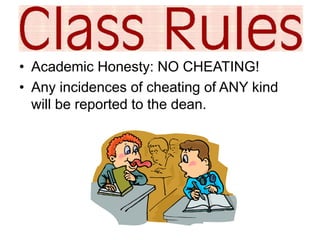
• Academic Honesty: NO CHEATING! 
• Any incidences of cheating of ANY kind 
will be reported to the dean.
• Cell Phones: 
– No talking or texting in class, it is 
inappropriate. 
– You may be asked to leave if you are 
disturbing others.
• If you need accommodations for a 
disability, please see me immediately after 
class. 
• If you think you might, please talk to me 
and please contact the DSPS office listed 
on your syllabus.
• Blackboard will be use 
extensively for this course! 
• You MUST learn to use it. 
– Your quizzes, and exams will be 
done using it. 
– You can also access the lectures, 
and your grades. 
– There may also be extra credit 
discussions. 
• If you do not know how to use 
Blackboard, stay after class 
today.
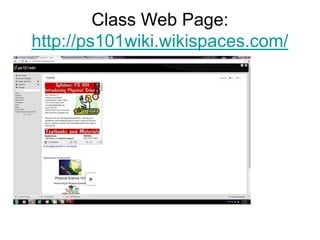
Class Web Page: 
http://ps101wiki.wikispaces.com/
• The best way to reach me is by text at 
(760) 440-8977 or by e-mail at 
lisa.schmidt@chaffey.edu
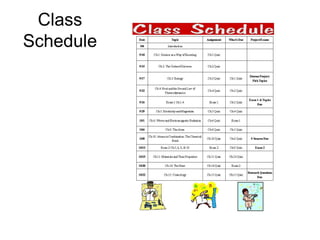
Class 
Schedule
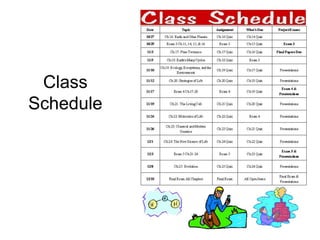
Class 
Schedule
• Let’s take a moment to look at 
the schedule… 
• Now all topics, dates, and point 
totals in the syllabus are 
tentative, in other words they 
may change. 
– It is your responsibility to get that 
information should you happen to 
miss class. 
– I suggest making friends with at 
least one other person in class.
• Tutoring is available. 
• Computers are 
available for your use 
on campus. 
– Library 
– The Learning Center 
• The Writing Center is 
here to help you with 
your paper.

Physical science 101 intro fall 2014

  • 1.
    Physical Science 101 Introducing to Physical Science
  • 2.
    Welcome to PS101, Introducing Physical Science! This class is an introduction To the fundamental physical science concepts of chemistry, physics, astronomy, Geology, and oceanography and how they apply to everyday life.
  • 3.
    • Physics isthe search for laws that describe the most fundamental aspects of nature: – Matter – Energy – Forces – Motion – Heat – Light – Other phenomena • All natural systems, including planets, stars, cells, and people display these basic phenomena, so physics is the starting point for almost any study of how nature works.
  • 4.
    • Chemistry isthe study of atoms in combination. – Chemicals form every material object of our world, while chemical reactions initiate vital changes in our environment and our bodies. – Chemistry is thus an immensely practical and profitable science.
  • 5.
    • Astronomy isthe study of stars, planets, and other objects in space. – We are living in an era of unprecedented astronomical discovery thanks to the development of powerful new telescopes and robotic space exploration.
  • 6.
    • Geology isthe study of the origin, evolution, and present state of our home planet, Earth. • Many geology departments also emphasize the study of other planets as a way to understand the unique character of our own world. – At many universities, this sort of study is carried out in departments with names like “Planetary Science” or “Earth Systems Science.”
  • 7.
    • Biology isthe study of living systems. • Biologists document life at many scales, from individual microscopic molecules and cells to expansive ecosystems.
  • 8.
    • Even thoughtwe divide the sciences into separate disciplines, all branches of science are interconnected in a single web of knowledge. • Most natural processes can only be studied by resorting to an integrated approach
  • 9.
    • Understanding such diverse topics as changes in global climate, the availability of natural resources, the safe storage of nuclear waste, and the discovery of alternative sources of energy requires expertise in physics, chemistry, geology, and biology. • All of the sciences are integrated in the natural world.
  • 10.
    • The Sciences:An Integrated Approach • James Trefil & Robert Hazen • ISBN 978- 0470118542 • Digital Edition Available-see class web page. • Older edition also available. A study guide is also available. It is recommended, but not required. Details on the class web page.
  • 11.
    • The college-widecore skill sets applicable to this course are: – 1.1 Read and retain information. – 1.4 Employ vocabulary of the subject studied. – 3.5 Apply principles of scientific reasoning to solve problems. – 3.6 Defend a logical hypothesis to explain observed phenomenon.
  • 12.
    • After completionof this course, students will be able to: – Apply the unifying principles that underlie the various branches of scientific endeavor to situations encountered in everyday life. – Identify the basic physical concepts necessary for an understanding of the science and technology of the natural environment. – Appraise each person’s role as a member of a society that is increasingly dependent on scientific and technological development. – Diagram and describe the structure of matter and its interactions . – Explain the relationship between microscopic activity and macroscopic phenomena. – Describe the structure of the Earth and its relationship to the cosmos.
  • 13.
    • Given alist of observations, students will develop a hypothesis to explain natural phenomena, and outline the scientific process by which the hypothesis can be evaluated. • Students will demonstrate an understanding of atomic and molecular properties as evidence of the structure of matter.
  • 14.
    • You willhave a quiz on each chapter that we cover in your textbook. – Quizzes will be given using Blackboard. – When a quiz is posted, you will have one week to complete it. – Quizzes are timed, you have 30 minutes to finish the quiz once you begin it. – Quizzes must be submitted by 1:30 PM on their due dates. – You get two chances to do your quizzes.
  • 15.
    • Quizzes willbe multiple choice, true/false, fill in the blank, and/or matching. • It is recommended that you completely read your chapter before attempting quizzes. • It is also recommended that you make notes while you read and use them for your quizzes. – 30 minutes goes by very quickly!
  • 16.
    • Exams willalso be given online using Blackboard. – Exams will be based on quiz questions. – You will have one week to complete exams when posted. – Exams will be timed, 60 minutes. – Exams must be submitted by 1:30 PM on their due dates.
  • 17.
    • The finalexam will also be given using Blackboard. • The final exam will be cumulative.
  • 18.
    • You arerequired to write a 5-page paper for this course and give a presentation. – We will discuss topics at a later date. – You may receive extra credit for seeking help from the writing center.
  • 19.
    • You arerequired to give a 5-minute presentation. • Your presentation will be about your paper. – Think about what you want to do now, sign ups will be soon, get the time slot you want!
  • 20.
    • There willbe (approx.) 21 quizzes worth 10 points each. • There will be 6 exams worth 100 points each. • Your paper is worth 100 points. • Your presentation is worth 100 points. • You have a web project-worth 120 points. – The total points possible for this course is 1230.
  • 21.
    • A 1230-1107100-90% • B 1106-984 89-80% • C 983-861 79-70% • D 860-738 69-60% • F 737-0 59-0% – Note: you need to earn at least 60% of the total points possible to pass this class.
  • 22.
    • No latework! • No missed exams… – They are on Blackboard and you have a week to complete them!
  • 23.
    • I maydrop you if you miss class more than twice. – Keep in touch if you do not want to be inadvertently dropped. • I may drop you if you are excessively tardy. – Excessive tardiness is being more than 5 minutes late more than 3 times.
  • 24.
    • Do note-mail assignments to me. • If you cannot make it to class when something is due, please contact me, or take it to my mailbox which is in the Physical Science building, where the receptionist is.
  • 25.
    • The lastday that anything can be turned in is Dec 8th, this means extra credit work or any late work that has been approved. – NO EXCEPTIONS!
  • 26.
    • It isyour responsibility to drop should you decide to. – If you stop attending and do not drop, you will likely end up with an F.
  • 27.
    • Pick upyour graded work otherwise I will recycle it. – It is a good idea to keep all of your graded work until after you have received your final grade.
  • 28.
    • Extra creditwill be offered throughout the semester. • You will need to be here to take advantage of it.
  • 29.
    • Academic Honesty:NO CHEATING! • Any incidences of cheating of ANY kind will be reported to the dean.
  • 30.
    • Cell Phones: – No talking or texting in class, it is inappropriate. – You may be asked to leave if you are disturbing others.
  • 31.
    • If youneed accommodations for a disability, please see me immediately after class. • If you think you might, please talk to me and please contact the DSPS office listed on your syllabus.
  • 32.
    • Blackboard willbe use extensively for this course! • You MUST learn to use it. – Your quizzes, and exams will be done using it. – You can also access the lectures, and your grades. – There may also be extra credit discussions. • If you do not know how to use Blackboard, stay after class today.
  • 33.
    Class Web Page: http://ps101wiki.wikispaces.com/
  • 34.
    • The bestway to reach me is by text at (760) 440-8977 or by e-mail at lisa.schmidt@chaffey.edu
  • 35.
  • 36.
  • 37.
    • Let’s takea moment to look at the schedule… • Now all topics, dates, and point totals in the syllabus are tentative, in other words they may change. – It is your responsibility to get that information should you happen to miss class. – I suggest making friends with at least one other person in class.
  • 38.
    • Tutoring isavailable. • Computers are available for your use on campus. – Library – The Learning Center • The Writing Center is here to help you with your paper.