Metric System Scientific  Measurements copyright cmassengale
Metric System Developed by the French in the late 1700’s. Based on powers of ten, so it is very easy to use. Used by almost every country in the world, with the notable exception of the USA. Especially used by scientists. Abbreviated SI, which is French for Systeme International. copyright cmassengale
Metric Prefixes Regardless of the unit, the entire metric system uses the same prefixes. Common prefixes are: kilo = 1000 centi = 1/100 th milli = 1/1000 th 1 meter = 100 centimeters= 1000 millimeters copyright cmassengale
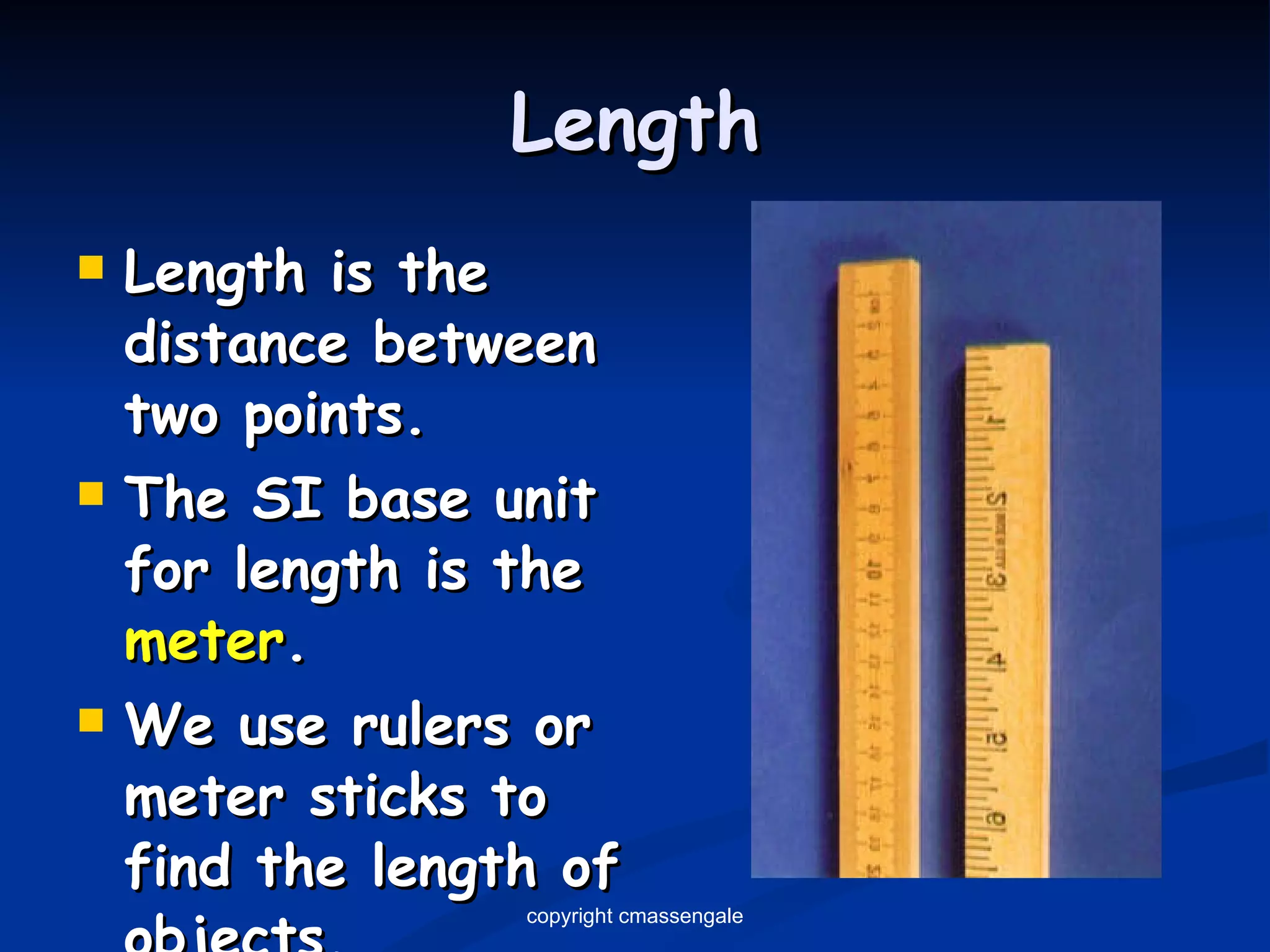
Length Length is the distance between two points. The SI base unit for length is the  meter . We use rulers or meter sticks to find the length of objects. copyright cmassengale
Mass Mass is the amount of matter that makes up an object. A golf ball and a ping pong ball are the same size, but the golf ball has a lot more matter in it.  So the golf ball will have more mass. The SI unit for mass is the  gram . A paper clip has a mass of about one gram. The mass of an object will not change unless we add or subtract matter from it. copyright cmassengale
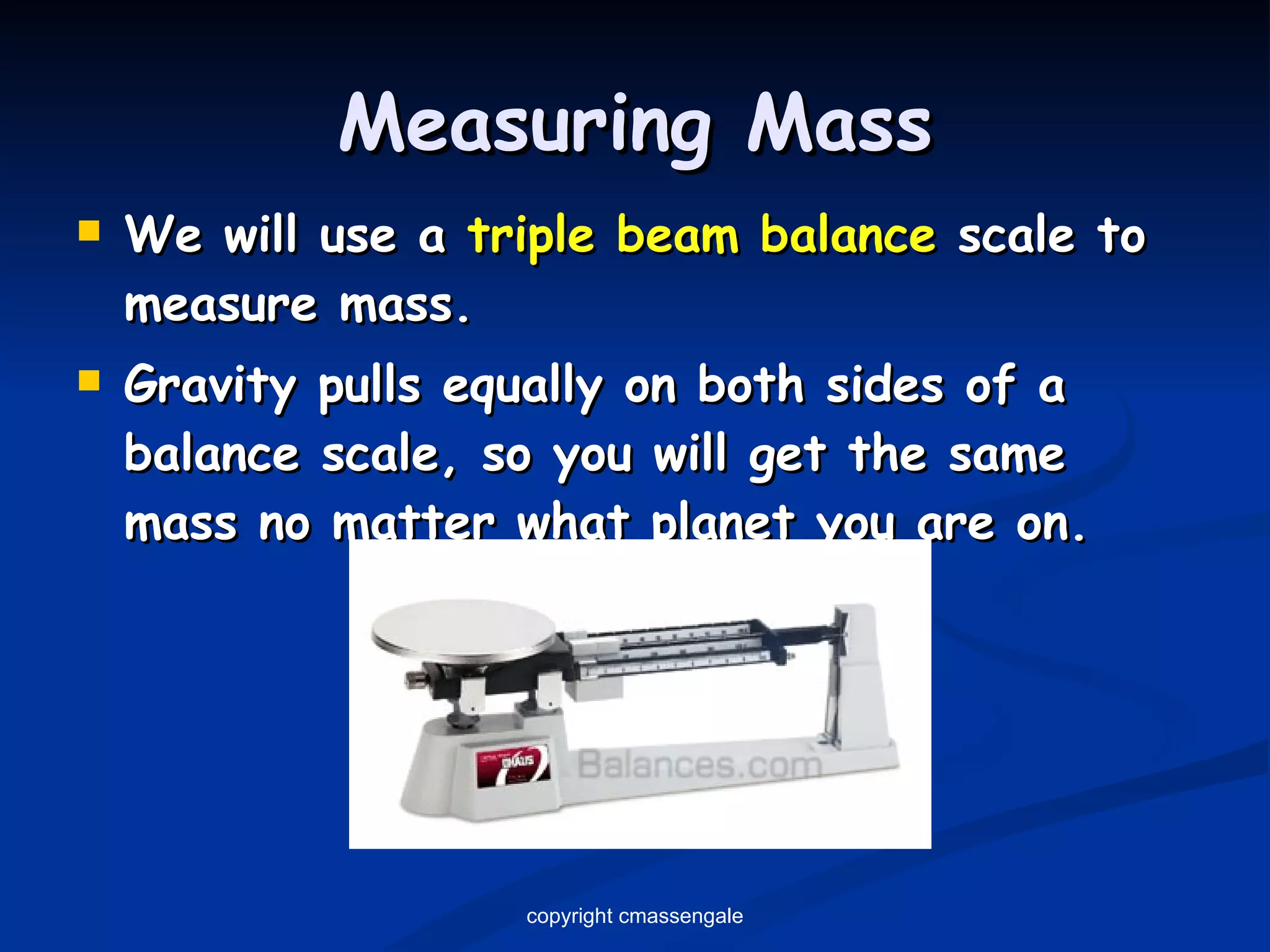
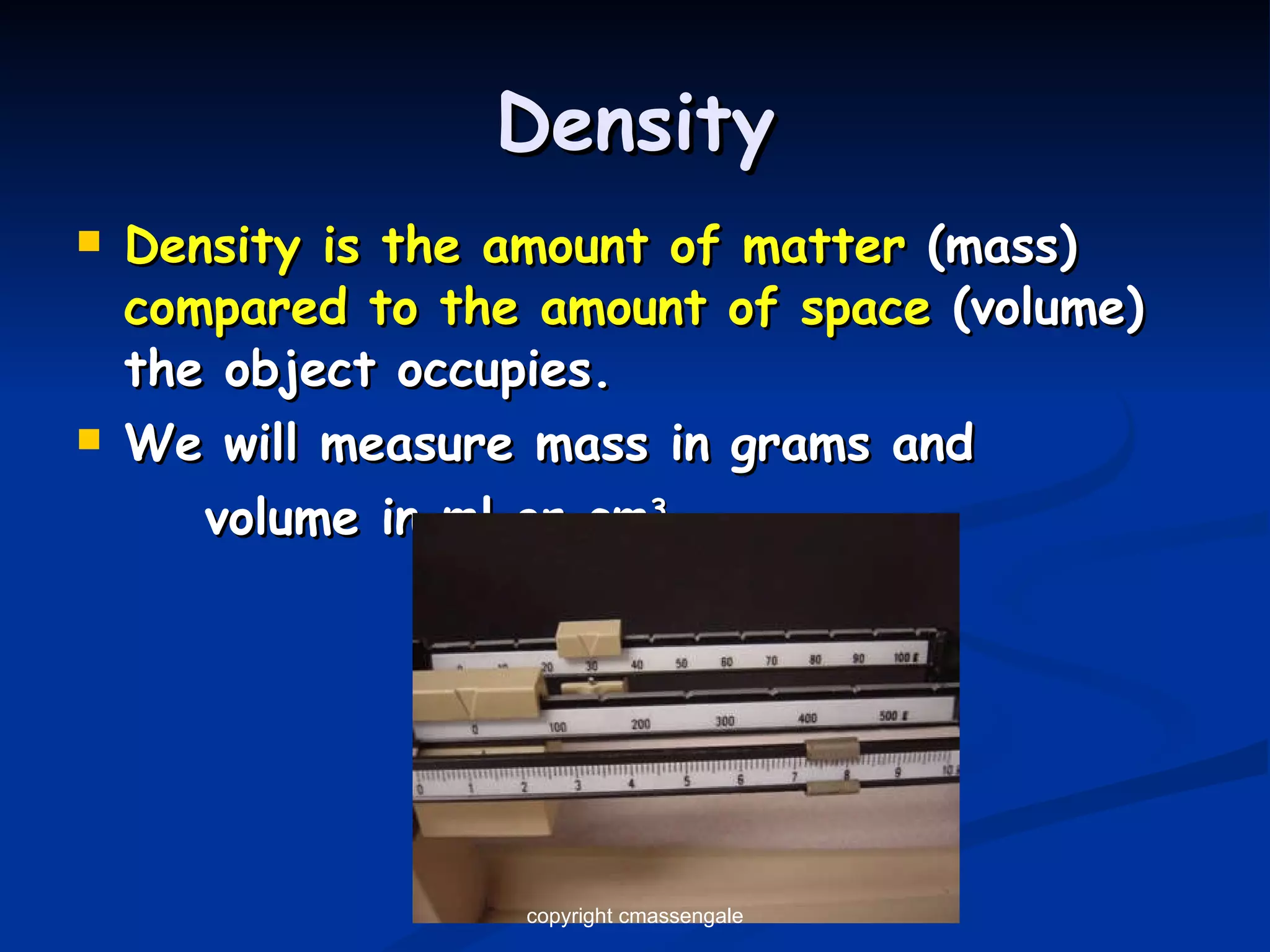
Measuring Mass We will use a  triple beam balance  scale to measure mass. Gravity pulls equally on both sides of a balance scale, so you will get the same mass no matter what planet you are on. copyright cmassengale
Weight Weight is a measure of the force of gravity on an object . Your weight can change depending on the force of gravity.  The gravity will change depending on the planet you are on. The SI unit for weight is the  Newton  (N). The English unit for weight is the pound. copyright cmassengale
Gravity Gravity is the force of attraction   between any two objects with mass. The force depends on two things: more distance = less gravity = less weight less distance = more gravity = more weight more mass  =  more gravity  = more weight less mass  =  less gravity  = less weight copyright cmassengale
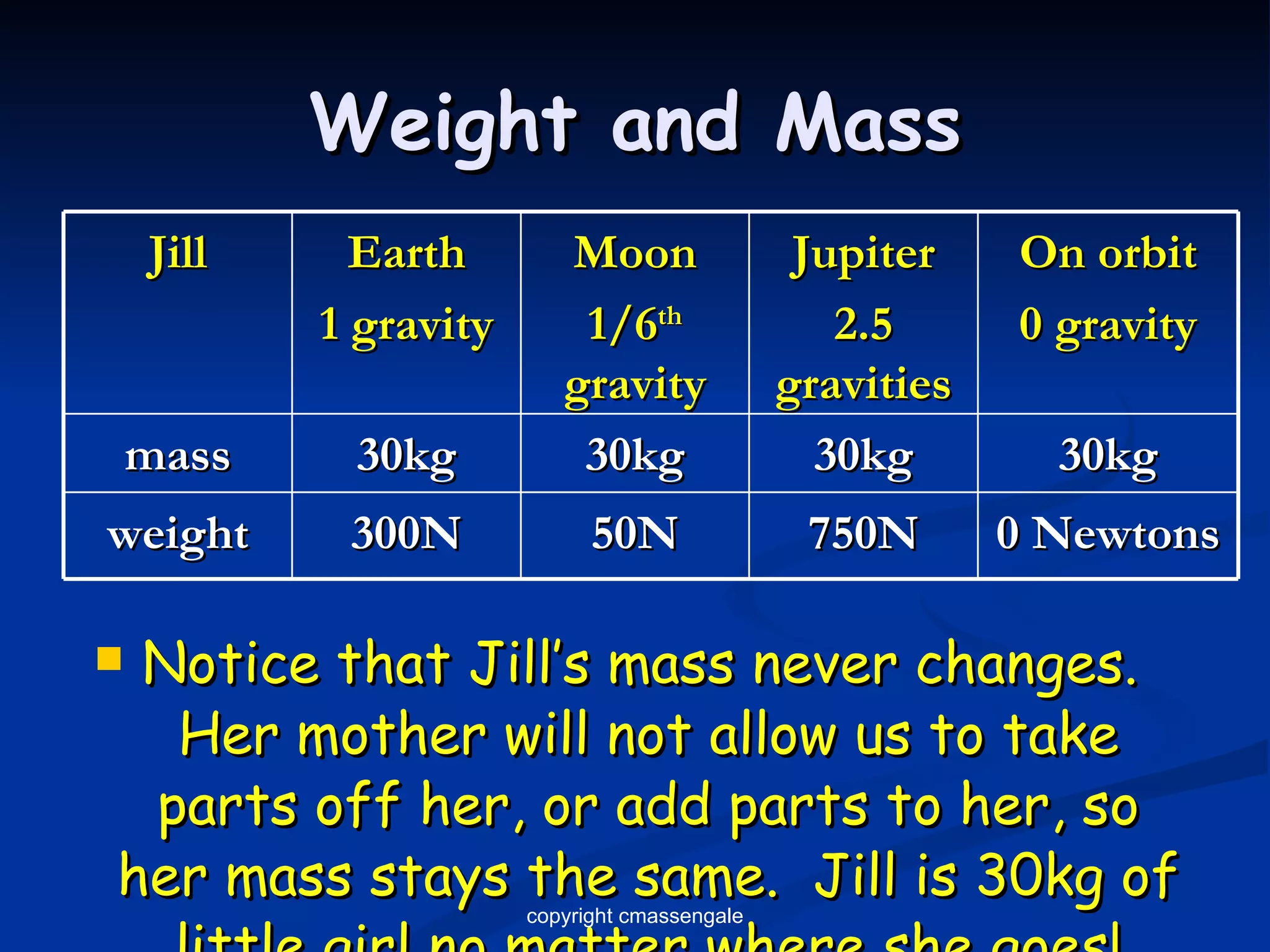
Weight and Mass Notice that Jill’s mass never changes.  Her mother will not allow us to take parts off her, or add parts to her, so her mass stays the same.  Jill is 30kg of little girl no matter where she goes! copyright cmassengale Jill Earth 1 gravity Moon 1/6 th  gravity Jupiter 2.5 gravities On orbit 0 gravity mass 30kg 30kg 30kg 30kg weight 300N 50N 750N 0 Newtons
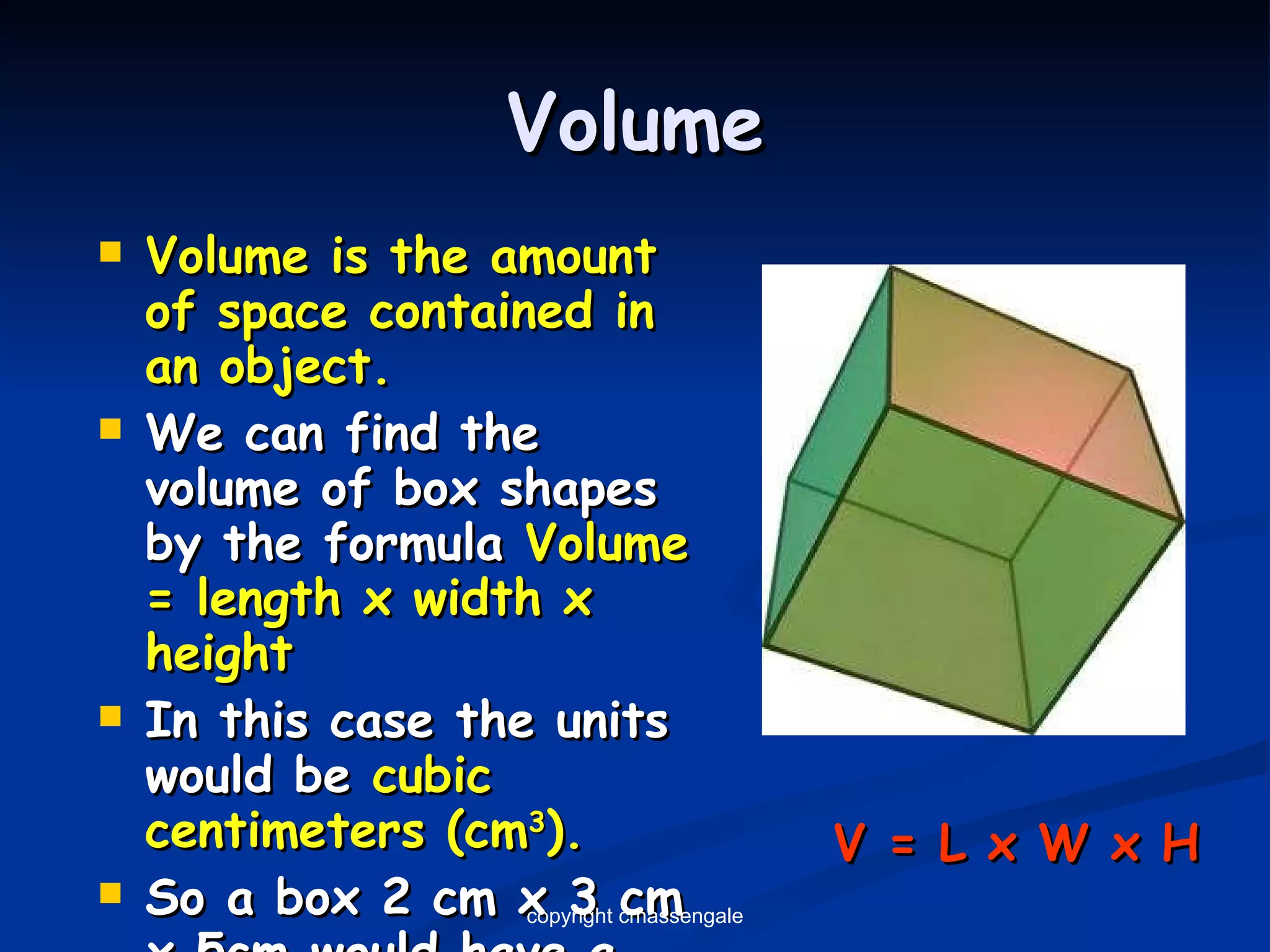
Volume Volume is the amount of space contained in an object. We can find the volume of box shapes by the formula  Volume = length x width x height In this case the units would be  cubic centimeters (cm 3 ). So a box 2 cm x 3 cm x 5cm would have a volume of 30 cm 3 V = L x W x H copyright cmassengale
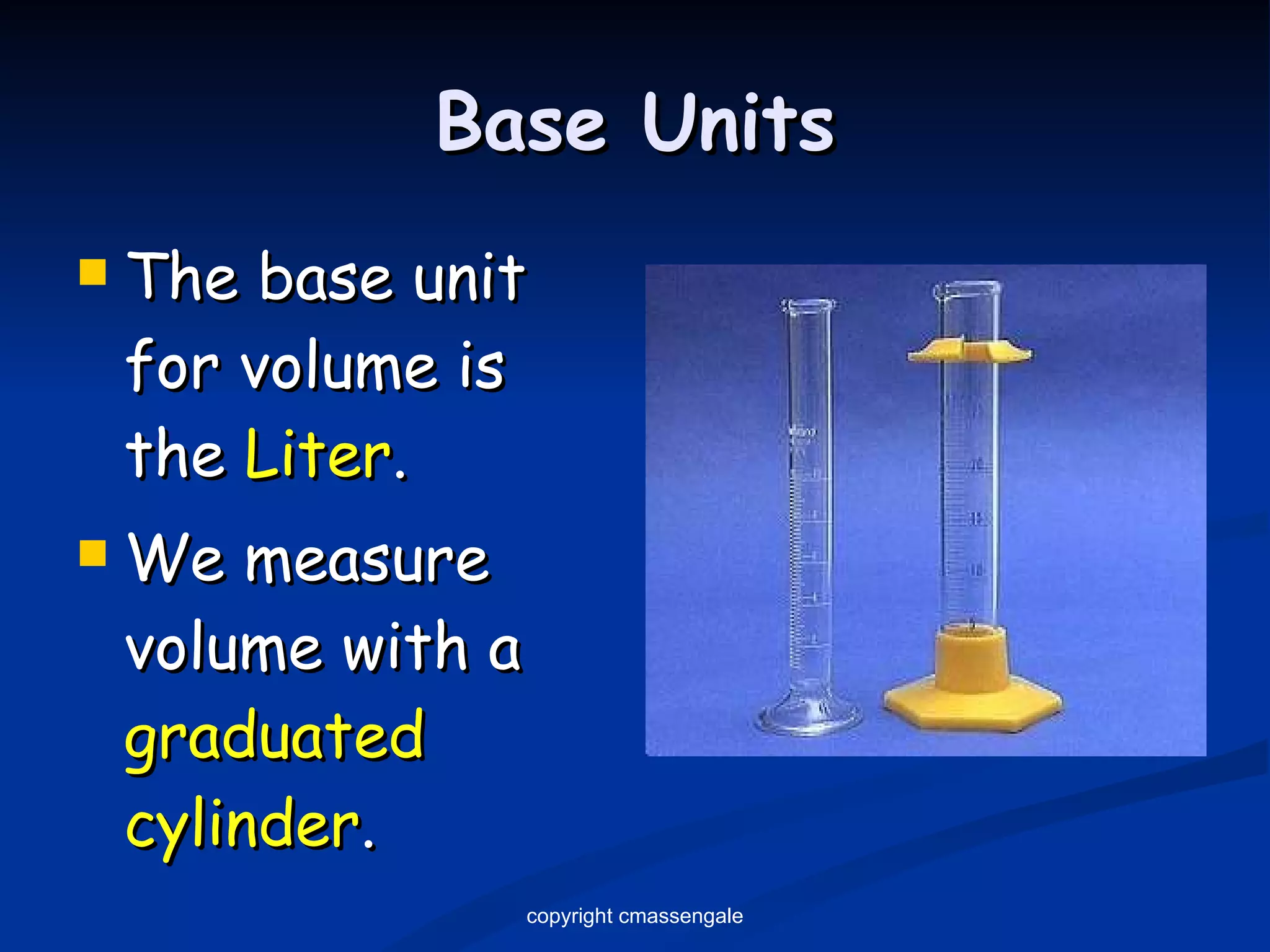
Base Units The base unit for volume is the  Liter . We measure volume with a  graduated cylinder . copyright cmassengale
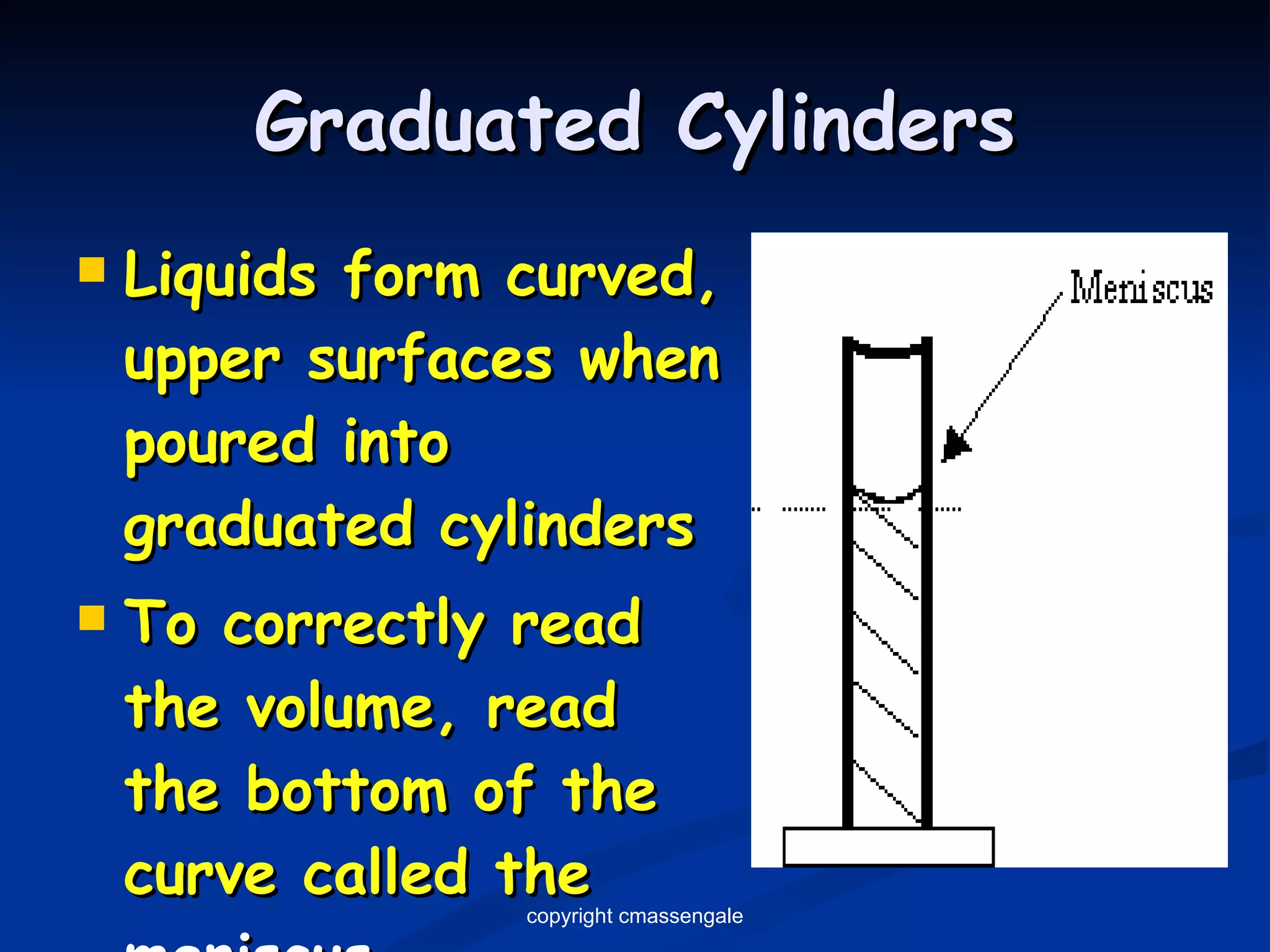
Graduated Cylinders Liquids form curved, upper surfaces when poured into  graduated cylinders To correctly read the volume, read the bottom of the curve called the  meniscus copyright cmassengale
Liquid Volume When the metric system was created, they decided that 1 cm 3   of water would equal 1 milliliter of water and the 1 mL of water will have a mass of one gram. 1cm 3  water =1 ml of water = 1 gram copyright cmassengale
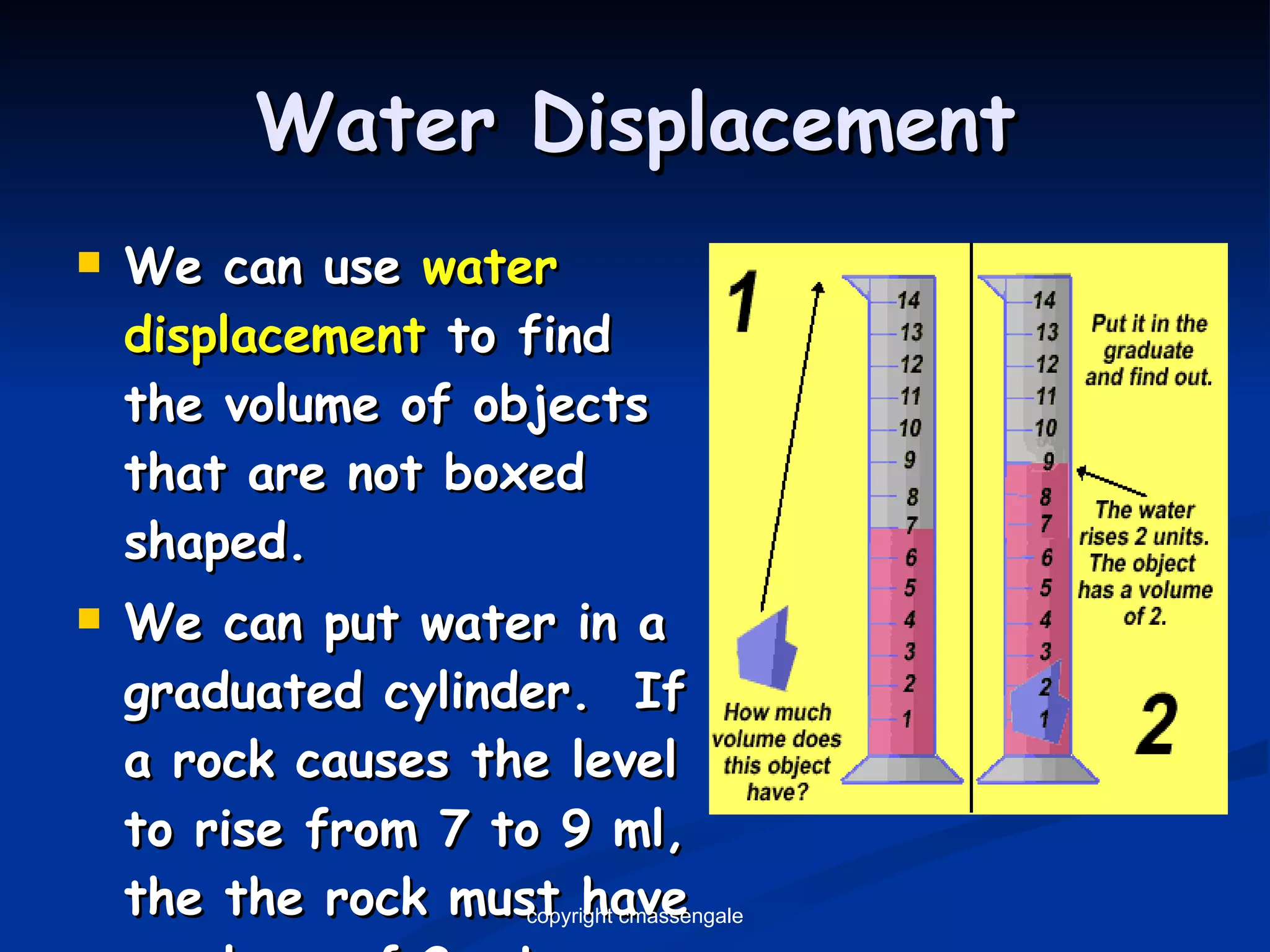
Water Displacement We can use  water displacement  to find the volume of objects that are not boxed shaped. We can put water in a graduated cylinder.  If a rock causes the level to rise from 7 to 9 ml, the the rock must have a volume of 2-mL. copyright cmassengale
Water Mass and Volume 1 cm 3  water =  1 mL of water = 1 gram So what would be the mass of 50 mL of water be? 50 grams So what would be the mass of 1 liter of water be? 1 L = 1000 mL so its mass would be 1000 grams or a kilogram. copyright cmassengale
Density Density is the amount of matter  (mass)  compared to the amount of space  (volume) the object occupies. We will measure mass in grams and  volume in ml or cm 3 copyright cmassengale
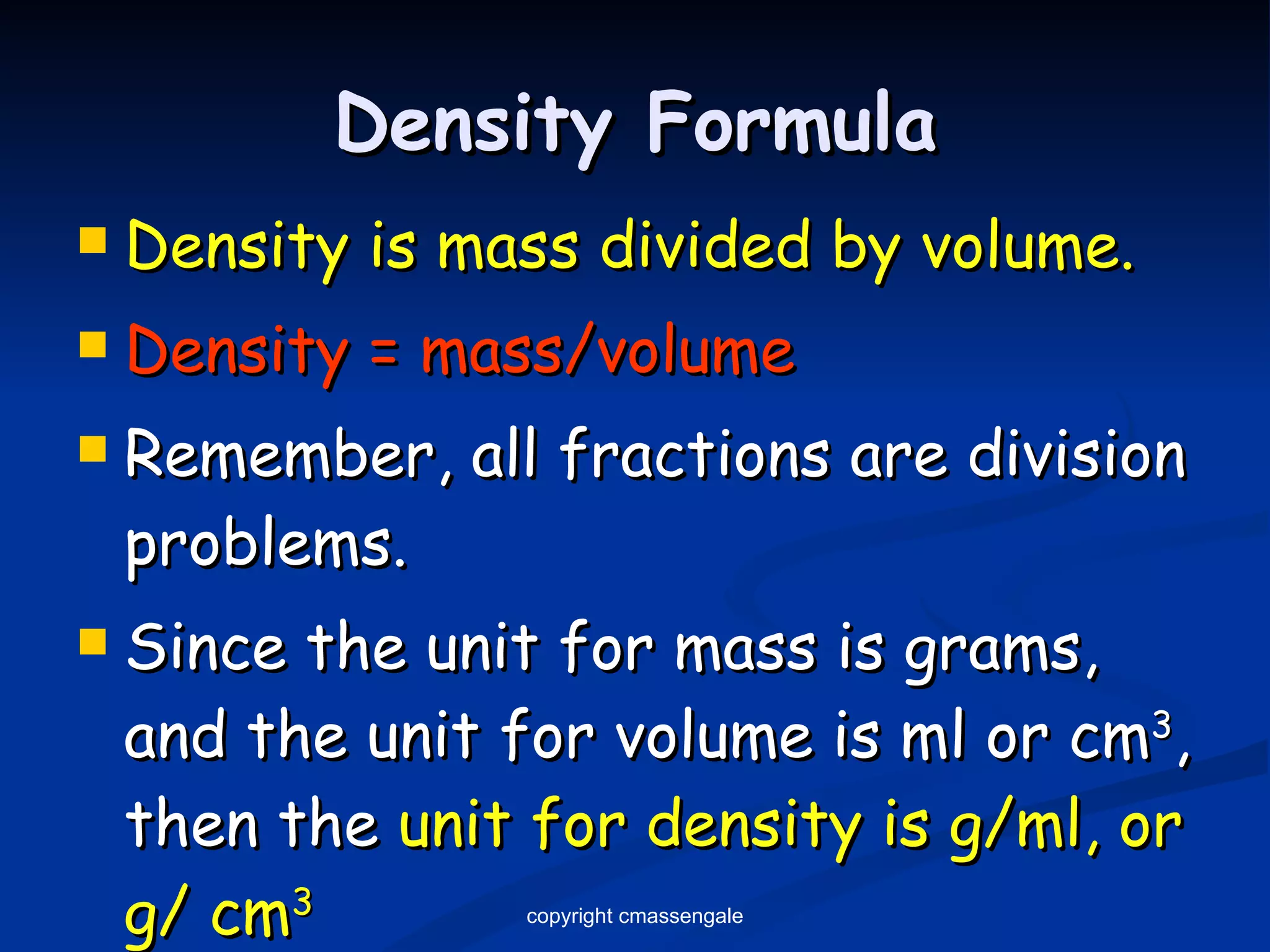
Density Formula Density is mass divided by volume. Density = mass/volume Remember, all fractions are division problems.  Since the unit for mass is grams, and the unit for volume is ml or cm 3 , then the  unit for density is g/ml, or g/ cm 3 copyright cmassengale
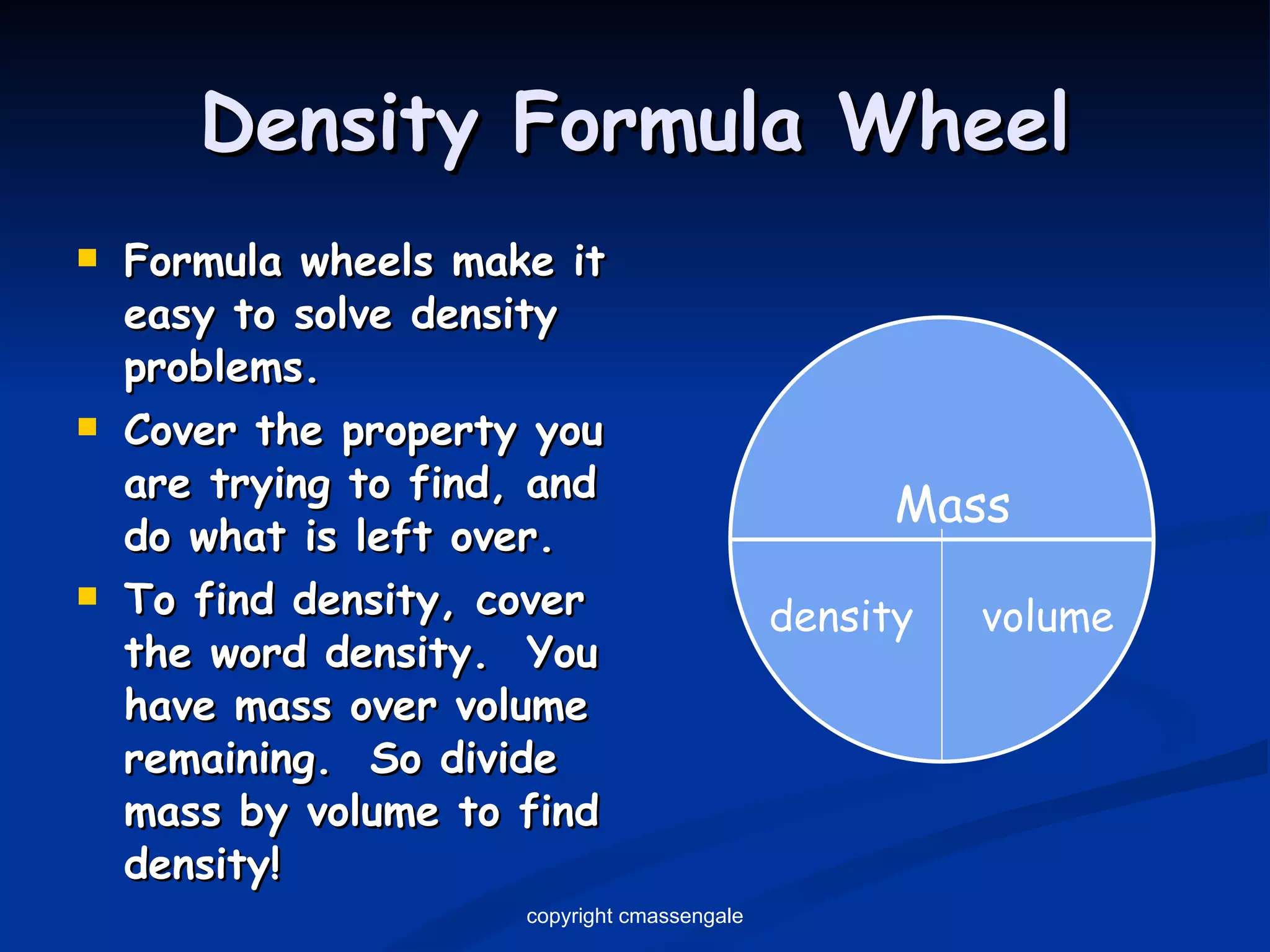
Density Formula Wheel Formula wheels make it easy to solve density problems. Cover the property you are trying to find, and do what is left over. To find density, cover the word density.  You have mass over volume remaining.  So divide mass by volume to find density! Mass density volume copyright cmassengale
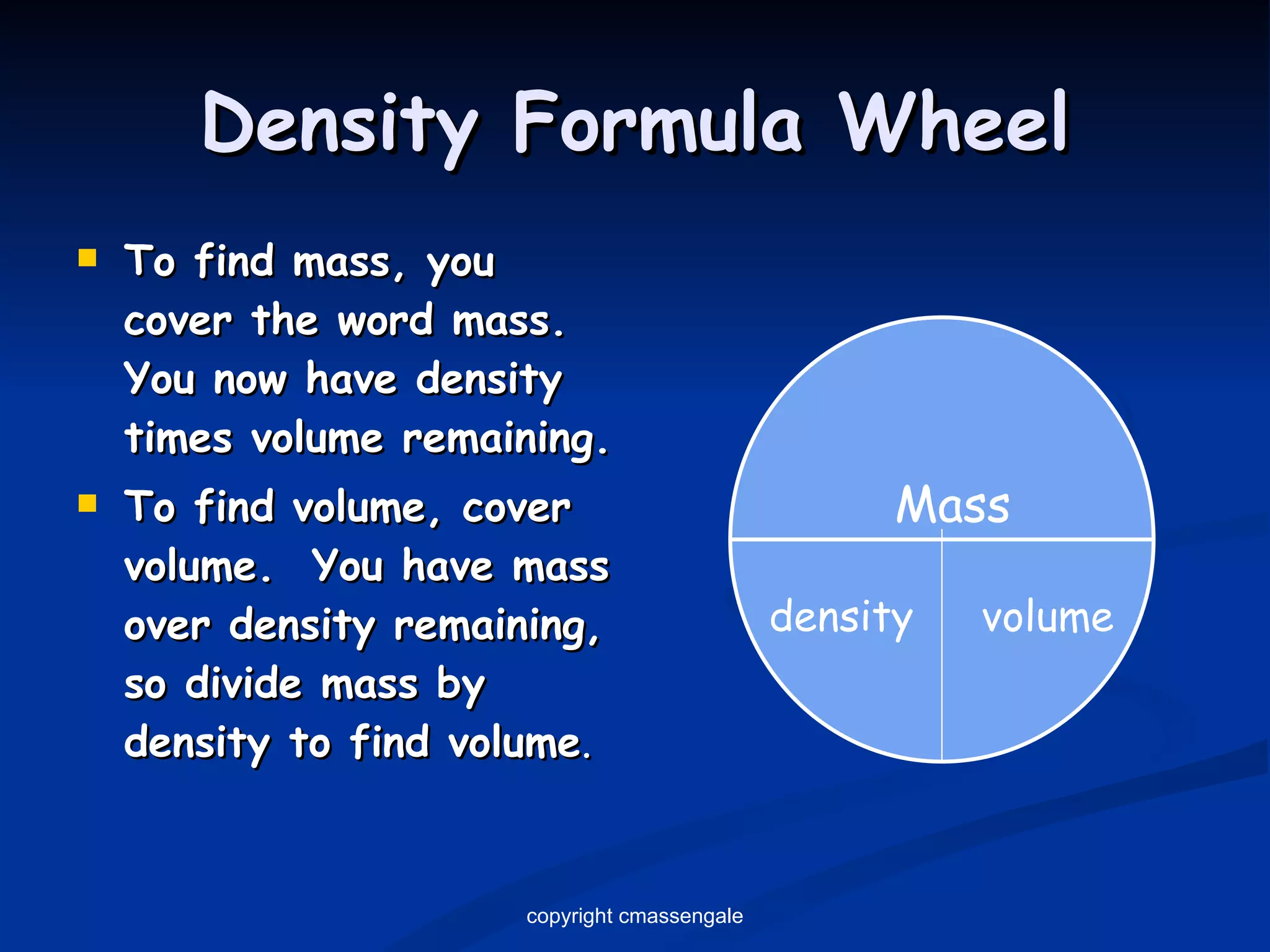
Density Formula Wheel To find mass, you cover the word mass.  You now have density times volume remaining. To find volume, cover volume.  You have mass over density remaining, so divide mass by density to find volume . Mass density volume copyright cmassengale
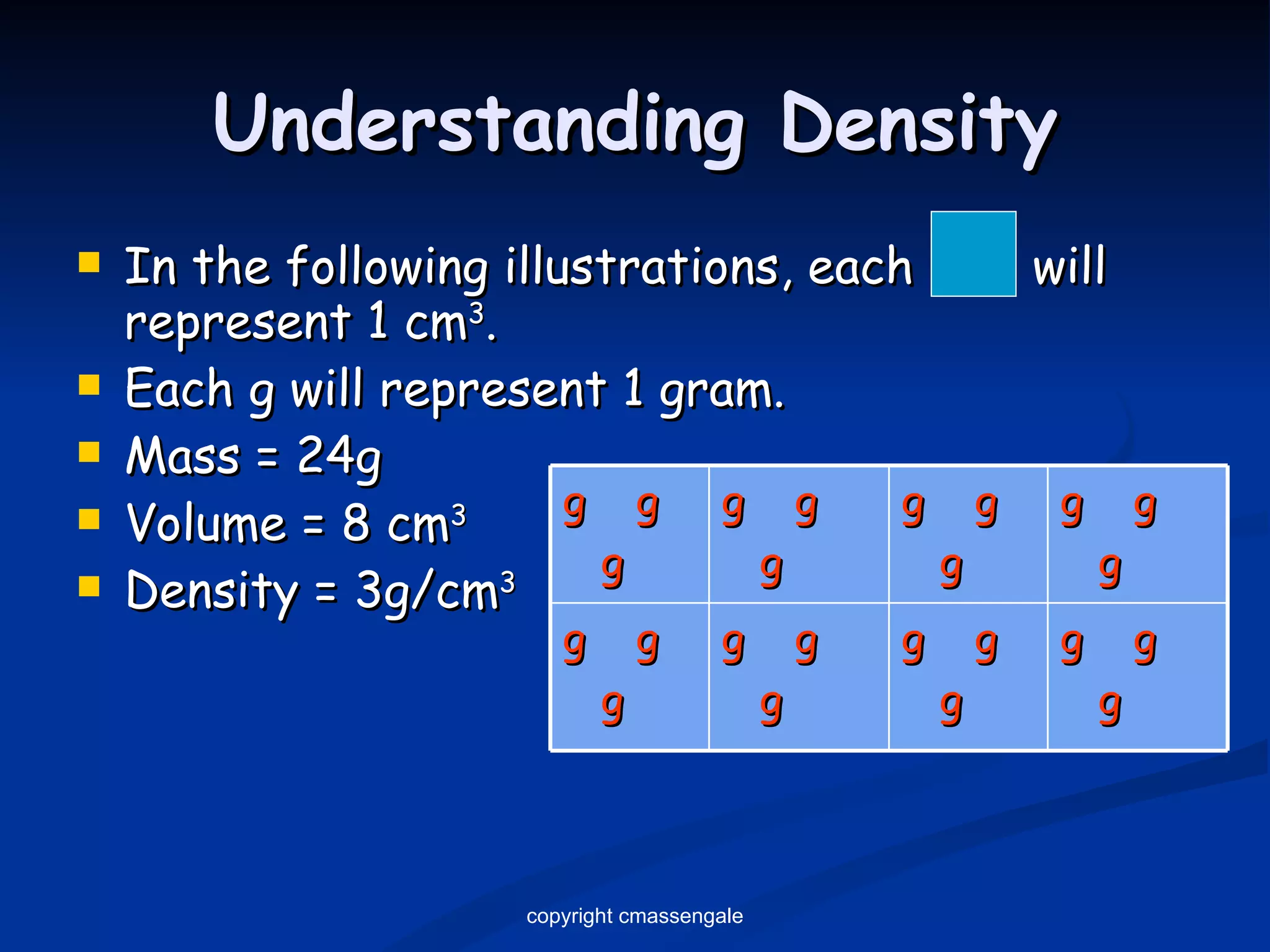
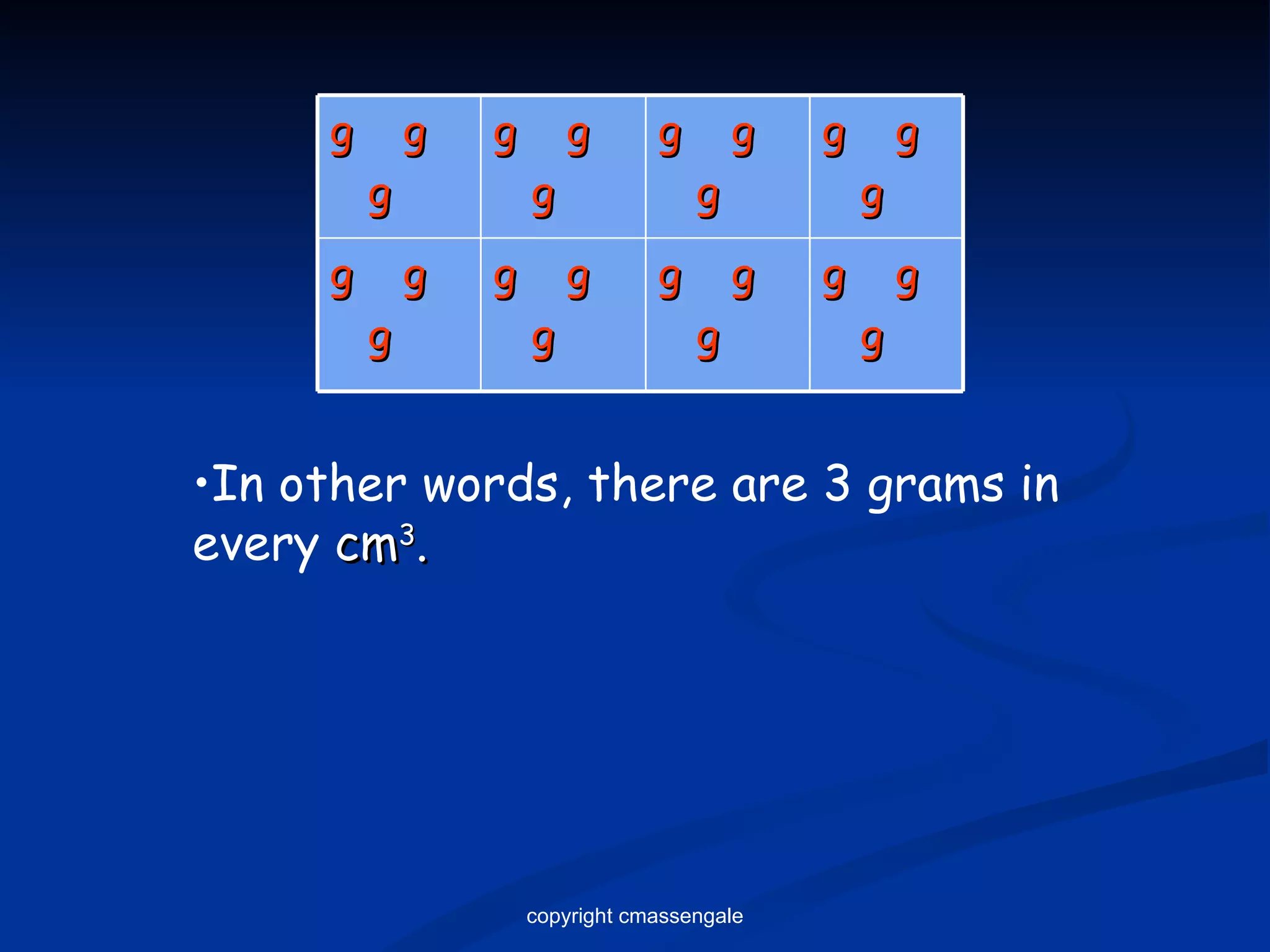
Understanding Density In the following illustrations, each  will represent 1 cm 3 . Each g will represent 1 gram. Mass = 24g Volume = 8 cm 3 Density = 3g/cm 3 copyright cmassengale g  g g g  g g g  g g g  g g g  g g g  g g g  g g g  g g
In other words, there are 3 grams in every  cm 3 . copyright cmassengale g  g g g  g g g  g g g  g g g  g g g  g g g  g g g  g g
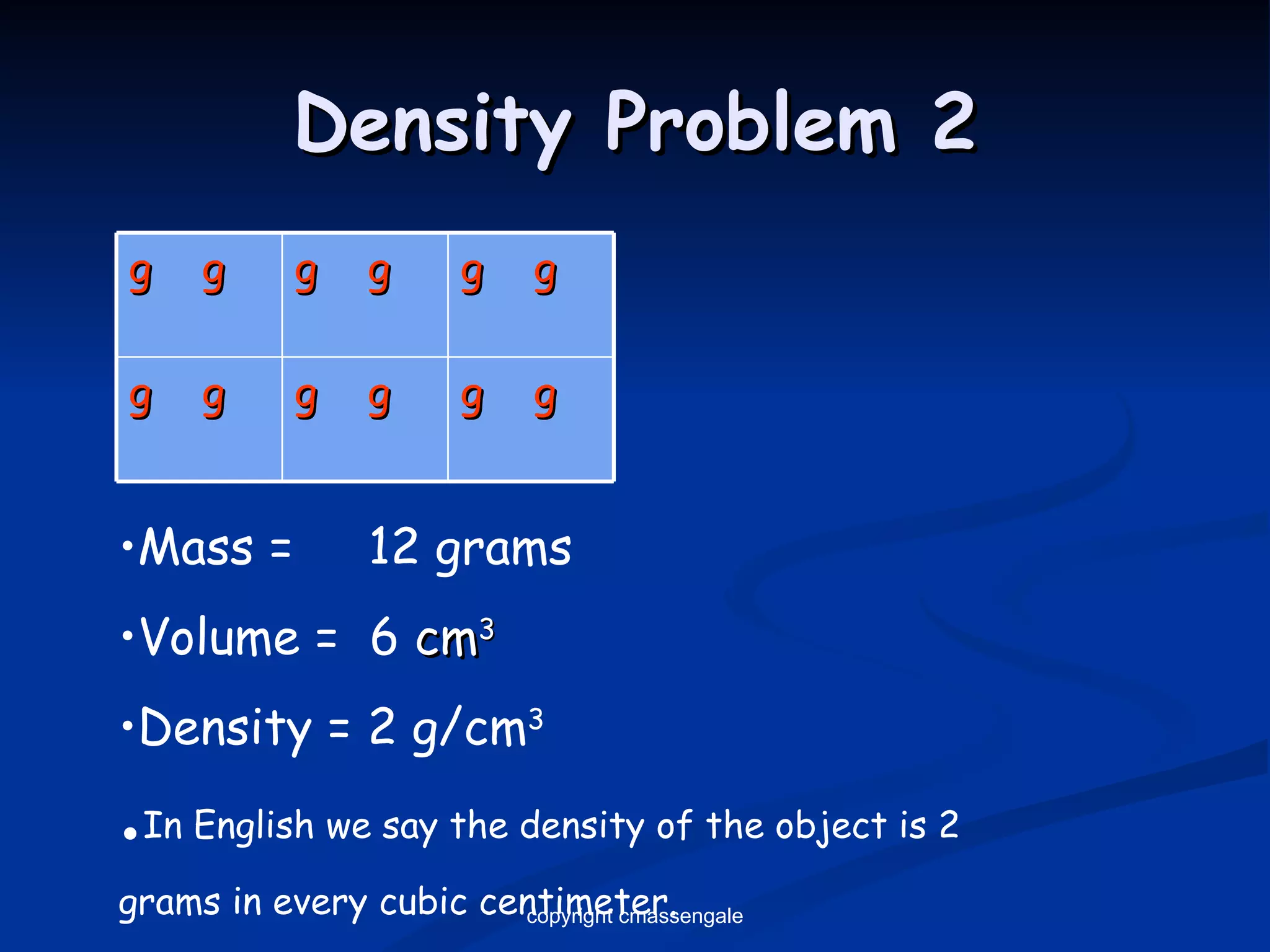
Density Problem 2 Mass =  12 grams Volume =  6  cm 3 Density = 2 g/cm 3 In English we say the density of the object is 2 grams in every cubic centimeter. copyright cmassengale g  g g  g g  g g  g g  g g  g
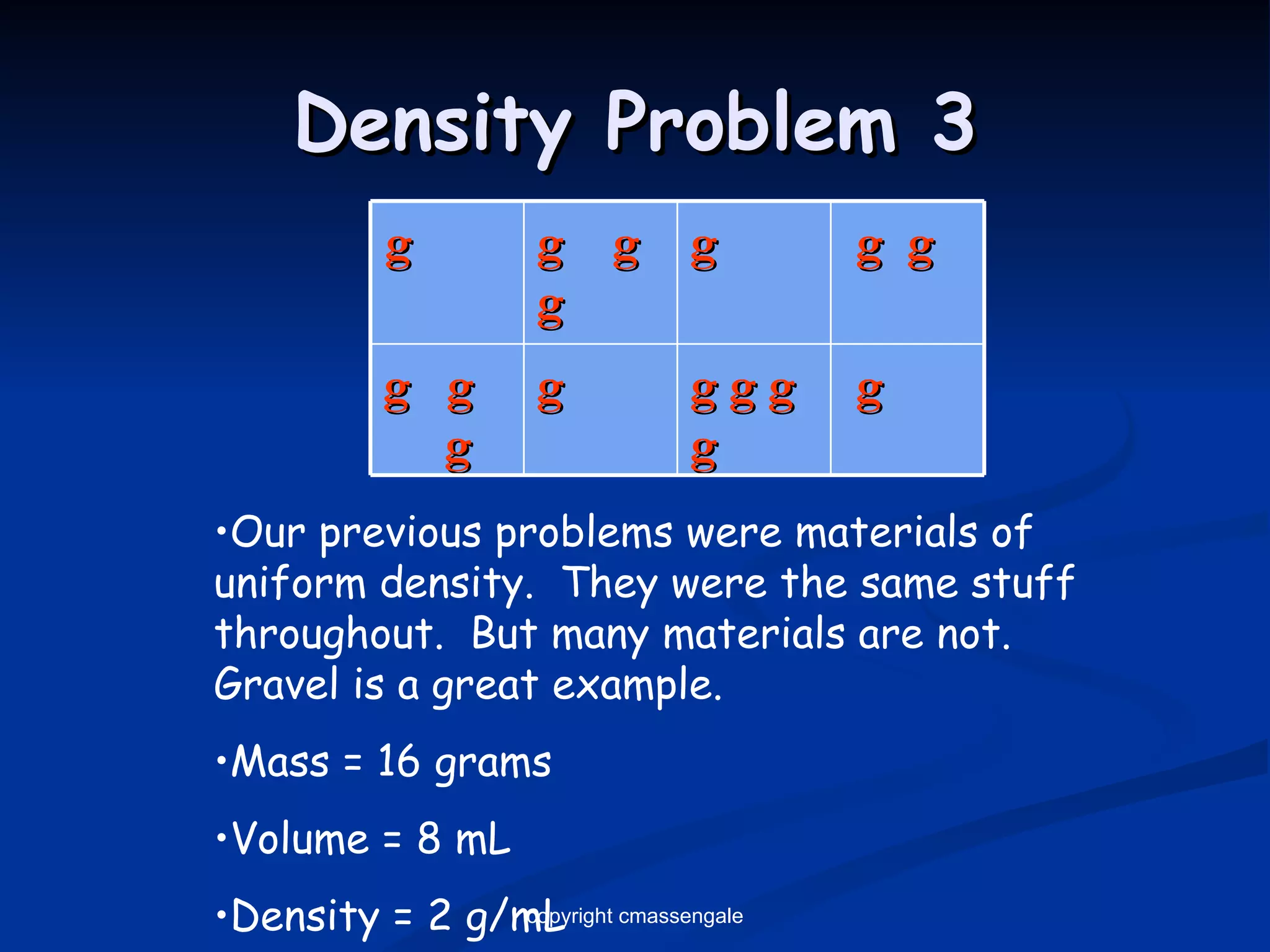
Density Problem 3 Our previous problems were materials of uniform density.  They were the same stuff throughout.  But many materials are not.  Gravel is a great example. Mass = 16 grams Volume = 8 mL Density = 2 g/mL copyright cmassengale g  g  g  g g g  g g  g  g g g g g g g
Water and Density Since 1-gram of water has a volume of 1-mL, then the density of water will always be 1 gram/ml. 5o-mL of water will have a mass of 50 grams, so again the density of pure water will be 1 g/ml. A kg of water will have a volume of 1000-mL, so it’s density will be 1 gram/ml. copyright cmassengale
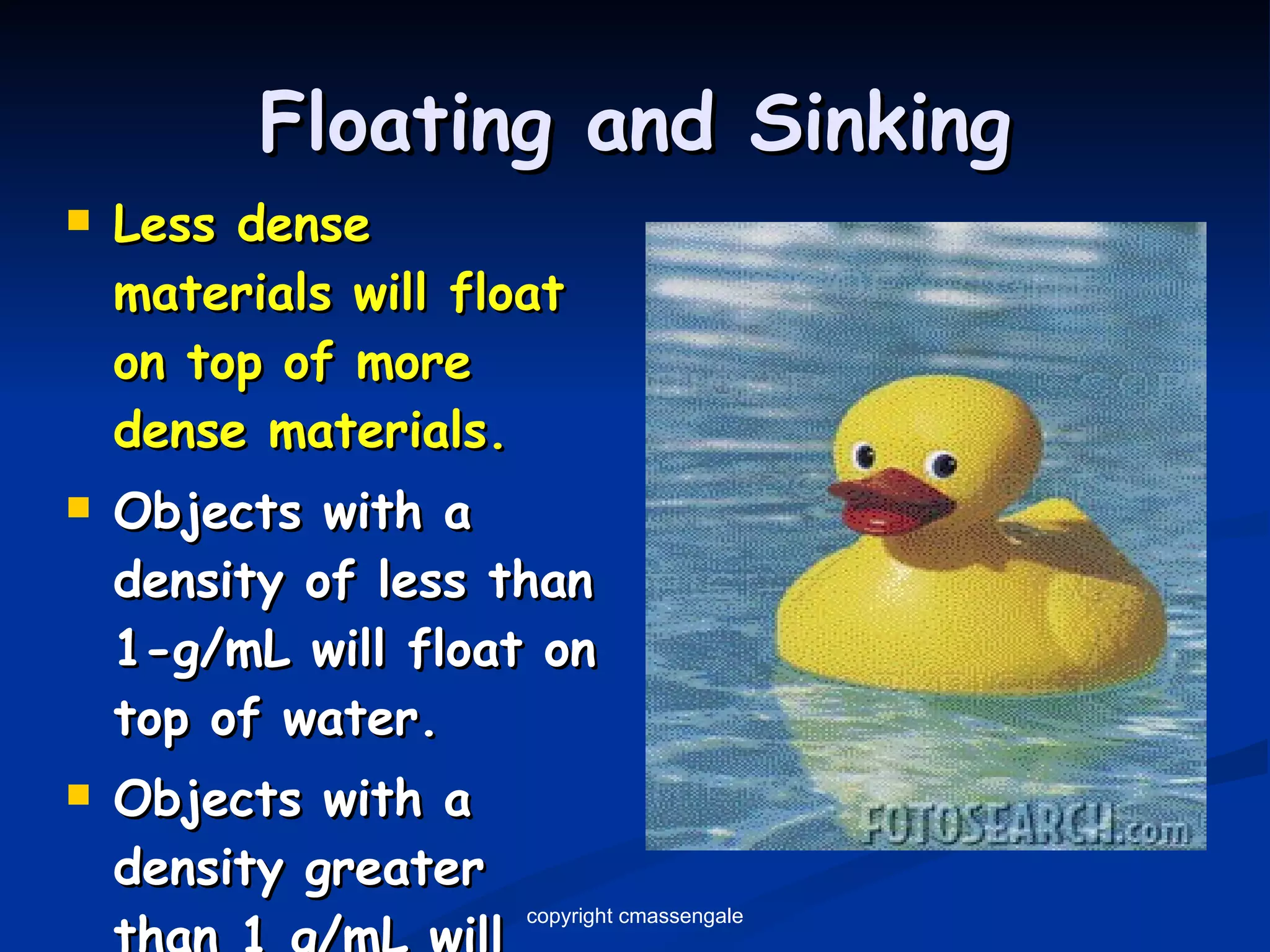
Floating and Sinking Less dense materials will float on top of more dense materials. Objects with a density of less than 1-g/mL will float on top of water. Objects with a density greater than 1 g/mL will sink in water. copyright cmassengale
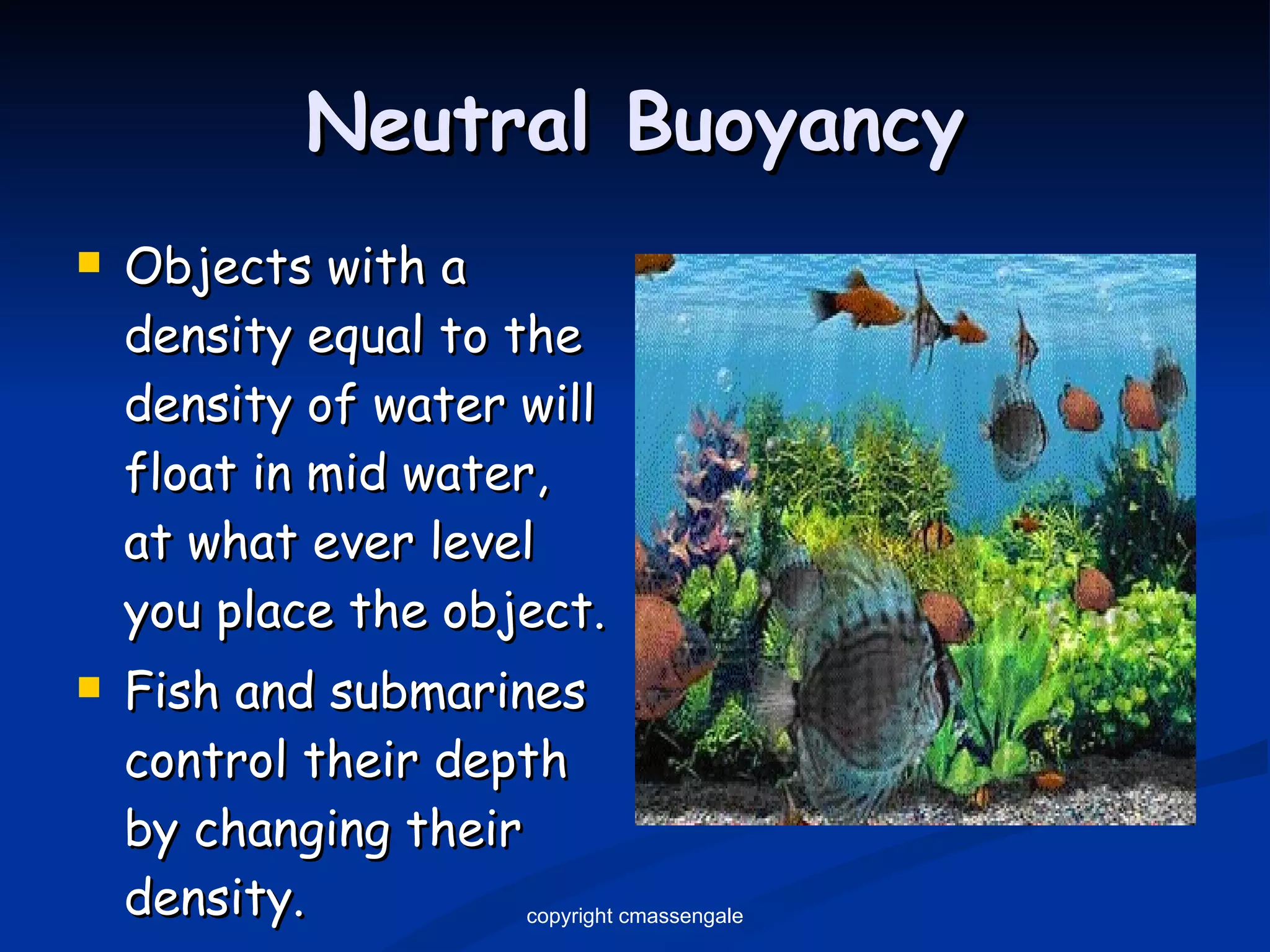
Neutral Buoyancy Objects with a density equal to the density of water will float in mid water, at what ever level you place the object. Fish and submarines control their depth by changing their density. copyright cmassengale
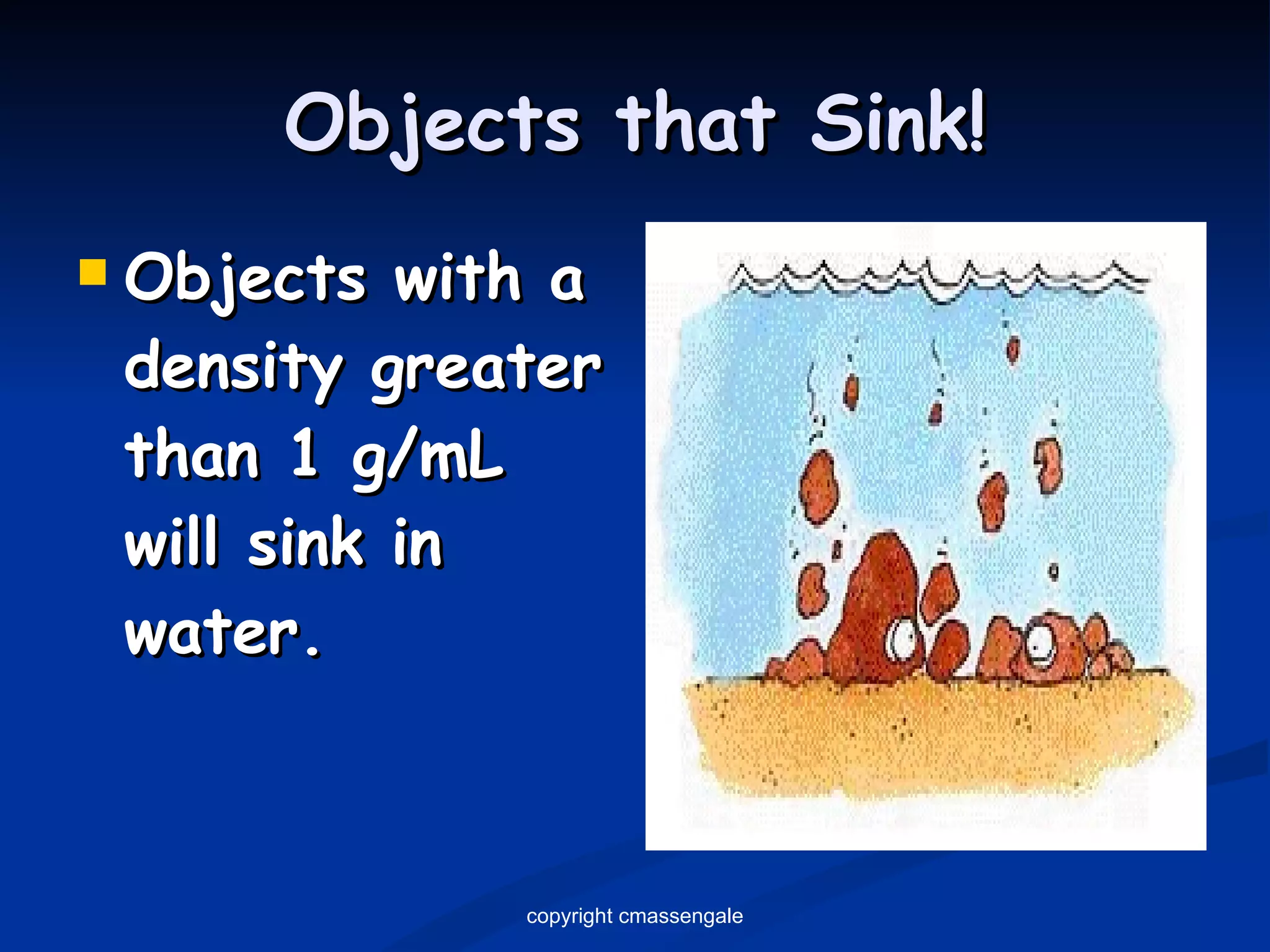
Objects that Sink! Objects with a density greater than 1 g/mL will sink in water. copyright cmassengale
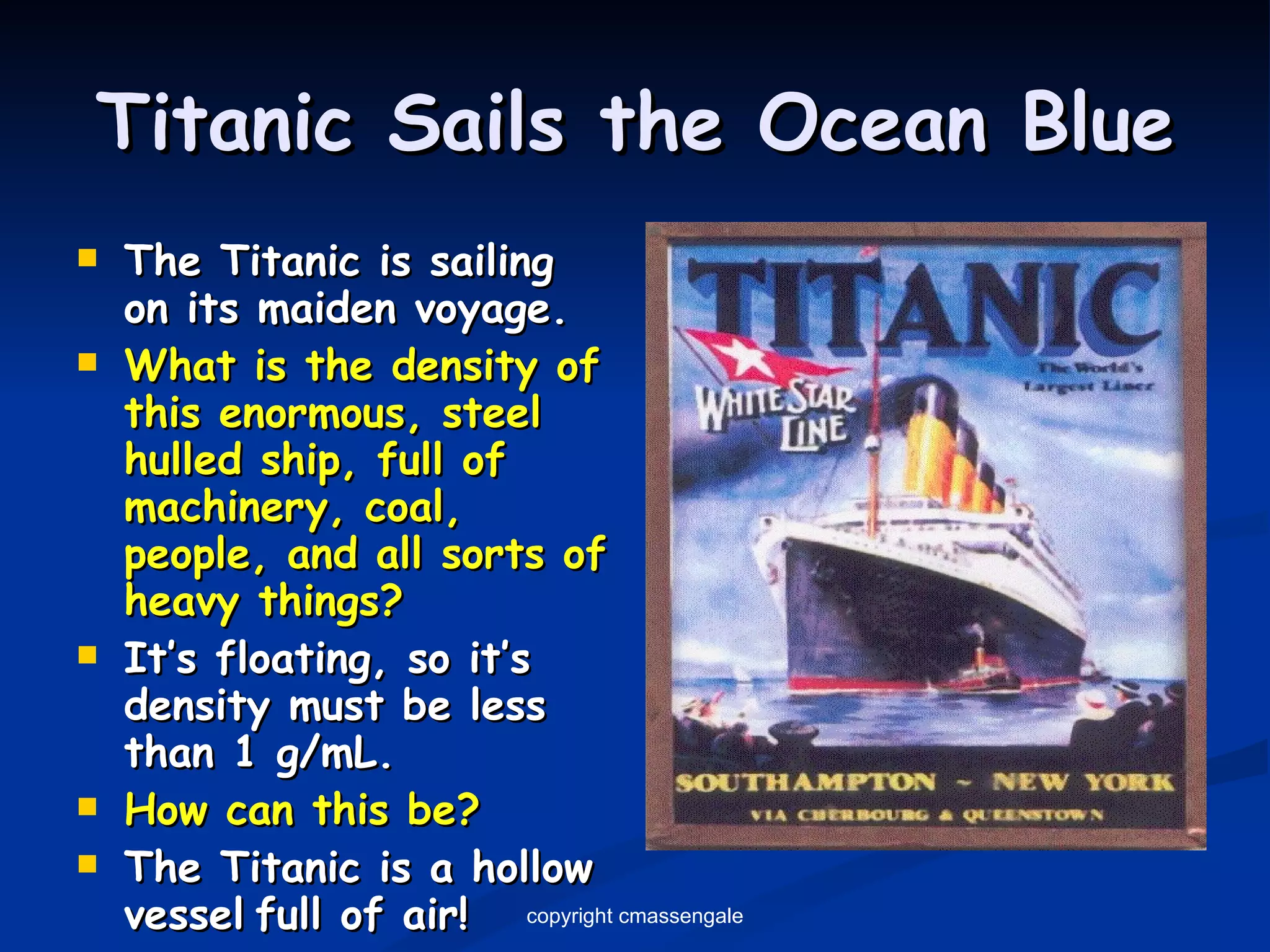
Titanic Sails the Ocean Blue The Titanic is sailing on its maiden voyage. What is the density of this enormous, steel hulled ship, full of machinery, coal, people, and all sorts of heavy things? It’s floating, so it’s density must be less than 1 g/mL. How can this be? The Titanic is a hollow vessel   full of air! copyright cmassengale
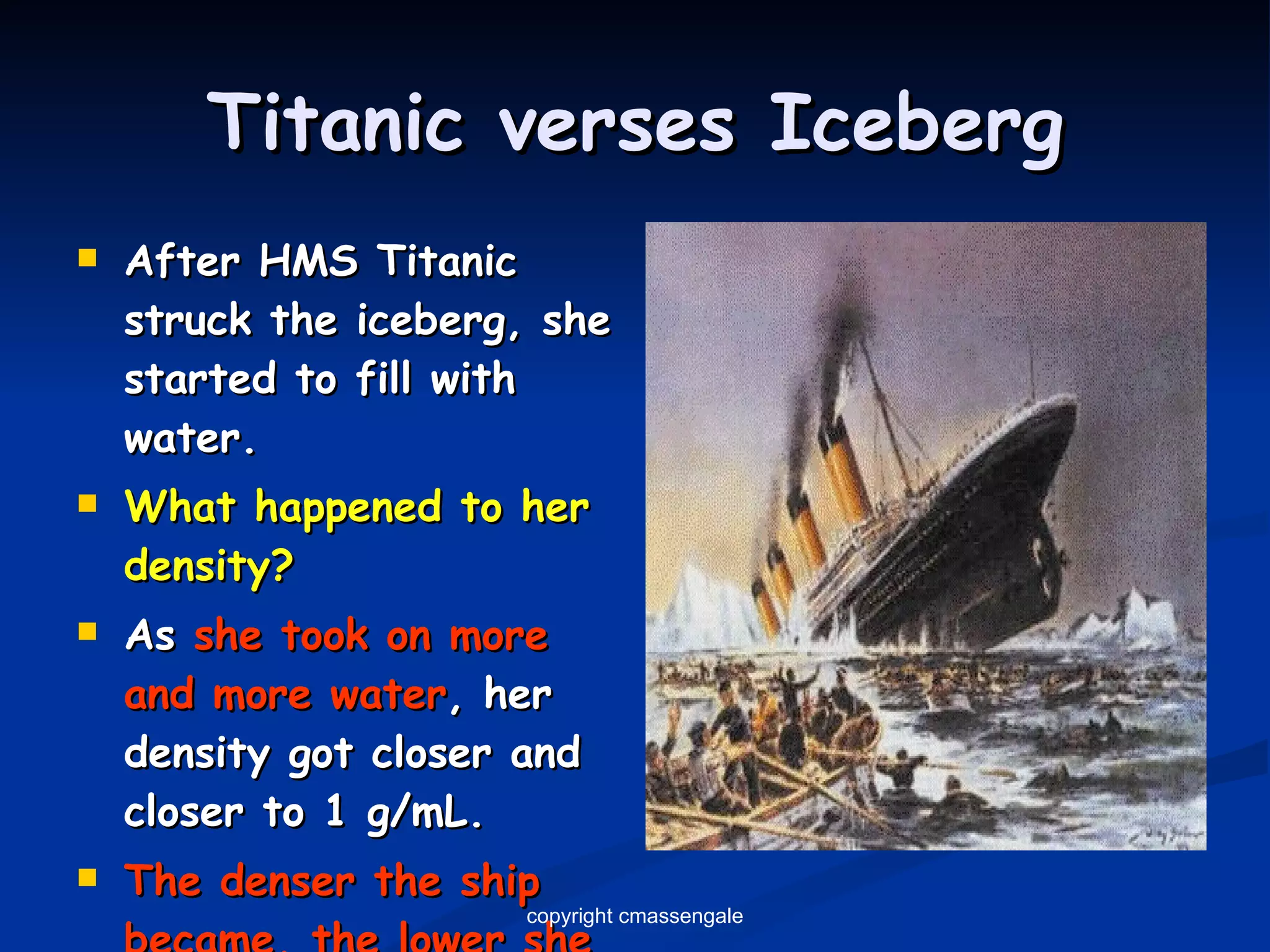
Titanic verses Iceberg After HMS Titanic struck the iceberg, she started to fill with water. What happened to her density? As  she took on more and more water , her density got closer and closer to 1 g/mL. The denser the ship became, the lower she settled into the water. copyright cmassengale
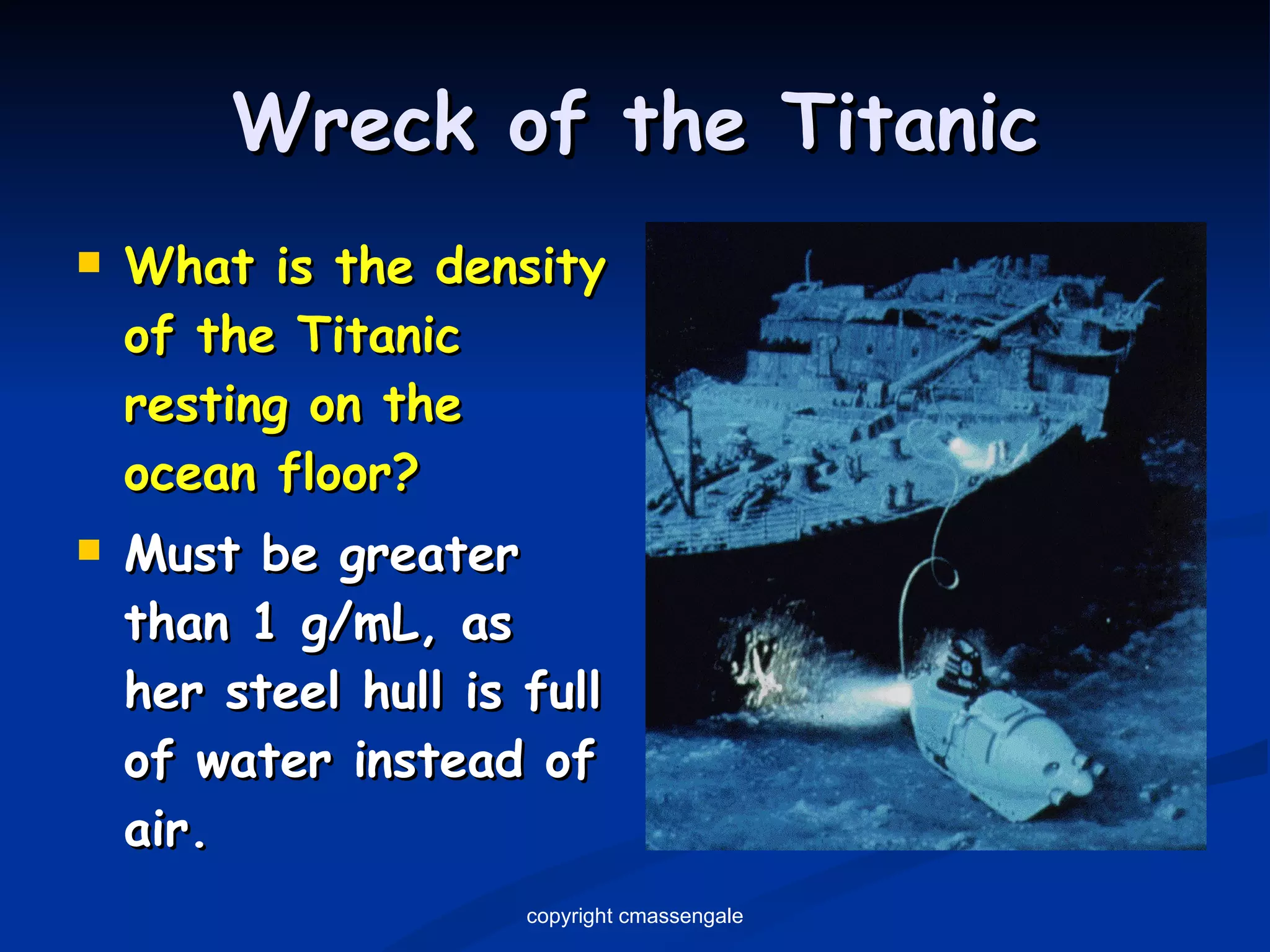
Wreck of the Titanic What is the density of the Titanic resting on the ocean floor? Must be greater than 1 g/mL, as her steel hull is full of water instead of air. copyright cmassengale
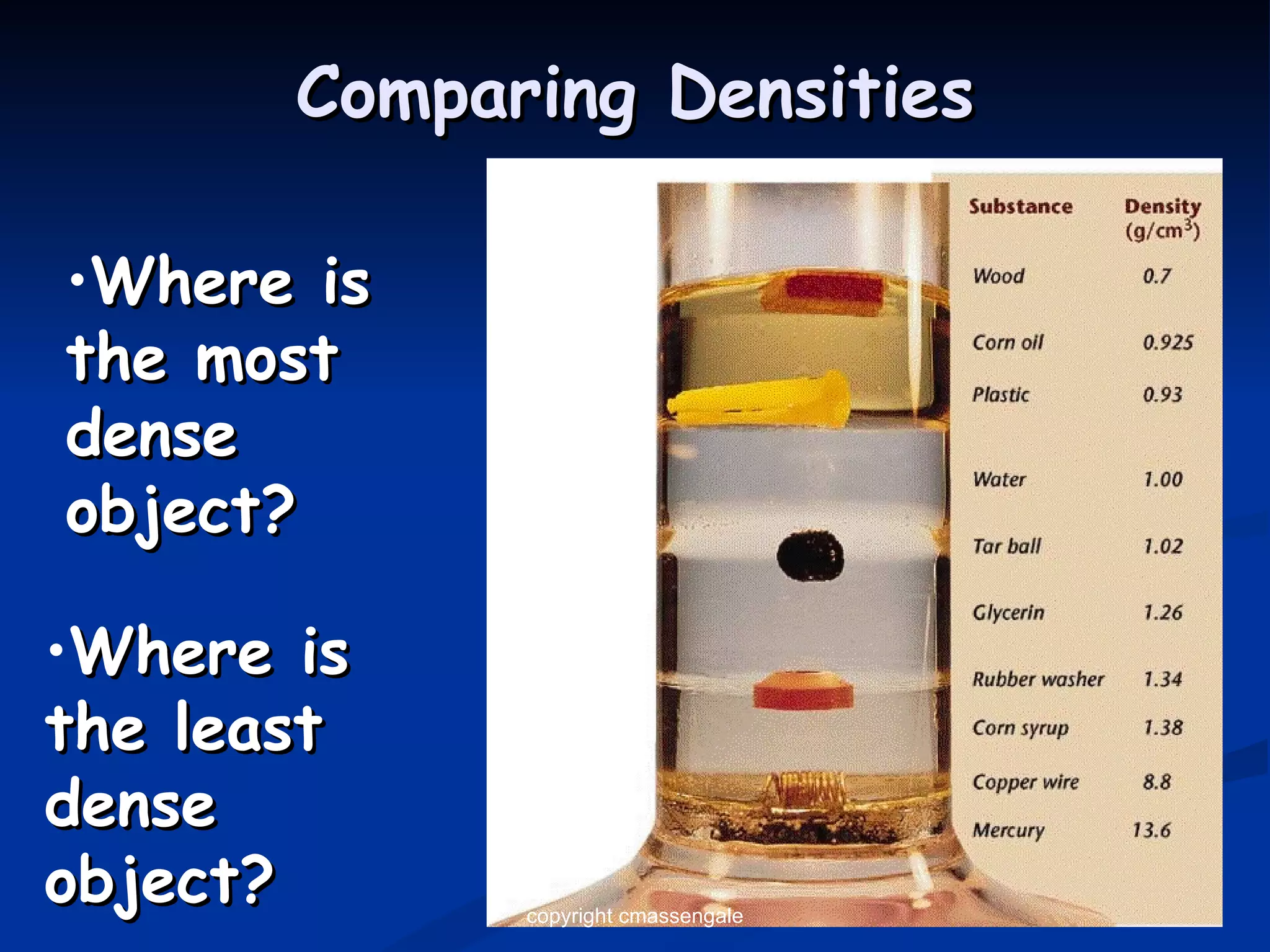
Comparing Densities Where is the most dense object? Where is the least dense object? copyright cmassengale
Density Review We don’t actually count g’s to find the mass of objects.  How would you find the mass of a rock? Use a balance scale. In real life, how would you find the volume of a rock? Use a graduated cylinder and see how much water the rock displaces . copyright cmassengale
copyright cmassengale

Metric system

  • 1.
    Metric System Scientific Measurements copyright cmassengale
  • 2.
    Metric System Developedby the French in the late 1700’s. Based on powers of ten, so it is very easy to use. Used by almost every country in the world, with the notable exception of the USA. Especially used by scientists. Abbreviated SI, which is French for Systeme International. copyright cmassengale
  • 3.
    Metric Prefixes Regardlessof the unit, the entire metric system uses the same prefixes. Common prefixes are: kilo = 1000 centi = 1/100 th milli = 1/1000 th 1 meter = 100 centimeters= 1000 millimeters copyright cmassengale
  • 4.
    Length Length isthe distance between two points. The SI base unit for length is the meter . We use rulers or meter sticks to find the length of objects. copyright cmassengale
  • 5.
    Mass Mass isthe amount of matter that makes up an object. A golf ball and a ping pong ball are the same size, but the golf ball has a lot more matter in it. So the golf ball will have more mass. The SI unit for mass is the gram . A paper clip has a mass of about one gram. The mass of an object will not change unless we add or subtract matter from it. copyright cmassengale
  • 6.
    Measuring Mass Wewill use a triple beam balance scale to measure mass. Gravity pulls equally on both sides of a balance scale, so you will get the same mass no matter what planet you are on. copyright cmassengale
  • 7.
    Weight Weight isa measure of the force of gravity on an object . Your weight can change depending on the force of gravity. The gravity will change depending on the planet you are on. The SI unit for weight is the Newton (N). The English unit for weight is the pound. copyright cmassengale
  • 8.
    Gravity Gravity isthe force of attraction between any two objects with mass. The force depends on two things: more distance = less gravity = less weight less distance = more gravity = more weight more mass = more gravity = more weight less mass = less gravity = less weight copyright cmassengale
  • 9.
    Weight and MassNotice that Jill’s mass never changes. Her mother will not allow us to take parts off her, or add parts to her, so her mass stays the same. Jill is 30kg of little girl no matter where she goes! copyright cmassengale Jill Earth 1 gravity Moon 1/6 th gravity Jupiter 2.5 gravities On orbit 0 gravity mass 30kg 30kg 30kg 30kg weight 300N 50N 750N 0 Newtons
  • 10.
    Volume Volume isthe amount of space contained in an object. We can find the volume of box shapes by the formula Volume = length x width x height In this case the units would be cubic centimeters (cm 3 ). So a box 2 cm x 3 cm x 5cm would have a volume of 30 cm 3 V = L x W x H copyright cmassengale
  • 11.
    Base Units Thebase unit for volume is the Liter . We measure volume with a graduated cylinder . copyright cmassengale
  • 12.
    Graduated Cylinders Liquidsform curved, upper surfaces when poured into graduated cylinders To correctly read the volume, read the bottom of the curve called the meniscus copyright cmassengale
  • 13.
    Liquid Volume Whenthe metric system was created, they decided that 1 cm 3 of water would equal 1 milliliter of water and the 1 mL of water will have a mass of one gram. 1cm 3 water =1 ml of water = 1 gram copyright cmassengale
  • 14.
    Water Displacement Wecan use water displacement to find the volume of objects that are not boxed shaped. We can put water in a graduated cylinder. If a rock causes the level to rise from 7 to 9 ml, the the rock must have a volume of 2-mL. copyright cmassengale
  • 15.
    Water Mass andVolume 1 cm 3 water = 1 mL of water = 1 gram So what would be the mass of 50 mL of water be? 50 grams So what would be the mass of 1 liter of water be? 1 L = 1000 mL so its mass would be 1000 grams or a kilogram. copyright cmassengale
  • 16.
    Density Density isthe amount of matter (mass) compared to the amount of space (volume) the object occupies. We will measure mass in grams and volume in ml or cm 3 copyright cmassengale
  • 17.
    Density Formula Densityis mass divided by volume. Density = mass/volume Remember, all fractions are division problems. Since the unit for mass is grams, and the unit for volume is ml or cm 3 , then the unit for density is g/ml, or g/ cm 3 copyright cmassengale
  • 18.
    Density Formula WheelFormula wheels make it easy to solve density problems. Cover the property you are trying to find, and do what is left over. To find density, cover the word density. You have mass over volume remaining. So divide mass by volume to find density! Mass density volume copyright cmassengale
  • 19.
    Density Formula WheelTo find mass, you cover the word mass. You now have density times volume remaining. To find volume, cover volume. You have mass over density remaining, so divide mass by density to find volume . Mass density volume copyright cmassengale
  • 20.
    Understanding Density Inthe following illustrations, each will represent 1 cm 3 . Each g will represent 1 gram. Mass = 24g Volume = 8 cm 3 Density = 3g/cm 3 copyright cmassengale g g g g g g g g g g g g g g g g g g g g g g g g
  • 21.
    In other words,there are 3 grams in every cm 3 . copyright cmassengale g g g g g g g g g g g g g g g g g g g g g g g g
  • 22.
    Density Problem 2Mass = 12 grams Volume = 6 cm 3 Density = 2 g/cm 3 In English we say the density of the object is 2 grams in every cubic centimeter. copyright cmassengale g g g g g g g g g g g g
  • 23.
    Density Problem 3Our previous problems were materials of uniform density. They were the same stuff throughout. But many materials are not. Gravel is a great example. Mass = 16 grams Volume = 8 mL Density = 2 g/mL copyright cmassengale g g g g g g g g g g g g g g g g
  • 24.
    Water and DensitySince 1-gram of water has a volume of 1-mL, then the density of water will always be 1 gram/ml. 5o-mL of water will have a mass of 50 grams, so again the density of pure water will be 1 g/ml. A kg of water will have a volume of 1000-mL, so it’s density will be 1 gram/ml. copyright cmassengale
  • 25.
    Floating and SinkingLess dense materials will float on top of more dense materials. Objects with a density of less than 1-g/mL will float on top of water. Objects with a density greater than 1 g/mL will sink in water. copyright cmassengale
  • 26.
    Neutral Buoyancy Objectswith a density equal to the density of water will float in mid water, at what ever level you place the object. Fish and submarines control their depth by changing their density. copyright cmassengale
  • 27.
    Objects that Sink!Objects with a density greater than 1 g/mL will sink in water. copyright cmassengale
  • 28.
    Titanic Sails theOcean Blue The Titanic is sailing on its maiden voyage. What is the density of this enormous, steel hulled ship, full of machinery, coal, people, and all sorts of heavy things? It’s floating, so it’s density must be less than 1 g/mL. How can this be? The Titanic is a hollow vessel full of air! copyright cmassengale
  • 29.
    Titanic verses IcebergAfter HMS Titanic struck the iceberg, she started to fill with water. What happened to her density? As she took on more and more water , her density got closer and closer to 1 g/mL. The denser the ship became, the lower she settled into the water. copyright cmassengale
  • 30.
    Wreck of theTitanic What is the density of the Titanic resting on the ocean floor? Must be greater than 1 g/mL, as her steel hull is full of water instead of air. copyright cmassengale
  • 31.
    Comparing Densities Whereis the most dense object? Where is the least dense object? copyright cmassengale
  • 32.
    Density Review Wedon’t actually count g’s to find the mass of objects. How would you find the mass of a rock? Use a balance scale. In real life, how would you find the volume of a rock? Use a graduated cylinder and see how much water the rock displaces . copyright cmassengale
  • 33.