PHYLUM NEMATODA
By
SYED SHAKEEL SHAH
Department of Zoology
University of Narowal
Phylum Nematoda
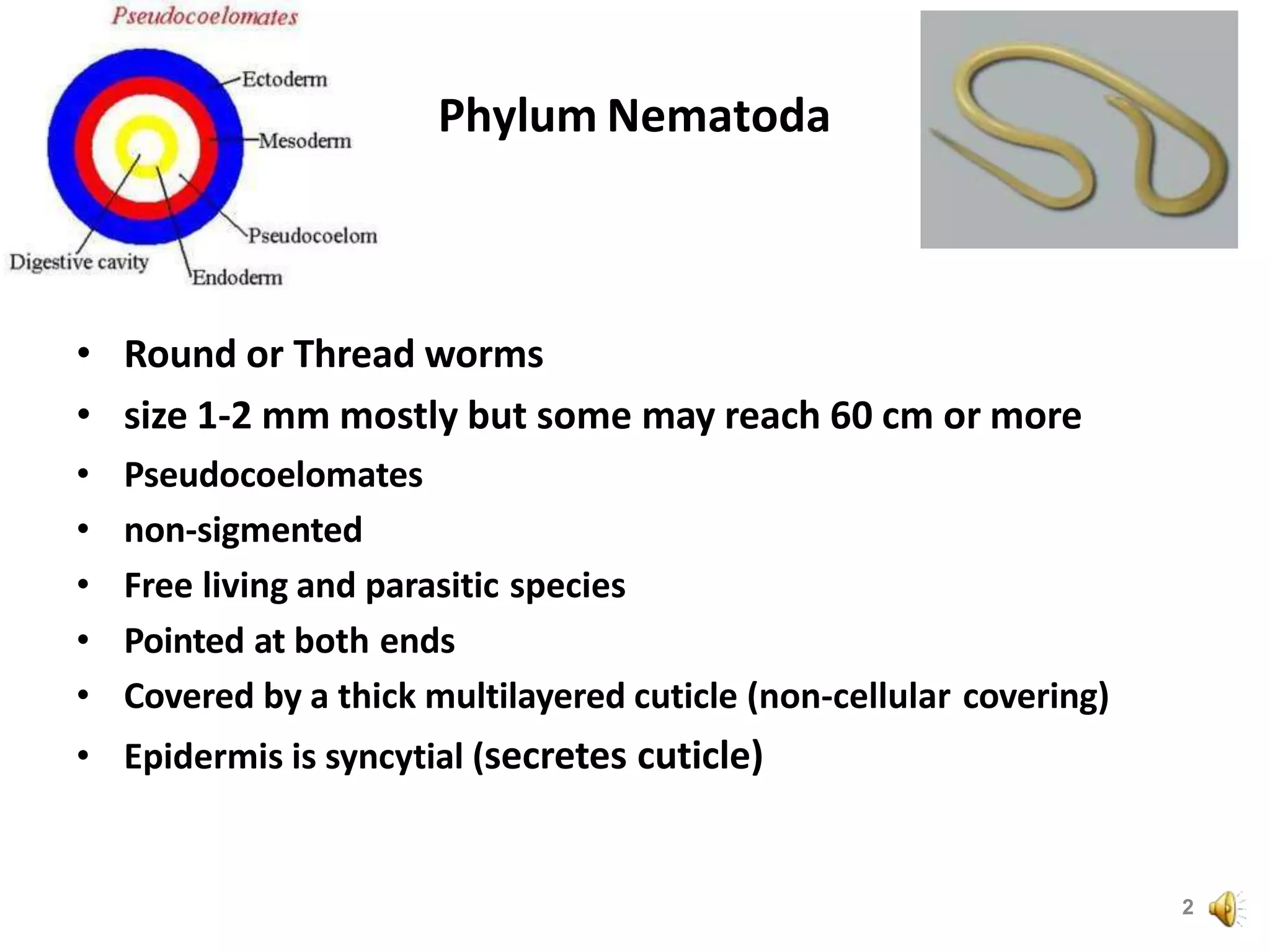
• Round or Thread worms
• size 1-2 mm mostly but some may reach 60 cm or more
• Pseudocoelomates
• non-sigmented
• Free living and parasitic species
• Pointed at both ends
• Covered by a thick multilayered cuticle (non-cellular covering)
• Epidermis is syncytial (secretes cuticle)
2
Nematode life cycle
• Cuticle is
shed 4
times
during
develop
ment
3
Musculature
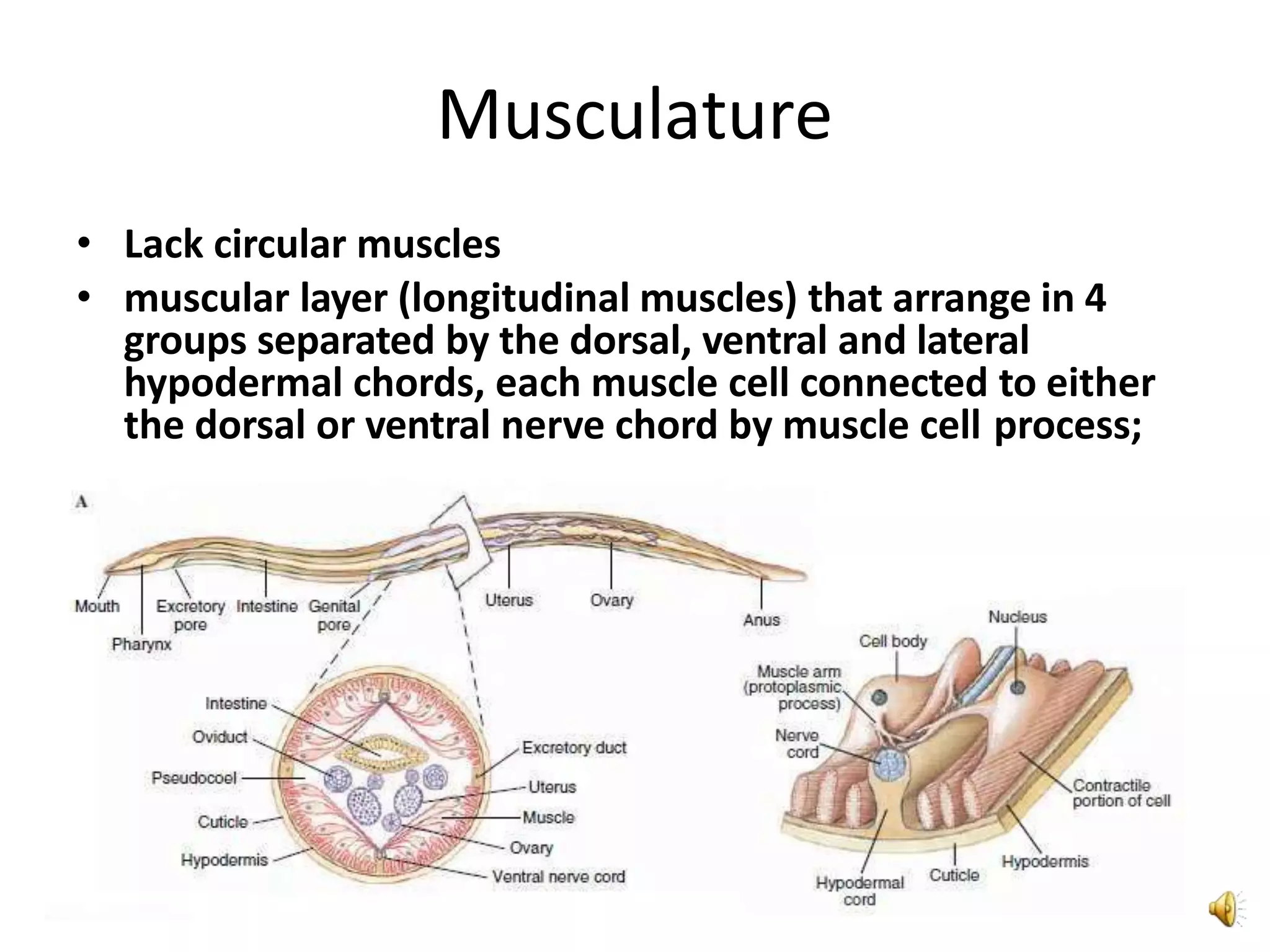
• Lack circular muscles
• muscular layer (longitudinal muscles) that arrange in 4
groups separated by the dorsal, ventral and lateral
hypodermal chords, each muscle cell connected to either
the dorsal or ventral nerve chord by muscle cell process;
Movement and hydrostatic skeleton
• Movement is by thrashing the
body into sinusoidal waves
generated by alternating
contraction of longitudinal
muscles on each side of the
body.
• The round shape of nematodes
is due to the hydrostatic
pressure generated by
celoemic fluid and its opposing
rigid cuticle.
Nervous system
• Nervous system made of brain (nerve ring and associated
ganglia and at least 4 longitudinal nerves that run in the
dorsal, ventral and lateral nerve chords in the hypodermis
• Sense organs include a pair of head chemoreceptive
amphids (characteristic feature of all nematodes), other
sense organs found in certain groups include: posteriorly
located chemoreceptive phasmids, ocelli, cephalic and
caudal papillae as well as mechanoceptors
7
Nematode Features
• Eutely: Cell number in adult tissue remain constant throughout
life so that the limited increase in size is a function of increase in
cell size NOT number).
• Tubes within tubes worms, all organ systems tubular;
Nematode Features
• Digestive system complete with mouth, muscular pharynx
(esophagous), intestine and rectum;
• Excretory system made of renette glandular cells in most spp;
• No specialized gas exchange or circulatory system.
8
9
Nematode Reproduction & Life Cycle
• Worms are mostly dioecious;
• Male reproductive system tubular and made of testis, vas
deferens, ejaculatory duct that opens in cloaca, many spp. have
bursa and 1-2 copulatory spicules;
• Female reproductive system tubular and made of one or two
ovaries, each leads into oviduct--seminal receptacle—uterus, a
vulva leads to female gonopore.
• Fertilization internal following copulation or hypodermic
impregnation;
• Females are oviparous, ovo-viviparous or viviparous;
• L.C. involves ecdysis of larval stages controlled by molting
hormones with 4 larval stages before worms become adults; some
larval stages can molt within the egg shell; Parasitic stages mostly
use the third larval stage (L-3) as infective stage to the final host..
10
Classification of parasitic Nematodes
• Class Chromadorea
(3 sub-classes) Sub-class: Rhabditia
• Orders: 1. Rhabditida –
• 2. Strongylida - Ancylostoma (hookworm), Enterobius (pin
worm)
– Sub-class: Spiruria –
• Orders: 1. Spirurida - Filarioidea - filarial worms. Wuchereria
bancrofti (elephantiasis), Onchocerca volvulus (river
blindness), Dirofilaria immitis (dog heartworm).
• 2. Ascaridida - intestinal parasites of vertebrates. Ascaris.
Ascaris, Toxocara canis (dog ascarid)
Debilitating effect of parasitic
Nematodes
• Blood suction. E.g Hook worms
– Suck about 0.6 ml blood/day
– 100 worms= 60 ml/day= 180 ml/month
• Blocking of intestine and bile ducts. E.g ascaris
– In cases of heavy infection.
• Blocking of blood or lymphatic system. E.g
Filaria
– Elephantiasis as in Onchocerca volnulus
Trichuris trichura L.C.
13
Hookworm L.C.
14
A. Lumbricoides L. C.
15
E. vermicularis L.C.
16
O. volvulus L.C.
17
Wuchereria bancrofti L.C.
18
Thank You…!

21. phylum nematoda full explanation only on slide share

  • 1.
    PHYLUM NEMATODA By SYED SHAKEELSHAH Department of Zoology University of Narowal
  • 2.
    Phylum Nematoda • Roundor Thread worms • size 1-2 mm mostly but some may reach 60 cm or more • Pseudocoelomates • non-sigmented • Free living and parasitic species • Pointed at both ends • Covered by a thick multilayered cuticle (non-cellular covering) • Epidermis is syncytial (secretes cuticle) 2
  • 3.
    Nematode life cycle •Cuticle is shed 4 times during develop ment 3
  • 4.
    Musculature • Lack circularmuscles • muscular layer (longitudinal muscles) that arrange in 4 groups separated by the dorsal, ventral and lateral hypodermal chords, each muscle cell connected to either the dorsal or ventral nerve chord by muscle cell process;
  • 5.
    Movement and hydrostaticskeleton • Movement is by thrashing the body into sinusoidal waves generated by alternating contraction of longitudinal muscles on each side of the body. • The round shape of nematodes is due to the hydrostatic pressure generated by celoemic fluid and its opposing rigid cuticle.
  • 6.
    Nervous system • Nervoussystem made of brain (nerve ring and associated ganglia and at least 4 longitudinal nerves that run in the dorsal, ventral and lateral nerve chords in the hypodermis • Sense organs include a pair of head chemoreceptive amphids (characteristic feature of all nematodes), other sense organs found in certain groups include: posteriorly located chemoreceptive phasmids, ocelli, cephalic and caudal papillae as well as mechanoceptors
  • 7.
    7 Nematode Features • Eutely:Cell number in adult tissue remain constant throughout life so that the limited increase in size is a function of increase in cell size NOT number). • Tubes within tubes worms, all organ systems tubular;
  • 8.
    Nematode Features • Digestivesystem complete with mouth, muscular pharynx (esophagous), intestine and rectum; • Excretory system made of renette glandular cells in most spp; • No specialized gas exchange or circulatory system. 8
  • 9.
    9 Nematode Reproduction &Life Cycle • Worms are mostly dioecious; • Male reproductive system tubular and made of testis, vas deferens, ejaculatory duct that opens in cloaca, many spp. have bursa and 1-2 copulatory spicules; • Female reproductive system tubular and made of one or two ovaries, each leads into oviduct--seminal receptacle—uterus, a vulva leads to female gonopore. • Fertilization internal following copulation or hypodermic impregnation; • Females are oviparous, ovo-viviparous or viviparous; • L.C. involves ecdysis of larval stages controlled by molting hormones with 4 larval stages before worms become adults; some larval stages can molt within the egg shell; Parasitic stages mostly use the third larval stage (L-3) as infective stage to the final host..
  • 10.
  • 11.
    Classification of parasiticNematodes • Class Chromadorea (3 sub-classes) Sub-class: Rhabditia • Orders: 1. Rhabditida – • 2. Strongylida - Ancylostoma (hookworm), Enterobius (pin worm) – Sub-class: Spiruria – • Orders: 1. Spirurida - Filarioidea - filarial worms. Wuchereria bancrofti (elephantiasis), Onchocerca volvulus (river blindness), Dirofilaria immitis (dog heartworm). • 2. Ascaridida - intestinal parasites of vertebrates. Ascaris. Ascaris, Toxocara canis (dog ascarid)
  • 12.
    Debilitating effect ofparasitic Nematodes • Blood suction. E.g Hook worms – Suck about 0.6 ml blood/day – 100 worms= 60 ml/day= 180 ml/month • Blocking of intestine and bile ducts. E.g ascaris – In cases of heavy infection. • Blocking of blood or lymphatic system. E.g Filaria – Elephantiasis as in Onchocerca volnulus
  • 13.
  • 14.
  • 15.
  • 16.
  • 17.
  • 18.
  • 19.