Philosophy of Modern Time
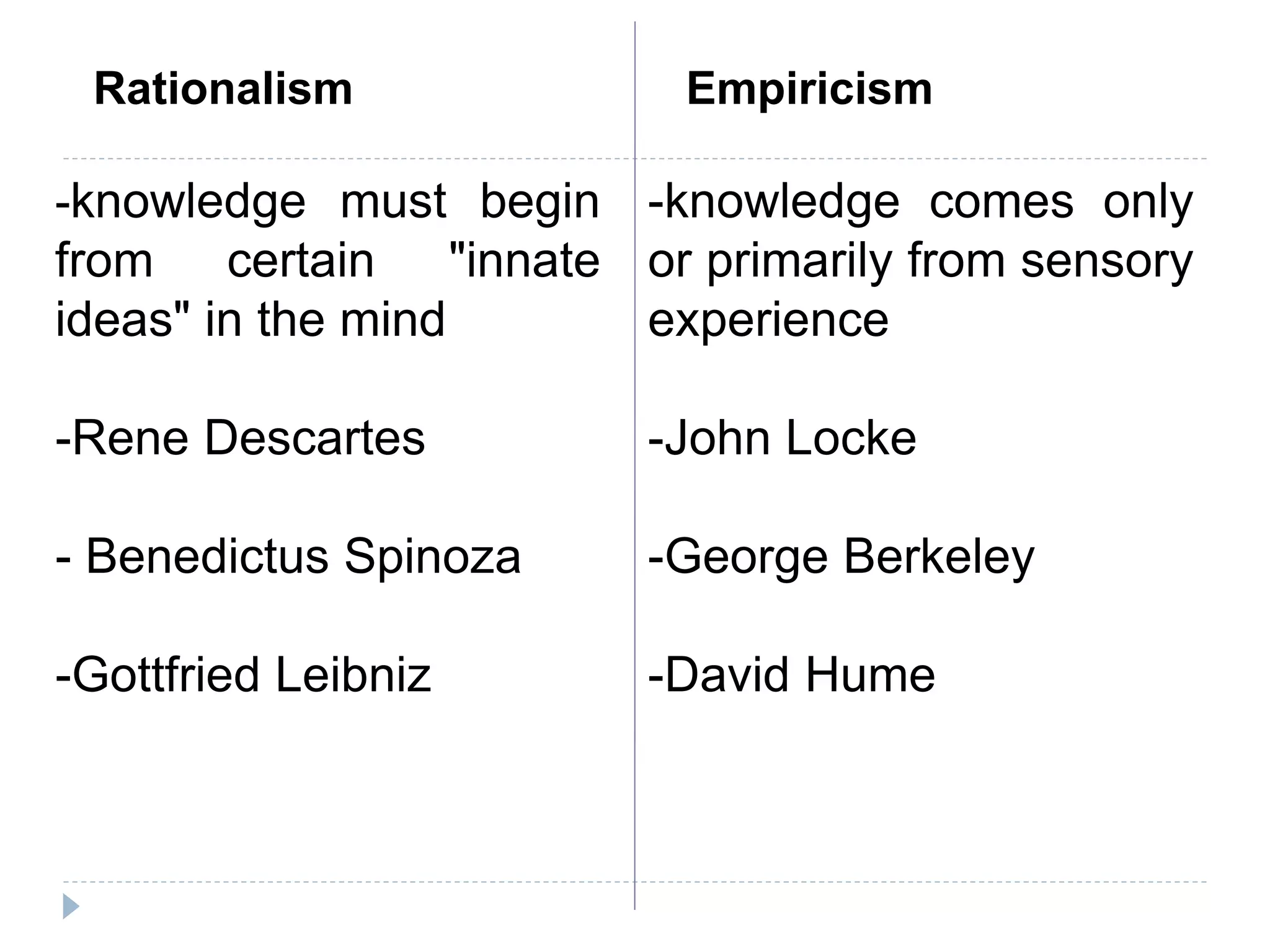
Empiricism
-knowledge comes only
or primarily from sensory
experience
-John Locke
-George Berkeley
-David Hume
Rationalism
-knowledge must begin
from certain "innate
ideas" in the mind
-Rene Descartes
- Benedictus Spinoza
-Gottfried Leibniz
Rene Descartes
 Seeks to demonstrate the possibility of knowledge
even from the most skeptical of positions, and from
this, to establish a firm foundation for the sciences.
 “This proposition, I am, I exist, is necessarily true
whenever it is put forward by me or conceived in my
mind”.
 “When someone says ‘I am thinking, therefore I am’,
he recognizes it as something self-evident by a
simple intuition of the mind”.
• An evil demon may be making me believe things that are false.
• There is nothing of which I can be certain.
• But when I say “I am; I exist”, I cannot be wrong about this.
• An evil demon could try to make me believe this only if I really do
exist.
• I am thinking, therefore I exist.
Benedict Spinoza
 “Substance monism” - “substance” as that which is
self-explanatory—or that which can be understood
by knowing its nature alone, as opposed to all other
things that can be known only by their relationships
with other things.
 Single substance that has both mental and physical
attributes.
 “Mind and body are one”.
 “The human mind is part of the infinite intellect of
God”.
Gottfried Leibniz
 “There are two kinds of truths: truths of reasoning and
truths of fact”. Truths of reasoning are “necessary”,
meaning that it is impossible to contradict them, while
truths of fact are “contingent”; they can be denied without
logical contradiction.
 “We know hardly anything adequately, few things a priori,
and most things through experience”.
 The universe is composed of individual, simple
substances called “monads”. Each monad is isolated
from other monads, and each contains a complete
representation of the whole universe in its past, present,
and future states.
 Each singular substance expresses the whole universe in
its own way.
John Locke
 The mind at birth is a tabula rasa—a blank tablet or
a new sheet of paper upon which experience writes.
We can then rationalize this knowledge to formulate
new ideas.
 All things have primary and secondary attributes.
Primary are those which belong to things
themselves and are inseparable from them (weight,
shape, permeability, hardness, etc). Secondary
qualities are sounds, colors, smells, which are
constantly changing and unstable. We find them
through our senses.
John Locke
 Man is a being that strives for happiness. To achieve it
human material needs shall be met first.
 The initial stage of people’s life - complete freedom,
independence from each other and with productive
labor in the name of survival.
 The state arises as a result of an agreement of people.
The state is a night watchman.
 Separation of the church and state and non-interference
in each other's affairs. People should respect religious
beliefs of others.
George Berkeley
 Humans as being made up of two distinct substances,
namely mind and body.
 There is only one kind of substance in the universe,
and this single substance is mind, or thought, rather than
matter.
 “To be is to perceive or to be perceived”. World
consists only of perceiving minds and their ideas.
 God—one who is constantly involved in the world. God
not
only creates us as perceivers, he is the cause and
constant generator of all our perceptions.
• All knowledge comes from perception.
• What we perceive are ideas, not things in themselves.
• A thing in itself must lie outside experience.
• So the world consists only of ideas and minds that perceive
those ideas.
• A thing only exists in so far as it perceives or is perceived.
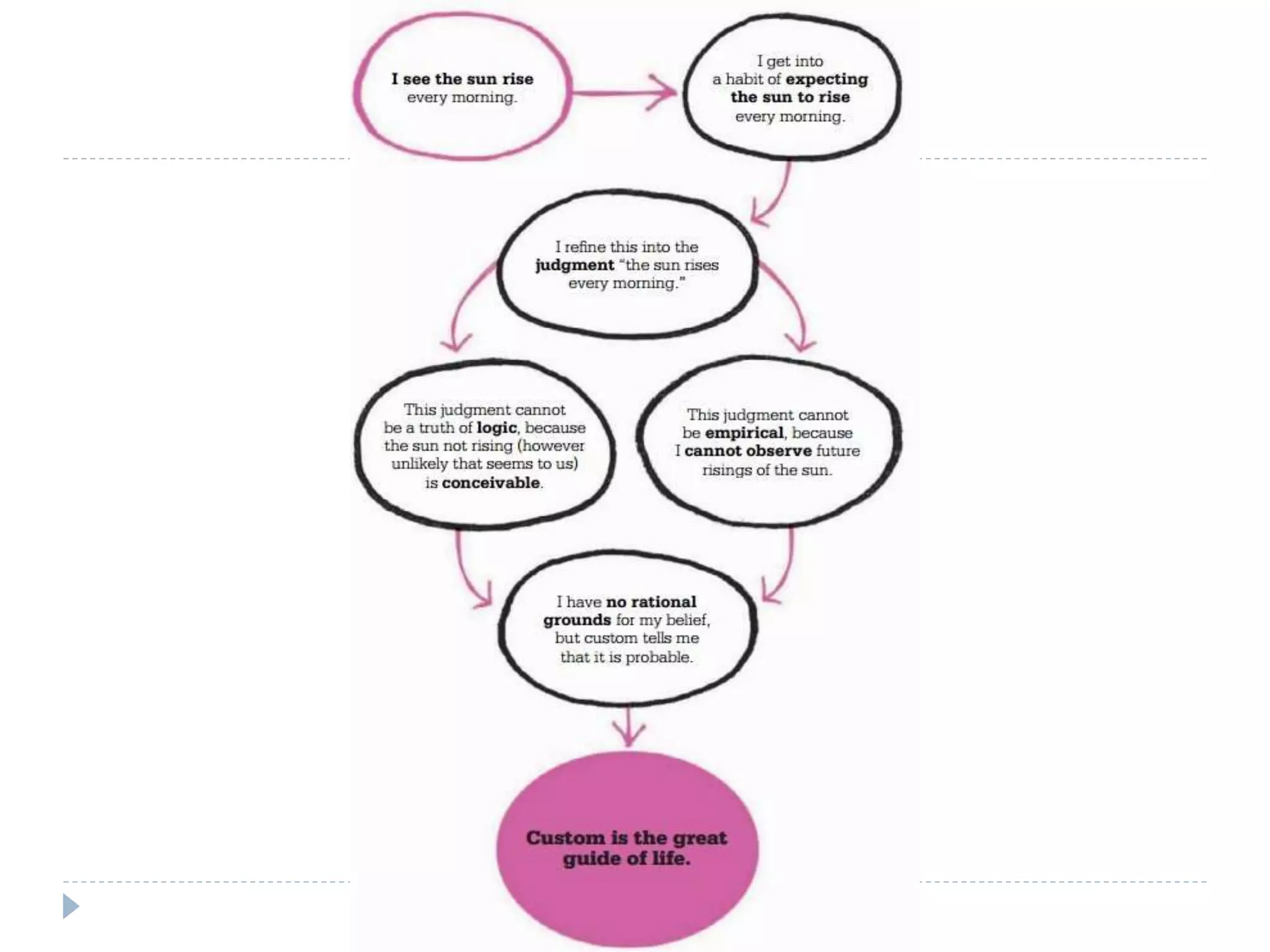
David Hume
 “Impressions” - or direct perceptions (“sensations,
passions, and emotions”).
 “Ideas”- faint copies of our impressions, such as
thoughts, reflections, and imaginings.
 Only meaningful statements could be verifiable.
Philosophy of modern time

Philosophy of modern time

  • 1.
  • 2.
    Empiricism -knowledge comes only orprimarily from sensory experience -John Locke -George Berkeley -David Hume Rationalism -knowledge must begin from certain "innate ideas" in the mind -Rene Descartes - Benedictus Spinoza -Gottfried Leibniz
  • 3.
    Rene Descartes  Seeksto demonstrate the possibility of knowledge even from the most skeptical of positions, and from this, to establish a firm foundation for the sciences.  “This proposition, I am, I exist, is necessarily true whenever it is put forward by me or conceived in my mind”.  “When someone says ‘I am thinking, therefore I am’, he recognizes it as something self-evident by a simple intuition of the mind”.
  • 4.
    • An evildemon may be making me believe things that are false. • There is nothing of which I can be certain. • But when I say “I am; I exist”, I cannot be wrong about this. • An evil demon could try to make me believe this only if I really do exist. • I am thinking, therefore I exist.
  • 5.
    Benedict Spinoza  “Substancemonism” - “substance” as that which is self-explanatory—or that which can be understood by knowing its nature alone, as opposed to all other things that can be known only by their relationships with other things.  Single substance that has both mental and physical attributes.  “Mind and body are one”.  “The human mind is part of the infinite intellect of God”.
  • 7.
    Gottfried Leibniz  “Thereare two kinds of truths: truths of reasoning and truths of fact”. Truths of reasoning are “necessary”, meaning that it is impossible to contradict them, while truths of fact are “contingent”; they can be denied without logical contradiction.  “We know hardly anything adequately, few things a priori, and most things through experience”.  The universe is composed of individual, simple substances called “monads”. Each monad is isolated from other monads, and each contains a complete representation of the whole universe in its past, present, and future states.  Each singular substance expresses the whole universe in its own way.
  • 9.
    John Locke  Themind at birth is a tabula rasa—a blank tablet or a new sheet of paper upon which experience writes. We can then rationalize this knowledge to formulate new ideas.  All things have primary and secondary attributes. Primary are those which belong to things themselves and are inseparable from them (weight, shape, permeability, hardness, etc). Secondary qualities are sounds, colors, smells, which are constantly changing and unstable. We find them through our senses.
  • 10.
    John Locke  Manis a being that strives for happiness. To achieve it human material needs shall be met first.  The initial stage of people’s life - complete freedom, independence from each other and with productive labor in the name of survival.  The state arises as a result of an agreement of people. The state is a night watchman.  Separation of the church and state and non-interference in each other's affairs. People should respect religious beliefs of others.
  • 11.
    George Berkeley  Humansas being made up of two distinct substances, namely mind and body.  There is only one kind of substance in the universe, and this single substance is mind, or thought, rather than matter.  “To be is to perceive or to be perceived”. World consists only of perceiving minds and their ideas.  God—one who is constantly involved in the world. God not only creates us as perceivers, he is the cause and constant generator of all our perceptions.
  • 12.
    • All knowledgecomes from perception. • What we perceive are ideas, not things in themselves. • A thing in itself must lie outside experience. • So the world consists only of ideas and minds that perceive those ideas. • A thing only exists in so far as it perceives or is perceived.
  • 13.
    David Hume  “Impressions”- or direct perceptions (“sensations, passions, and emotions”).  “Ideas”- faint copies of our impressions, such as thoughts, reflections, and imaginings.  Only meaningful statements could be verifiable.