Lesson 2:
Methods of
Philosophizing
By: Ms. Jo Marie Nel C. Garcia
Truth and Knowledge
 Truth lies at the heart of any
inquiry. It is a fact that has been
verified.
 Knowledge is simple data that
comes from the outside that pass
to our senses. It must be truthful
to gain validity and acceptance.
Propositions
 Philosophers consider truth as a
kind of quality or value.
 Propositions are statements
about the world or reality which
may or may not carry truth.
What is truth and why is it important?
 Knowledge is the clear awareness and
understanding of something. It is the
product of questions that allow for clear
answers provided by facts.
 What we know is what is observable or
evident in the real world.
 Propositions which are observed to be
real or truthful are considered FACTS.
 There are statements, however, that are
not evidently or immediately known to
be true and they are called CLAIMS.
They require further examination to
establish whether it is true or false.
How do we know if something is
true?
 Philosophers emphasize the
importance of belief as a basis for
determining truth.
 We assume that everything we know
about this world is true but philosophers
who pondered upon the origins of
knowledge doubted everything that
there is to know about themselves and
the world. In doing so, they were able
to better understand the means by
which humans gain knowledge and
determine the truth about everything.
 It is said that there are instances when we
have to unlearn something so that we may
learn anew. Philosophers questioned what
they knew and even analyzed their methods of
knowing in order to understand themselves
and the world much better.
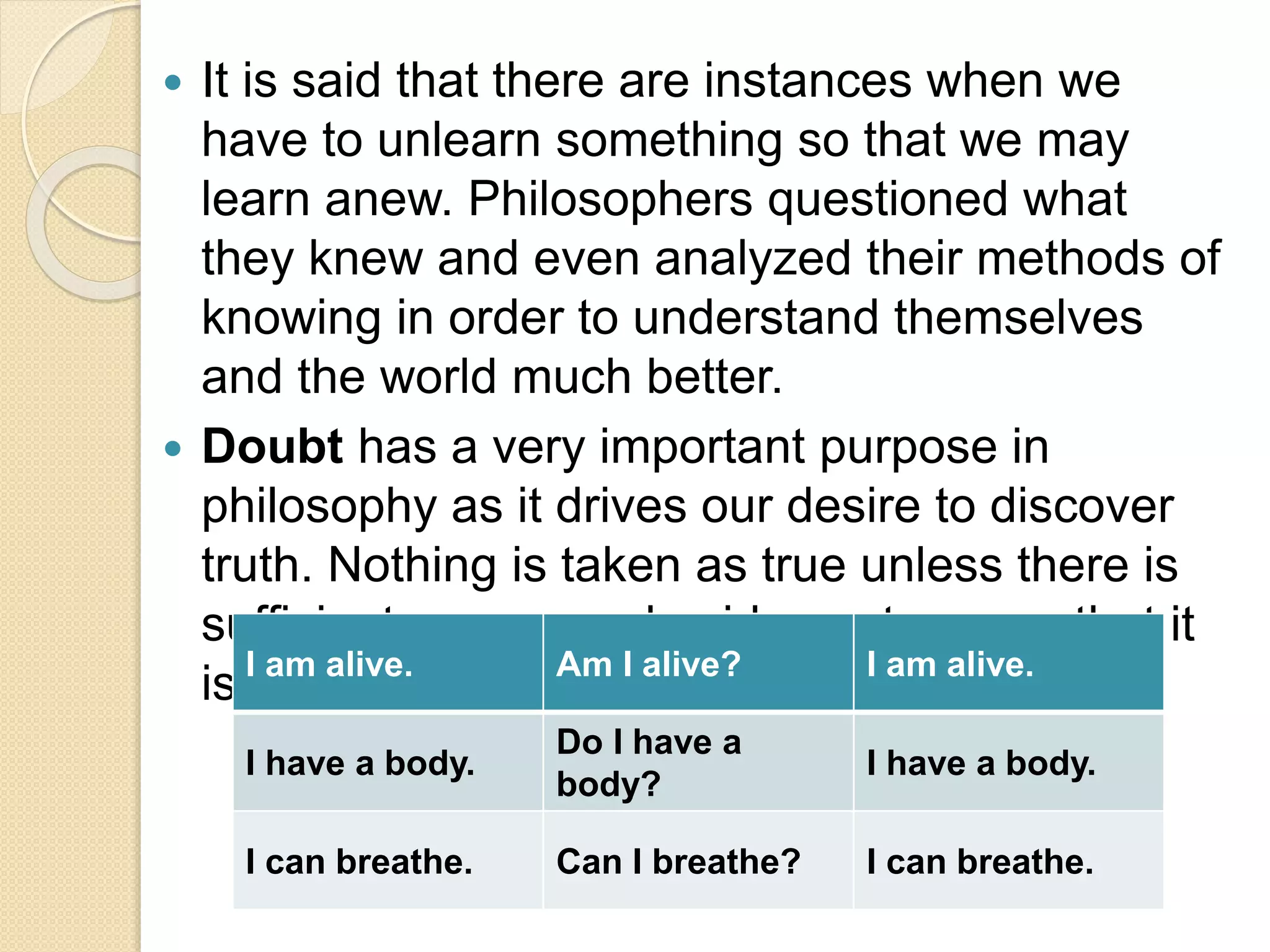
 Doubt has a very important purpose in
philosophy as it drives our desire to discover
truth. Nothing is taken as true unless there is
sufficient reason and evidence to prove that it
is indeed true.I am alive. Am I alive? I am alive.
I have a body.
Do I have a
body?
I have a body.
I can breathe. Can I breathe? I can breathe.
1. It can be justified or proven through
the use of one’s senses.
2. It is based on facts.
3. It is a product of agreement or
consensus.
4. It can be applied in real life (tested
and verified)
Something is true if…
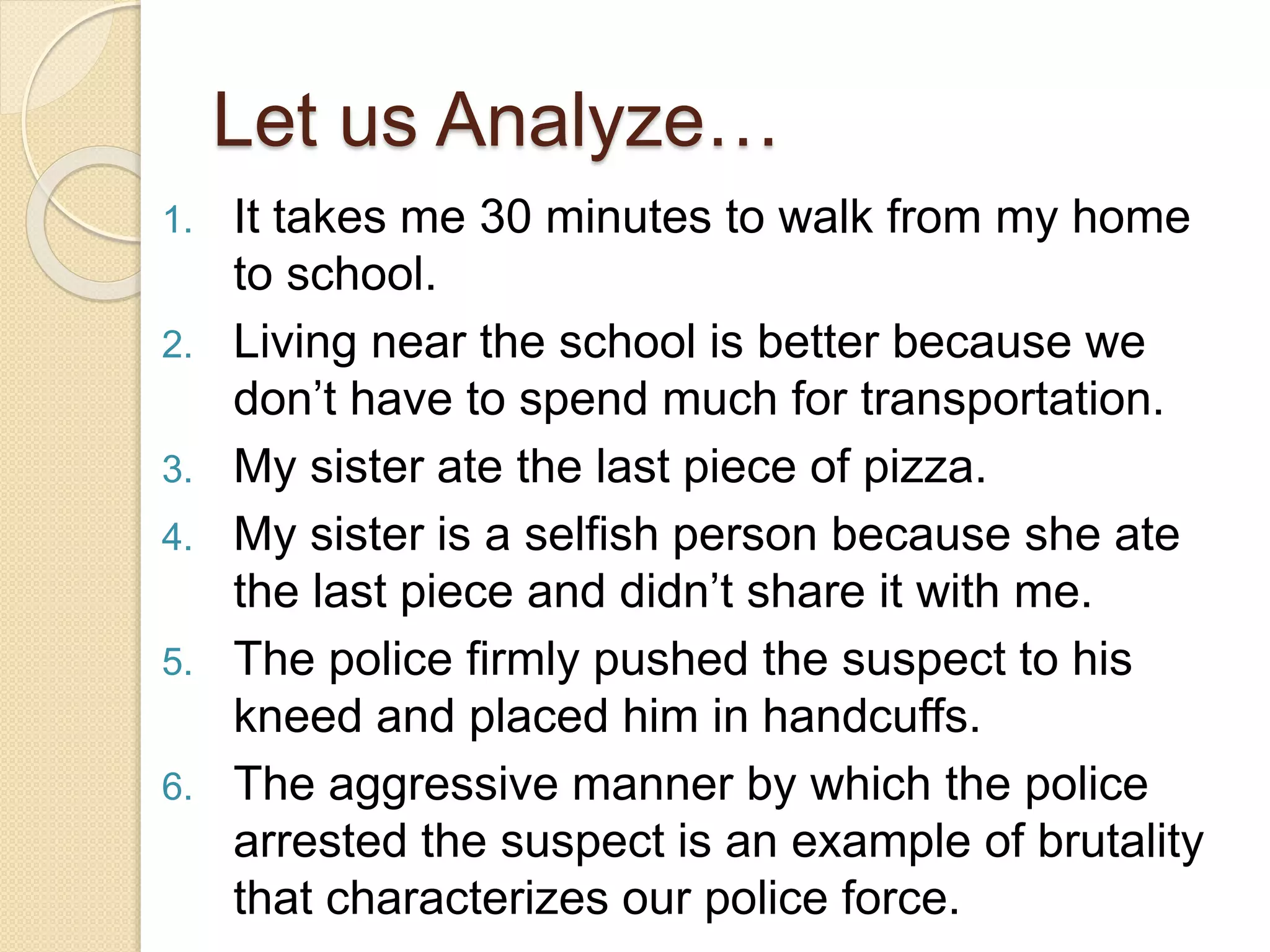
1. It takes me 30 minutes to walk from my home
to school.
2. Living near the school is better because we
don’t have to spend much for transportation.
3. My sister ate the last piece of pizza.
4. My sister is a selfish person because she ate
the last piece and didn’t share it with me.
5. The police firmly pushed the suspect to his
kneed and placed him in handcuffs.
6. The aggressive manner by which the police
arrested the suspect is an example of brutality
that characterizes our police force.
Let us Analyze…
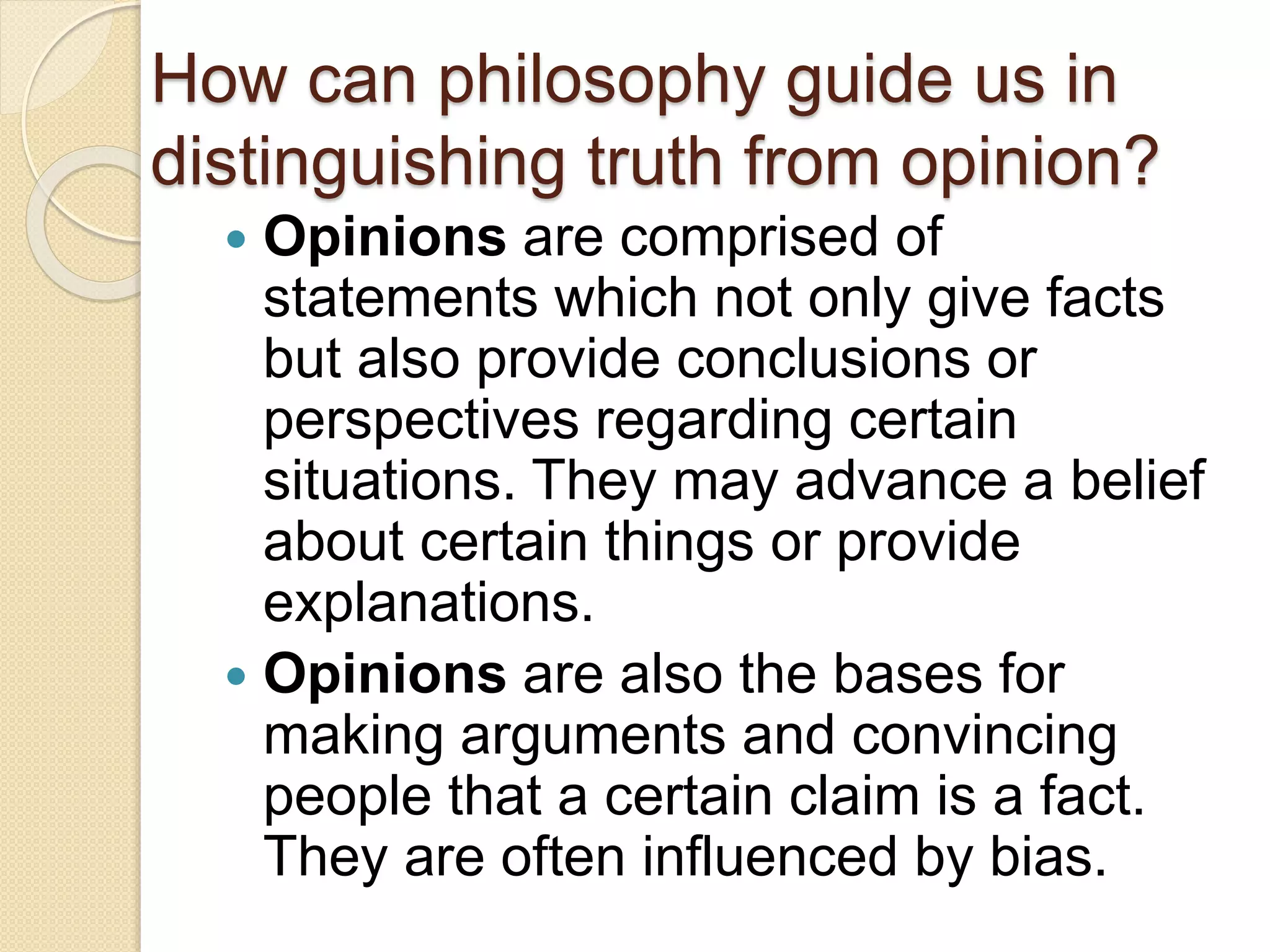
 Opinions are comprised of
statements which not only give facts
but also provide conclusions or
perspectives regarding certain
situations. They may advance a belief
about certain things or provide
explanations.
 Opinions are also the bases for
making arguments and convincing
people that a certain claim is a fact.
They are often influenced by bias.
How can philosophy guide us in
distinguishing truth from opinion?
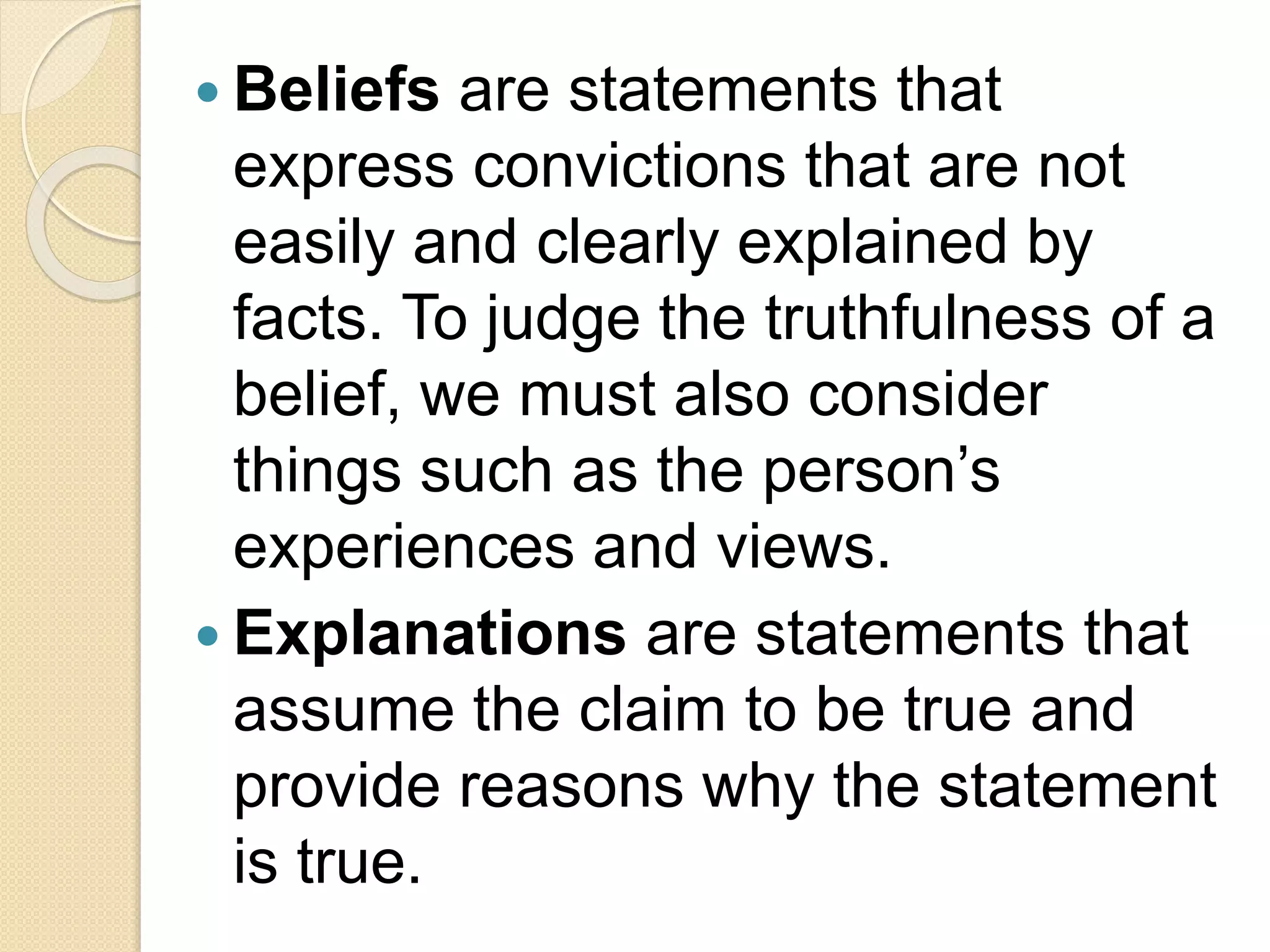
 Beliefs are statements that
express convictions that are not
easily and clearly explained by
facts. To judge the truthfulness of a
belief, we must also consider
things such as the person’s
experiences and views.
 Explanations are statements that
assume the claim to be true and
provide reasons why the statement
is true.
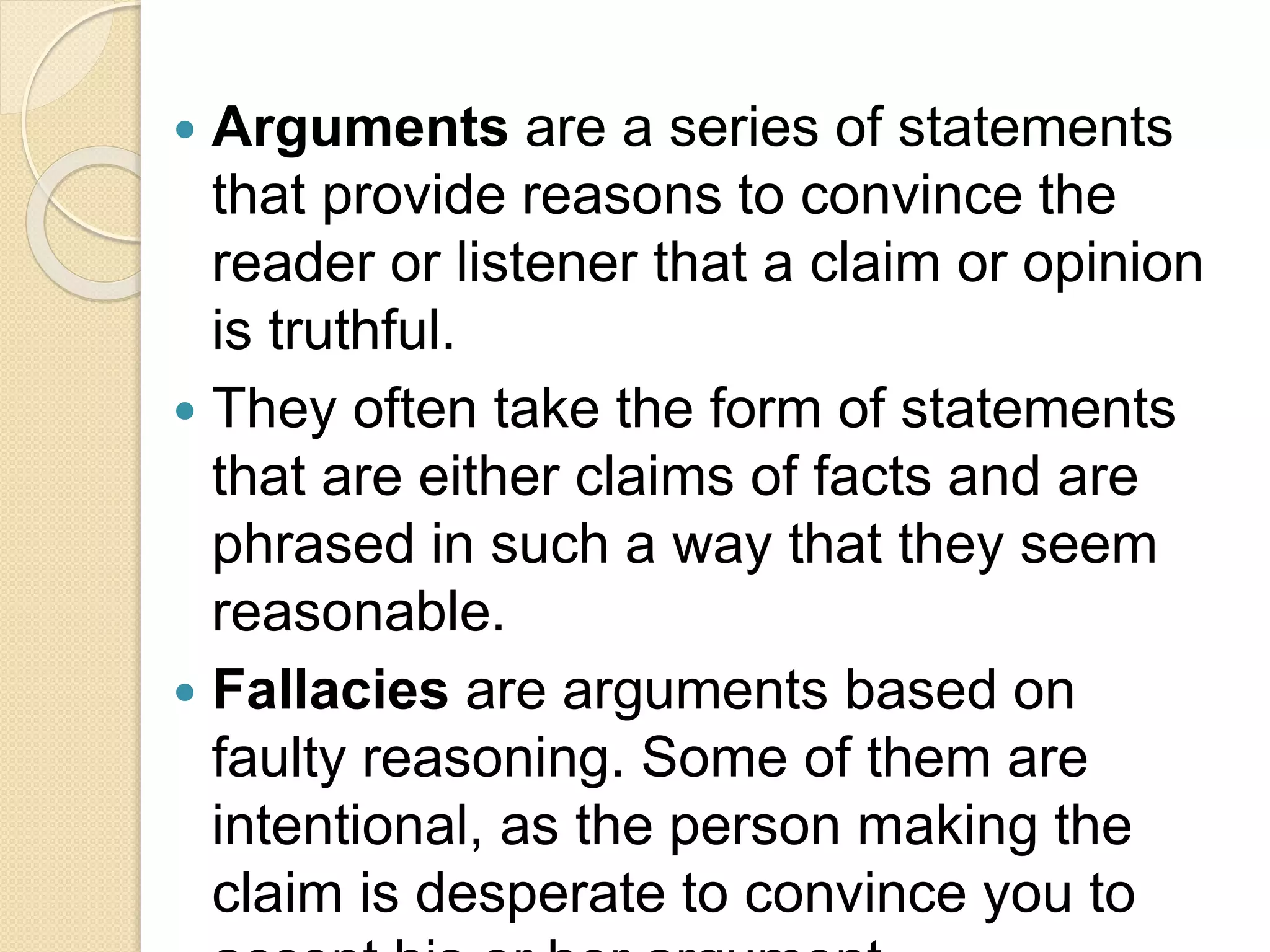
 Arguments are a series of statements
that provide reasons to convince the
reader or listener that a claim or opinion
is truthful.
 They often take the form of statements
that are either claims of facts and are
phrased in such a way that they seem
reasonable.
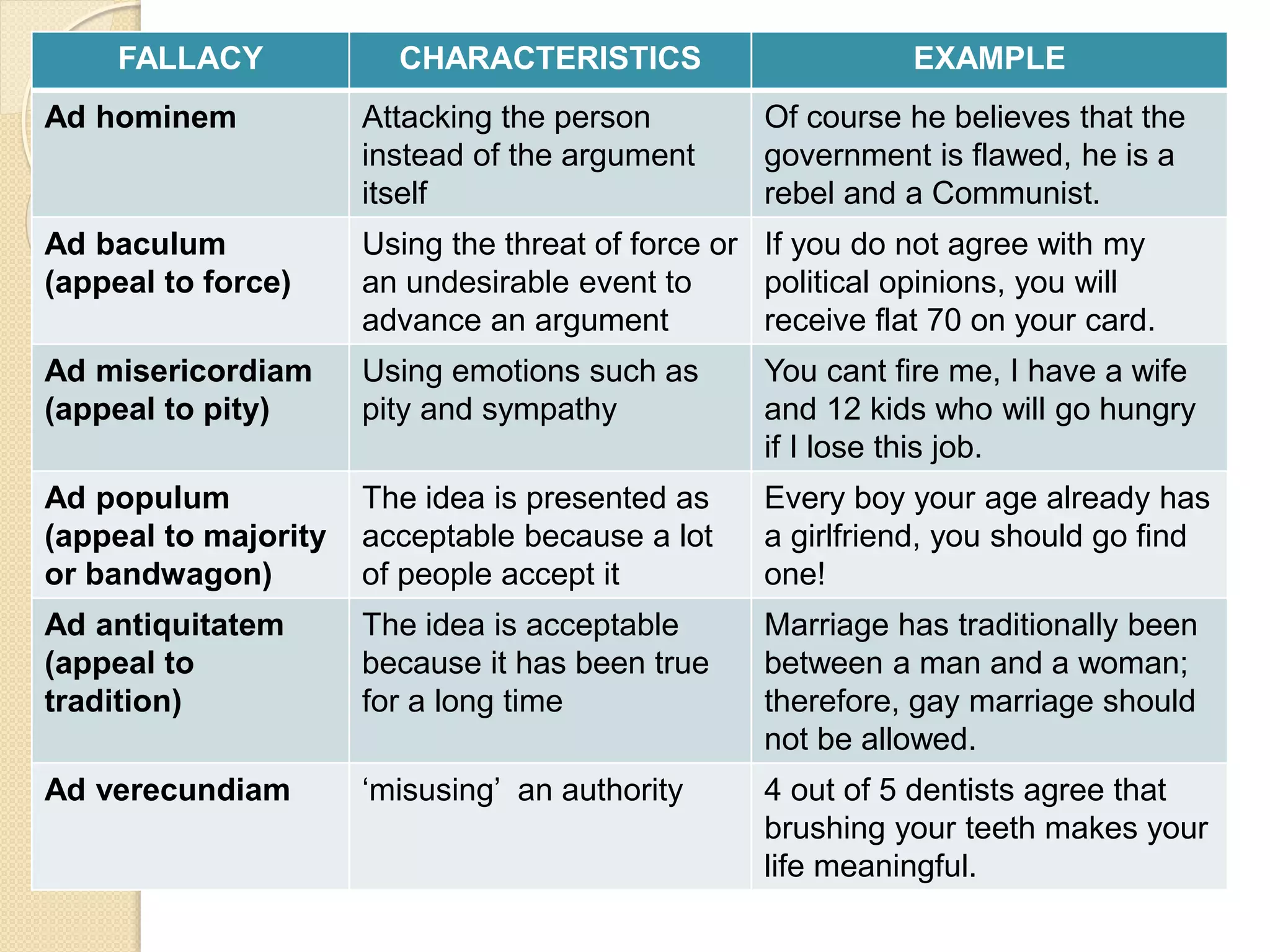
 Fallacies are arguments based on
faulty reasoning. Some of them are
intentional, as the person making the
claim is desperate to convince you to
FALLACY CHARACTERISTICS EXAMPLE
Ad hominem Attacking the person
instead of the argument
itself
Of course he believes that the
government is flawed, he is a
rebel and a Communist.
Ad baculum
(appeal to force)
Using the threat of force or
an undesirable event to
advance an argument
If you do not agree with my
political opinions, you will
receive flat 70 on your card.
Ad misericordiam
(appeal to pity)
Using emotions such as
pity and sympathy
You cant fire me, I have a wife
and 12 kids who will go hungry
if I lose this job.
Ad populum
(appeal to majority
or bandwagon)
The idea is presented as
acceptable because a lot
of people accept it
Every boy your age already has
a girlfriend, you should go find
one!
Ad antiquitatem
(appeal to
tradition)
The idea is acceptable
because it has been true
for a long time
Marriage has traditionally been
between a man and a woman;
therefore, gay marriage should
not be allowed.
Ad verecundiam ‘misusing’ an authority 4 out of 5 dentists agree that
brushing your teeth makes your
life meaningful.
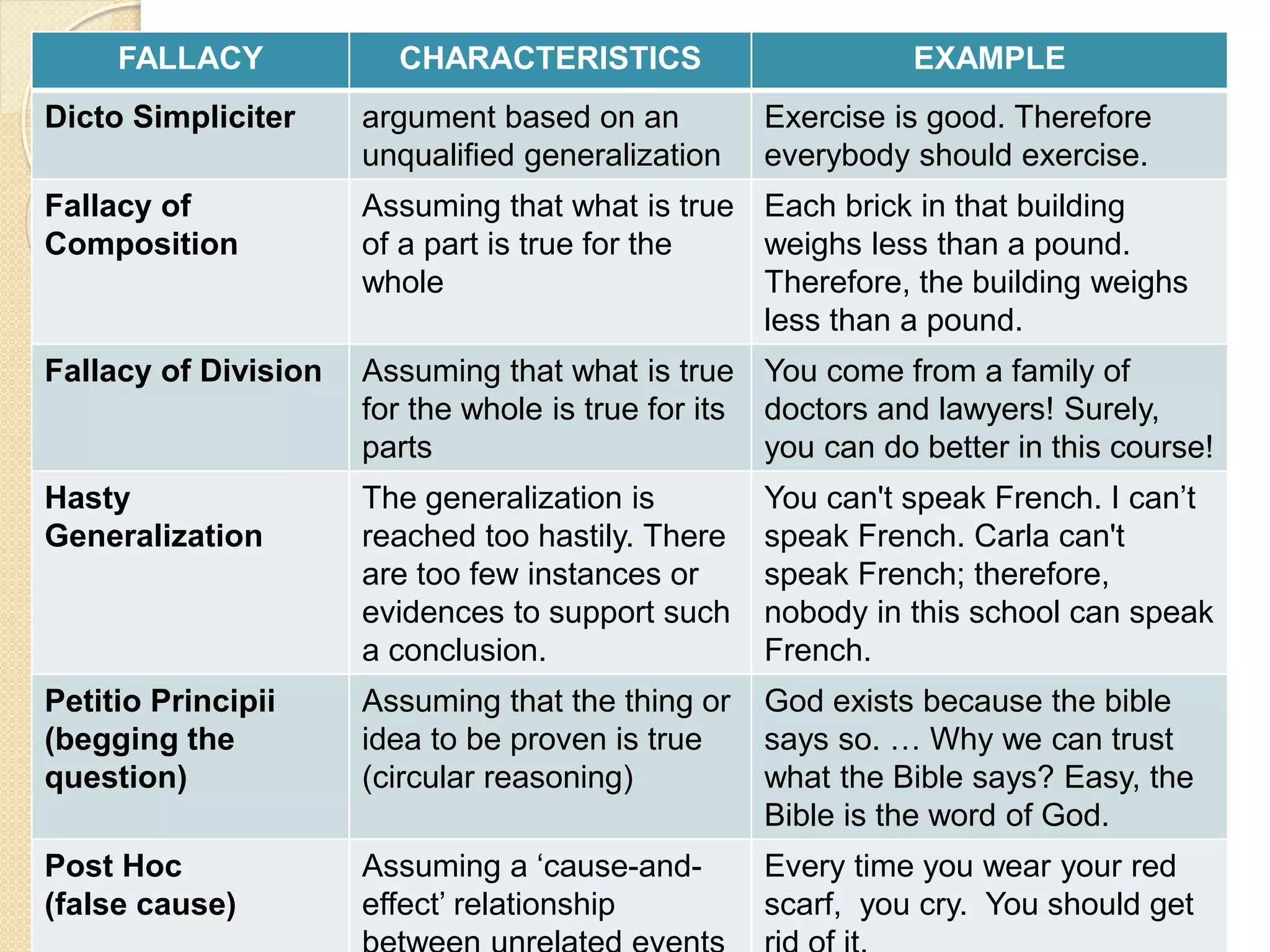
FALLACY CHARACTERISTICS EXAMPLE
Dicto Simpliciter argument based on an
unqualified generalization
Exercise is good. Therefore
everybody should exercise.
Fallacy of
Composition
Assuming that what is true
of a part is true for the
whole
Each brick in that building
weighs less than a pound.
Therefore, the building weighs
less than a pound.
Fallacy of Division Assuming that what is true
for the whole is true for its
parts
You come from a family of
doctors and lawyers! Surely,
you can do better in this course!
Hasty
Generalization
The generalization is
reached too hastily. There
are too few instances or
evidences to support such
a conclusion.
You can't speak French. I can’t
speak French. Carla can't
speak French; therefore,
nobody in this school can speak
French.
Petitio Principii
(begging the
question)
Assuming that the thing or
idea to be proven is true
(circular reasoning)
God exists because the bible
says so. … Why we can trust
what the Bible says? Easy, the
Bible is the word of God.
Post Hoc
(false cause)
Assuming a ‘cause-and-
effect’ relationship
Every time you wear your red
scarf, you cry. You should get
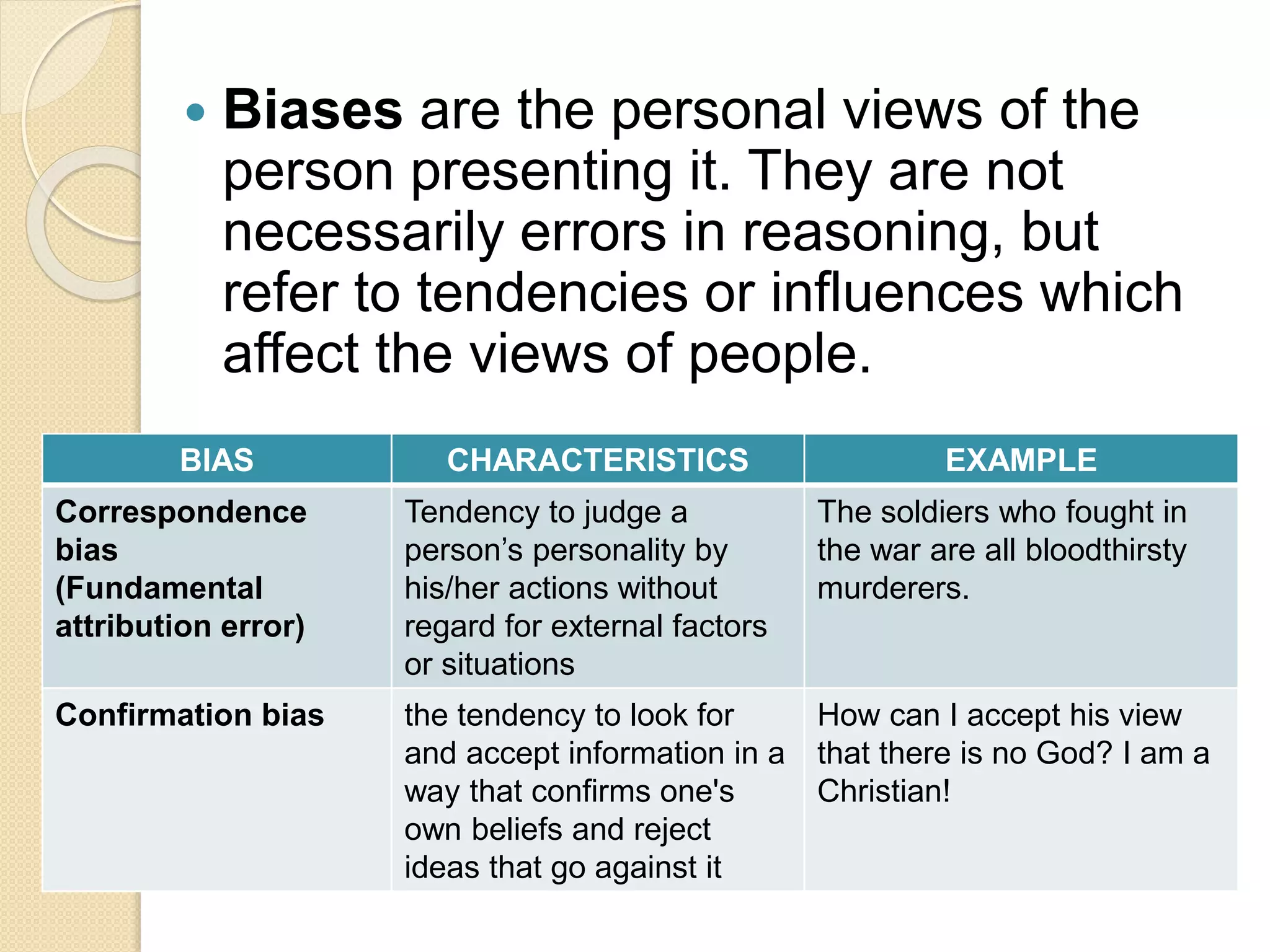
 Biases are the personal views of the
person presenting it. They are not
necessarily errors in reasoning, but
refer to tendencies or influences which
affect the views of people.
BIAS CHARACTERISTICS EXAMPLE
Correspondence
bias
(Fundamental
attribution error)
Tendency to judge a
person’s personality by
his/her actions without
regard for external factors
or situations
The soldiers who fought in
the war are all bloodthirsty
murderers.
Confirmation bias the tendency to look for
and accept information in a
way that confirms one's
own beliefs and reject
ideas that go against it
How can I accept his view
that there is no God? I am a
Christian!
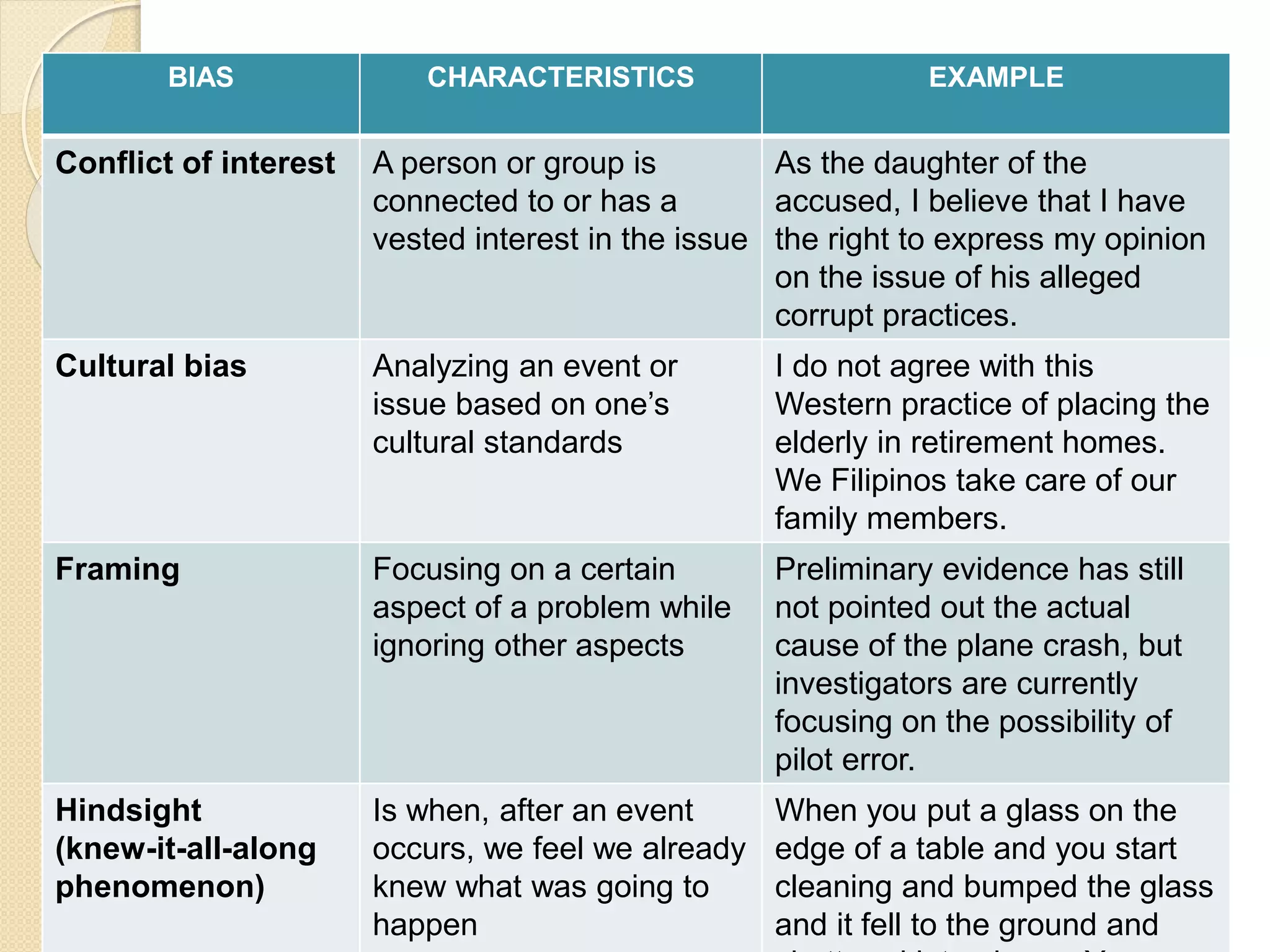
BIAS CHARACTERISTICS EXAMPLE
Conflict of interest A person or group is
connected to or has a
vested interest in the issue
As the daughter of the
accused, I believe that I have
the right to express my opinion
on the issue of his alleged
corrupt practices.
Cultural bias Analyzing an event or
issue based on one’s
cultural standards
I do not agree with this
Western practice of placing the
elderly in retirement homes.
We Filipinos take care of our
family members.
Framing Focusing on a certain
aspect of a problem while
ignoring other aspects
Preliminary evidence has still
not pointed out the actual
cause of the plane crash, but
investigators are currently
focusing on the possibility of
pilot error.
Hindsight
(knew-it-all-along
phenomenon)
Is when, after an event
occurs, we feel we already
knew what was going to
happen
When you put a glass on the
edge of a table and you start
cleaning and bumped the glass
and it fell to the ground and

Lesson 2 methods of philosophizing

  • 1.
    Lesson 2: Methods of Philosophizing By:Ms. Jo Marie Nel C. Garcia
  • 2.
    Truth and Knowledge Truth lies at the heart of any inquiry. It is a fact that has been verified.  Knowledge is simple data that comes from the outside that pass to our senses. It must be truthful to gain validity and acceptance.
  • 3.
    Propositions  Philosophers considertruth as a kind of quality or value.  Propositions are statements about the world or reality which may or may not carry truth.
  • 4.
    What is truthand why is it important?  Knowledge is the clear awareness and understanding of something. It is the product of questions that allow for clear answers provided by facts.  What we know is what is observable or evident in the real world.  Propositions which are observed to be real or truthful are considered FACTS.
  • 5.
     There arestatements, however, that are not evidently or immediately known to be true and they are called CLAIMS. They require further examination to establish whether it is true or false.
  • 6.
    How do weknow if something is true?  Philosophers emphasize the importance of belief as a basis for determining truth.  We assume that everything we know about this world is true but philosophers who pondered upon the origins of knowledge doubted everything that there is to know about themselves and the world. In doing so, they were able to better understand the means by which humans gain knowledge and determine the truth about everything.
  • 7.
     It issaid that there are instances when we have to unlearn something so that we may learn anew. Philosophers questioned what they knew and even analyzed their methods of knowing in order to understand themselves and the world much better.  Doubt has a very important purpose in philosophy as it drives our desire to discover truth. Nothing is taken as true unless there is sufficient reason and evidence to prove that it is indeed true.I am alive. Am I alive? I am alive. I have a body. Do I have a body? I have a body. I can breathe. Can I breathe? I can breathe.
  • 8.
    1. It canbe justified or proven through the use of one’s senses. 2. It is based on facts. 3. It is a product of agreement or consensus. 4. It can be applied in real life (tested and verified) Something is true if…
  • 9.
    1. It takesme 30 minutes to walk from my home to school. 2. Living near the school is better because we don’t have to spend much for transportation. 3. My sister ate the last piece of pizza. 4. My sister is a selfish person because she ate the last piece and didn’t share it with me. 5. The police firmly pushed the suspect to his kneed and placed him in handcuffs. 6. The aggressive manner by which the police arrested the suspect is an example of brutality that characterizes our police force. Let us Analyze…
  • 10.
     Opinions arecomprised of statements which not only give facts but also provide conclusions or perspectives regarding certain situations. They may advance a belief about certain things or provide explanations.  Opinions are also the bases for making arguments and convincing people that a certain claim is a fact. They are often influenced by bias. How can philosophy guide us in distinguishing truth from opinion?
  • 11.
     Beliefs arestatements that express convictions that are not easily and clearly explained by facts. To judge the truthfulness of a belief, we must also consider things such as the person’s experiences and views.  Explanations are statements that assume the claim to be true and provide reasons why the statement is true.
  • 12.
     Arguments area series of statements that provide reasons to convince the reader or listener that a claim or opinion is truthful.  They often take the form of statements that are either claims of facts and are phrased in such a way that they seem reasonable.  Fallacies are arguments based on faulty reasoning. Some of them are intentional, as the person making the claim is desperate to convince you to
  • 13.
    FALLACY CHARACTERISTICS EXAMPLE Adhominem Attacking the person instead of the argument itself Of course he believes that the government is flawed, he is a rebel and a Communist. Ad baculum (appeal to force) Using the threat of force or an undesirable event to advance an argument If you do not agree with my political opinions, you will receive flat 70 on your card. Ad misericordiam (appeal to pity) Using emotions such as pity and sympathy You cant fire me, I have a wife and 12 kids who will go hungry if I lose this job. Ad populum (appeal to majority or bandwagon) The idea is presented as acceptable because a lot of people accept it Every boy your age already has a girlfriend, you should go find one! Ad antiquitatem (appeal to tradition) The idea is acceptable because it has been true for a long time Marriage has traditionally been between a man and a woman; therefore, gay marriage should not be allowed. Ad verecundiam ‘misusing’ an authority 4 out of 5 dentists agree that brushing your teeth makes your life meaningful.
  • 14.
    FALLACY CHARACTERISTICS EXAMPLE DictoSimpliciter argument based on an unqualified generalization Exercise is good. Therefore everybody should exercise. Fallacy of Composition Assuming that what is true of a part is true for the whole Each brick in that building weighs less than a pound. Therefore, the building weighs less than a pound. Fallacy of Division Assuming that what is true for the whole is true for its parts You come from a family of doctors and lawyers! Surely, you can do better in this course! Hasty Generalization The generalization is reached too hastily. There are too few instances or evidences to support such a conclusion. You can't speak French. I can’t speak French. Carla can't speak French; therefore, nobody in this school can speak French. Petitio Principii (begging the question) Assuming that the thing or idea to be proven is true (circular reasoning) God exists because the bible says so. … Why we can trust what the Bible says? Easy, the Bible is the word of God. Post Hoc (false cause) Assuming a ‘cause-and- effect’ relationship Every time you wear your red scarf, you cry. You should get
  • 15.
     Biases arethe personal views of the person presenting it. They are not necessarily errors in reasoning, but refer to tendencies or influences which affect the views of people. BIAS CHARACTERISTICS EXAMPLE Correspondence bias (Fundamental attribution error) Tendency to judge a person’s personality by his/her actions without regard for external factors or situations The soldiers who fought in the war are all bloodthirsty murderers. Confirmation bias the tendency to look for and accept information in a way that confirms one's own beliefs and reject ideas that go against it How can I accept his view that there is no God? I am a Christian!
  • 16.
    BIAS CHARACTERISTICS EXAMPLE Conflictof interest A person or group is connected to or has a vested interest in the issue As the daughter of the accused, I believe that I have the right to express my opinion on the issue of his alleged corrupt practices. Cultural bias Analyzing an event or issue based on one’s cultural standards I do not agree with this Western practice of placing the elderly in retirement homes. We Filipinos take care of our family members. Framing Focusing on a certain aspect of a problem while ignoring other aspects Preliminary evidence has still not pointed out the actual cause of the plane crash, but investigators are currently focusing on the possibility of pilot error. Hindsight (knew-it-all-along phenomenon) Is when, after an event occurs, we feel we already knew what was going to happen When you put a glass on the edge of a table and you start cleaning and bumped the glass and it fell to the ground and