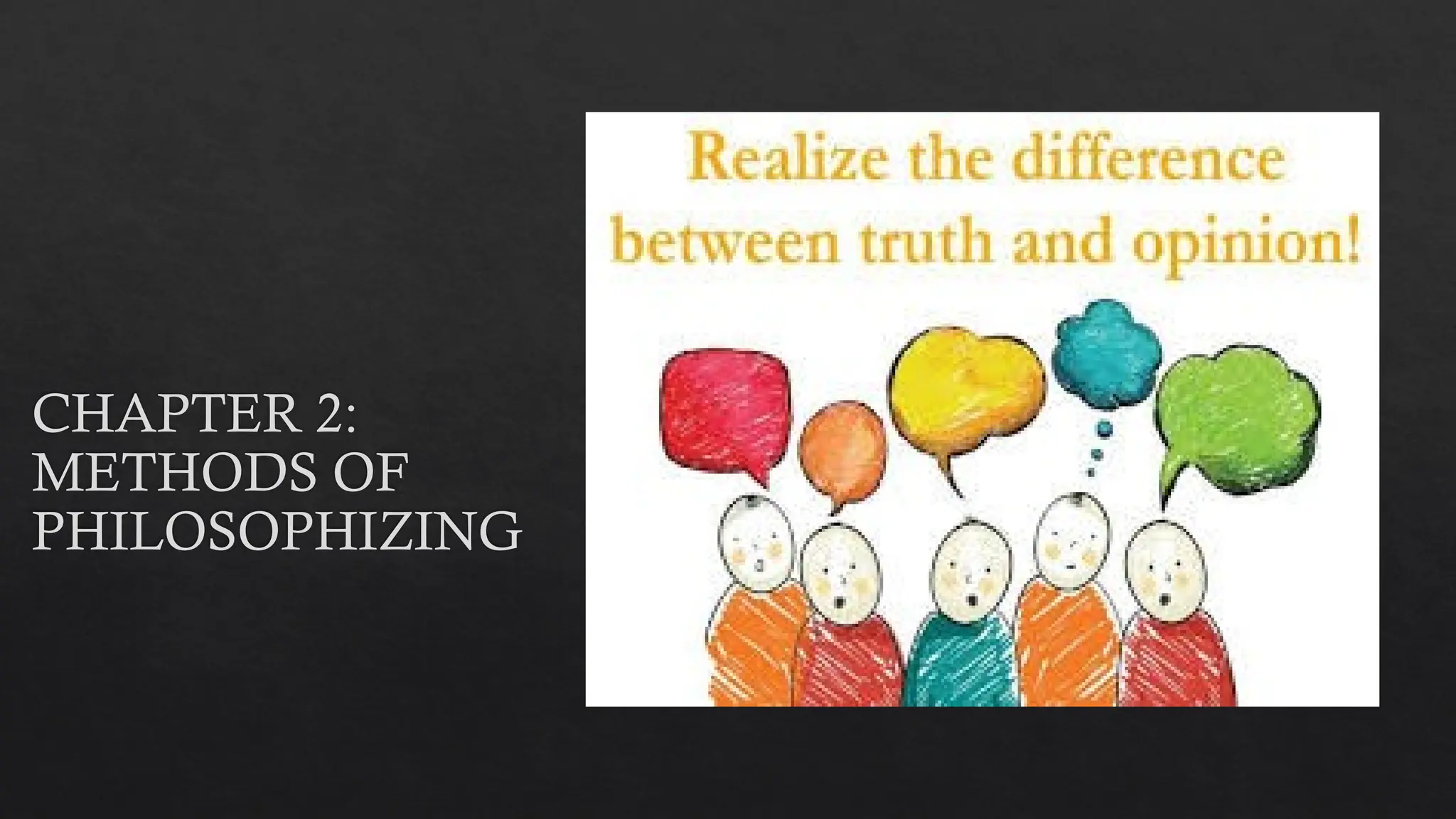
CHAPTER 2:
METHODS OF
PHILOSOPHIZING
Objectives:
1. Distinguish opinion from truth,
2. Realize that the methods of philosophy leads to wisdom and truth, and
3. Evaluate truth from opinions in different situations using the methods of philosophizing.
Philosophizing is to think or express
oneself in a philosophical manner. It
considers or discusses a (matter) from a
philosophical standpoint. In logic, truth is
based on reasoning and critical thinking.
 Philosophical method ( or philosophical methodology )
• is the study of how to do philosophy. A common view among philosophers is
that
philosophy is distinguished by the ways that philosophers follow in addressing
philosophical questions. There is not just one method that philosophers use to
answer philosophical questions.
• Philosophy is concerned with determining the concept of truth. Truth lies at
the heart of any inquiry.
Truth in metaphysics and the philosophy of language is the property sentences, assertions, beliefs,
thoughts, or propositions that are said, in ordinary discourse, to agree with the facts or to state what the case is. It is most
often used to mean being in accord in modern contexts as an of “truth to self”, or authenticity.
Propositions is a statement about the world or reality. Propositions may or may not carry truth.
Knowledge is the clear awareness and understanding of something. It is the product of that allow clear
answers provided by facts.
Facts are propositions or statement which are observe o be real or truthful.
Claim is a statement that is not evidently known to be true. This means that any claim can be proven by
verification and experimentation.
There are several views regarding truth. Philosophers emphasize the importance of belief as a
basis for determining truth. But as a philosopher, we do not assume that every statement is true. Remember
the famous French philosophers, Rene Descartes traced the need to philosophize to doubt.
In philosophy, systematic doubt is employed to help determine the truth. This means that every statement,
claim, evidence, and experience is scrutinized and analyzed.
Philosophers always engaged with the concept of truth. Philosophers consider truth as a kind of quality or
value. Knowledge is the clear awareness and understanding of something, since it is true knowing that we
are able to determine what is true.
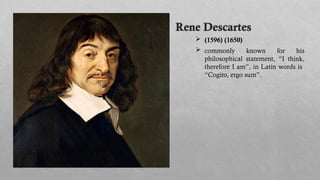
Rene Descartes
 (1596) (1650)
 commonly known for his
philosophical statement, “I think,
therefore I am”, in Latin words is
“Cogito, ergo sum”.
Doubt has a very important purpose in philosophy as it drives our
desire to discover the truth. In philosophy doubt is employed to help determine what is true.
A belief is true if it can be justified or proven through, he use of
one’s senses. Another basis for determine truth is a belief or statement is true if it is based on
facts.
Getting consensus or having a people agree on a common belief is
another of determining what is true. Although this approach has a certain limitations.
Getting everyone to agree on something may not take that belief true.
Philosophers also believe claim and belief should be subjective to
test to determine truth. In determining truth requires also that a person can prove a
statement through an action.
LESSON
2.1
DISTINGUISH OPINION
FROM TRUTH
 Fact is something concrete that can be proven. You can find facts
in legal records, scientific findings, encyclopedias, atlases, etc. in
other words, facts are he truth and accepted as such.
 Opinion is less concrete. It’s a view formed in the mind of a
person about a particular issue. In other thinks and it is what
someone believe or thinks and is not necessarily the truth. Also,
note in the examples below how facts are the same for everybody,
but opinions can differ quite widely.
FACT
OPINION
 Examples of an opinion:
• Ann can have the opinion that Italian food tastes best, while Joe has
the opinion that French food is ideal.
• Sue can have the opinion that reading is boring, while Mike can have
the opinion that reading is not.
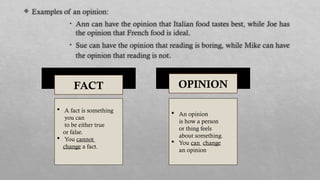
FACT OPINION
 A fact is something
you can
to be either true
or false.
 You cannot
change a fact.
 An opinion
is how a person
or thing feels
about something.
 You can change
an opinion.
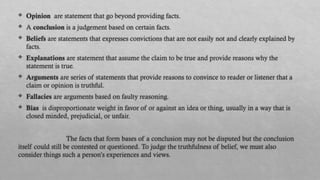
 Opinion are statement that go beyond providing facts.
 A conclusion is a judgement based on certain facts.
 Beliefs are statements that expresses convictions that are not easily not and clearly explained by
facts.
 Explanations are statement that assume the claim to be true and provide reasons why the
statement is true.
 Arguments are series of statements that provide reasons to convince to reader or listener that a
claim or opinion is truthful.
 Fallacies are arguments based on faulty reasoning.
 Bias is disproportionate weight in favor of or against an idea or thing, usually in a way that is
closed minded, prejudicial, or unfair.
The facts that form bases of a conclusion may not be disputed but the conclusion
itself could still be contested or questioned. To judge the truthfulness of belief, we must also
consider things such a person’s experiences and views.
Facts are statements that are observed to be real or truthful. Claims are statements that
require further examination to determine their truthfulness. Some arguments may contain fallacies. We
must be aware of the various kinds of fallacies as these affect the validity of arguments. Opinions are often
influenced by bias. We must be aware of bias to that we can objectively and critically examine points of
view.
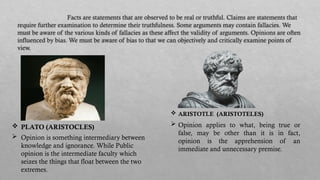
 Opinion is something intermediary between
knowledge and ignorance. While Public
opinion is the intermediate faculty which
seizes the things that float between the two
extremes.
 Opinion applies to what, being true or
false, may be other than it is in fact,
opinion is the apprehension of an
immediate and unnecessary premise.
 PLATO (ARISTOCLES)
 ARISTOTLE (ARISTOTELES)
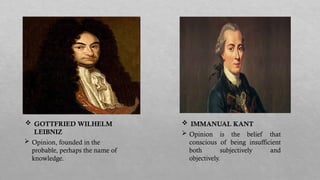
 Opinion, founded in the
probable, perhaps the name of
knowledge.
 Opinion is the belief that
conscious of being insufficient
both subjectively and
objectively.
 GOTTFRIED WILHELM
LEIBNIZ
 IMMANUAL KANT
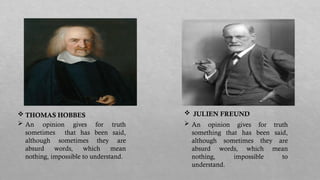
 An opinion gives for truth
sometimes that has been said,
although sometimes they are
absurd words, which mean
nothing, impossible to understand.
 An opinion gives for truth
something that has been said,
although sometimes they are
absurd words, which mean
nothing, impossible to
understand.
 JULIEN FREUND
 THOMAS HOBBES
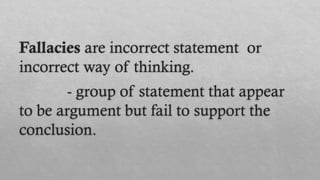
Fallacies are incorrect statement or
incorrect way of thinking.
- group of statement that appear
to be argument but fail to support the
conclusion.
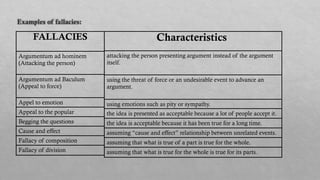
Examples of fallacies:
FALLACIES
Argumentum ad hominem
(Attacking the person)
Argumentum ad Baculum
(Appeal to force)
Appel to emotion
Appeal to the popular
Begging the questions
Cause and effect
Fallacy of composition
Fallacy of division
Characteristics
attacking the person presenting argument instead of the argument
itself.
using the threat of force or an undesirable event to advance an
argument.
using emotions such as pity or sympathy.
the idea is presented as acceptable because a lot of people accept it.
the idea is acceptable because it has been true for a long time.
assuming “cause and effect” relationship between unrelated events.
assuming that what is true of a part is true for the whole.
assuming that what is true for the whole is true for its parts.
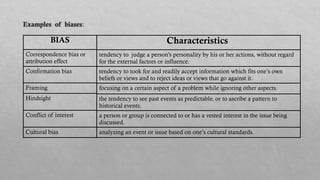
Examples of biases:
BIAS
Correspondence bias or
attribution effect
Confirmation bias
Framing
Hindsight
Conflict of interest
Cultural bias
Characteristics
tendency to judge a person’s personality by his or her actions, without regard
for the external factors or influence.
tendency to took for and readily accept information which fits one’s own
beliefs or views and to reject ideas or views that go against it.
focusing on a certain aspect of a problem while ignoring other aspects.
the tendency to see past events as predictable, or to ascribe a pattern to
historical events.
a person or group is connected to or has a vested interest in the issue being
discussed.
analyzing an event or issue based on one’s cultural standards.
LESSON
2.2
Methods of Philosophy Lead
to Wisdom and Truth
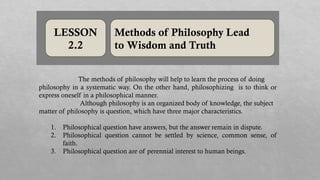
The methods of philosophy will help to learn the process of doing
philosophy in a systematic way. On the other hand, philosophizing is to think or
express oneself in a philosophical manner.
Although philosophy is an organized body of knowledge, the subject
matter of philosophy is question, which have three major characteristics.
1. Philosophical question have answers, but the answer remain in dispute.
2. Philosophical question cannot be settled by science, common sense, of
faith.
3. Philosophical question are of perennial interest to human beings.
The methodology or method that philosophers use to address philosophical
question is critical thinking.
Critical Thinking is the careful, reflective, rational and systematic approach to
question of very general interest.
Critical thinking means understanding if philosophy and refraining from merely
giving claims but through careful thought, one reasons through to argumentation.
The scientific method also leads to wisdom and truth because it uses an
evidence-based approach to come up with its conclusion. In this method, all truths are
supported by facts that can easily be tested or proven again through experiments, logical
reasoning, or observation.
LESSON
2.2
Methods of Philosophy Lead
to Wisdom and Truth

Methods of Philosophizing sdsdasdaa.pptx

  • 1.
  • 2.
    Objectives: 1. Distinguish opinionfrom truth, 2. Realize that the methods of philosophy leads to wisdom and truth, and 3. Evaluate truth from opinions in different situations using the methods of philosophizing.
  • 3.
    Philosophizing is tothink or express oneself in a philosophical manner. It considers or discusses a (matter) from a philosophical standpoint. In logic, truth is based on reasoning and critical thinking.
  • 4.
     Philosophical method( or philosophical methodology ) • is the study of how to do philosophy. A common view among philosophers is that philosophy is distinguished by the ways that philosophers follow in addressing philosophical questions. There is not just one method that philosophers use to answer philosophical questions. • Philosophy is concerned with determining the concept of truth. Truth lies at the heart of any inquiry. Truth in metaphysics and the philosophy of language is the property sentences, assertions, beliefs, thoughts, or propositions that are said, in ordinary discourse, to agree with the facts or to state what the case is. It is most often used to mean being in accord in modern contexts as an of “truth to self”, or authenticity.
  • 5.
    Propositions is astatement about the world or reality. Propositions may or may not carry truth. Knowledge is the clear awareness and understanding of something. It is the product of that allow clear answers provided by facts. Facts are propositions or statement which are observe o be real or truthful. Claim is a statement that is not evidently known to be true. This means that any claim can be proven by verification and experimentation. There are several views regarding truth. Philosophers emphasize the importance of belief as a basis for determining truth. But as a philosopher, we do not assume that every statement is true. Remember the famous French philosophers, Rene Descartes traced the need to philosophize to doubt. In philosophy, systematic doubt is employed to help determine the truth. This means that every statement, claim, evidence, and experience is scrutinized and analyzed. Philosophers always engaged with the concept of truth. Philosophers consider truth as a kind of quality or value. Knowledge is the clear awareness and understanding of something, since it is true knowing that we are able to determine what is true.
  • 6.
    Rene Descartes  (1596)(1650)  commonly known for his philosophical statement, “I think, therefore I am”, in Latin words is “Cogito, ergo sum”.
  • 7.
    Doubt has avery important purpose in philosophy as it drives our desire to discover the truth. In philosophy doubt is employed to help determine what is true. A belief is true if it can be justified or proven through, he use of one’s senses. Another basis for determine truth is a belief or statement is true if it is based on facts. Getting consensus or having a people agree on a common belief is another of determining what is true. Although this approach has a certain limitations. Getting everyone to agree on something may not take that belief true. Philosophers also believe claim and belief should be subjective to test to determine truth. In determining truth requires also that a person can prove a statement through an action.
  • 8.
    LESSON 2.1 DISTINGUISH OPINION FROM TRUTH Fact is something concrete that can be proven. You can find facts in legal records, scientific findings, encyclopedias, atlases, etc. in other words, facts are he truth and accepted as such.  Opinion is less concrete. It’s a view formed in the mind of a person about a particular issue. In other thinks and it is what someone believe or thinks and is not necessarily the truth. Also, note in the examples below how facts are the same for everybody, but opinions can differ quite widely. FACT OPINION
  • 9.
     Examples ofan opinion: • Ann can have the opinion that Italian food tastes best, while Joe has the opinion that French food is ideal. • Sue can have the opinion that reading is boring, while Mike can have the opinion that reading is not. FACT OPINION  A fact is something you can to be either true or false.  You cannot change a fact.  An opinion is how a person or thing feels about something.  You can change an opinion.
  • 10.
     Opinion arestatement that go beyond providing facts.  A conclusion is a judgement based on certain facts.  Beliefs are statements that expresses convictions that are not easily not and clearly explained by facts.  Explanations are statement that assume the claim to be true and provide reasons why the statement is true.  Arguments are series of statements that provide reasons to convince to reader or listener that a claim or opinion is truthful.  Fallacies are arguments based on faulty reasoning.  Bias is disproportionate weight in favor of or against an idea or thing, usually in a way that is closed minded, prejudicial, or unfair. The facts that form bases of a conclusion may not be disputed but the conclusion itself could still be contested or questioned. To judge the truthfulness of belief, we must also consider things such a person’s experiences and views.
  • 11.
    Facts are statementsthat are observed to be real or truthful. Claims are statements that require further examination to determine their truthfulness. Some arguments may contain fallacies. We must be aware of the various kinds of fallacies as these affect the validity of arguments. Opinions are often influenced by bias. We must be aware of bias to that we can objectively and critically examine points of view.  Opinion is something intermediary between knowledge and ignorance. While Public opinion is the intermediate faculty which seizes the things that float between the two extremes.  Opinion applies to what, being true or false, may be other than it is in fact, opinion is the apprehension of an immediate and unnecessary premise.  PLATO (ARISTOCLES)  ARISTOTLE (ARISTOTELES)
  • 12.
     Opinion, foundedin the probable, perhaps the name of knowledge.  Opinion is the belief that conscious of being insufficient both subjectively and objectively.  GOTTFRIED WILHELM LEIBNIZ  IMMANUAL KANT
  • 13.
     An opiniongives for truth sometimes that has been said, although sometimes they are absurd words, which mean nothing, impossible to understand.  An opinion gives for truth something that has been said, although sometimes they are absurd words, which mean nothing, impossible to understand.  JULIEN FREUND  THOMAS HOBBES
  • 14.
    Fallacies are incorrectstatement or incorrect way of thinking. - group of statement that appear to be argument but fail to support the conclusion.
  • 15.
    Examples of fallacies: FALLACIES Argumentumad hominem (Attacking the person) Argumentum ad Baculum (Appeal to force) Appel to emotion Appeal to the popular Begging the questions Cause and effect Fallacy of composition Fallacy of division Characteristics attacking the person presenting argument instead of the argument itself. using the threat of force or an undesirable event to advance an argument. using emotions such as pity or sympathy. the idea is presented as acceptable because a lot of people accept it. the idea is acceptable because it has been true for a long time. assuming “cause and effect” relationship between unrelated events. assuming that what is true of a part is true for the whole. assuming that what is true for the whole is true for its parts.
  • 16.
    Examples of biases: BIAS Correspondencebias or attribution effect Confirmation bias Framing Hindsight Conflict of interest Cultural bias Characteristics tendency to judge a person’s personality by his or her actions, without regard for the external factors or influence. tendency to took for and readily accept information which fits one’s own beliefs or views and to reject ideas or views that go against it. focusing on a certain aspect of a problem while ignoring other aspects. the tendency to see past events as predictable, or to ascribe a pattern to historical events. a person or group is connected to or has a vested interest in the issue being discussed. analyzing an event or issue based on one’s cultural standards.
  • 17.
    LESSON 2.2 Methods of PhilosophyLead to Wisdom and Truth The methods of philosophy will help to learn the process of doing philosophy in a systematic way. On the other hand, philosophizing is to think or express oneself in a philosophical manner. Although philosophy is an organized body of knowledge, the subject matter of philosophy is question, which have three major characteristics. 1. Philosophical question have answers, but the answer remain in dispute. 2. Philosophical question cannot be settled by science, common sense, of faith. 3. Philosophical question are of perennial interest to human beings.
  • 18.
    The methodology ormethod that philosophers use to address philosophical question is critical thinking. Critical Thinking is the careful, reflective, rational and systematic approach to question of very general interest. Critical thinking means understanding if philosophy and refraining from merely giving claims but through careful thought, one reasons through to argumentation. The scientific method also leads to wisdom and truth because it uses an evidence-based approach to come up with its conclusion. In this method, all truths are supported by facts that can easily be tested or proven again through experiments, logical reasoning, or observation.
  • 19.
    LESSON 2.2 Methods of PhilosophyLead to Wisdom and Truth