Evolution of manageentCH-2
Evolution of management
 Early Contribution
 Scientific Management
 Administrative Theory
 Bureaucracy Theory
 Human Relation Management
 Social System Approach
 Decision Theory Approach
Early Contribution
 Adam Smith(1723-1790)-
 Father of “Liberal Economics”
 Focus on Market and competition analysis for economic conditions
 Specialized Labour
 And Division of labour leads to Increased Productivities.
 Rise to the Human Capital.
 Job Security.
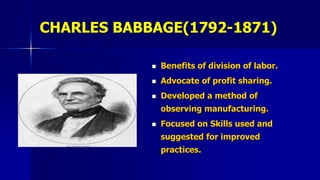
CHARLES BABBAGE(1792-1871)
 Benefits of division of labor.
 Advocate of profit sharing.
 Developed a method of
observing manufacturing.
 Focused on Skills used and
suggested for improved
practices.
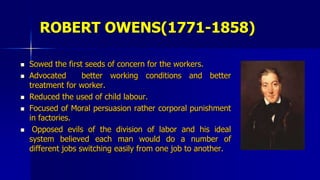
ROBERT OWENS(1771-1858)
 Sowed the first seeds of concern for the workers.
 Advocated better working conditions and better
treatment for worker.
 Reduced the used of child labour.
 Focused of Moral persuasion rather corporal punishment
in factories.
 Opposed evils of the division of labor and his ideal
system believed each man would do a number of
different jobs switching easily from one job to another.
Scientific management
 FREDERICK W. TAYLOR[1856-1956]-
 Father of Scientific Management
 Used time study for Division of Task.
 Introduced complementary piece-rate incentive
system.
 Focused on Best method of performing each task.
 Scientific Selection of worker.
 Scientific Education and development of Worker.
 Emphasized on Individual worker not the group.
Criticism of Scientific Management
Workers Viewpoint-
 Unemployment - Workers feel that management reduces employment
opportunities from them through replacement of men by machines.
 Exploitation - Workers feel they are exploited as they are not given due share in
increasing profits which is due to their increased productivity. Wages do not rise in
proportion as rise in production.
 Over speeding - The scientific management lays standard output, time so they
have to rush up and finish the work in time. These have adverse effect on health of
workers.
Employer’s Viewpoint-
 Expensive - Scientific management is a costly system and a huge investment is
required in establishment of planning dept., standardization, work study, training of
workers.
 Time Consuming - Scientific management requires mental revision and complete
reorganizing of organization.
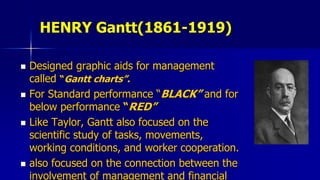
HENRY Gantt(1861-1919)
 Designed graphic aids for management
called “Gantt charts”.
 For Standard performance “BLACK” and for
below performance “RED”
 Like Taylor, Gantt also focused on the
scientific study of tasks, movements,
working conditions, and worker cooperation.
 also focused on the connection between the
involvement of management and financial
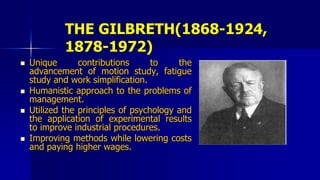
THE GILBRETH(1868-1924,
1878-1972)
 Unique contributions to the
advancement of motion study, fatigue
study and work simplification.
 Humanistic approach to the problems of
management.
 Utilized the principles of psychology and
the application of experimental results
to improve industrial procedures.
 Improving methods while lowering costs
and paying higher wages.
Administrative Theory
 HENRI FAYOL(1841-1925)-
 Fayol took a top-down approach to management by focusing on
managerial practices to increase efficiency in organizations.
 The major difference between Fayol and Taylor is Fayol's concern with
the "human" and behavioral characteristics of employees and his focus
on training management instead of on individual worker efficiency.
 Fayol stressed the importance and the practice of forecasting and
planning in order to train management and improve workplace
productivity.
 Fayol is also famous for putting forward 14 principles of management
and the five elements that constitute managerial responsibilities.
Fayol's 14 Principles of Management
 Division of Work
 Authority
 Discipline
 Unity of Command
 Unity of Direction
 Subordination of
Individual Interest
 Remuneration
 Centralization
 Scalar Chain
 Order
 Equity
 Stability of Tenure of
Personnel
 Initiative
 Esprit de Corps
Bureaucratic Management Theory
 Bureaucracy-Bureaucracies are all around us. This form of organization,
which is comprised of non-elected officials who implement rules, is not only
common in the public sector but in the business world as well.
 Examples of bureaucracies in the public sector include the Social Security
Administration, Environmental Protection Agency and public universities.
 Bureaucracy is an administrative system designed to accomplish large-scale
administrative tasks by systematically coordinating the work of many
individuals.
 Weber has observed three types of power in organizations: traditional,
charismatic and rational-legal or bureaucratic.
 He has emphasized that bureaucratic type of power is the ideal one.
Max weber(1864-1920)
 Max Weber Principle of Bureaucratic Theory-
 Job specialization
 Authority hierarchy
 Formal selection
 Formal rules and regulations
 Impersonality
 Career orientation
Mary Parker Follett
(September 3, 1868 – December 18,
1933) Prophet of Management/"Mother of Modern Management"
 1. Conflict resolution through Integration (i.e., identifying and
meeting each party's underlying and often compatible need, as
opposed to attempting to meet the frequently-incompatible
expressed desire of each) often results in a win-win situation.
2. In Mary Parker Follett leadership theory, genuine power is not
"coercive" ("power over") but "coactive" ("power with").
3. True leaders, according to Follett's theory, "create group power,
rather than expressing personal power.“
 Transformational Leadership
Human Relations Management
 ELTON MAYO(1880-1949) AND THE HAWTHORNE STUDIES-
 This theory stressed on formal structure.
 George Elton Mayo was in charge of certain experiments on human behavior
carried out at the Hawthorne Works of the General Electric Company in Chicago
between 1924 and 1927.
 His research findings have contributed to organization development in terms of
human relations and motivation theory.
 He found that work satisfaction depended to a large extent on the informal social
pattern of the work group. Where norms of cooperation and higher output were
established because of a feeling of importance, physical conditions or financial
incentives had little motivational value.
 People will form work groups and this can be used by management to benefit the
organization.
Cont..
 Elements of human relation theory
 Individual: – According to this theory each person bring his own set of
attitudes and skills to the job. The workers production depends upon the
human relation at the work and not the physical or the economic conditions.
 Informal organization - It recognizes the existence and influence of
informal organization. It is a sect of work relationships that grow out of the
mutual interaction of persons working together over a long period of time.
 Participative management - He advocated participation of workers in
decision making with regard to their working conditions.
Hawthorne Experiment
Conclusions
 Psychological Contract
 Interest in Workers
 Work is a Group Activity
 Social Aspect of Work
 Recognize Workers
 Communication
Conclusion
 The traditional view of how to motivate employees is that you offer monetary rewards (pay
increases, bonuses etc) for work completion. However the Hawthorne experiments may suggest
that motivation can be improved through improving working relationships and social interaction.
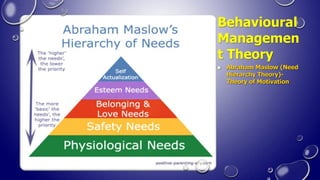
Behavioural
Managemen
t Theory
 Abraham Maslow (Need
Hierarchy Theory)-
Theory of Motivation
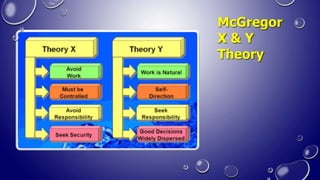
McGregor
X & Y
Theory
Contingency Theory
 A contingency theory is an organizational
theory that claims that there is no best way to
organize a corporation, to lead a company, or to
make decisions. Instead, the optimal course of
action is contingent (dependent) upon the internal
and external situation.
 A contingent leader effectively applies his own style
of leadership to the right situation.
 Organizations are open systems that need careful
management to satisfy and balance internal needs
and to adapt to environmental circumstances
 There is no one best way of organizing. The
appropriate form depends on the kind of task or
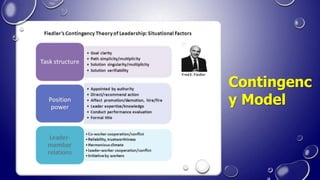
Contingenc
y Model
System
Approac
h
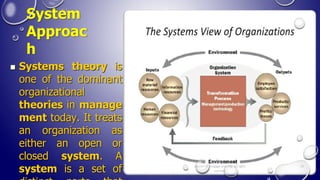
 Systems theory is
one of the dominant
organizational
theories in manage
ment today. It treats
an organization as
either an open or
closed system. A
system is a set of
Cont..
 Synergy
 Interdependence
 Interconnections
– within the organization
– between the organization and the environment
 Organization as ORGANISM
 “A set of elements standing in inter-relations”
Decision Theory approach
 decision making process. Decisions are made
through rationale choice among different
altenatives available. It is a choince
making activity and choice determines
our activity.Decision theories have expanded
their area of theory building in
the decision making process to the study of
decisions, decision-maker, and the enviroment
of decision-maker.
 Whatever a manager does, he does through
making decisions. Hence, decision making is
 The manager who seeks to take logical and
rationaleapproach to decision can follow the
following six steps:
1. Recognize and define the decision situation
2. Identify appropriate alternatives
3. Evaluate each alternative
4. Select the best alternative
5. Implement the alternative, and
6. Evaluate the results and follow up.

Evolution of management

  • 1.
  • 2.
    Evolution of management Early Contribution  Scientific Management  Administrative Theory  Bureaucracy Theory  Human Relation Management  Social System Approach  Decision Theory Approach
  • 3.
    Early Contribution  AdamSmith(1723-1790)-  Father of “Liberal Economics”  Focus on Market and competition analysis for economic conditions  Specialized Labour  And Division of labour leads to Increased Productivities.  Rise to the Human Capital.  Job Security.
  • 4.
    CHARLES BABBAGE(1792-1871)  Benefitsof division of labor.  Advocate of profit sharing.  Developed a method of observing manufacturing.  Focused on Skills used and suggested for improved practices.
  • 5.
    ROBERT OWENS(1771-1858)  Sowedthe first seeds of concern for the workers.  Advocated better working conditions and better treatment for worker.  Reduced the used of child labour.  Focused of Moral persuasion rather corporal punishment in factories.  Opposed evils of the division of labor and his ideal system believed each man would do a number of different jobs switching easily from one job to another.
  • 6.
    Scientific management  FREDERICKW. TAYLOR[1856-1956]-  Father of Scientific Management  Used time study for Division of Task.  Introduced complementary piece-rate incentive system.  Focused on Best method of performing each task.  Scientific Selection of worker.  Scientific Education and development of Worker.  Emphasized on Individual worker not the group.
  • 7.
    Criticism of ScientificManagement Workers Viewpoint-  Unemployment - Workers feel that management reduces employment opportunities from them through replacement of men by machines.  Exploitation - Workers feel they are exploited as they are not given due share in increasing profits which is due to their increased productivity. Wages do not rise in proportion as rise in production.  Over speeding - The scientific management lays standard output, time so they have to rush up and finish the work in time. These have adverse effect on health of workers. Employer’s Viewpoint-  Expensive - Scientific management is a costly system and a huge investment is required in establishment of planning dept., standardization, work study, training of workers.  Time Consuming - Scientific management requires mental revision and complete reorganizing of organization.
  • 8.
    HENRY Gantt(1861-1919)  Designedgraphic aids for management called “Gantt charts”.  For Standard performance “BLACK” and for below performance “RED”  Like Taylor, Gantt also focused on the scientific study of tasks, movements, working conditions, and worker cooperation.  also focused on the connection between the involvement of management and financial
  • 9.
    THE GILBRETH(1868-1924, 1878-1972)  Uniquecontributions to the advancement of motion study, fatigue study and work simplification.  Humanistic approach to the problems of management.  Utilized the principles of psychology and the application of experimental results to improve industrial procedures.  Improving methods while lowering costs and paying higher wages.
  • 10.
    Administrative Theory  HENRIFAYOL(1841-1925)-  Fayol took a top-down approach to management by focusing on managerial practices to increase efficiency in organizations.  The major difference between Fayol and Taylor is Fayol's concern with the "human" and behavioral characteristics of employees and his focus on training management instead of on individual worker efficiency.  Fayol stressed the importance and the practice of forecasting and planning in order to train management and improve workplace productivity.  Fayol is also famous for putting forward 14 principles of management and the five elements that constitute managerial responsibilities.
  • 11.
    Fayol's 14 Principlesof Management  Division of Work  Authority  Discipline  Unity of Command  Unity of Direction  Subordination of Individual Interest  Remuneration  Centralization  Scalar Chain  Order  Equity  Stability of Tenure of Personnel  Initiative  Esprit de Corps
  • 12.
    Bureaucratic Management Theory Bureaucracy-Bureaucracies are all around us. This form of organization, which is comprised of non-elected officials who implement rules, is not only common in the public sector but in the business world as well.  Examples of bureaucracies in the public sector include the Social Security Administration, Environmental Protection Agency and public universities.  Bureaucracy is an administrative system designed to accomplish large-scale administrative tasks by systematically coordinating the work of many individuals.  Weber has observed three types of power in organizations: traditional, charismatic and rational-legal or bureaucratic.  He has emphasized that bureaucratic type of power is the ideal one.
  • 13.
    Max weber(1864-1920)  MaxWeber Principle of Bureaucratic Theory-  Job specialization  Authority hierarchy  Formal selection  Formal rules and regulations  Impersonality  Career orientation
  • 14.
    Mary Parker Follett (September3, 1868 – December 18, 1933) Prophet of Management/"Mother of Modern Management"  1. Conflict resolution through Integration (i.e., identifying and meeting each party's underlying and often compatible need, as opposed to attempting to meet the frequently-incompatible expressed desire of each) often results in a win-win situation. 2. In Mary Parker Follett leadership theory, genuine power is not "coercive" ("power over") but "coactive" ("power with"). 3. True leaders, according to Follett's theory, "create group power, rather than expressing personal power.“  Transformational Leadership
  • 16.
    Human Relations Management ELTON MAYO(1880-1949) AND THE HAWTHORNE STUDIES-  This theory stressed on formal structure.  George Elton Mayo was in charge of certain experiments on human behavior carried out at the Hawthorne Works of the General Electric Company in Chicago between 1924 and 1927.  His research findings have contributed to organization development in terms of human relations and motivation theory.  He found that work satisfaction depended to a large extent on the informal social pattern of the work group. Where norms of cooperation and higher output were established because of a feeling of importance, physical conditions or financial incentives had little motivational value.  People will form work groups and this can be used by management to benefit the organization.
  • 17.
    Cont..  Elements ofhuman relation theory  Individual: – According to this theory each person bring his own set of attitudes and skills to the job. The workers production depends upon the human relation at the work and not the physical or the economic conditions.  Informal organization - It recognizes the existence and influence of informal organization. It is a sect of work relationships that grow out of the mutual interaction of persons working together over a long period of time.  Participative management - He advocated participation of workers in decision making with regard to their working conditions.
  • 18.
    Hawthorne Experiment Conclusions  PsychologicalContract  Interest in Workers  Work is a Group Activity  Social Aspect of Work  Recognize Workers  Communication Conclusion  The traditional view of how to motivate employees is that you offer monetary rewards (pay increases, bonuses etc) for work completion. However the Hawthorne experiments may suggest that motivation can be improved through improving working relationships and social interaction.
  • 19.
    Behavioural Managemen t Theory  AbrahamMaslow (Need Hierarchy Theory)- Theory of Motivation
  • 20.
  • 21.
    Contingency Theory  Acontingency theory is an organizational theory that claims that there is no best way to organize a corporation, to lead a company, or to make decisions. Instead, the optimal course of action is contingent (dependent) upon the internal and external situation.  A contingent leader effectively applies his own style of leadership to the right situation.  Organizations are open systems that need careful management to satisfy and balance internal needs and to adapt to environmental circumstances  There is no one best way of organizing. The appropriate form depends on the kind of task or
  • 22.
  • 23.
    System Approac h  Systems theoryis one of the dominant organizational theories in manage ment today. It treats an organization as either an open or closed system. A system is a set of
  • 24.
    Cont..  Synergy  Interdependence Interconnections – within the organization – between the organization and the environment  Organization as ORGANISM  “A set of elements standing in inter-relations”
  • 25.
    Decision Theory approach decision making process. Decisions are made through rationale choice among different altenatives available. It is a choince making activity and choice determines our activity.Decision theories have expanded their area of theory building in the decision making process to the study of decisions, decision-maker, and the enviroment of decision-maker.  Whatever a manager does, he does through making decisions. Hence, decision making is
  • 26.
     The managerwho seeks to take logical and rationaleapproach to decision can follow the following six steps: 1. Recognize and define the decision situation 2. Identify appropriate alternatives 3. Evaluate each alternative 4. Select the best alternative 5. Implement the alternative, and 6. Evaluate the results and follow up.