Adrenergic
System
S. Parasuraman, M.Pharm., Ph.D.,
Senior Lecturer, Faculty of Pharmacy, AIMST University
Nervous System
Central nervous
system
Peripheral
nervous system
Afferent division Efferent division
Somatic system Autonomic nervous
systemSympathetic
(thorcolumbar outflow)
Come from the thoracic
and lumbar regions (T1
to L2/3) of the spinal
cord
Parasympathetic
(craniosacral outflow)
Come from brainstem
(Cranial Nerves III, VII, IX, X)
or the sacral spinal cord (S2,
S3, S4)
Enteric nervous
system
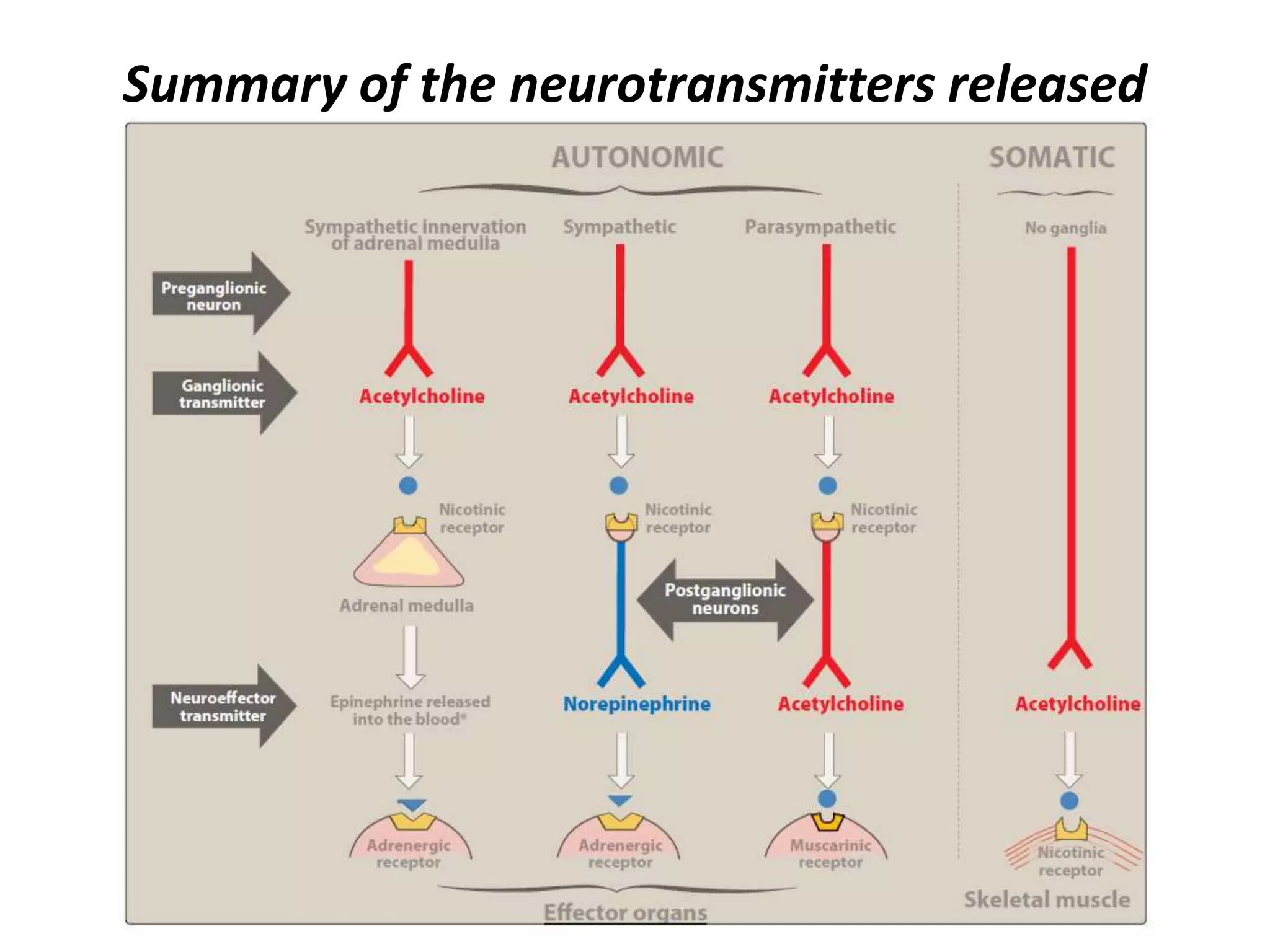
Summary of the neurotransmitters released
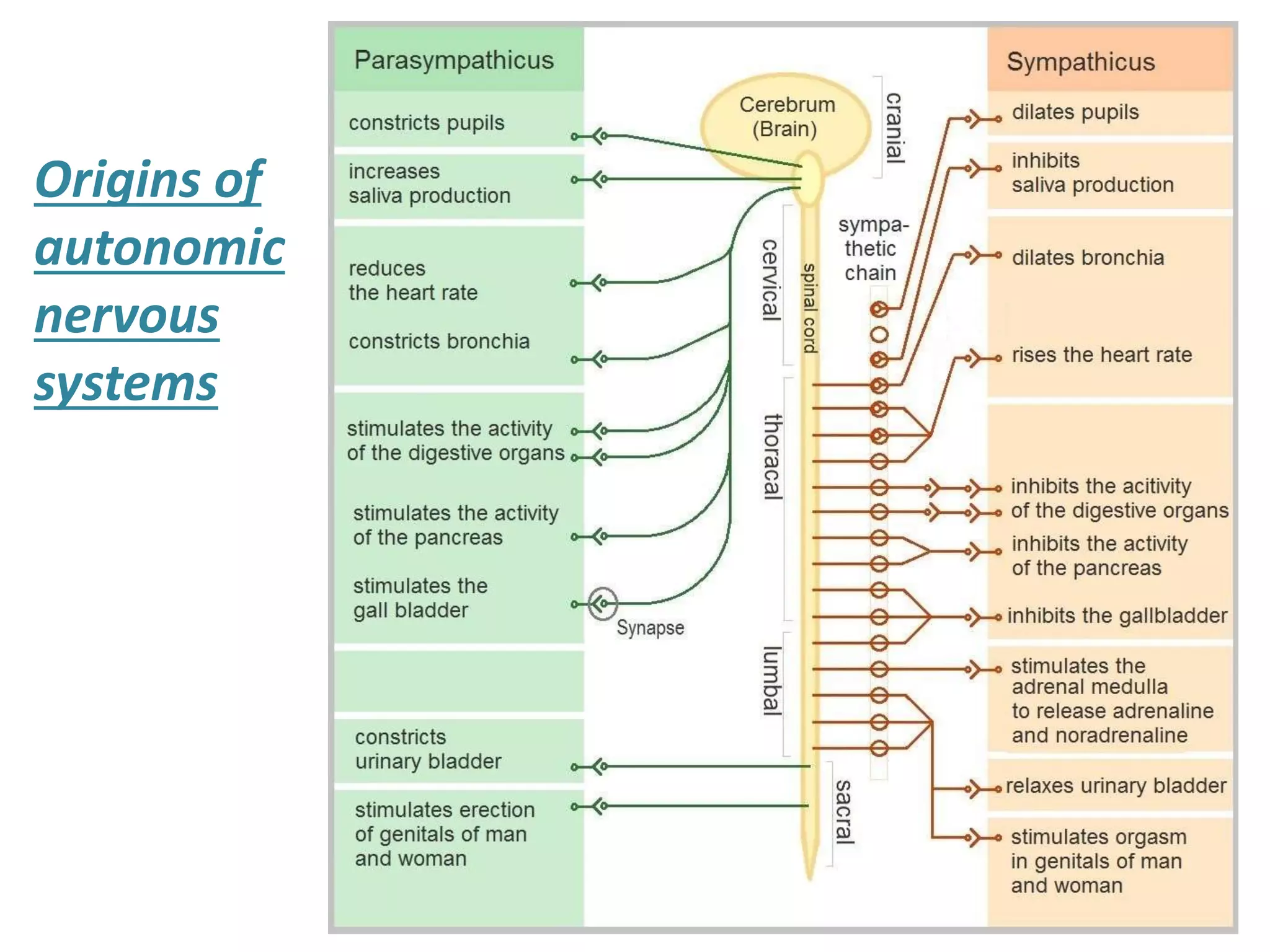
Origins of
autonomic
nervous
systems
Adrenergic system
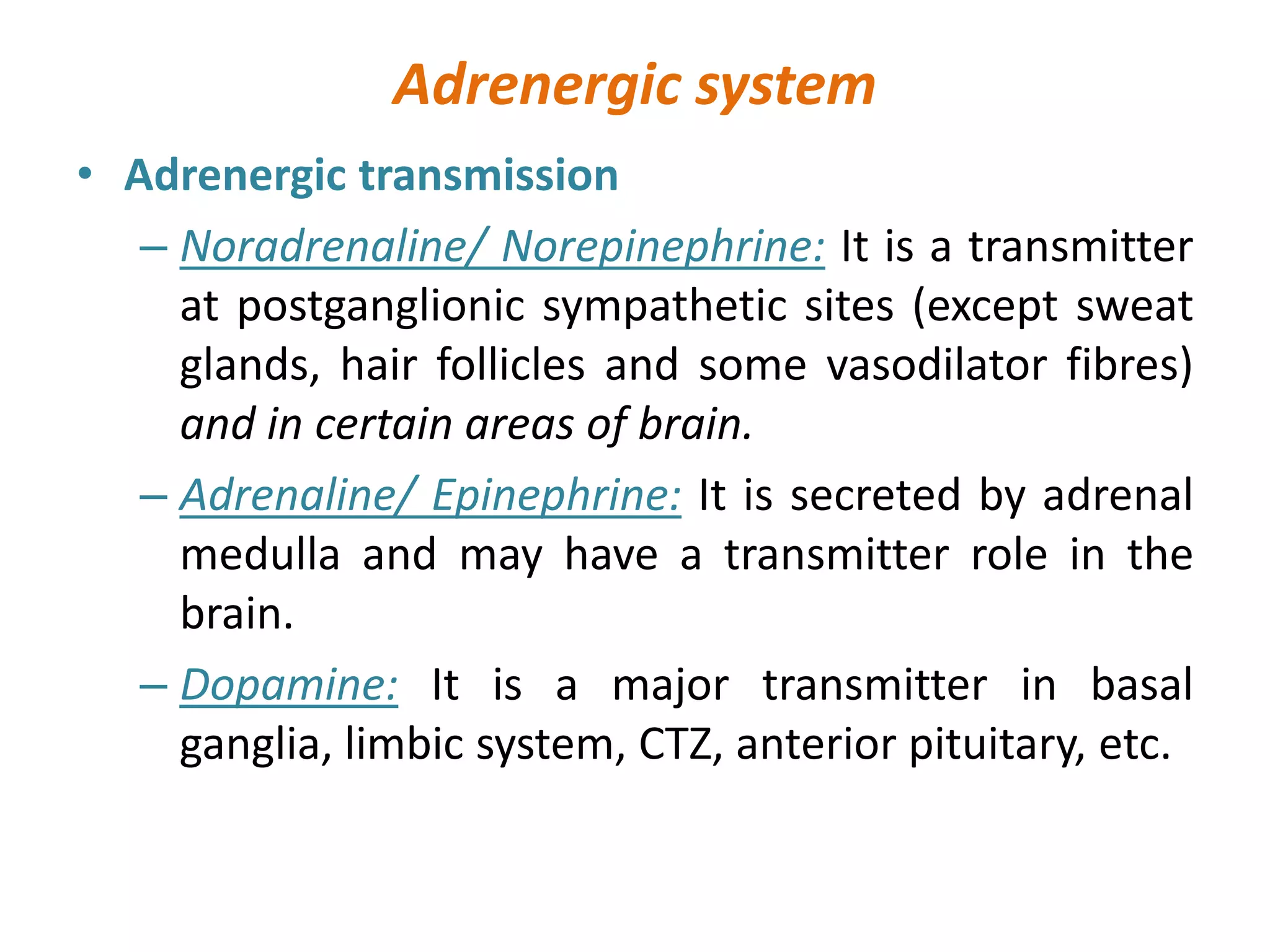
• Adrenergic transmission
– Noradrenaline/ Norepinephrine: It is a transmitter
at postganglionic sympathetic sites (except sweat
glands, hair follicles and some vasodilator fibres)
and in certain areas of brain.
– Adrenaline/ Epinephrine: It is secreted by adrenal
medulla and may have a transmitter role in the
brain.
– Dopamine: It is a major transmitter in basal
ganglia, limbic system, CTZ, anterior pituitary, etc.
Adrenergic system
• Steps in the synthesis of
catecholamines (CAs)
– Synthesis of CAs
– Storage of CAs
– Release of CAs
– Uptake of CAs
– Metabolism of CAs
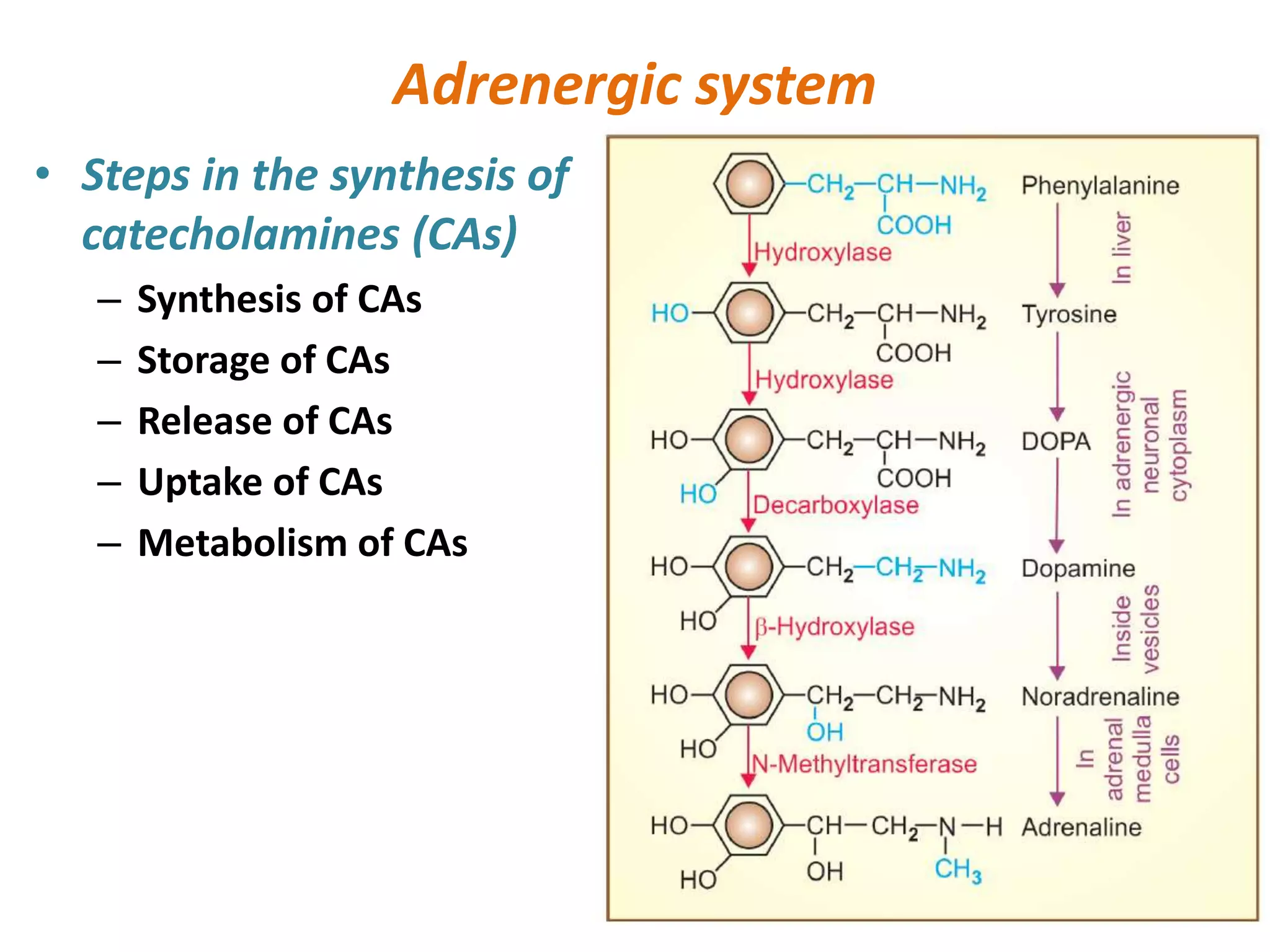
Steps in the synthesis of catecholamines
• Synthesis of CAs
– Catecholamines are synthesized from the amino acid
phenylalanine
– Tyrosine hydroxylase is a specific and the rate
limiting enzyme when its inhibited by alpha-
methyl-p-tyrosine (AMPT) results in depletion of
CAs.
– Synthesis of noradrenaline occurs in all
adrenergic neurones, while that of adrenaline
occurs only in the adrenal medullary cells.
Steps in the synthesis of catecholamines
• Storage of CAs
– Noradrenaline is stored in synaptic vesicles or
‘granules’ within the adrenergic nerve terminal
– The vesicular membrane actively takes up
dopamine from the cytoplasm and the final step
of synthesis of NA takes place inside the vesicle
which contains dopamine β-hydroxylase.
– Noradrenaline is stored as a complex with ATP (in
a ratio of 4 : 1) which is adsorbed on a protein
chromogranin.
Steps in the synthesis of catecholamines
• Release of CAs
– The nerve impulse coupled release of catecholamine takes
place by exocytosis and all the vesicular contents
noradrenaline or adrenaline, ATP, dopamine β hydroxylase,
chromogranin.
– The release is modulated by presynaptic receptors, of
which α2 inhibitory control is dominant.
Adrenergic system
• Uptake of CAs
– Axonal uptake: An Active Amine Pump (NET) is present at
the neuronal membrane which transports NA by a Na+
coupled mechanism. It takes up NA at a higher rate than
Adr and had been labelled uptake-1.
– Vesicular uptake: The membrane of intracellular vesicles
has another amine pump the ‘vesicular monoamine
transporter’ (VMAT-2), which transports catecholamine
from the cytoplasm to the interior of the storage vesicle.
This uptake is inhibited by reserpine, resulting in depletion
of CAs
– Extraneuronal uptake: It also called as uptake-2 and
carried out by extraneuronal amine transporter (ENT or
OCT3).
monoamine
oxidase (MAO)
Adrenergic system
• Metabolism of CAs
Noradrenaline Adrenalinemonoamine
oxidase (MAO)
3,4-dihydroxyphenylglycoaldehyde (DOPGAL)
catechol-O-
methyltransferase
(COMT)
catechol-O-
methyltransferase
(COMT)
Normetanephrine
Metanephrine
3,4-
dihydroxymandelic
acid( DOMA)
3,4-
dihydroxyphenylethylene
glycol (DOPEG)
Aldehyde reductase
3-methoxy-4-hydroxyphenylethylene
glycol (MOPEG)
Vanillylmandelic Acid
(VMA)
catechol-O- methyltransferase (COMT)
MOPGALMAO MAO
Aldehyde reductase Aldehyde reductase
Adrenergic receptors
• Adrenergic receptors are membrane bound G-
protein coupled receptors.
• Adrenergic receptors are classified into two types α
and β.
• The alpha-adrenergic receptors α1 receptor (α1A, α1B,
α1D) and α2 receptor (α2A, α2B, α2C) are GPCRs.
• The beta-adrenergic receptors β1, β2 and β3 receptor
are GPCRs.
• Presynaptically located α2 and β2 receptors playing
important roles in the regulation of
neurotransmitter release from sympathetic nerve
endings.
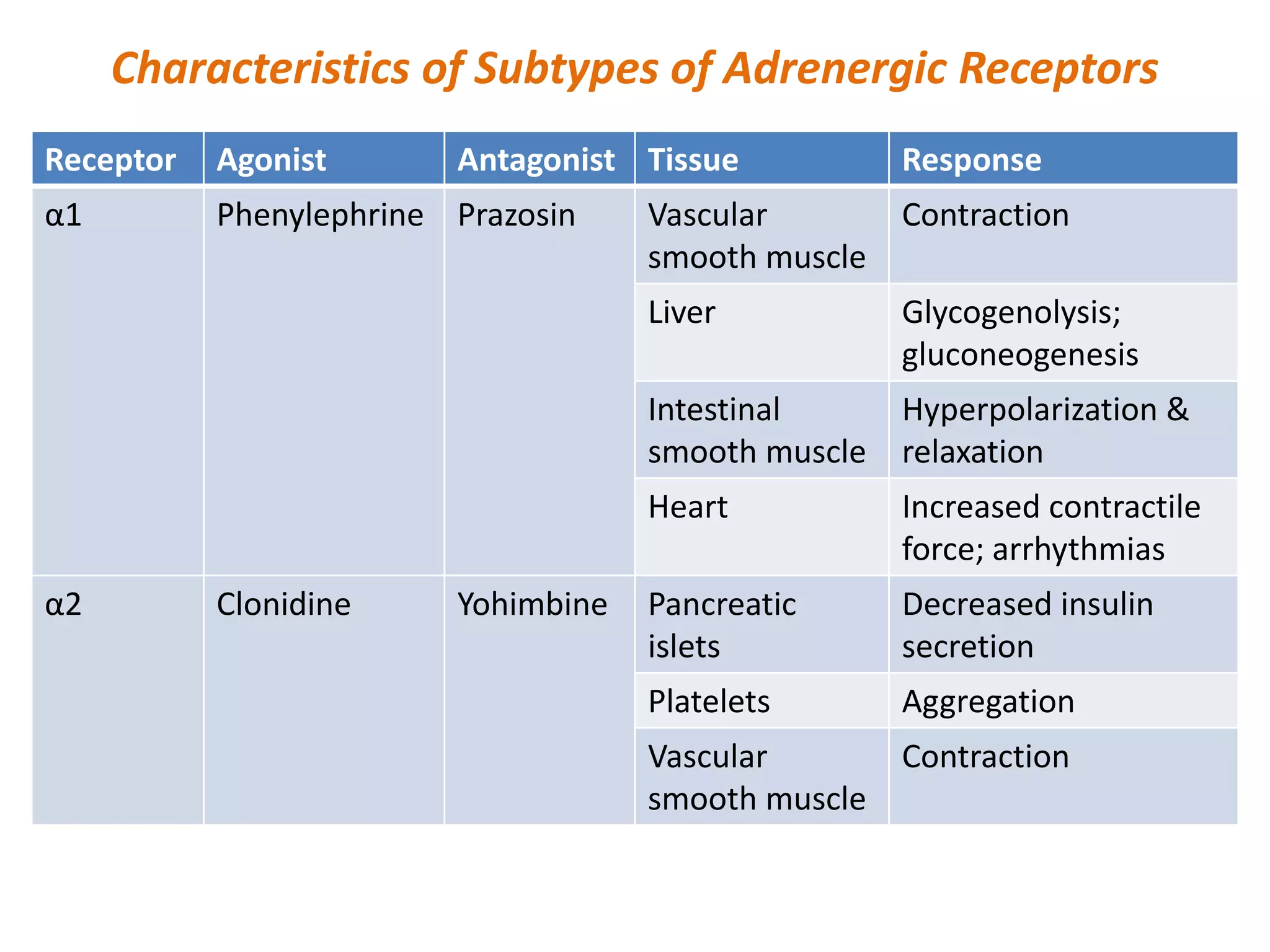
Characteristics of Subtypes of Adrenergic Receptors
Receptor Agonist Antagonist Tissue Response
α1 Phenylephrine Prazosin Vascular
smooth muscle
Contraction
Liver Glycogenolysis;
gluconeogenesis
Intestinal
smooth muscle
Hyperpolarization &
relaxation
Heart Increased contractile
force; arrhythmias
α2 Clonidine Yohimbine Pancreatic
islets
Decreased insulin
secretion
Platelets Aggregation
Vascular
smooth muscle
Contraction
Characteristics of Subtypes of Adrenergic Receptors
Receptor Agonist Antagonist Tissue Response
β1 Dobutamine Metoprolol Juxtaglomerular
cells
Increased renin
secretion
Nerve terminals Decreased release of
NE
Heart Increased force and
rate of contraction
and AV nodal
conduction
velocity
β2 Salbutamol,
Terbutaline
α-methyl
propranolol
Smooth muscle Relaxation
Skeletal muscle Glycogenolysis
Liver Glycogenolysis;
gluconeogenesis
β3 BRL 37344 ICI 118551 Adipose tissue Lipolysis
Adrenergic drugs
• Direct sympathomimetics: They act directly as
agonists on α and/or β adrenoceptors—Adr, NA,
isoprenaline (Iso), phenylephrine
• Indirect sympathomimetics: They act on adrenergic
neurone to release NA, which then acts on the
adrenoceptors—tyramine, amphetamine.
• Mixed action sympathomimetics: They act directly as
well as indirectly—ephedrine, dopamine,
mephentermine.
Adrenergic system

Adrenergic system

  • 1.
    Adrenergic System S. Parasuraman, M.Pharm.,Ph.D., Senior Lecturer, Faculty of Pharmacy, AIMST University
  • 2.
    Nervous System Central nervous system Peripheral nervoussystem Afferent division Efferent division Somatic system Autonomic nervous systemSympathetic (thorcolumbar outflow) Come from the thoracic and lumbar regions (T1 to L2/3) of the spinal cord Parasympathetic (craniosacral outflow) Come from brainstem (Cranial Nerves III, VII, IX, X) or the sacral spinal cord (S2, S3, S4) Enteric nervous system
  • 3.
    Summary of theneurotransmitters released
  • 4.
  • 5.
    Adrenergic system • Adrenergictransmission – Noradrenaline/ Norepinephrine: It is a transmitter at postganglionic sympathetic sites (except sweat glands, hair follicles and some vasodilator fibres) and in certain areas of brain. – Adrenaline/ Epinephrine: It is secreted by adrenal medulla and may have a transmitter role in the brain. – Dopamine: It is a major transmitter in basal ganglia, limbic system, CTZ, anterior pituitary, etc.
  • 6.
    Adrenergic system • Stepsin the synthesis of catecholamines (CAs) – Synthesis of CAs – Storage of CAs – Release of CAs – Uptake of CAs – Metabolism of CAs
  • 7.
    Steps in thesynthesis of catecholamines • Synthesis of CAs – Catecholamines are synthesized from the amino acid phenylalanine – Tyrosine hydroxylase is a specific and the rate limiting enzyme when its inhibited by alpha- methyl-p-tyrosine (AMPT) results in depletion of CAs. – Synthesis of noradrenaline occurs in all adrenergic neurones, while that of adrenaline occurs only in the adrenal medullary cells.
  • 8.
    Steps in thesynthesis of catecholamines • Storage of CAs – Noradrenaline is stored in synaptic vesicles or ‘granules’ within the adrenergic nerve terminal – The vesicular membrane actively takes up dopamine from the cytoplasm and the final step of synthesis of NA takes place inside the vesicle which contains dopamine β-hydroxylase. – Noradrenaline is stored as a complex with ATP (in a ratio of 4 : 1) which is adsorbed on a protein chromogranin.
  • 9.
    Steps in thesynthesis of catecholamines • Release of CAs – The nerve impulse coupled release of catecholamine takes place by exocytosis and all the vesicular contents noradrenaline or adrenaline, ATP, dopamine β hydroxylase, chromogranin. – The release is modulated by presynaptic receptors, of which α2 inhibitory control is dominant.
  • 10.
    Adrenergic system • Uptakeof CAs – Axonal uptake: An Active Amine Pump (NET) is present at the neuronal membrane which transports NA by a Na+ coupled mechanism. It takes up NA at a higher rate than Adr and had been labelled uptake-1. – Vesicular uptake: The membrane of intracellular vesicles has another amine pump the ‘vesicular monoamine transporter’ (VMAT-2), which transports catecholamine from the cytoplasm to the interior of the storage vesicle. This uptake is inhibited by reserpine, resulting in depletion of CAs – Extraneuronal uptake: It also called as uptake-2 and carried out by extraneuronal amine transporter (ENT or OCT3).
  • 11.
    monoamine oxidase (MAO) Adrenergic system •Metabolism of CAs Noradrenaline Adrenalinemonoamine oxidase (MAO) 3,4-dihydroxyphenylglycoaldehyde (DOPGAL) catechol-O- methyltransferase (COMT) catechol-O- methyltransferase (COMT) Normetanephrine Metanephrine 3,4- dihydroxymandelic acid( DOMA) 3,4- dihydroxyphenylethylene glycol (DOPEG) Aldehyde reductase 3-methoxy-4-hydroxyphenylethylene glycol (MOPEG) Vanillylmandelic Acid (VMA) catechol-O- methyltransferase (COMT) MOPGALMAO MAO Aldehyde reductase Aldehyde reductase
  • 12.
    Adrenergic receptors • Adrenergicreceptors are membrane bound G- protein coupled receptors. • Adrenergic receptors are classified into two types α and β. • The alpha-adrenergic receptors α1 receptor (α1A, α1B, α1D) and α2 receptor (α2A, α2B, α2C) are GPCRs. • The beta-adrenergic receptors β1, β2 and β3 receptor are GPCRs. • Presynaptically located α2 and β2 receptors playing important roles in the regulation of neurotransmitter release from sympathetic nerve endings.
  • 13.
    Characteristics of Subtypesof Adrenergic Receptors Receptor Agonist Antagonist Tissue Response α1 Phenylephrine Prazosin Vascular smooth muscle Contraction Liver Glycogenolysis; gluconeogenesis Intestinal smooth muscle Hyperpolarization & relaxation Heart Increased contractile force; arrhythmias α2 Clonidine Yohimbine Pancreatic islets Decreased insulin secretion Platelets Aggregation Vascular smooth muscle Contraction
  • 14.
    Characteristics of Subtypesof Adrenergic Receptors Receptor Agonist Antagonist Tissue Response β1 Dobutamine Metoprolol Juxtaglomerular cells Increased renin secretion Nerve terminals Decreased release of NE Heart Increased force and rate of contraction and AV nodal conduction velocity β2 Salbutamol, Terbutaline α-methyl propranolol Smooth muscle Relaxation Skeletal muscle Glycogenolysis Liver Glycogenolysis; gluconeogenesis β3 BRL 37344 ICI 118551 Adipose tissue Lipolysis
  • 16.
    Adrenergic drugs • Directsympathomimetics: They act directly as agonists on α and/or β adrenoceptors—Adr, NA, isoprenaline (Iso), phenylephrine • Indirect sympathomimetics: They act on adrenergic neurone to release NA, which then acts on the adrenoceptors—tyramine, amphetamine. • Mixed action sympathomimetics: They act directly as well as indirectly—ephedrine, dopamine, mephentermine.