Introduction
Pharmacodynamics is the
study of the biochemical
and physiological effects
of drugs and their
mechanisms of action.
Pharmacodynamics is
often referred to as
“what the drug does to
the body”.
In order to exert their effects, drugs usually
interact in a structurally specific way with a
protein receptor or act on physiological
processes within the body.
This activates a secondary messenger system
that produces a physiological effect.
Drugs do not create new action but they
can only modify (alter) the functions of
cells or tissues in body.
The drug–receptor complex initiates
alterations in biochemical and/or
molecular activity of a cell by a process
called signal transduction.
Principles of drug action
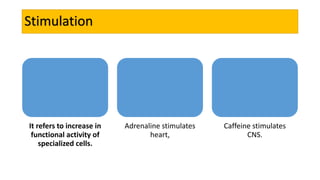
Stimulation
It refers to increase in
functional activity of
specialized cells.
Adrenaline stimulates
heart,
Caffeine stimulates
CNS.
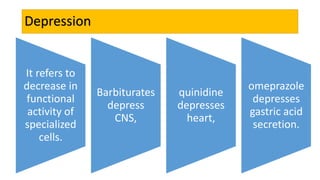
Depression
It refers to
decrease in
functional
activity of
specialized
cells.
Barbiturates
depress
CNS,
quinidine
depresses
heart,
omeprazole
depresses
gastric acid
secretion.
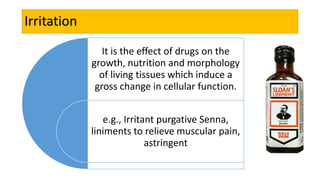
Irritation
It is the effect of drugs on the
growth, nutrition and morphology
of living tissues which induce a
gross change in cellular function.
e.g., Irritant purgative Senna,
liniments to relieve muscular pain,
astringent
Replacement
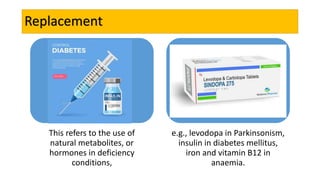
This refers to the use of
natural metabolites, or
hormones in deficiency
conditions,
e.g., levodopa in Parkinsonism,
insulin in diabetes mellitus,
iron and vitamin B12 in
anaemia.
Chemical action
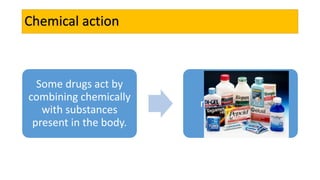
Some drugs act by
combining chemically
with substances
present in the body.
e.g., antacids
neutralise gastric
acid.
Cytotoxic action
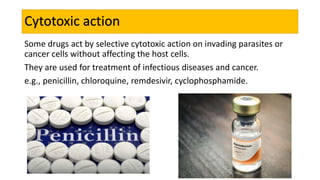
Some drugs act by selective cytotoxic action on invading parasites or
cancer cells without affecting the host cells.
They are used for treatment of infectious diseases and cancer.
e.g., penicillin, chloroquine, remdesivir, cyclophosphamide.
MECHANISMS OF DRUG ACTION
Most drugs produce their effects by binding to specific
target proteins like receptors, enzymes and ion channels.
Drugs may act on the cell membrane, inside or outside
the cell to produce their effect.
Drugs may act by one or more complex mechanisms of
action.
Some of them are yet to be understood.
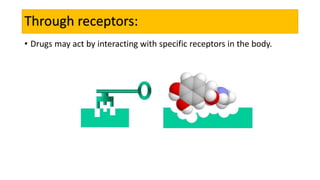
Through receptors:
• Drugs may act by interacting with specific receptors in the body.
Through enzymes and pumps:
Drugs may act by inhibition of various enzymes,
thus altering the enzyme-mediated reactions,
e.g. allopurinol inhibits the enzyme xanthine
oxidase;
acetazolamide inhibits carbonic anhydrase,
enalapril inhibits angiotensin converting enzyme,
Through ion channels:
Drugs may interfere with the
movement of ions across specific
channels,
e.g., calcium channel blockers, sodium
channel blockers, potassium channel
openers and GABA gated chloride
channel modulators.
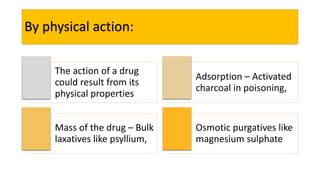
By physical action:
The action of a drug
could result from its
physical properties
Adsorption – Activated
charcoal in poisoning,
Mass of the drug – Bulk
laxatives like psyllium,
Osmotic purgatives like
magnesium sulphate
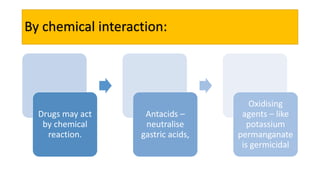
By chemical interaction:
Drugs may act
by chemical
reaction.
Antacids –
neutralise
gastric acids,
Oxidising
agents – like
potassium
permanganate
is germicidal
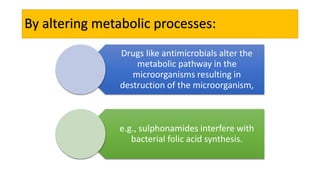
By altering metabolic processes:
Drugs like antimicrobials alter the
metabolic pathway in the
microorganisms resulting in
destruction of the microorganism,
e.g., sulphonamides interfere with
bacterial folic acid synthesis.
Drug and receptor concepts
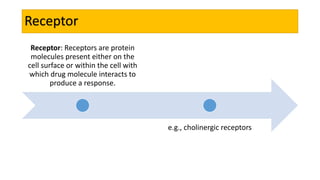
Receptor
Receptor: Receptors are protein
molecules present either on the
cell surface or within the cell with
which drug molecule interacts to
produce a response.
e.g., cholinergic receptors
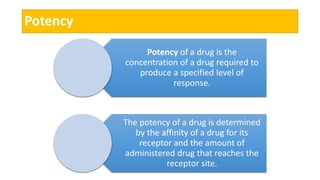
Potency
Potency of a drug is the
concentration of a drug required to
produce a specified level of
response.
The potency of a drug is determined
by the affinity of a drug for its
receptor and the amount of
administered drug that reaches the
receptor site.
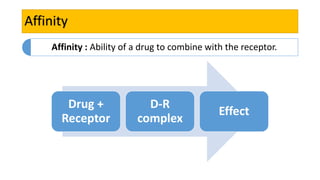
Affinity
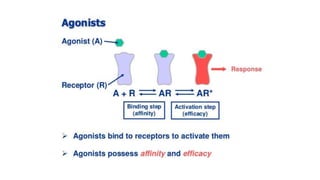
Affinity : Ability of a drug to combine with the receptor.
Drug +
Receptor
D-R
complex
Effect
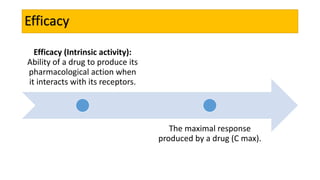
Efficacy
Efficacy (Intrinsic activity):
Ability of a drug to produce its
pharmacological action when
it interacts with its receptors.
The maximal response
produced by a drug (C max).
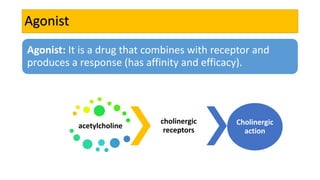
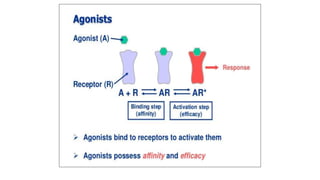
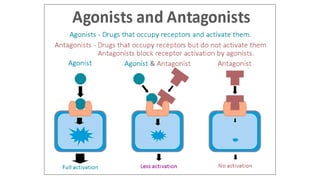
Agonist
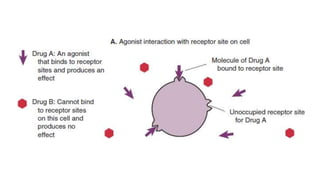
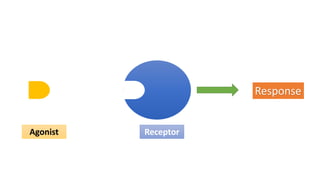
Agonist: It is a drug that combines with receptor and
produces a response (has affinity and efficacy).
acetylcholine
cholinergic
receptors
Cholinergic
action
Agonist Receptor
Response
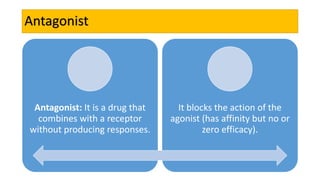
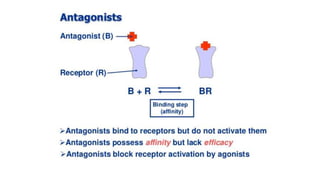
Antagonist
Antagonist: It is a drug that
combines with a receptor
without producing responses.
It blocks the action of the
agonist (has affinity but no or
zero efficacy).
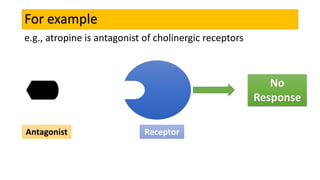
Antagonist Receptor
No
Response
e.g., atropine is antagonist of cholinergic receptors
For example
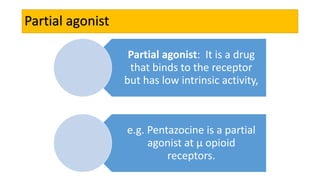
Partial agonist
Partial agonist: It is a drug
that binds to the receptor
but has low intrinsic activity,
e.g. Pentazocine is a partial
agonist at μ opioid
receptors.
Drug Receptor Interaction
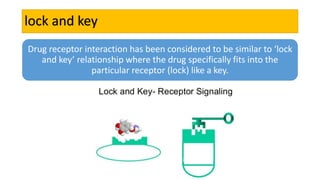
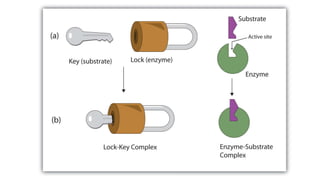
lock and key
Drug receptor interaction has been considered to be similar to ‘lock
and key’ relationship where the drug specifically fits into the
particular receptor (lock) like a key.
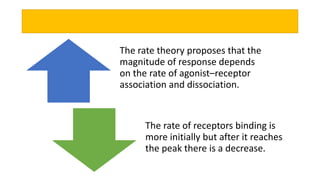
The rate theory proposes that the
magnitude of response depends
on the rate of agonist–receptor
association and dissociation.
The rate of receptors binding is
more initially but after it reaches
the peak there is a decrease.
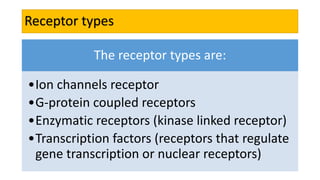
Receptor types
The receptor types are:
•Ion channels receptor
•G-protein coupled receptors
•Enzymatic receptors (kinase linked receptor)
•Transcription factors (receptors that regulate
gene transcription or nuclear receptors)
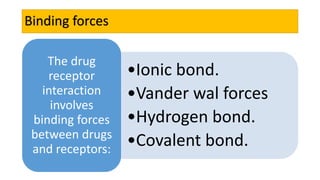
Binding forces
•Ionic bond.
•Vander wal forces
•Hydrogen bond.
•Covalent bond.
The drug
receptor
interaction
involves
binding forces
between drugs
and receptors:
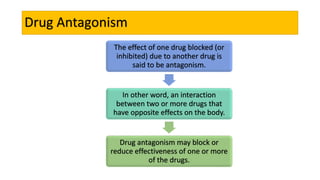
The effect of one drug blocked (or
inhibited) due to another drug is
said to be antagonism.
In other word, an interaction
between two or more drugs that
have opposite effects on the body.
Drug antagonism may block or
reduce effectiveness of one or more
of the drugs.
Drug Antagonism
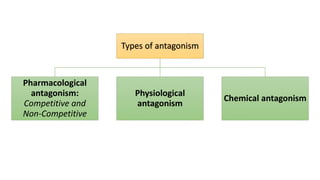
Types of antagonism
Pharmacological
antagonism:
Competitive and
Non-Competitive
Physiological
antagonism
Chemical antagonism
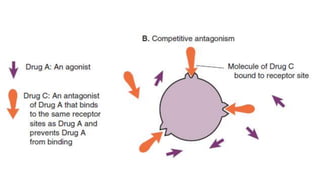
Competitive Antagonism
If both the agonist and the antagonist compete for the same
receptor in a reversible manner, they are said to be
“competitive.”
The antagonist drug interacts with the receptor, and blocks it.
Therefore it does not produce pharmacological action.
The extent of antagonism depends on number of receptors
occupied by the both drugs (agonist and antagonist), their
affinity for receptors and their concentration.
Competitive Antagonism
The increase in concentration of either one of these drugs can
displace the other from receptor binding sites.
Drugs interact with their receptors by weak bonds
i.e. ionic bond or Hydrogen bond or Vander wal force.
Hence duration of action of drug is short. Both agonist and
antagonist have chemical resemblance (structural similarity).
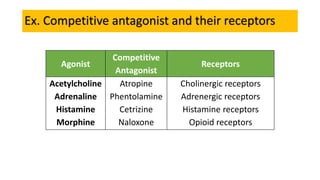
Ex. Competitive antagonist and their receptors
Agonist
Competitive
Antagonist
Receptors
Acetylcholine
Adrenaline
Histamine
Morphine
Atropine
Phentolamine
Cetrizine
Naloxone
Cholinergic receptors
Adrenergic receptors
Histamine receptors
Opioid receptors
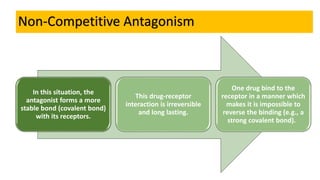
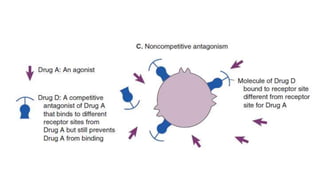
Non-Competitive Antagonism
In this situation, the
antagonist forms a more
stable bond (covalent bond)
with its receptors.
This drug-receptor
interaction is irreversible
and long lasting.
One drug bind to the
receptor in a manner which
makes it is impossible to
reverse the binding (e.g., a
strong covalent bond).
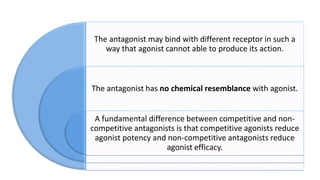
The antagonist may bind with different receptor in such a
way that agonist cannot able to produce its action.
The antagonist has no chemical resemblance with agonist.
A fundamental difference between competitive and non-
competitive antagonists is that competitive agonists reduce
agonist potency and non-competitive antagonists reduce
agonist efficacy.
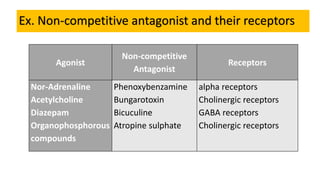
Ex. Non-competitive antagonist and their receptors
Agonist
Non-competitive
Antagonist
Receptors
Nor-Adrenaline
Acetylcholine
Diazepam
Organophosphorous
compounds
Phenoxybenzamine
Bungarotoxin
Bicuculine
Atropine sulphate
alpha receptors
Cholinergic receptors
GABA receptors
Cholinergic receptors
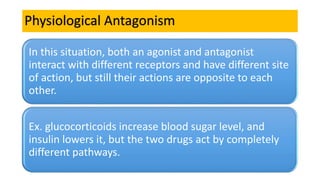
Physiological Antagonism
In this situation, both an agonist and antagonist
interact with different receptors and have different site
of action, but still their actions are opposite to each
other.
Ex. glucocorticoids increase blood sugar level, and
insulin lowers it, but the two drugs act by completely
different pathways.
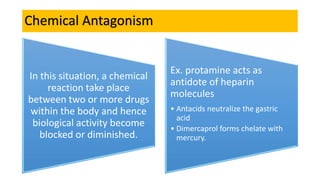
Chemical Antagonism
In this situation, a chemical
reaction take place
between two or more drugs
within the body and hence
biological activity become
blocked or diminished.
Ex. protamine acts as
antidote of heparin
molecules
• Antacids neutralize the gastric
acid
• Dimercaprol forms chelate with
mercury.
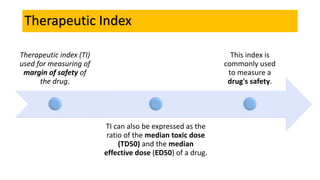
Therapeutic Index
Therapeutic index (TI)
used for measuring of
margin of safety of
the drug.
TI can also be expressed as the
ratio of the median toxic dose
(TD50) and the median
effective dose (ED50) of a drug.
This index is
commonly used
to measure a
drug's safety.
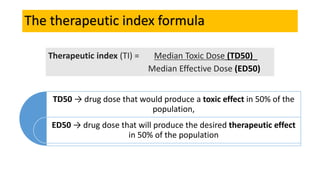
The therapeutic index formula
Therapeutic index (TI) = Median Toxic Dose (TD50)_
Median Effective Dose (ED50)
TD50 → drug dose that would produce a toxic effect in 50% of the
population,
ED50 → drug dose that will produce the desired therapeutic effect
in 50% of the population
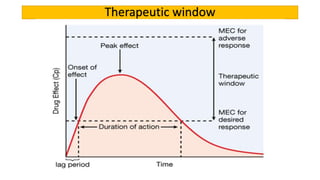
Therapeutic window
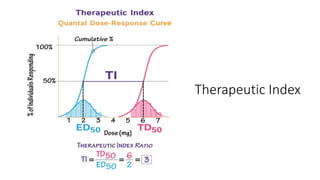
Therapeutic Index
The larger value of TI indicates that there is a wide
margin between the toxic and effective dose,
whereas a smaller value indicates that there is a
narrow margin between the effective and toxic dose.
In case of drugs that have a low TI, even a small
increase in the dosage can produce toxic effects.
Additional care must be taken while prescribing a
drug with a narrow therapeutic index (NTI).
Therefore, the pharmaceutical industry has
been making efforts to replace NTI drugs
(drugs that could be toxic at relatively low
levels) with drugs with higher TIs.
Some drugs that have a narrow therapeutic
index are: warfarin, lithium, digoxin,
phenytoin, gentamicin, amphotericin-b, 5-
fluorouracil, zidovudine etc.
Prof. Amol Deore

Pharmacodynamics

  • 2.
    Introduction Pharmacodynamics is the studyof the biochemical and physiological effects of drugs and their mechanisms of action. Pharmacodynamics is often referred to as “what the drug does to the body”.
  • 3.
    In order toexert their effects, drugs usually interact in a structurally specific way with a protein receptor or act on physiological processes within the body. This activates a secondary messenger system that produces a physiological effect.
  • 4.
    Drugs do notcreate new action but they can only modify (alter) the functions of cells or tissues in body. The drug–receptor complex initiates alterations in biochemical and/or molecular activity of a cell by a process called signal transduction.
  • 5.
  • 6.
    Stimulation It refers toincrease in functional activity of specialized cells. Adrenaline stimulates heart, Caffeine stimulates CNS.
  • 7.
    Depression It refers to decreasein functional activity of specialized cells. Barbiturates depress CNS, quinidine depresses heart, omeprazole depresses gastric acid secretion.
  • 8.
    Irritation It is theeffect of drugs on the growth, nutrition and morphology of living tissues which induce a gross change in cellular function. e.g., Irritant purgative Senna, liniments to relieve muscular pain, astringent
  • 9.
    Replacement This refers tothe use of natural metabolites, or hormones in deficiency conditions, e.g., levodopa in Parkinsonism, insulin in diabetes mellitus, iron and vitamin B12 in anaemia.
  • 10.
    Chemical action Some drugsact by combining chemically with substances present in the body. e.g., antacids neutralise gastric acid.
  • 11.
    Cytotoxic action Some drugsact by selective cytotoxic action on invading parasites or cancer cells without affecting the host cells. They are used for treatment of infectious diseases and cancer. e.g., penicillin, chloroquine, remdesivir, cyclophosphamide.
  • 12.
  • 13.
    Most drugs producetheir effects by binding to specific target proteins like receptors, enzymes and ion channels. Drugs may act on the cell membrane, inside or outside the cell to produce their effect. Drugs may act by one or more complex mechanisms of action. Some of them are yet to be understood.
  • 14.
    Through receptors: • Drugsmay act by interacting with specific receptors in the body.
  • 15.
    Through enzymes andpumps: Drugs may act by inhibition of various enzymes, thus altering the enzyme-mediated reactions, e.g. allopurinol inhibits the enzyme xanthine oxidase; acetazolamide inhibits carbonic anhydrase, enalapril inhibits angiotensin converting enzyme,
  • 16.
    Through ion channels: Drugsmay interfere with the movement of ions across specific channels, e.g., calcium channel blockers, sodium channel blockers, potassium channel openers and GABA gated chloride channel modulators.
  • 17.
    By physical action: Theaction of a drug could result from its physical properties Adsorption – Activated charcoal in poisoning, Mass of the drug – Bulk laxatives like psyllium, Osmotic purgatives like magnesium sulphate
  • 18.
    By chemical interaction: Drugsmay act by chemical reaction. Antacids – neutralise gastric acids, Oxidising agents – like potassium permanganate is germicidal
  • 19.
    By altering metabolicprocesses: Drugs like antimicrobials alter the metabolic pathway in the microorganisms resulting in destruction of the microorganism, e.g., sulphonamides interfere with bacterial folic acid synthesis.
  • 20.
  • 21.
    Receptor Receptor: Receptors areprotein molecules present either on the cell surface or within the cell with which drug molecule interacts to produce a response. e.g., cholinergic receptors
  • 22.
    Potency Potency of adrug is the concentration of a drug required to produce a specified level of response. The potency of a drug is determined by the affinity of a drug for its receptor and the amount of administered drug that reaches the receptor site.
  • 23.
    Affinity Affinity : Abilityof a drug to combine with the receptor. Drug + Receptor D-R complex Effect
  • 24.
    Efficacy Efficacy (Intrinsic activity): Abilityof a drug to produce its pharmacological action when it interacts with its receptors. The maximal response produced by a drug (C max).
  • 25.
    Agonist Agonist: It isa drug that combines with receptor and produces a response (has affinity and efficacy). acetylcholine cholinergic receptors Cholinergic action
  • 27.
  • 29.
    Antagonist Antagonist: It isa drug that combines with a receptor without producing responses. It blocks the action of the agonist (has affinity but no or zero efficacy).
  • 30.
    Antagonist Receptor No Response e.g., atropineis antagonist of cholinergic receptors For example
  • 32.
    Partial agonist Partial agonist:It is a drug that binds to the receptor but has low intrinsic activity, e.g. Pentazocine is a partial agonist at μ opioid receptors.
  • 33.
  • 34.
    lock and key Drugreceptor interaction has been considered to be similar to ‘lock and key’ relationship where the drug specifically fits into the particular receptor (lock) like a key.
  • 36.
    The rate theoryproposes that the magnitude of response depends on the rate of agonist–receptor association and dissociation. The rate of receptors binding is more initially but after it reaches the peak there is a decrease.
  • 38.
    Receptor types The receptortypes are: •Ion channels receptor •G-protein coupled receptors •Enzymatic receptors (kinase linked receptor) •Transcription factors (receptors that regulate gene transcription or nuclear receptors)
  • 39.
    Binding forces •Ionic bond. •Vanderwal forces •Hydrogen bond. •Covalent bond. The drug receptor interaction involves binding forces between drugs and receptors:
  • 40.
    The effect ofone drug blocked (or inhibited) due to another drug is said to be antagonism. In other word, an interaction between two or more drugs that have opposite effects on the body. Drug antagonism may block or reduce effectiveness of one or more of the drugs. Drug Antagonism
  • 41.
    Types of antagonism Pharmacological antagonism: Competitiveand Non-Competitive Physiological antagonism Chemical antagonism
  • 43.
    Competitive Antagonism If boththe agonist and the antagonist compete for the same receptor in a reversible manner, they are said to be “competitive.” The antagonist drug interacts with the receptor, and blocks it. Therefore it does not produce pharmacological action. The extent of antagonism depends on number of receptors occupied by the both drugs (agonist and antagonist), their affinity for receptors and their concentration.
  • 44.
    Competitive Antagonism The increasein concentration of either one of these drugs can displace the other from receptor binding sites. Drugs interact with their receptors by weak bonds i.e. ionic bond or Hydrogen bond or Vander wal force. Hence duration of action of drug is short. Both agonist and antagonist have chemical resemblance (structural similarity).
  • 46.
    Ex. Competitive antagonistand their receptors Agonist Competitive Antagonist Receptors Acetylcholine Adrenaline Histamine Morphine Atropine Phentolamine Cetrizine Naloxone Cholinergic receptors Adrenergic receptors Histamine receptors Opioid receptors
  • 47.
    Non-Competitive Antagonism In thissituation, the antagonist forms a more stable bond (covalent bond) with its receptors. This drug-receptor interaction is irreversible and long lasting. One drug bind to the receptor in a manner which makes it is impossible to reverse the binding (e.g., a strong covalent bond).
  • 48.
    The antagonist maybind with different receptor in such a way that agonist cannot able to produce its action. The antagonist has no chemical resemblance with agonist. A fundamental difference between competitive and non- competitive antagonists is that competitive agonists reduce agonist potency and non-competitive antagonists reduce agonist efficacy.
  • 50.
    Ex. Non-competitive antagonistand their receptors Agonist Non-competitive Antagonist Receptors Nor-Adrenaline Acetylcholine Diazepam Organophosphorous compounds Phenoxybenzamine Bungarotoxin Bicuculine Atropine sulphate alpha receptors Cholinergic receptors GABA receptors Cholinergic receptors
  • 51.
    Physiological Antagonism In thissituation, both an agonist and antagonist interact with different receptors and have different site of action, but still their actions are opposite to each other. Ex. glucocorticoids increase blood sugar level, and insulin lowers it, but the two drugs act by completely different pathways.
  • 52.
    Chemical Antagonism In thissituation, a chemical reaction take place between two or more drugs within the body and hence biological activity become blocked or diminished. Ex. protamine acts as antidote of heparin molecules • Antacids neutralize the gastric acid • Dimercaprol forms chelate with mercury.
  • 53.
    Therapeutic Index Therapeutic index(TI) used for measuring of margin of safety of the drug. TI can also be expressed as the ratio of the median toxic dose (TD50) and the median effective dose (ED50) of a drug. This index is commonly used to measure a drug's safety.
  • 54.
    The therapeutic indexformula Therapeutic index (TI) = Median Toxic Dose (TD50)_ Median Effective Dose (ED50) TD50 → drug dose that would produce a toxic effect in 50% of the population, ED50 → drug dose that will produce the desired therapeutic effect in 50% of the population
  • 55.
  • 56.
  • 57.
    The larger valueof TI indicates that there is a wide margin between the toxic and effective dose, whereas a smaller value indicates that there is a narrow margin between the effective and toxic dose. In case of drugs that have a low TI, even a small increase in the dosage can produce toxic effects. Additional care must be taken while prescribing a drug with a narrow therapeutic index (NTI).
  • 58.
    Therefore, the pharmaceuticalindustry has been making efforts to replace NTI drugs (drugs that could be toxic at relatively low levels) with drugs with higher TIs. Some drugs that have a narrow therapeutic index are: warfarin, lithium, digoxin, phenytoin, gentamicin, amphotericin-b, 5- fluorouracil, zidovudine etc.
  • 59.