Pharmacodynamics Dr Rizwan Ashraf
Lecture Objectives  To understand the basic concepts regarding  pharmacodynamics To define agonist and antagonists and other  terms in relation to pharmacodynamics To explain the mechanism of drug receptor  interaction Define spare receptors To differentitate between different tyes of  antagonism
WHAT IS PHARMACODYNAMICS ?
 
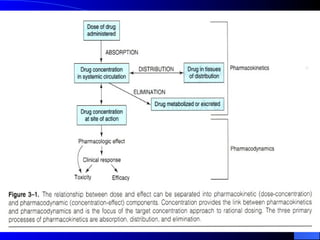
Action of a drug on the body   receptor interactions,  mechanisms of therapeutic dose-response phenomena,  toxic action .
RECEPTOR INTERACTION
A drug will not work unless it is bound AGREED or NOT AGREED
BOUND WITH WHAT ?
PARTICULAR CONSTITUENTS OF CELLS & TISSUES IN ORDER TO  PRODUCE AN EFFECT PROTEINS LIPIDS DNA RECEPTORS ?
ARE THERE DRUGS THAT ACT WITHOUT BEING BOUND TO ANY OF THE TISSUE CONSTITUENTS YES  OR  NO
YES OSMOTIC DIURETICS OSMOTIC PURGATIVES ANTACIDS HEAVY METALS CHELATING AGENTS
BUT   PRINCPLES REMAIN TRUE FOR GREAT MAJORITY THAT IS _____________________ ______________________________.
Most drugs act through  Receptors
Receptors
Drug Receptor A macromolecular component of a cell with which a drug interacts to produce a response Usually a protein
Receptors must be biologically important molecules Receptors must have structural features that permit  drug specificity   Receptors must have a  drug-binding site  and a  biologically active site
Characteristics of Receptors       a. specificity        b. selectivity of response        c. sensitivity
Molecules capable of serving as  Receptors
Enzymes Membrane proteins glycoproteins, lipoproteins) Nucleic acids Complex polysaccharides
Many drugs inhibit  enzymes in the patient (ACE inhibitors) in microbes (sulfas, Penicillins) in cancer cells (5-FU, 6-MP)
Types of Protein  Receptors Regulatory –  mediate the action of endogenous    chemicals e.g. hormones,    NT,autocoids Enzymes –  may be inhibited or activated   e.g. dihydrofolate reductase    receptor for methotrexate  Transport –  e.g. Na +  /K +  ATP’ase for digitalis    glycosides  Structural –  e.g. tubulin,receptor for colchicine
some drugs bind to: the genome (cyclophosphamide) microtubules (vincristine)
Non-receptor Mediated Effects Interaction with small molecules   (e.g. binding of heavy metals) Interaction with enzymes   (e.g. sulfonamides, digitalis) Incorporation into a macromolecule   (e.g. some anticancer agents - purine and    pyrimidine analogues) Nonspecific effects   (e.g. membrane perturbation by general    anesthetics)
Receptor-independent drug actions Chemically reactive agents Disinfectants Alkylating anticancer drugs Physically active agents Mannitol Hydrogen peroxide Counterfeit biochemical constituents 5-bromouracil
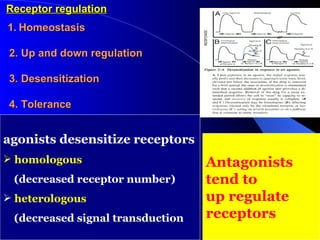
Antagonists  tend to  up regulate  receptors   Receptor regulation      1.   Homeostasis    2. Up and down regulation     3. Desensitization     4. Tolerance  agonists desensitize receptors homologous   (decreased receptor number) heterologous (decreased signal transduction
Pharmacodynamics Drug receptor interaction
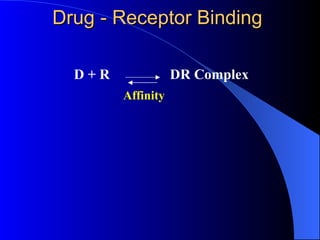
D + R DR Complex Drug - Receptor Binding Affinity
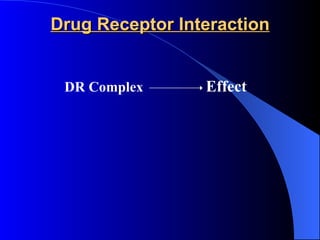
Drug Receptor Interaction DR Complex Effect
Theories of the  relationship between  binding and response
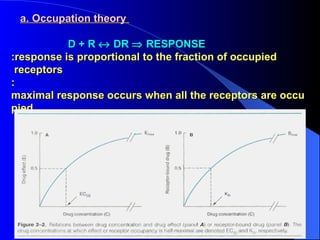
     a. Occupation theory          D + R    DR    RESPONSE :response is proportional to the fraction of occupied  receptors  :maximal response occurs when all the receptors are occupied
  Ariens   response is proportional to the fraction of  occupied receptors  AND  the   intrinsic activity  Stephenson  response is a  FUNCTION  of occupancy  maximum response can be produced  WITHOUT 100% occupation,  i.e. tissues have   spare receptors
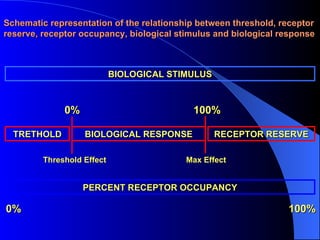
BIOLOGICAL STIMULUS PERCENT RECEPTOR OCCUPANCY 0% 100% BIOLOGICAL RESPONSE RECEPTOR RESERVE TRETHOLD 0% 100% Max Effect Threshold Effect Schematic representation of the relationship between threshold, receptor  reserve, receptor occupancy, biological stimulus and biological response
Receptors are said to be  spare  for a given pharmacological response when the maximal response can be elicited  by an agonist at a concentration that does not result in occupancy of the full complement of available receptors
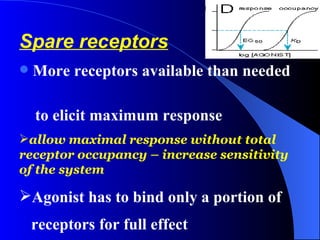
Spare receptors More receptors available than needed  to elicit maximum response allow maximal response without total receptor occupancy – increase sensitivity of the system Agonist has to bind only a portion of  receptors for full effect
 
Some terminologies regarding drug receptor interaction Affinity Efficacy Potency  Ligand
Affinity:   measure of propensity of a drug to bind    receptor; the attractiveness of drug and    receptor Efficacy:   Potential maximum therapeutic response  that a drug can produce. Potency:   A mount of drug needed to produce an  effect.
POTENCY OR   EFFICACY Which one is important while  selecting a drug for therapy ?
Ligand:   Molecules that binds to a receptor
Classification of Ligands  a.    agonist  b.   partial agonist c.   antagonist  pharmacological vs. physiological vs. chemical          pharmacological antagonists           -  competitive                surmountable             -  noncompetitive
AGONIST
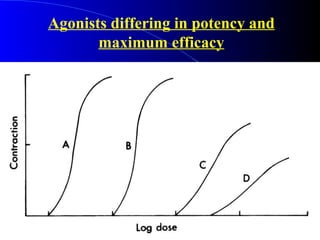
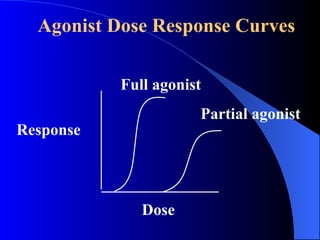
Agonists Drugs that cause a response Drugs that interact with  and  activate receptors;  They possess  both affinity and efficacy Types   Full agonists  An agonist with maximal efficacy (response) has affinity plus intrinsic activity Partial agonists An agonist with less then maximal efficacy has affinity and  less  intrinsic activity
Agonists differing in potency and maximum efficacy
Response Dose Full agonist Partial agonist Agonist Dose Response Curves
[D] (concentration units) % Maximal Effect 0.01 0.10 1.00 10.00 100.00 1000.00 0.0 0.2 0.4 0.6 0.8 1.0 Partial agonist Full Agonist Partial agonist PARTIAL AGONISTS - EFFICACY Even though drugs may occupy the same # of receptors, the magnitude of their effects may differ.
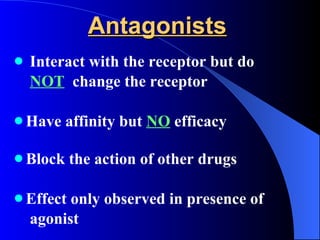
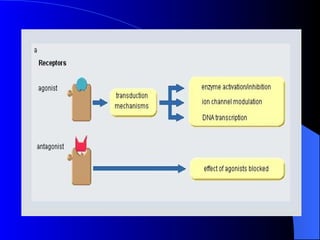
Antagonists Interact with the receptor but do   NOT   change the receptor Have affinity but  NO   efficacy Block the action of other drugs Effect only observed in presence of  agonist
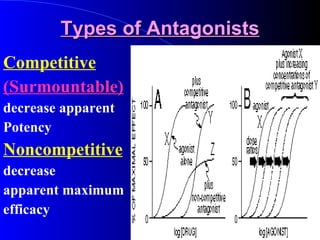
Types of Antagonists Competitive (Surmountable) decrease apparent Potency Noncompetitive decrease  apparent maximum  efficacy
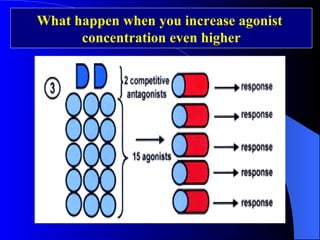
Competitive Antagonist competes with ________for receptor surmountable  with increasing agonist  concentration displaces agonist dose response curve to  the ___________(dextral shift) reduces the apparent affinity of the __________.
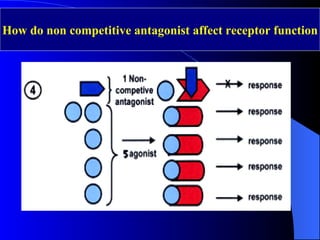
Noncompetitive Antagonist drug binds to receptor and stays bound irreversible – does not let go of receptor produces slight dextral shift in the agonist DR curve in the low concentration range but, as more and more receptors are bound (and essentially destroyed),  the agonist drug becomes incapable of eliciting a maximal effect
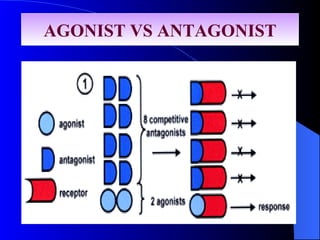
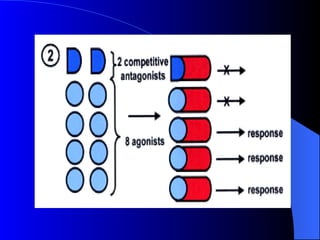
AGONIST VS ANTAGONIST
 
What happen when you increase agonist  concentration even higher
How do non competitive antagonist affect receptor function
 
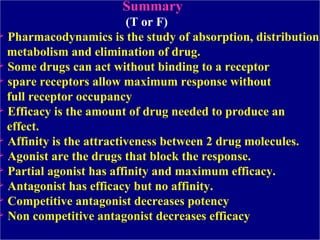
Summary   (T or F) Pharmacodynamics is the study of absorption, distribution,  metabolism and elimination of drug.  Some drugs can act without binding to a receptor spare receptors allow maximum response without  full receptor occupancy Efficacy is the amount of drug needed to produce an  effect. Affinity is the attractiveness between 2 drug molecules. Agonist are the drugs that block the response. Partial agonist has affinity and maximum efficacy.  Antagonist has efficacy but no affinity. Competitive antagonist decreases potency Non competitive antagonist decreases efficacy

Lecture 1 Pharmacodynamics

  • 1.
  • 2.
    Lecture Objectives To understand the basic concepts regarding pharmacodynamics To define agonist and antagonists and other terms in relation to pharmacodynamics To explain the mechanism of drug receptor interaction Define spare receptors To differentitate between different tyes of antagonism
  • 3.
  • 4.
  • 5.
    Action of adrug on the body receptor interactions, mechanisms of therapeutic dose-response phenomena, toxic action .
  • 6.
  • 7.
    A drug willnot work unless it is bound AGREED or NOT AGREED
  • 8.
  • 9.
    PARTICULAR CONSTITUENTS OFCELLS & TISSUES IN ORDER TO PRODUCE AN EFFECT PROTEINS LIPIDS DNA RECEPTORS ?
  • 10.
    ARE THERE DRUGSTHAT ACT WITHOUT BEING BOUND TO ANY OF THE TISSUE CONSTITUENTS YES OR NO
  • 11.
    YES OSMOTIC DIURETICSOSMOTIC PURGATIVES ANTACIDS HEAVY METALS CHELATING AGENTS
  • 12.
    BUT PRINCPLES REMAIN TRUE FOR GREAT MAJORITY THAT IS _____________________ ______________________________.
  • 13.
    Most drugs actthrough Receptors
  • 14.
  • 15.
    Drug Receptor Amacromolecular component of a cell with which a drug interacts to produce a response Usually a protein
  • 16.
    Receptors must bebiologically important molecules Receptors must have structural features that permit drug specificity Receptors must have a drug-binding site and a biologically active site
  • 17.
    Characteristics of Receptors      a. specificity       b. selectivity of response       c. sensitivity
  • 18.
    Molecules capable ofserving as Receptors
  • 19.
    Enzymes Membrane proteinsglycoproteins, lipoproteins) Nucleic acids Complex polysaccharides
  • 20.
    Many drugs inhibit enzymes in the patient (ACE inhibitors) in microbes (sulfas, Penicillins) in cancer cells (5-FU, 6-MP)
  • 21.
    Types of Protein Receptors Regulatory – mediate the action of endogenous chemicals e.g. hormones, NT,autocoids Enzymes – may be inhibited or activated e.g. dihydrofolate reductase receptor for methotrexate Transport – e.g. Na + /K + ATP’ase for digitalis glycosides Structural – e.g. tubulin,receptor for colchicine
  • 22.
    some drugs bindto: the genome (cyclophosphamide) microtubules (vincristine)
  • 23.
    Non-receptor Mediated EffectsInteraction with small molecules (e.g. binding of heavy metals) Interaction with enzymes (e.g. sulfonamides, digitalis) Incorporation into a macromolecule (e.g. some anticancer agents - purine and pyrimidine analogues) Nonspecific effects (e.g. membrane perturbation by general anesthetics)
  • 24.
    Receptor-independent drug actionsChemically reactive agents Disinfectants Alkylating anticancer drugs Physically active agents Mannitol Hydrogen peroxide Counterfeit biochemical constituents 5-bromouracil
  • 25.
    Antagonists tendto up regulate receptors   Receptor regulation    1.   Homeostasis    2. Up and down regulation    3. Desensitization    4. Tolerance agonists desensitize receptors homologous (decreased receptor number) heterologous (decreased signal transduction
  • 26.
  • 27.
    D + RDR Complex Drug - Receptor Binding Affinity
  • 28.
    Drug Receptor InteractionDR Complex Effect
  • 29.
  • 30.
         a. Occupation theory       D + R  DR  RESPONSE :response is proportional to the fraction of occupied  receptors :maximal response occurs when all the receptors are occupied
  • 31.
      Ariens response is proportional to the fraction of  occupied receptors  AND  the   intrinsic activity  Stephenson response is a  FUNCTION  of occupancy maximum response can be produced  WITHOUT 100% occupation,  i.e. tissues have   spare receptors
  • 32.
    BIOLOGICAL STIMULUS PERCENTRECEPTOR OCCUPANCY 0% 100% BIOLOGICAL RESPONSE RECEPTOR RESERVE TRETHOLD 0% 100% Max Effect Threshold Effect Schematic representation of the relationship between threshold, receptor reserve, receptor occupancy, biological stimulus and biological response
  • 33.
    Receptors are saidto be spare for a given pharmacological response when the maximal response can be elicited by an agonist at a concentration that does not result in occupancy of the full complement of available receptors
  • 34.
    Spare receptors Morereceptors available than needed to elicit maximum response allow maximal response without total receptor occupancy – increase sensitivity of the system Agonist has to bind only a portion of receptors for full effect
  • 35.
  • 36.
    Some terminologies regardingdrug receptor interaction Affinity Efficacy Potency Ligand
  • 37.
    Affinity: measure of propensity of a drug to bind receptor; the attractiveness of drug and receptor Efficacy: Potential maximum therapeutic response that a drug can produce. Potency: A mount of drug needed to produce an effect.
  • 38.
    POTENCY OR EFFICACY Which one is important while selecting a drug for therapy ?
  • 39.
    Ligand: Molecules that binds to a receptor
  • 40.
    Classification of Ligands a.  agonist b.  partial agonist c.  antagonist pharmacological vs. physiological vs. chemical        pharmacological antagonists        -  competitive             surmountable           -  noncompetitive
  • 41.
  • 42.
    Agonists Drugs thatcause a response Drugs that interact with and activate receptors; They possess both affinity and efficacy Types Full agonists An agonist with maximal efficacy (response) has affinity plus intrinsic activity Partial agonists An agonist with less then maximal efficacy has affinity and less intrinsic activity
  • 43.
    Agonists differing inpotency and maximum efficacy
  • 44.
    Response Dose Fullagonist Partial agonist Agonist Dose Response Curves
  • 45.
    [D] (concentration units)% Maximal Effect 0.01 0.10 1.00 10.00 100.00 1000.00 0.0 0.2 0.4 0.6 0.8 1.0 Partial agonist Full Agonist Partial agonist PARTIAL AGONISTS - EFFICACY Even though drugs may occupy the same # of receptors, the magnitude of their effects may differ.
  • 46.
    Antagonists Interact withthe receptor but do NOT change the receptor Have affinity but NO efficacy Block the action of other drugs Effect only observed in presence of agonist
  • 47.
    Types of AntagonistsCompetitive (Surmountable) decrease apparent Potency Noncompetitive decrease apparent maximum efficacy
  • 48.
    Competitive Antagonist competeswith ________for receptor surmountable with increasing agonist concentration displaces agonist dose response curve to the ___________(dextral shift) reduces the apparent affinity of the __________.
  • 49.
    Noncompetitive Antagonist drugbinds to receptor and stays bound irreversible – does not let go of receptor produces slight dextral shift in the agonist DR curve in the low concentration range but, as more and more receptors are bound (and essentially destroyed), the agonist drug becomes incapable of eliciting a maximal effect
  • 50.
  • 51.
  • 52.
    What happen whenyou increase agonist concentration even higher
  • 53.
    How do noncompetitive antagonist affect receptor function
  • 54.
  • 55.
    Summary (T or F) Pharmacodynamics is the study of absorption, distribution, metabolism and elimination of drug. Some drugs can act without binding to a receptor spare receptors allow maximum response without full receptor occupancy Efficacy is the amount of drug needed to produce an effect. Affinity is the attractiveness between 2 drug molecules. Agonist are the drugs that block the response. Partial agonist has affinity and maximum efficacy. Antagonist has efficacy but no affinity. Competitive antagonist decreases potency Non competitive antagonist decreases efficacy