FOOD-DRUG INTERACTION
PRESENTED BY:
DEEPIKA BARANWAL
PhD SCHOLAR
DEFINITION
ļ‚— Drug-nutrient interaction: the result of
the action between a drug and a nutrient
that would not happen with the nutrient or
the drug alone.
ļ‚— Food-drug interaction: a broad term that
includes drug-nutrient interactions and the
effect of a medication on nutritional status.
Food-Drug Interaction
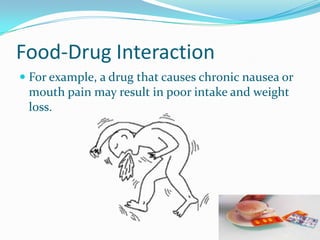
ļ‚— For example, a drug that causes chronic nausea or
mouth pain may result in poor intake and weight
loss.
BENEFITS OF MINIMISING DRUG
INTERACTION
ļ‚— Medications achieve their intended effects.
ļ‚— Patients do not discontinue their drug.
ļ‚— The need for additional medication is minimized.
ļ‚— Fewer caloric or nutrient supplements are required.
ļ‚— Adverse side effects are avoided.
ļ‚— Optimal nutritional status is preserved.
ļ‚— Accidents and injuries are avoided.
ļ‚— Disease complications are minimized.
ļ‚— The cost of health care services is reduced.
ļ‚— There is less professional liability.
ļ‚— Licensing agency requirements are met.
DRUG EFFECTS ON FOOD INTAKE
ļ‚—Increased appetite (antihistamines,
psychotropic drugs and steroids)
ļ‚—Decreased appetite(amphetamines, insulin
and alcohol)
ļ‚—Taste changes(chelating agents and
diuretics)
ļ‚—Nausea (cardiac glycosides )
ļ‚—Bulking effects (methylcellulose and other
dietary fiber products)
DRUG EFFECTS ON NUTRIENT
ABSORPTION AND METABOLISM
ļ‚— Increased nutrient absorption (cimetidine
and ranitidine)
ļ‚— Decrease nutrient
absorption(colchicine, alcohol, laxatives, an
tibiotic neomycin)
ļ‚— Mineral depletion (diuretics, chelating
agents, alcohol, antacids, aspirin)
ļ‚— Vitamin depletion(vitamin antagonists, oral
contraceptives)
OUTCOMES OF DRUG AND NUTRIENT
INTERACTIONS
ļ‚— BENEFICIAL EFFECTS:
Infectious disease control
Control of cancer
Prevention of thromboses
Treatment of metabolic disease
Prevention of acute drug toxicity
To be continued :
ADVERSE EFFECTS:
ļ‚—Loss of drug efficacy
ļ‚—Drug- induced nutritional deficiencies
ļ‚—Toxic reactions
ļ‚—Blocked feeding tubes
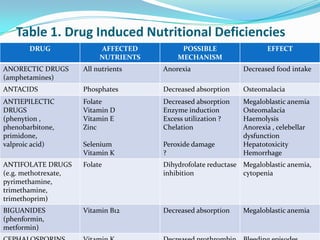
Table 1. Drug Induced Nutritional Deficiencies
DRUG AFFECTED
NUTRIENTS
POSSIBLE
MECHANISM
EFFECT
ANORECTIC DRUGS
(amphetamines)
All nutrients Anorexia Decreased food intake
ANTACIDS Phosphates Decreased absorption Osteomalacia
ANTIEPILECTIC
DRUGS
(phenytion ,
phenobarbitone,
primidone,
valproic acid)
Folate
Vitamin D
Vitamin E
Zinc
Selenium
Vitamin K
Decreased absorption
Enzyme induction
Excess utilization ?
Chelation
Peroxide damage
?
Megaloblastic anemia
Osteomalacia
Haemolysis
Anorexia , celebellar
dysfunction
Hepatotoxicity
Hemorrhage
ANTIFOLATE DRUGS
(e.g. methotrexate,
pyrimethamine,
trimethamine,
trimethoprim)
Folate Dihydrofolate reductase
inhibition
Megaloblastic anemia,
cytopenia
BIGUANIDES
(phenformin,
metformin)
Vitamin B12 Decreased absorption Megaloblastic anemia
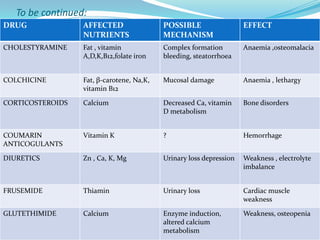
To be continued:
DRUG AFFECTED
NUTRIENTS
POSSIBLE
MECHANISM
EFFECT
CHOLESTYRAMINE Fat , vitamin
A,D,K,B12,folate iron
Complex formation
bleeding, steatorrhoea
Anaemia ,osteomalacia
COLCHICINE Fat, β-carotene, Na,K,
vitamin B12
Mucosal damage Anaemia , lethargy
CORTICOSTEROIDS Calcium Decreased Ca, vitamin
D metabolism
Bone disorders
COUMARIN
ANTICOGULANTS
Vitamin K ? Hemorrhage
DIURETICS Zn , Ca, K, Mg Urinary loss depression Weakness , electrolyte
imbalance
FRUSEMIDE Thiamin Urinary loss Cardiac muscle
weakness
GLUTETHIMIDE Calcium Enzyme induction,
altered calcium
metabolism
Weakness, osteopenia
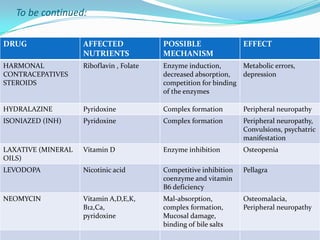
To be continued:
DRUG AFFECTED
NUTRIENTS
POSSIBLE
MECHANISM
EFFECT
HARMONAL
CONTRACEPATIVES
STEROIDS
Riboflavin , Folate Enzyme induction,
decreased absorption,
competition for binding
of the enzymes
Metabolic errors,
depression
HYDRALAZINE Pyridoxine Complex formation Peripheral neuropathy
ISONIAZED (INH) Pyridoxine Complex formation Peripheral neuropathy,
Convulsions, psychatric
manifestation
LAXATIVE (MINERAL
OILS)
Vitamin D Enzyme inhibition Osteopenia
LEVODOPA Nicotinic acid Competitive inhibition
coenzyme and vitamin
B6 deficiency
Pellagra
NEOMYCIN Vitamin A,D,E,K,
B12,Ca,
pyridoxine
Mal-absorption,
complex formation,
Mucosal damage,
binding of bile salts
Osteomalacia,
Peripheral neuropathy
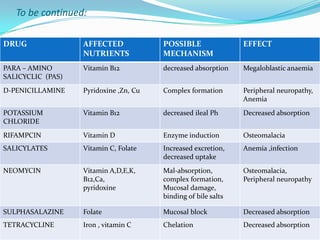
To be continued:
DRUG AFFECTED
NUTRIENTS
POSSIBLE
MECHANISM
EFFECT
PARA – AMINO
SALICYCLIC (PAS)
Vitamin B12 decreased absorption Megaloblastic anaemia
D-PENICILLAMINE Pyridoxine ,Zn, Cu Complex formation Peripheral neuropathy,
Anemia
POTASSIUM
CHLORIDE
Vitamin B12 decreased ileal Ph Decreased absorption
RIFAMPCIN Vitamin D Enzyme induction Osteomalacia
SALICYLATES Vitamin C, Folate Increased excretion,
decreased uptake
Anemia ,infection
NEOMYCIN Vitamin A,D,E,K,
B12,Ca,
pyridoxine
Mal-absorption,
complex formation,
Mucosal damage,
binding of bile salts
Osteomalacia,
Peripheral neuropathy
SULPHASALAZINE Folate Mucosal block Decreased absorption
TETRACYCLINE Iron , vitamin C Chelation Decreased absorption
TYPES:
1. Pharmacodynamic Interactions: which
affect the pharmacologic action of the
drug.
1. Pharmacokinetic Interaction: which
affect the movement of the drug
into, around, out of the body.
PHARMACODYNAMICS
Pharmaco-dynamics is the study of the biochemical
and physiologic effects of a drug.
ļ‚— The mechanism of action, e.g. how a drug works
ļ‚— Often the drug molecule binds to a receptor, enzyme,
or ion channel, producing a physiological response
PHARMACOKINETICS
ļ‚—Pharmacokinetics is the study of the
time course of a drug in the body
involving absorption, distribution,
metabolism (biotransformation), and
excretion of the drug.
ABSORPTION :
ļ‚— Absorption is the process of the movement of the drug from the site
of administration to the blood-stream.
ļ‚— This process is dependent on the
ļ‚— (1) route of administration,
ļ‚— (2) the chemistry of the drug and its ability to cross biologic
membranes,
ļ‚— (3.) the rate of gastric emptying & gastrointestinal movement, and
ļ‚— (4.) the quality of product formulation
ļ‚— Food, food components and nutritional supplements can interfere
with the absorption process, especially when the drug is
administered orally.
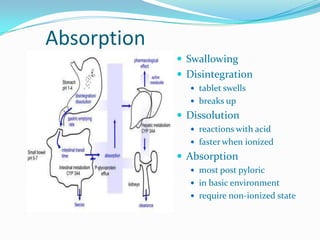
Absorption
ļ‚— Swallowing
ļ‚— Disintegration
ļ‚— tablet swells
ļ‚— breaks up
ļ‚— Dissolution
ļ‚— reactions with acid
ļ‚— faster when ionized
ļ‚— Absorption
ļ‚— most post pyloric
ļ‚— in basic environment
ļ‚— require non-ionized state
Food Interactions with Absorption
ļ‚— Milk products alter pH
ļ‚— Metals chelate some medications
ļ‚— Some foods compete for same absorption sites
ļ‚— Food speeds GI speed – reduced absorption
ļ‚— Degree of significance is important
DISTRIBUTION:
Distribution occurs when the drug leaves the
systemic circulation and moves to various parts of
the body
ļ‚— Drugs in the bloodstream are often bound to
plasma proteins; only unbound drugs can leave the
blood and affect target organs
ļ‚— Low serum albumin can increase availability of
drugs and potentiate their effects
Metabolism (biotransformation)
ļ‚— Primarily in the liver; cytochrome P-450 enzyme
system facilitates drug metabolism; metabolism
generally changes fat soluble compounds to water
soluble compounds that can be excreted
ļ‚— Foods or dietary supplements that increase or inhibit
these enzyme systems can change the rate or extent of
drug metabolism
Metabolism – Interaction with food
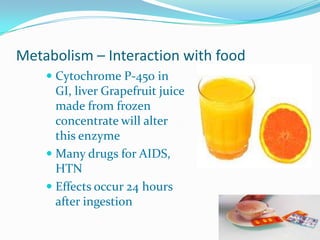
ļ‚— Cytochrome P-450 in
GI, liver Grapefruit juice
made from frozen
concentrate will alter
this enzyme
ļ‚— Many drugs for AIDS,
HTN
ļ‚— Effects occur 24 hours
after ingestion
EXCRETION
ļ‚— Drugs are eliminated from the body as an
unchanged drug or metabolite
ļ‚— Renal excretion the major route of elimination;
affected by renal function and urinary pH
ļ‚— Some drugs eliminated in bile and other body
fluids
Excretion
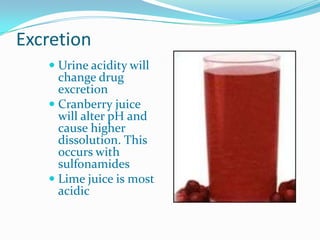
ļ‚— Urine acidity will
change drug
excretion
ļ‚— Cranberry juice
will alter pH and
cause higher
dissolution. This
occurs with
sulfonamides
ļ‚— Lime juice is most
acidic
PHARMACOGENOMICS
ļ‚— Genetically determined variations that are
revealed solely by the effects of drugs
ļ‚— Affect only a subset of people
ļ‚— Examples include G6PD (glucose-6-phosphate
dehydrogenase) enzyme deficiency, warfarin
resistance, and slow inactivation of isoniazid
(IHN) or phenelzine
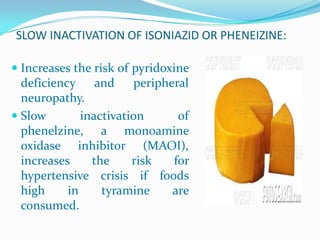
SLOW INACTIVATION OF ISONIAZID OR PHENEIZINE:
ļ‚— Increases the risk of pyridoxine
deficiency and peripheral
neuropathy.
ļ‚— Slow inactivation of
phenelzine, a monoamine
oxidase inhibitor (MAOI),
increases the risk for
hypertensive crisis if foods
high in tyramine are
consumed.
G6PD (GLUCOSE-6-PHOSPHATE
DEHYDROGENASE) ENZYME DEFICIENCY
ļ‚— It can lead to : Neonatal jaundice, hemolytic anemia or
acute hemolysis.
ļ‚— It is also called favism.
ļ‚— Drugs included: aspirin, sulfonamides and
antimalerial drugs caused hemolysis and acute
anemia.
ļ‚— Food –drug interactions in G6PD deficiency :
Ingestion of fava beans
Vitamin C
Vitamin K
Warfarin
ļ‚— Anticoagulant used to reduce strokes
ļ‚— Inactivated by Vitamin K - broccoli
ļ‚— Enteral nutrition products contain Vitamin K.
ļ‚— Warfarin activity drops when nutrition given
ļ‚— Study shows warfarin binds to protein at pH 8
Nutrient drug interaction

Nutrient drug interaction

  • 1.
  • 2.
    DEFINITION ļ‚— Drug-nutrient interaction:the result of the action between a drug and a nutrient that would not happen with the nutrient or the drug alone. ļ‚— Food-drug interaction: a broad term that includes drug-nutrient interactions and the effect of a medication on nutritional status.
  • 3.
    Food-Drug Interaction ļ‚— Forexample, a drug that causes chronic nausea or mouth pain may result in poor intake and weight loss.
  • 4.
    BENEFITS OF MINIMISINGDRUG INTERACTION ļ‚— Medications achieve their intended effects. ļ‚— Patients do not discontinue their drug. ļ‚— The need for additional medication is minimized. ļ‚— Fewer caloric or nutrient supplements are required. ļ‚— Adverse side effects are avoided. ļ‚— Optimal nutritional status is preserved. ļ‚— Accidents and injuries are avoided. ļ‚— Disease complications are minimized. ļ‚— The cost of health care services is reduced. ļ‚— There is less professional liability. ļ‚— Licensing agency requirements are met.
  • 5.
    DRUG EFFECTS ONFOOD INTAKE ļ‚—Increased appetite (antihistamines, psychotropic drugs and steroids) ļ‚—Decreased appetite(amphetamines, insulin and alcohol) ļ‚—Taste changes(chelating agents and diuretics) ļ‚—Nausea (cardiac glycosides ) ļ‚—Bulking effects (methylcellulose and other dietary fiber products)
  • 6.
    DRUG EFFECTS ONNUTRIENT ABSORPTION AND METABOLISM ļ‚— Increased nutrient absorption (cimetidine and ranitidine) ļ‚— Decrease nutrient absorption(colchicine, alcohol, laxatives, an tibiotic neomycin) ļ‚— Mineral depletion (diuretics, chelating agents, alcohol, antacids, aspirin) ļ‚— Vitamin depletion(vitamin antagonists, oral contraceptives)
  • 7.
    OUTCOMES OF DRUGAND NUTRIENT INTERACTIONS ļ‚— BENEFICIAL EFFECTS: Infectious disease control Control of cancer Prevention of thromboses Treatment of metabolic disease Prevention of acute drug toxicity
  • 8.
    To be continued: ADVERSE EFFECTS: ļ‚—Loss of drug efficacy ļ‚—Drug- induced nutritional deficiencies ļ‚—Toxic reactions ļ‚—Blocked feeding tubes
  • 9.
    Table 1. DrugInduced Nutritional Deficiencies DRUG AFFECTED NUTRIENTS POSSIBLE MECHANISM EFFECT ANORECTIC DRUGS (amphetamines) All nutrients Anorexia Decreased food intake ANTACIDS Phosphates Decreased absorption Osteomalacia ANTIEPILECTIC DRUGS (phenytion , phenobarbitone, primidone, valproic acid) Folate Vitamin D Vitamin E Zinc Selenium Vitamin K Decreased absorption Enzyme induction Excess utilization ? Chelation Peroxide damage ? Megaloblastic anemia Osteomalacia Haemolysis Anorexia , celebellar dysfunction Hepatotoxicity Hemorrhage ANTIFOLATE DRUGS (e.g. methotrexate, pyrimethamine, trimethamine, trimethoprim) Folate Dihydrofolate reductase inhibition Megaloblastic anemia, cytopenia BIGUANIDES (phenformin, metformin) Vitamin B12 Decreased absorption Megaloblastic anemia
  • 10.
    To be continued: DRUGAFFECTED NUTRIENTS POSSIBLE MECHANISM EFFECT CHOLESTYRAMINE Fat , vitamin A,D,K,B12,folate iron Complex formation bleeding, steatorrhoea Anaemia ,osteomalacia COLCHICINE Fat, β-carotene, Na,K, vitamin B12 Mucosal damage Anaemia , lethargy CORTICOSTEROIDS Calcium Decreased Ca, vitamin D metabolism Bone disorders COUMARIN ANTICOGULANTS Vitamin K ? Hemorrhage DIURETICS Zn , Ca, K, Mg Urinary loss depression Weakness , electrolyte imbalance FRUSEMIDE Thiamin Urinary loss Cardiac muscle weakness GLUTETHIMIDE Calcium Enzyme induction, altered calcium metabolism Weakness, osteopenia
  • 11.
    To be continued: DRUGAFFECTED NUTRIENTS POSSIBLE MECHANISM EFFECT HARMONAL CONTRACEPATIVES STEROIDS Riboflavin , Folate Enzyme induction, decreased absorption, competition for binding of the enzymes Metabolic errors, depression HYDRALAZINE Pyridoxine Complex formation Peripheral neuropathy ISONIAZED (INH) Pyridoxine Complex formation Peripheral neuropathy, Convulsions, psychatric manifestation LAXATIVE (MINERAL OILS) Vitamin D Enzyme inhibition Osteopenia LEVODOPA Nicotinic acid Competitive inhibition coenzyme and vitamin B6 deficiency Pellagra NEOMYCIN Vitamin A,D,E,K, B12,Ca, pyridoxine Mal-absorption, complex formation, Mucosal damage, binding of bile salts Osteomalacia, Peripheral neuropathy
  • 12.
    To be continued: DRUGAFFECTED NUTRIENTS POSSIBLE MECHANISM EFFECT PARA – AMINO SALICYCLIC (PAS) Vitamin B12 decreased absorption Megaloblastic anaemia D-PENICILLAMINE Pyridoxine ,Zn, Cu Complex formation Peripheral neuropathy, Anemia POTASSIUM CHLORIDE Vitamin B12 decreased ileal Ph Decreased absorption RIFAMPCIN Vitamin D Enzyme induction Osteomalacia SALICYLATES Vitamin C, Folate Increased excretion, decreased uptake Anemia ,infection NEOMYCIN Vitamin A,D,E,K, B12,Ca, pyridoxine Mal-absorption, complex formation, Mucosal damage, binding of bile salts Osteomalacia, Peripheral neuropathy SULPHASALAZINE Folate Mucosal block Decreased absorption TETRACYCLINE Iron , vitamin C Chelation Decreased absorption
  • 13.
    TYPES: 1. Pharmacodynamic Interactions:which affect the pharmacologic action of the drug. 1. Pharmacokinetic Interaction: which affect the movement of the drug into, around, out of the body.
  • 14.
    PHARMACODYNAMICS Pharmaco-dynamics is thestudy of the biochemical and physiologic effects of a drug. ļ‚— The mechanism of action, e.g. how a drug works ļ‚— Often the drug molecule binds to a receptor, enzyme, or ion channel, producing a physiological response
  • 15.
    PHARMACOKINETICS ļ‚—Pharmacokinetics is thestudy of the time course of a drug in the body involving absorption, distribution, metabolism (biotransformation), and excretion of the drug.
  • 16.
    ABSORPTION : ļ‚— Absorptionis the process of the movement of the drug from the site of administration to the blood-stream. ļ‚— This process is dependent on the ļ‚— (1) route of administration, ļ‚— (2) the chemistry of the drug and its ability to cross biologic membranes, ļ‚— (3.) the rate of gastric emptying & gastrointestinal movement, and ļ‚— (4.) the quality of product formulation ļ‚— Food, food components and nutritional supplements can interfere with the absorption process, especially when the drug is administered orally.
  • 17.
    Absorption ļ‚— Swallowing ļ‚— Disintegration ļ‚—tablet swells ļ‚— breaks up ļ‚— Dissolution ļ‚— reactions with acid ļ‚— faster when ionized ļ‚— Absorption ļ‚— most post pyloric ļ‚— in basic environment ļ‚— require non-ionized state
  • 18.
    Food Interactions withAbsorption ļ‚— Milk products alter pH ļ‚— Metals chelate some medications ļ‚— Some foods compete for same absorption sites ļ‚— Food speeds GI speed – reduced absorption ļ‚— Degree of significance is important
  • 19.
    DISTRIBUTION: Distribution occurs whenthe drug leaves the systemic circulation and moves to various parts of the body ļ‚— Drugs in the bloodstream are often bound to plasma proteins; only unbound drugs can leave the blood and affect target organs ļ‚— Low serum albumin can increase availability of drugs and potentiate their effects
  • 20.
    Metabolism (biotransformation) ļ‚— Primarilyin the liver; cytochrome P-450 enzyme system facilitates drug metabolism; metabolism generally changes fat soluble compounds to water soluble compounds that can be excreted ļ‚— Foods or dietary supplements that increase or inhibit these enzyme systems can change the rate or extent of drug metabolism
  • 21.
    Metabolism – Interactionwith food ļ‚— Cytochrome P-450 in GI, liver Grapefruit juice made from frozen concentrate will alter this enzyme ļ‚— Many drugs for AIDS, HTN ļ‚— Effects occur 24 hours after ingestion
  • 22.
    EXCRETION ļ‚— Drugs areeliminated from the body as an unchanged drug or metabolite ļ‚— Renal excretion the major route of elimination; affected by renal function and urinary pH ļ‚— Some drugs eliminated in bile and other body fluids
  • 23.
    Excretion ļ‚— Urine aciditywill change drug excretion ļ‚— Cranberry juice will alter pH and cause higher dissolution. This occurs with sulfonamides ļ‚— Lime juice is most acidic
  • 24.
    PHARMACOGENOMICS ļ‚— Genetically determinedvariations that are revealed solely by the effects of drugs ļ‚— Affect only a subset of people ļ‚— Examples include G6PD (glucose-6-phosphate dehydrogenase) enzyme deficiency, warfarin resistance, and slow inactivation of isoniazid (IHN) or phenelzine
  • 25.
    SLOW INACTIVATION OFISONIAZID OR PHENEIZINE: ļ‚— Increases the risk of pyridoxine deficiency and peripheral neuropathy. ļ‚— Slow inactivation of phenelzine, a monoamine oxidase inhibitor (MAOI), increases the risk for hypertensive crisis if foods high in tyramine are consumed.
  • 26.
    G6PD (GLUCOSE-6-PHOSPHATE DEHYDROGENASE) ENZYMEDEFICIENCY ļ‚— It can lead to : Neonatal jaundice, hemolytic anemia or acute hemolysis. ļ‚— It is also called favism. ļ‚— Drugs included: aspirin, sulfonamides and antimalerial drugs caused hemolysis and acute anemia. ļ‚— Food –drug interactions in G6PD deficiency : Ingestion of fava beans Vitamin C Vitamin K
  • 27.
    Warfarin ļ‚— Anticoagulant usedto reduce strokes ļ‚— Inactivated by Vitamin K - broccoli ļ‚— Enteral nutrition products contain Vitamin K. ļ‚— Warfarin activity drops when nutrition given ļ‚— Study shows warfarin binds to protein at pH 8