11
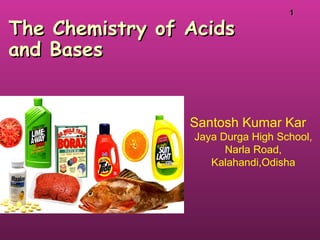
The Chemistry of AcidsThe Chemistry of Acids
and Basesand Bases
Santosh Kumar Kar
Jaya Durga High School,
Narla Road,
Kalahandi,Odisha
22
Acids
Have a sour taste. Vinegar is a solution of acetic acid. CitrusHave a sour taste. Vinegar is a solution of acetic acid. Citrus
fruits contain citric acid.fruits contain citric acid.
React with certain metals to produce hydrogen gasReact with certain metals to produce hydrogen gas..
React with carbonates and bicarbonates to produce carbonReact with carbonates and bicarbonates to produce carbon
dioxide gasdioxide gas
Have a bitter taste.Have a bitter taste.
Feel slippery. Many soaps contain bases.Feel slippery. Many soaps contain bases.
Bases
33
Some Properties of Acids
 Produce H+
(as H3O+
) ions in water (the hydronium ion is a
hydrogen ion attached to a water molecule)
 Taste sour
 Corrode metals
 Electrolytes
 React with bases to form a salt and water
 pH is less than 7
 Turns blue litmus paper to red “Blue to Red A-CID”
44
• HBrHBr (aq)(aq)
• HH22COCO33
• HH22SOSO33
⇒⇒ hydrohydrobromicbromic acidacid
⇒⇒ carboncarbonicic acidacid
⇒⇒ sulfursulfurousous acidacid
Acid Nomenclature Review
55
Some Properties of Bases
 Produce OHProduce OH--
ions in waterions in water
 Taste bitter, chalkyTaste bitter, chalky
 Are electrolytesAre electrolytes
 Feel soapy, slipperyFeel soapy, slippery
 React with acids to form salts and waterReact with acids to form salts and water
 pH greater than 7pH greater than 7
 Turns red litmus paper to blue “Turns red litmus paper to blue “BBasicasic BBlue”lue”
66
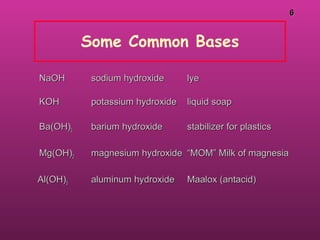
Some Common Bases
NaOHNaOH sodium hydroxidesodium hydroxide lyelye
KOHKOH potassium hydroxidepotassium hydroxide liquid soapliquid soap
Ba(OH)Ba(OH)22 barium hydroxidebarium hydroxide stabilizer for plasticsstabilizer for plastics
Mg(OH)Mg(OH)22 magnesium hydroxidemagnesium hydroxide “MOM” Milk of magnesia“MOM” Milk of magnesia
Al(OH)Al(OH)33 aluminum hydroxidealuminum hydroxide Maalox (antacid)Maalox (antacid)
77
Acid/Base definitions
• Definition #1: Arrhenius (traditional)
Acids – produce H+
ions (or hydronium ions
H3O+
)
Bases – produce OH-
ions
(problem: some bases don’t have hydroxide
ions!)
88
Acid/Base Definitions
• Definition #2: Brønsted – Lowry
Acids – proton donor
Bases – proton acceptor
A “proton” is really just a hydrogen
atom that has lost it’s electron!
99
Learning Check!
Label the acid, base, conjugate acid, andLabel the acid, base, conjugate acid, and
conjugate base in each reaction:conjugate base in each reaction:
HCl + OHHCl + OH--
   Cl  Cl--
+ H+ H22OO
HH22O + HO + H22SOSO44    HSO  HSO44
--
+ H+ H33OO++
1010
Acids & Base DefinitionsAcids & Base Definitions
Lewis acid - aLewis acid - a
substance thatsubstance that
accepts an electronaccepts an electron
pairpair
Lewis base - aLewis base - a
substance thatsubstance that
donates an electrondonates an electron
pairpair
Definition #3 – Lewis
1111
Lewis Acid-Base InteractionsLewis Acid-Base Interactions
in Biologyin Biology
• The heme group in hemoglobin canThe heme group in hemoglobin can
interact with Ointeract with O22 and CO.and CO.
• The Fe ion in hemoglobin is a Lewis acidThe Fe ion in hemoglobin is a Lewis acid
• OO22 and CO can act as Lewis basesand CO can act as Lewis bases
1212
TheThe pH scalepH scale is a way ofis a way of
expressing the strength ofexpressing the strength of
acids and bases. Instead ofacids and bases. Instead of
using very small numbers, weusing very small numbers, we
just use the NEGATIVE powerjust use the NEGATIVE power
of 10 on the Molarity of the Hof 10 on the Molarity of the H++
(or OH(or OH--
) ion.) ion.
Under 7 = acidUnder 7 = acid
7 = neutral7 = neutral
Over 7 = baseOver 7 = base
1313
Calculating the pH
pH = - log [H+]
(Remember that the [ ] mean Molarity)
Example: If [H+
] = 1 X 10⁻¹⁰
pH = - log 1 X 10⁻¹⁰
pH = - (- 10)
pH = 10
Example: If [H+
] = 1.8 X 10⁻⁵
pH = - log 1.8 X 10⁻⁵
pH = - (- 4.74)
pH = 4.74
1414
pH calculations – Solving for H+pH calculations – Solving for H+
If the pH of Coke is 3.12, [HIf the pH of Coke is 3.12, [H++
] = ???] = ???
Because pH = - log [HBecause pH = - log [H++
] then] then
- pH = log [H- pH = log [H++
]]
Take antilog (10Take antilog (10xx
) of both) of both
sides and getsides and get
1010-pH-pH
==[H[H++
]]
[H[H++
] = 10] = 10-3.12-3.12
= 7.6 x 10= 7.6 x 10⁻⁴-4
MM
*** to find antilog on your calculator, look for “Shift” or “2*** to find antilog on your calculator, look for “Shift” or “2ndnd
function” and then the log buttonfunction” and then the log button
1515
pH calculations – Solving for H+pH calculations – Solving for H+
• A solution has a pH of 8.5. What is theA solution has a pH of 8.5. What is the
Molarity of hydrogen ions in theMolarity of hydrogen ions in the
solution?solution?
pH = - log [HpH = - log [H++
]]
8.5 = - log [H8.5 = - log [H++
]]
-8.5 = log [H-8.5 = log [H++
]]
Antilog -8.5 = antilog (log [HAntilog -8.5 = antilog (log [H++
])])
1010-8.5-8.5
= [H= [H++
]]
3.16 X 103.16 X 10-9-9
= [H= [H++
]]
1616
More About Water
KKww = [H= [H33OO++
] [OH] [OH--
] = 1.00 x 10] = 1.00 x 10⁻¹⁴-14
at 25at 25 oo
CC
In aIn a neutralneutral solution [Hsolution [H33OO++
] = [OH] = [OH--
]]
so Kso Kww = [H= [H33OO++
]]22
= [OH= [OH--
]]22
and so [Hand so [H33OO++
] = [OH] = [OH--
] = 1.00 x 10] = 1.00 x 10⁻⁷-7
MM
AutoionizationAutoionization
1717
pOH
• Since acids and bases areSince acids and bases are
opposites, pH and pOH areopposites, pH and pOH are
opposites!opposites!
• pOH does not really exist, but it ispOH does not really exist, but it is
useful for changing bases to pH.useful for changing bases to pH.
• pOH looks at the perspective of apOH looks at the perspective of a
basebase
pOH = - log [OHpOH = - log [OH--
]]
Since pH and pOH are on oppositeSince pH and pOH are on opposite
ends,ends,
pH + pOH = 14pH + pOH = 14
1818
[H[H33OO++
], [OH], [OH--
] and pH] and pH
What is the pH of theWhat is the pH of the
0.0010 M NaOH solution?0.0010 M NaOH solution?
[OH-] = 0.0010 (or 1.0 X 10[OH-] = 0.0010 (or 1.0 X 10⁻³-3
M)M)
pOH = - log 0.0010pOH = - log 0.0010
pOH = 3pOH = 3
pH = 14 – 3 = 11pH = 14 – 3 = 11
OR KOR Kww = [H= [H33OO++
] [OH] [OH--
]]
[H[H3OO++
] = 1.0 x 10] = 1.0 x 10⁻¹¹-11
MM
pH = - log (1.0 x 10pH = - log (1.0 x 10⁻¹¹-11
) = 11.00) = 11.00
1919
[OH[OH--
]]
[H[H++
]] pOHpOH
pHpH 1010
-pOH
-pOH
1010
-pH
-pH
-Log[H
-Log[H
++]]
-Log[OH
Log[OH
--]]
14
- pO
H
14
- pO
H
14
- pH
14
- pH
1.0
x
10
1.0
x
10
-14
-14
[O
H
[O
H
-- ]]
1.0
x
10
1.0
x
10
-14
-14
[H[H
++ ]]
2020
HNO3, HCl, H2SO4 and HClO4 are among the
only known strong acids.
Strong and Weak Acids/BasesStrong and Weak Acids/Bases
The strength of an acid (or base) is
determined by the amount of
IONIZATION.
2121
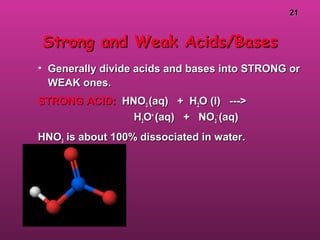
Strong and Weak Acids/BasesStrong and Weak Acids/Bases
• Generally divide acids and bases into STRONG orGenerally divide acids and bases into STRONG or
WEAK ones.WEAK ones.
STRONG ACID:STRONG ACID: HNOHNO33 (aq) + H(aq) + H22O (l) --->O (l) --->
HH33OO++
(aq) + NO(aq) + NO33
--
(aq)(aq)
HNOHNO33 is about 100% dissociated in water.is about 100% dissociated in water.
2222
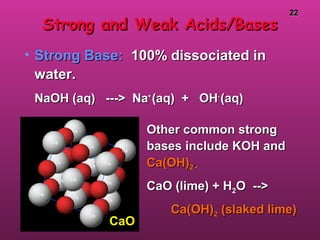
• Strong Base:Strong Base: 100% dissociated in100% dissociated in
water.water.
NaOH (aq) ---> NaNaOH (aq) ---> Na++
(aq) + OH(aq) + OH--
(aq)(aq)
Strong and Weak Acids/BasesStrong and Weak Acids/Bases
Other common strongOther common strong
bases include KOH andbases include KOH and
Ca(OH)Ca(OH)22..
CaO (lime) + HCaO (lime) + H22O -->O -->
Ca(OH)Ca(OH)22 (slaked lime)(slaked lime)
CaOCaO
2323
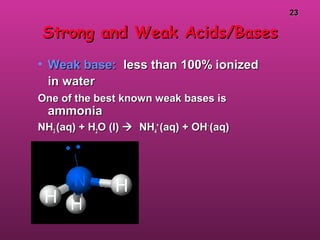
• Weak base:Weak base: less than 100% ionizedless than 100% ionized
in waterin water
One of the best known weak bases isOne of the best known weak bases is
ammoniaammonia
NHNH33 (aq) + H(aq) + H22O (l)O (l)  NHNH44
++
(aq) + OH(aq) + OH--
(aq)(aq)
Strong and Weak Acids/BasesStrong and Weak Acids/Bases
2424
Equilibria InvolvingEquilibria Involving
Weak Acids and BasesWeak Acids and Bases
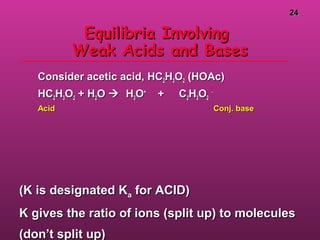
Consider acetic acid, HCConsider acetic acid, HC22HH33OO22 (HOAc)(HOAc)
HCHC22HH33OO22 + H+ H22OO  HH33OO++
+ C+ C22HH33OO22
--
AcidAcid Conj. baseConj. base
(K is designated K(K is designated Kaa for ACID)for ACID)
K gives the ratio of ions (split up) to moleculesK gives the ratio of ions (split up) to molecules
(don’t split up)(don’t split up)
2525
Equilibria Involving A Weak AcidEquilibria Involving A Weak Acid
You have 1.00 M HOAc. Calc. theYou have 1.00 M HOAc. Calc. the
equilibrium concs. of HOAc, Hequilibrium concs. of HOAc, H33OO++
, OAc, OAc--
,,
and the pH.and the pH.
Step 1.Step 1. Define equilibrium concs. in ICEDefine equilibrium concs. in ICE
table.table.
[HOAc][HOAc] [H[H33OO++
]][OAc[OAc--
]]
initialinitial
changechange
equilibequilib
1.001.00 00 00
-x-x +x+x +x+x
1.00-x1.00-x xx xx
2626
Equilibria Involving A Weak AcidEquilibria Involving A Weak Acid
Step 2.Step 2. Write KWrite Kaa expressionexpression
You have 1.00 M HOAc. Calc. the equilibrium concs.You have 1.00 M HOAc. Calc. the equilibrium concs.
of HOAc, Hof HOAc, H33OO++
, OAc, OAc--
, and the pH., and the pH.
This is a quadratic. Solve using quadraticThis is a quadratic. Solve using quadratic
formula.formula.
or you can make an approximation if x is veryor you can make an approximation if x is very
small! (Rule of thumb: 10small! (Rule of thumb: 10-5-5
or smaller is ok)or smaller is ok)
2727
Equilibria Involving A Weak AcidEquilibria Involving A Weak Acid
Calculate the pH of a 0.0010 M solution ofCalculate the pH of a 0.0010 M solution of
formic acid, HCOformic acid, HCO22H.H.
HCOHCO22H + HH + H22OO  HCOHCO22
--
+ H+ H33OO++
KKaa = 1.8 x 10= 1.8 x 10⁻⁴-4
Approximate solutionApproximate solution
[H[H33OO++
] = 4.2 x 10] = 4.2 x 10⁻⁴-4
M,M, pH = 3.37pH = 3.37
Exact SolutionExact Solution
[H[H33OO++
] = [HCO] = [HCO22
--
] = 3.4 x 10] = 3.4 x 10⁻⁴-4
MM
[HCO[HCO22H] = 0.0010 - 3.4 x 10H] = 0.0010 - 3.4 x 10⁻⁴-4
= 0.0007 M= 0.0007 M
pH = 3.47pH = 3.47
2828
Equilibria Involving A Weak BaseEquilibria Involving A Weak Base
You have 0.010 M NHYou have 0.010 M NH33. Calc. the pH.. Calc. the pH.
NHNH33 + H+ H22OO  NHNH44
++
+ OH+ OH--
KKbb = 1.8 x 10= 1.8 x 10⁻⁵-5
Step 1.Step 1. Define equilibrium concs. in ICE tableDefine equilibrium concs. in ICE table
[NH[NH33]] [NH[NH44
++
]][OH[OH--
]]
initialinitial
changechange
equilibequilib
0.0100.010 00 00
-x-x +x+x +x+x
0.010 - x0.010 - x xx xx
2929
Equilibria Involving A Weak BaseEquilibria Involving A Weak Base
You have 0.010 M NHYou have 0.010 M NH33. Calc. the pH.. Calc. the pH.
NHNH33 + H+ H22OO  NHNH44
++
+ OH+ OH--
KKbb = 1.8 x 10= 1.8 x 10⁻⁵-5
Step 1.Step 1. Define equilibrium concs. in ICE tableDefine equilibrium concs. in ICE table
[NH[NH33]] [NH[NH44
++
]][OH[OH--
]]
initialinitial
changechange
equilibequilib
0.0100.010 00 00
-x-x +x+x +x+x
0.010 - x0.010 - x xx xx
3030
pH testing
• There are several ways to test pHThere are several ways to test pH
–Blue litmus paper (red = acid)Blue litmus paper (red = acid)
–Red litmus paper (blue = basic)Red litmus paper (blue = basic)
–pH paper (multi-colored)pH paper (multi-colored)
–pH meter (7 is neutral, <7 acid, >7pH meter (7 is neutral, <7 acid, >7
base)base)
–Universal indicator (multi-colored)Universal indicator (multi-colored)
–Indicators like phenolphthaleinIndicators like phenolphthalein
–Natural indicators like red cabbage,Natural indicators like red cabbage,
radishesradishes
3131
Paper testing
• Paper tests like litmus paper and pHPaper tests like litmus paper and pH
paperpaper
– Put a stirring rod into the solutionPut a stirring rod into the solution
and stir.and stir.
– Take the stirring rod out, andTake the stirring rod out, and
place a drop of the solution fromplace a drop of the solution from
the end of the stirring rod onto athe end of the stirring rod onto a
piece of the paperpiece of the paper
– Read and record the colorRead and record the color
change. Note what the colorchange. Note what the color
indicates.indicates.
– You should only use a smallYou should only use a small
portion of the paper. You can useportion of the paper. You can use
one piece of paper for severalone piece of paper for several
tests.tests.
3232
pH meter
• Tests the voltage of theTests the voltage of the
electrolyteelectrolyte
• Converts the voltage toConverts the voltage to
pHpH
• Very cheap, accurateVery cheap, accurate
• Must be calibrated withMust be calibrated with
a buffer solutiona buffer solution
3333
pH indicators
• Indicators are dyes that can be
added that will change color in
the presence of an acid or base.
• Some indicators only work in a
specific range of pH
• Once the drops are added, the
sample is ruined
• Some dyes are natural, like radish
skin or red cabbage
3434
ACID-BASE REACTIONSACID-BASE REACTIONS
TitrationsTitrations
ACID-BASE REACTIONSACID-BASE REACTIONS
TitrationsTitrations
HH22CC22OO44(aq) + 2 NaOH(aq) --->(aq) + 2 NaOH(aq) --->
acidacid basebase
NaNa22CC22OO44(aq) + 2 H(aq) + 2 H22O(liq)O(liq)
Carry out this reaction using aCarry out this reaction using a TITRATIONTITRATION..
Oxalic acid,Oxalic acid,
HH22CC22OO44
3535
TitrationTitration
1. Add solution from the buret.1. Add solution from the buret.
2. Reagent (base) reacts with compound2. Reagent (base) reacts with compound
(acid) in solution in the flask.(acid) in solution in the flask.
3.3. Indicator shows when exactIndicator shows when exact
stoichiometric reaction has occurred.stoichiometric reaction has occurred.
(Acid = Base)(Acid = Base)
This is called NEUTRALIZATION.This is called NEUTRALIZATION.
3636
THANK YOU

Acids bases

  • 1.
    11 The Chemistry ofAcidsThe Chemistry of Acids and Basesand Bases Santosh Kumar Kar Jaya Durga High School, Narla Road, Kalahandi,Odisha
  • 2.
    22 Acids Have a sourtaste. Vinegar is a solution of acetic acid. CitrusHave a sour taste. Vinegar is a solution of acetic acid. Citrus fruits contain citric acid.fruits contain citric acid. React with certain metals to produce hydrogen gasReact with certain metals to produce hydrogen gas.. React with carbonates and bicarbonates to produce carbonReact with carbonates and bicarbonates to produce carbon dioxide gasdioxide gas Have a bitter taste.Have a bitter taste. Feel slippery. Many soaps contain bases.Feel slippery. Many soaps contain bases. Bases
  • 3.
    33 Some Properties ofAcids  Produce H+ (as H3O+ ) ions in water (the hydronium ion is a hydrogen ion attached to a water molecule)  Taste sour  Corrode metals  Electrolytes  React with bases to form a salt and water  pH is less than 7  Turns blue litmus paper to red “Blue to Red A-CID”
  • 4.
    44 • HBrHBr (aq)(aq) •HH22COCO33 • HH22SOSO33 ⇒⇒ hydrohydrobromicbromic acidacid ⇒⇒ carboncarbonicic acidacid ⇒⇒ sulfursulfurousous acidacid Acid Nomenclature Review
  • 5.
    55 Some Properties ofBases  Produce OHProduce OH-- ions in waterions in water  Taste bitter, chalkyTaste bitter, chalky  Are electrolytesAre electrolytes  Feel soapy, slipperyFeel soapy, slippery  React with acids to form salts and waterReact with acids to form salts and water  pH greater than 7pH greater than 7  Turns red litmus paper to blue “Turns red litmus paper to blue “BBasicasic BBlue”lue”
  • 6.
    66 Some Common Bases NaOHNaOHsodium hydroxidesodium hydroxide lyelye KOHKOH potassium hydroxidepotassium hydroxide liquid soapliquid soap Ba(OH)Ba(OH)22 barium hydroxidebarium hydroxide stabilizer for plasticsstabilizer for plastics Mg(OH)Mg(OH)22 magnesium hydroxidemagnesium hydroxide “MOM” Milk of magnesia“MOM” Milk of magnesia Al(OH)Al(OH)33 aluminum hydroxidealuminum hydroxide Maalox (antacid)Maalox (antacid)
  • 7.
    77 Acid/Base definitions • Definition#1: Arrhenius (traditional) Acids – produce H+ ions (or hydronium ions H3O+ ) Bases – produce OH- ions (problem: some bases don’t have hydroxide ions!)
  • 8.
    88 Acid/Base Definitions • Definition#2: Brønsted – Lowry Acids – proton donor Bases – proton acceptor A “proton” is really just a hydrogen atom that has lost it’s electron!
  • 9.
    99 Learning Check! Label theacid, base, conjugate acid, andLabel the acid, base, conjugate acid, and conjugate base in each reaction:conjugate base in each reaction: HCl + OHHCl + OH--    Cl  Cl-- + H+ H22OO HH22O + HO + H22SOSO44    HSO  HSO44 -- + H+ H33OO++
  • 10.
    1010 Acids & BaseDefinitionsAcids & Base Definitions Lewis acid - aLewis acid - a substance thatsubstance that accepts an electronaccepts an electron pairpair Lewis base - aLewis base - a substance thatsubstance that donates an electrondonates an electron pairpair Definition #3 – Lewis
  • 11.
    1111 Lewis Acid-Base InteractionsLewisAcid-Base Interactions in Biologyin Biology • The heme group in hemoglobin canThe heme group in hemoglobin can interact with Ointeract with O22 and CO.and CO. • The Fe ion in hemoglobin is a Lewis acidThe Fe ion in hemoglobin is a Lewis acid • OO22 and CO can act as Lewis basesand CO can act as Lewis bases
  • 12.
    1212 TheThe pH scalepHscale is a way ofis a way of expressing the strength ofexpressing the strength of acids and bases. Instead ofacids and bases. Instead of using very small numbers, weusing very small numbers, we just use the NEGATIVE powerjust use the NEGATIVE power of 10 on the Molarity of the Hof 10 on the Molarity of the H++ (or OH(or OH-- ) ion.) ion. Under 7 = acidUnder 7 = acid 7 = neutral7 = neutral Over 7 = baseOver 7 = base
  • 13.
    1313 Calculating the pH pH= - log [H+] (Remember that the [ ] mean Molarity) Example: If [H+ ] = 1 X 10⁻¹⁰ pH = - log 1 X 10⁻¹⁰ pH = - (- 10) pH = 10 Example: If [H+ ] = 1.8 X 10⁻⁵ pH = - log 1.8 X 10⁻⁵ pH = - (- 4.74) pH = 4.74
  • 14.
    1414 pH calculations –Solving for H+pH calculations – Solving for H+ If the pH of Coke is 3.12, [HIf the pH of Coke is 3.12, [H++ ] = ???] = ??? Because pH = - log [HBecause pH = - log [H++ ] then] then - pH = log [H- pH = log [H++ ]] Take antilog (10Take antilog (10xx ) of both) of both sides and getsides and get 1010-pH-pH ==[H[H++ ]] [H[H++ ] = 10] = 10-3.12-3.12 = 7.6 x 10= 7.6 x 10⁻⁴-4 MM *** to find antilog on your calculator, look for “Shift” or “2*** to find antilog on your calculator, look for “Shift” or “2ndnd function” and then the log buttonfunction” and then the log button
  • 15.
    1515 pH calculations –Solving for H+pH calculations – Solving for H+ • A solution has a pH of 8.5. What is theA solution has a pH of 8.5. What is the Molarity of hydrogen ions in theMolarity of hydrogen ions in the solution?solution? pH = - log [HpH = - log [H++ ]] 8.5 = - log [H8.5 = - log [H++ ]] -8.5 = log [H-8.5 = log [H++ ]] Antilog -8.5 = antilog (log [HAntilog -8.5 = antilog (log [H++ ])]) 1010-8.5-8.5 = [H= [H++ ]] 3.16 X 103.16 X 10-9-9 = [H= [H++ ]]
  • 16.
    1616 More About Water KKww= [H= [H33OO++ ] [OH] [OH-- ] = 1.00 x 10] = 1.00 x 10⁻¹⁴-14 at 25at 25 oo CC In aIn a neutralneutral solution [Hsolution [H33OO++ ] = [OH] = [OH-- ]] so Kso Kww = [H= [H33OO++ ]]22 = [OH= [OH-- ]]22 and so [Hand so [H33OO++ ] = [OH] = [OH-- ] = 1.00 x 10] = 1.00 x 10⁻⁷-7 MM AutoionizationAutoionization
  • 17.
    1717 pOH • Since acidsand bases areSince acids and bases are opposites, pH and pOH areopposites, pH and pOH are opposites!opposites! • pOH does not really exist, but it ispOH does not really exist, but it is useful for changing bases to pH.useful for changing bases to pH. • pOH looks at the perspective of apOH looks at the perspective of a basebase pOH = - log [OHpOH = - log [OH-- ]] Since pH and pOH are on oppositeSince pH and pOH are on opposite ends,ends, pH + pOH = 14pH + pOH = 14
  • 18.
    1818 [H[H33OO++ ], [OH], [OH-- ]and pH] and pH What is the pH of theWhat is the pH of the 0.0010 M NaOH solution?0.0010 M NaOH solution? [OH-] = 0.0010 (or 1.0 X 10[OH-] = 0.0010 (or 1.0 X 10⁻³-3 M)M) pOH = - log 0.0010pOH = - log 0.0010 pOH = 3pOH = 3 pH = 14 – 3 = 11pH = 14 – 3 = 11 OR KOR Kww = [H= [H33OO++ ] [OH] [OH-- ]] [H[H3OO++ ] = 1.0 x 10] = 1.0 x 10⁻¹¹-11 MM pH = - log (1.0 x 10pH = - log (1.0 x 10⁻¹¹-11 ) = 11.00) = 11.00
  • 19.
    1919 [OH[OH-- ]] [H[H++ ]] pOHpOH pHpH 1010 -pOH -pOH 1010 -pH -pH -Log[H -Log[H ++]] -Log[OH Log[OH --]] 14 -pO H 14 - pO H 14 - pH 14 - pH 1.0 x 10 1.0 x 10 -14 -14 [O H [O H -- ]] 1.0 x 10 1.0 x 10 -14 -14 [H[H ++ ]]
  • 20.
    2020 HNO3, HCl, H2SO4and HClO4 are among the only known strong acids. Strong and Weak Acids/BasesStrong and Weak Acids/Bases The strength of an acid (or base) is determined by the amount of IONIZATION.
  • 21.
    2121 Strong and WeakAcids/BasesStrong and Weak Acids/Bases • Generally divide acids and bases into STRONG orGenerally divide acids and bases into STRONG or WEAK ones.WEAK ones. STRONG ACID:STRONG ACID: HNOHNO33 (aq) + H(aq) + H22O (l) --->O (l) ---> HH33OO++ (aq) + NO(aq) + NO33 -- (aq)(aq) HNOHNO33 is about 100% dissociated in water.is about 100% dissociated in water.
  • 22.
    2222 • Strong Base:StrongBase: 100% dissociated in100% dissociated in water.water. NaOH (aq) ---> NaNaOH (aq) ---> Na++ (aq) + OH(aq) + OH-- (aq)(aq) Strong and Weak Acids/BasesStrong and Weak Acids/Bases Other common strongOther common strong bases include KOH andbases include KOH and Ca(OH)Ca(OH)22.. CaO (lime) + HCaO (lime) + H22O -->O --> Ca(OH)Ca(OH)22 (slaked lime)(slaked lime) CaOCaO
  • 23.
    2323 • Weak base:Weakbase: less than 100% ionizedless than 100% ionized in waterin water One of the best known weak bases isOne of the best known weak bases is ammoniaammonia NHNH33 (aq) + H(aq) + H22O (l)O (l)  NHNH44 ++ (aq) + OH(aq) + OH-- (aq)(aq) Strong and Weak Acids/BasesStrong and Weak Acids/Bases
  • 24.
    2424 Equilibria InvolvingEquilibria Involving WeakAcids and BasesWeak Acids and Bases Consider acetic acid, HCConsider acetic acid, HC22HH33OO22 (HOAc)(HOAc) HCHC22HH33OO22 + H+ H22OO  HH33OO++ + C+ C22HH33OO22 -- AcidAcid Conj. baseConj. base (K is designated K(K is designated Kaa for ACID)for ACID) K gives the ratio of ions (split up) to moleculesK gives the ratio of ions (split up) to molecules (don’t split up)(don’t split up)
  • 25.
    2525 Equilibria Involving AWeak AcidEquilibria Involving A Weak Acid You have 1.00 M HOAc. Calc. theYou have 1.00 M HOAc. Calc. the equilibrium concs. of HOAc, Hequilibrium concs. of HOAc, H33OO++ , OAc, OAc-- ,, and the pH.and the pH. Step 1.Step 1. Define equilibrium concs. in ICEDefine equilibrium concs. in ICE table.table. [HOAc][HOAc] [H[H33OO++ ]][OAc[OAc-- ]] initialinitial changechange equilibequilib 1.001.00 00 00 -x-x +x+x +x+x 1.00-x1.00-x xx xx
  • 26.
    2626 Equilibria Involving AWeak AcidEquilibria Involving A Weak Acid Step 2.Step 2. Write KWrite Kaa expressionexpression You have 1.00 M HOAc. Calc. the equilibrium concs.You have 1.00 M HOAc. Calc. the equilibrium concs. of HOAc, Hof HOAc, H33OO++ , OAc, OAc-- , and the pH., and the pH. This is a quadratic. Solve using quadraticThis is a quadratic. Solve using quadratic formula.formula. or you can make an approximation if x is veryor you can make an approximation if x is very small! (Rule of thumb: 10small! (Rule of thumb: 10-5-5 or smaller is ok)or smaller is ok)
  • 27.
    2727 Equilibria Involving AWeak AcidEquilibria Involving A Weak Acid Calculate the pH of a 0.0010 M solution ofCalculate the pH of a 0.0010 M solution of formic acid, HCOformic acid, HCO22H.H. HCOHCO22H + HH + H22OO  HCOHCO22 -- + H+ H33OO++ KKaa = 1.8 x 10= 1.8 x 10⁻⁴-4 Approximate solutionApproximate solution [H[H33OO++ ] = 4.2 x 10] = 4.2 x 10⁻⁴-4 M,M, pH = 3.37pH = 3.37 Exact SolutionExact Solution [H[H33OO++ ] = [HCO] = [HCO22 -- ] = 3.4 x 10] = 3.4 x 10⁻⁴-4 MM [HCO[HCO22H] = 0.0010 - 3.4 x 10H] = 0.0010 - 3.4 x 10⁻⁴-4 = 0.0007 M= 0.0007 M pH = 3.47pH = 3.47
  • 28.
    2828 Equilibria Involving AWeak BaseEquilibria Involving A Weak Base You have 0.010 M NHYou have 0.010 M NH33. Calc. the pH.. Calc. the pH. NHNH33 + H+ H22OO  NHNH44 ++ + OH+ OH-- KKbb = 1.8 x 10= 1.8 x 10⁻⁵-5 Step 1.Step 1. Define equilibrium concs. in ICE tableDefine equilibrium concs. in ICE table [NH[NH33]] [NH[NH44 ++ ]][OH[OH-- ]] initialinitial changechange equilibequilib 0.0100.010 00 00 -x-x +x+x +x+x 0.010 - x0.010 - x xx xx
  • 29.
    2929 Equilibria Involving AWeak BaseEquilibria Involving A Weak Base You have 0.010 M NHYou have 0.010 M NH33. Calc. the pH.. Calc. the pH. NHNH33 + H+ H22OO  NHNH44 ++ + OH+ OH-- KKbb = 1.8 x 10= 1.8 x 10⁻⁵-5 Step 1.Step 1. Define equilibrium concs. in ICE tableDefine equilibrium concs. in ICE table [NH[NH33]] [NH[NH44 ++ ]][OH[OH-- ]] initialinitial changechange equilibequilib 0.0100.010 00 00 -x-x +x+x +x+x 0.010 - x0.010 - x xx xx
  • 30.
    3030 pH testing • Thereare several ways to test pHThere are several ways to test pH –Blue litmus paper (red = acid)Blue litmus paper (red = acid) –Red litmus paper (blue = basic)Red litmus paper (blue = basic) –pH paper (multi-colored)pH paper (multi-colored) –pH meter (7 is neutral, <7 acid, >7pH meter (7 is neutral, <7 acid, >7 base)base) –Universal indicator (multi-colored)Universal indicator (multi-colored) –Indicators like phenolphthaleinIndicators like phenolphthalein –Natural indicators like red cabbage,Natural indicators like red cabbage, radishesradishes
  • 31.
    3131 Paper testing • Papertests like litmus paper and pHPaper tests like litmus paper and pH paperpaper – Put a stirring rod into the solutionPut a stirring rod into the solution and stir.and stir. – Take the stirring rod out, andTake the stirring rod out, and place a drop of the solution fromplace a drop of the solution from the end of the stirring rod onto athe end of the stirring rod onto a piece of the paperpiece of the paper – Read and record the colorRead and record the color change. Note what the colorchange. Note what the color indicates.indicates. – You should only use a smallYou should only use a small portion of the paper. You can useportion of the paper. You can use one piece of paper for severalone piece of paper for several tests.tests.
  • 32.
    3232 pH meter • Teststhe voltage of theTests the voltage of the electrolyteelectrolyte • Converts the voltage toConverts the voltage to pHpH • Very cheap, accurateVery cheap, accurate • Must be calibrated withMust be calibrated with a buffer solutiona buffer solution
  • 33.
    3333 pH indicators • Indicatorsare dyes that can be added that will change color in the presence of an acid or base. • Some indicators only work in a specific range of pH • Once the drops are added, the sample is ruined • Some dyes are natural, like radish skin or red cabbage
  • 34.
    3434 ACID-BASE REACTIONSACID-BASE REACTIONS TitrationsTitrations ACID-BASEREACTIONSACID-BASE REACTIONS TitrationsTitrations HH22CC22OO44(aq) + 2 NaOH(aq) --->(aq) + 2 NaOH(aq) ---> acidacid basebase NaNa22CC22OO44(aq) + 2 H(aq) + 2 H22O(liq)O(liq) Carry out this reaction using aCarry out this reaction using a TITRATIONTITRATION.. Oxalic acid,Oxalic acid, HH22CC22OO44
  • 35.
    3535 TitrationTitration 1. Add solutionfrom the buret.1. Add solution from the buret. 2. Reagent (base) reacts with compound2. Reagent (base) reacts with compound (acid) in solution in the flask.(acid) in solution in the flask. 3.3. Indicator shows when exactIndicator shows when exact stoichiometric reaction has occurred.stoichiometric reaction has occurred. (Acid = Base)(Acid = Base) This is called NEUTRALIZATION.This is called NEUTRALIZATION.
  • 36.

Editor's Notes

  • #2 To play the movies and simulations included, view the presentation in Slide Show Mode.