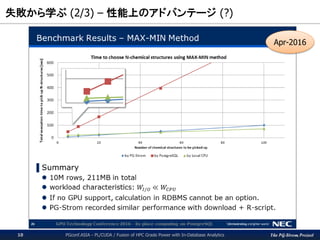
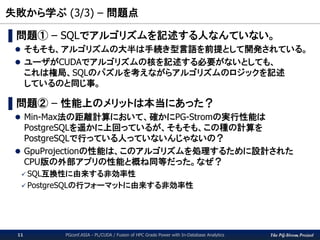
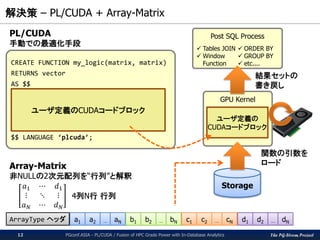
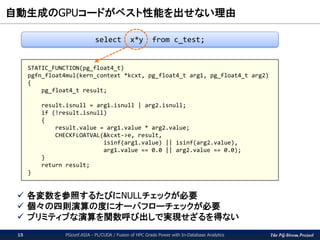
PL/CUDA - Fusion of HPC Grade Power with In-Database Analytics
1.
PL/CUDA
~Fusion of HPCGrade Power with In-Database Analytics~
The PG-Strom Project / NEC OSS Promotion Center
KaiGai Kohei <kaigai@ak.jp.nec.com>
http://www.slideshare.net/kaigai/pgconfasia2016-plcuda
2.
The PG-Strom Project
自己紹介
PGconf.ASIA- PL/CUDA / Fusion of HPC Grade Power with In-Database Analytics2
▌KaiGai Kohei
tw: @kkaigai
https://github.com/kaigai
▌PostgreSQL
SELinux, FDW, CustomScan, ...
▌PG-Strom
GPUを用いたPostgreSQL向け
高速化モジュールの作者
▌お仕事
NEC OSS推進センタ
SW開発/ビジネス開拓
3.
The PG-Strom Project
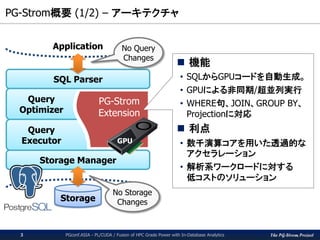
PG-Strom概要(1/2) – アーキテクチャ
PGconf.ASIA - PL/CUDA / Fusion of HPC Grade Power with In-Database Analytics3
Application
Storage
Query
Optimizer
Query
Executor
PG-Strom
Extension
SQL Parser
Storage Manager
GPU
No Storage
Changes
No Query
Changes
機能
• SQLからGPUコードを自動生成。
• GPUによる非同期/超並列実行
• WHERE句、JOIN、GROUP BY、
Projectionに対応
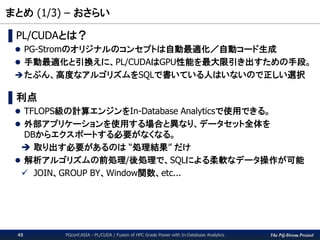
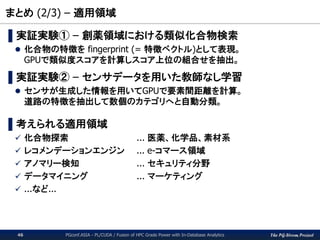
利点
• 数千演算コアを用いた透過的な
アクセラレーション
• 解析系ワークロードに対する
低コストのソリューション
4.
The PG-Strom Project
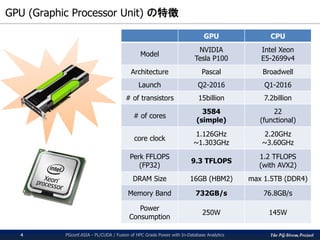
GPU(Graphic Processor Unit) の特徴
PGconf.ASIA - PL/CUDA / Fusion of HPC Grade Power with In-Database Analytics4
GPU CPU
Model
NVIDIA
Tesla P100
Intel Xeon
E5-2699v4
Architecture Pascal Broadwell
Launch Q2-2016 Q1-2016
# of transistors 15billion 7.2billion
# of cores
3584
(simple)
22
(functional)
core clock
1.126GHz
~1.303GHz
2.20GHz
~3.60GHz
Perk FFLOPS
(FP32)
9.3 TFLOPS
1.2 TFLOPS
(with AVX2)
DRAM Size 16GB (HBM2) max 1.5TB (DDR4)
Memory Band 732GB/s 76.8GB/s
Power
Consumption
250W 145W
5.
The PG-Strom Project
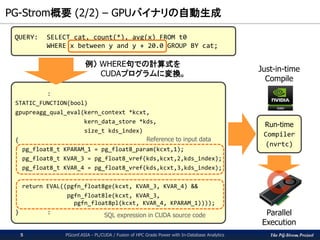
PG-Strom概要(2/2) – GPUバイナリの自動生成
PGconf.ASIA - PL/CUDA / Fusion of HPC Grade Power with In-Database Analytics
QUERY: SELECT cat, count(*), avg(x) FROM t0
WHERE x between y and y + 20.0 GROUP BY cat;
:
STATIC_FUNCTION(bool)
gpupreagg_qual_eval(kern_context *kcxt,
kern_data_store *kds,
size_t kds_index)
{
pg_float8_t KPARAM_1 = pg_float8_param(kcxt,1);
pg_float8_t KVAR_3 = pg_float8_vref(kds,kcxt,2,kds_index);
pg_float8_t KVAR_4 = pg_float8_vref(kds,kcxt,3,kds_index);
return EVAL((pgfn_float8ge(kcxt, KVAR_3, KVAR_4) &&
pgfn_float8le(kcxt, KVAR_3,
pgfn_float8pl(kcxt, KVAR_4, KPARAM_1))));
} :
例) WHERE句での計算式を
CUDAプログラムに変換。
Reference to input data
SQL expression in CUDA source code
Run-time
Compiler
(nvrtc)
Just-in-time
Compile
Parallel
Execution
5
6.
The PG-Strom Project
GPUによるSQL実行高速化の一例
PGconf.ASIA- PL/CUDA / Fusion of HPC Grade Power with In-Database Analytics6
▌Test Query:
SELECT cat, count(*), avg(x)
FROM t0 NATURAL JOIN t1 [NATURAL JOIN t2 ...]
GROUP BY cat;
t0 contains 100M rows, t1...t8 contains 100K rows (like a start schema)
40.44
62.79
79.82
100.50
119.51
144.55
201.12
248.95
9.96 9.93 9.96 9.99 10.02 10.03 9.98 10.00
0
50
100
150
200
250
300
2 3 4 5 6 7 8 9
QueryResponseTime[sec]
Number of joined tables
PG-Strom microbenchmark with JOIN/GROUP BY
PostgreSQL v9.5 PG-Strom v1.0
CPU: Xeon E5-2670v3
GPU: GTX1080
RAM: 384GB
OS: CentOS 7.2
DB: PostgreSQL 9.5 +
PG-Strom v1.0
7.
The PG-Strom Project
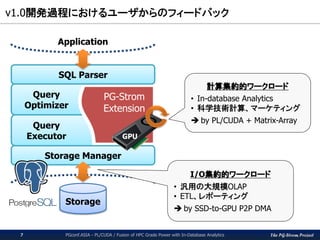
v1.0開発過程におけるユーザからのフィードバック
PGconf.ASIA- PL/CUDA / Fusion of HPC Grade Power with In-Database Analytics7
Application
Storage
Query
Optimizer
Query
Executor
PG-Strom
Extension
SQL Parser
Storage Manager
GPU
計算集約的ワークロード
• In-database Analytics
• 科学技術計算、マーケティング
by PL/CUDA + Matrix-Array
I/O集約的ワークロード
• 汎用の大規模OLAP
• ETL、レポーティング
by SSD-to-GPU P2P DMA
The PG-Strom Project
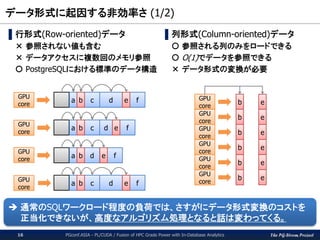
データ形式に起因する非効率さ(1/2)
PGconf.ASIA - PL/CUDA / Fusion of HPC Grade Power with In-Database Analytics16
▌行形式(Row-oriented)データ
× 参照されない値も含む
× データアクセスに複数回のメモリ参照
〇 PostgreSQLにおける標準のデータ構造
▌列形式(Column-oriented)データ
〇 参照される列のみをロードできる
〇 O(1)でデータを参照できる
× データ形式の変換が必要
GPU
core
GPU
core
GPU
core
a c d feb
a c d feb
a d feb
a c d feb
GPU
core
eb
GPU
core
GPU
core
GPU
core
GPU
core
b
b
b
b
b
GPU
core
GPU
core
e
e
e
e
e
通常のSQLワークロード程度の負荷では、さすがにデータ形式変換のコストを
正当化できないが、高度なアルゴリズム処理となると話は変わってくる。
The PG-Strom Project
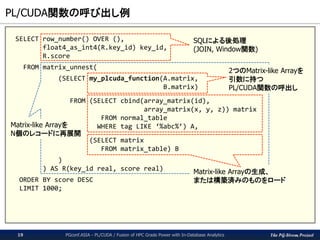
PL/CUDA関数の呼び出し例
PGconf.ASIA- PL/CUDA / Fusion of HPC Grade Power with In-Database Analytics19
SELECT row_number() OVER (),
float4_as_int4(R.key_id) key_id,
R.score
FROM matrix_unnest(
(SELECT my_plcuda_function(A.matrix,
B.matrix)
FROM (SELECT cbind(array_matrix(id),
array_matrix(x, y, z)) matrix
FROM normal_table
WHERE tag LIKE ‘%abc%’) A,
(SELECT matrix
FROM matrix_table) B
)
) AS R(key_id real, score real)
ORDER BY score DESC
LIMIT 1000;
2つのMatrix-like Arrayを
引数に持つ
PL/CUDA関数の呼出し
Matrix-like Arrayの生成、
または構築済みのものをロード
Matrix-like Arrayを
N個のレコードに再展開
SQLによる後処理
(JOIN, Window関数)
The PG-Strom Project
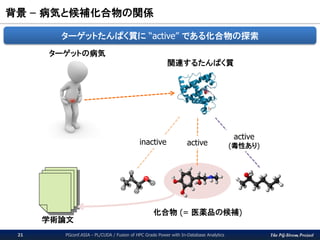
背景– 病気と候補化合物の関係
PGconf.ASIA - PL/CUDA / Fusion of HPC Grade Power with In-Database Analytics21
ターゲットの病気
関連するたんぱく質
化合物 (= 医薬品の候補)
ターゲットたんぱく質に “active” である化合物の探索
inactive active
active
(毒性あり)
学術論文
22.
The PG-Strom Project
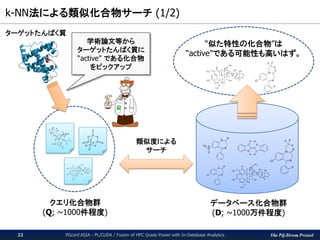
k-NN法による類似化合物サーチ(1/2)
PGconf.ASIA - PL/CUDA / Fusion of HPC Grade Power with In-Database Analytics22
データベース化合物群
(D; ~1000万件程度)
クエリ化合物群
(Q; ~1000件程度)
類似度による
サーチ
ターゲットたんぱく質
“似た特性の化合物”は
“active”である可能性も高いはず。
学術論文等から
ターゲットたんぱく質に
“active” である化合物
をピックアップ
23.
The PG-Strom Project
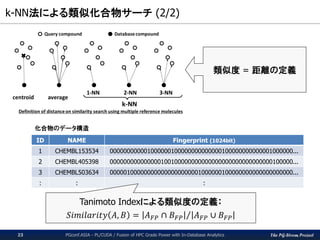
k-NN法による類似化合物サーチ(2/2)
PGconf.ASIA - PL/CUDA / Fusion of HPC Grade Power with In-Database Analytics23
類似度 = 距離の定義
ID NAME Fingerprint (1024bit)
1 CHEMBL153534 000000000001000000100000000000000100000000000001000000...
2 CHEMBL405398 000000000000000100100000000000000000000000000000100000...
3 CHEMBL503634 000001000000000000000000001000000100000000000000000000...
: : :
化合物のデータ構造
Tanimoto Indexによる類似度の定義:
𝑆𝑖𝑚𝑖𝑙𝑎𝑟𝑖𝑡𝑦 𝐴, 𝐵 = 𝐴 𝐹𝑃 ∩ 𝐵 𝐹𝑃 𝐴 𝐹𝑃 ∪ 𝐵 𝐹𝑃
24.
The PG-Strom Project
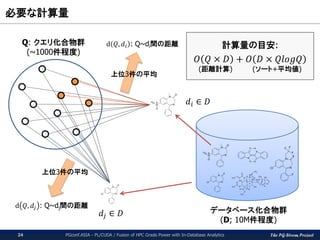
必要な計算量
PGconf.ASIA- PL/CUDA / Fusion of HPC Grade Power with In-Database Analytics24
データベース化合物群
(D; 10M件程度)
Q: クエリ化合物群
(~1000件程度)
上位3件の平均
𝑑𝑖 ∈ 𝐷
d 𝑄, 𝑑𝑖 : Q~di間の距離
𝑑𝑗 ∈ 𝐷
上位3件の平均
計算量の目安:
𝑂 𝑄 × 𝐷 + 𝑂 𝐷 × 𝑄𝑙𝑜𝑔𝑄
(距離計算) (ソート+平均値)
d 𝑄, 𝑑𝑗 : Q~dj間の距離
25.
The PG-Strom Project
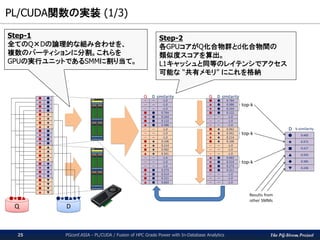
PL/CUDA関数の実装(1/3)
PGconf.ASIA - PL/CUDA / Fusion of HPC Grade Power with In-Database Analytics25
Step-1
全てのQ×Dの論理的な組み合わせを、
複数のパーティションに分割。これらを
GPUの実行ユニットであるSMMに割り当て。
Step-2
各GPUコアがQ化合物群とd化合物間の
類似度スコアを算出。
L1キャッシュと同等のレイテンシでアクセス
可能な “共有メモリ” にこれを格納
26.
The PG-Strom Project
PL/CUDA関数の実装(2/3)
PGconf.ASIA - PL/CUDA / Fusion of HPC Grade Power with In-Database Analytics26
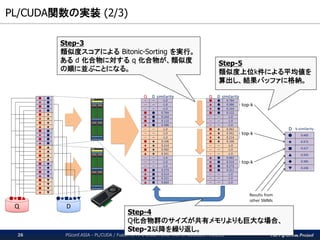
Step-3
類似度スコアによる Bitonic-Sorting を実行。
ある d 化合物に対する q 化合物が、類似度
の順に並ぶことになる。
Step-5
類似度上位k件による平均値を
算出し、結果バッファに格納。
Step-4
Q化合物群のサイズが共有メモリよりも巨大な場合、
Step-2以降を繰り返し。
27.
The PG-Strom Project
PL/CUDA関数の実装(3/3)
PGconf.ASIA - PL/CUDA / Fusion of HPC Grade Power with In-Database Analytics27
CREATE OR REPLACE FUNCTION
knn_gpu_similarity(int, -- k-value
int[], -- ID+bitmap of Q
int[]) -- ID+bitmap of D
RETURNS float4[] -- result: ID+similarity
AS $$
#plcuda_decl
:
#plcuda_begin
#plcuda_kernel_blocksz ¥
knn_gpu_similarity_main_block_size
#plcuda_num_threads ¥
knn_gpu_similarity_main_num_threads
#plcuda_shmem_blocksz 8192
cl_int k = arg1.value;
MatrixType *Q = (MatrixType *) arg2.value;
MatrixType *D = (MatrixType *) arg3.value;
MatrixType *R = (MatrixType *) results;
:
for (loop=0; loop < nloops; loop++)
{
/* 1. calculation of the similarity */
for (i = get_local_id();
i < part_sz * part_nums;
i += get_local_size()) {
j = i % part_sz; /* index within partition */
dindex = part_nums * get_global_index()
+ (i / part_sz);
qindex = loop * (part_sz - k) + (j - k);
if (dindex < ARRAY_MATRIX_HEIGHT(D) &&
qindex < ARRAY_MATRIX_HEIGHT(Q)) {
values[i] = knn_similarity_compute(D, dindex,
Q, qindex);
}
}
__syncthreads();
/* 2. sorting by the similarity for each partition */
knn_similarity_sorting(values, part_sz, part_nums);
__syncthreads();
:
}
#plcuda_end
#plcuda_sanity_check knn_gpu_similarity_sanity_check
#plcuda_working_bufsz 0
#plcuda_results_bufsz knn_gpu_similarity_results_bufsz
$$ LANGUAGE 'plcuda';
real[] -- ID+Similarity of D化合物 (2xN)
knn_gpu_similarity(int k, -- k-value
int[] Q, -- ID+Fingerprint of Q化合物 (33xM)
int[] D); -- ID+Fingerprint of D化合物 (33xN)
28.
The PG-Strom Project
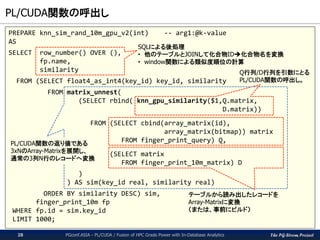
PL/CUDA関数の呼出し
PGconf.ASIA- PL/CUDA / Fusion of HPC Grade Power with In-Database Analytics28
PREPARE knn_sim_rand_10m_gpu_v2(int) -- arg1:@k-value
AS
SELECT row_number() OVER (),
fp.name,
similarity
FROM (SELECT float4_as_int4(key_id) key_id, similarity
FROM matrix_unnest(
(SELECT rbind( knn_gpu_similarity($1,Q.matrix,
D.matrix))
FROM (SELECT cbind(array_matrix(id),
array_matrix(bitmap)) matrix
FROM finger_print_query) Q,
(SELECT matrix
FROM finger_print_10m_matrix) D
)
) AS sim(key_id real, similarity real)
ORDER BY similarity DESC) sim,
finger_print_10m fp
WHERE fp.id = sim.key_id
LIMIT 1000;
SQLによる後処理
• 他のテーブルとJOINして化合物ID化合物名を変換
• window関数による類似度順位の計算
Q行列/D行列を引数にとる
PL/CUDA関数の呼出し。
テーブルから読み出したレコードを
Array-Matrixに変換
(または、事前にビルド)
PL/CUDA関数の返り値である
3xNのArray-Matrixを展開し、
通常の3列N行のレコードへ変換
The PG-Strom Project
GPU版k-means関数の呼出し
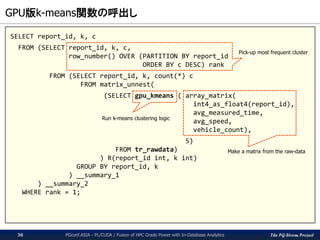
PGconf.ASIA- PL/CUDA / Fusion of HPC Grade Power with In-Database Analytics36
SELECT report_id, k, c
FROM (SELECT report_id, k, c,
row_number() OVER (PARTITION BY report_id
ORDER BY c DESC) rank
FROM (SELECT report_id, k, count(*) c
FROM matrix_unnest(
(SELECT gpu_kmeans ( array_matrix(
int4_as_float4(report_id),
avg_measured_time,
avg_speed,
vehicle_count),
5)
FROM tr_rawdata)
) R(report_id int, k int)
GROUP BY report_id, k
) __summary_1
) __summary_2
WHERE rank = 1;
Make a matrix from the raw-data
Run k-means clustering logic
Pick-up most frequent cluster
37.
The PG-Strom Project
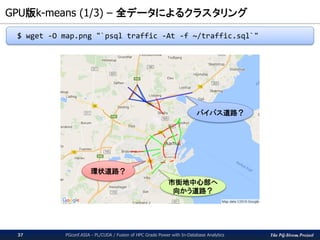
GPU版k-means(1/3) – 全データによるクラスタリング
PGconf.ASIA - PL/CUDA / Fusion of HPC Grade Power with In-Database Analytics37
$ wget -O map.png "`psql traffic -At -f ~/traffic.sql`"
バイパス道路?
市街地中心部へ
向かう道路?
環状道路?
38.
The PG-Strom Project
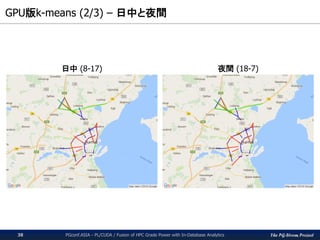
GPU版k-means(2/3) – 日中と夜間
PGconf.ASIA - PL/CUDA / Fusion of HPC Grade Power with In-Database Analytics38
日中 (8-17) 夜間 (18-7)
39.
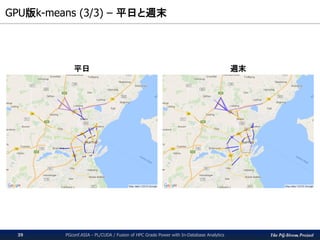
The PG-Strom Project
GPU版k-means(3/3) – 平日と週末
PGconf.ASIA - PL/CUDA / Fusion of HPC Grade Power with In-Database Analytics39
平日 週末
40.
The PG-Strom Project
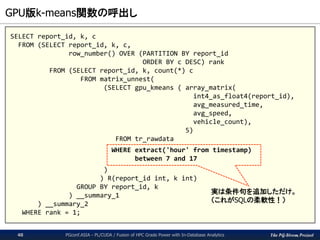
GPU版k-means関数の呼出し
PGconf.ASIA- PL/CUDA / Fusion of HPC Grade Power with In-Database Analytics40
SELECT report_id, k, c
FROM (SELECT report_id, k, c,
row_number() OVER (PARTITION BY report_id
ORDER BY c DESC) rank
FROM (SELECT report_id, k, count(*) c
FROM matrix_unnest(
(SELECT gpu_kmeans ( array_matrix(
int4_as_float4(report_id),
avg_measured_time,
avg_speed,
vehicle_count),
5)
FROM tr_rawdata
WHERE extract('hour' from timestamp)
between 7 and 17
)
) R(report_id int, k int)
GROUP BY report_id, k
) __summary_1
) __summary_2
WHERE rank = 1;
実は条件句を追加しただけ。
(これがSQLの柔軟性!)
41.
The PG-Strom Project
パフォーマンス(1/3)
PGconf.ASIA - PL/CUDA / Fusion of HPC Grade Power with In-Database Analytics41
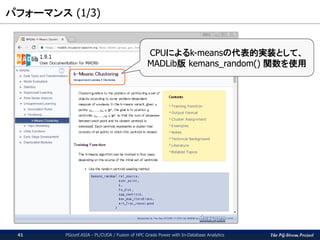
CPUによるk-meansの代表的実装として、
MADLib版 kemans_random() 関数を使用
42.
The PG-Strom Project
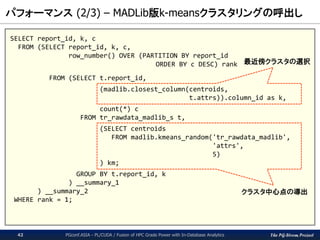
パフォーマンス(2/3) – MADLib版k-meansクラスタリングの呼出し
PGconf.ASIA - PL/CUDA / Fusion of HPC Grade Power with In-Database Analytics42
SELECT report_id, k, c
FROM (SELECT report_id, k, c,
row_number() OVER (PARTITION BY report_id
ORDER BY c DESC) rank
FROM (SELECT t.report_id,
(madlib.closest_column(centroids,
t.attrs)).column_id as k,
count(*) c
FROM tr_rawdata_madlib_s t,
(SELECT centroids
FROM madlib.kmeans_random('tr_rawdata_madlib',
'attrs',
5)
) km;
GROUP BY t.report_id, k
) __summary_1
) __summary_2
WHERE rank = 1;
クラスタ中心点の導出
最近傍クラスタの選択
43.
The PG-Strom Project
パフォーマンス(3/3) – GPU版 vs CPU版実装
PGconf.ASIA - PL/CUDA / Fusion of HPC Grade Power with In-Database Analytics43
測定環境
HW) CPU: Xeon E5-2670v3, GPU: GTX1080, RAM: 384GB
SW) CentOS7, CUDA8.0, PostgreSQL v9.5 + PG-Strom v1.0, MADLib 1.9
CPU版は、同等のロジックをC言語によるバイナリ版で実装して比較計測
1.41 12.44
126.59
1668.49
0.21 0.29 0.94 8.41
0
200
400
600
800
1000
1200
1400
1600
1800
10,000 100,000 1,000,000 13,577,132
QueryResponseTime[sec]
(※Lowerisbetter)
Number of Items that were clustered based on the k-means algorithm
Performance comparison of in-database k-means clustering
MADLib PL/CUDA
x200倍高速化
![The PG-Strom Project
GPUによるSQL実行高速化の一例
PGconf.ASIA - PL/CUDA / Fusion of HPC Grade Power with In-Database Analytics6
▌Test Query:
SELECT cat, count(*), avg(x)
FROM t0 NATURAL JOIN t1 [NATURAL JOIN t2 ...]
GROUP BY cat;
t0 contains 100M rows, t1...t8 contains 100K rows (like a start schema)
40.44
62.79
79.82
100.50
119.51
144.55
201.12
248.95
9.96 9.93 9.96 9.99 10.02 10.03 9.98 10.00
0
50
100
150
200
250
300
2 3 4 5 6 7 8 9
QueryResponseTime[sec]
Number of joined tables
PG-Strom microbenchmark with JOIN/GROUP BY
PostgreSQL v9.5 PG-Strom v1.0
CPU: Xeon E5-2670v3
GPU: GTX1080
RAM: 384GB
OS: CentOS 7.2
DB: PostgreSQL 9.5 +
PG-Strom v1.0](https://image.slidesharecdn.com/20161203pgconf-161201122505/85/PL-CUDA-Fusion-of-HPC-Grade-Power-with-In-Database-Analytics-6-320.jpg)
![The PG-Strom Project
PL/CUDA関数定義の例
PGconf.ASIA - PL/CUDA / Fusion of HPC Grade Power with In-Database Analytics13
CREATE OR REPLACE FUNCTION
knn_gpu_similarity(int, int[], int[])
RETURNS float4[]
AS $$
#plcuda_begin
cl_int k = arg1.value;
MatrixType *Q = (MatrixType *) arg2.value;
MatrixType *D = (MatrixType *) arg3.value;
MatrixType *R = (MatrixType *) results;
:
nloops = (ARRAY_MATRIX_HEIGHT(Q) + (part_sz - k - 1)) / (part_sz - k);
for (loop=0; loop < nloops; loop++) {
/* 1. calculation of the similarity */
for (i = get_local_id(); i < part_sz * part_nums; i += get_local_size()) {
j = i % part_sz; /* index within partition */
/* index of database matrix (D) */
dindex = part_nums * get_global_index() + (i / part_sz);
/* index of query matrix (Q) */
qindex = loop * (part_sz - k) + (j - k);
values[i] = knn_similarity_compute(D, dindex, Q, qindex);
}
}
:
#plcuda_end
$$ LANGUAGE 'plcuda';
CUDA code block](https://image.slidesharecdn.com/20161203pgconf-161201122505/85/PL-CUDA-Fusion-of-HPC-Grade-Power-with-In-Database-Analytics-13-320.jpg)
![The PG-Strom Project
どのようにGPUカーネルを起動するか
PGconf.ASIA - PL/CUDA / Fusion of HPC Grade Power with In-Database Analytics14
CREATE OR REPLACE FUNCTION
my_cuda_func(float[])
RETURNS int[]
$$
#plcuda_sanity_check func_sc
#plcuda_begin
#plcuda_end
#plcuda_working_bufsz func_wb
$$ LANGUAGE ‘plcuda’;
ユーザ定義のCUDAコードブロック
bool func_sc(float[])
引数チェックのためのヘルパー関数
bigint func_wb(float[])
バッファサイズ推定のためのヘルパー関数
GPU
バイナリ
GPU
カーネル
作業用
バッファ
PL/CUDA
関数の引数
ランタイム
コンパイラ
SQLデータの
入出力
ユーザ定義の
CUDAコードブロック
共通の
GPUライブラリ
GPUカーネルの
ソースコード
GPU側へ
引数をロード](https://image.slidesharecdn.com/20161203pgconf-161201122505/85/PL-CUDA-Fusion-of-HPC-Grade-Power-with-In-Database-Analytics-14-320.jpg)
![The PG-Strom Project
行列表現としての二次元配列
PGconf.ASIA - PL/CUDA / Fusion of HPC Grade Power with In-Database Analytics18
▌datatype[] array_matrix(variadic datatype[])
入力データを蓄積し二次元配列として出力する集約関数
datatypeはint2, int4, int8, float4 および float8 のどれか。
この二次元配列はNULLを含んでいてはならない。
▌SETOF record matrix_unnest(datatype[])
m列n行の二次元配列を、m列から成るn個のレコードへと展開する関数。
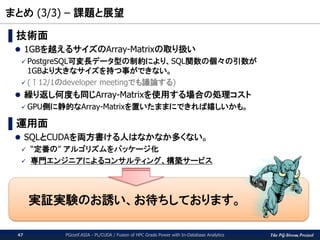
▌課題
可変長データを扱う事ができない。
PostgreSQLの可変長データの制約により、最大でも1GBになってしまう。
ArrayType header a1 a2 aN… b1 b2 bN… c1 c2 cN… d1 d2 dN…
𝑎1 ⋯ 𝑑1
⋮ ⋱ ⋮
𝑎 𝑁 ⋯ 𝑑 𝑁
4列N行行列
Array-Matrix
非NULL固定長の二次元配列を “行列” と見なす](https://image.slidesharecdn.com/20161203pgconf-161201122505/85/PL-CUDA-Fusion-of-HPC-Grade-Power-with-In-Database-Analytics-18-320.jpg)

![The PG-Strom Project
PL/CUDA関数の実装 (3/3)
PGconf.ASIA - PL/CUDA / Fusion of HPC Grade Power with In-Database Analytics27
CREATE OR REPLACE FUNCTION
knn_gpu_similarity(int, -- k-value
int[], -- ID+bitmap of Q
int[]) -- ID+bitmap of D
RETURNS float4[] -- result: ID+similarity
AS $$
#plcuda_decl
:
#plcuda_begin
#plcuda_kernel_blocksz ¥
knn_gpu_similarity_main_block_size
#plcuda_num_threads ¥
knn_gpu_similarity_main_num_threads
#plcuda_shmem_blocksz 8192
cl_int k = arg1.value;
MatrixType *Q = (MatrixType *) arg2.value;
MatrixType *D = (MatrixType *) arg3.value;
MatrixType *R = (MatrixType *) results;
:
for (loop=0; loop < nloops; loop++)
{
/* 1. calculation of the similarity */
for (i = get_local_id();
i < part_sz * part_nums;
i += get_local_size()) {
j = i % part_sz; /* index within partition */
dindex = part_nums * get_global_index()
+ (i / part_sz);
qindex = loop * (part_sz - k) + (j - k);
if (dindex < ARRAY_MATRIX_HEIGHT(D) &&
qindex < ARRAY_MATRIX_HEIGHT(Q)) {
values[i] = knn_similarity_compute(D, dindex,
Q, qindex);
}
}
__syncthreads();
/* 2. sorting by the similarity for each partition */
knn_similarity_sorting(values, part_sz, part_nums);
__syncthreads();
:
}
#plcuda_end
#plcuda_sanity_check knn_gpu_similarity_sanity_check
#plcuda_working_bufsz 0
#plcuda_results_bufsz knn_gpu_similarity_results_bufsz
$$ LANGUAGE 'plcuda';
real[] -- ID+Similarity of D化合物 (2xN)
knn_gpu_similarity(int k, -- k-value
int[] Q, -- ID+Fingerprint of Q化合物 (33xM)
int[] D); -- ID+Fingerprint of D化合物 (33xN)](https://image.slidesharecdn.com/20161203pgconf-161201122505/85/PL-CUDA-Fusion-of-HPC-Grade-Power-with-In-Database-Analytics-27-320.jpg)
![The PG-Strom Project
パフォーマンス
PGconf.ASIA - PL/CUDA / Fusion of HPC Grade Power with In-Database Analytics29
CPU版は、同等のロジックをC言語によるバイナリ版で実装して比較計測
D化合物群の数は1000万レコード、Q化合物群の数は10,50,100,500,1000個の5通り
最大で100億通りの組合せを計算。これは実際の創薬ワークロードの規模と同等。
HW) CPU: Xeon E5-2670v3, GPU: GTX980 / GTX1080, RAM:384GB
SW) CentOS7, CUDA8.0, PostgreSQL v9.5 + PG-Strom v1.0
30.25
145.29
295.95
1503.31
3034.94
12.97 13.46 13.90 18.16 24.6513.00 13.23 13.59 16.01 19.13
0
500
1000
1500
2000
2500
3000
3500
10 50 100 500 1000
QueryResponseTime[sec]
(*Lowerisbetter)
クエリ化合物群の数[Q]
k-NN法による類似化合物サーチ応答時間 (k=3, D=10M)
CPU(E5-2670v3) GTX980 GTX1080
x150 times
faster!](https://image.slidesharecdn.com/20161203pgconf-161201122505/85/PL-CUDA-Fusion-of-HPC-Grade-Power-with-In-Database-Analytics-29-320.jpg)
![The PG-Strom Project
PL/CUDAによるk-meansクラスタリングの実装
PGconf.ASIA - PL/CUDA / Fusion of HPC Grade Power with In-Database Analytics34
CREATE OR REPLACE FUNCTION
gpu_kmeans(real[], -- ID + Data Matrix
int, -- k-value (number of clusters)
int = 10, -- max number of iteration
int = 1) -- seed of initial randomness
RETURNS int[]
AS $$
#plcuda_decl
:
KERNEL_FUNCTION_MAXTHREADS(void)
update_centroid(MatrixType *D,
MatrixType *R,
MatrixType *C)
{
:
/* accumulate the local centroid */
for (did = get_global_id();
did < nitems;
did += get_global_size())
{
/* pick up the target cluster */
cid = r_values[nitems + did];
atomicAdd(&l_cent[cid], 1.0);
for (index=1; index < width; index++)
atomicAdd(&l_cent[index * k_value + cid],
d_values[index * nitems + did]);
}
__syncthreads();
/* write back to the global C-matrix */
for (index = get_local_id();
index < width * k_value;
index += get_local_size())
atomicAdd(&c_values[index], l_cent[index]);
}
:
#plcuda_begin
:
status = pgstromLaunchDynamicKernel4((void *)
setup_initial_cluster,
(kern_arg_t)(D),
(kern_arg_t)(R),
(kern_arg_t)(C),
(kern_arg_t)(r_seed),
nitems, 0, 0);
if (status != cudaSuccess)
PLCUDA_RUNTIME_ERROR_RETURN(status);
for (loop=0; loop < nloops; loop++)
{
:
status = pgstromLaunchDynamicKernelMaxThreads3(
(void *)kmeans_update_cluster,
(kern_arg_t)(D),
(kern_arg_t)(R),
(kern_arg_t)(C),
(kern_arg_t)k_value,
nitems, 0,
sizeof(cl_int) + sizeof(cl_float));
if (status != cudaSuccess)
PLCUDA_RUNTIME_ERROR_RETURN(status);
:
}
#plcuda_sanity_check gpu_kmeans_sanity_check
#plcuda_working_bufsz gpu_kmeans_working_bufsz
#plcuda_results_bufsz gpu_kmeans_results_bufsz
#plcuda_end
$$ LANGUAGE 'plcuda';](https://image.slidesharecdn.com/20161203pgconf-161201122505/85/PL-CUDA-Fusion-of-HPC-Grade-Power-with-In-Database-Analytics-34-320.jpg)
![The PG-Strom Project
パフォーマンス (3/3) – GPU版 vs CPU版実装
PGconf.ASIA - PL/CUDA / Fusion of HPC Grade Power with In-Database Analytics43
測定環境
HW) CPU: Xeon E5-2670v3, GPU: GTX1080, RAM: 384GB
SW) CentOS7, CUDA8.0, PostgreSQL v9.5 + PG-Strom v1.0, MADLib 1.9
CPU版は、同等のロジックをC言語によるバイナリ版で実装して比較計測
1.41 12.44
126.59
1668.49
0.21 0.29 0.94 8.41
0
200
400
600
800
1000
1200
1400
1600
1800
10,000 100,000 1,000,000 13,577,132
QueryResponseTime[sec]
(※Lowerisbetter)
Number of Items that were clustered based on the k-means algorithm
Performance comparison of in-database k-means clustering
MADLib PL/CUDA
x200倍高速化](https://image.slidesharecdn.com/20161203pgconf-161201122505/85/PL-CUDA-Fusion-of-HPC-Grade-Power-with-In-Database-Analytics-43-320.jpg)





![GPUとSSDがPostgreSQLを加速する~クエリ処理スループット10GB/sへの挑戦~ [DB Tech Showcase Tokyo/2017]](https://cdn.slidesharecdn.com/ss_thumbnails/20170906dbtsgpussdacceleratespostgresqljp-170906073226-thumbnail.jpg?width=640&height=640&fit=bounds)


![[20170922 Sapporo Tech Bar] 地図用データを高速処理!オープンソースGPUデータベースMapDってどんなもの?? by 株式会社...](https://cdn.slidesharecdn.com/ss_thumbnails/20170922mapd-170926064811-thumbnail.jpg?width=640&height=640&fit=bounds)


![[D31] PostgreSQLでスケールアウト構成を構築しよう by Yugo Nagata](https://cdn.slidesharecdn.com/ss_thumbnails/d31postgresnagata-131128230735-phpapp01-thumbnail.jpg?width=640&height=640&fit=bounds)


