Steven Perdoch
Matthew Dymit
  Carrie Loera
Dan McGowan
Elana Muradova

                 Strategic Management, Spring 2012
History

 Founded  in 1837
 William Procter and James
  Gamble
 Incorporated in Ohio on May 5,
  1905
In the beginning…
   Proctor and Gamble came to be by manufacturing
    soap and candles.

   After the invention of the electric light bulb, the
    demand for candles fell significantly, thus causing
    the newly formed P&G to cease their production.

   During the Civil War, the government began to
    order mass quantities of soap from P&G for the
    Soldiers’ use—this significantly led to P&G’s return
    to the market and their second chance at rising in
    the business world.
Organizational Structure
Acquisition Summary

   Between 1905 (Incorporated) – 2010, P&G
    invested in 34 acquisitions
   Periods of frequent acquisitions occur in the
    1930’s, 50’s, 80’s and 90’s.
   Some of the larger acquisitions include:
    –   Charmin, Clorox, Crush, Revlon, and Gillette
P&G Today

   Products sold in > 180 Countries
   On the ground operations in 80 countries
   Organized into 2 Global Business Units (GBU’s)

     Health Care                              Fabric and
                              &               Home Care

                   Beauty &       Household   Baby and
     Grooming
                   Grooming         Care      Family Care


     Beauty                                   Snacks and
                                              Pet Care
P&G: Who we are.


   http://www.youtube.com/watch?v=tAT-cFFGNQg
Health Care

   Segment includes products in oral care, feminine
    care, respiratory, toothpaste, OTC drugs and other
    personal care categories
Health Care - Overview

   14% of Net Sales in 2011
   Products sold in drug stores
    supermarkets, and mass
    merchandisers
   Mature market
   Name Brand & Private Label competitors
Health Care – Core Competencies

   Strong, Dependable, High Quality Products
    –   Strict internal standards and guidelines to comply
        with FDA
    –   Most recent recall was early 2010 - Vicks
    –   Vicks 4-Hour Nasal Spray (wrong expiration date)
   Health Care Research Center
    –   Promote innovation and bring new products to the
        market quicker
PGT Healthcare
Threats

   Intense competition
    –   Private labels are much cheaper
           Top Cough Syrup Makers - Market Share
        Company                     % - 2010 % - 2011    % Change
        Wyeth Labs, Inc. (Pfizer)      25.17    25.87            0.7
        Reckitt Benckiser              26.82    24.23          -2.59
        Private label                  24.78    22.17          -2.61
        Procter and Gamble Co.         13.59        19          5.41
        Other                               3     3.31          0.31
        Novartis Consumer Health         2.61     3.02          0.41
        Blacksmith Brands                0.65     1.12          0.47
        Health Care Products             1.36     0.73         -0.63
        Boiron-Borneman                  1.13     0.55         -0.58
        Qualitest Products                0.9        0          -0.9
Baby Care and Family Care

•   Segment includes diapers, baby wipes, paper
    towels, and toilet paper
Baby Care & Family Care Key Info.

•   19 % Of Net Sales
•   Products sold in supermarkets, convenience
    stores, hotels,motels,and other industries
•   Baby Care and Family Care competitors
Beauty Segment

   This segment includes cosmetics, fragrances,
    hair care, and skin care products
Beauty Segment

   Beauty accounts for approximately 34% of
    P&G’s product portfolio.
   24% of Net Sales & Net Earnings
    –   Head & Shoulders, Olay, and Pantene are some of
        the biggest brands within this segment.
P&G Beauty in The Marketplace

   P&G’s beauty products are highly
    recognizable; brand differentiation is a
    strength.
   Product availably is great; products are sold at
    practically all domestic retailer chain and drug
    stores.
   Proctor & Gamble is associated with tried and
    true, trusted products.
Beauty Segment
Competition and Growth

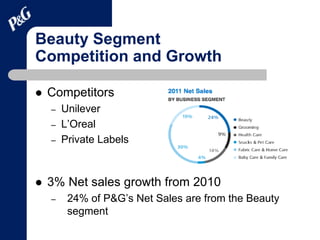
   Competitors
    –   Unilever
    –   L’Oreal
    –   Private Labels


   3% Net sales growth from 2010
    –    24% of P&G’s Net Sales are from the Beauty
         segment
Threats to Beauty Segment

   Greatest threat to P&G’s Beauty Segment is the
    Threat of Rivalry
    –   Unilever, L’Oreal, Private Labels
   Mature Market
   Threat of Buyers and/or Suppliers?
    –   Relatively low, due to the working relationship between
        both categories and the trust created in order to
        maximize that relationship.
            Suppliers are even involved in P&G’s creative process in
             developing new products.
Fabric and Homecare

   Segment contains products including laundry
    cleaning products and fabric conditioners;
    home care products, including dishwashing
    liquids and detergents, surface cleaners and
    air fresheners; and batteries
   Fabric care dominates the market with over
    30% of the global market share
   Global home care market share is over 15%
    across the categories in which we compete
Fabric and Homecare (Cont.)

   Proctor and Gambles largest, and most
    profitable division - 30% of net sales
   Has been increasing steadily - 6% in 2011
   Mature Market
   Market made up of Brand name and Generic
    brands
Snack and Pet Care

   This segment includes food products and pet
    food products
   Smallest segment
Snack and Pet Care Overview

   Least profitable P&G business segment
   4% of P&G’s net sales in 2011
   Pringles was the only existing snack brand*
   Pringles owned 3% of US Snack Food
    Production Industy’s market share
   Utilizes Eukanoba and Iams to appeal to all
    types of pet owners
Threats

   Lack of presence in the industries
   Mature market
   Fierce competition
   Extension would require major investment into
    creating new products and brands
   Competition has more industry-focused
    product lines
Recommendations
Disinvest/Sell off Snack & Pet Care
Business Segment

   Least profitable business segment (4% net
    sales ’11)
   Pringles sold for $2.7 Billion
   Iams and Eukanoba (value?)
   Increased focus on profitable business
    segments
   Increased opportunity to innovate in successful
    segments
Growth in Developing Markets

   Company-wide initiative: Acquire 1 billion additional
    consumers by 2014/2015
                                        P&G Sales Growth: 2000 to 2012
                                 90%
                                       80%
                                 80%                77%                       Developed
      % of Total Company Sales


                                 70%                             63%          Developing
                                 60%

                                 50%

                                 40%                                    37%

                                 30%                       23%
                                              20%
                                 20%

                                 10%

                                 0%
                                         FY '00       FY '05       FY '12
Demographic/Socioeconomic
Trends

   Population is forecasted to grow 700 million
    people by 2020 (Think of all those diapers?)
   95% of this growth will come from developing
    markets
   Wealth and Per Capita income increasing
   Plan of attack?
    –   Expand geographically and fill in the ―White Space‖
Improve Productivity in All Areas

   Cost of Goods
    –   Reduce RM costs
            Long-term contracts
            Increase # of Suppliers?
    –   Reduce excess inventory
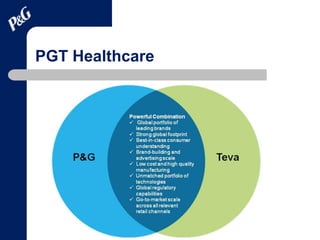
    –   Develop partnerships (PGT Healthcare)
   Research & Development ~ $2 billion annually
    –   Continuous improvement
    –   Product Innovation
Open Innovate Connect + Develop

   Continue to nurture the Open Innovate:
    Connect + Develop method of research and
    development.

   What is OIC+D?
Connect + Develop


“Today, open innovation at P&G works both ways — inbound and outbound — and
encompasses everything from trademarks to packaging, marketing models to
engineering, and business services to design. It's so much more than technology.”
-Bruce Brown, CTO
Why is OIC+D Important?


          Collaboration


                                  Ultra-fast
                          product-to-market delivery
Marketing Opportunities

   Proctor and Gamble wants to cut $10 Billion in
    expenses
   In 2010 P&G spent $2.2 million on Television
    advertising
   While many of its advertising campaigns boost
    sales is it too much?
   Focus on digital marketing & social media and
    spend more efficiently
         http://www.youtube.com/watch?v=PvYP_d2S1Pg
Top 10 Advertisers in 2010
Thank you… Any Questions?

Procter & Gamble Strategic Analysis

  • 2.
    Steven Perdoch Matthew Dymit Carrie Loera Dan McGowan Elana Muradova Strategic Management, Spring 2012
  • 3.
    History  Founded in 1837  William Procter and James Gamble  Incorporated in Ohio on May 5, 1905
  • 4.
    In the beginning…  Proctor and Gamble came to be by manufacturing soap and candles.  After the invention of the electric light bulb, the demand for candles fell significantly, thus causing the newly formed P&G to cease their production.  During the Civil War, the government began to order mass quantities of soap from P&G for the Soldiers’ use—this significantly led to P&G’s return to the market and their second chance at rising in the business world.
  • 5.
  • 6.
    Acquisition Summary  Between 1905 (Incorporated) – 2010, P&G invested in 34 acquisitions  Periods of frequent acquisitions occur in the 1930’s, 50’s, 80’s and 90’s.  Some of the larger acquisitions include: – Charmin, Clorox, Crush, Revlon, and Gillette
  • 7.
    P&G Today  Products sold in > 180 Countries  On the ground operations in 80 countries  Organized into 2 Global Business Units (GBU’s) Health Care Fabric and & Home Care Beauty & Household Baby and Grooming Grooming Care Family Care Beauty Snacks and Pet Care
  • 8.
    P&G: Who weare.  http://www.youtube.com/watch?v=tAT-cFFGNQg
  • 9.
    Health Care  Segment includes products in oral care, feminine care, respiratory, toothpaste, OTC drugs and other personal care categories
  • 10.
    Health Care -Overview  14% of Net Sales in 2011  Products sold in drug stores supermarkets, and mass merchandisers  Mature market  Name Brand & Private Label competitors
  • 11.
    Health Care –Core Competencies  Strong, Dependable, High Quality Products – Strict internal standards and guidelines to comply with FDA – Most recent recall was early 2010 - Vicks – Vicks 4-Hour Nasal Spray (wrong expiration date)  Health Care Research Center – Promote innovation and bring new products to the market quicker
  • 12.
  • 13.
    Threats  Intense competition – Private labels are much cheaper Top Cough Syrup Makers - Market Share Company % - 2010 % - 2011 % Change Wyeth Labs, Inc. (Pfizer) 25.17 25.87 0.7 Reckitt Benckiser 26.82 24.23 -2.59 Private label 24.78 22.17 -2.61 Procter and Gamble Co. 13.59 19 5.41 Other 3 3.31 0.31 Novartis Consumer Health 2.61 3.02 0.41 Blacksmith Brands 0.65 1.12 0.47 Health Care Products 1.36 0.73 -0.63 Boiron-Borneman 1.13 0.55 -0.58 Qualitest Products 0.9 0 -0.9
  • 14.
    Baby Care andFamily Care • Segment includes diapers, baby wipes, paper towels, and toilet paper
  • 15.
    Baby Care &Family Care Key Info. • 19 % Of Net Sales • Products sold in supermarkets, convenience stores, hotels,motels,and other industries • Baby Care and Family Care competitors
  • 16.
    Beauty Segment  This segment includes cosmetics, fragrances, hair care, and skin care products
  • 17.
    Beauty Segment  Beauty accounts for approximately 34% of P&G’s product portfolio.  24% of Net Sales & Net Earnings – Head & Shoulders, Olay, and Pantene are some of the biggest brands within this segment.
  • 18.
    P&G Beauty inThe Marketplace  P&G’s beauty products are highly recognizable; brand differentiation is a strength.  Product availably is great; products are sold at practically all domestic retailer chain and drug stores.  Proctor & Gamble is associated with tried and true, trusted products.
  • 19.
    Beauty Segment Competition andGrowth  Competitors – Unilever – L’Oreal – Private Labels  3% Net sales growth from 2010 – 24% of P&G’s Net Sales are from the Beauty segment
  • 20.
    Threats to BeautySegment  Greatest threat to P&G’s Beauty Segment is the Threat of Rivalry – Unilever, L’Oreal, Private Labels  Mature Market  Threat of Buyers and/or Suppliers? – Relatively low, due to the working relationship between both categories and the trust created in order to maximize that relationship.  Suppliers are even involved in P&G’s creative process in developing new products.
  • 21.
    Fabric and Homecare  Segment contains products including laundry cleaning products and fabric conditioners; home care products, including dishwashing liquids and detergents, surface cleaners and air fresheners; and batteries  Fabric care dominates the market with over 30% of the global market share  Global home care market share is over 15% across the categories in which we compete
  • 22.
    Fabric and Homecare(Cont.)  Proctor and Gambles largest, and most profitable division - 30% of net sales  Has been increasing steadily - 6% in 2011  Mature Market  Market made up of Brand name and Generic brands
  • 23.
    Snack and PetCare  This segment includes food products and pet food products  Smallest segment
  • 24.
    Snack and PetCare Overview  Least profitable P&G business segment  4% of P&G’s net sales in 2011  Pringles was the only existing snack brand*  Pringles owned 3% of US Snack Food Production Industy’s market share  Utilizes Eukanoba and Iams to appeal to all types of pet owners
  • 25.
    Threats  Lack of presence in the industries  Mature market  Fierce competition  Extension would require major investment into creating new products and brands  Competition has more industry-focused product lines
  • 26.
  • 27.
    Disinvest/Sell off Snack& Pet Care Business Segment  Least profitable business segment (4% net sales ’11)  Pringles sold for $2.7 Billion  Iams and Eukanoba (value?)  Increased focus on profitable business segments  Increased opportunity to innovate in successful segments
  • 28.
    Growth in DevelopingMarkets  Company-wide initiative: Acquire 1 billion additional consumers by 2014/2015 P&G Sales Growth: 2000 to 2012 90% 80% 80% 77% Developed % of Total Company Sales 70% 63% Developing 60% 50% 40% 37% 30% 23% 20% 20% 10% 0% FY '00 FY '05 FY '12
  • 29.
    Demographic/Socioeconomic Trends  Population is forecasted to grow 700 million people by 2020 (Think of all those diapers?)  95% of this growth will come from developing markets  Wealth and Per Capita income increasing  Plan of attack? – Expand geographically and fill in the ―White Space‖
  • 32.
    Improve Productivity inAll Areas  Cost of Goods – Reduce RM costs  Long-term contracts  Increase # of Suppliers? – Reduce excess inventory – Develop partnerships (PGT Healthcare)  Research & Development ~ $2 billion annually – Continuous improvement – Product Innovation
  • 33.
    Open Innovate Connect+ Develop  Continue to nurture the Open Innovate: Connect + Develop method of research and development.  What is OIC+D?
  • 34.
    Connect + Develop “Today,open innovation at P&G works both ways — inbound and outbound — and encompasses everything from trademarks to packaging, marketing models to engineering, and business services to design. It's so much more than technology.” -Bruce Brown, CTO
  • 35.
    Why is OIC+DImportant? Collaboration Ultra-fast product-to-market delivery
  • 36.
    Marketing Opportunities  Proctor and Gamble wants to cut $10 Billion in expenses  In 2010 P&G spent $2.2 million on Television advertising  While many of its advertising campaigns boost sales is it too much?  Focus on digital marketing & social media and spend more efficiently http://www.youtube.com/watch?v=PvYP_d2S1Pg
  • 37.
  • 38.
    Thank you… AnyQuestions?

Editor's Notes

  • #6 P&G’s structure has removed many of the traditional overlaps and inefficiencies that exist in many large companies.Global Business Units (GBUs) focus solely on consumers, brands and competitors around the world. They are responsible for the innovation pipeline, profitability and shareholder returns from their businesses.Market Development Organizations (MDOs) are charged with knowing consumers and retailers in each market where P&G competes and integrating the innovations flowing from the GBUs into business plans that work in each country.Global Business Services (GBS) utilizes P&G talent and expert partners to provide best-in-class business support services at the lowest possible costs to leverage P&G’s scale for a winning advantage.Lean Corporate Functions ensure ongoing functional innovation and capability improvement.
  • #36 Glad: Competition turned Joint venture.PG provided information from plastic research done via diaper testing.Olay: Partnership with french brand to develop anti-aging creams to fight wrinkles.Pulsonic:Febreeze: PG exited candle industry and febreeze invited PG to enter the market with them to collaborate on the febreeze candle line.P&G brought their air care expertise to the table, while febreeze brought the candle-making and scent expertise.Swiffer:
  • #37 Social Media + Digital AdvertisingReduce Advertising and Marketing costs from 15% of sales to 10% of sales