STRATEGIC MANAGEMENT
               Strategic Report on
                Procter & Gamble


                          Presented By :
                          Ritu Lakhotia- Pgdma1146
Date:-17 February 2012    Ronak H.Patel- Pgdma1147
                          Sandeep Kumar-pgdma1148
                          Sandeev Kumar Rp- Pgdma1149
                          Sandeev Kumar Sk- Pgdma1150
Contents

   OVERVIEW

   SWOT ANALYSIS

   PRODUCT DIFFERENTATION

   DISTRIBUTION STRATEGY

   PROMOTION STARTEGY

   PRICING STRATEGY

   BIBLIOGRAPHY
Overview
   Procter & Gamble (P&G) is a Fortune 500 American
    multinational corporation headquartered in downtown
    ,Cincinnati, Ohio.
   And manufactures a wide range of consumer goods.
   In 2011, P&G recorded $82.6 billion dollars[4 lakh crores] in sales.
    Fortune magazine ranked P&G at fifth place of the
     "World's Most Admired Companies" list, which was up from sixth
    place in 2010.
   P&G is credited with many business innovations including brand
    management and "Connect & Develop" innovation.
   According to the Nielsen Company, in 2007 P&G spent more on
    U.S. advertising than any other company.
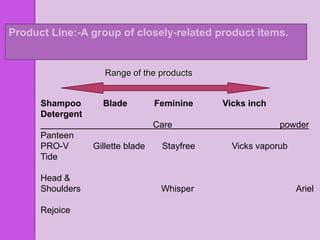
Product Line:-A group of closely-related product items.


                     Range of the products


      Shampoo       Blade          Feminine    Vicks inch
      Detergent
                                   Care                     powder
      Panteen
      PRO-V       Gillette blade    Stayfree     Vicks vaporub
      Tide

      Head &
      Shoulders                     Whisper                      Ariel

      Rejoice
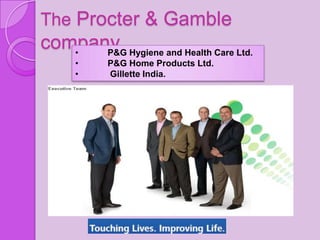
The Procter & Gamble
company Hygiene and Health Care Ltd.
   •  P&G
     •     P&G Home Products Ltd.
     •     Gillette India.
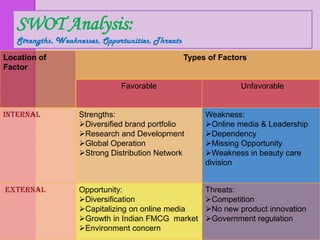
SWOT Analysis:
   Strengths, Weaknesses, Opportunities, Threats
Location of                                        Types of Factors
Factor

                               Favorable                         Unfavorable


Internal            Strengths:                          Weakness:
                    Diversified brand portfolio        Online media & Leadership
                    Research and Development           Dependency
                    Global Operation                   Missing Opportunity
                    Strong Distribution Network        Weakness in beauty care
                                                        division


External            Opportunity:                        Threats:
                    Diversification                    Competition
                    Capitalizing on online media       No new product innovation
                    Growth in Indian FMCG market       Government regulation
                    Environment concern
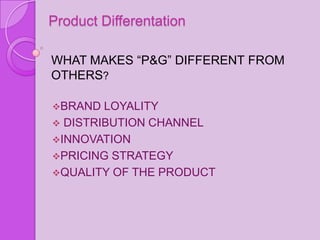
Product Differentation

WHAT MAKES “P&G” DIFFERENT FROM
OTHERS?

BRAND  LOYALITY
 DISTRIBUTION CHANNEL
INNOVATION
PRICING STRATEGY
QUALITY OF THE PRODUCT
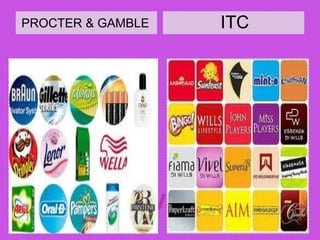
PROCTER & GAMBLE       ITC


          P&G VS ITC
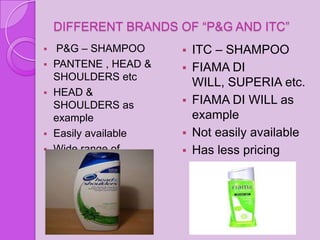
DIFFERENT BRANDS OF “P&G AND ITC”
   P&G – SHAMPOO         ITC – SHAMPOO
   PANTENE , HEAD &      FIAMA DI
    SHOULDERS etc
                           WILL, SUPERIA etc.
   HEAD &
    SHOULDERS as          FIAMA DI WILL as
    example                example
   Easily available      Not easily available
   Wide range of         Has less pricing
    pricing                range.
DISTRIBUTION STRATEGY

Distribution :-
 “Marketing channels are sets of
  interdependent organizations involved
  in the process of making a product or
  service available for use or
  consumption”
      Philip Kotler
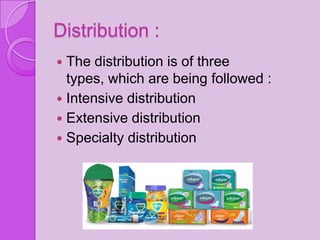
Distribution :
 The distribution is of three
  types, which are being followed :
 Intensive distribution
 Extensive distribution
 Specialty distribution
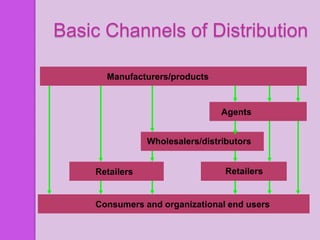
Basic Channels of Distribution

      Manufacturers/products


                                 Agents


                Wholesalers/distributors


    Retailers                     Retailers


    Consumers and organizational end users
Distribution criteria:
   Ordering Speed:- It is the time taken after
    the manufacturing of product and the time
    till it reaches the consumer.
   Delivery Flexibility:- How easy to distribute
    the product.
   Personal Selection And Customization:-
    Which distribution channel to select
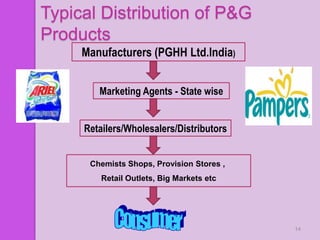
Typical Distribution of P&G
Products
     Manufacturers (PGHH Ltd.India)


        Marketing Agents - State wise


     Retailers/Wholesalers/Distributors


      Chemists Shops, Provision Stores ,
         Retail Outlets, Big Markets etc


                                           14
Intensive distribution:
 PGHH Ltd, is following this strategy in india.
 As the company manufactures the FMCG
  convenience/ necessity goods.
 As these serve the necessity goods hence
  there is lesser/no brand loyalty from the
  customers side, so the distribution network
  of the company needs to be very strong
  and proactive.
Promotion strategy
 P&G insists on a pull strategy
 Heavy advertising and media pioneer
 Advertising creativity
 P&G – A click mortar company
 Coupon
Pricing strategies
 Understand how companies find a set
  of prices that maximizes the profits
  from the total product mix.
 Learn how companies adjust their
  prices to take into account different
  types of customers and situations.
 Know the key issues related to
  initiating and responding to price
  changes.
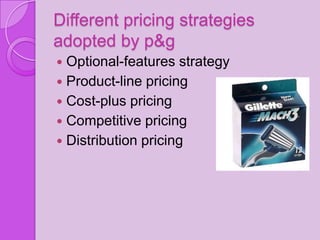
Different pricing strategies
adopted by p&g
 Optional-features strategy
 Product-line pricing
 Cost-plus pricing
 Competitive pricing
 Distribution pricing
CONCLUSION


  As we know this market is known as FMCG market so there
 are many competitor in this time in the market so P&G
 company were focused in this time and target the middle class
 segment for increasing the sales as well as market shares .

  Some products like Gillette is made by the company to target
 the higher segment of the market.

  In India HUL is biggest competitor in FMCG market.
BIBLIOGRAPHY
   http://www.wikiswot.com/SWOT/3_Consumer_Packaged_Goods_(C
    PGs)/Procter_and_Gamble.html
   http://wiki.answers.com/Q/Swot_analysis_of_procter_gamble
   http://www.corporatewatch.org/?lid=247
   http://www.cisco.com/warp/public/779/ibs/solutions/supply/pgcasestu
    dy1.pdf
   http://www.emory.edu/BUSINESS/dra/PGsmartersupplychain.pdf
   http://www.business-standard.com/india/news/with-pringles-buy-
    kelloggs-haslarger-canvas-in-india/464942/
   http://www.pg-india.com/
p&g marketing strategies

p&g marketing strategies

  • 1.
    STRATEGIC MANAGEMENT Strategic Report on Procter & Gamble Presented By : Ritu Lakhotia- Pgdma1146 Date:-17 February 2012 Ronak H.Patel- Pgdma1147 Sandeep Kumar-pgdma1148 Sandeev Kumar Rp- Pgdma1149 Sandeev Kumar Sk- Pgdma1150
  • 2.
    Contents  OVERVIEW  SWOT ANALYSIS  PRODUCT DIFFERENTATION  DISTRIBUTION STRATEGY  PROMOTION STARTEGY  PRICING STRATEGY  BIBLIOGRAPHY
  • 3.
    Overview  Procter & Gamble (P&G) is a Fortune 500 American multinational corporation headquartered in downtown ,Cincinnati, Ohio.  And manufactures a wide range of consumer goods.  In 2011, P&G recorded $82.6 billion dollars[4 lakh crores] in sales.  Fortune magazine ranked P&G at fifth place of the "World's Most Admired Companies" list, which was up from sixth place in 2010.  P&G is credited with many business innovations including brand management and "Connect & Develop" innovation.  According to the Nielsen Company, in 2007 P&G spent more on U.S. advertising than any other company.
  • 4.
    Product Line:-A groupof closely-related product items. Range of the products Shampoo Blade Feminine Vicks inch Detergent Care powder Panteen PRO-V Gillette blade Stayfree Vicks vaporub Tide Head & Shoulders Whisper Ariel Rejoice
  • 5.
    The Procter &Gamble company Hygiene and Health Care Ltd. • P&G • P&G Home Products Ltd. • Gillette India.
  • 6.
    SWOT Analysis: Strengths, Weaknesses, Opportunities, Threats Location of Types of Factors Factor Favorable Unfavorable Internal Strengths: Weakness: Diversified brand portfolio Online media & Leadership Research and Development Dependency Global Operation Missing Opportunity Strong Distribution Network Weakness in beauty care division External Opportunity: Threats: Diversification Competition Capitalizing on online media No new product innovation Growth in Indian FMCG market Government regulation Environment concern
  • 7.
    Product Differentation WHAT MAKES“P&G” DIFFERENT FROM OTHERS? BRAND LOYALITY  DISTRIBUTION CHANNEL INNOVATION PRICING STRATEGY QUALITY OF THE PRODUCT
  • 8.
    PROCTER & GAMBLE ITC P&G VS ITC
  • 9.
    DIFFERENT BRANDS OF“P&G AND ITC”  P&G – SHAMPOO  ITC – SHAMPOO  PANTENE , HEAD &  FIAMA DI SHOULDERS etc WILL, SUPERIA etc.  HEAD & SHOULDERS as  FIAMA DI WILL as example example  Easily available  Not easily available  Wide range of  Has less pricing pricing range.
  • 10.
    DISTRIBUTION STRATEGY Distribution :- “Marketing channels are sets of interdependent organizations involved in the process of making a product or service available for use or consumption” Philip Kotler
  • 11.
    Distribution :  Thedistribution is of three types, which are being followed :  Intensive distribution  Extensive distribution  Specialty distribution
  • 12.
    Basic Channels ofDistribution Manufacturers/products Agents Wholesalers/distributors Retailers Retailers Consumers and organizational end users
  • 13.
    Distribution criteria:  Ordering Speed:- It is the time taken after the manufacturing of product and the time till it reaches the consumer.  Delivery Flexibility:- How easy to distribute the product.  Personal Selection And Customization:- Which distribution channel to select
  • 14.
    Typical Distribution ofP&G Products Manufacturers (PGHH Ltd.India) Marketing Agents - State wise Retailers/Wholesalers/Distributors Chemists Shops, Provision Stores , Retail Outlets, Big Markets etc 14
  • 15.
    Intensive distribution:  PGHHLtd, is following this strategy in india.  As the company manufactures the FMCG convenience/ necessity goods.  As these serve the necessity goods hence there is lesser/no brand loyalty from the customers side, so the distribution network of the company needs to be very strong and proactive.
  • 16.
    Promotion strategy  P&Ginsists on a pull strategy  Heavy advertising and media pioneer  Advertising creativity  P&G – A click mortar company  Coupon
  • 17.
    Pricing strategies  Understandhow companies find a set of prices that maximizes the profits from the total product mix.  Learn how companies adjust their prices to take into account different types of customers and situations.  Know the key issues related to initiating and responding to price changes.
  • 18.
    Different pricing strategies adoptedby p&g  Optional-features strategy  Product-line pricing  Cost-plus pricing  Competitive pricing  Distribution pricing
  • 19.
    CONCLUSION  Aswe know this market is known as FMCG market so there are many competitor in this time in the market so P&G company were focused in this time and target the middle class segment for increasing the sales as well as market shares .  Some products like Gillette is made by the company to target the higher segment of the market.  In India HUL is biggest competitor in FMCG market.
  • 20.
    BIBLIOGRAPHY  http://www.wikiswot.com/SWOT/3_Consumer_Packaged_Goods_(C PGs)/Procter_and_Gamble.html  http://wiki.answers.com/Q/Swot_analysis_of_procter_gamble  http://www.corporatewatch.org/?lid=247  http://www.cisco.com/warp/public/779/ibs/solutions/supply/pgcasestu dy1.pdf  http://www.emory.edu/BUSINESS/dra/PGsmartersupplychain.pdf  http://www.business-standard.com/india/news/with-pringles-buy- kelloggs-haslarger-canvas-in-india/464942/  http://www.pg-india.com/