PSYCHOLOGICAL TESTS IN
GUIDANCE AND THEIR USES
Personality Testing
Presented by
Zubia
B.Ed 2nd
year
PSYCHOLOGICAL TEST
A Psychological test is a STANDARDIZED
INSTRUMENT designed to MEASURES objectively
one or more aspects of a total personality by
means of samples of verbal and non-verbal
responses, or by means of other behaviours.
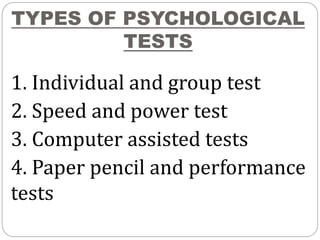
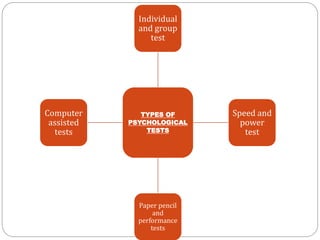
TYPES OF PSYCHOLOGICAL
TESTS
1. Individual and group test
2. Speed and power test
3. Computer assisted tests
4. Paper pencil and performance
tests
TYPES OF
PSYCHOLOGICAL
TESTS
Individual
and group
test
Speed and
power
test
Paper pencil
and
performance
tests
Computer
assisted
tests
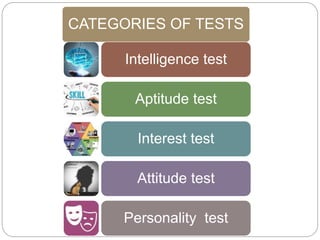
CATEGORIES OF TESTS
Intelligence test
Aptitude test
Interest test
Attitude test
Personality test
PERSONALITY
Personality is the dynamic organisation
within the individual of those
psychophysical systems that determine his
unique adjustment to his environment.
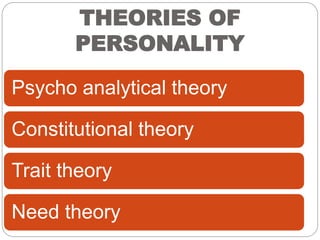
THEORIES OF
PERSONALITY
Psycho analytical theory
Constitutional theory
Trait theory
Need theory
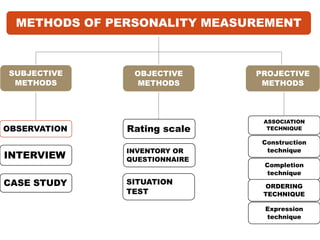
METHODS OF PERSONALITY MEASUREMENT
SUBJECTIVE
METHODS
PROJECTIVE
METHODS
OBJECTIVE
METHODS
CASE STUDY
INTERVIEW
OBSERVATION
SITUATION
TEST
INVENTORY OR
QUESTIONNAIRE
Rating scale
ASSOCIATION
TECHNIQUE
Construction
technique
Completion
technique
ORDERING
TECHNIQUE
Expression
technique
PROJECTIVE TECHNIQUE
Is a personality test designed to let a
person respond to ambiguous stimuli,
presumably revealing hidden emotions
and internal conflicts.
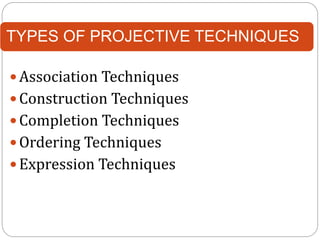
TYPES OF PROJECTIVE TECHNIQUES
 Association Techniques
 Construction Techniques
 Completion Techniques
 Ordering Techniques
 Expression Techniques
PROJECTIVE TESTS
 Rorschach Ink Blot Test
 Thematic Apperception Test
 Children Apperception Test
 Word Association Test
 Mosaic Test
 Verbal Test
 Draw & Man Test
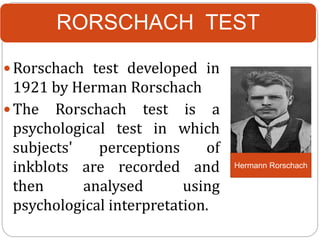
RORSCHACH TEST
 Rorschach test developed in
1921 by Herman Rorschach
 The Rorschach test is a
psychological test in which
subjects' perceptions of
inkblots are recorded and
then analysed using
psychological interpretation.
Hermann Rorschach
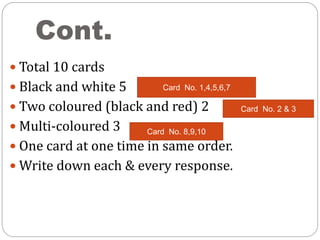
Cont.
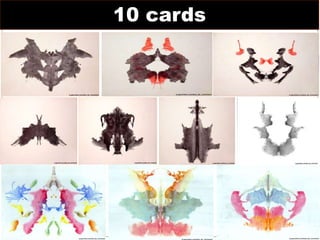
 Total 10 cards
 Black and white 5
 Two coloured (black and red) 2
 Multi-coloured 3
 One card at one time in same order.
 Write down each & every response.
Card No. 1,4,5,6,7
Card No. 2 & 3
Card No. 8,9,10
10 cards
SCORING METHOD
• LOCATION
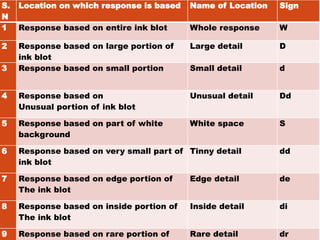
S.
N
Location on which response is based Name of Location Sign
1 Response based on entire ink blot Whole response W
2 Response based on large portion of
ink blot
Large detail D
3 Response based on small portion Small detail d
4 Response based on
Unusual portion of ink blot
Unusual detail Dd
5 Response based on part of white
background
White space S
6 Response based on very small part of
ink blot
Tinny detail dd
7 Response based on edge portion of
The ink blot
Edge detail de
8 Response based on inside portion of
The ink blot
Inside detail di
9 Response based on rare portion of Rare detail dr
SCORING METHOD
• LOCATION
• DETERMINANTS
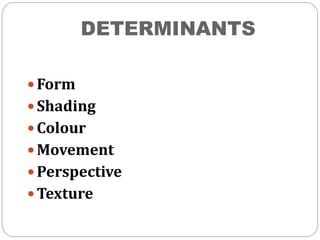
DETERMINANTS
 Form
 Shading
 Colour
 Movement
 Perspective
 Texture
SCORING METHOD
• LOCATION
• DETERMINANTS
• CONTENT
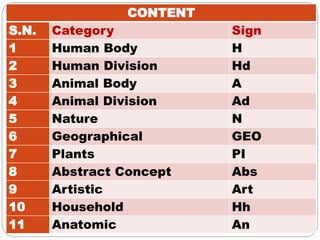
CONTENT
S.N. Category Sign
1 Human Body H
2 Human Division Hd
3 Animal Body A
4 Animal Division Ad
5 Nature N
6 Geographical GEO
7 Plants PI
8 Abstract Concept Abs
9 Artistic Art
10 Household Hh
11 Anatomic An
SCORING METHOD
• LOCATION
• DETERMINANTS
• CONTENT
• ORIGINALS & POPULARS
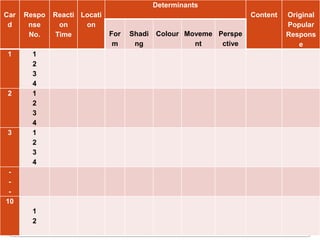
Car
d
Respo
nse
No.
Reacti
on
Time
Locati
on
Determinants
Content Original
Popular
Respons
e
For
m
Shadi
ng
Colour Moveme
nt
Perspe
ctive
1 1
2
3
4
2 1
2
3
4
3 1
2
3
4
-
-
-
10
1
2
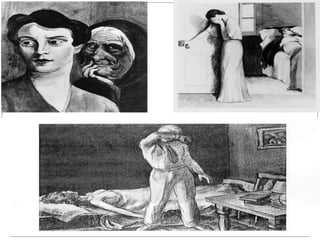
THEMATIC APPERCEPTION TEST
(TAT)
The TAT was developed during the 1930s by the
American psychologist Henry A. Murray and
Christiana D. Morgan
 Total 31 cards 5 min for each card
 1 of the blank Total 2 hours
 10 for boys
 10 for girls
 10 for both
Cont.……
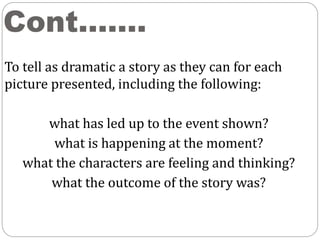
To tell as dramatic a story as they can for each
picture presented, including the following:
what has led up to the event shown?
what is happening at the moment?
what the characters are feeling and thinking?
what the outcome of the story was?
CHILDREN APPERCEPTION TEST
 It was devised by Leopoled Bellak in 1949.
 Young children aged between 3 and 10 years.
 10 pictures all these are of animals.
 What went in the story before and what will
happen later?
 The CAT is intended to measure the
personality traits, attitudes, and
psychodynamic processes evident in pre-
pubertal children.
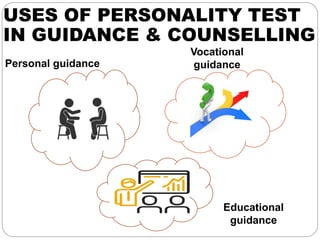
USES OF PERSONALITY TEST
IN GUIDANCE & COUNSELLING
Personal guidance
Vocational
guidance
Educational
guidance
REFERENCES
SOURCES
https://s3.amazonaws.com
http://wesleyphd.com/assessmentppt/Personality%20Testing
%20-%2012
https://boganhs.org/ourpages/auto/2013/3/22/50901095/Proj
ective%20Personality%20Tests
BOOK
Gupta, S.P & Gupta, Alka.”Modern Measurement & Evaluation
with Statistics”.Sharda pustak bhawan.2010

Personality testing