INTERVIEW

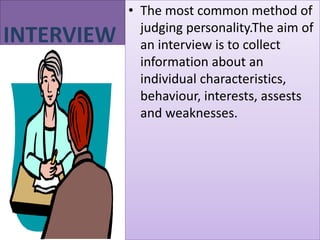
• The most common method of
judging personality.The aim of
an interview is to collect
information about an
individual characteristics,
behaviour, interests, assests
and weaknesses.
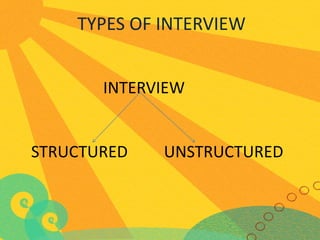
TYPES OF INTERVIEW
INTERVIEW

STRUCTURED

UNSTRUCTURED
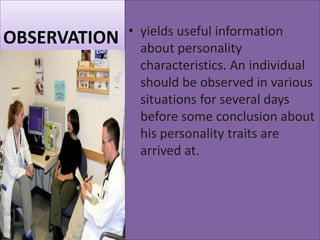
OBSERVATION

• yields useful information
about personality
characteristics. An individual
should be observed in various
situations for several days
before some conclusion about
his personality traits are
arrived at.
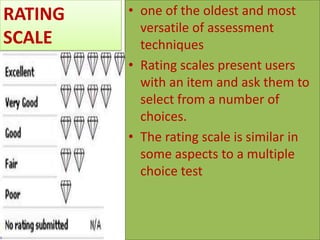
RATING
SCALE

• one of the oldest and most
versatile of assessment
techniques
• Rating scales present users
with an item and ask them to
select from a number of
choices.
• The rating scale is similar in
some aspects to a multiple
choice test
• Integration of the information
that is obtained from various
sources about the individual is
done. It requires many
interviews with the individual.
OBJECTIVE
PERSONALTY TESTS
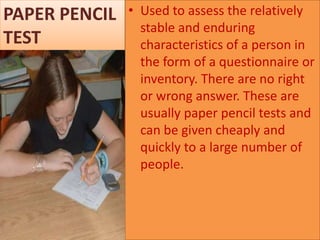
PAPER PENCIL
TEST

• Used to assess the relatively
stable and enduring
characteristics of a person in
the form of a questionnaire or
inventory. There are no right
or wrong answer. These are
usually paper pencil tests and
can be given cheaply and
quickly to a large number of
people.
PAPER PENCIL TEST (CONT.)
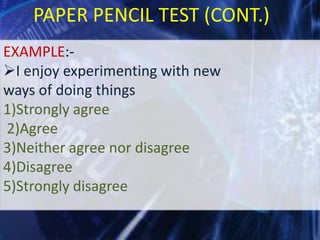
EXAMPLE:I enjoy experimenting with new
ways of doing things
1)Strongly agree
2)Agree
3)Neither agree nor disagree
4)Disagree
5)Strongly disagree
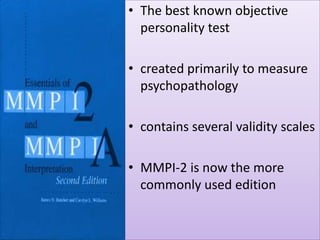
• The best known objective
personality test
• created primarily to measure
psychopathology
• contains several validity scales
• MMPI-2 is now the more
commonly used edition
MMPI [CONTD..]
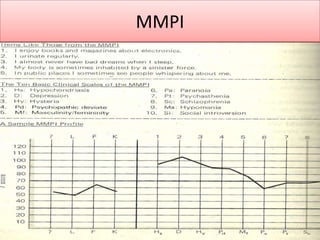
→MMPI was designed to identify people
with tendencies toward certain psychological
disorders. Sometimes it is used as an aid in
determining what diagnosis will be given to
people psychological problems.
MMPI
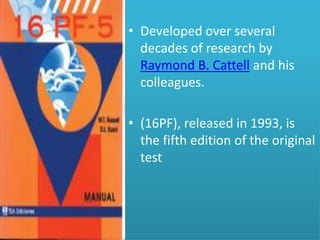
• Developed over several
decades of research by
Raymond B. Cattell and his
colleagues.
• (16PF), released in 1993, is
the fifth edition of the original
test
16PF [CONT…..]
→Fifth Edition contains 185 multiplechoice items which are written at a
fifth-grade reading level.
→Administration of the test :35–50
minutes for the paper-and-pencil
version and about 30 minutes by
computer.
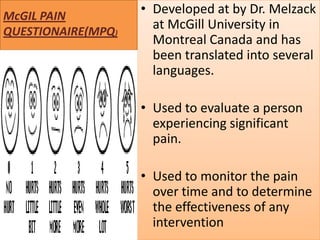
McGIL PAIN
QUESTIONAIRE(MPQ)

• Developed at by Dr. Melzack
at McGill University in
Montreal Canada and has
been translated into several
languages.
• Used to evaluate a person
experiencing significant
pain.
• Used to monitor the pain
over time and to determine
the effectiveness of any
intervention
CONTD……
Sections:
(1) What Does Your Pain Feel Like?
(2) How Does Your Pain Change with
Time?
(3) How Strong is Your Pain?
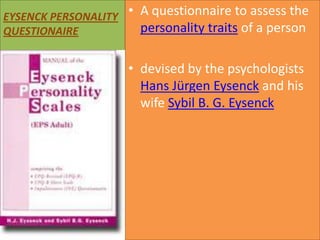
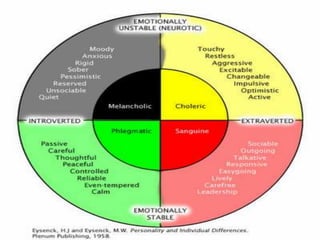
EYSENCK PERSONALITY • A questionnaire to assess the
personality traits of a person
QUESTIONAIRE

• devised by the psychologists
Hans Jürgen Eysenck and his
wife Sybil B. G. Eysenck
PROJECTVE

PERSONALITY

TESTS
RORSCHACH TEST
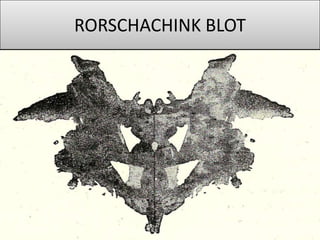
Hermann Rorschach,a swiss psychiatrist
developed the first major use of projective
techniques around 1910.Test consists of ten
ambiguous,symmetrical inkblots.Inkblot card
appears as if a blot of ink was poured onto a
piece of paper and folded over.These 61/2 x
91/2 ink blot cards are the standard stimuli
RORSCHACHINK BLOT
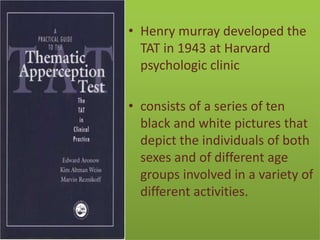
• Henry murray developed the
TAT in 1943 at Harvard
psychologic clinic
• consists of a series of ten
black and white pictures that
depict the individuals of both
sexes and of different age
groups involved in a variety of
different activities.
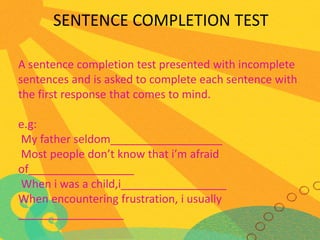
SENTENCE COMPLETION TEST
A sentence completion test presented with incomplete
sentences and is asked to complete each sentence with
the first response that comes to mind.

e.g:
My father seldom__________________
Most people don’t know that i’m afraid
of_________________
When i was a child,i_________________
When encountering frustration, i usually
_________________
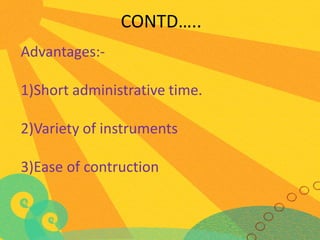
CONTD…..
Advantages:-

1)Short administrative time.
2)Variety of instruments
3)Ease of contruction
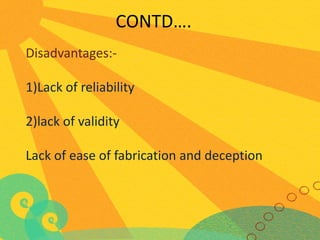
CONTD….
Disadvantages:1)Lack of reliability

2)lack of validity
Lack of ease of fabrication and deception
HOLTZMAN INKBLOT TECHNIQUE(HIT)
>developed in an attempt to minimize certain
statistical difficulties that arise in the analysis of
Rorschach results.

>subject responds to each of a series of 45
ambiguous inkblots

>These responses are scored to describe and to
classify the personality of the subject
Contd……
Strength:-Only one response per card,making
research less troublesome.
Weakness:-Not widely accepted and rarely
used,not directly comparable to Rorschach
interpretive strategies.
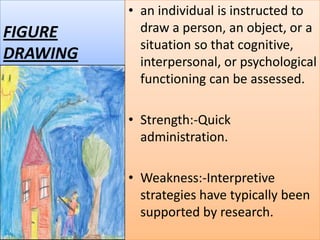
FIGURE
DRAWING

• an individual is instructed to
draw a person, an object, or a
situation so that cognitive,
interpersonal, or psychological
functioning can be assessed.
• Strength:-Quick
administration.
• Weakness:-Interpretive
strategies have typically been
supported by research.
MAKE A PICTURE STORY
similar to TAT however,stimulation may be
manipulated by patient.
assist the practitioner in arriving at differential
diagnoses and understanding the individual
psychodynamics in any particular patient
CONTD…..
Strength:-Provides idiographic personality
information through thematic analysis.
Weakness:-Minimal research support and
rarely used.
THANK UUU…!!!!

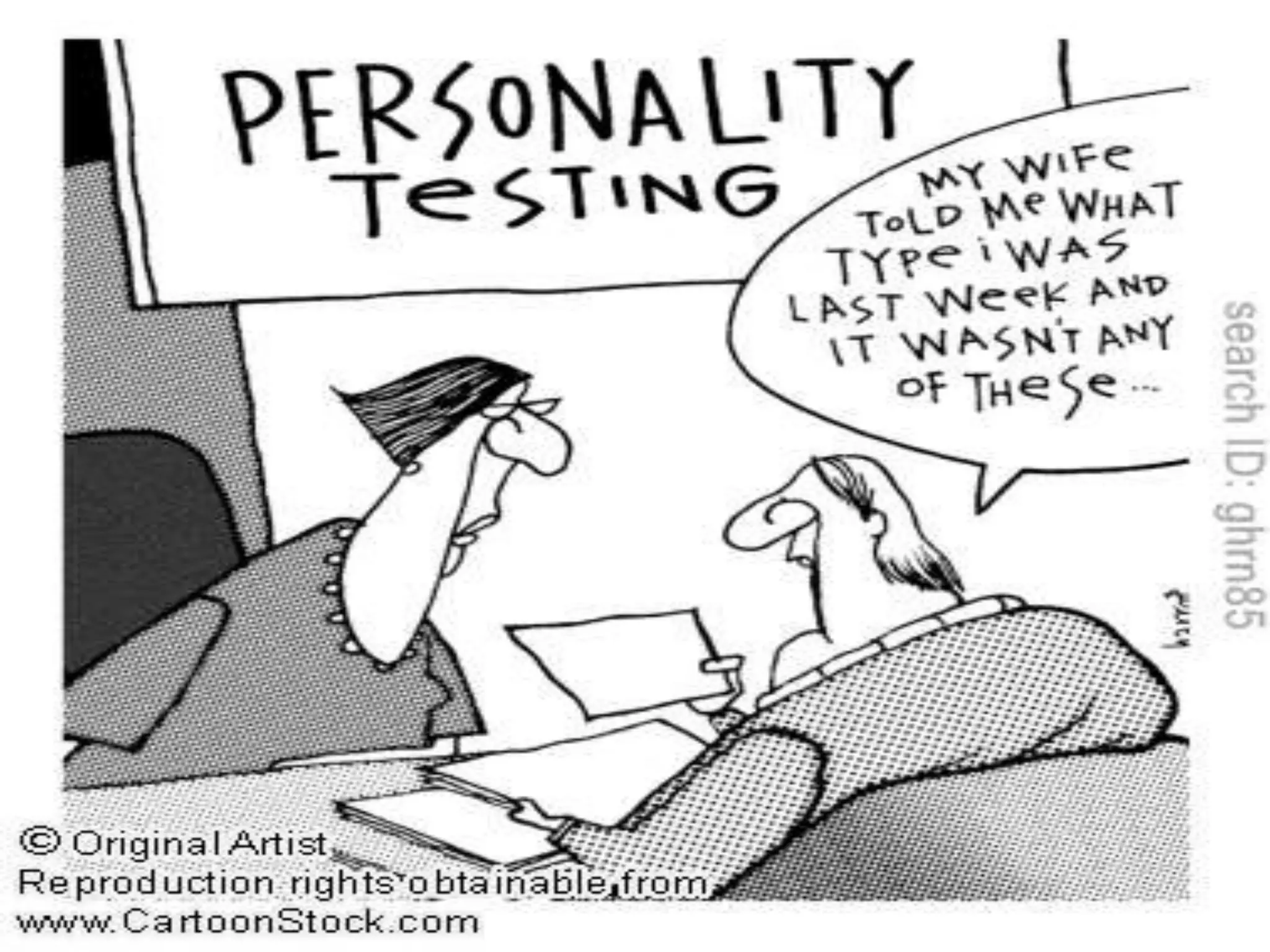
Personality testing

  • 2.
    INTERVIEW • The mostcommon method of judging personality.The aim of an interview is to collect information about an individual characteristics, behaviour, interests, assests and weaknesses.
  • 3.
  • 4.
    OBSERVATION • yields usefulinformation about personality characteristics. An individual should be observed in various situations for several days before some conclusion about his personality traits are arrived at.
  • 5.
    RATING SCALE • one ofthe oldest and most versatile of assessment techniques • Rating scales present users with an item and ask them to select from a number of choices. • The rating scale is similar in some aspects to a multiple choice test
  • 6.
    • Integration ofthe information that is obtained from various sources about the individual is done. It requires many interviews with the individual.
  • 7.
  • 8.
    PAPER PENCIL TEST • Usedto assess the relatively stable and enduring characteristics of a person in the form of a questionnaire or inventory. There are no right or wrong answer. These are usually paper pencil tests and can be given cheaply and quickly to a large number of people.
  • 9.
    PAPER PENCIL TEST(CONT.) EXAMPLE:I enjoy experimenting with new ways of doing things 1)Strongly agree 2)Agree 3)Neither agree nor disagree 4)Disagree 5)Strongly disagree
  • 10.
    • The bestknown objective personality test • created primarily to measure psychopathology • contains several validity scales • MMPI-2 is now the more commonly used edition
  • 11.
    MMPI [CONTD..] →MMPI wasdesigned to identify people with tendencies toward certain psychological disorders. Sometimes it is used as an aid in determining what diagnosis will be given to people psychological problems.
  • 12.
  • 13.
    • Developed overseveral decades of research by Raymond B. Cattell and his colleagues. • (16PF), released in 1993, is the fifth edition of the original test
  • 14.
    16PF [CONT…..] →Fifth Editioncontains 185 multiplechoice items which are written at a fifth-grade reading level. →Administration of the test :35–50 minutes for the paper-and-pencil version and about 30 minutes by computer.
  • 15.
    McGIL PAIN QUESTIONAIRE(MPQ) • Developedat by Dr. Melzack at McGill University in Montreal Canada and has been translated into several languages. • Used to evaluate a person experiencing significant pain. • Used to monitor the pain over time and to determine the effectiveness of any intervention
  • 16.
    CONTD…… Sections: (1) What DoesYour Pain Feel Like? (2) How Does Your Pain Change with Time? (3) How Strong is Your Pain?
  • 17.
    EYSENCK PERSONALITY •A questionnaire to assess the personality traits of a person QUESTIONAIRE • devised by the psychologists Hans Jürgen Eysenck and his wife Sybil B. G. Eysenck
  • 19.
  • 20.
    RORSCHACH TEST Hermann Rorschach,aswiss psychiatrist developed the first major use of projective techniques around 1910.Test consists of ten ambiguous,symmetrical inkblots.Inkblot card appears as if a blot of ink was poured onto a piece of paper and folded over.These 61/2 x 91/2 ink blot cards are the standard stimuli
  • 21.
  • 22.
    • Henry murraydeveloped the TAT in 1943 at Harvard psychologic clinic • consists of a series of ten black and white pictures that depict the individuals of both sexes and of different age groups involved in a variety of different activities.
  • 24.
    SENTENCE COMPLETION TEST Asentence completion test presented with incomplete sentences and is asked to complete each sentence with the first response that comes to mind. e.g: My father seldom__________________ Most people don’t know that i’m afraid of_________________ When i was a child,i_________________ When encountering frustration, i usually _________________
  • 25.
  • 26.
    CONTD…. Disadvantages:1)Lack of reliability 2)lackof validity Lack of ease of fabrication and deception
  • 27.
    HOLTZMAN INKBLOT TECHNIQUE(HIT) >developedin an attempt to minimize certain statistical difficulties that arise in the analysis of Rorschach results. >subject responds to each of a series of 45 ambiguous inkblots >These responses are scored to describe and to classify the personality of the subject
  • 28.
    Contd…… Strength:-Only one responseper card,making research less troublesome. Weakness:-Not widely accepted and rarely used,not directly comparable to Rorschach interpretive strategies.
  • 29.
    FIGURE DRAWING • an individualis instructed to draw a person, an object, or a situation so that cognitive, interpersonal, or psychological functioning can be assessed. • Strength:-Quick administration. • Weakness:-Interpretive strategies have typically been supported by research.
  • 30.
    MAKE A PICTURESTORY similar to TAT however,stimulation may be manipulated by patient. assist the practitioner in arriving at differential diagnoses and understanding the individual psychodynamics in any particular patient
  • 31.
    CONTD….. Strength:-Provides idiographic personality informationthrough thematic analysis. Weakness:-Minimal research support and rarely used.
  • 32.