TERM PAPER
SUBJECT: (PSY294) PSYCHOMETRICS
TOPIC: INDIVIDUAL AND GROUP TESTS
SUBMITTED BY
DEVIREDDY DINESH
(11502811)
SECTION : M32A84
UNDER THE GUIDANCE OF
SAJAD HUSSIAN
(ASSISTANT PROFESSOR)
DEPARTMENT OF PSYCHOLOGY
LOVELY PROFESSIONAL UNIVERSITY
INTRODUCTION
Individual Test and Group Test
The term intelligence refers the individual differences in mental ability.
Intelligence test can be administered individually or in group.
Distinction between individual and group tests:
Individual Tests: A test can be said individual test in the sense that they
can be administered to only one person at a time. Many of the tests in
these scales require oral responses from the examinee or necessitate the
manipulation of the materials.
Individual intelligence tests are preferred by psychologist in clinics,
hospitals and other settings where clinical diagnosis are made, and
where they serve not only as measures of general intelligence but also as
means of observing behavior in a standard situation.
Group Test:
Group test was developed to meet a pressing practical need. Group test
can be administered to a group of persons at a time.
Group tests were designed as mass testing instruments; they not only
permit the simultaneous examination of large groups but they also use
simplified instruction and administration procedures. There by requiring
a minimum of training on the part of examiner.
Individual Tests:
The first tests that were prepared were individual. The ideal of preparing
group test was motivated by economy and mass-scale testing work. Binet’s
test was individual, and so was Terman-Merril Stanford Revision. Individual
tests are most reliable but these consume more time and energy. These are,
however, useful in making case-studies or individual studies of behaviour
problems or backwardness.
The tests prepared in the beginning were individual verbal i.e., where some
sort of language (the mother-tongue of the child) was used. Each question in
Simon-Binet or Stanford Revision test is in verbal form. The child has to read
the question or listen to the question and answer in language.
But suppose the child is not fully conversant with the language of the
examiner, or he is illiterate. In that case verbal tests do not serve the purpose.
Hence non-verbal or performance tests have been prepared. Here the tasks set
up require the child to do ‘something’ rather than reply a question.
The child may, for instance, fit in a wooden board with depressions in some
geometrical forms, some wooden shapes like triangles or rectangles or
circles. He may put some cubes in descending or ascending order of size. He
may assemble certain disintegrated parts to form full designs or pictures. No
language is used here. Instructions also can be had through demonstration or
action.
A number of performance tests have been prepared. The most important
are:
1. Alexander’s Pass-a-long test.
2. Koh’s Block Design test.
3. Collin and Drever’s Performance Tests.
4. Weschlers Performance Test.
5. Terman and Merill’s Performance Test.
6. Kent’s Performance Test.
Kent’s test is used for clinical purposes. It consists of five oral tests and seven
written tests, each requiring one minute.
Individual performance tests have the disadvantage that these take a lot of
time. Their reliability is also questioned on the ground that temporary
response sets or work habits may play a major role in determining score. The
habits rewarded in one test may lead to a low score or more scores on
another.
Again, the intelligence measured by performance tests is not quite the same
as tested by Binet and others. Some psychologists have even questioned
whether performance test batteries measure general intelligence at all. Further
details about performance tests are given below elsewhere.
Group Tests:
These are more helpful as these deal with large masses of subjects such as in
schools, industry, army and public. Under favourable administering
conditions these are reliable and have high predictive validity, and can be
compared favourably with individual tests.
The Army Alpha and Beta were the most prominent tests in the beginning,
Spearman constructed group tests in which questions were read out to the
candidates. Cyril, Burt prepared group test comprising of large number of
sections each section being a large number of problems of one particular
kind.
His group-test no. 23 comprises 50 same-opposite problems, 30 sentence
completion problems, 30 mixed sentences, 25 analogies and 18 reasoning
problems.
A specimen of Burt’s graded reasoning test is given in Appendix VII.
In the ‘Omnibus’ test or ‘Richardson’s ‘Simplex Text’, the different sections
are not timed separately, but there is a time limit for the whole test.
Army Beta test is the most widely known group performance test.
In general, group tests have the following characteristics:
(i) Most of the group-tests have been standardised, and these are commonly
used in educational institutions in the western countries. The directions and
manuals for examiners have been worked out, so that even a lay-man can
administer these.
(ii) Most of the test items in group verbal tests are linguistic in character.
Some of the test items include problems requiring reasoning about numbers,
or geometrical forms.
(iii) Some group verbal tests have been used in measuring scholastic aptitude
also.
(iv) These are convenient in administration and scoring.
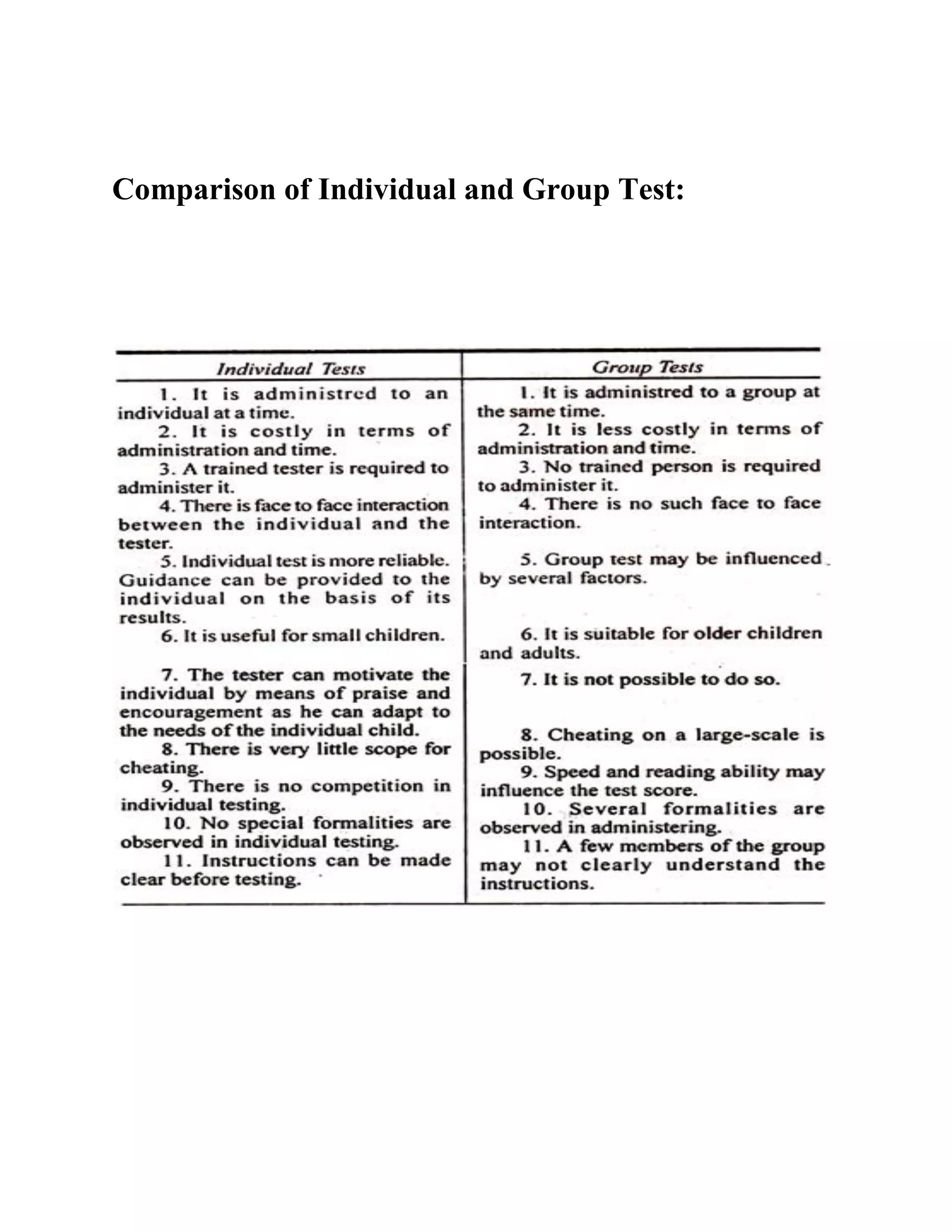
Comparison of Individual and Group Test:
Advantages and Disadvantages of individual tests:
Advantages: Examiner can pay more attention to the examinee.
Examiner can easily encourage the examinee and observe his behavior
during the test more closely.
Scores on individual tests are not as dependent on reading ability as
scores in group tests.
Disadvantages: It is very time consuming
This type of tests requires a highly-trained examiner.
It costs more than the group test.
Advantages and Disadvantages of group tests:
Advantages: can be administered to very large numbers simultaneously
simplified examiner role
scoring typically more objective
large, representative samples often used leading to better established
norms
A highly verbal group test can have a higher validity co-efficient than an
individual test.
Disadvantages: Scores on the group test are generally dependent on the
reading ability.
Information obtained by the group test generally less accurate than the
individual tests
examiner has less opportunity to establish rapport, obtain cooperation,
and maintain interest
CONCLUSION : This is the information about the individual test
and group test in psychometrics based upon the problem and its
solutions the test can be taken
THANKYOU

PSYCHOMETRICS INDIVIDUAL AND GROUP TESTS

  • 1.
    TERM PAPER SUBJECT: (PSY294)PSYCHOMETRICS TOPIC: INDIVIDUAL AND GROUP TESTS SUBMITTED BY DEVIREDDY DINESH (11502811) SECTION : M32A84 UNDER THE GUIDANCE OF SAJAD HUSSIAN (ASSISTANT PROFESSOR) DEPARTMENT OF PSYCHOLOGY LOVELY PROFESSIONAL UNIVERSITY
  • 2.
    INTRODUCTION Individual Test andGroup Test The term intelligence refers the individual differences in mental ability. Intelligence test can be administered individually or in group. Distinction between individual and group tests: Individual Tests: A test can be said individual test in the sense that they can be administered to only one person at a time. Many of the tests in these scales require oral responses from the examinee or necessitate the manipulation of the materials. Individual intelligence tests are preferred by psychologist in clinics, hospitals and other settings where clinical diagnosis are made, and where they serve not only as measures of general intelligence but also as means of observing behavior in a standard situation. Group Test: Group test was developed to meet a pressing practical need. Group test can be administered to a group of persons at a time. Group tests were designed as mass testing instruments; they not only permit the simultaneous examination of large groups but they also use simplified instruction and administration procedures. There by requiring a minimum of training on the part of examiner.
  • 3.
    Individual Tests: The firsttests that were prepared were individual. The ideal of preparing group test was motivated by economy and mass-scale testing work. Binet’s test was individual, and so was Terman-Merril Stanford Revision. Individual tests are most reliable but these consume more time and energy. These are, however, useful in making case-studies or individual studies of behaviour problems or backwardness. The tests prepared in the beginning were individual verbal i.e., where some sort of language (the mother-tongue of the child) was used. Each question in Simon-Binet or Stanford Revision test is in verbal form. The child has to read the question or listen to the question and answer in language. But suppose the child is not fully conversant with the language of the examiner, or he is illiterate. In that case verbal tests do not serve the purpose. Hence non-verbal or performance tests have been prepared. Here the tasks set up require the child to do ‘something’ rather than reply a question. The child may, for instance, fit in a wooden board with depressions in some geometrical forms, some wooden shapes like triangles or rectangles or circles. He may put some cubes in descending or ascending order of size. He may assemble certain disintegrated parts to form full designs or pictures. No language is used here. Instructions also can be had through demonstration or action.
  • 4.
    A number ofperformance tests have been prepared. The most important are: 1. Alexander’s Pass-a-long test. 2. Koh’s Block Design test. 3. Collin and Drever’s Performance Tests. 4. Weschlers Performance Test. 5. Terman and Merill’s Performance Test. 6. Kent’s Performance Test. Kent’s test is used for clinical purposes. It consists of five oral tests and seven written tests, each requiring one minute. Individual performance tests have the disadvantage that these take a lot of time. Their reliability is also questioned on the ground that temporary response sets or work habits may play a major role in determining score. The habits rewarded in one test may lead to a low score or more scores on another. Again, the intelligence measured by performance tests is not quite the same as tested by Binet and others. Some psychologists have even questioned whether performance test batteries measure general intelligence at all. Further details about performance tests are given below elsewhere.
  • 5.
    Group Tests: These aremore helpful as these deal with large masses of subjects such as in schools, industry, army and public. Under favourable administering conditions these are reliable and have high predictive validity, and can be compared favourably with individual tests. The Army Alpha and Beta were the most prominent tests in the beginning, Spearman constructed group tests in which questions were read out to the candidates. Cyril, Burt prepared group test comprising of large number of sections each section being a large number of problems of one particular kind. His group-test no. 23 comprises 50 same-opposite problems, 30 sentence completion problems, 30 mixed sentences, 25 analogies and 18 reasoning problems. A specimen of Burt’s graded reasoning test is given in Appendix VII. In the ‘Omnibus’ test or ‘Richardson’s ‘Simplex Text’, the different sections are not timed separately, but there is a time limit for the whole test. Army Beta test is the most widely known group performance test.
  • 6.
    In general, grouptests have the following characteristics: (i) Most of the group-tests have been standardised, and these are commonly used in educational institutions in the western countries. The directions and manuals for examiners have been worked out, so that even a lay-man can administer these. (ii) Most of the test items in group verbal tests are linguistic in character. Some of the test items include problems requiring reasoning about numbers, or geometrical forms. (iii) Some group verbal tests have been used in measuring scholastic aptitude also. (iv) These are convenient in administration and scoring.
  • 7.
    Comparison of Individualand Group Test:
  • 8.
    Advantages and Disadvantagesof individual tests: Advantages: Examiner can pay more attention to the examinee. Examiner can easily encourage the examinee and observe his behavior during the test more closely. Scores on individual tests are not as dependent on reading ability as scores in group tests. Disadvantages: It is very time consuming This type of tests requires a highly-trained examiner. It costs more than the group test. Advantages and Disadvantages of group tests: Advantages: can be administered to very large numbers simultaneously simplified examiner role scoring typically more objective large, representative samples often used leading to better established norms A highly verbal group test can have a higher validity co-efficient than an individual test. Disadvantages: Scores on the group test are generally dependent on the reading ability. Information obtained by the group test generally less accurate than the individual tests examiner has less opportunity to establish rapport, obtain cooperation, and maintain interest
  • 9.
    CONCLUSION : Thisis the information about the individual test and group test in psychometrics based upon the problem and its solutions the test can be taken THANKYOU