What we will learn:
Personality
Attitudes
Motivation and Achievement Motivation
Goal Setting
Group Dynamics
Leadership Skills and Styles
Explain the 3
   Name 3                      theory areas
 prospectives                    and there
      of                        limitations
  personality                   (naming at
    theory                    least 1 theory)

                 Describe
                 how we
                personality
                  profile
                                Understand the
                                 links between
  Define                       personality theory
personality                         and sport
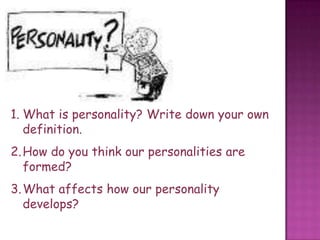
1. What is personality? Write down your own
   definition.
2. How do you think our personalities are
   formed?
3. What affects how our personality
   develops?
•Personality is. . .
“The sum total of an          individual‟s psychological
characteristics which make     him or her unique.”
(Hollander)
•„Personality. . .
represents those characteristics of the person that
account for consistent patterns of behaviour‟ (Pervin,
1993)
•Personality is. . .
”The more or less stable and enduring organisation of a
persons character, temperament, intellect and physique
which determines the unique adjustment (the individual
makes) to the environment”  (Eysenck)
Exam Tip. . .
Exam questions often ask for explanations of the 3 personality
perspectives. You need to be aware of the drawbacks found in trait
and social learning perspectives and the advantages of the
interactionist approach. CRITICALLY EVALUATE!
The trait theory of personality suggests that personality is
 made up of secondary traits inherited from parental genes.

 The trait view therefore maintains that all behaviour is innate
 and genetically programmed.


 “Traits are innate characteristics and are thought to be
 relatively stable. They are highly consistent attributes that
 exert a widely generalised casual effect on behaviour.”
“People are born with established personality characteristics”
•Inherited at birth.
•Stable
•Enduring
•Consistent in all situations.

BEHAVIOUR = FUNCTION OF PERSONALITY (B=F(P)).                      `
•Outgoing, Aggressive, Tense, Shy, Relaxed, Sensitive etc.

• Traits can be arranged in hierarchical order.

• The stronger the trait, the more dominant the behaviour.

• Trait theory does not believe that the situation or environment
has any bearing on a person‟s behaviour.

• Behaviour is said to be consistent.

•Traits are thought to be stable, enduring and consistent in all
situations.

Trait theory attempts to predict behaviour.
+ve = Can be easily measured through questionnaires
-ve = Does not take into account environmental influences.

It is not a true indicator of behavior.
The drawback with the trait approach is that in reality,
behaviour is not always predictable. People adapt their
behaviour in response to a particular environmental situation.

Trait theory does not account for this.

Also, the influence that the environment and other people
have on shaping personality is not considered.

There are 3 specific theories that belong to the trait
perspective of personality that we need to know:
Eysenck's Theory 1968

•Originally Personality types are arranged on 2 dimensions.

•Introvert/Extrovert
•Stable/Neurotic
                                        Neurotic


                       Introvert                         Extrovert


                                        Stable
•   Said to achieve more in
    higher arousal situations.
•   Become aroused more
    slowly than introverts
•   There is a low sensitivity of
    the reticular activating
    system (RAS)
•   Prefer team oriented
    situations.
•   Like activities which
    involve gross motor skills.
•   Extrovert behaviour is
    loud, bright & outgoing.
   High levels of excitation.
   Tend not to need added
    stimulation & excitement.
   Become aroused more
    quickly than extroverts
   There is a high sensitivity of
    the reticular activating
    system (RAS)
   Prefer to take part in
    activities requiring more
    precision eg. Archery.
   Introvert behaviour is shy,
    quiet & reserved.
•Displays predictable
emotions in appropriate
situations
•Their moods are
predictable
•They tend not to
experience intense
stress
•Their recovery from
stress is rapid
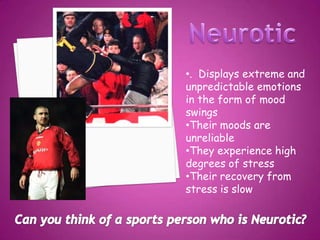
•. Displays extreme and
unpredictable emotions
in the form of mood
swings
•Their moods are
unreliable
•They experience high
degrees of stress
•Their recovery from
stress is slow
Eysenck proposed the existence of 4 personality
types:

•Extrovert & Stable
•Extrovert and Neurotic
•Introvert & Stable
•Introvert & Neurotic

Later he added a third scale to his model which he
termed Psychoticism - A measure of how Tough-
Minded people are. Eysenck used this third scale in
a test to determine an individual‟s Personality
Profile.
This test was called the Eysenck‟s Personality
Questionnaire (EPQ) – Let‟s have a go at the
questionnaire………(QR codes)
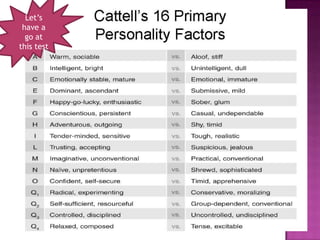
Cattell was also a believer of trait theory.
However, he questioned whether personality
could be understood using only 3 dimensions....
Instead, he considered a much larger number of
traits. Cattell examined 16 Personality Factors in
a questionnaire called „Cattell‟s 16PF test‟.
Let‟s
 have a
  go at
this test
1. With a partner, choose 1 sports person each and describe
   to them why you think their psychological make up makes
   them successful?


2. Make a note of each others responses to this question
   jotting down any key characteristics that are being
   identified!


3. Can you think of a sports person who has the opposite
   characteristics to those that you have mentioned but is
   equally as successful?
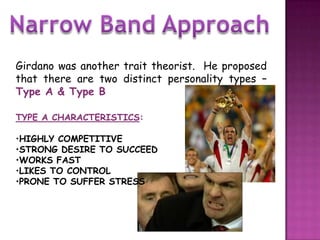
Girdano was another trait theorist. He proposed
that there are two distinct personality types –
Type A & Type B

TYPE A CHARACTERISTICS:

•HIGHLY COMPETITIVE
•STRONG DESIRE TO SUCCEED
•WORKS FAST
•LIKES TO CONTROL
•PRONE TO SUFFER STRESS
TYPE B CHARACTERISTICS:

•NON-COMPETITIVE
•UNAMBITIOUS
•WORKS MORE SLOWLY
•APPEARS TO LACK DESIRE
TO SUCCEED
•DOES NOT ENJOY CONTROL
•LESS PRONE TO STRESS
•Which of the characteristics are most
common with the sports person you
identified?


• Which of the characteristics   do   you
demonstrate predominantly?
T. ORFORD

1. There are 3 sports people below who display significantly different
   characteristics to the rest, who are they and why do you think this?!
Monty Panesar      Sven Goran Eriksson   Paula Radcliffe    Amir Kahn        Tiger Woods


Martin Johnson       Ronnie O‟Sullivan    Steve Redgrave   Stephen Hendry   Kevin Pietersen


 Anna Kournikova   Tanni-Grey Thomson       John Terry      Kelly Holmes    Jose Mourinho
• If you identified the 3 below as sports people who all display more type „B‟
  characteristics than type „A‟ then well done!

  Sven Goran Eriksson             Anna Kournikova                Stephen Hendry


• Sven is more of             • Kournikova                   • Like Sven,
a strategist,                 appears to be less             Stephen is a
taking his time to            competitive as                 thinker and is
work through                  she concentrates               reserved in his
things. As a result           on commercial                  approach in
he works more                 modelling rather               comparison with
slowly and is less            than tennis.                   Ronnie O‟Sullivan.
prone to stress.                                                            T. ORFORD
•    Why do you think there were only 3 out of 15 successful sports
    people with type „B‟ characteristics?
•    So……..how can we develop these characteristics or are they pre -
    defined, already existing, non – changeable features of our
    personality?
1. Discuss with your partner whether you think you can change the
   way you are born!?


                                                                      T. ORFORD
biological components
                                    Even if biology plays no direct
   strongly determine our
                                     role in our personality, the
physical characteristics such
                                    way we look certainly affects
  as eye color, height, hair
                                      how we see ourselves and
color, body type, and general
                                    how others interact with us.
            looks.


                     Other aspects of human
                      development, such as
                        temperament and
                  extroversion and introversion
                  have also been shown to have
                      strong biological links
 •Individuals possess certain body types that
  predispose behavioural consistency:
 –Ectomorph: Tense, introverted, inhibited
 –Endomorph: Affectionate, sociable, relaxed
 –Mesomorph: Adventurous, dominant,
  aggressive, risk-taking
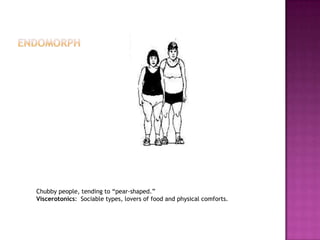
Chubby people, tending to “pear-shaped.”
Viscerotonics: Sociable types, lovers of food and physical comforts.
Stockier people, with broad shoulders and good musculature.
Somatotonics: Active types, physically fit and energetic.
Slender, often tall, people, with long arms and legs and fine features.
Cerebrotonics: Nervous types, relatively shy, often intellectual.
Social Learning Theory in direct contrast to trait
theory proposes that all behavior is learned.

Learning occurs by way of environmental
experiences and through the influence of other
people e.g. Parents, Coaches, Role Models, Friends
and other significant others.

Personality is     NOT      therefore     genetically
programmed.

 “All behaviour is learned through interaction with
                  the environment”
BEHAVIOUR = FUNCTION OF ENVIRONMENT (B
= F(E))

-ve = Does not consider inherited behavior (traits)
          NATURE V’s NURTURE debate

The Social Learning approach was presented by
psychologist Bandura. He believed learning was
stimulated by environmental experiences and this
involved two processes:

•The behaviour of others being imitated through
observation
•New behaviour being acquired after observation,
but only when it is endorsed through social
reinforcement
• Demonstration
Important to observe performance.

• Attention
look carefully for detail of movement.

• Retention
remember the demo AND the teaching points / error
correction.

• Motor Reproduction
demo is only of use if observers can attempt a successful
performance.

• Motivation
the performer must be motivated to perform the action.

• Matching Performance
the performer attempts to match the demo and to improve it.
Example
An inexperienced sports performer may be
inspired by the positive attitude and commitment
displayed in training by an experienced player. The
novice copies the desirable approach of the role
model and receives positive reinforcement from
both coach and peers. The process of
reinforcement has facilitated learning.
CONDITIONS THAT SUPPORT
                      SOCIAL LEARNING
                                  When observed behaviour
                                     is demonstrated by a
                                   „significant‟ other of role
                                      model of high status


                                   The observer wants to
     The role model is powerful   adopt the norms & values         The observer and role
          and authoritative       of a new culture, i.e. after   model are the same gender
                                      joining a new team


A drawback of social learning perspective is that it doesn‟t
take into account genetically inherited factors.              This
perspective does provide explanation as to why there are
individual differences in „attitude‟ „aggression‟, and „motivation‟
of sports performers.
Can also explain why young people elect to take part in
sport or follow a lifestyle that is healthy, active and
balanced.
1. Can you think of any environmental
  factors that have effected your behaviour?
  a.)
  b.)
  c.)
  d.)
  e.)
  f.)
  g.)
  h.)
  i.)
  j.)
•Combines trait theory & social learning theory.
•This recognises that the trait theory and
social learning theory both have a role in
determining behaviour and personality.
• More realistic explanation of personality?!
• Different behaviours produced for different
situations.
•Suggests that we base behaviour on inherent
traits that we then adapt to the situation we
are in.
•EQUATION = B = f (PxE)
•where behaviour is a function
of personality & environment.


Example:
• A games player might be loud,
extrovert & dominant manner in
the game because that is the best
way to succeed, but would be
more quiet & focused when in a
training session designed to
improve individual technique.
The Interactionist approach is based on the work
of Hollander (1967). Hollander proposed that
personality has three levels that interact to
form personality.


Hollander‟s Structure of Personality
                               Social Environment

   1 – PSYCHOLGICAL CORE– THE
   REAL YOU.

 2 – TYPICAL RESPONSE– THE WAY
 YOU RESPOND TO
 ENVIRONMENTAL DEMANDS.                             1   2 3

 3 - ROLE-RELATED BEHAVIOUR–
 VERY CHANGEABLE DEPENDING
 ON THE ROLE.
1   = The Psychological Core:
    The „real you‟
    Private, not revealed in questioning
2   = Typical Responses:
    Usual way we respond to the environment.
    Learned & stored experience. LH
    Responses may indicate the nature of the core.
3   = Role-related behaviour:
    Determined by our perception of env. at any given time.
    Can be changed at any time
    Action may not be a typical response but uncharacteristic
     action. AGG
Marten’s Structure
             of Personality


                         Role related
       External           behaviour            Dynamic
                        Good captain!?

                       Typical responses
                     e.g. win at all costs –
                   Instrumental aggression


                    Psychological core –
             Attitudes, values, beliefs, motives.
Internal        e.g. achievement motivation         Consistent
1. Interviews - are they reliable and valid in each case?
               - are they of value in assessing a persons sporting ability?
2. Questionnaires - e.g. psychometric self questionnaires, personality
   tests, multiphasic personality inventory and Catells 16 primary
   factors questionnaire.
    - are these appropriate for the results the researcher wants to gain?
3. Observations - difficult to remain unobtrusive which will affect
   behaviour.
   - secret observation is unethical


 What are the pros and cons of each method?
• NOT A TRUE PREDICTOR OF BEHAVIOUR, NO
SIGNIFICANT DIFFERENCE EXISTS BETWEEN SPORTS
PERFORMANCE & PEOPLE WITH DIFFERING TRAIT
STRENGTHS.

• DOES NOT TAKE INTO ACCOUNT THE INFLUENCE OF
THE ENVIRONMENT – TOO GENERAL.


•TAKES LITTLE ACCOUNT OF EXTERNAL FACTORS
THAT MAY EFFECT BEHAVIOUR.
•What are the 3 theories we
have been looking at?


                                                 Personality


 • Additional Reading -
 •Create a poster that illustrates either one OR all of the three
 theories, use pictures and diagrams as well as key words / information
 to illustrate the theory.
 •You can either use A3 paper or produce using ICT and get your images
 from the internet.
 •Note this work will be displayed therefore it must be accurate & well
 presented.
 •All work must be handed in next lesson.

Personality presentation 2013

  • 1.
    What we willlearn: Personality Attitudes Motivation and Achievement Motivation Goal Setting Group Dynamics Leadership Skills and Styles
  • 2.
    Explain the 3 Name 3 theory areas prospectives and there of limitations personality (naming at theory least 1 theory) Describe how we personality profile Understand the links between Define personality theory personality and sport
  • 3.
    1. What ispersonality? Write down your own definition. 2. How do you think our personalities are formed? 3. What affects how our personality develops?
  • 4.
    •Personality is. .. “The sum total of an individual‟s psychological characteristics which make him or her unique.” (Hollander) •„Personality. . . represents those characteristics of the person that account for consistent patterns of behaviour‟ (Pervin, 1993) •Personality is. . . ”The more or less stable and enduring organisation of a persons character, temperament, intellect and physique which determines the unique adjustment (the individual makes) to the environment” (Eysenck)
  • 5.
    Exam Tip. .. Exam questions often ask for explanations of the 3 personality perspectives. You need to be aware of the drawbacks found in trait and social learning perspectives and the advantages of the interactionist approach. CRITICALLY EVALUATE!
  • 6.
    The trait theoryof personality suggests that personality is made up of secondary traits inherited from parental genes. The trait view therefore maintains that all behaviour is innate and genetically programmed. “Traits are innate characteristics and are thought to be relatively stable. They are highly consistent attributes that exert a widely generalised casual effect on behaviour.” “People are born with established personality characteristics” •Inherited at birth. •Stable •Enduring •Consistent in all situations. BEHAVIOUR = FUNCTION OF PERSONALITY (B=F(P)). `
  • 7.
    •Outgoing, Aggressive, Tense,Shy, Relaxed, Sensitive etc. • Traits can be arranged in hierarchical order. • The stronger the trait, the more dominant the behaviour. • Trait theory does not believe that the situation or environment has any bearing on a person‟s behaviour. • Behaviour is said to be consistent. •Traits are thought to be stable, enduring and consistent in all situations. Trait theory attempts to predict behaviour. +ve = Can be easily measured through questionnaires -ve = Does not take into account environmental influences. It is not a true indicator of behavior.
  • 8.
    The drawback withthe trait approach is that in reality, behaviour is not always predictable. People adapt their behaviour in response to a particular environmental situation. Trait theory does not account for this. Also, the influence that the environment and other people have on shaping personality is not considered. There are 3 specific theories that belong to the trait perspective of personality that we need to know:
  • 9.
    Eysenck's Theory 1968 •OriginallyPersonality types are arranged on 2 dimensions. •Introvert/Extrovert •Stable/Neurotic Neurotic Introvert Extrovert Stable
  • 10.
    Said to achieve more in higher arousal situations. • Become aroused more slowly than introverts • There is a low sensitivity of the reticular activating system (RAS) • Prefer team oriented situations. • Like activities which involve gross motor skills. • Extrovert behaviour is loud, bright & outgoing.
  • 11.
    High levels of excitation.  Tend not to need added stimulation & excitement.  Become aroused more quickly than extroverts  There is a high sensitivity of the reticular activating system (RAS)  Prefer to take part in activities requiring more precision eg. Archery.  Introvert behaviour is shy, quiet & reserved.
  • 12.
    •Displays predictable emotions inappropriate situations •Their moods are predictable •They tend not to experience intense stress •Their recovery from stress is rapid
  • 13.
    •. Displays extremeand unpredictable emotions in the form of mood swings •Their moods are unreliable •They experience high degrees of stress •Their recovery from stress is slow
  • 15.
    Eysenck proposed theexistence of 4 personality types: •Extrovert & Stable •Extrovert and Neurotic •Introvert & Stable •Introvert & Neurotic Later he added a third scale to his model which he termed Psychoticism - A measure of how Tough- Minded people are. Eysenck used this third scale in a test to determine an individual‟s Personality Profile. This test was called the Eysenck‟s Personality Questionnaire (EPQ) – Let‟s have a go at the questionnaire………(QR codes)
  • 16.
    Cattell was alsoa believer of trait theory. However, he questioned whether personality could be understood using only 3 dimensions.... Instead, he considered a much larger number of traits. Cattell examined 16 Personality Factors in a questionnaire called „Cattell‟s 16PF test‟.
  • 17.
    Let‟s have a go at this test
  • 18.
    1. With apartner, choose 1 sports person each and describe to them why you think their psychological make up makes them successful? 2. Make a note of each others responses to this question jotting down any key characteristics that are being identified! 3. Can you think of a sports person who has the opposite characteristics to those that you have mentioned but is equally as successful?
  • 19.
    Girdano was anothertrait theorist. He proposed that there are two distinct personality types – Type A & Type B TYPE A CHARACTERISTICS: •HIGHLY COMPETITIVE •STRONG DESIRE TO SUCCEED •WORKS FAST •LIKES TO CONTROL •PRONE TO SUFFER STRESS
  • 20.
    TYPE B CHARACTERISTICS: •NON-COMPETITIVE •UNAMBITIOUS •WORKSMORE SLOWLY •APPEARS TO LACK DESIRE TO SUCCEED •DOES NOT ENJOY CONTROL •LESS PRONE TO STRESS
  • 21.
    •Which of thecharacteristics are most common with the sports person you identified? • Which of the characteristics do you demonstrate predominantly?
  • 22.
    T. ORFORD 1. Thereare 3 sports people below who display significantly different characteristics to the rest, who are they and why do you think this?! Monty Panesar Sven Goran Eriksson Paula Radcliffe Amir Kahn Tiger Woods Martin Johnson Ronnie O‟Sullivan Steve Redgrave Stephen Hendry Kevin Pietersen Anna Kournikova Tanni-Grey Thomson John Terry Kelly Holmes Jose Mourinho
  • 23.
    • If youidentified the 3 below as sports people who all display more type „B‟ characteristics than type „A‟ then well done! Sven Goran Eriksson Anna Kournikova Stephen Hendry • Sven is more of • Kournikova • Like Sven, a strategist, appears to be less Stephen is a taking his time to competitive as thinker and is work through she concentrates reserved in his things. As a result on commercial approach in he works more modelling rather comparison with slowly and is less than tennis. Ronnie O‟Sullivan. prone to stress. T. ORFORD
  • 24.
    Why do you think there were only 3 out of 15 successful sports people with type „B‟ characteristics? • So……..how can we develop these characteristics or are they pre - defined, already existing, non – changeable features of our personality? 1. Discuss with your partner whether you think you can change the way you are born!? T. ORFORD
  • 25.
    biological components Even if biology plays no direct strongly determine our role in our personality, the physical characteristics such way we look certainly affects as eye color, height, hair how we see ourselves and color, body type, and general how others interact with us. looks. Other aspects of human development, such as temperament and extroversion and introversion have also been shown to have strong biological links
  • 26.
     •Individuals possesscertain body types that predispose behavioural consistency:  –Ectomorph: Tense, introverted, inhibited  –Endomorph: Affectionate, sociable, relaxed  –Mesomorph: Adventurous, dominant, aggressive, risk-taking
  • 28.
    Chubby people, tendingto “pear-shaped.” Viscerotonics: Sociable types, lovers of food and physical comforts.
  • 29.
    Stockier people, withbroad shoulders and good musculature. Somatotonics: Active types, physically fit and energetic.
  • 30.
    Slender, often tall,people, with long arms and legs and fine features. Cerebrotonics: Nervous types, relatively shy, often intellectual.
  • 32.
    Social Learning Theoryin direct contrast to trait theory proposes that all behavior is learned. Learning occurs by way of environmental experiences and through the influence of other people e.g. Parents, Coaches, Role Models, Friends and other significant others. Personality is NOT therefore genetically programmed. “All behaviour is learned through interaction with the environment”
  • 33.
    BEHAVIOUR = FUNCTIONOF ENVIRONMENT (B = F(E)) -ve = Does not consider inherited behavior (traits) NATURE V’s NURTURE debate The Social Learning approach was presented by psychologist Bandura. He believed learning was stimulated by environmental experiences and this involved two processes: •The behaviour of others being imitated through observation •New behaviour being acquired after observation, but only when it is endorsed through social reinforcement
  • 34.
    • Demonstration Important toobserve performance. • Attention look carefully for detail of movement. • Retention remember the demo AND the teaching points / error correction. • Motor Reproduction demo is only of use if observers can attempt a successful performance. • Motivation the performer must be motivated to perform the action. • Matching Performance the performer attempts to match the demo and to improve it.
  • 35.
    Example An inexperienced sportsperformer may be inspired by the positive attitude and commitment displayed in training by an experienced player. The novice copies the desirable approach of the role model and receives positive reinforcement from both coach and peers. The process of reinforcement has facilitated learning.
  • 36.
    CONDITIONS THAT SUPPORT SOCIAL LEARNING When observed behaviour is demonstrated by a „significant‟ other of role model of high status The observer wants to The role model is powerful adopt the norms & values The observer and role and authoritative of a new culture, i.e. after model are the same gender joining a new team A drawback of social learning perspective is that it doesn‟t take into account genetically inherited factors. This perspective does provide explanation as to why there are individual differences in „attitude‟ „aggression‟, and „motivation‟ of sports performers. Can also explain why young people elect to take part in sport or follow a lifestyle that is healthy, active and balanced.
  • 37.
    1. Can youthink of any environmental factors that have effected your behaviour? a.) b.) c.) d.) e.) f.) g.) h.) i.) j.)
  • 38.
    •Combines trait theory& social learning theory. •This recognises that the trait theory and social learning theory both have a role in determining behaviour and personality. • More realistic explanation of personality?! • Different behaviours produced for different situations. •Suggests that we base behaviour on inherent traits that we then adapt to the situation we are in.
  • 39.
    •EQUATION = B= f (PxE) •where behaviour is a function of personality & environment. Example: • A games player might be loud, extrovert & dominant manner in the game because that is the best way to succeed, but would be more quiet & focused when in a training session designed to improve individual technique.
  • 40.
    The Interactionist approachis based on the work of Hollander (1967). Hollander proposed that personality has three levels that interact to form personality. Hollander‟s Structure of Personality Social Environment 1 – PSYCHOLGICAL CORE– THE REAL YOU. 2 – TYPICAL RESPONSE– THE WAY YOU RESPOND TO ENVIRONMENTAL DEMANDS. 1 2 3 3 - ROLE-RELATED BEHAVIOUR– VERY CHANGEABLE DEPENDING ON THE ROLE.
  • 41.
    1 = The Psychological Core:  The „real you‟  Private, not revealed in questioning 2 = Typical Responses:  Usual way we respond to the environment.  Learned & stored experience. LH  Responses may indicate the nature of the core. 3 = Role-related behaviour:  Determined by our perception of env. at any given time.  Can be changed at any time  Action may not be a typical response but uncharacteristic action. AGG
  • 42.
    Marten’s Structure of Personality Role related External behaviour Dynamic Good captain!? Typical responses e.g. win at all costs – Instrumental aggression Psychological core – Attitudes, values, beliefs, motives. Internal e.g. achievement motivation Consistent
  • 43.
    1. Interviews -are they reliable and valid in each case? - are they of value in assessing a persons sporting ability? 2. Questionnaires - e.g. psychometric self questionnaires, personality tests, multiphasic personality inventory and Catells 16 primary factors questionnaire. - are these appropriate for the results the researcher wants to gain? 3. Observations - difficult to remain unobtrusive which will affect behaviour. - secret observation is unethical What are the pros and cons of each method?
  • 44.
    • NOT ATRUE PREDICTOR OF BEHAVIOUR, NO SIGNIFICANT DIFFERENCE EXISTS BETWEEN SPORTS PERFORMANCE & PEOPLE WITH DIFFERING TRAIT STRENGTHS. • DOES NOT TAKE INTO ACCOUNT THE INFLUENCE OF THE ENVIRONMENT – TOO GENERAL. •TAKES LITTLE ACCOUNT OF EXTERNAL FACTORS THAT MAY EFFECT BEHAVIOUR.
  • 45.
    •What are the3 theories we have been looking at? Personality • Additional Reading - •Create a poster that illustrates either one OR all of the three theories, use pictures and diagrams as well as key words / information to illustrate the theory. •You can either use A3 paper or produce using ICT and get your images from the internet. •Note this work will be displayed therefore it must be accurate & well presented. •All work must be handed in next lesson.