
Confrontation and Challenging
Skills
by
MeaningofConfrontationandChallenging skills
Generally speaking the term confrontation means
challenging another person over a disagreement.
However, confrontation as a counselling skill is an
attempt by the counsellor to gently bring about
awareness in the client of something that may
they may have overlooked or avoided.
ConfrontationandChallengingSkills
00
Confrontationand Challenging skill
• Goals
To increase participation in the counseling process
 To increase client’s awareness of blind spots and develop new
perspectives
 To identify responsibility for problems and unused potential
 To enhance the client’s problem solving ability
 To challenge distortions, excuses, games
 To explore consequences of client’s actions
 To move beyond discussion and lethargy into action
ConfrontationandChallengingSkills
01
• A client will not perceive your efforts as confrontational.
• Invite clients to challenge themselves to change ways of thinking
and acting that keep them stuck in problem situations and
prevent them from identifying and developing opportunities.
• If they do not accept the invitation, then challenge them directly
to change. Examine what the benefits and costs (logical
consequence) there are for the client if they do not choose to
make change.
ConfrontationandChallengingSkills
Confrontationand Challenging skill
02
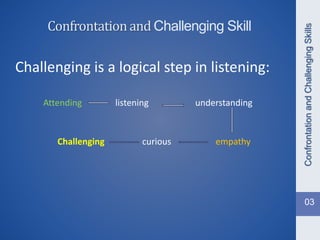
Challenging is a logical step in listening:
Attending listening understanding
Challenging curious empathy
ConfrontationandChallengingSkills
Confrontationand Challenging Skill
03
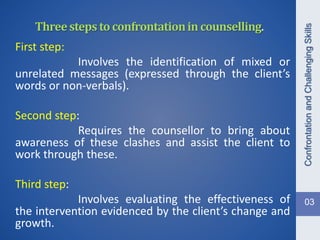
First step:
Involves the identification of mixed or
unrelated messages (expressed through the client’s
words or non-verbals).
Second step:
Requires the counsellor to bring about
awareness of these clashes and assist the client to
work through these.
Third step:
Involves evaluating the effectiveness of
the intervention evidenced by the client’s change and
growth.
ConfrontationandChallengingSkills
Threesteps toconfrontationincounselling.
03
• What to Challenge
• Between what is said now vs. earlier
• “Earlier I thought I heard you say that you did not want to quit your job, now I am
hearing you say that you are planning to quit.”
• Between verbal and nonverbal cues
• “I hear you say that you are not angry with him, but I can’t help but notice that your fists
are clenched, you are talking faster, and you are using strong words when you talk
about him.”
ConfrontationandChallengingSkills
Confrontationand Challenging Skill
04
 What to Challenge (cont.)
 Between what the client says s/he wants and what s/he is doing to
achieve it
 I understand that you want to not be dependent on your parents any longer,
however I don’t see that you are planning to get a job to make this happen.
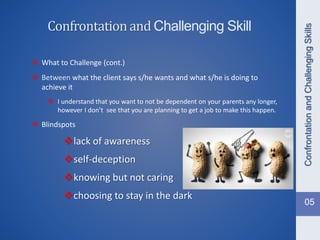
 Blindspots
lack of awareness
self-deception
knowing but not caring
choosing to stay in the dark
ConfrontationandChallengingSkills
Confrontationand Challenging Skill
05
What to Challenge (cont.)
• Disputing Beliefs when thinking is distorted, irrational, or illogical
• Help the client explore underlying beliefs that might be leading to self
defeating patterns
• Listen for exaggerated, hyperbolic language (e.g.,
“never”, “always”, “only”)
• Listen for absolutes
• Listen for sense of entitlement
• Listen for overgeneralizations
• Listen for “musts” and “shoulds”
• Listen for shirking of responsibility
ConfrontationandChallengingSkills
Confrontationand Challenging Skill
06
What to Challenge (cont.)
 Problems they are avoiding
 Opportunities they are ignoring
 Things they are overlooking
 Things they are refusing to see
 Things they don’t want to do
 Assumptions they are making
ConfrontationandChallengingSkills
Confrontationand Challenging Skill
07
Activity
Practice challenging these clients:
 A woman who takes care of everyone else
except herself
 A student who says she plans go to university but her Z.score is
not enough.
A client who professes to hold strong religious
values, but disparages people of other racial
and ethnic groups
 A client who is crying while stating that
everything is fine
ConfrontationandChallengingSkills
08
Skill: Immediacy
Immediacy – using a moment in counseling to deal with an issue, whether it be
b/w you and the client or you are challenging the client
Situations for Immediacy
 lack of direction
 tension
 trust
 diversity
 dependency
 counterdependency
 attraction (be very careful in this discussion)
ConfrontationandChallengingSkills
09
Where can be usedConfrontationand
Challenging Skill
 Client with depression (S)
 Client with OCD
 Client with Traumatic experience
 Addiction
 Client with Behavioral issues
A good confrontation is gentle, supportive and
accurately reflects what the client has shared
with you.
ConfrontationandChallengingSkills
10
ConfrontationandChallengingSkills
Thank you,

Confrontation and challenging skills

  • 1.
  • 2.
    MeaningofConfrontationandChallenging skills Generally speakingthe term confrontation means challenging another person over a disagreement. However, confrontation as a counselling skill is an attempt by the counsellor to gently bring about awareness in the client of something that may they may have overlooked or avoided. ConfrontationandChallengingSkills 00
  • 3.
    Confrontationand Challenging skill •Goals To increase participation in the counseling process  To increase client’s awareness of blind spots and develop new perspectives  To identify responsibility for problems and unused potential  To enhance the client’s problem solving ability  To challenge distortions, excuses, games  To explore consequences of client’s actions  To move beyond discussion and lethargy into action ConfrontationandChallengingSkills 01
  • 4.
    • A clientwill not perceive your efforts as confrontational. • Invite clients to challenge themselves to change ways of thinking and acting that keep them stuck in problem situations and prevent them from identifying and developing opportunities. • If they do not accept the invitation, then challenge them directly to change. Examine what the benefits and costs (logical consequence) there are for the client if they do not choose to make change. ConfrontationandChallengingSkills Confrontationand Challenging skill 02
  • 5.
    Challenging is alogical step in listening: Attending listening understanding Challenging curious empathy ConfrontationandChallengingSkills Confrontationand Challenging Skill 03
  • 6.
    First step: Involves theidentification of mixed or unrelated messages (expressed through the client’s words or non-verbals). Second step: Requires the counsellor to bring about awareness of these clashes and assist the client to work through these. Third step: Involves evaluating the effectiveness of the intervention evidenced by the client’s change and growth. ConfrontationandChallengingSkills Threesteps toconfrontationincounselling. 03
  • 7.
    • What toChallenge • Between what is said now vs. earlier • “Earlier I thought I heard you say that you did not want to quit your job, now I am hearing you say that you are planning to quit.” • Between verbal and nonverbal cues • “I hear you say that you are not angry with him, but I can’t help but notice that your fists are clenched, you are talking faster, and you are using strong words when you talk about him.” ConfrontationandChallengingSkills Confrontationand Challenging Skill 04
  • 8.
     What toChallenge (cont.)  Between what the client says s/he wants and what s/he is doing to achieve it  I understand that you want to not be dependent on your parents any longer, however I don’t see that you are planning to get a job to make this happen.  Blindspots lack of awareness self-deception knowing but not caring choosing to stay in the dark ConfrontationandChallengingSkills Confrontationand Challenging Skill 05
  • 9.
    What to Challenge(cont.) • Disputing Beliefs when thinking is distorted, irrational, or illogical • Help the client explore underlying beliefs that might be leading to self defeating patterns • Listen for exaggerated, hyperbolic language (e.g., “never”, “always”, “only”) • Listen for absolutes • Listen for sense of entitlement • Listen for overgeneralizations • Listen for “musts” and “shoulds” • Listen for shirking of responsibility ConfrontationandChallengingSkills Confrontationand Challenging Skill 06
  • 10.
    What to Challenge(cont.)  Problems they are avoiding  Opportunities they are ignoring  Things they are overlooking  Things they are refusing to see  Things they don’t want to do  Assumptions they are making ConfrontationandChallengingSkills Confrontationand Challenging Skill 07
  • 11.
    Activity Practice challenging theseclients:  A woman who takes care of everyone else except herself  A student who says she plans go to university but her Z.score is not enough. A client who professes to hold strong religious values, but disparages people of other racial and ethnic groups  A client who is crying while stating that everything is fine ConfrontationandChallengingSkills 08
  • 12.
    Skill: Immediacy Immediacy –using a moment in counseling to deal with an issue, whether it be b/w you and the client or you are challenging the client Situations for Immediacy  lack of direction  tension  trust  diversity  dependency  counterdependency  attraction (be very careful in this discussion) ConfrontationandChallengingSkills 09
  • 13.
    Where can beusedConfrontationand Challenging Skill  Client with depression (S)  Client with OCD  Client with Traumatic experience  Addiction  Client with Behavioral issues A good confrontation is gentle, supportive and accurately reflects what the client has shared with you. ConfrontationandChallengingSkills 10
  • 14.