Lecture No#2
Personality
Personality
 When we describe people using such a terms such as quite,
loud, aggressive, ambitious loyal, we are describing their
personality.
 Some people are brave, scared, smart, mean, nice
 In General:
 External appearance
 Personality is the characteristics patterns of thoughts,
feelings, and behaviours that make a person unique
 Personality signifies the role which person display to the
public
 Personality – Example
 Grit: Passion to win
 Proactivity: Taking action ahead of others
 Risk taking: ability to take risk
 Conscientiousness: Doing one thing only at a time
 Openness: collect ideas from different sources
 Timeliness: completing project timely
• Personality refers to both physical and psychological
qualities of an individual
• It is unique in the sense that no two individuals are same in
terms of their personality
• Personality is dynamic: it changes with the time and
situation.
Determinants of Personality
Determinants: An element that identifies the
nature of something
Personality is a result of the combination of
four factors-
1. Physical environment,
2. Heredity or biological factors,
3. Culture factors
4. Situational factors
 Biological factors
• Heredity: the passing on of physical or
mental characteristics genetically from
one generation to another
• Hair colour, face, eyes etc
• Physical features: external appearance
like height, weight, strength etc
 Family and social factors
• Home environment : friendly, loving, fear,
joint etc
• Family members: mother, father, siblings,
grand father
• Social groups: friends, relatives, peers etc
 Cultural factors
 Underlying determinants of human
decision making
 The ideas, customs and social behavior of
a particular people or society
 Traditional practices, norms, values, rules
and regulations
 Situational factors:
Employees working with power and
freedom may become frustrated and react
aggressively if he put in a bureaucratized
work situation
Personality Traits and Its Types
 An individual’s behaviour towards others, attitude,
mind-set make his personality.
 These five dimensions are also called as “Big Five”
Factors, and the model is referred to as Five Factor
Model also abbreviated as FFM.
 The Five Factor Model was initially proposed by Costa
& McCrae in the year 1992 and often describes the
relation between an individual’s personality and
various behaviours.
 The model proposes that human personality can
measured along five major dimensions, each of which is
distinct and independent from the others.
 The Big Five model is also called OCEAN
 O: openness
 C: conscientiousness
 E: extroversion
 A: agreeableness
 N: neuroticism (Emotional Stability)
Cont.
 1.Openness to experience: Individuals with openness to
experience are generally very active, have a tremendous
inclination towards creativity.
 Person with high level of openness are:
willing to listen to new ideas and to change their own
ideas, beliefs and attitudes to new information.
• Person with low level of openness are:
Less receptive to new ideas and less willing to change their
mind
 2.Conscientiousness: As the name suggests,
individuals with a Conscientiousness personality
trait listen to their conscience and act
accordingly. Such individuals are extremely
cautious and self disciplined.
 Person who focus few goals at a time are:
 Organized, systematic, careful, disciplines
 Person with less conscientiousness tend to
pursue many goals are more disorganised,
careless, irresponsible, and less self disciplined
Cont.
 i. Extraversion: Extraversion refers to a state where
individuals show more concern towards what is happening
outside. Such individuals love interacting with people
around and are generally talkative.
 These kinds of people are working in sales activities and
public relations unit.
 ii.Introversion: Introversion, on the other hand refers to a
state when an individual is concerned only with his own
life and nothing else. Such individuals do not bother about
others and are seldom interested in what is happening
around.
Cont.
 4.Agreeableness: Agreeableness is a personality trait which
teaches individuals to be adjusting in almost all situations. Such
individuals do not hesitate and face changes with a smile. They
accommodate themselves to all situations and are friendly and
kind hearted.
 Cooperative, forgiving, understanding, good natured in dealing
with others
 5.Neuroticism: Neuroticism is a trait where individuals are
prone to negative thoughts such as anxiety, anger, envy, guilt and
so on.
Type A and Type B personality
 Friedman and Roseman classified personality into two types A & B
 Type A: Personality is one which is stress prone, in a hurry, impatient and
fast in whatever they do. They aggressively involved in a struggle to
achieve more and more in less time and work obsessed.
 Patience level: Low
 Highly Competitive.
 Stress level High.
 They move, walk and eat fast.
 Great at multitasking.
 Self-driven feels guilty when relaxing.
 Feels impatient with the pace of things, dislikes waiting.
 They have a busy schedule and does not have time to enjoy life.
 Uses nervous gestures, like a clenched fist or banging hand on the table.
 They do not easily accept failure.
Type B Personality
 Type B personality is one which is less stress prone patient,
relaxed and easy going.
 They are not concerned about time.
 They compete for fun, not to win.
 Mild-mannered.
 Never in a hurry and has no pressing deadlines.
 Focus on quality rather than quantity.
 Laidback and live a stress-less life.
Type A and Type B personality
The theory describes Type A
individuals as
 outgoing, ambitious,
rigidly organized, highly status-
conscious, sensitive, impatient,
anxious, proactive, and concerned
with time management.
 People with Type A personalities
are often high-achieving
"workaholics." They push
themselves with deadlines, and
hate delays.
The theory describes Type B
individuals as
 a contrast to those of Type A. Type
B personality, by definition, are
noted to live at lower stress levels.
 They typically work steadily, and
may enjoy achievement, although
they have a greater tendency to
disregard physical or mental stress
when they do not achieve.
 When faced with competition,
they may focus less on winning or
losing than their Type A
counterparts, and more on
enjoying the game regardless of
winning or losing.
Theory X and Theory Y
 Motivation implies the act of stimulating or inspiring
subordinates to pursue the desired course of action.
 Professor Douglas McGregor put forward a theory of
motivation IN 1960
 He suggest two aspects of human bevaviour at work
 Theory X: Theory X is a conventional approach to
motivation, based on negative assumption.
 An average employee naturally does not like work and
tries to escape it whenever possible
 Employees generally dislike responsibilities
 It is a motivational theory, which involves high
supervision and control over the subordinates, and
greater degree of centralization.
Cont.
 Theory Y:
 Is an advanced theory, wherein it is assumed that
the workers are self-directed and self-motivated,
for growth and development and takes active part
in decision making.
 It is opposite to theory X.
 Employees may not require only threat, external
control and coercion to work, but they can use self
direction and they are dedicated and sincere to
achieve the organizational goals.
If the job is rewarding and satisfying , then it will
result in employee’s loyalty and commitment to
organization.
 They can even learn to obtain responsibility.
 Myers-Briggs Type Indicator MBTI
 How to measure personality
 Developed by two Americans, Katharine Cook Briggs and
her daughter Isabel Briggs Myers
 Inspired from the theory of Carl Jung’s book
Psychological types
 MBTI handbook published in 1944
Purpose of MBTI
• Personality effects the behavior in various situations
• To measure the personality of someone
• It has 100 questions to assess someone personality
across various situations
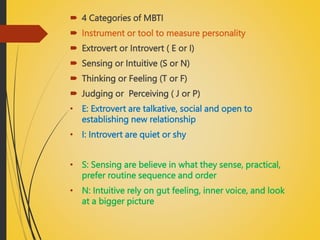
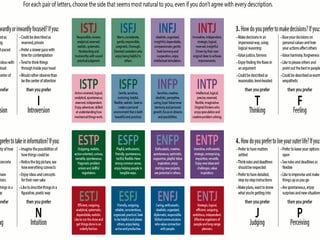
 4 Categories of MBTI
 Instrument or tool to measure personality
 Extrovert or Introvert ( E or I)
 Sensing or Intuitive (S or N)
 Thinking or Feeling (T or F)
 Judging or Perceiving ( J or P)
• E: Extrovert are talkative, social and open to
establishing new relationship
• I: Introvert are quiet or shy
• S: Sensing are believe in what they sense, practical,
prefer routine sequence and order
• N: Intuitive rely on gut feeling, inner voice, and look
at a bigger picture
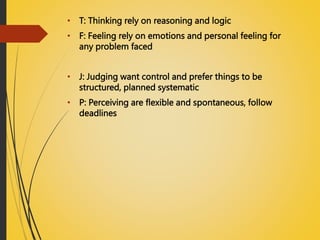
• T: Thinking rely on reasoning and logic
• F: Feeling rely on emotions and personal feeling for
any problem faced
• J: Judging want control and prefer things to be
structured, planned systematic
• P: Perceiving are flexible and spontaneous, follow
deadlines
Human Behavior Lecture Chapter 02 ppt sl

Human Behavior Lecture Chapter 02 ppt sl

  • 1.
  • 2.
    Personality  When wedescribe people using such a terms such as quite, loud, aggressive, ambitious loyal, we are describing their personality.  Some people are brave, scared, smart, mean, nice  In General:  External appearance  Personality is the characteristics patterns of thoughts, feelings, and behaviours that make a person unique  Personality signifies the role which person display to the public
  • 3.
     Personality –Example  Grit: Passion to win  Proactivity: Taking action ahead of others  Risk taking: ability to take risk  Conscientiousness: Doing one thing only at a time  Openness: collect ideas from different sources  Timeliness: completing project timely • Personality refers to both physical and psychological qualities of an individual • It is unique in the sense that no two individuals are same in terms of their personality • Personality is dynamic: it changes with the time and situation.
  • 4.
    Determinants of Personality Determinants:An element that identifies the nature of something Personality is a result of the combination of four factors- 1. Physical environment, 2. Heredity or biological factors, 3. Culture factors 4. Situational factors
  • 5.
     Biological factors •Heredity: the passing on of physical or mental characteristics genetically from one generation to another • Hair colour, face, eyes etc • Physical features: external appearance like height, weight, strength etc
  • 6.
     Family andsocial factors • Home environment : friendly, loving, fear, joint etc • Family members: mother, father, siblings, grand father • Social groups: friends, relatives, peers etc
  • 7.
     Cultural factors Underlying determinants of human decision making  The ideas, customs and social behavior of a particular people or society  Traditional practices, norms, values, rules and regulations
  • 8.
     Situational factors: Employeesworking with power and freedom may become frustrated and react aggressively if he put in a bureaucratized work situation
  • 9.
    Personality Traits andIts Types  An individual’s behaviour towards others, attitude, mind-set make his personality.  These five dimensions are also called as “Big Five” Factors, and the model is referred to as Five Factor Model also abbreviated as FFM.  The Five Factor Model was initially proposed by Costa & McCrae in the year 1992 and often describes the relation between an individual’s personality and various behaviours.
  • 10.
     The modelproposes that human personality can measured along five major dimensions, each of which is distinct and independent from the others.  The Big Five model is also called OCEAN  O: openness  C: conscientiousness  E: extroversion  A: agreeableness  N: neuroticism (Emotional Stability)
  • 11.
    Cont.  1.Openness toexperience: Individuals with openness to experience are generally very active, have a tremendous inclination towards creativity.  Person with high level of openness are: willing to listen to new ideas and to change their own ideas, beliefs and attitudes to new information. • Person with low level of openness are: Less receptive to new ideas and less willing to change their mind
  • 12.
     2.Conscientiousness: Asthe name suggests, individuals with a Conscientiousness personality trait listen to their conscience and act accordingly. Such individuals are extremely cautious and self disciplined.  Person who focus few goals at a time are:  Organized, systematic, careful, disciplines  Person with less conscientiousness tend to pursue many goals are more disorganised, careless, irresponsible, and less self disciplined
  • 13.
    Cont.  i. Extraversion:Extraversion refers to a state where individuals show more concern towards what is happening outside. Such individuals love interacting with people around and are generally talkative.  These kinds of people are working in sales activities and public relations unit.  ii.Introversion: Introversion, on the other hand refers to a state when an individual is concerned only with his own life and nothing else. Such individuals do not bother about others and are seldom interested in what is happening around.
  • 14.
    Cont.  4.Agreeableness: Agreeablenessis a personality trait which teaches individuals to be adjusting in almost all situations. Such individuals do not hesitate and face changes with a smile. They accommodate themselves to all situations and are friendly and kind hearted.  Cooperative, forgiving, understanding, good natured in dealing with others  5.Neuroticism: Neuroticism is a trait where individuals are prone to negative thoughts such as anxiety, anger, envy, guilt and so on.
  • 15.
    Type A andType B personality  Friedman and Roseman classified personality into two types A & B  Type A: Personality is one which is stress prone, in a hurry, impatient and fast in whatever they do. They aggressively involved in a struggle to achieve more and more in less time and work obsessed.  Patience level: Low  Highly Competitive.  Stress level High.  They move, walk and eat fast.  Great at multitasking.  Self-driven feels guilty when relaxing.  Feels impatient with the pace of things, dislikes waiting.  They have a busy schedule and does not have time to enjoy life.  Uses nervous gestures, like a clenched fist or banging hand on the table.  They do not easily accept failure.
  • 16.
    Type B Personality Type B personality is one which is less stress prone patient, relaxed and easy going.  They are not concerned about time.  They compete for fun, not to win.  Mild-mannered.  Never in a hurry and has no pressing deadlines.  Focus on quality rather than quantity.  Laidback and live a stress-less life.
  • 17.
    Type A andType B personality The theory describes Type A individuals as  outgoing, ambitious, rigidly organized, highly status- conscious, sensitive, impatient, anxious, proactive, and concerned with time management.  People with Type A personalities are often high-achieving "workaholics." They push themselves with deadlines, and hate delays. The theory describes Type B individuals as  a contrast to those of Type A. Type B personality, by definition, are noted to live at lower stress levels.  They typically work steadily, and may enjoy achievement, although they have a greater tendency to disregard physical or mental stress when they do not achieve.  When faced with competition, they may focus less on winning or losing than their Type A counterparts, and more on enjoying the game regardless of winning or losing.
  • 18.
    Theory X andTheory Y  Motivation implies the act of stimulating or inspiring subordinates to pursue the desired course of action.  Professor Douglas McGregor put forward a theory of motivation IN 1960  He suggest two aspects of human bevaviour at work  Theory X: Theory X is a conventional approach to motivation, based on negative assumption.  An average employee naturally does not like work and tries to escape it whenever possible  Employees generally dislike responsibilities  It is a motivational theory, which involves high supervision and control over the subordinates, and greater degree of centralization.
  • 19.
    Cont.  Theory Y: Is an advanced theory, wherein it is assumed that the workers are self-directed and self-motivated, for growth and development and takes active part in decision making.  It is opposite to theory X.  Employees may not require only threat, external control and coercion to work, but they can use self direction and they are dedicated and sincere to achieve the organizational goals. If the job is rewarding and satisfying , then it will result in employee’s loyalty and commitment to organization.  They can even learn to obtain responsibility.
  • 20.
     Myers-Briggs TypeIndicator MBTI  How to measure personality  Developed by two Americans, Katharine Cook Briggs and her daughter Isabel Briggs Myers  Inspired from the theory of Carl Jung’s book Psychological types  MBTI handbook published in 1944 Purpose of MBTI • Personality effects the behavior in various situations • To measure the personality of someone • It has 100 questions to assess someone personality across various situations
  • 21.
     4 Categoriesof MBTI  Instrument or tool to measure personality  Extrovert or Introvert ( E or I)  Sensing or Intuitive (S or N)  Thinking or Feeling (T or F)  Judging or Perceiving ( J or P) • E: Extrovert are talkative, social and open to establishing new relationship • I: Introvert are quiet or shy • S: Sensing are believe in what they sense, practical, prefer routine sequence and order • N: Intuitive rely on gut feeling, inner voice, and look at a bigger picture
  • 22.
    • T: Thinkingrely on reasoning and logic • F: Feeling rely on emotions and personal feeling for any problem faced • J: Judging want control and prefer things to be structured, planned systematic • P: Perceiving are flexible and spontaneous, follow deadlines

Editor's Notes

  • #16 The two cardiologists who developed this theory came to believe that Type A personalities had a greater chance of developing coronary heart disease. Nevertheless, this research had a significant effect on the development of the health psychology field, in which psychologists look at how an individual's mental state affects their physical health.[1]
  • #24 https://www.google.com.pk/search?q=mbti+test&source=lnms&tbm=isch&sa=X&ved=0ahUKEwjs5oeXpZnSAhWMPBQKHWbcBMIQ_AUICCgB&biw=1366&bih=613#imgrc=mNIWlB2Eoy8x7M: