ROMOUR
Group Behavior In Social Contest
DEEPTI
MSW 1st YEAR
MAIN CONDENTS
Definition Of Rumor
Meaning Of Rumor
Case Of Spreading
The Process
Propagation Of Romour
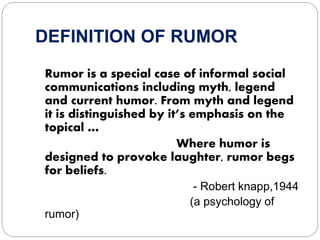
DEFINITION OF RUMOR
Rumor is a special case of informal social
communications including myth, legend
and current humor. From myth and legend
it is distinguished by it’s emphasis on the
topical …
Where humor is
designed to provoke laughter, rumor begs
for beliefs.
- Robert knapp,1944
(a psychology of
rumor)
DEFINITION OF RUMOR
A rumor is a piece of
information or a story
that has not been verified,
meaning that the person
telling it doesn’t know if
it’s true or false.
MEANING OF RUMOR
 Rumours spread from person to person, or can
spread from one person to a whole bunch of
people at once.
 Rumours can change slightly each time they're
told, so they get more exaggerated over time.
 Most people who spread rumours don't care if
the story is true of not, and don't bother to check
it out.
 A rumour might be true, it might be partially true
and partially made up, or it might be totally made
up. Unless somebody can definitely say that a
story is real or fake, it will stay a rumour.
CASES FOR SPREADING
 when there is uncertainty.
 when they feel anxiety.
 when the information is important.
 When they believe the information.
 When it helps their self-image.
 When it helps their social status.
PROCESS
 In order to create the right rumor you need to
have a goal in mind while you make it up
1. Convince others to spread you rumor.
2. Hone in on the big mouth.
3. Through social media.
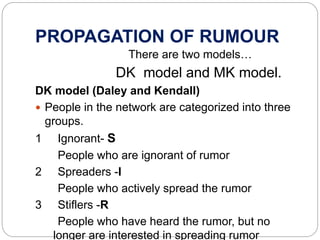
PROPAGATION OF RUMOUR
There are two models…
DK model and MK model.
DK model (Daley and Kendall)
 People in the network are categorized into three
groups.
1 Ignorant- S
People who are ignorant of rumor
2 Spreaders -I
People who actively spread the rumor
3 Stiflers -R
People who have heard the rumor, but no
longer are interested in spreading rumor
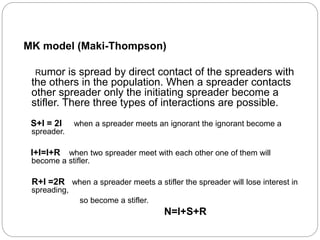
MK model (Maki-Thompson)
Rumor is spread by direct contact of the spreaders with
the others in the population. When a spreader contacts
other spreader only the initiating spreader become a
stifler. There three types of interactions are possible.
S+I = 2I when a spreader meets an ignorant the ignorant become a
spreader.
I+I=I+R when two spreader meet with each other one of them will
become a stifler.
R+I =2R when a spreader meets a stifler the spreader will lose interest in
spreading,
so become a stifler.
N=I+S+R
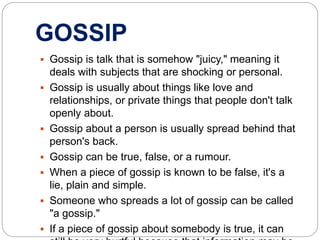
GOSSIP
 Gossip is talk that is somehow "juicy," meaning it
deals with subjects that are shocking or personal.
 Gossip is usually about things like love and
relationships, or private things that people don't talk
openly about.
 Gossip about a person is usually spread behind that
person's back.
 Gossip can be true, false, or a rumour.
 When a piece of gossip is known to be false, it's a
lie, plain and simple.
 Someone who spreads a lot of gossip can be called
"a gossip."
 If a piece of gossip about somebody is true, it can
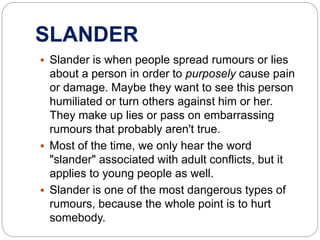
SLANDER
 Slander is when people spread rumours or lies
about a person in order to purposely cause pain
or damage. Maybe they want to see this person
humiliated or turn others against him or her.
They make up lies or pass on embarrassing
rumours that probably aren't true.
 Most of the time, we only hear the word
"slander" associated with adult conflicts, but it
applies to young people as well.
 Slander is one of the most dangerous types of
rumours, because the whole point is to hurt
somebody.
JOKES AND FUNS
 Sometimes rumours start out as silly jokes, then
get spread around and changed over and over
again. When lots of people are telling the same
tale, it makes it seem more like the truth. You
might think, "How can all these people be
wrong?"
 When these rumours last long enough and
spread far enough, they actually become part of
our culture, often called "Urban Legends,"
"Modern Legends," or "Urban Myths."
WHY RUMORS
 To feel superior
 To feel like part of the group
 For attention
 For control or power
 Out of jealousy or a need for revenge
 Out of boredom
AT LAST. . .
 Gossip and rumours can destroy trust
 True or not, private is private
 Believing rumours can lead to bad choices
 Decide whether it's hurtful or harmless
 Make the rumour stop with you
 Don't be an audience
 Be a Peacemaker
 Respect others' privacy
REFERANCE
 ALLPORT, G W., & POSTMAN,L. (1965). The
psychology of rumor. New York :Russell & Russell Inc.
(original work published in 1947)
 ROSNOW, R. L., & FINE, G. A. (1976). Rumor and
gossip: The social psychology of hearsay. New York:
Elsevier.
 IYER, E. S., & DEBEVEC, K. (1991). Origin of
rumor and tone of message in rumor quelling
strategies. Psychology & Marketing, 8, 161-175.
THANK YOU

Rumor

  • 1.
    ROMOUR Group Behavior InSocial Contest DEEPTI MSW 1st YEAR
  • 2.
    MAIN CONDENTS Definition OfRumor Meaning Of Rumor Case Of Spreading The Process Propagation Of Romour
  • 3.
    DEFINITION OF RUMOR Rumoris a special case of informal social communications including myth, legend and current humor. From myth and legend it is distinguished by it’s emphasis on the topical … Where humor is designed to provoke laughter, rumor begs for beliefs. - Robert knapp,1944 (a psychology of rumor)
  • 4.
    DEFINITION OF RUMOR Arumor is a piece of information or a story that has not been verified, meaning that the person telling it doesn’t know if it’s true or false.
  • 5.
    MEANING OF RUMOR Rumours spread from person to person, or can spread from one person to a whole bunch of people at once.  Rumours can change slightly each time they're told, so they get more exaggerated over time.  Most people who spread rumours don't care if the story is true of not, and don't bother to check it out.  A rumour might be true, it might be partially true and partially made up, or it might be totally made up. Unless somebody can definitely say that a story is real or fake, it will stay a rumour.
  • 6.
    CASES FOR SPREADING when there is uncertainty.  when they feel anxiety.  when the information is important.  When they believe the information.  When it helps their self-image.  When it helps their social status.
  • 7.
    PROCESS  In orderto create the right rumor you need to have a goal in mind while you make it up 1. Convince others to spread you rumor. 2. Hone in on the big mouth. 3. Through social media.
  • 8.
    PROPAGATION OF RUMOUR Thereare two models… DK model and MK model. DK model (Daley and Kendall)  People in the network are categorized into three groups. 1 Ignorant- S People who are ignorant of rumor 2 Spreaders -I People who actively spread the rumor 3 Stiflers -R People who have heard the rumor, but no longer are interested in spreading rumor
  • 9.
    MK model (Maki-Thompson) Rumoris spread by direct contact of the spreaders with the others in the population. When a spreader contacts other spreader only the initiating spreader become a stifler. There three types of interactions are possible. S+I = 2I when a spreader meets an ignorant the ignorant become a spreader. I+I=I+R when two spreader meet with each other one of them will become a stifler. R+I =2R when a spreader meets a stifler the spreader will lose interest in spreading, so become a stifler. N=I+S+R
  • 10.
    GOSSIP  Gossip istalk that is somehow "juicy," meaning it deals with subjects that are shocking or personal.  Gossip is usually about things like love and relationships, or private things that people don't talk openly about.  Gossip about a person is usually spread behind that person's back.  Gossip can be true, false, or a rumour.  When a piece of gossip is known to be false, it's a lie, plain and simple.  Someone who spreads a lot of gossip can be called "a gossip."  If a piece of gossip about somebody is true, it can
  • 11.
    SLANDER  Slander iswhen people spread rumours or lies about a person in order to purposely cause pain or damage. Maybe they want to see this person humiliated or turn others against him or her. They make up lies or pass on embarrassing rumours that probably aren't true.  Most of the time, we only hear the word "slander" associated with adult conflicts, but it applies to young people as well.  Slander is one of the most dangerous types of rumours, because the whole point is to hurt somebody.
  • 12.
    JOKES AND FUNS Sometimes rumours start out as silly jokes, then get spread around and changed over and over again. When lots of people are telling the same tale, it makes it seem more like the truth. You might think, "How can all these people be wrong?"  When these rumours last long enough and spread far enough, they actually become part of our culture, often called "Urban Legends," "Modern Legends," or "Urban Myths."
  • 13.
    WHY RUMORS  Tofeel superior  To feel like part of the group  For attention  For control or power  Out of jealousy or a need for revenge  Out of boredom
  • 14.
    AT LAST. ..  Gossip and rumours can destroy trust  True or not, private is private  Believing rumours can lead to bad choices  Decide whether it's hurtful or harmless  Make the rumour stop with you  Don't be an audience  Be a Peacemaker  Respect others' privacy
  • 15.
    REFERANCE  ALLPORT, GW., & POSTMAN,L. (1965). The psychology of rumor. New York :Russell & Russell Inc. (original work published in 1947)  ROSNOW, R. L., & FINE, G. A. (1976). Rumor and gossip: The social psychology of hearsay. New York: Elsevier.  IYER, E. S., & DEBEVEC, K. (1991). Origin of rumor and tone of message in rumor quelling strategies. Psychology & Marketing, 8, 161-175.
  • 16.