PREPAREDAND PRESENTED
BY
ASARE, RICHARD OPOKU
COLLEGE OF NURSING, NTOTROSO
BRONGAHAFO REGION, GHANA
PERSONALITY CONFLICT AND
MANAGEMENT
asareor@gmail.com ©20171
INTRODUCTION TO PERSONALITY
asareor@gmail.com 20172
 For instance, when you say of someone‘She is a kind
woman but loses his temper easily’, you are describing
her personality.Thus, personality means a person’s
qualities and character as seen by others.
 Every personality is unique. It develops as a reflection
of the life experiences which shape the feelings and
behaviour of the individual from the moment s/he is
born.
WHAT IS PERSONALITY
asareor@gmail.com 20173
 Personality is the dynamic organization within the
individual of those psycho-physical systems that
determine his unique adjustments to its
environment.
 Personality is said to be dynamic meaning It varies
with changes in Person-Environment fitting across
situations. It is developed through self monitoring
and learning.
Cont’d
asareor@gmail.com 20174
 In terms of organization, Personality can not be
studied with only one attribute.Therefore, it is
multi-dimensional.
 Personality is described to be unique meaning It
varies from individual to individual.
 With regards to adjustment, Personality directs
individual to cope with environment in unique way.
Cont’d
asareor@gmail.com 20175
 Personality is defined as the set of habitual
behaviours, cognitions and emotional patterns
that evolve from biological and environmental
factors (Wikipedia, 2017).
 Personality is also seen as the combination of
characteristics or qualities that form an
individual’s distinctive character.
Cont’d
asareor@gmail.com 20176
 Personality is defined as the set of habitual
behaviours, cognitions and emotional patterns
that evolve from biological and environmental
factors (Wikipedia, 2017).
 In other words, it refers to individual differences
in characteristic patterns of thinking, feeling and
behaving (Encyclopedia of psychology, 2000).
Cont’d
asareor@gmail.com 20177
 Personality is also seen as the combination
of characteristics or qualities that form an
individual’s distinctive character.
 Other synonyms used to describe
personality are character, nature,
disposition, temperament, make-up,
persona, psyche, identity.
Cont’d
asareor@gmail.com 20178
So as human beings, there are “reasons”
for everything we do; though we
sometimes find it difficult to
understand why we think like we think,
feel like we feel, or act like we act in
life.
MYTHS ABOUT PERSONALITY
asareor@gmail.com 20179
1) Personality can be assessed by appearance.
2) Personality can be assessed by one’s
conscious behavior.
3) It is inherited and Environment has no
role.Therefore, we can not change our
personality.
PERSONALITY TYPES
asareor@gmail.com 201710
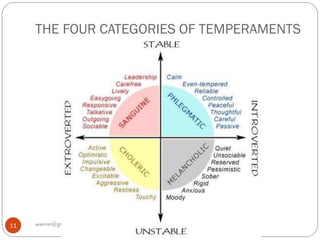
 According to the scientific analysis all human
personalities are commonly divided up into four
major categories and these four types are further
broken down into two categories —
Extroverts and Introverts.
1) Extroverted Personalities: are more “out-going,”
more sociable, talkative. (Choleric and
Sanguine)
2) Introverted Personalities: are more shy and
“reserved”. (Melancholy and Phlegmatic)
THE FOUR CATEGORIES OF TEMPERAMENTS
asareor@gmail.com 201711
SANGUINE
asareor@gmail.com 201712
 Strengths
• Is warm, lively, never at loss of words
• Is responsive to people, enjoyable, optimistic, apologizes
easily, engages in activities requiring energy
 Weakness
• Is emotionally unpredictable
• Forgets promises and obligations
• Is sometimes disorganized
CHOLERIC
asareor@gmail.com 201713
 Strengths
• Is confident, strong- willed, self determined, self-
sufficient, fearless and bold
• Is a good organizer and promoter
 Weakness
• Is insensitive to the needs of others, sometimes disgusted
by the tears of others and almost never cries
• Can be cruel, blunt, bossy, domineering
PHLEGMATIC
asareor@gmail.com 201714
 Strengths
• Is calm, dependable, good-natured, pleasant and peace-
loving
• Has many friends because they are easy-going
 Weakness
• Is sometimes too calm, slow and lazy, indecisive
•They don’t get involved, selfish and stingy, indifferent
about others
MELANCHOLIC
asareor@gmail.com 201715
 Strengths
•Though makes friends cautiously, they can be very dependable
• Has strong perfectionist tendencies and likes detailed,
intellectual work
•They love music and art; can be deep reflective thinkers
 Weakness
• Critical of other imperfections
• Can be very impractical, hesitant to begin a new project and
over-analyses things
• Can be moody and gloomy
CONFLICTS
asareor@gmail.com 201716
 Personality conflict arises when there is
mismatch between expected self and actual
self that causes conflict.
 Given the uniqueness of our personalities
even as nurses in a health team, there is
bound to be conflict when we work
together...
asareor@gmail.com 201717
WHAT IS CONFLICT
asareor@gmail.com 201718
Conflict occurs when two or more
parties (people, groups, etc.) perceive
that they have mutually incompatible
goals.
They want different outcomes.
Conflicts vary in intensity and duration.
Intensity affects the way we intervene.
THE MYTHS OF CONFLICTS
asareor@gmail.com ©201719
1) Conflict is only negative
2) Conflict is only about Outcomes
3) There is only one right way
4) Conflict is abnormal
LEVELS OF CONFLICT
asareor@gmail.com 201720
 Intra-personal (within the individual)
 Interpersonal (between individuals)
 Intragroup (within a group)
 Intergroup (between groups)
 Organizational
 Societal
 National
 International
 Global
CAUSES OF CONFLICT
asareor@gmail.com ©201721
Conflict of aims – different goals
Conflict of ideas – different
interpretations
Conflict of attitudes – different
opinions
Conflict of behavior – different
behaviors are unacceptable
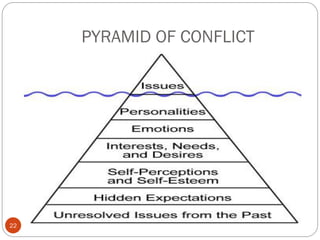
PYRAMID OF CONFLICT
asareor@gmail.com 201722
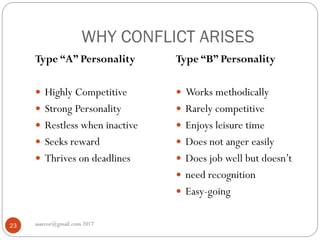
WHY CONFLICT ARISES
asareor@gmail.com 201723
Type “A” Personality
 Highly Competitive
 Strong Personality
 Restless when inactive
 Seeks reward
 Thrives on deadlines
Type “B” Personality
 Works methodically
 Rarely competitive
 Enjoys leisure time
 Does not anger easily
 Does job well but doesn’t
 need recognition
 Easy-going
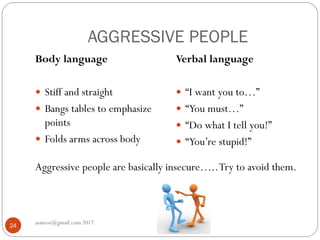
AGGRESSIVE PEOPLE
Aggressive people are basically insecure…..Try to avoid them.
asareor@gmail.com 2017
24
Body language
 Stiff and straight
 Bangs tables to emphasize
points
 Folds arms across body
Verbal language
 “I want you to…”
 “You must…”
 “Do what I tell you!”
 “You’re stupid!”
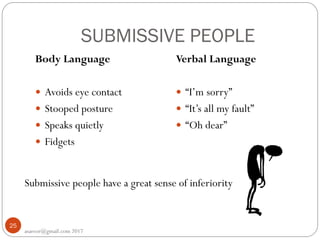
SUBMISSIVE PEOPLE
Submissive people have a great sense of inferiority
asareor@gmail.com 2017
25
Body Language
 Avoids eye contact
 Stooped posture
 Speaks quietly
 Fidgets
Verbal Language
 “I’m sorry”
 “It’s all my fault”
 “Oh dear”
ASSERTIVE PEOPLE
asareor@gmail.com 201726
Body language
 Stands straight
 Appears composed
 Smiles
 Maintains eye contact
Verbal language
 “Let’s”
 “How shall we do this?”
 “I think…What do you
think?”
 “I would like…”
PERSONALITIES WHO CAUSE
CONFLICT
asareor@gmail.com 201727
Aggressor
Passive
Error prone
Negative attitude
Chatterbox
Do nothing
CONFLICT MANAGEMENT
STYLES/TECHNIQUES
asareor@gmail.com ©201728
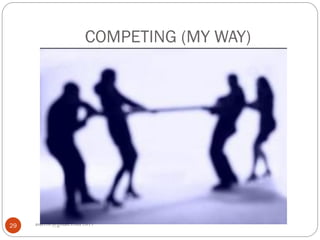
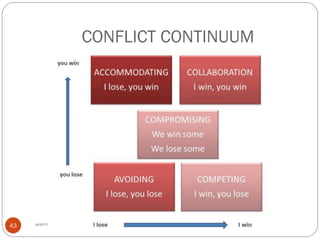
COMPETING (MY WAY)
asareor@gmail.com 201729
Competing (Forcing) – Cont’d
asareor@gmail.com 201730
 This is where an individual firmly pursues
his or her own concerns despite the
resistance of the other person.This may
involve maintaining firm resistance to
another person’s actions.
 When one person seeks to satisfy his or her
own interests, regardless of the impact on
the other parties to the conflict.
COLLABORATING (OUR WAY)
asareor@gmail.com 201731
Collaborating – Cont’d
asareor@gmail.com 201732
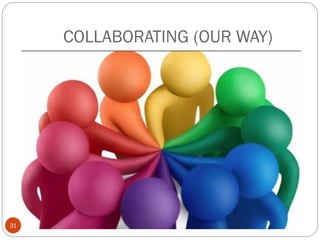
 Collaboration involves an attempt to work
with the other person to find a solution to
the problem in hand (the one that most
satisfies the concerns of both parties).
 The intention is to solve the problem by
clarifying differences rather than by
accommodating various points of view.
 It is win-win situation.
Examples of when Win-Win may be
appropriate:
asareor@gmail.com 201733
 When consensus and commitment of
other parties is important.
When a long-term relationship is
important.
When it is required to address the
interests of multiple stakeholders.
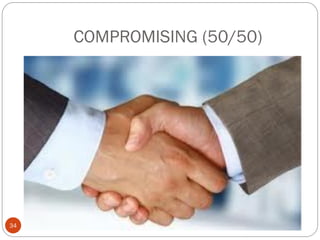
COMPROMISING (50/50)
asareor@gmail.com 201734
Compromising – Cont’d
asareor@gmail.com 201735
 Compromising looks for a mutually
acceptable solution which partially satisfies
both parties.
 Each party in conflict seeks to give up some
thing, sharing occurs, resulting in a
compromised outcome. Here no one is a
loser or a winner, but solution provides
incomplete satisfaction of both parties’
concerns.
Examples of when Compromising may
be appropriate:
asareor@gmail.com 201736
To reach temporary settlement on
complex issues.
As a first step when the involved parties
do not know each other well.
When collaboration or forcing do not
work.
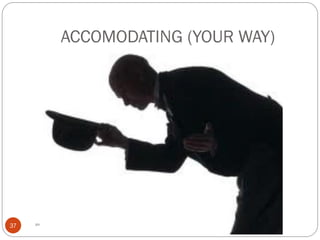
ACCOMODATING (YOUR WAY)
asareor@gmail.com 201737
Accommodating (Smoothing) – Cont’d
asareor@gmail.com 201738
Accommodating is accepting the
concerns of other people first of all,
rather than one's own concerns.
It is where one party seeks to
appease an opponent, that party
may be willing to place the
opponent’s interests above his or
her own.
Examples of when Accommodating
(Smoothing) may be appropriate:
asareor@gmail.com 201739
 When the issue is not as important to
you as it is to the other person.
When you accept that you are wrong.
When you have no choice or when
continued competition would be
detrimental.
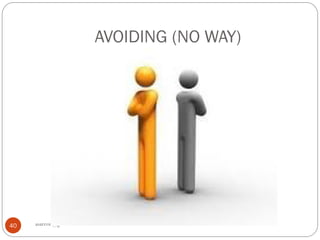
AVOIDING (NO WAY)
asareor@gmail.com 201740
Avoiding (Withdrawing) – Cont’d
asareor@gmail.com 201741
This is when a person does not pursue
her/his own concerns or those of the
opponent. He/she does not address the
conflict, sidesteps, postpones or simply
withdraws.
It is where a person recognizes that a
conflict exists and want to withdraw
from it or suppress it.
Examples of when Withdrawing may be
appropriate:
asareor@gmail.com 201742
 When the issue is trivial and not worth the
effort.
 When more important issues are pressing,
and you don't have time to deal with it.
 When you are unable to handle the conflict
(e.g. if you are too emotionally involved or
 others can handle it better).
CONFLICT CONTINUUM
asareor@gmail.com 201743
asareor@gmail.com 201744
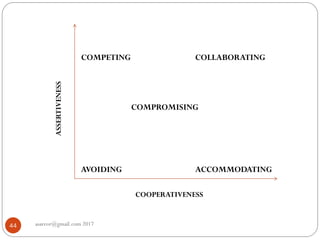
COMPETING COLLABORATING
COMPROMISING
AVOIDING ACCOMMODATING
ASSERTIVENESS
COOPERATIVENESS
ADVANTAGES AND DISADVANTAGES
OF EACH CONFLICT STYLE
asareor@gmail.com 201745
Competing/Forcing - Advantages
asareor@gmail.com 201746
The winner is clear.
Winners usually experience gains.
May provide a quick resolution to a
conflict.
Increases self-esteem and draws respect
when firm resistance or actions were
response to an aggression or hostility.
Competing/Forcing - Disadvantages
asareor@gmail.com 201747
 Establishes the battleground for the next conflict.
 May cause worthy competitors to withdraw or
leave the organization.
 May negatively affect your relationship with the
opponent in the long run.
 May cause the opponent to react in the same way,
even if the opponent did not intend to be forceful
originally.
Accommodation - Advantages
asareor@gmail.com 201748
Curtails conflict situation
Enhances ego of the other
In some cases smoothing will help to
protect more important interests while
giving up on some less important ones
Gives an opportunity to reassess the
situation from a different angle
Accommodation - Disadvantages
asareor@gmail.com 201749
 Sometimes establishes a precedence
 Does not fully engage participants
 There is a risk to be abused, i.e. the
opponent may constantly try to take
advantage of your tendency toward
smoothing/accommodating.Therefore it is
important to keep the right balance and this
requires some skill.
Compromising - Advantages
asareor@gmail.com 201750
Shows good will.
Establishes friendship.
Faster issue resolution.
Can provide a temporary solution while
still looking for a win-win solution.
Lowers the levels of tension and stress
resulting from the conflict.
Compromising - Disadvantages
asareor@gmail.com 201751
No one gets what they want.
May feel like a dead end.
May result in a situation when both
parties are not satisfied with the
outcome.
May require close monitoring and control
to ensure the agreements are met.
Collaboration - Advantages
asareor@gmail.com 201752
 Everyone “wins”
 Creates good feelings
 Leads to solving the actual problem
 Builds a foundation for effective
collaboration in the future
 You earn the reputation of a good
negotiator
Collaboration - Disadvantages
asareor@gmail.com 201753
 Hard to achieve since no one knows how.
 Often confusing since players can “win”
something they didn’t know they wanted.
 Requires a commitment from all parties to
look for a mutually acceptable solution.
 May require more effort and more time than
some other methods.
Avoiding/Withdrawing - Advantages
asareor@gmail.com 201754
When the opponent is forcing, you may
choose to withdraw and postpone your
response until you are in a more
favourable circumstance for you to
response.
Gives the ability/time to focus on more
important or more urgent issues instead.
Avoiding/Withdrawing - Disadvantages
asareor@gmail.com 201755
Not acting may be sometimes be
interpreted as an agreement.
Sometimes withdrawing may
negatively affect your relationship
with a party that expects your action.
LEVELS OF CONFLICT
MANAGEMENT
asareor@gmail.com 201756
 INDIVIDUAL LEVEL
 GROUP LEVEL
 ORGANIZATIONAL LEVEL
CONFLICT MANAGEMENT
ORGANIZATIONAL LEVEL
asareor@gmail.com 201757
Unambiguous communication
Realigning work group
Altering rules and regulations
Increasing interdependence
Structural changes to disrupt status
quo
SUMMARY
asareor@gmail.com 201758
 All human beings are unique in their behavior but can be
classified into four major personality types – Sanguine,
Choleric, Melancholic and Phlegmatic.
 All personalities have their strengths and weaknesses which
must be understood if we are to work together effectively.
 Due to our personality differences, conflicts are bound to
arise.
 There are five techniques for resolving conflicts –
Withdrawing, Forcing,Win-Win, Smoothing and
Compromising.
CONCLUSION
asareor@gmail.com 201759
Despite our different personalities,
proper application of the resolution
techniques in their appropriate
contexts always guarantees harmony
in our workplaces even when
conflicts arise.
END OF LECTURE
asareor@gmail.com 201760
THANKYOU
ACKNOWLEDGEMENT
asareor@gmail.com 201761
 My gratitude goes to all authors whose publication(s) I
used for this presentation.
 My appreciation goes to the 2017/2018 first year
students of College of Nursing, Ntotroso for having the
patience to sit in and giving me the attention during the
presentation of this material.
 I thank all my colleagues who did the proof-reading
before the presentation of this material.
 For all members of the slideshare community, I say
continue imparting your knowledge to us. God bless
you.

Personality Conflict and Management

  • 1.
    PREPAREDAND PRESENTED BY ASARE, RICHARDOPOKU COLLEGE OF NURSING, NTOTROSO BRONGAHAFO REGION, GHANA PERSONALITY CONFLICT AND MANAGEMENT asareor@gmail.com ©20171
  • 2.
    INTRODUCTION TO PERSONALITY asareor@gmail.com20172  For instance, when you say of someone‘She is a kind woman but loses his temper easily’, you are describing her personality.Thus, personality means a person’s qualities and character as seen by others.  Every personality is unique. It develops as a reflection of the life experiences which shape the feelings and behaviour of the individual from the moment s/he is born.
  • 3.
    WHAT IS PERSONALITY asareor@gmail.com20173  Personality is the dynamic organization within the individual of those psycho-physical systems that determine his unique adjustments to its environment.  Personality is said to be dynamic meaning It varies with changes in Person-Environment fitting across situations. It is developed through self monitoring and learning.
  • 4.
    Cont’d asareor@gmail.com 20174  Interms of organization, Personality can not be studied with only one attribute.Therefore, it is multi-dimensional.  Personality is described to be unique meaning It varies from individual to individual.  With regards to adjustment, Personality directs individual to cope with environment in unique way.
  • 5.
    Cont’d asareor@gmail.com 20175  Personalityis defined as the set of habitual behaviours, cognitions and emotional patterns that evolve from biological and environmental factors (Wikipedia, 2017).  Personality is also seen as the combination of characteristics or qualities that form an individual’s distinctive character.
  • 6.
    Cont’d asareor@gmail.com 20176  Personalityis defined as the set of habitual behaviours, cognitions and emotional patterns that evolve from biological and environmental factors (Wikipedia, 2017).  In other words, it refers to individual differences in characteristic patterns of thinking, feeling and behaving (Encyclopedia of psychology, 2000).
  • 7.
    Cont’d asareor@gmail.com 20177  Personalityis also seen as the combination of characteristics or qualities that form an individual’s distinctive character.  Other synonyms used to describe personality are character, nature, disposition, temperament, make-up, persona, psyche, identity.
  • 8.
    Cont’d asareor@gmail.com 20178 So ashuman beings, there are “reasons” for everything we do; though we sometimes find it difficult to understand why we think like we think, feel like we feel, or act like we act in life.
  • 9.
    MYTHS ABOUT PERSONALITY asareor@gmail.com20179 1) Personality can be assessed by appearance. 2) Personality can be assessed by one’s conscious behavior. 3) It is inherited and Environment has no role.Therefore, we can not change our personality.
  • 10.
    PERSONALITY TYPES asareor@gmail.com 201710 According to the scientific analysis all human personalities are commonly divided up into four major categories and these four types are further broken down into two categories — Extroverts and Introverts. 1) Extroverted Personalities: are more “out-going,” more sociable, talkative. (Choleric and Sanguine) 2) Introverted Personalities: are more shy and “reserved”. (Melancholy and Phlegmatic)
  • 11.
    THE FOUR CATEGORIESOF TEMPERAMENTS asareor@gmail.com 201711
  • 12.
    SANGUINE asareor@gmail.com 201712  Strengths •Is warm, lively, never at loss of words • Is responsive to people, enjoyable, optimistic, apologizes easily, engages in activities requiring energy  Weakness • Is emotionally unpredictable • Forgets promises and obligations • Is sometimes disorganized
  • 13.
    CHOLERIC asareor@gmail.com 201713  Strengths •Is confident, strong- willed, self determined, self- sufficient, fearless and bold • Is a good organizer and promoter  Weakness • Is insensitive to the needs of others, sometimes disgusted by the tears of others and almost never cries • Can be cruel, blunt, bossy, domineering
  • 14.
    PHLEGMATIC asareor@gmail.com 201714  Strengths •Is calm, dependable, good-natured, pleasant and peace- loving • Has many friends because they are easy-going  Weakness • Is sometimes too calm, slow and lazy, indecisive •They don’t get involved, selfish and stingy, indifferent about others
  • 15.
    MELANCHOLIC asareor@gmail.com 201715  Strengths •Thoughmakes friends cautiously, they can be very dependable • Has strong perfectionist tendencies and likes detailed, intellectual work •They love music and art; can be deep reflective thinkers  Weakness • Critical of other imperfections • Can be very impractical, hesitant to begin a new project and over-analyses things • Can be moody and gloomy
  • 16.
    CONFLICTS asareor@gmail.com 201716  Personalityconflict arises when there is mismatch between expected self and actual self that causes conflict.  Given the uniqueness of our personalities even as nurses in a health team, there is bound to be conflict when we work together...
  • 17.
  • 18.
    WHAT IS CONFLICT asareor@gmail.com201718 Conflict occurs when two or more parties (people, groups, etc.) perceive that they have mutually incompatible goals. They want different outcomes. Conflicts vary in intensity and duration. Intensity affects the way we intervene.
  • 19.
    THE MYTHS OFCONFLICTS asareor@gmail.com ©201719 1) Conflict is only negative 2) Conflict is only about Outcomes 3) There is only one right way 4) Conflict is abnormal
  • 20.
    LEVELS OF CONFLICT asareor@gmail.com201720  Intra-personal (within the individual)  Interpersonal (between individuals)  Intragroup (within a group)  Intergroup (between groups)  Organizational  Societal  National  International  Global
  • 21.
    CAUSES OF CONFLICT asareor@gmail.com©201721 Conflict of aims – different goals Conflict of ideas – different interpretations Conflict of attitudes – different opinions Conflict of behavior – different behaviors are unacceptable
  • 22.
  • 23.
    WHY CONFLICT ARISES asareor@gmail.com201723 Type “A” Personality  Highly Competitive  Strong Personality  Restless when inactive  Seeks reward  Thrives on deadlines Type “B” Personality  Works methodically  Rarely competitive  Enjoys leisure time  Does not anger easily  Does job well but doesn’t  need recognition  Easy-going
  • 24.
    AGGRESSIVE PEOPLE Aggressive peopleare basically insecure…..Try to avoid them. asareor@gmail.com 2017 24 Body language  Stiff and straight  Bangs tables to emphasize points  Folds arms across body Verbal language  “I want you to…”  “You must…”  “Do what I tell you!”  “You’re stupid!”
  • 25.
    SUBMISSIVE PEOPLE Submissive peoplehave a great sense of inferiority asareor@gmail.com 2017 25 Body Language  Avoids eye contact  Stooped posture  Speaks quietly  Fidgets Verbal Language  “I’m sorry”  “It’s all my fault”  “Oh dear”
  • 26.
    ASSERTIVE PEOPLE asareor@gmail.com 201726 Bodylanguage  Stands straight  Appears composed  Smiles  Maintains eye contact Verbal language  “Let’s”  “How shall we do this?”  “I think…What do you think?”  “I would like…”
  • 27.
    PERSONALITIES WHO CAUSE CONFLICT asareor@gmail.com201727 Aggressor Passive Error prone Negative attitude Chatterbox Do nothing
  • 28.
  • 29.
  • 30.
    Competing (Forcing) –Cont’d asareor@gmail.com 201730  This is where an individual firmly pursues his or her own concerns despite the resistance of the other person.This may involve maintaining firm resistance to another person’s actions.  When one person seeks to satisfy his or her own interests, regardless of the impact on the other parties to the conflict.
  • 31.
  • 32.
    Collaborating – Cont’d asareor@gmail.com201732  Collaboration involves an attempt to work with the other person to find a solution to the problem in hand (the one that most satisfies the concerns of both parties).  The intention is to solve the problem by clarifying differences rather than by accommodating various points of view.  It is win-win situation.
  • 33.
    Examples of whenWin-Win may be appropriate: asareor@gmail.com 201733  When consensus and commitment of other parties is important. When a long-term relationship is important. When it is required to address the interests of multiple stakeholders.
  • 34.
  • 35.
    Compromising – Cont’d asareor@gmail.com201735  Compromising looks for a mutually acceptable solution which partially satisfies both parties.  Each party in conflict seeks to give up some thing, sharing occurs, resulting in a compromised outcome. Here no one is a loser or a winner, but solution provides incomplete satisfaction of both parties’ concerns.
  • 36.
    Examples of whenCompromising may be appropriate: asareor@gmail.com 201736 To reach temporary settlement on complex issues. As a first step when the involved parties do not know each other well. When collaboration or forcing do not work.
  • 37.
  • 38.
    Accommodating (Smoothing) –Cont’d asareor@gmail.com 201738 Accommodating is accepting the concerns of other people first of all, rather than one's own concerns. It is where one party seeks to appease an opponent, that party may be willing to place the opponent’s interests above his or her own.
  • 39.
    Examples of whenAccommodating (Smoothing) may be appropriate: asareor@gmail.com 201739  When the issue is not as important to you as it is to the other person. When you accept that you are wrong. When you have no choice or when continued competition would be detrimental.
  • 40.
  • 41.
    Avoiding (Withdrawing) –Cont’d asareor@gmail.com 201741 This is when a person does not pursue her/his own concerns or those of the opponent. He/she does not address the conflict, sidesteps, postpones or simply withdraws. It is where a person recognizes that a conflict exists and want to withdraw from it or suppress it.
  • 42.
    Examples of whenWithdrawing may be appropriate: asareor@gmail.com 201742  When the issue is trivial and not worth the effort.  When more important issues are pressing, and you don't have time to deal with it.  When you are unable to handle the conflict (e.g. if you are too emotionally involved or  others can handle it better).
  • 43.
  • 44.
  • 45.
    ADVANTAGES AND DISADVANTAGES OFEACH CONFLICT STYLE asareor@gmail.com 201745
  • 46.
    Competing/Forcing - Advantages asareor@gmail.com201746 The winner is clear. Winners usually experience gains. May provide a quick resolution to a conflict. Increases self-esteem and draws respect when firm resistance or actions were response to an aggression or hostility.
  • 47.
    Competing/Forcing - Disadvantages asareor@gmail.com201747  Establishes the battleground for the next conflict.  May cause worthy competitors to withdraw or leave the organization.  May negatively affect your relationship with the opponent in the long run.  May cause the opponent to react in the same way, even if the opponent did not intend to be forceful originally.
  • 48.
    Accommodation - Advantages asareor@gmail.com201748 Curtails conflict situation Enhances ego of the other In some cases smoothing will help to protect more important interests while giving up on some less important ones Gives an opportunity to reassess the situation from a different angle
  • 49.
    Accommodation - Disadvantages asareor@gmail.com201749  Sometimes establishes a precedence  Does not fully engage participants  There is a risk to be abused, i.e. the opponent may constantly try to take advantage of your tendency toward smoothing/accommodating.Therefore it is important to keep the right balance and this requires some skill.
  • 50.
    Compromising - Advantages asareor@gmail.com201750 Shows good will. Establishes friendship. Faster issue resolution. Can provide a temporary solution while still looking for a win-win solution. Lowers the levels of tension and stress resulting from the conflict.
  • 51.
    Compromising - Disadvantages asareor@gmail.com201751 No one gets what they want. May feel like a dead end. May result in a situation when both parties are not satisfied with the outcome. May require close monitoring and control to ensure the agreements are met.
  • 52.
    Collaboration - Advantages asareor@gmail.com201752  Everyone “wins”  Creates good feelings  Leads to solving the actual problem  Builds a foundation for effective collaboration in the future  You earn the reputation of a good negotiator
  • 53.
    Collaboration - Disadvantages asareor@gmail.com201753  Hard to achieve since no one knows how.  Often confusing since players can “win” something they didn’t know they wanted.  Requires a commitment from all parties to look for a mutually acceptable solution.  May require more effort and more time than some other methods.
  • 54.
    Avoiding/Withdrawing - Advantages asareor@gmail.com201754 When the opponent is forcing, you may choose to withdraw and postpone your response until you are in a more favourable circumstance for you to response. Gives the ability/time to focus on more important or more urgent issues instead.
  • 55.
    Avoiding/Withdrawing - Disadvantages asareor@gmail.com201755 Not acting may be sometimes be interpreted as an agreement. Sometimes withdrawing may negatively affect your relationship with a party that expects your action.
  • 56.
    LEVELS OF CONFLICT MANAGEMENT asareor@gmail.com201756  INDIVIDUAL LEVEL  GROUP LEVEL  ORGANIZATIONAL LEVEL
  • 57.
    CONFLICT MANAGEMENT ORGANIZATIONAL LEVEL asareor@gmail.com201757 Unambiguous communication Realigning work group Altering rules and regulations Increasing interdependence Structural changes to disrupt status quo
  • 58.
    SUMMARY asareor@gmail.com 201758  Allhuman beings are unique in their behavior but can be classified into four major personality types – Sanguine, Choleric, Melancholic and Phlegmatic.  All personalities have their strengths and weaknesses which must be understood if we are to work together effectively.  Due to our personality differences, conflicts are bound to arise.  There are five techniques for resolving conflicts – Withdrawing, Forcing,Win-Win, Smoothing and Compromising.
  • 59.
    CONCLUSION asareor@gmail.com 201759 Despite ourdifferent personalities, proper application of the resolution techniques in their appropriate contexts always guarantees harmony in our workplaces even when conflicts arise.
  • 60.
  • 61.
    ACKNOWLEDGEMENT asareor@gmail.com 201761  Mygratitude goes to all authors whose publication(s) I used for this presentation.  My appreciation goes to the 2017/2018 first year students of College of Nursing, Ntotroso for having the patience to sit in and giving me the attention during the presentation of this material.  I thank all my colleagues who did the proof-reading before the presentation of this material.  For all members of the slideshare community, I say continue imparting your knowledge to us. God bless you.