4-1
ATTITUDES vs EMOTIONS
Attitudes is a mental
state of readiness
learned and organized
through experience,
exerting specific
influence on a
person’s response to
people, objects, and
institution with which it
is related
A state of
physiological arousal
accompanied by
changes in facial
expressions, gestures,
posture, or subjective
feelings. Examples of
emotions are: surprise,
joy, anticipation,
sadness, disgust, fear,
acceptance and anger.
4-2
Attitudes versus Emotions
AttitudesAttitudes EmotionsEmotions
Judgments about anJudgments about an
attitude objectattitude object
Judgments about anJudgments about an
attitude objectattitude object
Based mainly onBased mainly on
rational logicrational logic
Based mainly onBased mainly on
rational logicrational logic
Usually stable for daysUsually stable for days
or longeror longer
Usually stable for daysUsually stable for days
or longeror longer
Experiences related to anExperiences related to an
attitude objectattitude object
Experiences related to anExperiences related to an
attitude objectattitude object
Based on innate and learnedBased on innate and learned
responses to environmentresponses to environment
Based on innate and learnedBased on innate and learned
responses to environmentresponses to environment
Usually experienced forUsually experienced for
seconds or lessseconds or less
Usually experienced forUsually experienced for
seconds or lessseconds or less
4-3
Traditional Model of Attitudes
Purely cognitive approach
 Beliefs: established perceptions of attitude object
 Feelings: calculation of good or bad based on beliefs
about the attitude object
 Behavioral intentions: motivation to act in response to
the attitude object
Problem: Ignores important role of emotions in
shaping attitudes
4-4
BehaviorBehavior
Emotions, Attitudes and Behavior
Perceived EnvironmentPerceived Environment
Attitude FeelingsFeelings
BeliefsBeliefs
BehavioralBehavioral
IntentionsIntentions
Cognitive
process
Emotional
process
Emotional
Episodes
4-5
Role of Emotions in Attitudes
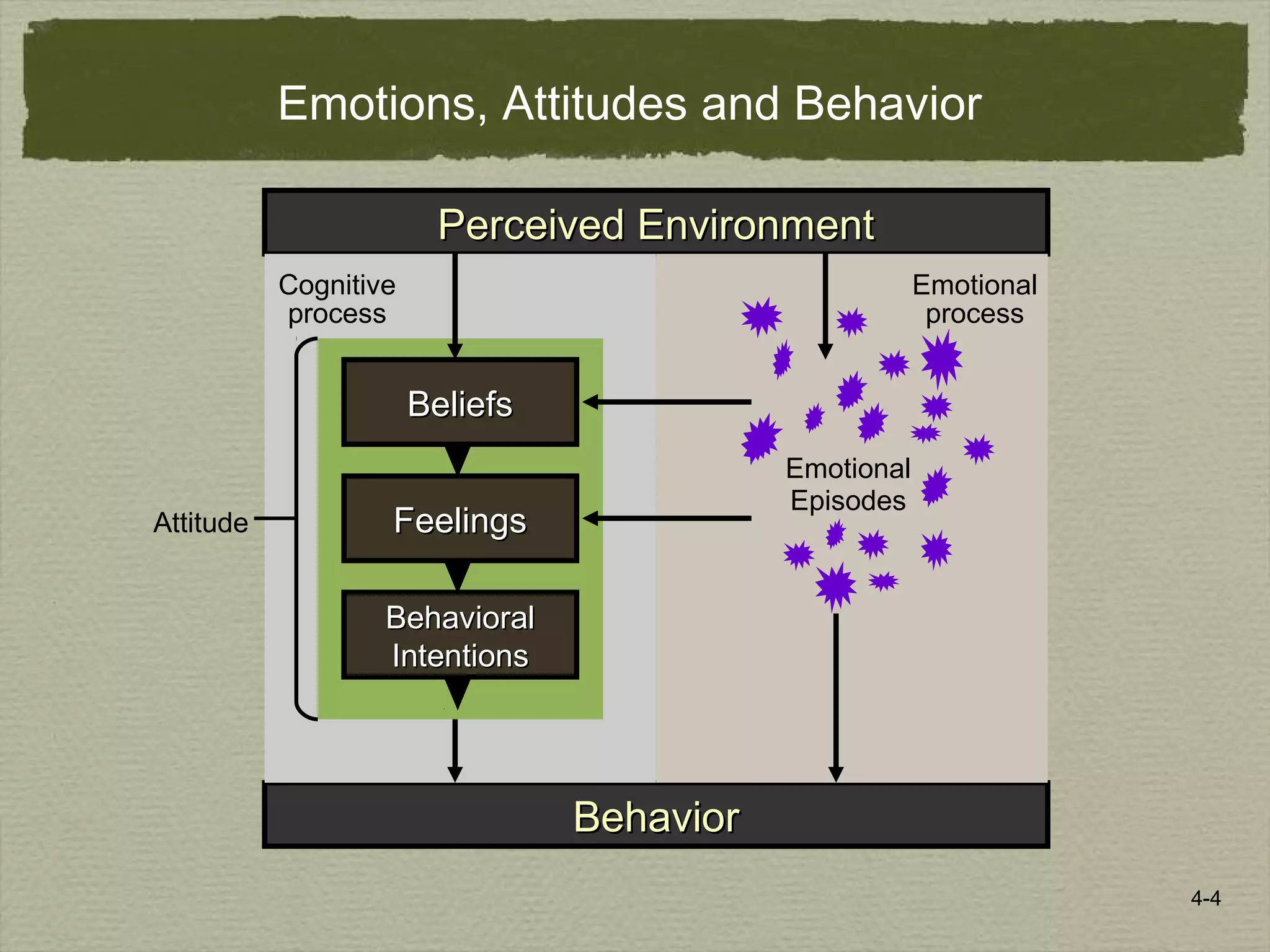
Feelings toward attitude object influenced by
cumulative emotional episodes toward it
We ‘listen in’ on our emotions while thinking
through what we like or dislike
Cognitive and emotional processes don’t always
agree with each other
Emotions also directly affect behavior
 e.g. facial expression
4-6
Generating Positive Emotions at Work
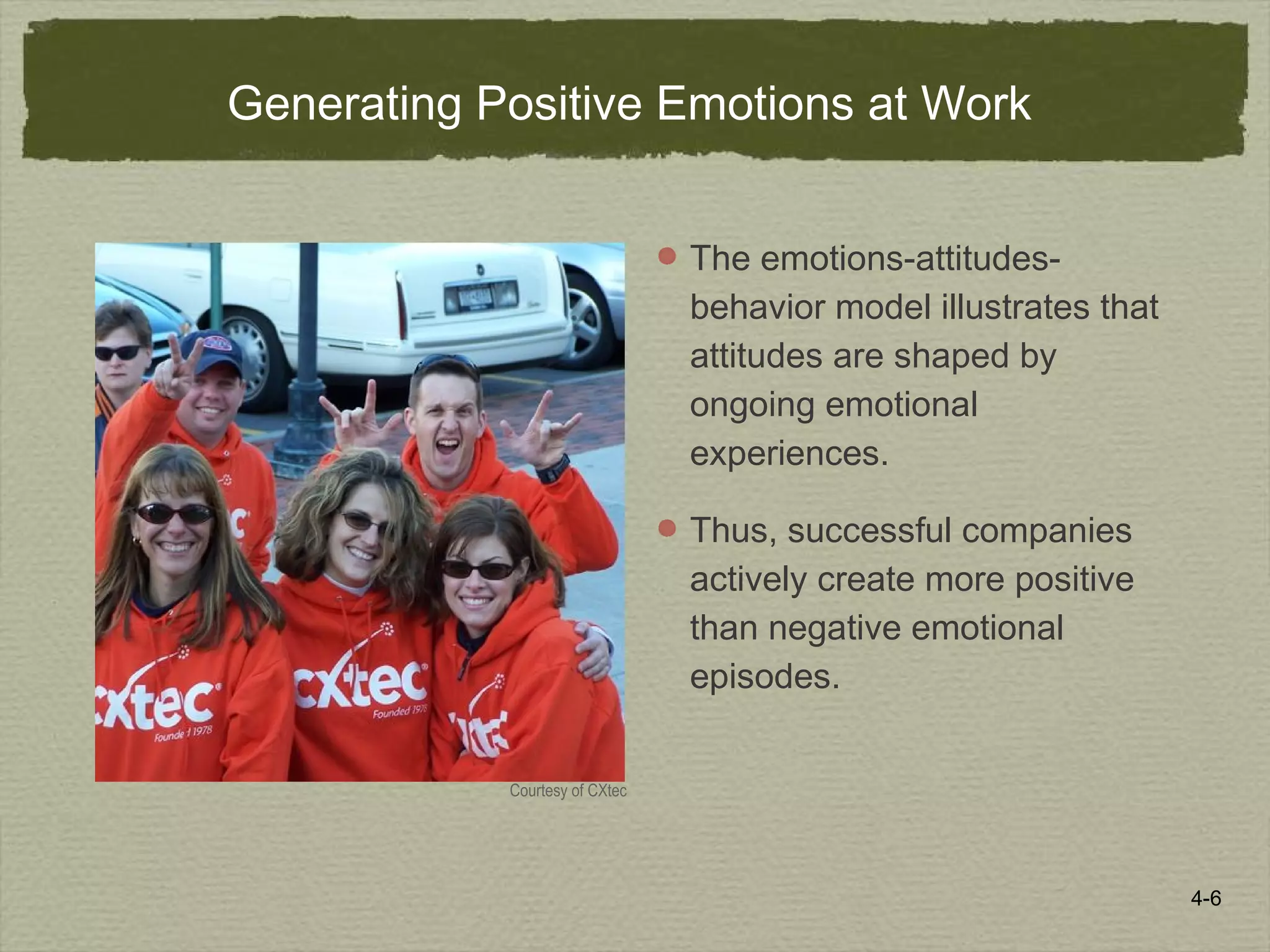
The emotions-attitudes-
behavior model illustrates that
attitudes are shaped by
ongoing emotional
experiences.
Thus, successful companies
actively create more positive
than negative emotional
episodes.
Courtesy of CXtec
4-7
Cognitive Dissonance
A state of anxiety that occurs when an individual’s
beliefs, feelings and behaviors are inconsistent
with one another
Most common when behavior is:
 known to others
 done voluntarily
 can’t be undone
Copyright © 2009 by The McGraw-Hill Companies, Inc. All rights reserved.McGraw-Hill/Irwin
Emotional Labor and
Emotional Intelligence
Workplace Emotions, Attitudes, and Stress
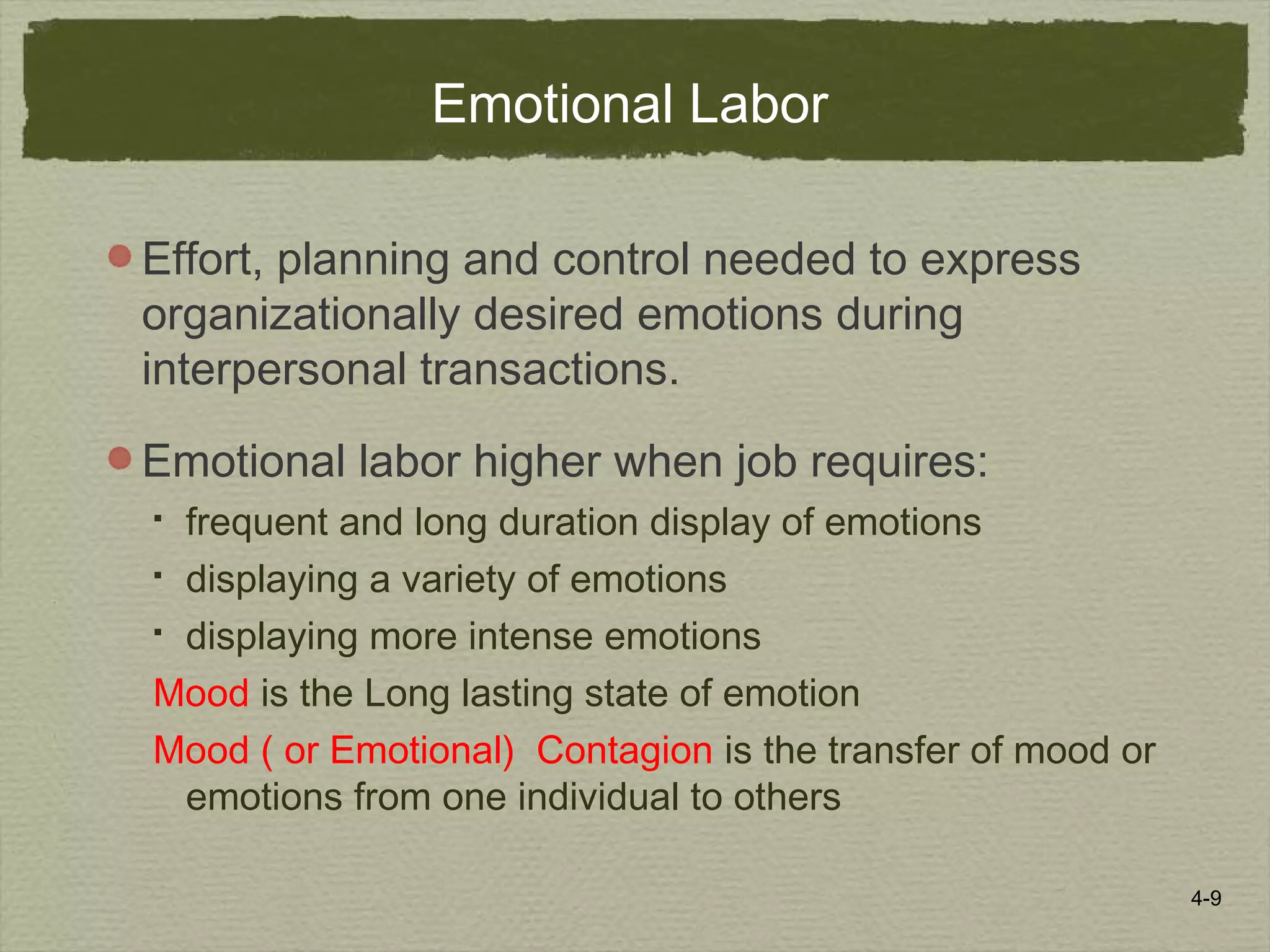
4-9
Emotional Labor
Effort, planning and control needed to express
organizationally desired emotions during
interpersonal transactions.
Emotional labor higher when job requires:
 frequent and long duration display of emotions
 displaying a variety of emotions
 displaying more intense emotions
Mood is the Long lasting state of emotion
Mood ( or Emotional) Contagion is the transfer of mood or
emotions from one individual to others
4-10
Emotional Labor Across Cultures
Displaying or hiding emotions varies across
cultures
 Minimal emotional expression and monotonic voice in
Korea, Japan, Austria
 Encourage emotional expression in Kuwait, Egypt,
Spain, Russia
4-11
Emotional Labor Challenges
Difficult to display expected emotions accurately,
and to hide true emotions
Emotional dissonance
 Conflict between true and required emotions
 Potentially stressful with surface acting
 Less stress through deep acting
4-12
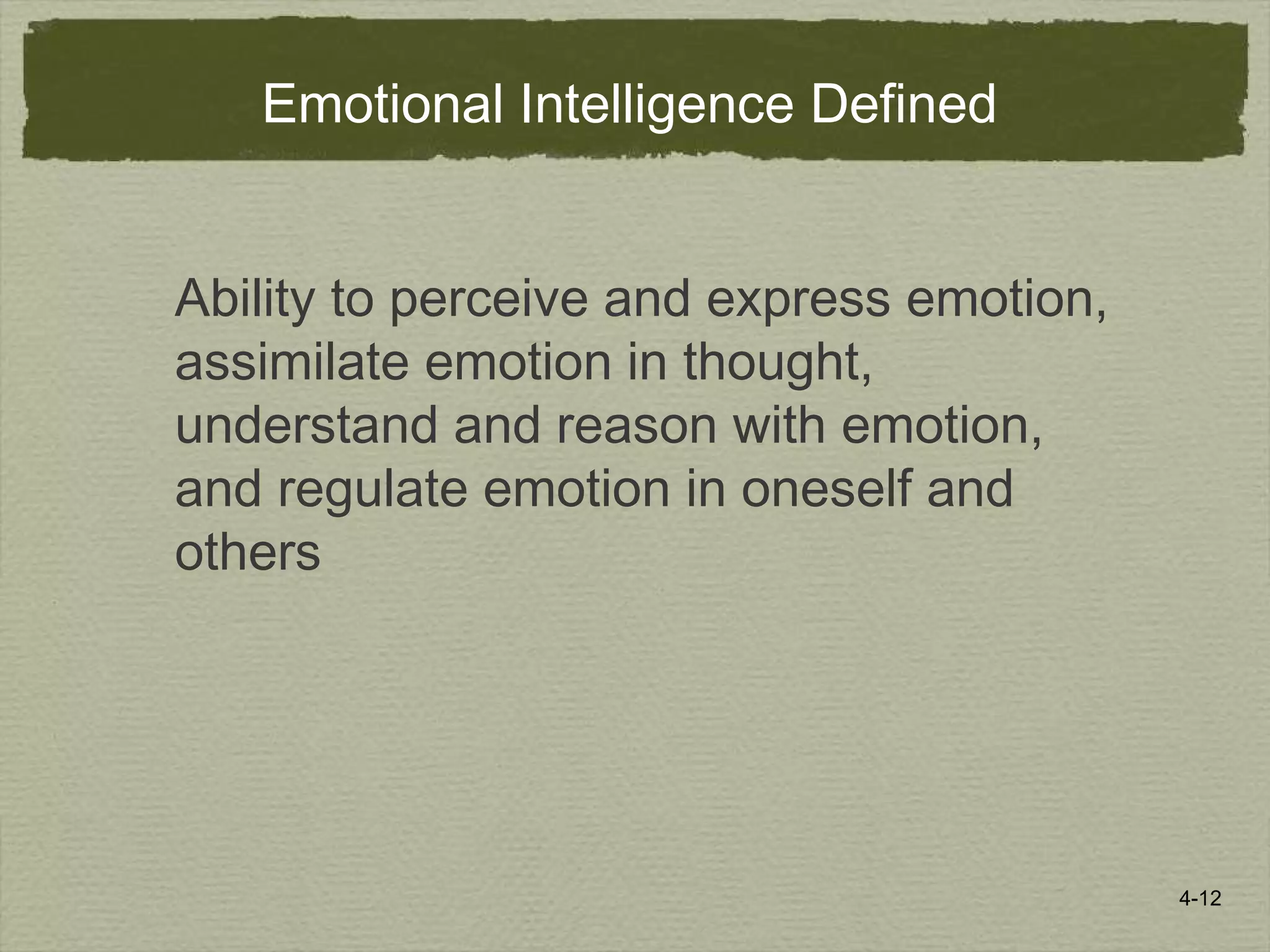
Emotional Intelligence Defined
Ability to perceive and express emotion,
assimilate emotion in thought,
understand and reason with emotion,
and regulate emotion in oneself and
others
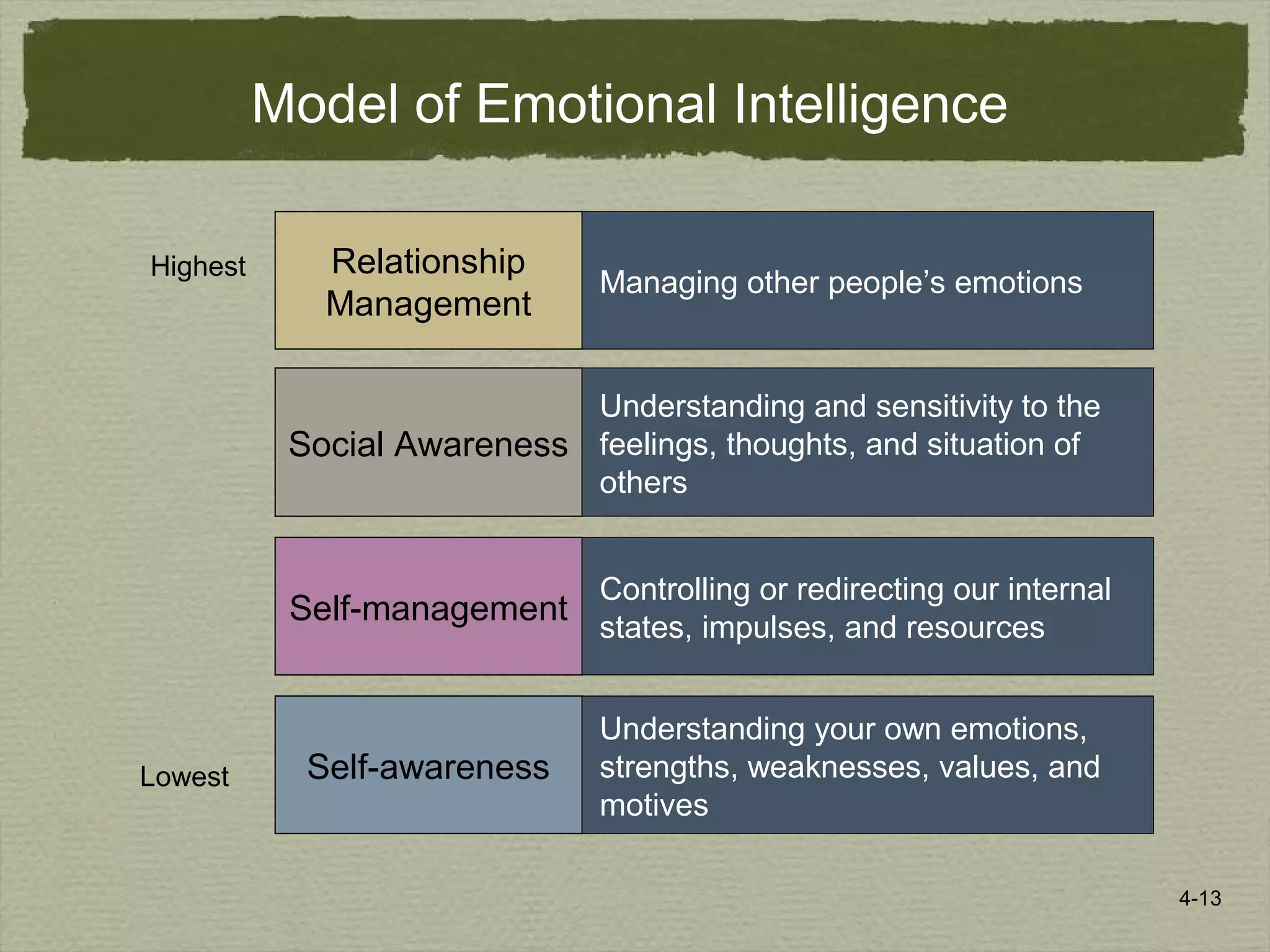
4-13
Social Awareness
Self-management
Understanding and sensitivity to the
feelings, thoughts, and situation of
others
Controlling or redirecting our internal
states, impulses, and resources
Self-awareness
Understanding your own emotions,
strengths, weaknesses, values, and
motives
Relationship
Management
Managing other people’s emotions
Lowest
Highest
Model of Emotional Intelligence
4-14
Emotional Intelligence Competencies
Self-awareness Social awareness
Self-management Relationship
management
Self
(personal competence)
Other
(social competence)
Recognition
of emotions
Regulation
of emotions
4-15
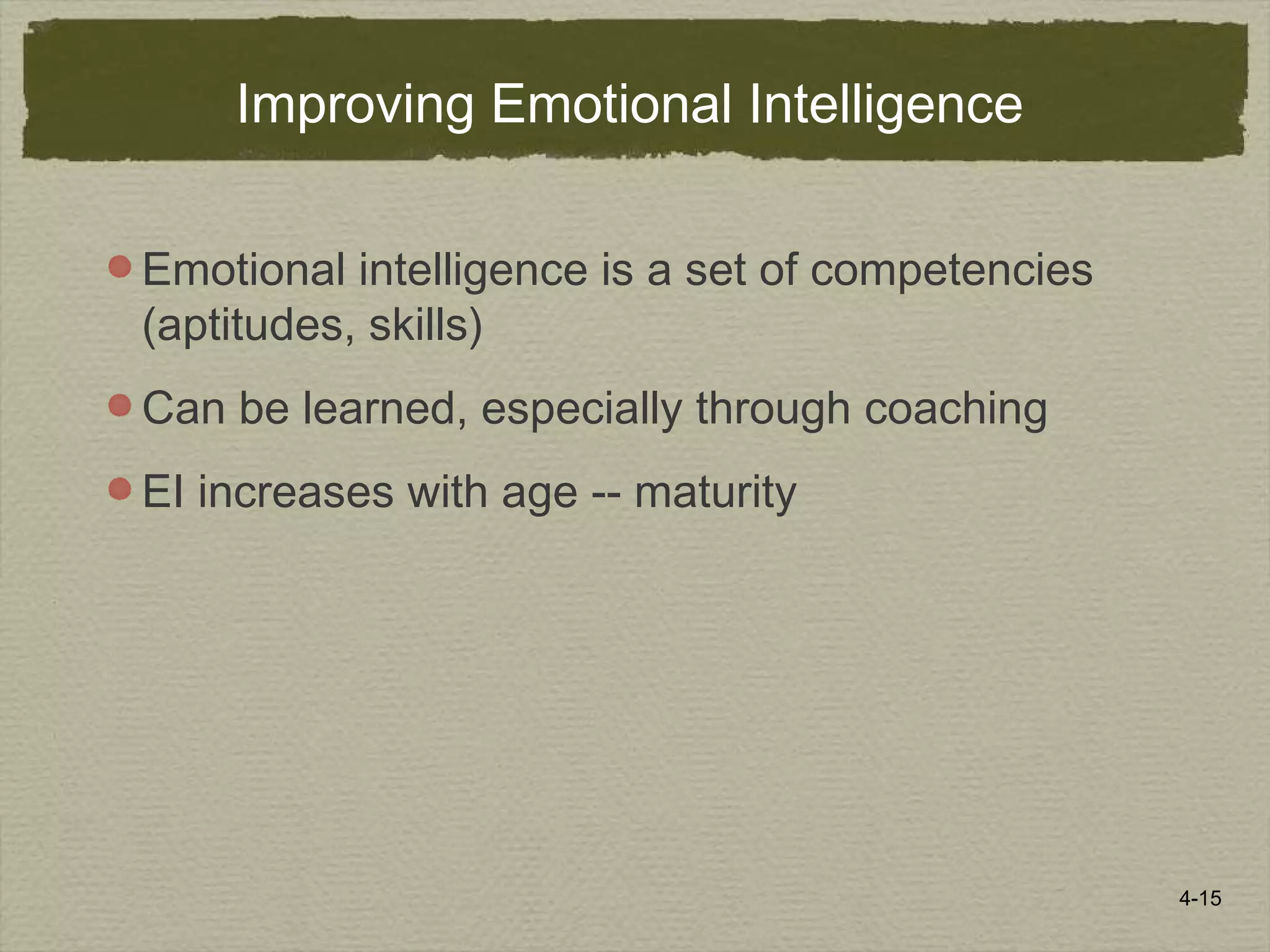
Improving Emotional Intelligence
Emotional intelligence is a set of competencies
(aptitudes, skills)
Can be learned, especially through coaching
EI increases with age -- maturity
Copyright © 2009 by The McGraw-Hill Companies, Inc. All rights reserved.McGraw-Hill/Irwin
Job Satisfaction and
Organizational
Commitment
Workplace Emotions,
Attitudes, and Stress
4-17
Job Satisfaction
A person's evaluation of his or her job and work
context
A collection of attitudes about specific facets of
the job
4-18
LoyaltyLoyalty
VoiceVoice
ExitExit
NeglectNeglect
• Leaving the situation
• Quitting, transferring
• Changing the situation
• Problem solving, complaining
• Patiently waiting for the situation
to improve
• Reducing work effort/quality
• Increasing absenteeism
EVLN: Responses to Dissatisfaction
4-19
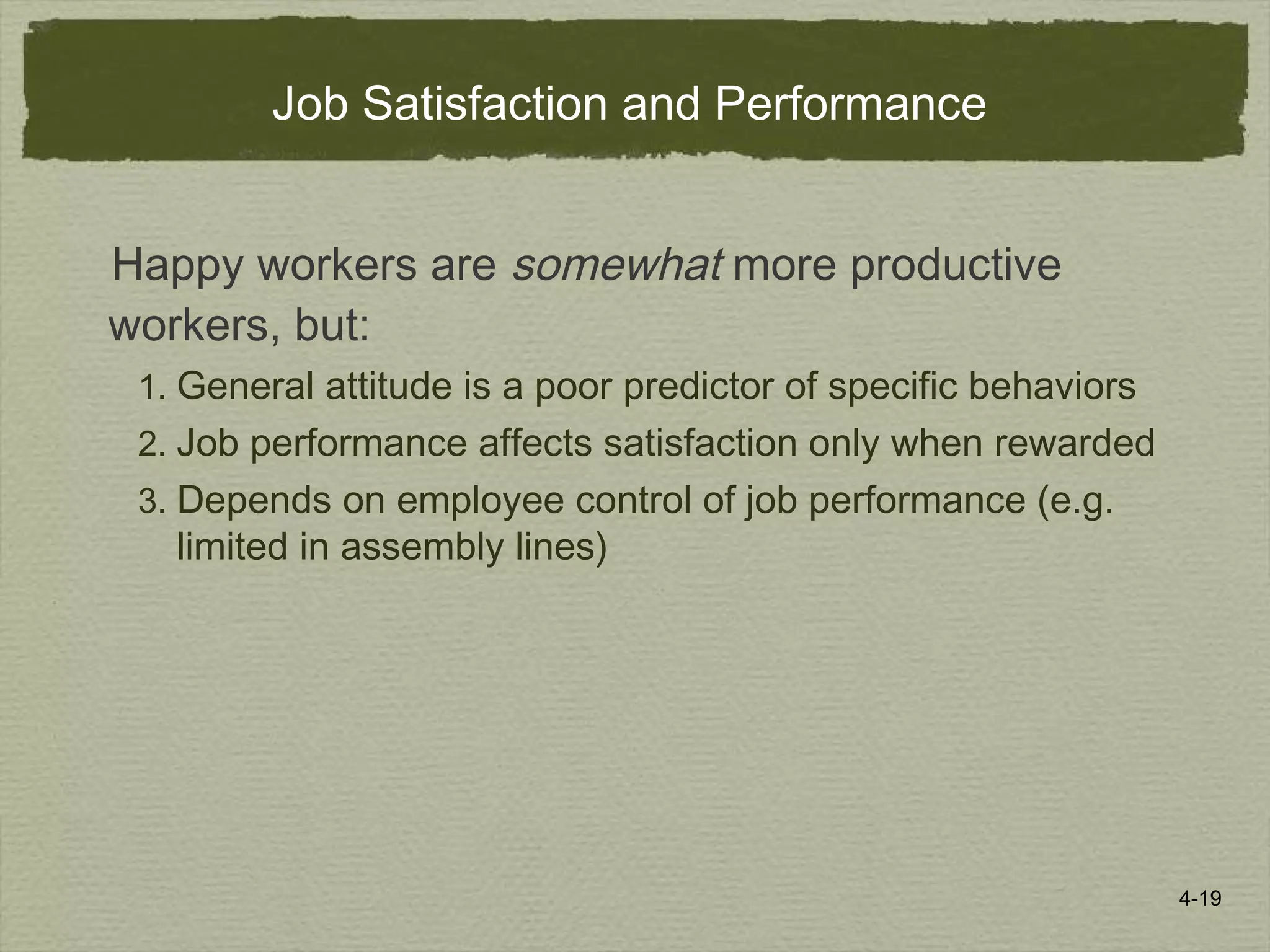
Job Satisfaction and Performance
Happy workers are somewhat more productive
workers, but:
1. General attitude is a poor predictor of specific behaviors
2. Job performance affects satisfaction only when rewarded
3. Depends on employee control of job performance (e.g.
limited in assembly lines)
4-20
Happy Staff = Happy Customers at Wegmans
Wegmans Food Market enjoys strong customer loyalty and low
employee turnover by keeping employees happy. Shown here, CEO
Danny Wegman meets with staff during a new store opening.
Courtesy of Wegmans Food Markets
4-21
Job Satisfaction and Customers
Job satisfaction affects mood, leading to positive behaviors toward
customers
Less employee turnover, resulting in more consistent and familiar
service
Courtesy of Wegmans Food Markets
4-22
Organizational Commitment
Affective commitment
 Emotional attachment to, identification with, and
involvement in an organization
Continuance commitment
 Belief that staying with the organization serves your
personal interests
4-23
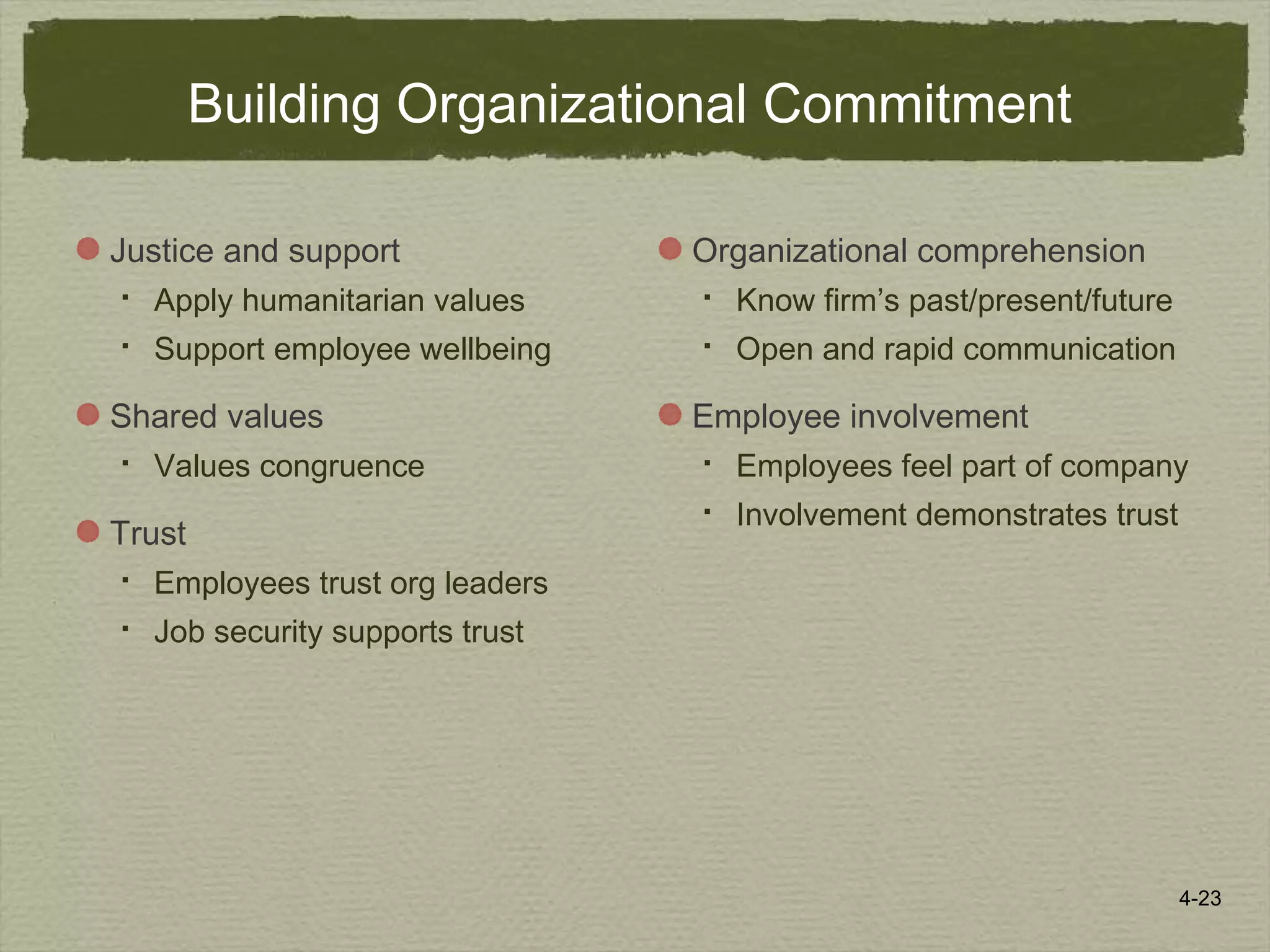
Building Organizational Commitment
Justice and support
 Apply humanitarian values
 Support employee wellbeing
Shared values
 Values congruence
Trust
 Employees trust org leaders
 Job security supports trust
Organizational comprehension
 Know firm’s past/present/future
 Open and rapid communication
Employee involvement
 Employees feel part of company
 Involvement demonstrates trust

Emotions and attitudes

  • 1.
    4-1 ATTITUDES vs EMOTIONS Attitudesis a mental state of readiness learned and organized through experience, exerting specific influence on a person’s response to people, objects, and institution with which it is related A state of physiological arousal accompanied by changes in facial expressions, gestures, posture, or subjective feelings. Examples of emotions are: surprise, joy, anticipation, sadness, disgust, fear, acceptance and anger.
  • 2.
    4-2 Attitudes versus Emotions AttitudesAttitudesEmotionsEmotions Judgments about anJudgments about an attitude objectattitude object Judgments about anJudgments about an attitude objectattitude object Based mainly onBased mainly on rational logicrational logic Based mainly onBased mainly on rational logicrational logic Usually stable for daysUsually stable for days or longeror longer Usually stable for daysUsually stable for days or longeror longer Experiences related to anExperiences related to an attitude objectattitude object Experiences related to anExperiences related to an attitude objectattitude object Based on innate and learnedBased on innate and learned responses to environmentresponses to environment Based on innate and learnedBased on innate and learned responses to environmentresponses to environment Usually experienced forUsually experienced for seconds or lessseconds or less Usually experienced forUsually experienced for seconds or lessseconds or less
  • 3.
    4-3 Traditional Model ofAttitudes Purely cognitive approach  Beliefs: established perceptions of attitude object  Feelings: calculation of good or bad based on beliefs about the attitude object  Behavioral intentions: motivation to act in response to the attitude object Problem: Ignores important role of emotions in shaping attitudes
  • 4.
    4-4 BehaviorBehavior Emotions, Attitudes andBehavior Perceived EnvironmentPerceived Environment Attitude FeelingsFeelings BeliefsBeliefs BehavioralBehavioral IntentionsIntentions Cognitive process Emotional process Emotional Episodes
  • 5.
    4-5 Role of Emotionsin Attitudes Feelings toward attitude object influenced by cumulative emotional episodes toward it We ‘listen in’ on our emotions while thinking through what we like or dislike Cognitive and emotional processes don’t always agree with each other Emotions also directly affect behavior  e.g. facial expression
  • 6.
    4-6 Generating Positive Emotionsat Work The emotions-attitudes- behavior model illustrates that attitudes are shaped by ongoing emotional experiences. Thus, successful companies actively create more positive than negative emotional episodes. Courtesy of CXtec
  • 7.
    4-7 Cognitive Dissonance A stateof anxiety that occurs when an individual’s beliefs, feelings and behaviors are inconsistent with one another Most common when behavior is:  known to others  done voluntarily  can’t be undone
  • 8.
    Copyright © 2009by The McGraw-Hill Companies, Inc. All rights reserved.McGraw-Hill/Irwin Emotional Labor and Emotional Intelligence Workplace Emotions, Attitudes, and Stress
  • 9.
    4-9 Emotional Labor Effort, planningand control needed to express organizationally desired emotions during interpersonal transactions. Emotional labor higher when job requires:  frequent and long duration display of emotions  displaying a variety of emotions  displaying more intense emotions Mood is the Long lasting state of emotion Mood ( or Emotional) Contagion is the transfer of mood or emotions from one individual to others
  • 10.
    4-10 Emotional Labor AcrossCultures Displaying or hiding emotions varies across cultures  Minimal emotional expression and monotonic voice in Korea, Japan, Austria  Encourage emotional expression in Kuwait, Egypt, Spain, Russia
  • 11.
    4-11 Emotional Labor Challenges Difficultto display expected emotions accurately, and to hide true emotions Emotional dissonance  Conflict between true and required emotions  Potentially stressful with surface acting  Less stress through deep acting
  • 12.
    4-12 Emotional Intelligence Defined Abilityto perceive and express emotion, assimilate emotion in thought, understand and reason with emotion, and regulate emotion in oneself and others
  • 13.
    4-13 Social Awareness Self-management Understanding andsensitivity to the feelings, thoughts, and situation of others Controlling or redirecting our internal states, impulses, and resources Self-awareness Understanding your own emotions, strengths, weaknesses, values, and motives Relationship Management Managing other people’s emotions Lowest Highest Model of Emotional Intelligence
  • 14.
    4-14 Emotional Intelligence Competencies Self-awarenessSocial awareness Self-management Relationship management Self (personal competence) Other (social competence) Recognition of emotions Regulation of emotions
  • 15.
    4-15 Improving Emotional Intelligence Emotionalintelligence is a set of competencies (aptitudes, skills) Can be learned, especially through coaching EI increases with age -- maturity
  • 16.
    Copyright © 2009by The McGraw-Hill Companies, Inc. All rights reserved.McGraw-Hill/Irwin Job Satisfaction and Organizational Commitment Workplace Emotions, Attitudes, and Stress
  • 17.
    4-17 Job Satisfaction A person'sevaluation of his or her job and work context A collection of attitudes about specific facets of the job
  • 18.
    4-18 LoyaltyLoyalty VoiceVoice ExitExit NeglectNeglect • Leaving thesituation • Quitting, transferring • Changing the situation • Problem solving, complaining • Patiently waiting for the situation to improve • Reducing work effort/quality • Increasing absenteeism EVLN: Responses to Dissatisfaction
  • 19.
    4-19 Job Satisfaction andPerformance Happy workers are somewhat more productive workers, but: 1. General attitude is a poor predictor of specific behaviors 2. Job performance affects satisfaction only when rewarded 3. Depends on employee control of job performance (e.g. limited in assembly lines)
  • 20.
    4-20 Happy Staff =Happy Customers at Wegmans Wegmans Food Market enjoys strong customer loyalty and low employee turnover by keeping employees happy. Shown here, CEO Danny Wegman meets with staff during a new store opening. Courtesy of Wegmans Food Markets
  • 21.
    4-21 Job Satisfaction andCustomers Job satisfaction affects mood, leading to positive behaviors toward customers Less employee turnover, resulting in more consistent and familiar service Courtesy of Wegmans Food Markets
  • 22.
    4-22 Organizational Commitment Affective commitment Emotional attachment to, identification with, and involvement in an organization Continuance commitment  Belief that staying with the organization serves your personal interests
  • 23.
    4-23 Building Organizational Commitment Justiceand support  Apply humanitarian values  Support employee wellbeing Shared values  Values congruence Trust  Employees trust org leaders  Job security supports trust Organizational comprehension  Know firm’s past/present/future  Open and rapid communication Employee involvement  Employees feel part of company  Involvement demonstrates trust