PREPAREDAND PRESENTED
BY
ASARE, RICHARD OPOKU
https://orcid.org/0000-0002-9392-9569
https://www.linkedin.com/in/richard-asare-b6931584/
APPRECIATING CRITICISM
1 asareor@gmail.com ©2022
Introduction
 Many people get defensive or sad
when they are criticized at work.
However, criticism is an evaluative or
corrective exercise that can occur in
any area of human life.
 Criticism can therefore take many
different forms. How people go about
criticizing, can vary a great deal.
2 asareor@gmail.com ©2022
asareor@gmail.com ©2022
3
 In specific areas of human
endeavour, the form of criticism can
be highly specialized and technical; it
often requires professional
knowledge to appreciate the criticism.
 To criticize does not necessarily
imply "to find fault", but the word is
often taken to mean the simple
expression of an object against
prejudice, no matter positive or
negative.
asareor@gmail.com ©2022
4
 Often criticism involves active
disagreement, but it may only mean
"taking sides".
 Criticism is often presented as
something unpleasant, but there are
friendly criticisms, amicably discussed,
and some people find great pleasure in
criticism ("keeping people sharp",
"providing the critical edge").
asareor@gmail.com ©2022
5
 By definition, criticism is the practice of
judging the merits and faults of
something.
 The judger is called a critic.
 Target – object of the criticism (criticism
"of whom" or criticism "of what“).
 Context – place, setting or situation for
the criticism ("where" is the criticism being
made).
 Recipients – audience of the criticism,
intended or unintended (criticism directed
or addressed "to where" or "to whom").
asareor@gmail.com ©2022
6
 Criticism can be made according to:
Point of view from which the criticism
is made ("in what framework", "from
what angle or perspective" is the
criticism made).
Content of criticism, what it consists of
("what" is the criticism).
Purpose, motive, use or function of
criticism ("why" is the criticism being
raised, what is its aim).
asareor@gmail.com ©2022
7
Form of criticism, language used or
medium of expression (in what "style"
or format is the criticism presented).
Method of delivery, transmission or
communication for the criticism
("how", or by what means, is the
criticism conveyed).
Type of critic or the source making
the criticism ("from whom" criticism
originates).
Qualities of a Good Critic
asareor@gmail.com ©2022
8
 Insight: critics should clearly
understand why they are criticizing.
 Attitude: critics should be emotionally
confident and morally comfortable, both
about making a criticism, and about
dealing with the response to criticism.
 Inquiry: critics should be willing to
question authority, popular opinion, and
assumptions.
asareor@gmail.com ©2022
9
 Knowledge: critics should research the
subject of their criticism to maintain the
factual integrity of their criticism.
 Skills: critics should choose and apply the
correct kind of criticism to an issue, so that
the criticism will be balanced, complete
and persuasive. Critics require adequate
skills in reasoning, research, and
communication.
 Integrity: critics should remain consistent
and honest before, during, and after a
criticism is expressed.
Critic-Recipient Relationship
asareor@gmail.com ©2022
10
 It is recommend that before a
criticism is made to a person, the
critic should try to establish
rapport with the person being
criticized.
 If that is not possible, the best
thing may be not to express the
criticism at all, or get a
mediator.
asareor@gmail.com ©2022
11
It may take considerable
strategy in order to find a way of
making a criticism.
Rather than criticizing the
person, it may be wise if
people say nothing, until the
right time and place arrives to
make the criticism.
asareor@gmail.com ©2022
12
 One problem at the receiving end is
that a criticism may be taken
more seriously than it really
merits, or that it is taken "too
personally", even though that
was not the intention of the critic.
 Criticisms are often voiced without
knowing exactly what the response
will be. It may be that this problem
cannot be entirely removed.
asareor@gmail.com ©2022
13
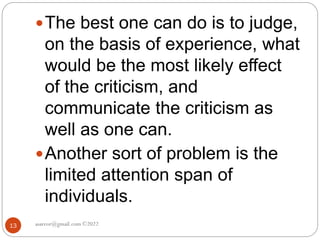
The best one can do is to judge,
on the basis of experience, what
would be the most likely effect
of the criticism, and
communicate the criticism as
well as one can.
Another sort of problem is the
limited attention span of
individuals.
asareor@gmail.com ©2022
14
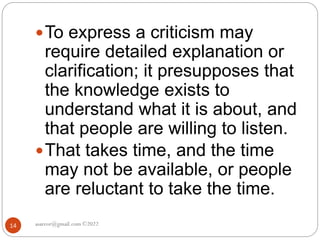
To express a criticism may
require detailed explanation or
clarification; it presupposes that
the knowledge exists to
understand what it is about, and
that people are willing to listen.
That takes time, and the time
may not be available, or people
are reluctant to take the time.
asareor@gmail.com ©2022
15
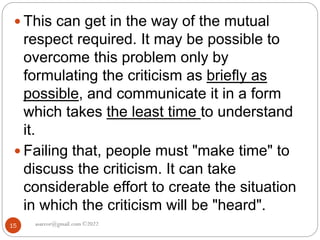
 This can get in the way of the mutual
respect required. It may be possible to
overcome this problem only by
formulating the criticism as briefly as
possible, and communicate it in a form
which takes the least time to understand
it.
 Failing that, people must "make time" to
discuss the criticism. It can take
considerable effort to create the situation
in which the criticism will be "heard".
asareor@gmail.com ©2022
16
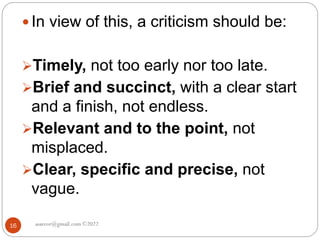
 In view of this, a criticism should be:
Timely, not too early nor too late.
Brief and succinct, with a clear start
and a finish, not endless.
Relevant and to the point, not
misplaced.
Clear, specific and precise, not
vague.
asareor@gmail.com ©2022
17
Well-researched, not based on
hear-say or speculative thought.
Sincere and positively intended,
not malicious.
Articulate, persuasive and
actionable, so that the recipient
can both understand the criticism
and be motivated to act on the
message.
asareor@gmail.com ©2022
18
 Criticism can go wrong when:
1. Criticism is made at the wrong time
and place: people might accept that
the critic has a point, but "they cannot
do anything about it now.“
2. Criticism is too long: people get
confused over what it is all about, they
get lost in it, and become disoriented.
asareor@gmail.com ©2022
19
3. Criticism is vague: people are likely
to say, "so what"?
4. Criticism is inappropriate, or the
critic is not really in a position to
make it: people will say "you're way
out of line".
5. Criticism has no clear target: people
are likely just to conclude that "so-
and-so is in a bad mood right now" or
"he's had too much of it.”
asareor@gmail.com ©2022
20
6. Criticism assigns blame or states
problems without suggesting
solutions ("empty criticism"):
people are likely to conclude this
information is not very useful.
7. Critic did no research before
making the criticism: people will
say, "very interesting, but this
makes no difference or fails to
impress.
asareor@gmail.com ©2022
21
8. Criticism has no clear
motivation: "why are you telling
me this, and why are you telling
me about it now?".
9. Critic makes bad criticisms
regularly: it discredits the critic.
TYPES OF CRITICISMS
22 asareor@gmail.com ©2022
Constructive Criticism
asareor@gmail.com ©2022
23
 Constructive criticism aims to show
that an intent or purpose of something
is better served by an alternative
approach.
 In this case, making the criticism is not
necessarily deemed wrong, and its
purpose is respected; rather, it is
claimed that the same goal could be
better achieved via a different route.
asareor@gmail.com ©2022
24
Constructive criticisms are often
suggestions for improvement –
how things could be done better
or more acceptably.
They draw attention to how an
identified problem could be
solved, or how it could be
solved better.
asareor@gmail.com ©2022
25
Constructive criticism is more
likely accepted if the criticism is:
Timely,
Clear,
Specific,
Detailed, and
Actionable.
Destructive Criticism
asareor@gmail.com ©2022
26
Destructive criticism aims to
destroy the target of criticism.
(e.g., "You should shut up and
follow the program.").
The aim is to show that the
point of view of someone else
has no validity at all, or lacks
any merit.
asareor@gmail.com ©2022
27
 Destructive criticism is regarded as an
undesirable nuisance, a threat, or as
completely unjustifiable, especially if it
involves personal attacks.
 Destructive criticism is often criticized
because it has a destructive effect,
instead of a positive effect (this may
also just be an accusation or
allegation if there is no proof that the
effect actually is destructive).
Self-Criticism (Personal Criticism)
asareor@gmail.com ©2022
28
Self-criticism (or autocritique)
refers to the ability to appraise
(or evaluate) the pros and cons
of one's own beliefs, thoughts,
actions, behaviour or results,
especially from the point of view
of how others might regard them.
asareor@gmail.com ©2022
29
 The self-criticism might occur in
private, or it might happen in a group
discussion.
 Sometimes the self-criticism is aired
publicly, specifically to show people
that a person or group no longer
believes in something which it
formerly did;
 At other times, the self-criticism
remains a hidden secret behind
closed doors.
asareor@gmail.com ©2022
30
 Self-criticism requires a certain flexibility
of mind, because it assumes a person
is able to call into question his own
behaviour and thinking – instead of
believing that he "naturally" is the way
he is, or that he can "never be wrong".
 Often it requires that people are able to
"step outside themselves“ or reflect by
doing introspection, and see
themselves from a different perspective.
asareor@gmail.com ©2022
31
The self-critic is willing to search
for, recognize, and accept
objections against his own
behavior, or his own
characteristics;
he is willing to accept that he
could be wrong, or indeed that he
is in the wrong.
Reasons Self-Criticism is Difficult
asareor@gmail.com ©2022
32
1) People can be very resistant to
admitting they are wrong about
something, or that they did (or said) the
wrong thing. They like to believe they
got it right, even when others disagree.
Acknowledging that they got it wrong,
could be very embarrassing, confusing
or distressing –especially if they
personally invested a lot in the wrong
idea. Their whole world might crumble.
asareor@gmail.com ©2022
33
2) People might have "blind spots"
in their awareness, i.e., they are
simply unable to see a part of
themselves for what it is (unless
others point it out to them). In
that case, they are unable to
criticize themselves, because
they don't know what there is to
criticize.
asareor@gmail.com ©2022
34
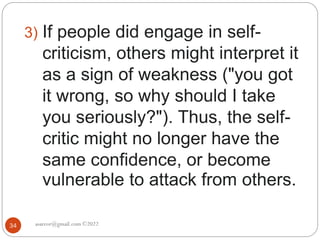
3) If people did engage in self-
criticism, others might interpret it
as a sign of weakness ("you got
it wrong, so why should I take
you seriously?"). Thus, the self-
critic might no longer have the
same confidence, or become
vulnerable to attack from others.
Negative Criticism
asareor@gmail.com ©2022
35
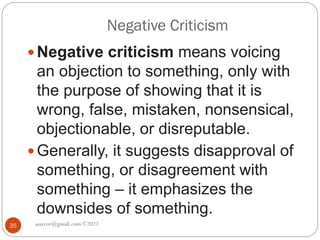
 Negative criticism means voicing
an objection to something, only with
the purpose of showing that it is
wrong, false, mistaken, nonsensical,
objectionable, or disreputable.
 Generally, it suggests disapproval of
something, or disagreement with
something – it emphasizes the
downsides of something.
Negative Criticism
asareor@gmail.com ©2022
36
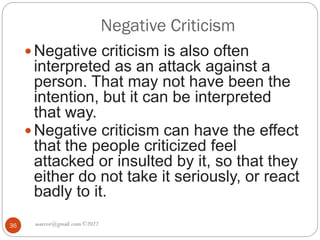
 Negative criticism is also often
interpreted as an attack against a
person. That may not have been the
intention, but it can be interpreted
that way.
 Negative criticism can have the effect
that the people criticized feel
attacked or insulted by it, so that they
either do not take it seriously, or react
badly to it.
Negative Criticism
asareor@gmail.com ©2022
37
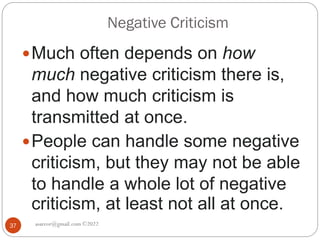
Much often depends on how
much negative criticism there is,
and how much criticism is
transmitted at once.
People can handle some negative
criticism, but they may not be able
to handle a whole lot of negative
criticism, at least not all at once.
Negative Criticism
asareor@gmail.com ©2022
38
 The disadvantage of negative criticism is,
often, that it tells people what they cannot
or should not do or believe, rather than
telling them what they can or should do
(what possibilities or options there are). So it
may be disabling, rather than enabling.
People might reply to a negative criticism
that "this is all very well, but I cannot do
anything with it", or they might say "now
what?!".
asareor@gmail.com ©2022
39
 Yet, negative criticism may be necessary at
times, to prevent a course of action
harmful to the people concerned.
 If people are afraid to state a negative
criticism, the existing problem might get
worse.
 The advantage of negative criticism is that
it can explain what the limitations of an
idea, an action or a situation are, for the
sake of being realistic. Sometimes it is
necessary to say "no" to something (and
explain why "no" is "no").
Negative Criticism
asareor@gmail.com ©2022
40
 In the modern world, negative
criticism has acquired the stigma of
"being negative", and people who
make negative criticisms can be
easily exploited or manipulated. For
this reason, many people nowadays
express their negative criticism simply
by not saying anything, not paying
attention to something or someone, or
by being absent.
Positive Criticism
asareor@gmail.com ©2022
41
 A positive criticism draws attention to a
good or positive aspect of something that
is being ignored, disregarded or
overlooked.
 People may be able to see only the
negative side of something, so that it
becomes necessary to highlight the
positive side.
 A positive criticism may also be a type of
self-justification or self-defense.
Positive Criticism
asareor@gmail.com ©2022
42
 The term "positive criticism" is also
used in the sense that the criticism
is "well-meant" or "well-intentioned“
("I mean it in a positive way").
 Here, the criticism intends to serve
a purpose that is constructive, or
that the targeted person would
approve of.
Positive Criticism
asareor@gmail.com ©2022
43
 The basic aim of positive criticism is
usually to provide a better orientation,
or frame of reference, for behavior.
 It provides ideas people can act on to
improve the situation.
 At the very least, it provides more
choices for behavior, and therefore
potentially enlarges behavioral
freedom.
Positive Criticism
asareor@gmail.com ©2022
44
 A positive criticism can be stated as a
positive alternative ("there are good
reasons for thinking that we are better
off to do Y, instead of X").
 It does not necessarily say, that the
option criticized is all bad, but rather
that an alternative option is better, or
preferable.
How to Receive Negative Feedback
asareor@gmail.com ©2022
45
1) Listen.
 Actually hear what’s being said. If
necessary, ask questions to make sure
you understand the criticism fully.
2) Assume good intentions.
 Unless proven otherwise, assume good
intentions. Don’t automatically jump to
the conclusion that the person criticizing
you is “out to get you.” Of course,
sometimes they are.
How to Receive Negative Feedback
asareor@gmail.com ©2022
46
3) Do not get defensive and start
making excuses.
• Instead you might say what you’ve
learned and what you will do differently
from now on.
4) Do not take it personally
• Remember that they are criticizing your
work, not you as a person. Never take
negative feedback about your work as a
criticism of you as a person.
asareor@gmail.com ©2022
47
5) See criticism as help.
 Remember that all constructive feedback
(including negative feedback) is a sign of interest
and a sign that people want to help you do better.
It would be far worse for people to notice you doing
bad work and not say a word.
6) Do not be too hard on yourself.
 Remember that everyone makes mistakes and has
things to learn. Yes, that includes you. There’s
nothing wrong with making mistakes, but making
the same mistakes over and over because you
refuse to listen to criticism and learn is just stupid.
7) Say thank you.
 Thank the person for their feedback.
How to Offer Constructive Feedback
asareor@gmail.com ©2022
48
1) Start with praise
2) Don’t make it personal
3) Be specific in your criticism
4) Be kind when offering criticism
5) Lead by example
6) Criticize your own behaviour first
7) Ask questions, instead of giving orders
8) Pick the right time
9) Allow recipient to ask questions and clarify
10)Thank him/her
asareor@gmail.com ©2022
49
END OF
PRESENTATION
THANK YOU
Acknowledgements
asareor@gmail.com ©2022
50
 My appreciation goes to wikipedia.org.
 My gratitude to all authors, publishers and institutions whose
materials important information were referenced for this
piece of presentation.
 To the past and present students of College of Nursing,
Ntotroso, in theAhafo Region of Ghana, I salute you for
urging me on to put pieces of my lecture notes into a
PowerPoint presentation format for easy access and reading.
 To my family, God bless you for your support, despite the
challenges.
 Thank you all.
51 asareor@gmail.com ©2022

APPRECIATING CRITICISM.pdf

  • 1.
    PREPAREDAND PRESENTED BY ASARE, RICHARDOPOKU https://orcid.org/0000-0002-9392-9569 https://www.linkedin.com/in/richard-asare-b6931584/ APPRECIATING CRITICISM 1 asareor@gmail.com ©2022
  • 2.
    Introduction  Many peopleget defensive or sad when they are criticized at work. However, criticism is an evaluative or corrective exercise that can occur in any area of human life.  Criticism can therefore take many different forms. How people go about criticizing, can vary a great deal. 2 asareor@gmail.com ©2022
  • 3.
    asareor@gmail.com ©2022 3  Inspecific areas of human endeavour, the form of criticism can be highly specialized and technical; it often requires professional knowledge to appreciate the criticism.  To criticize does not necessarily imply "to find fault", but the word is often taken to mean the simple expression of an object against prejudice, no matter positive or negative.
  • 4.
    asareor@gmail.com ©2022 4  Oftencriticism involves active disagreement, but it may only mean "taking sides".  Criticism is often presented as something unpleasant, but there are friendly criticisms, amicably discussed, and some people find great pleasure in criticism ("keeping people sharp", "providing the critical edge").
  • 5.
    asareor@gmail.com ©2022 5  Bydefinition, criticism is the practice of judging the merits and faults of something.  The judger is called a critic.  Target – object of the criticism (criticism "of whom" or criticism "of what“).  Context – place, setting or situation for the criticism ("where" is the criticism being made).  Recipients – audience of the criticism, intended or unintended (criticism directed or addressed "to where" or "to whom").
  • 6.
    asareor@gmail.com ©2022 6  Criticismcan be made according to: Point of view from which the criticism is made ("in what framework", "from what angle or perspective" is the criticism made). Content of criticism, what it consists of ("what" is the criticism). Purpose, motive, use or function of criticism ("why" is the criticism being raised, what is its aim).
  • 7.
    asareor@gmail.com ©2022 7 Form ofcriticism, language used or medium of expression (in what "style" or format is the criticism presented). Method of delivery, transmission or communication for the criticism ("how", or by what means, is the criticism conveyed). Type of critic or the source making the criticism ("from whom" criticism originates).
  • 8.
    Qualities of aGood Critic asareor@gmail.com ©2022 8  Insight: critics should clearly understand why they are criticizing.  Attitude: critics should be emotionally confident and morally comfortable, both about making a criticism, and about dealing with the response to criticism.  Inquiry: critics should be willing to question authority, popular opinion, and assumptions.
  • 9.
    asareor@gmail.com ©2022 9  Knowledge:critics should research the subject of their criticism to maintain the factual integrity of their criticism.  Skills: critics should choose and apply the correct kind of criticism to an issue, so that the criticism will be balanced, complete and persuasive. Critics require adequate skills in reasoning, research, and communication.  Integrity: critics should remain consistent and honest before, during, and after a criticism is expressed.
  • 10.
    Critic-Recipient Relationship asareor@gmail.com ©2022 10 It is recommend that before a criticism is made to a person, the critic should try to establish rapport with the person being criticized.  If that is not possible, the best thing may be not to express the criticism at all, or get a mediator.
  • 11.
    asareor@gmail.com ©2022 11 It maytake considerable strategy in order to find a way of making a criticism. Rather than criticizing the person, it may be wise if people say nothing, until the right time and place arrives to make the criticism.
  • 12.
    asareor@gmail.com ©2022 12  Oneproblem at the receiving end is that a criticism may be taken more seriously than it really merits, or that it is taken "too personally", even though that was not the intention of the critic.  Criticisms are often voiced without knowing exactly what the response will be. It may be that this problem cannot be entirely removed.
  • 13.
    asareor@gmail.com ©2022 13 The bestone can do is to judge, on the basis of experience, what would be the most likely effect of the criticism, and communicate the criticism as well as one can. Another sort of problem is the limited attention span of individuals.
  • 14.
    asareor@gmail.com ©2022 14 To expressa criticism may require detailed explanation or clarification; it presupposes that the knowledge exists to understand what it is about, and that people are willing to listen. That takes time, and the time may not be available, or people are reluctant to take the time.
  • 15.
    asareor@gmail.com ©2022 15  Thiscan get in the way of the mutual respect required. It may be possible to overcome this problem only by formulating the criticism as briefly as possible, and communicate it in a form which takes the least time to understand it.  Failing that, people must "make time" to discuss the criticism. It can take considerable effort to create the situation in which the criticism will be "heard".
  • 16.
    asareor@gmail.com ©2022 16  Inview of this, a criticism should be: Timely, not too early nor too late. Brief and succinct, with a clear start and a finish, not endless. Relevant and to the point, not misplaced. Clear, specific and precise, not vague.
  • 17.
    asareor@gmail.com ©2022 17 Well-researched, notbased on hear-say or speculative thought. Sincere and positively intended, not malicious. Articulate, persuasive and actionable, so that the recipient can both understand the criticism and be motivated to act on the message.
  • 18.
    asareor@gmail.com ©2022 18  Criticismcan go wrong when: 1. Criticism is made at the wrong time and place: people might accept that the critic has a point, but "they cannot do anything about it now.“ 2. Criticism is too long: people get confused over what it is all about, they get lost in it, and become disoriented.
  • 19.
    asareor@gmail.com ©2022 19 3. Criticismis vague: people are likely to say, "so what"? 4. Criticism is inappropriate, or the critic is not really in a position to make it: people will say "you're way out of line". 5. Criticism has no clear target: people are likely just to conclude that "so- and-so is in a bad mood right now" or "he's had too much of it.”
  • 20.
    asareor@gmail.com ©2022 20 6. Criticismassigns blame or states problems without suggesting solutions ("empty criticism"): people are likely to conclude this information is not very useful. 7. Critic did no research before making the criticism: people will say, "very interesting, but this makes no difference or fails to impress.
  • 21.
    asareor@gmail.com ©2022 21 8. Criticismhas no clear motivation: "why are you telling me this, and why are you telling me about it now?". 9. Critic makes bad criticisms regularly: it discredits the critic.
  • 22.
    TYPES OF CRITICISMS 22asareor@gmail.com ©2022
  • 23.
    Constructive Criticism asareor@gmail.com ©2022 23 Constructive criticism aims to show that an intent or purpose of something is better served by an alternative approach.  In this case, making the criticism is not necessarily deemed wrong, and its purpose is respected; rather, it is claimed that the same goal could be better achieved via a different route.
  • 24.
    asareor@gmail.com ©2022 24 Constructive criticismsare often suggestions for improvement – how things could be done better or more acceptably. They draw attention to how an identified problem could be solved, or how it could be solved better.
  • 25.
    asareor@gmail.com ©2022 25 Constructive criticismis more likely accepted if the criticism is: Timely, Clear, Specific, Detailed, and Actionable.
  • 26.
    Destructive Criticism asareor@gmail.com ©2022 26 Destructivecriticism aims to destroy the target of criticism. (e.g., "You should shut up and follow the program."). The aim is to show that the point of view of someone else has no validity at all, or lacks any merit.
  • 27.
    asareor@gmail.com ©2022 27  Destructivecriticism is regarded as an undesirable nuisance, a threat, or as completely unjustifiable, especially if it involves personal attacks.  Destructive criticism is often criticized because it has a destructive effect, instead of a positive effect (this may also just be an accusation or allegation if there is no proof that the effect actually is destructive).
  • 28.
    Self-Criticism (Personal Criticism) asareor@gmail.com©2022 28 Self-criticism (or autocritique) refers to the ability to appraise (or evaluate) the pros and cons of one's own beliefs, thoughts, actions, behaviour or results, especially from the point of view of how others might regard them.
  • 29.
    asareor@gmail.com ©2022 29  Theself-criticism might occur in private, or it might happen in a group discussion.  Sometimes the self-criticism is aired publicly, specifically to show people that a person or group no longer believes in something which it formerly did;  At other times, the self-criticism remains a hidden secret behind closed doors.
  • 30.
    asareor@gmail.com ©2022 30  Self-criticismrequires a certain flexibility of mind, because it assumes a person is able to call into question his own behaviour and thinking – instead of believing that he "naturally" is the way he is, or that he can "never be wrong".  Often it requires that people are able to "step outside themselves“ or reflect by doing introspection, and see themselves from a different perspective.
  • 31.
    asareor@gmail.com ©2022 31 The self-criticis willing to search for, recognize, and accept objections against his own behavior, or his own characteristics; he is willing to accept that he could be wrong, or indeed that he is in the wrong.
  • 32.
    Reasons Self-Criticism isDifficult asareor@gmail.com ©2022 32 1) People can be very resistant to admitting they are wrong about something, or that they did (or said) the wrong thing. They like to believe they got it right, even when others disagree. Acknowledging that they got it wrong, could be very embarrassing, confusing or distressing –especially if they personally invested a lot in the wrong idea. Their whole world might crumble.
  • 33.
    asareor@gmail.com ©2022 33 2) Peoplemight have "blind spots" in their awareness, i.e., they are simply unable to see a part of themselves for what it is (unless others point it out to them). In that case, they are unable to criticize themselves, because they don't know what there is to criticize.
  • 34.
    asareor@gmail.com ©2022 34 3) Ifpeople did engage in self- criticism, others might interpret it as a sign of weakness ("you got it wrong, so why should I take you seriously?"). Thus, the self- critic might no longer have the same confidence, or become vulnerable to attack from others.
  • 35.
    Negative Criticism asareor@gmail.com ©2022 35 Negative criticism means voicing an objection to something, only with the purpose of showing that it is wrong, false, mistaken, nonsensical, objectionable, or disreputable.  Generally, it suggests disapproval of something, or disagreement with something – it emphasizes the downsides of something.
  • 36.
    Negative Criticism asareor@gmail.com ©2022 36 Negative criticism is also often interpreted as an attack against a person. That may not have been the intention, but it can be interpreted that way.  Negative criticism can have the effect that the people criticized feel attacked or insulted by it, so that they either do not take it seriously, or react badly to it.
  • 37.
    Negative Criticism asareor@gmail.com ©2022 37 Muchoften depends on how much negative criticism there is, and how much criticism is transmitted at once. People can handle some negative criticism, but they may not be able to handle a whole lot of negative criticism, at least not all at once.
  • 38.
    Negative Criticism asareor@gmail.com ©2022 38 The disadvantage of negative criticism is, often, that it tells people what they cannot or should not do or believe, rather than telling them what they can or should do (what possibilities or options there are). So it may be disabling, rather than enabling. People might reply to a negative criticism that "this is all very well, but I cannot do anything with it", or they might say "now what?!".
  • 39.
    asareor@gmail.com ©2022 39  Yet,negative criticism may be necessary at times, to prevent a course of action harmful to the people concerned.  If people are afraid to state a negative criticism, the existing problem might get worse.  The advantage of negative criticism is that it can explain what the limitations of an idea, an action or a situation are, for the sake of being realistic. Sometimes it is necessary to say "no" to something (and explain why "no" is "no").
  • 40.
    Negative Criticism asareor@gmail.com ©2022 40 In the modern world, negative criticism has acquired the stigma of "being negative", and people who make negative criticisms can be easily exploited or manipulated. For this reason, many people nowadays express their negative criticism simply by not saying anything, not paying attention to something or someone, or by being absent.
  • 41.
    Positive Criticism asareor@gmail.com ©2022 41 A positive criticism draws attention to a good or positive aspect of something that is being ignored, disregarded or overlooked.  People may be able to see only the negative side of something, so that it becomes necessary to highlight the positive side.  A positive criticism may also be a type of self-justification or self-defense.
  • 42.
    Positive Criticism asareor@gmail.com ©2022 42 The term "positive criticism" is also used in the sense that the criticism is "well-meant" or "well-intentioned“ ("I mean it in a positive way").  Here, the criticism intends to serve a purpose that is constructive, or that the targeted person would approve of.
  • 43.
    Positive Criticism asareor@gmail.com ©2022 43 The basic aim of positive criticism is usually to provide a better orientation, or frame of reference, for behavior.  It provides ideas people can act on to improve the situation.  At the very least, it provides more choices for behavior, and therefore potentially enlarges behavioral freedom.
  • 44.
    Positive Criticism asareor@gmail.com ©2022 44 A positive criticism can be stated as a positive alternative ("there are good reasons for thinking that we are better off to do Y, instead of X").  It does not necessarily say, that the option criticized is all bad, but rather that an alternative option is better, or preferable.
  • 45.
    How to ReceiveNegative Feedback asareor@gmail.com ©2022 45 1) Listen.  Actually hear what’s being said. If necessary, ask questions to make sure you understand the criticism fully. 2) Assume good intentions.  Unless proven otherwise, assume good intentions. Don’t automatically jump to the conclusion that the person criticizing you is “out to get you.” Of course, sometimes they are.
  • 46.
    How to ReceiveNegative Feedback asareor@gmail.com ©2022 46 3) Do not get defensive and start making excuses. • Instead you might say what you’ve learned and what you will do differently from now on. 4) Do not take it personally • Remember that they are criticizing your work, not you as a person. Never take negative feedback about your work as a criticism of you as a person.
  • 47.
    asareor@gmail.com ©2022 47 5) Seecriticism as help.  Remember that all constructive feedback (including negative feedback) is a sign of interest and a sign that people want to help you do better. It would be far worse for people to notice you doing bad work and not say a word. 6) Do not be too hard on yourself.  Remember that everyone makes mistakes and has things to learn. Yes, that includes you. There’s nothing wrong with making mistakes, but making the same mistakes over and over because you refuse to listen to criticism and learn is just stupid. 7) Say thank you.  Thank the person for their feedback.
  • 48.
    How to OfferConstructive Feedback asareor@gmail.com ©2022 48 1) Start with praise 2) Don’t make it personal 3) Be specific in your criticism 4) Be kind when offering criticism 5) Lead by example 6) Criticize your own behaviour first 7) Ask questions, instead of giving orders 8) Pick the right time 9) Allow recipient to ask questions and clarify 10)Thank him/her
  • 49.
  • 50.
    Acknowledgements asareor@gmail.com ©2022 50  Myappreciation goes to wikipedia.org.  My gratitude to all authors, publishers and institutions whose materials important information were referenced for this piece of presentation.  To the past and present students of College of Nursing, Ntotroso, in theAhafo Region of Ghana, I salute you for urging me on to put pieces of my lecture notes into a PowerPoint presentation format for easy access and reading.  To my family, God bless you for your support, despite the challenges.  Thank you all.
  • 51.