Individual Differences
    Personality and Abilities


                                Chapter 3
Learning Objectives
1.   Define personality and describe its role in the study of
     organizational behavior.
2.   Identify the big five dimensions of personality and
     describe what is meant by positive and negative
     affectivity.
3.   Describe the Type A and Type B behavior patterns and
     describe the nature of Machiavellianism.
4.   Define achievement motivation (or need for achievement)
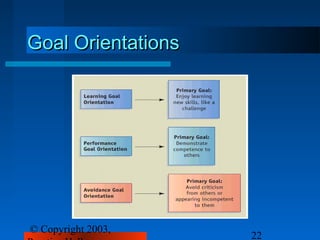
     and describe the difference between learning,
     performance, and avoidance goal orientations.
5.   Describe the differences between morning and evening
     persons and the relevance of this individual difference to
     on-the-job behavior.
6.   Define cognitive intelligence, practical intelligence,
     emotional intelligence, and successful intelligence.
      © Copyright 2003, Prentice Hall                             2
Personality Concepts
 Personality: The unique and relatively
 Personality
 stable patterns of behavior, thoughts, and
 emotions shown by individuals.
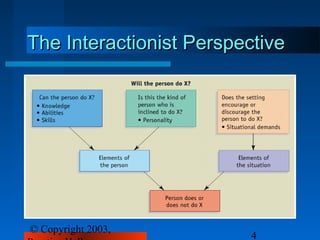
 Interactionist Perspective: The view that
                Perspective
 behavior is a result of a complex interplay
 between personality and situational
 factors.
 Person-Job Fit: The extent to which
              Fit
 individuals possess the traits and
 competencies required to perform specific
 jobs.
© Copyright 2003,
                                     3
The Interactionist Perspective


© Copyright 2003,
                         4
Measuring Personality
 Objective Tests:
            Tests   Questionnaires and
  inventories designed to measure
  various aspects of personality.
 Reliability: The extent to which a
  Reliability
  test yields consistent scores on
  various occasions.
 Validity: The extent to which a test
  Validity
  actually measures what it claims to
  measure.
© Copyright 2003,
                                5
The Big Five Dimensions of Personality

 Fivebasic dimensions of personality
 that are assumed to underlie many
 specific traits.
  – Conscientiousness
  – Extraversion-Introversion
  – Agreeableness
  – Emotional Stability
  – Openness to Experience
 © Copyright 2003,
                                6
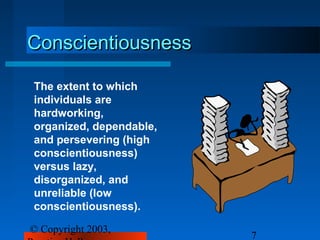
Conscientiousness

The extent to which
individuals are
hardworking,
organized, dependable,
and persevering (high
conscientiousness)
versus lazy,
disorganized, and
unreliable (low
conscientiousness).

© Copyright 2003,
                         7
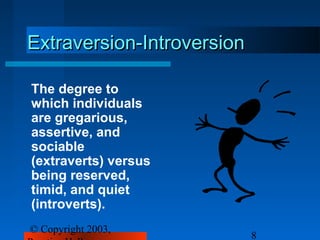
Extraversion-Introversion

The degree to
which individuals
are gregarious,
assertive, and
sociable
(extraverts) versus
being reserved,
timid, and quiet
(introverts).
© Copyright 2003,
                            8
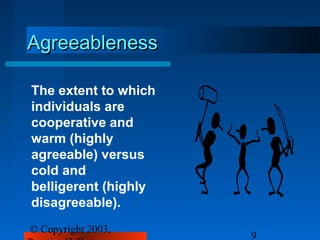
Agreeableness

The extent to which
individuals are
cooperative and
warm (highly
agreeable) versus
cold and
belligerent (highly
disagreeable).
© Copyright 2003,
                      9
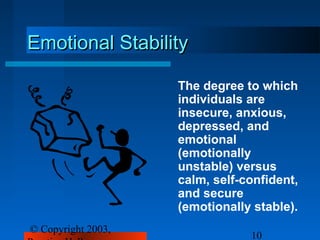
Emotional Stability

                    The degree to which
                    individuals are
                    insecure, anxious,
                    depressed, and
                    emotional
                    (emotionally
                    unstable) versus
                    calm, self-confident,
                    and secure
                    (emotionally stable).
© Copyright 2003,
                                10
Openness to Experience

The extent to which
individuals are
creative, curious,
and cultured (open
to experience)
versus practical
and with narrow
interests (closed to
experience).
© Copyright 2003,
                         11
Affectivity

 Positive Affectivity: The tendency to
            Affectivity
  experience positive moods and
  feelings in a wide range of settings
  and under many different conditions.
 Negative Affectivity: The tendency
             Affectivity
  to experience negative moods in a
  wide range of settings and under
  many different conditions.
© Copyright 2003,
                                 12
Self-Efficacy
 Individuals’beliefs concerning their ability
  to perform specific tasks successfully.
 Judgments of self-efficacy consist of three
  components:
  Magnitude: The level at which an individual
    Magnitude
    believes she or he can perform.
  Strength: The person’s confidence that she or
    Strength
    he can perform at that level.
  Generality: The extent to which self-efficacy in
    Generality
    one situation or for one task extends to other
    situations and other tasks.
 © Copyright 2003,
                                              13
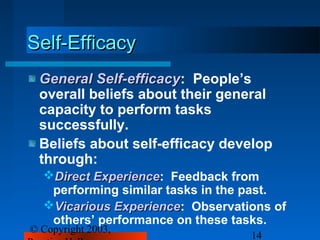
Self-Efficacy
 General Self-efficacy: People’s
          Self-efficacy
 overall beliefs about their general
 capacity to perform tasks
 successfully.
 Beliefs about self-efficacy develop
 through:
  Direct Experience: Feedback from
          Experience
   performing similar tasks in the past.
  Vicarious Experience: Observations of
             Experience
   others’ performance on these tasks.
© Copyright 2003,
                                  14
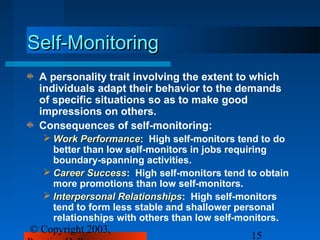
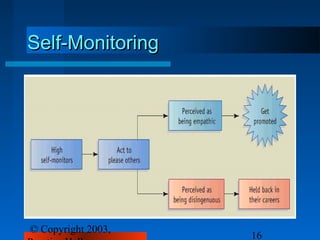
Self-Monitoring
 A personality trait involving the extent to which
 individuals adapt their behavior to the demands
 of specific situations so as to make good
 impressions on others.
 Consequences of self-monitoring:
   Work Performance: High self-monitors tend to do
           Performance
    better than low self-monitors in jobs requiring
    boundary-spanning activities.
   Career Success: High self-monitors tend to obtain
            Success
    more promotions than low self-monitors.
   Interpersonal Relationships: High self-monitors
                  Relationships
    tend to form less stable and shallower personal
    relationships with others than low self-monitors.
© Copyright 2003,
                                             15
Self-Monitoring


© Copyright 2003,
                    16
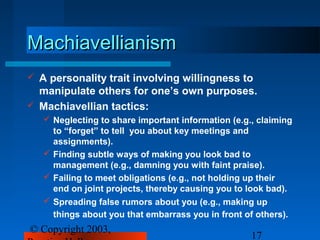
Machiavellianism
   A personality trait involving willingness to
    manipulate others for one’s own purposes.
   Machiavellian tactics:
     Neglecting to share important information (e.g., claiming
      to “forget” to tell you about key meetings and
      assignments).
     Finding subtle ways of making you look bad to
      management (e.g., damning you with faint praise).
     Failing to meet obligations (e.g., not holding up their
      end on joint projects, thereby causing you to look bad).
     Spreading false rumors about you (e.g., making up
      things about you that embarrass you in front of others).
© Copyright 2003,
                                                     17
Type A vs. Type B
 Type A Behavior Pattern: A pattern
                   Pattern
 of behavior involving high levels of
 competitiveness, time urgency, and
 irritability.
 Type B Behavior Pattern: A pattern
                   Pattern
 of behavior characterized by a
 casual, laid-back style; the opposite
 of the Type A behavior pattern.
© Copyright 2003,
                                 18
Type A vs. Type B
 Task Performance
   Type As tend to excel on tasks involving time
    pressure or solitary work.
   Type Bs have the advantage when it comes to
    tasks involving complex judgments and
    accuracy as opposed to speed.
 Interpersonal Relations
   Type As tend to annoy coworkers, are more
    likely to lose their tempers and lash out at
    others, are more likely to become involved in
    conflict, and are more likely to engage in
    aggressive and counterproductive behavior.
© Copyright 2003,
                                            19
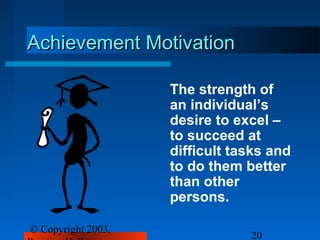
Achievement Motivation

                    The strength of
                    an individual’s
                    desire to excel –
                    to succeed at
                    difficult tasks and
                    to do them better
                    than other
                    persons.

© Copyright 2003,
                                20
High Need Achievers
 Prefer moderately difficult tasks.
 In terms of career success, tend to
 be
  • Promoted more rapidly.
  • Less inclined to delegate.
  • More interested in performance
    feedback.
  • More interested in merit-based pay than
    seniority-based pay.
© Copyright 2003,
                                    21
Goal Orientations


© Copyright 2003,
                    22
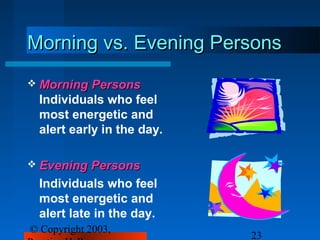
Morning vs. Evening Persons
 Morning Persons
 Individuals who feel
 most energetic and
 alert early in the day.

 Evening Persons

 Individuals who feel
 most energetic and
 alert late in the day.
© Copyright 2003,
                           23
Abilities
 Mental and physical capacities to perform
 various tasks.
 Cognitive Intelligence: The ability to
            Intelligence
 understand complex ideas, to adapt
 effectively to the environment, to learn
 from experience, to engage in various
 forms of reasoning, and to overcome
 obstacles by careful thought.
 Practical Intelligence: Adeptness at
           Intelligence
 solving the practical problems of everyday
 life.
© Copyright 2003,
                                    24
Tacit Knowledge
   Knowledge about how to get things done.
   Major characteristics:
    – Tacit knowledge is action oriented; it involves
                                oriented
      knowing how to do something as opposed to
      knowing that something is the case.
    – Tacit knowledge is practically useful; it allows
                                     useful
      individuals to achieve goals they personally
      value.
    – Tacit knowledge is acquired without direct
      help from others.
                others
© Copyright 2003,
                                              25
Emotional Intelligence
A  cluster of skills relating to the emotional
  side of life.
 Major components:
   The ability to recognize and regulate our own
    emotions.
   The ability to recognize and influence others’
    emotions.
   Self motivation.
   The ability to form effective long-term
    relationships with others.
© Copyright 2003,
                                            26
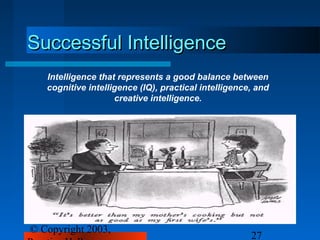
Successful Intelligence
   Intelligence that represents a good balance between
   cognitive intelligence (IQ), practical intelligence, and
                    creative intelligence.


© Copyright 2003,
                                                      27
Other Cognitive Abilities
   Perceptual Speed: The ability to quickly recognize
                 Speed
    similarities and differences in visual stimuli.
     Example: A designer recognizing irregular patterns in a
      fabric.
   Number Aptitude: The ability to work with
           Aptitude
    numbers in a quick and accurate manner.
     Example: An accountant spotting an error in a financial
      report.
   Spatial Visualization: The ability to imagine how
            Visualization
    various objects will look when rotated or moved in
    space.
     Example: An architect planning a change in a building
      design.
© Copyright 2003,
                                                    28
Physical Abilities
   People’s capacities to engage in the
    physical tasks required to perform a job.
   Common types:
  – Strength: The capacity to exert physical force
    Strength
    against various objects.
  – Flexibility: The capacity to move one’s body in
    Flexibility
    an agile manner.
  – Stamina: The capacity to endure physical
    Stamina
    activity over prolonged periods.
  – Speed: The ability to move quickly.
    Speed
© Copyright 2003,
                                           29

Personality and ability

  • 1.
    Individual Differences Personality and Abilities Chapter 3
  • 2.
    Learning Objectives 1. Define personality and describe its role in the study of organizational behavior. 2. Identify the big five dimensions of personality and describe what is meant by positive and negative affectivity. 3. Describe the Type A and Type B behavior patterns and describe the nature of Machiavellianism. 4. Define achievement motivation (or need for achievement) and describe the difference between learning, performance, and avoidance goal orientations. 5. Describe the differences between morning and evening persons and the relevance of this individual difference to on-the-job behavior. 6. Define cognitive intelligence, practical intelligence, emotional intelligence, and successful intelligence. © Copyright 2003, Prentice Hall 2
  • 3.
    Personality Concepts Personality:The unique and relatively Personality stable patterns of behavior, thoughts, and emotions shown by individuals. Interactionist Perspective: The view that Perspective behavior is a result of a complex interplay between personality and situational factors. Person-Job Fit: The extent to which Fit individuals possess the traits and competencies required to perform specific jobs. © Copyright 2003, 3
  • 4.
  • 5.
    Measuring Personality  ObjectiveTests: Tests Questionnaires and inventories designed to measure various aspects of personality.  Reliability: The extent to which a Reliability test yields consistent scores on various occasions.  Validity: The extent to which a test Validity actually measures what it claims to measure. © Copyright 2003, 5
  • 6.
    The Big FiveDimensions of Personality  Fivebasic dimensions of personality that are assumed to underlie many specific traits. – Conscientiousness – Extraversion-Introversion – Agreeableness – Emotional Stability – Openness to Experience © Copyright 2003, 6
  • 7.
    Conscientiousness The extent towhich individuals are hardworking, organized, dependable, and persevering (high conscientiousness) versus lazy, disorganized, and unreliable (low conscientiousness). © Copyright 2003, 7
  • 8.
    Extraversion-Introversion The degree to whichindividuals are gregarious, assertive, and sociable (extraverts) versus being reserved, timid, and quiet (introverts). © Copyright 2003, 8
  • 9.
    Agreeableness The extent towhich individuals are cooperative and warm (highly agreeable) versus cold and belligerent (highly disagreeable). © Copyright 2003, 9
  • 10.
    Emotional Stability The degree to which individuals are insecure, anxious, depressed, and emotional (emotionally unstable) versus calm, self-confident, and secure (emotionally stable). © Copyright 2003, 10
  • 11.
    Openness to Experience Theextent to which individuals are creative, curious, and cultured (open to experience) versus practical and with narrow interests (closed to experience). © Copyright 2003, 11
  • 12.
    Affectivity  Positive Affectivity:The tendency to Affectivity experience positive moods and feelings in a wide range of settings and under many different conditions.  Negative Affectivity: The tendency Affectivity to experience negative moods in a wide range of settings and under many different conditions. © Copyright 2003, 12
  • 13.
    Self-Efficacy  Individuals’beliefs concerningtheir ability to perform specific tasks successfully.  Judgments of self-efficacy consist of three components: Magnitude: The level at which an individual Magnitude believes she or he can perform. Strength: The person’s confidence that she or Strength he can perform at that level. Generality: The extent to which self-efficacy in Generality one situation or for one task extends to other situations and other tasks. © Copyright 2003, 13
  • 14.
    Self-Efficacy General Self-efficacy:People’s Self-efficacy overall beliefs about their general capacity to perform tasks successfully. Beliefs about self-efficacy develop through: Direct Experience: Feedback from Experience performing similar tasks in the past. Vicarious Experience: Observations of Experience others’ performance on these tasks. © Copyright 2003, 14
  • 15.
    Self-Monitoring A personalitytrait involving the extent to which individuals adapt their behavior to the demands of specific situations so as to make good impressions on others. Consequences of self-monitoring:  Work Performance: High self-monitors tend to do Performance better than low self-monitors in jobs requiring boundary-spanning activities.  Career Success: High self-monitors tend to obtain Success more promotions than low self-monitors.  Interpersonal Relationships: High self-monitors Relationships tend to form less stable and shallower personal relationships with others than low self-monitors. © Copyright 2003, 15
  • 16.
  • 17.
    Machiavellianism  A personality trait involving willingness to manipulate others for one’s own purposes.  Machiavellian tactics:  Neglecting to share important information (e.g., claiming to “forget” to tell you about key meetings and assignments).  Finding subtle ways of making you look bad to management (e.g., damning you with faint praise).  Failing to meet obligations (e.g., not holding up their end on joint projects, thereby causing you to look bad).  Spreading false rumors about you (e.g., making up things about you that embarrass you in front of others). © Copyright 2003, 17
  • 18.
    Type A vs.Type B Type A Behavior Pattern: A pattern Pattern of behavior involving high levels of competitiveness, time urgency, and irritability. Type B Behavior Pattern: A pattern Pattern of behavior characterized by a casual, laid-back style; the opposite of the Type A behavior pattern. © Copyright 2003, 18
  • 19.
    Type A vs.Type B Task Performance  Type As tend to excel on tasks involving time pressure or solitary work.  Type Bs have the advantage when it comes to tasks involving complex judgments and accuracy as opposed to speed. Interpersonal Relations  Type As tend to annoy coworkers, are more likely to lose their tempers and lash out at others, are more likely to become involved in conflict, and are more likely to engage in aggressive and counterproductive behavior. © Copyright 2003, 19
  • 20.
    Achievement Motivation The strength of an individual’s desire to excel – to succeed at difficult tasks and to do them better than other persons. © Copyright 2003, 20
  • 21.
    High Need Achievers Prefer moderately difficult tasks. In terms of career success, tend to be • Promoted more rapidly. • Less inclined to delegate. • More interested in performance feedback. • More interested in merit-based pay than seniority-based pay. © Copyright 2003, 21
  • 22.
  • 23.
    Morning vs. EveningPersons  Morning Persons Individuals who feel most energetic and alert early in the day.  Evening Persons Individuals who feel most energetic and alert late in the day. © Copyright 2003, 23
  • 24.
    Abilities Mental andphysical capacities to perform various tasks. Cognitive Intelligence: The ability to Intelligence understand complex ideas, to adapt effectively to the environment, to learn from experience, to engage in various forms of reasoning, and to overcome obstacles by careful thought. Practical Intelligence: Adeptness at Intelligence solving the practical problems of everyday life. © Copyright 2003, 24
  • 25.
    Tacit Knowledge  Knowledge about how to get things done.  Major characteristics: – Tacit knowledge is action oriented; it involves oriented knowing how to do something as opposed to knowing that something is the case. – Tacit knowledge is practically useful; it allows useful individuals to achieve goals they personally value. – Tacit knowledge is acquired without direct help from others. others © Copyright 2003, 25
  • 26.
    Emotional Intelligence A cluster of skills relating to the emotional side of life.  Major components:  The ability to recognize and regulate our own emotions.  The ability to recognize and influence others’ emotions.  Self motivation.  The ability to form effective long-term relationships with others. © Copyright 2003, 26
  • 27.
    Successful Intelligence Intelligence that represents a good balance between cognitive intelligence (IQ), practical intelligence, and creative intelligence. © Copyright 2003, 27
  • 28.
    Other Cognitive Abilities  Perceptual Speed: The ability to quickly recognize Speed similarities and differences in visual stimuli.  Example: A designer recognizing irregular patterns in a fabric.  Number Aptitude: The ability to work with Aptitude numbers in a quick and accurate manner.  Example: An accountant spotting an error in a financial report.  Spatial Visualization: The ability to imagine how Visualization various objects will look when rotated or moved in space.  Example: An architect planning a change in a building design. © Copyright 2003, 28
  • 29.
    Physical Abilities  People’s capacities to engage in the physical tasks required to perform a job.  Common types: – Strength: The capacity to exert physical force Strength against various objects. – Flexibility: The capacity to move one’s body in Flexibility an agile manner. – Stamina: The capacity to endure physical Stamina activity over prolonged periods. – Speed: The ability to move quickly. Speed © Copyright 2003, 29