
SUBJECT : Human Resource Management
TOPIC : Selection Process
By
A. Raja
MEANING AND DEFINITION OF SELECTION
• Selection is the process of making a hire or
no-hire decision regarding each applicant for
a job. -Terrie Nolinske
• Selection is the process by which candidates
for employment are divided into two classes
those who will be offered employment and
those who will not.
-Dale Yoder
• Selection is the process of picking
individuals with requisite qualifications and
competence to fill the job.
IMPORTANCE OF SELECTION
 Selects suitable candidate.
 Determines applicant’s capabilities.
 Places right candidate at right job.
 Generates information about candidate.
 Saves cost.
DIFFERENCES BETWEEN RECRUITMENT&SELECTION
 NATURE
• It is a positive process
• It is a negative process
 SEQUENCE
• It always precedes selection
• It always succeeds recruitment
 OBJECTIVE
• The basic objective of recruitment is to attract maximum
number of candidates so that more options are available.
• The basic objective of selection is to choose best out of
the available candidates.
 PROCESS
• Recruitment adopts the process of creating application
pool as large as possible.
• Selection adopts the process through which more and
more candidates are rejected.
 OUTCOME
• The outcome of recruitment is application pool which
becomes input for selection process
• The outcome of selection process is in the form of
finalizing candidates who will be offered job
PROCESS OF SELECTION
It involves six steps. They are
1) Screening of Applicants:
• Prospective employees have to fill up
some sort of application forms or
application blanks.
• These forms have variety of Information
about the applicants.
• Such information is used to screen the
applicants who are found to be qualified
for the consideration of employment.
• The information may also be used to keep
permanent records of those persons who
are selected.
• Based on screening of applications only
those candidates are called for further
process of selection who are found to be
meeting the job standards of the
organization.
2. Selection Tests :
• Many organizations hold different kinds of
tests to know more about the candidates or
to reject the candidates who cannot be
called for interview.
• Selection tests normally supplement the
information provided in the applicant forms.
• Such form may contain factual information
about the candidates.
• Such tests provide information about their
aptitude, interests, personality.
3. Selection Interviews :
• Selection tests are normally followed by
personal interview of the candidates.
• Basic idea here is to find out the overall
suitability of candidates for the jobs.
• Provides opportunity to give relevant
information about the organization to the
candidates
4. Medical Examination :
• Medical examination is not conducted for
every job.
• But certain jobs gives equal importance to
medical test also like in Defense jobs and
police jobs etc..
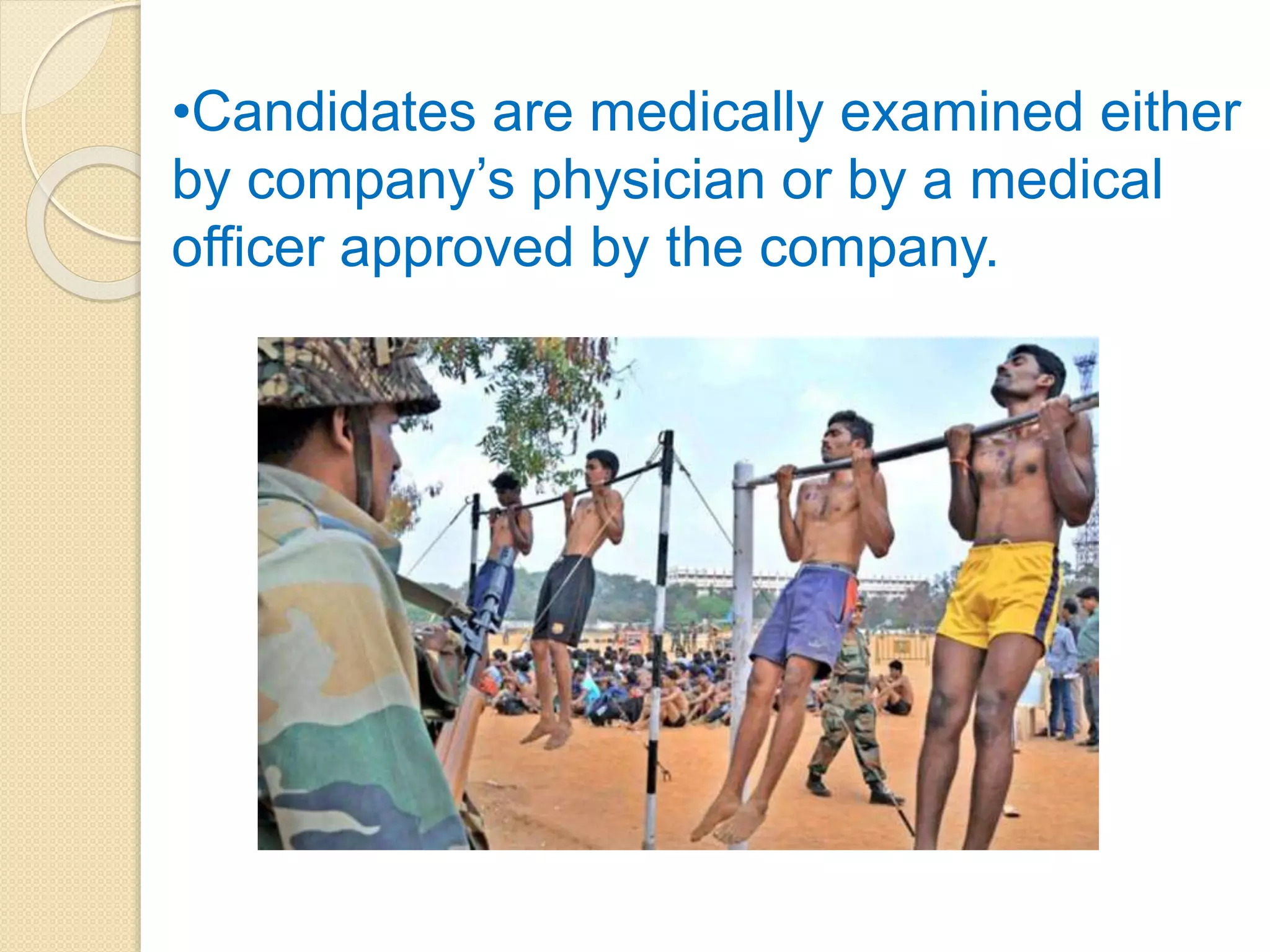
• These type of jobs require stamina , strength
and tolerance of hard work
• Medical examination tells weather the
person is capable for the job physically or
not.
•Candidates are medically examined either
by company’s physician or by a medical
officer approved by the company.
5. Reference Check And Background
Verification :
• Many organizations ask the candidates to
provide the name of referees from
whom more information about the
candidates can be solicited.
• Such information may be related to the
character, working.
• The usual referees may be previous
employers, persons related to educational
institutions from where the candidates
have received education .
6. Hiring Decisions Or Approval :
• On the basis of above steps suitable
candidates are recommended for selection
by the selection committee or personnel
department.
• Organization may designate the various
authorities for approval of final selection
of candidates for different categories of
candidates.
• When the approval is received the
candidates are informed about their
selection.
THANK YOU

Selection Process

  • 1.
    SUBJECT : HumanResource Management TOPIC : Selection Process By A. Raja
  • 2.
    MEANING AND DEFINITIONOF SELECTION • Selection is the process of making a hire or no-hire decision regarding each applicant for a job. -Terrie Nolinske • Selection is the process by which candidates for employment are divided into two classes those who will be offered employment and those who will not. -Dale Yoder • Selection is the process of picking individuals with requisite qualifications and competence to fill the job.
  • 3.
    IMPORTANCE OF SELECTION Selects suitable candidate.  Determines applicant’s capabilities.  Places right candidate at right job.  Generates information about candidate.  Saves cost.
  • 4.
    DIFFERENCES BETWEEN RECRUITMENT&SELECTION NATURE • It is a positive process • It is a negative process  SEQUENCE • It always precedes selection • It always succeeds recruitment  OBJECTIVE • The basic objective of recruitment is to attract maximum number of candidates so that more options are available. • The basic objective of selection is to choose best out of the available candidates.
  • 5.
     PROCESS • Recruitmentadopts the process of creating application pool as large as possible. • Selection adopts the process through which more and more candidates are rejected.  OUTCOME • The outcome of recruitment is application pool which becomes input for selection process • The outcome of selection process is in the form of finalizing candidates who will be offered job
  • 6.
    PROCESS OF SELECTION Itinvolves six steps. They are 1) Screening of Applicants: • Prospective employees have to fill up some sort of application forms or application blanks. • These forms have variety of Information about the applicants. • Such information is used to screen the applicants who are found to be qualified for the consideration of employment.
  • 7.
    • The informationmay also be used to keep permanent records of those persons who are selected. • Based on screening of applications only those candidates are called for further process of selection who are found to be meeting the job standards of the organization.
  • 8.
    2. Selection Tests: • Many organizations hold different kinds of tests to know more about the candidates or to reject the candidates who cannot be called for interview. • Selection tests normally supplement the information provided in the applicant forms. • Such form may contain factual information about the candidates. • Such tests provide information about their aptitude, interests, personality.
  • 9.
    3. Selection Interviews: • Selection tests are normally followed by personal interview of the candidates. • Basic idea here is to find out the overall suitability of candidates for the jobs. • Provides opportunity to give relevant information about the organization to the candidates
  • 10.
    4. Medical Examination: • Medical examination is not conducted for every job. • But certain jobs gives equal importance to medical test also like in Defense jobs and police jobs etc.. • These type of jobs require stamina , strength and tolerance of hard work • Medical examination tells weather the person is capable for the job physically or not.
  • 11.
    •Candidates are medicallyexamined either by company’s physician or by a medical officer approved by the company.
  • 12.
    5. Reference CheckAnd Background Verification : • Many organizations ask the candidates to provide the name of referees from whom more information about the candidates can be solicited. • Such information may be related to the character, working. • The usual referees may be previous employers, persons related to educational institutions from where the candidates have received education .
  • 13.
    6. Hiring DecisionsOr Approval : • On the basis of above steps suitable candidates are recommended for selection by the selection committee or personnel department. • Organization may designate the various authorities for approval of final selection of candidates for different categories of candidates. • When the approval is received the candidates are informed about their selection.
  • 14.