ARBITRATION &
ADJUDICATION
CHANDAN SINGH
FACULTY OF COMMERCE AND MANAGEMENT
PURNEA UNIVERSITY, PURNIA
Contents
• Introduction.
• Types of Arbitration.
• Merits of Arbitration.
• Demerits of Arbitration.
• Tier system of Arbitration.
 Arbitration means when two parties are arguing
they can not come to an agreement they call
someone in who is neutral and they figure out the
matter.
 In arbitration rules will be followed to solve the
problem by the mediator.
Introduction
Types of Arbitration
1. Voluntary Arbitration
2. Compulsory Arbitration
Voluntary Arbitration
 It is a non-binding.
 Under voluntary arbitration the parties to the
dispute can and do they refer voluntarily and
dispute to arbitration before it is referred for
adjudication . This type of reference is known as
voluntary reference.
Essential elements in Voluntary
Arbitration
 The voluntary submission of dispute to an
arbitrator.
 It involves the presence of witness and
investigation.
 The enforcement of an award may not be necessary
and binding because there is no compulsion.
 Voluntary arbitration may be specially needed for
disputes arising under agreements.
Compulsory arbitration
 Compulsory arbitration is a non-binding.
 Compulsory arbitration is one where the parties are
required to accept arbitration without any
willingness on their part.
 Compulsory arbitration leaves no scope for strikes
and lock-outs, it deprives both the parties of their
very important and fundamental rights.
Essential elements in compulsory
arbitration
 The parties fail to arrive at a settlement by a
voluntary method.
 When there is a national emergency which requires
that the wheels of production should not be
obstructed by frequent work-stoppages.
 The country is passing through a grave economic
crisis.
 Public interest and the working conditions have to
be safeguarded and regulated by the state.
Merits of Arbitration
 Confidential
 Cost saving
 Time saving
 Expert neutral
 Arbitrators often work faster than a judge to decide
disputes.
 The parties can select their arbitrator.
Demerits of Arbitration
 Worker can not go on a strike during the discussion.
 Sometimes arbitrator show result towards one group
due to bias.
 Two groups of people should agree the result what
the arbitrator said.
 The couple gives up their power to decide and
leaves their fate in the hands of a third party
stranger.
 The arbitrator’s settlement is final.
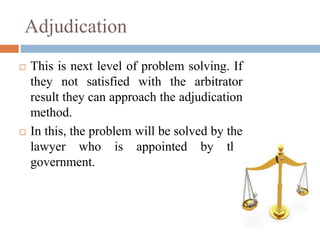
Adjudication
 This is next level of problem solving. If
they not satisfied with the arbitrator
result they can approach the adjudication
method.
 In this, the problem will be solved by the
lawyer who is appointed by the
government.
Tier system of adjudication
 Labour courts
 Industrial tribunals
 National tribunals
Labour courts
Labour court shall consist of one person.
 Retirement of high court judge.
 For a period of not less than three years as district
judge.
 Judicial office in India for not less than seven
years.
Function of labour courts
 To hold adjudication proceedings expeditiously.
 Submit its award to the appropriate government as
soon as practicable on the conclusion of the
proceedings.
Industrial tribunal
 It is formed by central or state government.
 One man court who is the president or retired high
court judge.
 Industrial disputes will come under this.
National tribunal
 Only central government is empowered to form
national tribunal.
 Single member body who is the president. He can
be retired judge of supreme or high court.
Arbitration and Adjudication

Arbitration and Adjudication

  • 1.
    ARBITRATION & ADJUDICATION CHANDAN SINGH FACULTYOF COMMERCE AND MANAGEMENT PURNEA UNIVERSITY, PURNIA
  • 2.
    Contents • Introduction. • Typesof Arbitration. • Merits of Arbitration. • Demerits of Arbitration. • Tier system of Arbitration.
  • 3.
     Arbitration meanswhen two parties are arguing they can not come to an agreement they call someone in who is neutral and they figure out the matter.  In arbitration rules will be followed to solve the problem by the mediator. Introduction
  • 4.
    Types of Arbitration 1.Voluntary Arbitration 2. Compulsory Arbitration
  • 5.
    Voluntary Arbitration  Itis a non-binding.  Under voluntary arbitration the parties to the dispute can and do they refer voluntarily and dispute to arbitration before it is referred for adjudication . This type of reference is known as voluntary reference.
  • 6.
    Essential elements inVoluntary Arbitration  The voluntary submission of dispute to an arbitrator.  It involves the presence of witness and investigation.  The enforcement of an award may not be necessary and binding because there is no compulsion.  Voluntary arbitration may be specially needed for disputes arising under agreements.
  • 7.
    Compulsory arbitration  Compulsoryarbitration is a non-binding.  Compulsory arbitration is one where the parties are required to accept arbitration without any willingness on their part.  Compulsory arbitration leaves no scope for strikes and lock-outs, it deprives both the parties of their very important and fundamental rights.
  • 8.
    Essential elements incompulsory arbitration  The parties fail to arrive at a settlement by a voluntary method.  When there is a national emergency which requires that the wheels of production should not be obstructed by frequent work-stoppages.  The country is passing through a grave economic crisis.  Public interest and the working conditions have to be safeguarded and regulated by the state.
  • 9.
    Merits of Arbitration Confidential  Cost saving  Time saving  Expert neutral  Arbitrators often work faster than a judge to decide disputes.  The parties can select their arbitrator.
  • 10.
    Demerits of Arbitration Worker can not go on a strike during the discussion.  Sometimes arbitrator show result towards one group due to bias.  Two groups of people should agree the result what the arbitrator said.  The couple gives up their power to decide and leaves their fate in the hands of a third party stranger.  The arbitrator’s settlement is final.
  • 11.
    Adjudication  This isnext level of problem solving. If they not satisfied with the arbitrator result they can approach the adjudication method.  In this, the problem will be solved by the lawyer who is appointed by the government.
  • 12.
    Tier system ofadjudication  Labour courts  Industrial tribunals  National tribunals
  • 13.
    Labour courts Labour courtshall consist of one person.  Retirement of high court judge.  For a period of not less than three years as district judge.  Judicial office in India for not less than seven years.
  • 14.
    Function of labourcourts  To hold adjudication proceedings expeditiously.  Submit its award to the appropriate government as soon as practicable on the conclusion of the proceedings.
  • 15.
    Industrial tribunal  Itis formed by central or state government.  One man court who is the president or retired high court judge.  Industrial disputes will come under this.
  • 16.
    National tribunal  Onlycentral government is empowered to form national tribunal.  Single member body who is the president. He can be retired judge of supreme or high court.