TRAINING & DEVELOPMENT -
DESIGNING TRAINING PROGRAM-
KEY FACTORS, STRATEGIES &
CHALLENGES
PRESENTED BY
SHATAKSHI SINGH
1 INTRODUCTION
1.1 Meaning and Significance of Training Design
• Training design is a planning activity which refers to the framework for
analysing a training problem, defining the intended outcomes,
determining how to present the content to learners to achieve those
outcomes, determining how to present or develop the training course
according to the design, implementing the course, evaluating its
effectiveness and devising follow-up activities.
• Careful and correct designing of the training program is very crucial to
the transfer of learning to the participants in effective manner.
• At the design stage the training manager has to define purpose of
training and the target audience, determine participant's learning needs,
evaluation criteria, methods of training and prepare the written training
design.
• A well-designed training programme minimizes new employee "on-
boarding" time and time-to-first-contribution. An effective training
design is a prime opportunity to expand the knowledge base of the
employees undergoing training.
1.2 Need of Designing a Training Programme
• Increased production
• Reduced turnover
• Maximum transfer of learning
• Optimum utilisation of training resources.
• Systematic implementation.
•PRE TRAINING DESIGN PROCESS
- Before designing a training program, a training design managers have
to keep two things in mind which is also known as Pre Training Design
Process.
1. Facilitation of learning : Ensuring that learning happens
2. Facilitation of transfer : From learning to action
2 KEY FACTORS
2.1 Key Elements of Training Design Framework
• There are few basic key elements which has to be taken into consideration
in training design framework and is an essential step in designing a training
program.
a) Training need assessment : this part of framework considers the kind of
training needed in the organization. It determines if a training need exist and
if it does what training is required to fill the gap.
b) Training objectives : once the training need assessment is determined,
setting learning objectives to measure at the end of the training are
determined.
c) Learning style : teaching a variety of learning style is important.
d) Course content : it includes what needs to be taught? How will you
sequence information?
e) Delivering of training mode : what is the best way to get your message
across? Is web based training more appropriate or should mentoring be
used? Can vestibule training be used for a portion of the training? Most
training programs will include a variety of delivery methods.
f) Organisational climate : the success or failure of any training programs
depends on the type of the organisational climate prevailing in the training
institution.
g) Measuring effectiveness of training : how will you know if the training
was successful? What ways will you you use to to measure this?
h) Timeline : how long will it take to develop the training? Is there a
deadline for training to be completed?
i) Budget : it will determine how much money has to be spend on the the
training program.
2.2 The ADDIE Model : 5 Stages to Effective
Communication
• ADDIE is an acronym for five stages of development process :
Analysis, Design, Development, Implementation, and Evaluation.
• Analysis- before developing any content or training strategies, one
should analyse the current situation in terms of training, knowledge
gap, etc.
• Design- once the training plan is done, then the phase of designing a
training program starts. This phase determines strategy, delivery
methods, structure, duration, assessment and feedback.
• Development - at this stage, courses are created. Each element of the
course should be developed to match the design phase.
• Implementation - once the designing and development phase is
completed, then implementation of training design is done. The
decisions made in the design phase will influence how this is actually
carried out.
• Evaluation - getting feedback on every aspect of the course is really
important so that the organisations can improve and revise the
training content.
2.3 STAGES OF DESIGNING A TRAINING
PROGRAMME
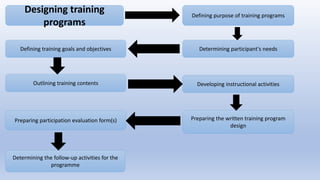
• STEP 1 - Defining Purpose of Training Programme
The first step in designing a training program involves clear communication and
understanding of the objectives of the training program. The design of training
program can be undertaken only when a clear training objective has been
produced. Training objectives assist trainers to design the training program.
• STEP 2 – Determining Participant’s Needs
The essential step in designing a training program is to determine what kind of
training is needed. There are three types of analysis which has to be conducted
for the examination of a company's training need, such as; factors that will inhibit
and aid training , identify employees that need to be trained and task most
employees need to be trained in.
Those three-tiered analysis are -
- Organisational Analysis : identifies company factors that can negatively or
positively impact the effectiveness of training program.
- Task Analysis : identifies what skills and activities need to be taught.
- Person Analysis : identification of people in the company that need
training.
• STEP 3 - Defining Training Goals and Objectives
After determining needs and expectations of the employees, it is important
to define the goals and objective for training. A training goal should be broad
and clearly defined.
• STEP 4 – Outlining Training Content
A typical design specification has the following consideration:
- The trainee: Before starting a training program, a trainer analyzes his
technical, judgemental and interpersonal skills in order to deliver quantity
and quality content to trainees.
- The trainees - A good training design requires close scrutiny of the
trainees and the profiles.
- The trainee’s learning style - The learning style, age, experience,
educational background of trainees must be kept in mind in order to get a
right pitch to the design of the program.
- Training topics - The training design manager decides upon the
content to be delivered. The training designer breaks the content into
headings, topics and modules which are then classified into
knowledge, skills and attitudes.
- Training tactics - Selection of most appropriate training tactics or
methods or techniques .
• STEP 5 – Developing Instructional Activities
After identifying who needs to be trained in what areas, it is essential
to determine what training methodology to use. For instance,
seminars, examining case studies, simulation, role - playing, etc.
• STEP 6 – Preparing the Written Training Program Design
Once the skills that need to be focused on are identified , the employees that
need training and the methodologies that will be used , it is essential to put
everything down in writing. For example - training objectives, training
materials, educational materials, etc.
• STEP 7 – Preparing Participation Evaluation Form
After the completion of training programs, the employees need to fill an
evaluation form of the program that goes over how well the information was
presented, if they found the training helpful, which areas of the training
program needs improvement or needs to be removed.
• STEP 8 – Determine the Follow-up Activities for the Programme
Follow-up activities provide the continued support and feedback necessary for
the successful implementation of new ideas and practices.
Designing training
programs
Defining purpose of training programs
Determining participant's needsDefining training goals and objectives
Outlining training contents Developing instructional activities
Preparing the written training program
design
Preparing participation evaluation form(s)
Determining the follow-up activities for the
programme
3 STRATEGIES IN DESGINING A TRAINING
PROGRAMME
• When the training programme is designed, the resources must be spent
wisely. It is, therefore, best to create an overall training strategy to steer the
training plans for successful training. Here are some guidelines to help
make the training successful:
• Analyze the needs : The first step in putting together a training strategy is
to look at the needs of the organisation. What are the types of skills,
knowledge, and expertise that the employees of a successful company in
the industry need to have? What are the organisation’s business goals and
strategies? What knowledge, skills, and abilities do employees need to
achieve those strategies?
• Identifying skill gaps : Comparing the skills and the positions require with
employee's current abilities. Understanding where there may be gaps will
identify the types of training required.
• Plan and deliver the training : Determining the type of training to be
used and the method to apply it, i.e., whether the training will be on-
the-job or off-the-job, type of trainers.
- Internal Resources : Resources that are in-house seasoned employees
may be perfect to take on coaching and mentoring roles. Inexpensive and
the most effective type of training.
- External resources : Formal seminars, conferences, private trainers and
videos are good methods for learning. More expensive but a
professionally developed and often yield good results.
- Budget- The designed training program must be feasible and must use
the available resources within the organization accordingly. The training
must be the best type of training within the available resources.
- On-the-job Training / Off-the-job Training :
On the job training is-
i. Generally more cost effective.
ii. Less disruptive to the business.
iii. Gain direct experience to a standard approved by the employer.
iv. On the job training is also productive, as the trainee are still working as
while learning.
Similarly, off-the-job training also have its own advantage-
i. Training becomes more reality-based.
ii. Directly applies to jobs.
iii. Increases the chance of retention.
iv. Prevent trainees from making costly mistakes or damaging equipments.
v. Allows instructors to give more personalized attention to the learners.
But off- the-job training has the following disadvantages too-
i. Time consuming
ii. Expensive
iii. There has to be elaborate setups for the same.
- Internal Trainers/ External Trainers
Internal trainers are cost efficient. They also have better knowledge
of company's policies and procedures. But, unlike external trainer,
many internal trainers do not have easy access to new methodologies
and ideas in training. Many of the internal trainers are unaware of what
is happening in other organisations. So the training design manager has
to keep the strategy in mind as to whom to appoint for a successful
training program.
4 CHALLENGES
• The training design manager has to go through few obstacles or
challenges while designing a training program. Such as:
- Who will Conduct the training ?
- Dispersed or Global workforce with cultural distinction
- Training Budget
- When it comes to Design a training program which is beneficial for
each and every training is also a challenge as each individual possesses
different learning style.
5 CONCLUSIONS
Training Design takes the element of training styles and motivation and
applies them to the training program.
A well designed training program will increase learning and ensure transfer
of training. While organizing a training program, the main focus must be on
designing a training program that would impart the desired skills and
knowledge to the employees or trainees. Recognizing different types of
learners is an essential part of a successful training program. Training
program must be designed in such a way that it accomplishes the goals and
objectives of the training as well as of the organization.
REFERENCES
• TRAINING and Development – Text, Research and Cases by G.Pandu
Naik
• Personal Growth and Training & Development by Madhurima Lall &
Sheetal Sharma
• Training for Development by Pareek Udai & P. Rolf Lynton
• www.go2hr.ca
• www.trainingcoursematerial.com
• www.managmentation.com
THANKYOU

Training & Development - Designing a training program - key factors, strategies & challenges

  • 1.
    TRAINING & DEVELOPMENT- DESIGNING TRAINING PROGRAM- KEY FACTORS, STRATEGIES & CHALLENGES PRESENTED BY SHATAKSHI SINGH
  • 2.
    1 INTRODUCTION 1.1 Meaningand Significance of Training Design • Training design is a planning activity which refers to the framework for analysing a training problem, defining the intended outcomes, determining how to present the content to learners to achieve those outcomes, determining how to present or develop the training course according to the design, implementing the course, evaluating its effectiveness and devising follow-up activities. • Careful and correct designing of the training program is very crucial to the transfer of learning to the participants in effective manner. • At the design stage the training manager has to define purpose of training and the target audience, determine participant's learning needs, evaluation criteria, methods of training and prepare the written training design.
  • 3.
    • A well-designedtraining programme minimizes new employee "on- boarding" time and time-to-first-contribution. An effective training design is a prime opportunity to expand the knowledge base of the employees undergoing training.
  • 4.
    1.2 Need ofDesigning a Training Programme • Increased production • Reduced turnover • Maximum transfer of learning • Optimum utilisation of training resources. • Systematic implementation.
  • 5.
    •PRE TRAINING DESIGNPROCESS - Before designing a training program, a training design managers have to keep two things in mind which is also known as Pre Training Design Process. 1. Facilitation of learning : Ensuring that learning happens 2. Facilitation of transfer : From learning to action
  • 6.
    2 KEY FACTORS 2.1Key Elements of Training Design Framework • There are few basic key elements which has to be taken into consideration in training design framework and is an essential step in designing a training program. a) Training need assessment : this part of framework considers the kind of training needed in the organization. It determines if a training need exist and if it does what training is required to fill the gap. b) Training objectives : once the training need assessment is determined, setting learning objectives to measure at the end of the training are determined. c) Learning style : teaching a variety of learning style is important. d) Course content : it includes what needs to be taught? How will you sequence information?
  • 7.
    e) Delivering oftraining mode : what is the best way to get your message across? Is web based training more appropriate or should mentoring be used? Can vestibule training be used for a portion of the training? Most training programs will include a variety of delivery methods. f) Organisational climate : the success or failure of any training programs depends on the type of the organisational climate prevailing in the training institution. g) Measuring effectiveness of training : how will you know if the training was successful? What ways will you you use to to measure this? h) Timeline : how long will it take to develop the training? Is there a deadline for training to be completed? i) Budget : it will determine how much money has to be spend on the the training program.
  • 8.
    2.2 The ADDIEModel : 5 Stages to Effective Communication • ADDIE is an acronym for five stages of development process : Analysis, Design, Development, Implementation, and Evaluation. • Analysis- before developing any content or training strategies, one should analyse the current situation in terms of training, knowledge gap, etc. • Design- once the training plan is done, then the phase of designing a training program starts. This phase determines strategy, delivery methods, structure, duration, assessment and feedback. • Development - at this stage, courses are created. Each element of the course should be developed to match the design phase.
  • 9.
    • Implementation -once the designing and development phase is completed, then implementation of training design is done. The decisions made in the design phase will influence how this is actually carried out. • Evaluation - getting feedback on every aspect of the course is really important so that the organisations can improve and revise the training content.
  • 10.
    2.3 STAGES OFDESIGNING A TRAINING PROGRAMME • STEP 1 - Defining Purpose of Training Programme The first step in designing a training program involves clear communication and understanding of the objectives of the training program. The design of training program can be undertaken only when a clear training objective has been produced. Training objectives assist trainers to design the training program. • STEP 2 – Determining Participant’s Needs The essential step in designing a training program is to determine what kind of training is needed. There are three types of analysis which has to be conducted for the examination of a company's training need, such as; factors that will inhibit and aid training , identify employees that need to be trained and task most employees need to be trained in. Those three-tiered analysis are -
  • 11.
    - Organisational Analysis: identifies company factors that can negatively or positively impact the effectiveness of training program. - Task Analysis : identifies what skills and activities need to be taught. - Person Analysis : identification of people in the company that need training. • STEP 3 - Defining Training Goals and Objectives After determining needs and expectations of the employees, it is important to define the goals and objective for training. A training goal should be broad and clearly defined.
  • 12.
    • STEP 4– Outlining Training Content A typical design specification has the following consideration: - The trainee: Before starting a training program, a trainer analyzes his technical, judgemental and interpersonal skills in order to deliver quantity and quality content to trainees. - The trainees - A good training design requires close scrutiny of the trainees and the profiles. - The trainee’s learning style - The learning style, age, experience, educational background of trainees must be kept in mind in order to get a right pitch to the design of the program.
  • 13.
    - Training topics- The training design manager decides upon the content to be delivered. The training designer breaks the content into headings, topics and modules which are then classified into knowledge, skills and attitudes. - Training tactics - Selection of most appropriate training tactics or methods or techniques . • STEP 5 – Developing Instructional Activities After identifying who needs to be trained in what areas, it is essential to determine what training methodology to use. For instance, seminars, examining case studies, simulation, role - playing, etc.
  • 14.
    • STEP 6– Preparing the Written Training Program Design Once the skills that need to be focused on are identified , the employees that need training and the methodologies that will be used , it is essential to put everything down in writing. For example - training objectives, training materials, educational materials, etc. • STEP 7 – Preparing Participation Evaluation Form After the completion of training programs, the employees need to fill an evaluation form of the program that goes over how well the information was presented, if they found the training helpful, which areas of the training program needs improvement or needs to be removed. • STEP 8 – Determine the Follow-up Activities for the Programme Follow-up activities provide the continued support and feedback necessary for the successful implementation of new ideas and practices.
  • 15.
    Designing training programs Defining purposeof training programs Determining participant's needsDefining training goals and objectives Outlining training contents Developing instructional activities Preparing the written training program design Preparing participation evaluation form(s) Determining the follow-up activities for the programme
  • 16.
    3 STRATEGIES INDESGINING A TRAINING PROGRAMME • When the training programme is designed, the resources must be spent wisely. It is, therefore, best to create an overall training strategy to steer the training plans for successful training. Here are some guidelines to help make the training successful: • Analyze the needs : The first step in putting together a training strategy is to look at the needs of the organisation. What are the types of skills, knowledge, and expertise that the employees of a successful company in the industry need to have? What are the organisation’s business goals and strategies? What knowledge, skills, and abilities do employees need to achieve those strategies? • Identifying skill gaps : Comparing the skills and the positions require with employee's current abilities. Understanding where there may be gaps will identify the types of training required.
  • 17.
    • Plan anddeliver the training : Determining the type of training to be used and the method to apply it, i.e., whether the training will be on- the-job or off-the-job, type of trainers. - Internal Resources : Resources that are in-house seasoned employees may be perfect to take on coaching and mentoring roles. Inexpensive and the most effective type of training. - External resources : Formal seminars, conferences, private trainers and videos are good methods for learning. More expensive but a professionally developed and often yield good results. - Budget- The designed training program must be feasible and must use the available resources within the organization accordingly. The training must be the best type of training within the available resources.
  • 18.
    - On-the-job Training/ Off-the-job Training : On the job training is- i. Generally more cost effective. ii. Less disruptive to the business. iii. Gain direct experience to a standard approved by the employer. iv. On the job training is also productive, as the trainee are still working as while learning. Similarly, off-the-job training also have its own advantage- i. Training becomes more reality-based. ii. Directly applies to jobs. iii. Increases the chance of retention. iv. Prevent trainees from making costly mistakes or damaging equipments. v. Allows instructors to give more personalized attention to the learners.
  • 19.
    But off- the-jobtraining has the following disadvantages too- i. Time consuming ii. Expensive iii. There has to be elaborate setups for the same. - Internal Trainers/ External Trainers Internal trainers are cost efficient. They also have better knowledge of company's policies and procedures. But, unlike external trainer, many internal trainers do not have easy access to new methodologies and ideas in training. Many of the internal trainers are unaware of what is happening in other organisations. So the training design manager has to keep the strategy in mind as to whom to appoint for a successful training program.
  • 20.
    4 CHALLENGES • Thetraining design manager has to go through few obstacles or challenges while designing a training program. Such as: - Who will Conduct the training ? - Dispersed or Global workforce with cultural distinction
  • 21.
    - Training Budget -When it comes to Design a training program which is beneficial for each and every training is also a challenge as each individual possesses different learning style.
  • 22.
    5 CONCLUSIONS Training Designtakes the element of training styles and motivation and applies them to the training program. A well designed training program will increase learning and ensure transfer of training. While organizing a training program, the main focus must be on designing a training program that would impart the desired skills and knowledge to the employees or trainees. Recognizing different types of learners is an essential part of a successful training program. Training program must be designed in such a way that it accomplishes the goals and objectives of the training as well as of the organization.
  • 23.
    REFERENCES • TRAINING andDevelopment – Text, Research and Cases by G.Pandu Naik • Personal Growth and Training & Development by Madhurima Lall & Sheetal Sharma • Training for Development by Pareek Udai & P. Rolf Lynton • www.go2hr.ca • www.trainingcoursematerial.com • www.managmentation.com
  • 24.