


Dr. B C Mondal
Principal, Nikhil Banga
Sikshan Mahavidyalaya
Inculcating values
among the students
Introduction
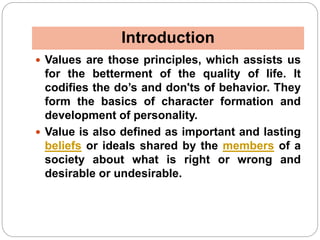
 Values are those principles, which assists us
for the betterment of the quality of life. It
codifies the do’s and don'ts of behavior. They
form the basics of character formation and
development of personality.
 Value is also defined as important and lasting
beliefs or ideals shared by the members of a
society about what is right or wrong and
desirable or undesirable.
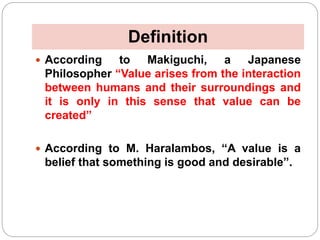
 According to Makiguchi, a Japanese
Philosopher “Value arises from the interaction
between humans and their surroundings and
it is only in this sense that value can be
created”
 According to M. Haralambos, “A value is a
belief that something is good and desirable”.
Definition
Definition
 According to Zaleznik and David, “Values are
the ideas in the mind of men compared to
norms in that they specify how people should
behave. Values also attach degrees of
goodness to activities and relationships”
 Values defined in Organizational Behavior as
the collective conceptions of what is
considered good, desirable, and proper or
bad, undesirable, and improper in a culture.
Characteristics
 Values are relatively permanent.
 These can provide standards of competence
and morality.
 Personal values can be influenced by culture,
tradition, and a combination of internal and
external factors.
 Most of our core values are learned early in
life from family, friends, neighborhood school,
the mass print, visual media and other
sources within the society.
 Values are loaded with effective thoughts
about ideas, objects, behaviour, etc.
 They contain a judgmental element in that
they carry an individual’s ideas as to what is
right, good, or desirable.
 Values can differ from culture to culture and
even person to person.
 Values play a significant role in the integration
and fulfillment of man’s basic impulses and
desire stably and consistently appropriate for
his living.
Characteristics
 Value build up societies, integrate social
relations.
 They mold the ideal dimensions of personality
and depth of culture.
 They have a great role to play in the conduct
of social life. They help in creating norms to
guide day-to-day behaviour.
Characteristics
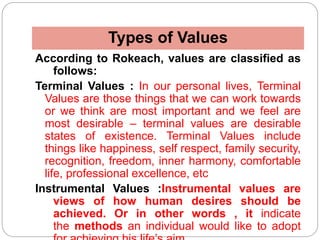
Types of Values
According to Rokeach, values are classified as
follows:
Terminal Values : In our personal lives, Terminal
Values are those things that we can work towards
or we think are most important and we feel are
most desirable – terminal values are desirable
states of existence. Terminal Values include
things like happiness, self respect, family security,
recognition, freedom, inner harmony, comfortable
life, professional excellence, etc
Instrumental Values :Instrumental values are
views of how human desires should be
achieved. Or in other words , it indicate
the methods an individual would like to adopt
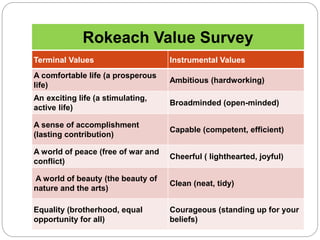
Rokeach Value Survey
Terminal Values Instrumental Values
A comfortable life (a prosperous
life)
Ambitious (hardworking)
An exciting life (a stimulating,
active life)
Broadminded (open-minded)
A sense of accomplishment
(lasting contribution)
Capable (competent, efficient)
A world of peace (free of war and
conflict)
Cheerful ( lighthearted, joyful)
A world of beauty (the beauty of
nature and the arts)
Clean (neat, tidy)
Equality (brotherhood, equal
opportunity for all)
Courageous (standing up for your
beliefs)
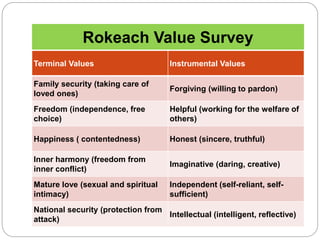
Terminal Values Instrumental Values
Family security (taking care of
loved ones)
Forgiving (willing to pardon)
Freedom (independence, free
choice)
Helpful (working for the welfare of
others)
Happiness ( contentedness) Honest (sincere, truthful)
Inner harmony (freedom from
inner conflict)
Imaginative (daring, creative)
Mature love (sexual and spiritual
intimacy)
Independent (self-reliant, self-
sufficient)
National security (protection from
attack)
Intellectual (intelligent, reflective)
Rokeach Value Survey
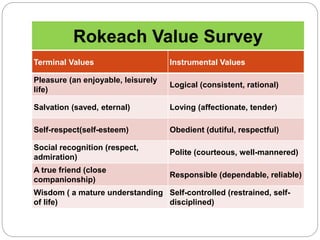
Terminal Values Instrumental Values
Pleasure (an enjoyable, leisurely
life)
Logical (consistent, rational)
Salvation (saved, eternal) Loving (affectionate, tender)
Self-respect(self-esteem) Obedient (dutiful, respectful)
Social recognition (respect,
admiration)
Polite (courteous, well-mannered)
A true friend (close
companionship)
Responsible (dependable, reliable)
Wisdom ( a mature understanding
of life)
Self-controlled (restrained, self-
disciplined)
Rokeach Value Survey
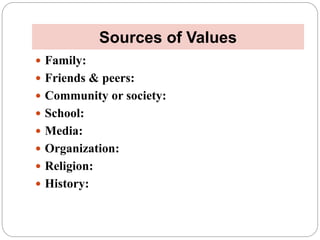
Sources of Values
 Family:
 Friends & peers:
 Community or society:
 School:
 Media:
 Organization:
 Religion:
 History:
Why Value Inculcation ?
 Lack of our education system : Students are
nurtured in a spirit of enormous competition and
are trained right from the beginning to aggressive
competition and facts detached from contexts.
 Learners hardly realize why they are in school,
why they are studying different subjects and how
their schooling will be helpful to them.They hardly
know how they should live their lives, commit
themselves to the welfare of the country, care for
the environment and other social and moral
issues.
 Value crisis : The problem of declining values is
multi dimensional arising out of combination of
major social forces such as globalization,
actualization, consumerism, commercialization of
education, threats to humanity due to climatic
changes, degradation of environment, violence
and terrorism. These lead to insecurities,
individualistic life styles, acceleration of desires,
misuse of science and technology, pessimisms,
sense of alienation and other negative
consequences.
Why Value Inculcation
 Despite considerable development made, our
society is full of conflicts, corruption and violence
as a result of which distortion of value system
occurs in our society.
Why Value Inculcation ?
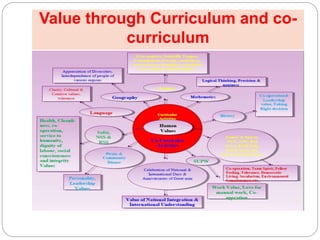
Value through Curriculum and co-
curriculum
Strategies for Value inculcation
 Organization of various clubs like nature club,
adventure club, literature club in the school.
 Organize projects work.
 Organization of educational excursion.
 Organize student self-government, Mock
parliaments, etc.
 Encourage the students to learn more and more
international and regional languages and
provide facilities for the same.
 Organization of exhibitions on history of
freedom movement
 Organize cultural activities like paragraph
writing, storytelling, recitations, group
songs, action songs, solo songs, shadow
play, one act play, group dances, etc. for
developing self confidence, sense of
achievements, self-respect, team spirit and
appreciation.
 Organize national integration exhibitions
depicting the cultural, economic, historical
and social aspects.
Strategies for Value inculcation
 Organizing debates, declamations and paper
reading contests on the suggested topics for
discrimination between right and wrong and
the topics from the lives of great leaders,
patriot, sages etc.
 Have a notice board with “new thought of the
day”- for students to read, reflect and
introspect.
 In the morning assembly include prayer, good
thoughts, talk by teachers, students,
recitations. Patriotic songs of different
languages may be sung as song of the day.
Strategies for Value inculcation
 Organization of social service camps,
cleaning colonies, hospitals, schools,
distribution of food material, medicines,
clothing’s etc. during natural calamities, help
accident victims, lending help to blind, old,
children etc. for developing team spirit,
dignity of labour, helpfulness, service to
humanity, honesty and concern others.
 Organizing inter-house meets, and cultural
meets to develop quality of leadership,
initiative, and fellow feeling amongst the
participants.
Strategies for Value inculcation
 Organizing games-sports, scouting
guiding, NCC and Yoga programmes to
help cultivate sense of discipline,
punctuality, cooperation and spirit of
competition amongst the students.
 Participation of students in national days
and other days of national importance.
 Display quotations from great thinkers on
the themes of value education at all the
suitable corners of the school.
Strategies for Value inculcation
 Ensure active participation of local
community and parents to strengthen
the programme of value education in
schools.
 Ensure that the students participate
in plantation programmes organized
by local communities / NGOs /
Government Departments /
Organizations for improvement of
environment.
Strategies for Value inculcation
 Organization of Meditation : Sitting quietly for a few
minutes with the attention turned inwards towards a
peace-filled realm is good for health. Silent sitting
also helpful in improving self confidence, enhancing
positive emotions and experiencing calmness and
inspiration.
 Story Telling : Authenticate and persuasive tales,
rooted in real world, to be communicated in such a
way so that it is comprehensible and appealing to
students for understanding values.
 Group Singing : Lyric of the meaning song generally
remains in the consciousness for a long time. Singing
in a choir provides an immediate and tangible
manifestation of the power and the joy of co-
operation.
Role of Teacher
 Group Works : Improvement of fundamental
values of love, tolerance, cooperation, peaceful
co-existence, mutual respect is important.
 Reflective practice : Reflective practice is a
process by which individual think over a practice,
consciously analyze the process of decision
making and draw on theory and relate it to what
to do in practice.
 Teaching Accountability :The children should be
encouraged to be accountable for their own
actions and should learn to respect and treat
others kindly.
 Playing Role model : The teachers are the first
role model to the children outside their family.
When the children sees the model showing
concern for others, motivating them for their good
deeds and cooperating and helpful with their
academic issues, the children learn them by
observing and imitate with fellow peers.
Role of Teacher
 Teaching Basic morals and values : The
children are taught basic morals and
values in school. They should be taught by
emphasizing the idea through many
activities, stories and tales, which will
encourage them to engage in more helping
behaviours
 Appreciation : The teacher should
appreciate the children for developing pro-
social behaviour, especially for any
specific action they have done to help
other
Role of Teacher
Value inculcation through teaching

Value inculcation through teaching

  • 1.
    Dr. B CMondal Principal, Nikhil Banga Sikshan Mahavidyalaya Inculcating values among the students
  • 2.
    Introduction  Values arethose principles, which assists us for the betterment of the quality of life. It codifies the do’s and don'ts of behavior. They form the basics of character formation and development of personality.  Value is also defined as important and lasting beliefs or ideals shared by the members of a society about what is right or wrong and desirable or undesirable.
  • 3.
     According toMakiguchi, a Japanese Philosopher “Value arises from the interaction between humans and their surroundings and it is only in this sense that value can be created”  According to M. Haralambos, “A value is a belief that something is good and desirable”. Definition
  • 4.
    Definition  According toZaleznik and David, “Values are the ideas in the mind of men compared to norms in that they specify how people should behave. Values also attach degrees of goodness to activities and relationships”  Values defined in Organizational Behavior as the collective conceptions of what is considered good, desirable, and proper or bad, undesirable, and improper in a culture.
  • 5.
    Characteristics  Values arerelatively permanent.  These can provide standards of competence and morality.  Personal values can be influenced by culture, tradition, and a combination of internal and external factors.  Most of our core values are learned early in life from family, friends, neighborhood school, the mass print, visual media and other sources within the society.
  • 6.
     Values areloaded with effective thoughts about ideas, objects, behaviour, etc.  They contain a judgmental element in that they carry an individual’s ideas as to what is right, good, or desirable.  Values can differ from culture to culture and even person to person.  Values play a significant role in the integration and fulfillment of man’s basic impulses and desire stably and consistently appropriate for his living. Characteristics
  • 7.
     Value buildup societies, integrate social relations.  They mold the ideal dimensions of personality and depth of culture.  They have a great role to play in the conduct of social life. They help in creating norms to guide day-to-day behaviour. Characteristics
  • 8.
    Types of Values Accordingto Rokeach, values are classified as follows: Terminal Values : In our personal lives, Terminal Values are those things that we can work towards or we think are most important and we feel are most desirable – terminal values are desirable states of existence. Terminal Values include things like happiness, self respect, family security, recognition, freedom, inner harmony, comfortable life, professional excellence, etc Instrumental Values :Instrumental values are views of how human desires should be achieved. Or in other words , it indicate the methods an individual would like to adopt
  • 9.
    Rokeach Value Survey TerminalValues Instrumental Values A comfortable life (a prosperous life) Ambitious (hardworking) An exciting life (a stimulating, active life) Broadminded (open-minded) A sense of accomplishment (lasting contribution) Capable (competent, efficient) A world of peace (free of war and conflict) Cheerful ( lighthearted, joyful) A world of beauty (the beauty of nature and the arts) Clean (neat, tidy) Equality (brotherhood, equal opportunity for all) Courageous (standing up for your beliefs)
  • 10.
    Terminal Values InstrumentalValues Family security (taking care of loved ones) Forgiving (willing to pardon) Freedom (independence, free choice) Helpful (working for the welfare of others) Happiness ( contentedness) Honest (sincere, truthful) Inner harmony (freedom from inner conflict) Imaginative (daring, creative) Mature love (sexual and spiritual intimacy) Independent (self-reliant, self- sufficient) National security (protection from attack) Intellectual (intelligent, reflective) Rokeach Value Survey
  • 11.
    Terminal Values InstrumentalValues Pleasure (an enjoyable, leisurely life) Logical (consistent, rational) Salvation (saved, eternal) Loving (affectionate, tender) Self-respect(self-esteem) Obedient (dutiful, respectful) Social recognition (respect, admiration) Polite (courteous, well-mannered) A true friend (close companionship) Responsible (dependable, reliable) Wisdom ( a mature understanding of life) Self-controlled (restrained, self- disciplined) Rokeach Value Survey
  • 12.
    Sources of Values Family:  Friends & peers:  Community or society:  School:  Media:  Organization:  Religion:  History:
  • 13.
    Why Value Inculcation?  Lack of our education system : Students are nurtured in a spirit of enormous competition and are trained right from the beginning to aggressive competition and facts detached from contexts.  Learners hardly realize why they are in school, why they are studying different subjects and how their schooling will be helpful to them.They hardly know how they should live their lives, commit themselves to the welfare of the country, care for the environment and other social and moral issues.
  • 14.
     Value crisis: The problem of declining values is multi dimensional arising out of combination of major social forces such as globalization, actualization, consumerism, commercialization of education, threats to humanity due to climatic changes, degradation of environment, violence and terrorism. These lead to insecurities, individualistic life styles, acceleration of desires, misuse of science and technology, pessimisms, sense of alienation and other negative consequences. Why Value Inculcation
  • 15.
     Despite considerabledevelopment made, our society is full of conflicts, corruption and violence as a result of which distortion of value system occurs in our society. Why Value Inculcation ?
  • 16.
    Value through Curriculumand co- curriculum
  • 17.
    Strategies for Valueinculcation  Organization of various clubs like nature club, adventure club, literature club in the school.  Organize projects work.  Organization of educational excursion.  Organize student self-government, Mock parliaments, etc.  Encourage the students to learn more and more international and regional languages and provide facilities for the same.
  • 18.
     Organization ofexhibitions on history of freedom movement  Organize cultural activities like paragraph writing, storytelling, recitations, group songs, action songs, solo songs, shadow play, one act play, group dances, etc. for developing self confidence, sense of achievements, self-respect, team spirit and appreciation.  Organize national integration exhibitions depicting the cultural, economic, historical and social aspects. Strategies for Value inculcation
  • 19.
     Organizing debates,declamations and paper reading contests on the suggested topics for discrimination between right and wrong and the topics from the lives of great leaders, patriot, sages etc.  Have a notice board with “new thought of the day”- for students to read, reflect and introspect.  In the morning assembly include prayer, good thoughts, talk by teachers, students, recitations. Patriotic songs of different languages may be sung as song of the day. Strategies for Value inculcation
  • 20.
     Organization ofsocial service camps, cleaning colonies, hospitals, schools, distribution of food material, medicines, clothing’s etc. during natural calamities, help accident victims, lending help to blind, old, children etc. for developing team spirit, dignity of labour, helpfulness, service to humanity, honesty and concern others.  Organizing inter-house meets, and cultural meets to develop quality of leadership, initiative, and fellow feeling amongst the participants. Strategies for Value inculcation
  • 21.
     Organizing games-sports,scouting guiding, NCC and Yoga programmes to help cultivate sense of discipline, punctuality, cooperation and spirit of competition amongst the students.  Participation of students in national days and other days of national importance.  Display quotations from great thinkers on the themes of value education at all the suitable corners of the school. Strategies for Value inculcation
  • 22.
     Ensure activeparticipation of local community and parents to strengthen the programme of value education in schools.  Ensure that the students participate in plantation programmes organized by local communities / NGOs / Government Departments / Organizations for improvement of environment. Strategies for Value inculcation
  • 23.
     Organization ofMeditation : Sitting quietly for a few minutes with the attention turned inwards towards a peace-filled realm is good for health. Silent sitting also helpful in improving self confidence, enhancing positive emotions and experiencing calmness and inspiration.  Story Telling : Authenticate and persuasive tales, rooted in real world, to be communicated in such a way so that it is comprehensible and appealing to students for understanding values.  Group Singing : Lyric of the meaning song generally remains in the consciousness for a long time. Singing in a choir provides an immediate and tangible manifestation of the power and the joy of co- operation. Role of Teacher
  • 24.
     Group Works: Improvement of fundamental values of love, tolerance, cooperation, peaceful co-existence, mutual respect is important.  Reflective practice : Reflective practice is a process by which individual think over a practice, consciously analyze the process of decision making and draw on theory and relate it to what to do in practice.
  • 28.
     Teaching Accountability:The children should be encouraged to be accountable for their own actions and should learn to respect and treat others kindly.  Playing Role model : The teachers are the first role model to the children outside their family. When the children sees the model showing concern for others, motivating them for their good deeds and cooperating and helpful with their academic issues, the children learn them by observing and imitate with fellow peers. Role of Teacher
  • 29.
     Teaching Basicmorals and values : The children are taught basic morals and values in school. They should be taught by emphasizing the idea through many activities, stories and tales, which will encourage them to engage in more helping behaviours  Appreciation : The teacher should appreciate the children for developing pro- social behaviour, especially for any specific action they have done to help other Role of Teacher