PERSONALITY
1
Sadique Nayeem
Asst. Professor
Dept. of CSE
Sitamarhi Institute of Technology, Sitamarhi
Personality
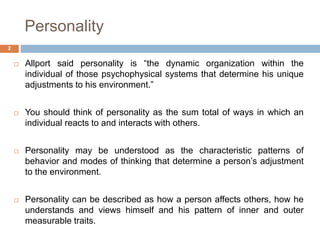
 Allport said personality is “the dynamic organization within the
individual of those psychophysical systems that determine his unique
adjustments to his environment.”
 You should think of personality as the sum total of ways in which an
individual reacts to and interacts with others.
 Personality may be understood as the characteristic patterns of
behavior and modes of thinking that determine a person’s adjustment
to the environment.
 Personality can be described as how a person affects others, how he
understands and views himself and his pattern of inner and outer
measurable traits.
2
Determinants of Personality
3
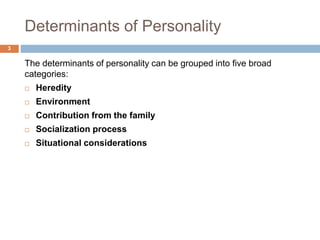
The determinants of personality can be grouped into five broad
categories:
 Heredity
 Environment
 Contribution from the family
 Socialization process
 Situational considerations
Personality Traits
4
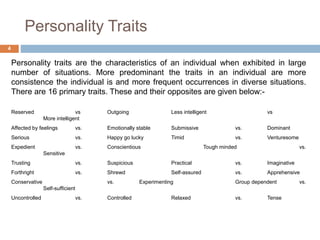
Personality traits are the characteristics of an individual when exhibited in large
number of situations. More predominant the traits in an individual are more
consistence the individual is and more frequent occurrences in diverse situations.
There are 16 primary traits. These and their opposites are given below:-
Reserved vs Outgoing Less intelligent vs
More intelligent
Affected by feelings vs. Emotionally stable Submissive vs. Dominant
Serious vs. Happy go lucky Timid vs. Venturesome
Expedient vs. Conscientious Tough minded vs.
Sensitive
Trusting vs. Suspicious Practical vs. Imaginative
Forthright vs. Shrewd Self-assured vs. Apprehensive
Conservative vs. Experimenting Group dependent vs.
Self-sufficient
Uncontrolled vs. Controlled Relaxed vs. Tense
MAJOR TRAITS INFLUENCING
ORGANIZATIONAL BEHAVIOUR
5
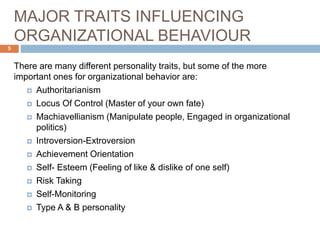
There are many different personality traits, but some of the more
important ones for organizational behavior are:
 Authoritarianism
 Locus Of Control (Master of your own fate)
 Machiavellianism (Manipulate people, Engaged in organizational
politics)
 Introversion-Extroversion
 Achievement Orientation
 Self- Esteem (Feeling of like & dislike of one self)
 Risk Taking
 Self-Monitoring
 Type A & B personality
Type A & B personality
6
 Type A: People having Type A personality are always moving, walking
and eating rapidly. They feel impatient with the speed the events take
place. They always strive to do two or three thing at any one time and
cannot cope with leisure. They are generally obsessed with work
involved with numbers.
 Type B: People possessing Type B personality never suffer from
sense of urgency and take thing as it comes coolly. They do not
discuss achievement and leave it to the superiors to identify it. People
having B type of personality play for fun and relaxation rather than to
show off. These people have the tendency to relax without guilt.
The End
7

Personality

  • 1.
    PERSONALITY 1 Sadique Nayeem Asst. Professor Dept.of CSE Sitamarhi Institute of Technology, Sitamarhi
  • 2.
    Personality  Allport saidpersonality is “the dynamic organization within the individual of those psychophysical systems that determine his unique adjustments to his environment.”  You should think of personality as the sum total of ways in which an individual reacts to and interacts with others.  Personality may be understood as the characteristic patterns of behavior and modes of thinking that determine a person’s adjustment to the environment.  Personality can be described as how a person affects others, how he understands and views himself and his pattern of inner and outer measurable traits. 2
  • 3.
    Determinants of Personality 3 Thedeterminants of personality can be grouped into five broad categories:  Heredity  Environment  Contribution from the family  Socialization process  Situational considerations
  • 4.
    Personality Traits 4 Personality traitsare the characteristics of an individual when exhibited in large number of situations. More predominant the traits in an individual are more consistence the individual is and more frequent occurrences in diverse situations. There are 16 primary traits. These and their opposites are given below:- Reserved vs Outgoing Less intelligent vs More intelligent Affected by feelings vs. Emotionally stable Submissive vs. Dominant Serious vs. Happy go lucky Timid vs. Venturesome Expedient vs. Conscientious Tough minded vs. Sensitive Trusting vs. Suspicious Practical vs. Imaginative Forthright vs. Shrewd Self-assured vs. Apprehensive Conservative vs. Experimenting Group dependent vs. Self-sufficient Uncontrolled vs. Controlled Relaxed vs. Tense
  • 5.
    MAJOR TRAITS INFLUENCING ORGANIZATIONALBEHAVIOUR 5 There are many different personality traits, but some of the more important ones for organizational behavior are:  Authoritarianism  Locus Of Control (Master of your own fate)  Machiavellianism (Manipulate people, Engaged in organizational politics)  Introversion-Extroversion  Achievement Orientation  Self- Esteem (Feeling of like & dislike of one self)  Risk Taking  Self-Monitoring  Type A & B personality
  • 6.
    Type A &B personality 6  Type A: People having Type A personality are always moving, walking and eating rapidly. They feel impatient with the speed the events take place. They always strive to do two or three thing at any one time and cannot cope with leisure. They are generally obsessed with work involved with numbers.  Type B: People possessing Type B personality never suffer from sense of urgency and take thing as it comes coolly. They do not discuss achievement and leave it to the superiors to identify it. People having B type of personality play for fun and relaxation rather than to show off. These people have the tendency to relax without guilt.
  • 7.