COMPUTER
WORMS
Pondicherry University
By:
SADIQUE
NAYEEM
Worms
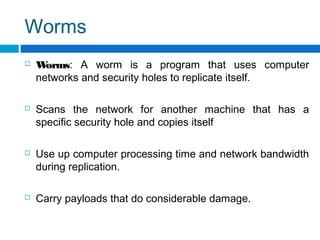
 Worms: A worm is a program that uses computer
networks and security holes to replicate itself.
 Scans the network for another machine that has a
specific security hole and copies itself
 Use up computer processing time and network bandwidth
during replication.
 Carry payloads that do considerable damage.
Virus v/s Worm
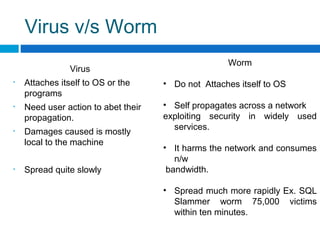
Virus
• Attaches itself to OS or the
programs
• Need user action to abet their
propagation.
• Damages caused is mostly
local to the machine
• Spread quite slowly
Worm
• Do not Attaches itself to OS
• Self propagates across a network
exploiting security in widely used
services.
• It harms the network and consumes
n/w
bandwidth.
• Spread much more rapidly Ex. SQL
Slammer worm 75,000 victims
within ten minutes.
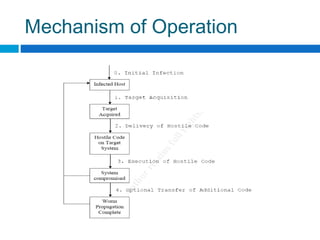
Mechanism of Operation
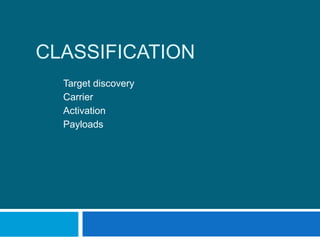
CLASSIFICATION
Target discovery
Carrier
Activation
Payloads
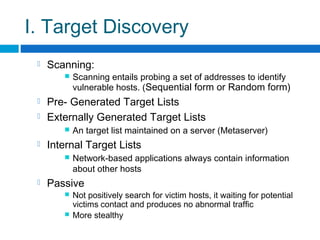
I. Target Discovery
 Scanning:
 Scanning entails probing a set of addresses to identify
vulnerable hosts. (Sequential form or Random form)
 Pre- Generated Target Lists
 Externally Generated Target Lists
 An target list maintained on a server (Metaserver)
 Internal Target Lists
 Network-based applications always contain information
about other hosts
 Passive
 Not positively search for victim hosts, it waiting for potential
victims contact and produces no abnormal traffic
 More stealthy
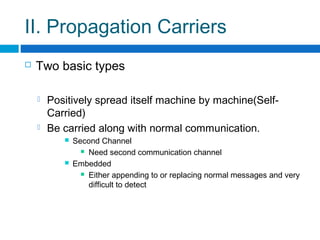
II. Propagation Carriers
 Two basic types
 Positively spread itself machine by machine(Self-
Carried)
 Be carried along with normal communication.
 Second Channel
 Need second communication channel
 Embedded
 Either appending to or replacing normal messages and very
difficult to detect
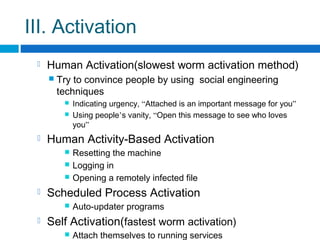
III. Activation
 Human Activation(slowest worm activation method)
 Try to convince people by using social engineering
techniques
 Indicating urgency, “Attached is an important message for you”
 Using people’s vanity, “Open this message to see who loves
you”
 Human Activity-Based Activation
 Resetting the machine
 Logging in
 Opening a remotely infected file
 Scheduled Process Activation
 Auto-updater programs
 Self Activation(fastest worm activation)
 Attach themselves to running services
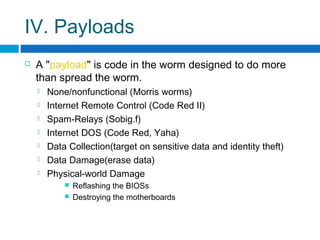
IV. Payloads
 A "payload" is code in the worm designed to do more
than spread the worm.
 None/nonfunctional (Morris worms)
 Internet Remote Control (Code Red II)
 Spam-Relays (Sobig.f)
 Internet DOS (Code Red, Yaha)
 Data Collection(target on sensitive data and identity theft)
 Data Damage(erase data)
 Physical-world Damage
 Reflashing the BIOSs
 Destroying the motherboards
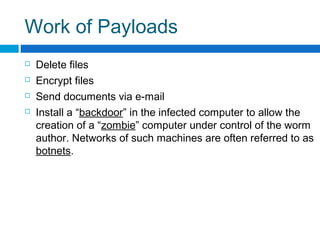
Work of Payloads
 Delete files
 Encrypt files
 Send documents via e-mail
 Install a “backdoor” in the infected computer to allow the
creation of a “zombie” computer under control of the worm
author. Networks of such machines are often referred to as
botnets.
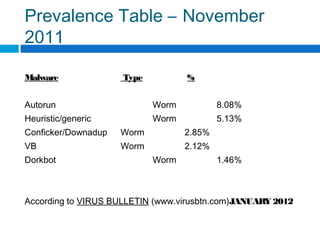
Prevalence Table – November
2011
Malware Type %
Autorun Worm 8.08%
Heuristic/generic Worm 5.13%
Conficker/Downadup Worm 2.85%
VB Worm 2.12%
Dorkbot Worm 1.46%
According to VIRUS BULLETIN (www.virusbtn.com)JANUARY 2012
Motivation
 experimental curiosity(Morris worms)
 pride
 extortion and criminal gain
 random protest
 political protest
 terrorism
 Cyber warfare
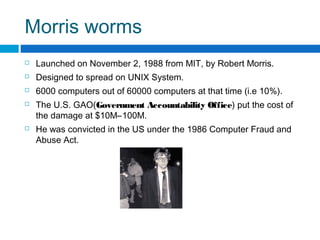
Morris worms
 Launched on November 2, 1988 from MIT, by Robert Morris.
 Designed to spread on UNIX System.
 6000 computers out of 60000 computers at that time (i.e 10%).
 The U.S. GAO(Government Accountability Office) put the cost of
the damage at $10M–100M.
 He was convicted in the US under the 1986 Computer Fraud and
Abuse Act.
Code Red
 Made huge headlines in 2001.
 It slowed down Internet traffic when it began to replicate itself.
 Worm scanned the Internet for unpatched Windows NT or Windows
2000 servers.
 The Code Red worm had instructions to do three things:
 Replicate itself for the first 20 days of each month
 Replace Web pages featuring the message "Hacked by
Chinese"
 Launch a concerted attack on the White House Web site.
----The U.S. government changed the IP address of
www.whitehouse.gov (198.137.240.91).
Nimda
 The worm was released on September 18, 2001
 the Internet’s most widespread virus/worm within 22 minutes.
 Nimda affected both user workstations (clients) running Windows
95, 98, Me, NT, 2000 or XP and servers running Windows NT and
2000.
 Nimda spread by five different infection vectors:
 via email
 via open network shares
 via browsing of compromised web sites
 via back doors left behind by the "Code Red II" and "sadmind/IIS" worms.
SQL Slammer worm
 Starting on January 25, 2003. It spread rapidly, infecting most of its
75,000 victims within ten minutes.
 Although titled "SQL slammer worm", the program did not use the
SQL language
 It exploited a buffer overflow bug in Microsoft's SQL Server
 Slammer's tiny (376 byte) program.
Sobig.f Worm
 In late 2003, the Sobig.f worm exploited open proxy servers to turn
infected machines into a spam engine.
 The Sobig worm appears as an electronic mail with one of the
following subjects: Re: Approved, Re: Details, Re: My details, Re:
Thank you!, Re: That movie etc.
 It will contain the text: "See the attached file for details” and have
attachments such as application.pif, details.pif, movie0045.pif etc.
 At its peak Sobig.f reportedly accounted for 1 in every 17
messages.
 It produced more than one million copies of itself with in the first 24
hours.
 It was written using the Microsoft Visual C++ compiler.
Prevention
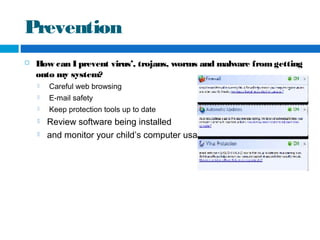
 How can I prevent virus’, trojans, worms and malware fromgetting
onto my system?
 Careful web browsing
 E-mail safety
 Keep protection tools up to date
 Review software being installed
 and monitor your child’s computer usage
Current research Focus
 Modelling: To model Worm propagation
 Scanning Techniques
 Sequential Scanning
 Hit List Based Scanning
 Permutation Scanning
 Preferential Subnet Scanning
 Propagation Mechanisms
 Prevention Techniques
Refrences
1. VIRUS BULLETIN (www.virusbtn.com)JANUARY 2012
2. A Taxonomy of ComputerWorms WO RM’0 3, O cto be r 27 , 20 0 3,
Washing to n, DC, USA.
3. www.vxheavens.com
4. www. wikipe dia. co m
5. www. ho wstuffwo rks. co m
6. NetworkSecurity Essentials -William Stallings

Computer Worms

  • 1.
  • 2.
    Worms  Worms: Aworm is a program that uses computer networks and security holes to replicate itself.  Scans the network for another machine that has a specific security hole and copies itself  Use up computer processing time and network bandwidth during replication.  Carry payloads that do considerable damage.
  • 3.
    Virus v/s Worm Virus •Attaches itself to OS or the programs • Need user action to abet their propagation. • Damages caused is mostly local to the machine • Spread quite slowly Worm • Do not Attaches itself to OS • Self propagates across a network exploiting security in widely used services. • It harms the network and consumes n/w bandwidth. • Spread much more rapidly Ex. SQL Slammer worm 75,000 victims within ten minutes.
  • 4.
  • 5.
  • 6.
    I. Target Discovery Scanning:  Scanning entails probing a set of addresses to identify vulnerable hosts. (Sequential form or Random form)  Pre- Generated Target Lists  Externally Generated Target Lists  An target list maintained on a server (Metaserver)  Internal Target Lists  Network-based applications always contain information about other hosts  Passive  Not positively search for victim hosts, it waiting for potential victims contact and produces no abnormal traffic  More stealthy
  • 7.
    II. Propagation Carriers Two basic types  Positively spread itself machine by machine(Self- Carried)  Be carried along with normal communication.  Second Channel  Need second communication channel  Embedded  Either appending to or replacing normal messages and very difficult to detect
  • 8.
    III. Activation  HumanActivation(slowest worm activation method)  Try to convince people by using social engineering techniques  Indicating urgency, “Attached is an important message for you”  Using people’s vanity, “Open this message to see who loves you”  Human Activity-Based Activation  Resetting the machine  Logging in  Opening a remotely infected file  Scheduled Process Activation  Auto-updater programs  Self Activation(fastest worm activation)  Attach themselves to running services
  • 9.
    IV. Payloads  A"payload" is code in the worm designed to do more than spread the worm.  None/nonfunctional (Morris worms)  Internet Remote Control (Code Red II)  Spam-Relays (Sobig.f)  Internet DOS (Code Red, Yaha)  Data Collection(target on sensitive data and identity theft)  Data Damage(erase data)  Physical-world Damage  Reflashing the BIOSs  Destroying the motherboards
  • 10.
    Work of Payloads Delete files  Encrypt files  Send documents via e-mail  Install a “backdoor” in the infected computer to allow the creation of a “zombie” computer under control of the worm author. Networks of such machines are often referred to as botnets.
  • 11.
    Prevalence Table –November 2011 Malware Type % Autorun Worm 8.08% Heuristic/generic Worm 5.13% Conficker/Downadup Worm 2.85% VB Worm 2.12% Dorkbot Worm 1.46% According to VIRUS BULLETIN (www.virusbtn.com)JANUARY 2012
  • 12.
    Motivation  experimental curiosity(Morrisworms)  pride  extortion and criminal gain  random protest  political protest  terrorism  Cyber warfare
  • 13.
    Morris worms  Launchedon November 2, 1988 from MIT, by Robert Morris.  Designed to spread on UNIX System.  6000 computers out of 60000 computers at that time (i.e 10%).  The U.S. GAO(Government Accountability Office) put the cost of the damage at $10M–100M.  He was convicted in the US under the 1986 Computer Fraud and Abuse Act.
  • 14.
    Code Red  Madehuge headlines in 2001.  It slowed down Internet traffic when it began to replicate itself.  Worm scanned the Internet for unpatched Windows NT or Windows 2000 servers.  The Code Red worm had instructions to do three things:  Replicate itself for the first 20 days of each month  Replace Web pages featuring the message "Hacked by Chinese"  Launch a concerted attack on the White House Web site. ----The U.S. government changed the IP address of www.whitehouse.gov (198.137.240.91).
  • 15.
    Nimda  The wormwas released on September 18, 2001  the Internet’s most widespread virus/worm within 22 minutes.  Nimda affected both user workstations (clients) running Windows 95, 98, Me, NT, 2000 or XP and servers running Windows NT and 2000.  Nimda spread by five different infection vectors:  via email  via open network shares  via browsing of compromised web sites  via back doors left behind by the "Code Red II" and "sadmind/IIS" worms.
  • 16.
    SQL Slammer worm Starting on January 25, 2003. It spread rapidly, infecting most of its 75,000 victims within ten minutes.  Although titled "SQL slammer worm", the program did not use the SQL language  It exploited a buffer overflow bug in Microsoft's SQL Server  Slammer's tiny (376 byte) program.
  • 17.
    Sobig.f Worm  Inlate 2003, the Sobig.f worm exploited open proxy servers to turn infected machines into a spam engine.  The Sobig worm appears as an electronic mail with one of the following subjects: Re: Approved, Re: Details, Re: My details, Re: Thank you!, Re: That movie etc.  It will contain the text: "See the attached file for details” and have attachments such as application.pif, details.pif, movie0045.pif etc.  At its peak Sobig.f reportedly accounted for 1 in every 17 messages.  It produced more than one million copies of itself with in the first 24 hours.  It was written using the Microsoft Visual C++ compiler.
  • 18.
    Prevention  How canI prevent virus’, trojans, worms and malware fromgetting onto my system?  Careful web browsing  E-mail safety  Keep protection tools up to date  Review software being installed  and monitor your child’s computer usage
  • 19.
    Current research Focus Modelling: To model Worm propagation  Scanning Techniques  Sequential Scanning  Hit List Based Scanning  Permutation Scanning  Preferential Subnet Scanning  Propagation Mechanisms  Prevention Techniques
  • 20.
    Refrences 1. VIRUS BULLETIN(www.virusbtn.com)JANUARY 2012 2. A Taxonomy of ComputerWorms WO RM’0 3, O cto be r 27 , 20 0 3, Washing to n, DC, USA. 3. www.vxheavens.com 4. www. wikipe dia. co m 5. www. ho wstuffwo rks. co m 6. NetworkSecurity Essentials -William Stallings