2
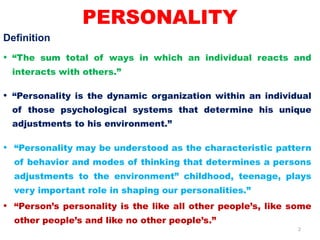
PERSONALITY
Definition
• “The sumtotal of ways in which an individual reacts and
interacts with others.”
• “Personality is the dynamic organization within an individual
of those psychological systems that determine his unique
adjustments to his environment.”
• “Personality may be understood as the characteristic pattern
of behavior and modes of thinking that determines a persons
adjustments to the environment” childhood, teenage, plays
very important role in shaping our personalities.”
• “Person’s personality is the like all other people’s, like some
other people’s and like no other people’s.”
3.
3
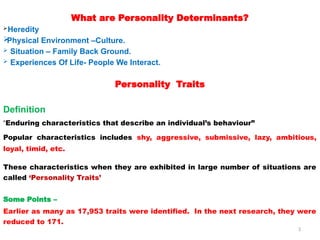
What are PersonalityDeterminants?
Heredity
Physical Environment –Culture.
Situation – Family Back Ground.
Experiences Of Life- People We Interact.
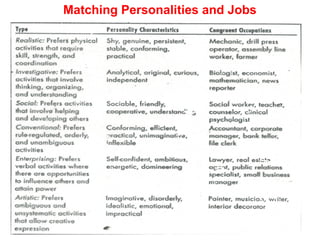
Personality Traits
Definition
“Enduring characteristics that describe an individual’s behaviour”
Popular characteristics includes shy, aggressive, submissive, lazy, ambitious,
loyal, timid, etc.
These characteristics when they are exhibited in large number of situations are
called ‘Personality Traits’
Some Points –
Earlier as many as 17,953 traits were identified. In the next research, they were
reduced to 171.
4.
4
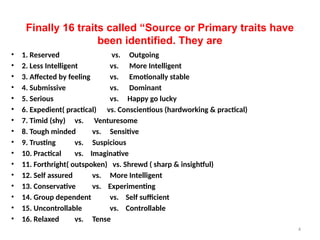
Finally 16 traitscalled “Source or Primary traits have
been identified. They are
• 1. Reserved vs. Outgoing
• 2. Less Intelligent vs. More Intelligent
• 3. Affected by feeling vs. Emotionally stable
• 4. Submissive vs. Dominant
• 5. Serious vs. Happy go lucky
• 6. Expedient( practical) vs. Conscientious (hardworking & practical)
• 7. Timid (shy) vs. Venturesome
• 8. Tough minded vs. Sensitive
• 9. Trusting vs. Suspicious
• 10. Practical vs. Imaginative
• 11. Forthright( outspoken) vs. Shrewd ( sharp & insightful)
• 12. Self assured vs. More Intelligent
• 13. Conservative vs. Experimenting
• 14. Group dependent vs. Self sufficient
• 15. Uncontrollable vs. Controllable
• 16. Relaxed vs. Tense
6
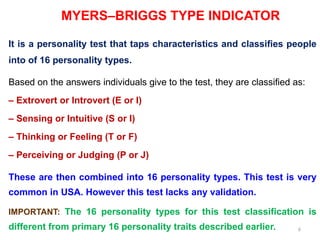
MYERS–BRIGGS TYPE INDICATOR
Itis a personality test that taps characteristics and classifies people
into of 16 personality types.
Based on the answers individuals give to the test, they are classified as:
– Extrovert or Introvert (E or I)
– Sensing or Intuitive (S or I)
– Thinking or Feeling (T or F)
– Perceiving or Judging (P or J)
These are then combined into 16 personality types. This test is very
common in USA. However this test lacks any validation.
IMPORTANT: The 16 personality types for this test classification is
different from primary 16 personality traits described earlier.
7.
7
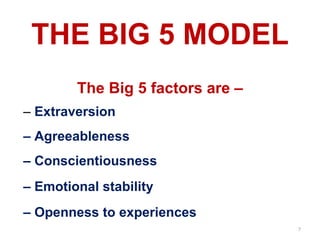
THE BIG 5MODEL
The Big 5 factors are –
– Extraversion
– Agreeableness
– Conscientiousness
– Emotional stability
– Openness to experiences
8.
8
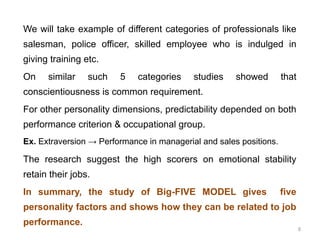
We will takeexample of different categories of professionals like
salesman, police officer, skilled employee who is indulged in
giving training etc.
On similar such 5 categories studies showed that
conscientiousness is common requirement.
For other personality dimensions, predictability depended on both
performance criterion & occupational group.
Ex. Extraversion → Performance in managerial and sales positions.
The research suggest the high scorers on emotional stability
retain their jobs.
In summary, the study of Big-FIVE MODEL gives five
personality factors and shows how they can be related to job
performance.
9.
9
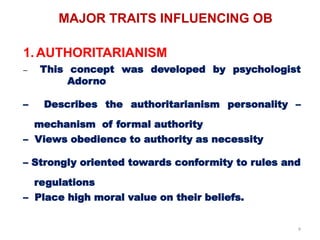
MAJOR TRAITS INFLUENCINGOB
1. AUTHORITARIANISM
– This concept was developed by psychologist
Adorno
– Describes the authoritarianism personality –
mechanism of formal authority
– Views obedience to authority as necessity
– Strongly oriented towards conformity to rules and
regulations
– Place high moral value on their beliefs.
10.
10
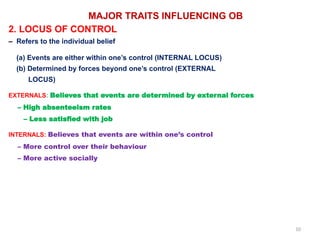
MAJOR TRAITS INFLUENCINGOB
2. LOCUS OF CONTROL
– Refers to the individual belief
(a) Events are either within one’s control (INTERNAL LOCUS)
(b) Determined by forces beyond one’s control (EXTERNAL
LOCUS)
EXTERNALS: Believes that events are determined by external forces
– High absenteeism rates
– Less satisfied with job
INTERNALS: Believes that events are within one’s control
– More control over their behaviour
– More active socially
11.
11
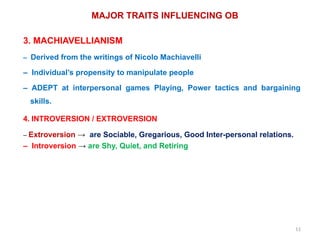
MAJOR TRAITS INFLUENCINGOB
3. MACHIAVELLIANISM
– Derived from the writings of Nicolo Machiavelli
– Individual’s propensity to manipulate people
– ADEPT at interpersonal games Playing, Power tactics and bargaining
skills.
4. INTROVERSION / EXTROVERSION
– Extroversion → are Sociable, Gregarious, Good Inter-personal relations.
– Introversion → are Shy, Quiet, and Retiring
12.
12
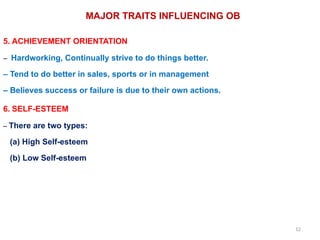
MAJOR TRAITS INFLUENCINGOB
5. ACHIEVEMENT ORIENTATION
– Hardworking, Continually strive to do things better.
– Tend to do better in sales, sports or in management
– Believes success or failure is due to their own actions.
6. SELF-ESTEEM
– There are two types:
(a) High Self-esteem
(b) Low Self-esteem
13.
13
MAJOR TRAITS INFLUENCINGOB
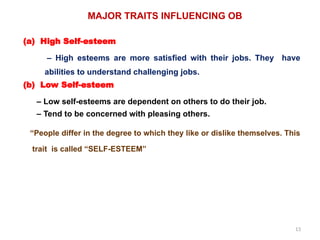
(a) High Self-esteem
– High esteems are more satisfied with their jobs. They have
abilities to understand challenging jobs.
(b) Low Self-esteem
– Low self-esteems are dependent on others to do their job.
– Tend to be concerned with pleasing others.
“People differ in the degree to which they like or dislike themselves. This
trait is called “SELF-ESTEEM”