

PERSONALITY
General Psychology (1/23)
    C. Sagarbarria
Personality
Personality - the unique and
relatively stable ways in which
people think, feel, and behave
“Characteristic patterns of
behavior, thought, and emotion that
determine a person’s adjustment to
environment”
THREE FORCES IN THE
STUDY OF PERSONALITY
The Psychodynamic Perspective
  Focuses on the role of the unconscious mind in the
  development of personality
The Behaviorist Perspective
  Focuses on the effect of the environment on behavior
The Humanist Perspective
  Focuses on the role of each person’s real-life
  experiences and choices in personality development
The Man and the Couch: Sigmund
 Freud and the Psychodynamic
         Perspective
Freud’s Psychoanalytic Approach
Jung’s* Analytic Psychology
Adler’s* Individual Psychology
Horney’s* Socio-Cultural Approach
 * - called Neo-Freudians
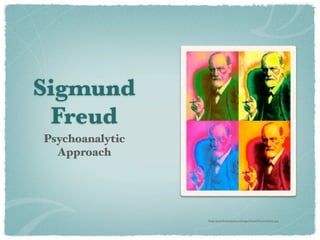
Sigmund
  Freud
Psychoanalytic
  Approach


                 http://psychoanalysis.cz/images/freud%20warhol1.jpg
Freud’s Psychoanalytic
      Approach
Freud believed that the mind was
divided into three parts:
 Preconscious
 Conscious
 Unconscious
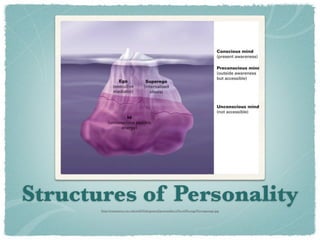
3 structures of Personality:

 ID - consists of instincts and urges ,
 operates on pleasure principle (If it
 feels good, do it)

 EGO- rational and logical, works on
 the reality principle (If it feels good, do
 it - but only if you can get away with it )

 SUPEREGO - houses the conscience,
 the moral compass of our personality
 (why even bother, you’re gonna get
 caught anyway)
Structures of Personality
       http://www.pierce.ctc.edu/staff/tlink/general/personality/4%20id%20ego%20superego.jpg
The Angel,
The Devil,
 and Me
How the 3 structures
 of our personality
   work together
Defense
Mechanisms
Methods employed
by the ego to reduce
  the conflict and
anxiety brought on
 by the Id and the
     Superego

                       http://www.savagechickens.com/images/chickenhangover3.jpg
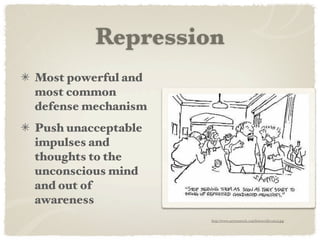
Repression
Most powerful and
most common
defense mechanism
Push unacceptable
impulses and
thoughts to the
unconscious mind
and out of
awareness
                    http://www.cartoonstock.com/lowres/shr0964l.jpg
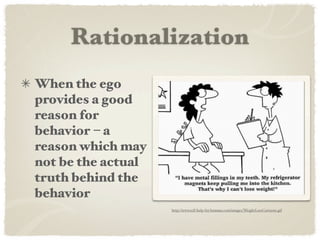
Rationalization
When the ego
provides a good
reason for
behavior – a
reason which may
not be the actual
truth behind the
behavior
                    http://www.self-help-for-humans.com/images/WeightLossCartoon1.gif
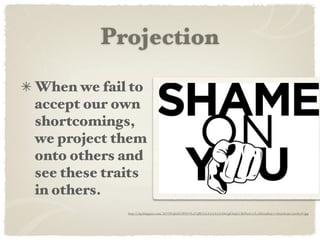
Projection
When we fail to
accept our own
shortcomings,
we project them
onto others and
see these traits
in others.
             http://3.bp.blogspot.com/_btVf1Fq8z8A/S8YvYb4NqBI/AAAAAAAAASw/giOunJ0Ole8/s1600/l_e8d219385ac777ba3ed03ac7ea1d90f7.jpg
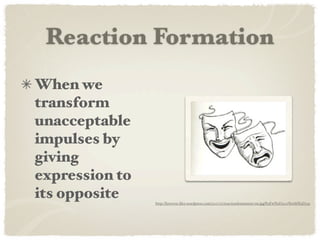
Reaction Formation
When we
transform
unacceptable
impulses by
giving
expression to
its opposite    http://listverse.files.wordpress.com/2007/11/reactionformation-tm.jpg%3Fw%3D300%26h%3D233
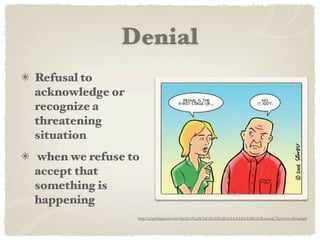
Denial
Refusal to
acknowledge or
recognize a
threatening
situation
when we refuse to
accept that
something is
happening
                 http://4.bp.blogspot.com/-6jaAJ7vV4Ak/TjCD0SXbaJI/AAAAAAAAAjk/7URzm41gCX4/s1600/denial.gif
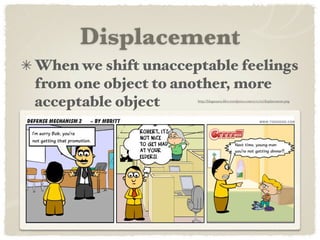
Displacement
When we shift unacceptable feelings
from one object to another, more
acceptable object    http://blogasarea.files.wordpress.com/2010/12/displacement.png
Sublimation

 A type of displacement

 When the ego replaces
 unacceptable impulse with a
 socially approved course of action
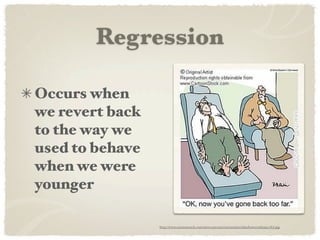
Regression

Occurs when
we revert back
to the way we
used to behave
when we were
younger

                 http://www.cartoonstock.com/newscartoons/cartoonists/mba/lowres/mban2082l.jpg
Compensation

 The process of concealing or
offsetting a psychological difficulty
by developing in another direction.
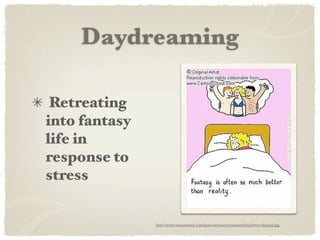
Daydreaming

 Retreating
into fantasy
life in
response to
stress


               http://www.cartoonstock.com/newscartoons/cartoonists/kta/lowres/ktan35l.jpg
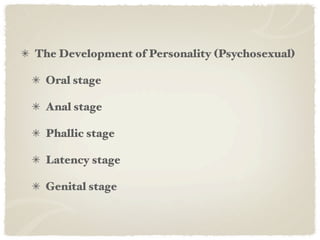
The Development of Personality (Psychosexual)

 Oral stage

 Anal stage

 Phallic stage

 Latency stage

 Genital stage
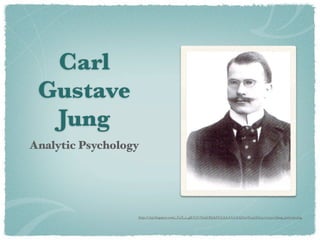
Carl
 Gustave
  Jung
Analytic Psychology


                  http://1.bp.blogspot.com/_T4X_e_gKYyU/SyjaLBJyhZI/AAAAAAAADzo/Fj4syIzG400/s400/Jung_portrait.png
Emphasized the greater role of the
unconscious

 Personal Unconscious&

   Part of the mind that is rarely accessible
   to awareness

 Collective Unconscious

   The impersonal, deepest layer of the
   unconscious mind that is shared by all
   human beings
Archetypes

 Emotionally laden ideas and
 images in the Collective
 Unconscious that have rich and
 symbolic meaning

 Emerge in Art, Religion,
 Literature, and dreams
Anima (Woman - feminine side of a man)

Animus (Man - masculine side of a
woman)

Mandala (Self - individuality)

Persona (our alter-ego)

Shadow (Darker Self - the darker,
immoral self)
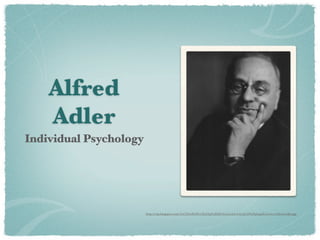
Alfred
    Adler
Individual Psychology


                        http://1.bp.blogspot.com/-Z2CHw1BAB7s/TarFbpUxKBI/AAAAAAAACqA/tPt1PpLqmEA/s1600/alfred+adler.jpg
Individual Psychology

 The primary concept of Individual
 Psychology is inferiority and the
 crux of human condition is the
 struggle against inferiority and the
 attainment of superiority
Inferiority Complex

 Exaggerated feelings of weakness
 and inadequacy

Superiority Complex

 Exaggerated feelings of self-
 importance, assumed mainly to
 mask very strong feelings of
 inferiority
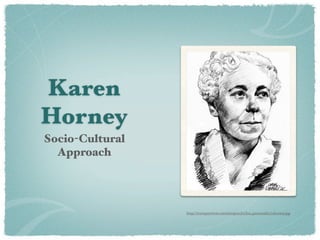
Karen
Horney
Socio-Cultural
  Approach


                 http://www.psywww.com/intropsych/ch11_personality/11horney.jpg
Disagreed with Freud’s Penis Envy

 Countered it with her own concept of womb
 envy

As children, we develop a sense of basic anxiety

 People whose parents give them love,
 affection, and security overcome this anxiety

 Those with less secure upbringing develop
 neurotic tendencies
moving towards people

 seek love, support, safety – being
 dependent on others

moving away from people

 becoming more independent

moving against people

 becoming competitive and domineering -
 aggressive
BEHAVIORAL
      APPROACH

The Associative Learning Approach
The Social Learning Approach
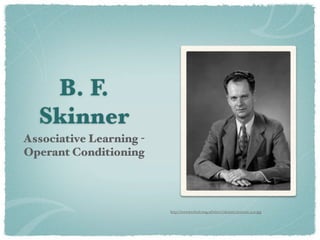
B. F.
  Skinner
Associative Learning -
Operant Conditioning


                         http://www.leerbeleving.nl/wbts/1/skinner-portrait-40s.jpg
B.F. Skinner

 Major influence and impact on
 mainstream Psychology

Personality

 A collection of observable and overt or
 outward behaviors

 Behaviors are learned through reward
 and punishment experiences
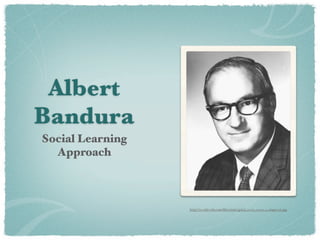
Albert
Bandura
Social Learning
  Approach


                  http://01.edu-cdn.com/files/static/g/pcl_0001_0001_0_img0016.jpg
People learn new behavior through
overt reinforcement or punishment,
via observational learning of the
social factors in their environment.

Learning can take place even if we
have not experienced (punished or
rewarded) it ourselves - vicarious
learning
The Phenomenological
or Humanistic Approach


 Carl Rogers
 Abraham Maslow
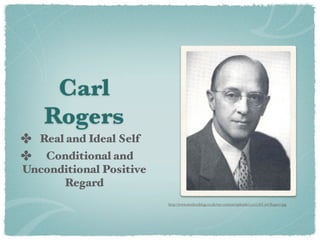
Carl
    Rogers
✤ Real and Ideal Self
✤ Conditional and
Unconditional Positive
      Regard
                         http://www.modernblog.co.uk/wp-content/uploads/2011/08/Carl-Rogers.jpg
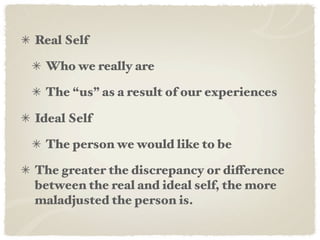
Real Self

 Who we really are

 The “us” as a result of our experiences

Ideal Self

 The person we would like to be

The greater the discrepancy or difference
between the real and ideal self, the more
maladjusted the person is.
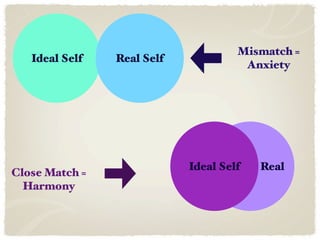
Mismatch =
   Ideal Self   Real Self
                                      Anxiety


                            Ideal Self   Real
Close Match =
  Harmony
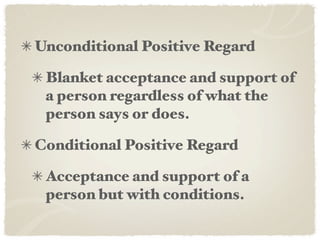
Unconditional Positive Regard

 Blanket acceptance and support of
 a person regardless of what the
 person says or does.

Conditional Positive Regard

 Acceptance and support of a
 person but with conditions.
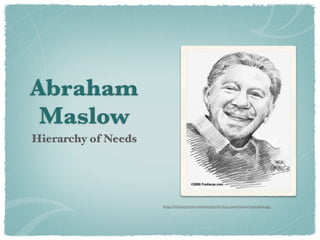
Abraham
 Maslow
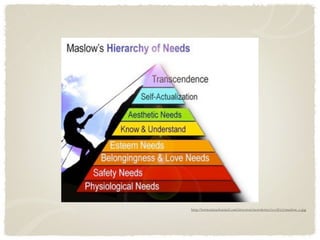
Hierarchy of Needs


                     http://www.psywww.com/intropsych/ch09_motivation/09maslow.jpg
Proposed a Hierarchy of Needs

Ascending from basic biological
needs to more complex
psychological motivations
http://www.miraclemind.com/investors/newsletter/2008/5/5/maslow_2.jpg

Personality

  • 1.
  • 2.
    Personality Personality - theunique and relatively stable ways in which people think, feel, and behave “Characteristic patterns of behavior, thought, and emotion that determine a person’s adjustment to environment”
  • 3.
    THREE FORCES INTHE STUDY OF PERSONALITY The Psychodynamic Perspective Focuses on the role of the unconscious mind in the development of personality The Behaviorist Perspective Focuses on the effect of the environment on behavior The Humanist Perspective Focuses on the role of each person’s real-life experiences and choices in personality development
  • 4.
    The Man andthe Couch: Sigmund Freud and the Psychodynamic Perspective Freud’s Psychoanalytic Approach Jung’s* Analytic Psychology Adler’s* Individual Psychology Horney’s* Socio-Cultural Approach * - called Neo-Freudians
  • 5.
    Sigmund Freud Psychoanalytic Approach http://psychoanalysis.cz/images/freud%20warhol1.jpg
  • 6.
    Freud’s Psychoanalytic Approach Freud believed that the mind was divided into three parts: Preconscious Conscious Unconscious
  • 7.
    3 structures ofPersonality: ID - consists of instincts and urges , operates on pleasure principle (If it feels good, do it) EGO- rational and logical, works on the reality principle (If it feels good, do it - but only if you can get away with it ) SUPEREGO - houses the conscience, the moral compass of our personality (why even bother, you’re gonna get caught anyway)
  • 8.
    Structures of Personality http://www.pierce.ctc.edu/staff/tlink/general/personality/4%20id%20ego%20superego.jpg
  • 9.
    The Angel, The Devil, and Me How the 3 structures of our personality work together
  • 10.
    Defense Mechanisms Methods employed by theego to reduce the conflict and anxiety brought on by the Id and the Superego http://www.savagechickens.com/images/chickenhangover3.jpg
  • 11.
    Repression Most powerful and mostcommon defense mechanism Push unacceptable impulses and thoughts to the unconscious mind and out of awareness http://www.cartoonstock.com/lowres/shr0964l.jpg
  • 12.
    Rationalization When the ego providesa good reason for behavior – a reason which may not be the actual truth behind the behavior http://www.self-help-for-humans.com/images/WeightLossCartoon1.gif
  • 13.
    Projection When we failto accept our own shortcomings, we project them onto others and see these traits in others. http://3.bp.blogspot.com/_btVf1Fq8z8A/S8YvYb4NqBI/AAAAAAAAASw/giOunJ0Ole8/s1600/l_e8d219385ac777ba3ed03ac7ea1d90f7.jpg
  • 14.
    Reaction Formation When we transform unacceptable impulsesby giving expression to its opposite http://listverse.files.wordpress.com/2007/11/reactionformation-tm.jpg%3Fw%3D300%26h%3D233
  • 15.
    Denial Refusal to acknowledge or recognizea threatening situation when we refuse to accept that something is happening http://4.bp.blogspot.com/-6jaAJ7vV4Ak/TjCD0SXbaJI/AAAAAAAAAjk/7URzm41gCX4/s1600/denial.gif
  • 16.
    Displacement When we shiftunacceptable feelings from one object to another, more acceptable object http://blogasarea.files.wordpress.com/2010/12/displacement.png
  • 17.
    Sublimation A typeof displacement When the ego replaces unacceptable impulse with a socially approved course of action
  • 18.
    Regression Occurs when we revertback to the way we used to behave when we were younger http://www.cartoonstock.com/newscartoons/cartoonists/mba/lowres/mban2082l.jpg
  • 19.
    Compensation The processof concealing or offsetting a psychological difficulty by developing in another direction.
  • 20.
    Daydreaming Retreating into fantasy lifein response to stress http://www.cartoonstock.com/newscartoons/cartoonists/kta/lowres/ktan35l.jpg
  • 21.
    The Development ofPersonality (Psychosexual) Oral stage Anal stage Phallic stage Latency stage Genital stage
  • 22.
    Carl Gustave Jung Analytic Psychology http://1.bp.blogspot.com/_T4X_e_gKYyU/SyjaLBJyhZI/AAAAAAAADzo/Fj4syIzG400/s400/Jung_portrait.png
  • 23.
    Emphasized the greaterrole of the unconscious Personal Unconscious& Part of the mind that is rarely accessible to awareness Collective Unconscious The impersonal, deepest layer of the unconscious mind that is shared by all human beings
  • 24.
    Archetypes Emotionally ladenideas and images in the Collective Unconscious that have rich and symbolic meaning Emerge in Art, Religion, Literature, and dreams
  • 25.
    Anima (Woman -feminine side of a man) Animus (Man - masculine side of a woman) Mandala (Self - individuality) Persona (our alter-ego) Shadow (Darker Self - the darker, immoral self)
  • 26.
    Alfred Adler Individual Psychology http://1.bp.blogspot.com/-Z2CHw1BAB7s/TarFbpUxKBI/AAAAAAAACqA/tPt1PpLqmEA/s1600/alfred+adler.jpg
  • 27.
    Individual Psychology Theprimary concept of Individual Psychology is inferiority and the crux of human condition is the struggle against inferiority and the attainment of superiority
  • 28.
    Inferiority Complex Exaggeratedfeelings of weakness and inadequacy Superiority Complex Exaggerated feelings of self- importance, assumed mainly to mask very strong feelings of inferiority
  • 29.
    Karen Horney Socio-Cultural Approach http://www.psywww.com/intropsych/ch11_personality/11horney.jpg
  • 30.
    Disagreed with Freud’sPenis Envy Countered it with her own concept of womb envy As children, we develop a sense of basic anxiety People whose parents give them love, affection, and security overcome this anxiety Those with less secure upbringing develop neurotic tendencies
  • 31.
    moving towards people seek love, support, safety – being dependent on others moving away from people becoming more independent moving against people becoming competitive and domineering - aggressive
  • 32.
    BEHAVIORAL APPROACH The Associative Learning Approach The Social Learning Approach
  • 33.
    B. F. Skinner Associative Learning - Operant Conditioning http://www.leerbeleving.nl/wbts/1/skinner-portrait-40s.jpg
  • 34.
    B.F. Skinner Majorinfluence and impact on mainstream Psychology Personality A collection of observable and overt or outward behaviors Behaviors are learned through reward and punishment experiences
  • 35.
    Albert Bandura Social Learning Approach http://01.edu-cdn.com/files/static/g/pcl_0001_0001_0_img0016.jpg
  • 36.
    People learn newbehavior through overt reinforcement or punishment, via observational learning of the social factors in their environment. Learning can take place even if we have not experienced (punished or rewarded) it ourselves - vicarious learning
  • 37.
    The Phenomenological or HumanisticApproach Carl Rogers Abraham Maslow
  • 38.
    Carl Rogers ✤ Real and Ideal Self ✤ Conditional and Unconditional Positive Regard http://www.modernblog.co.uk/wp-content/uploads/2011/08/Carl-Rogers.jpg
  • 39.
    Real Self Whowe really are The “us” as a result of our experiences Ideal Self The person we would like to be The greater the discrepancy or difference between the real and ideal self, the more maladjusted the person is.
  • 40.
    Mismatch = Ideal Self Real Self Anxiety Ideal Self Real Close Match = Harmony
  • 41.
    Unconditional Positive Regard Blanket acceptance and support of a person regardless of what the person says or does. Conditional Positive Regard Acceptance and support of a person but with conditions.
  • 42.
    Abraham Maslow Hierarchy ofNeeds http://www.psywww.com/intropsych/ch09_motivation/09maslow.jpg
  • 43.
    Proposed a Hierarchyof Needs Ascending from basic biological needs to more complex psychological motivations
  • 44.