Need
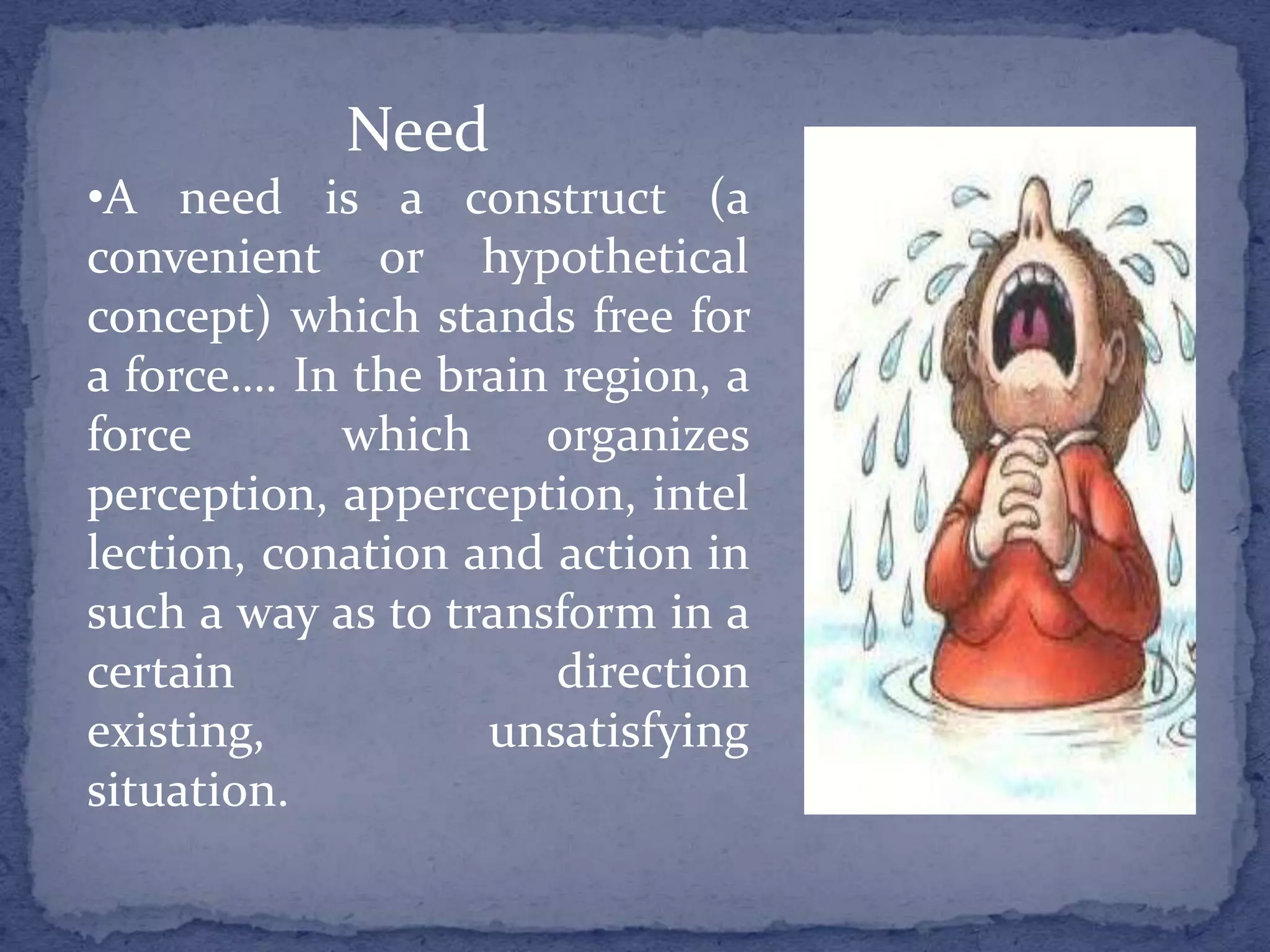
•A need is a construct (a
convenient or hypothetical
concept) which stands free for
a force…. In the brain region, a
force
which
organizes
perception, apperception, intel
lection, conation and action in
such a way as to transform in a
certain
direction
existing,
unsatisfying
situation.
Basis for Distinguishing between
types of needs.
1.
2.
3.
4.
5.

Primary and Secondary Need
Overt and Covert Needs
Focal and Diffuse Needs
Proactive and Reactive Needs
Process activity, modal needs and effect needs
Murray's Psychogenic Needs

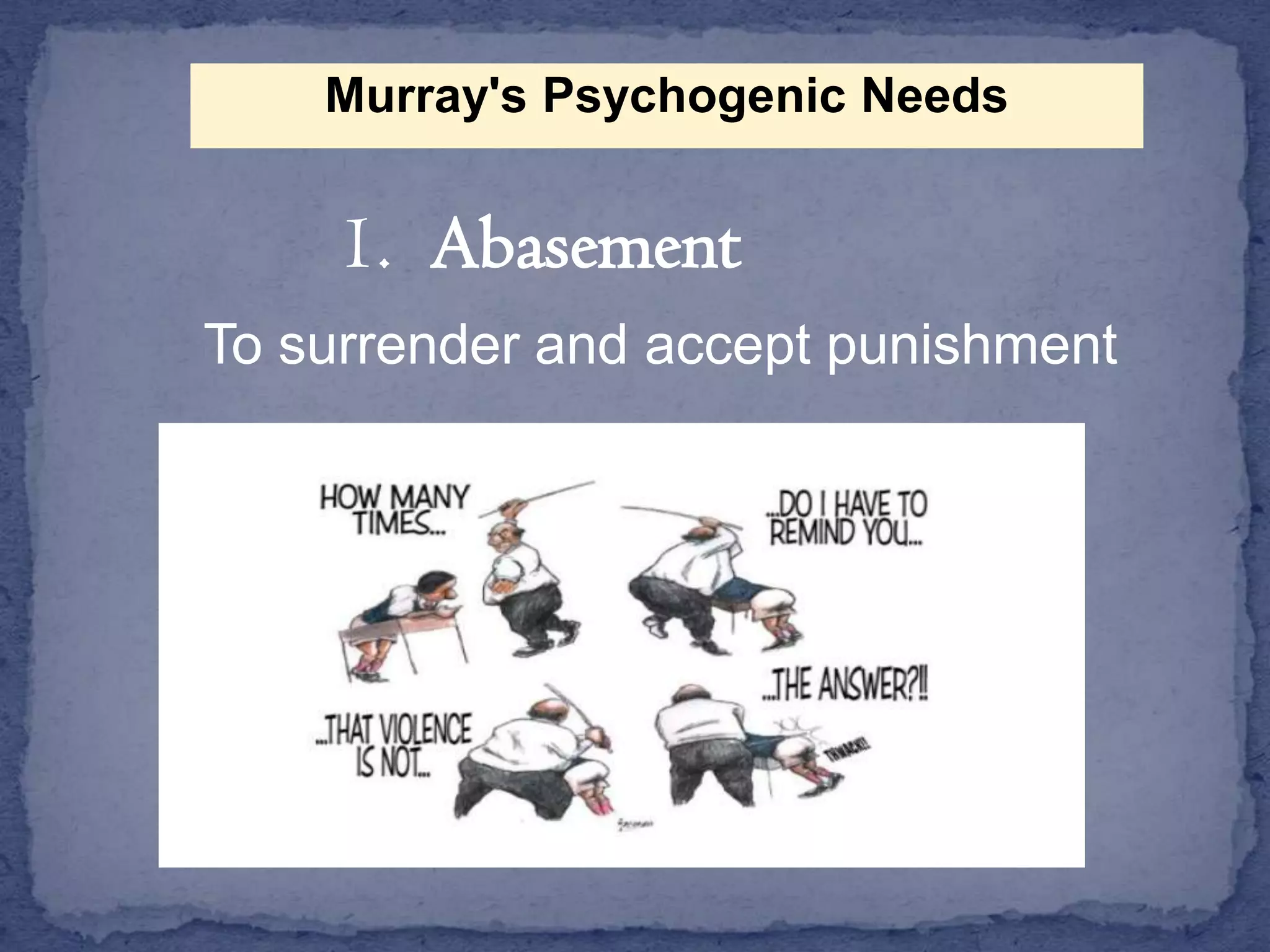
1. Abasement
To surrender and accept punishment
Murray's Psychogenic Needs

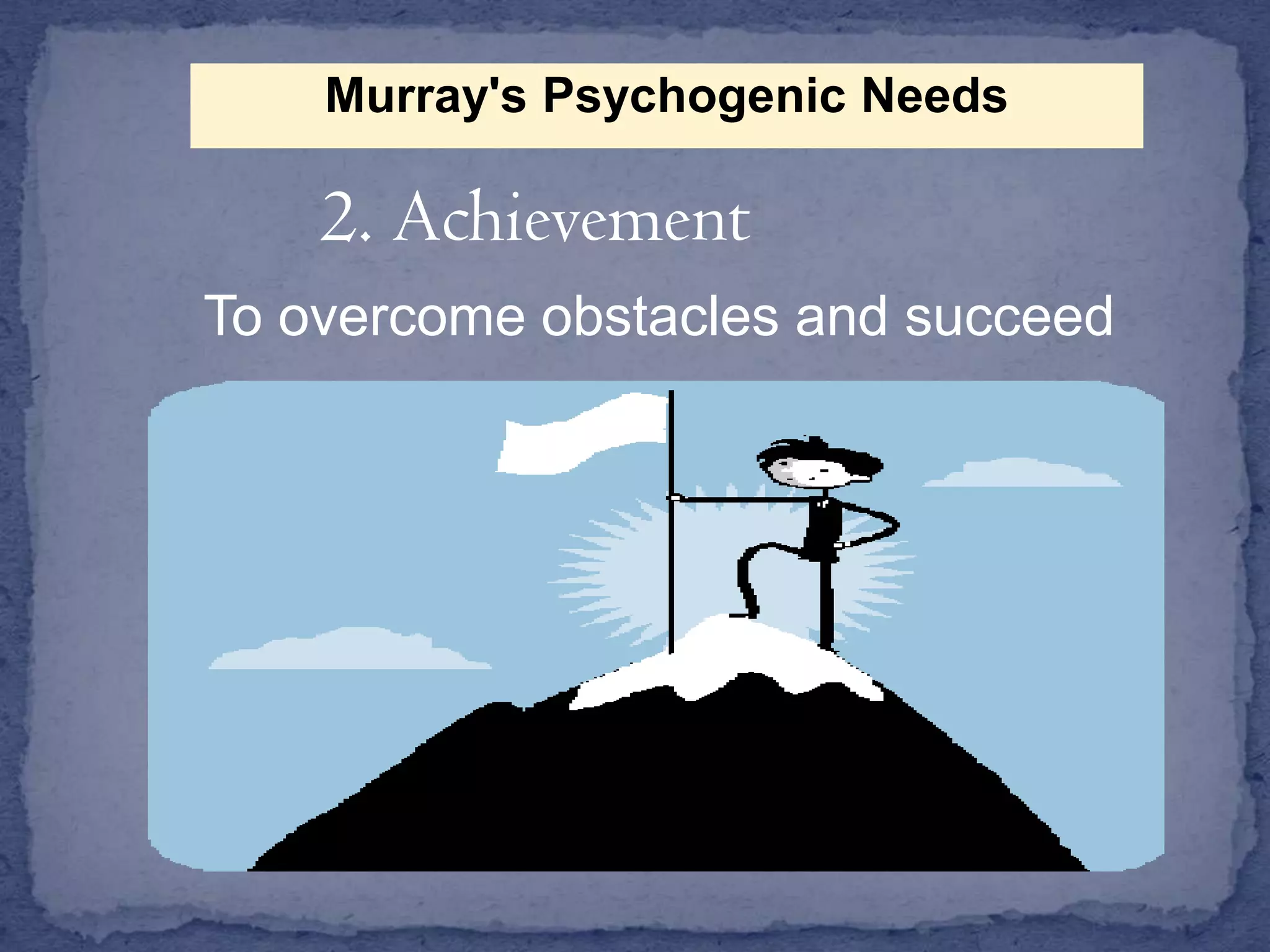
2. Achievement
To overcome obstacles and succeed
Murray's Psychogenic Needs

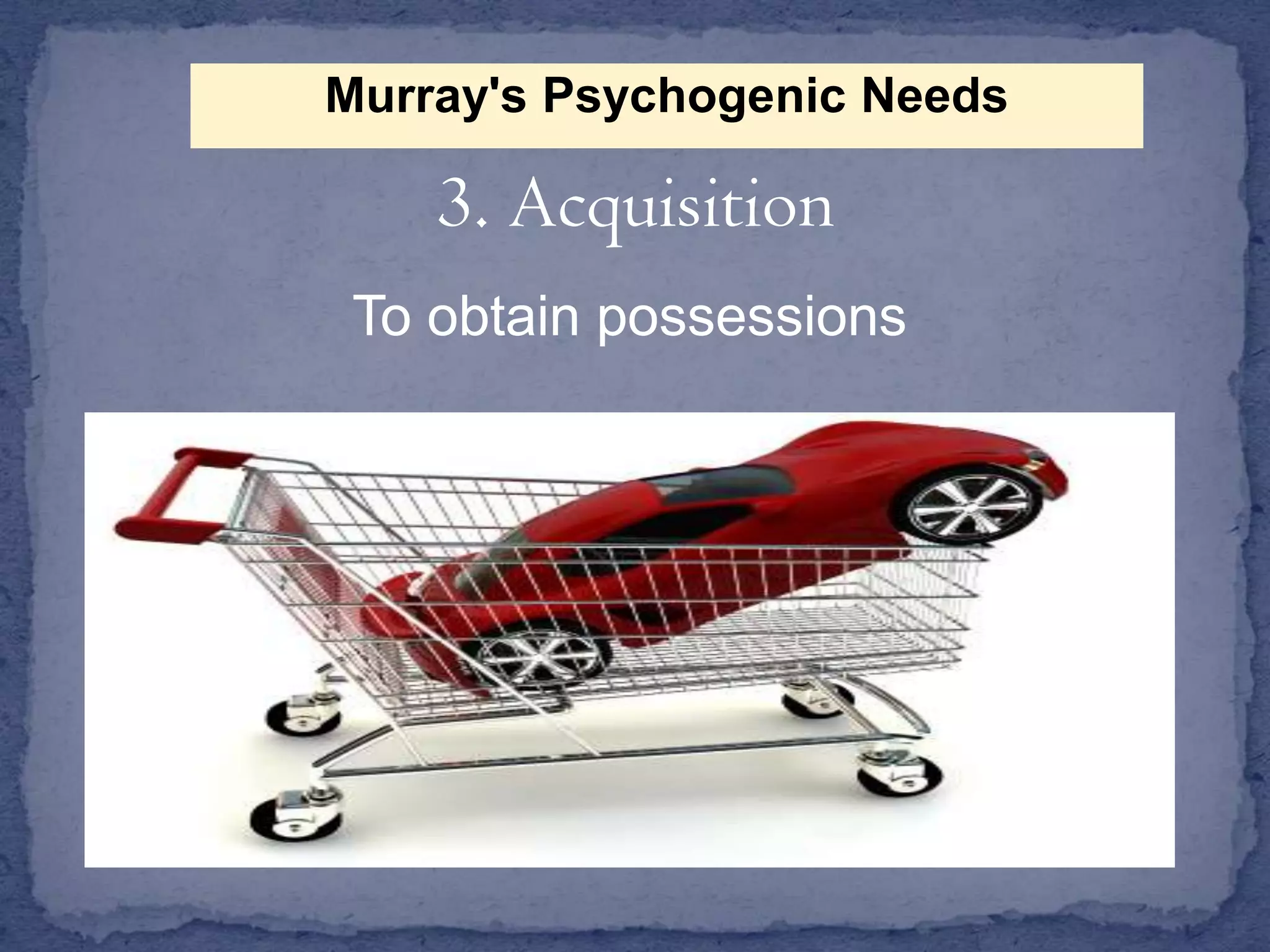
3. Acquisition
To obtain possessions
Murray's Psychogenic Needs

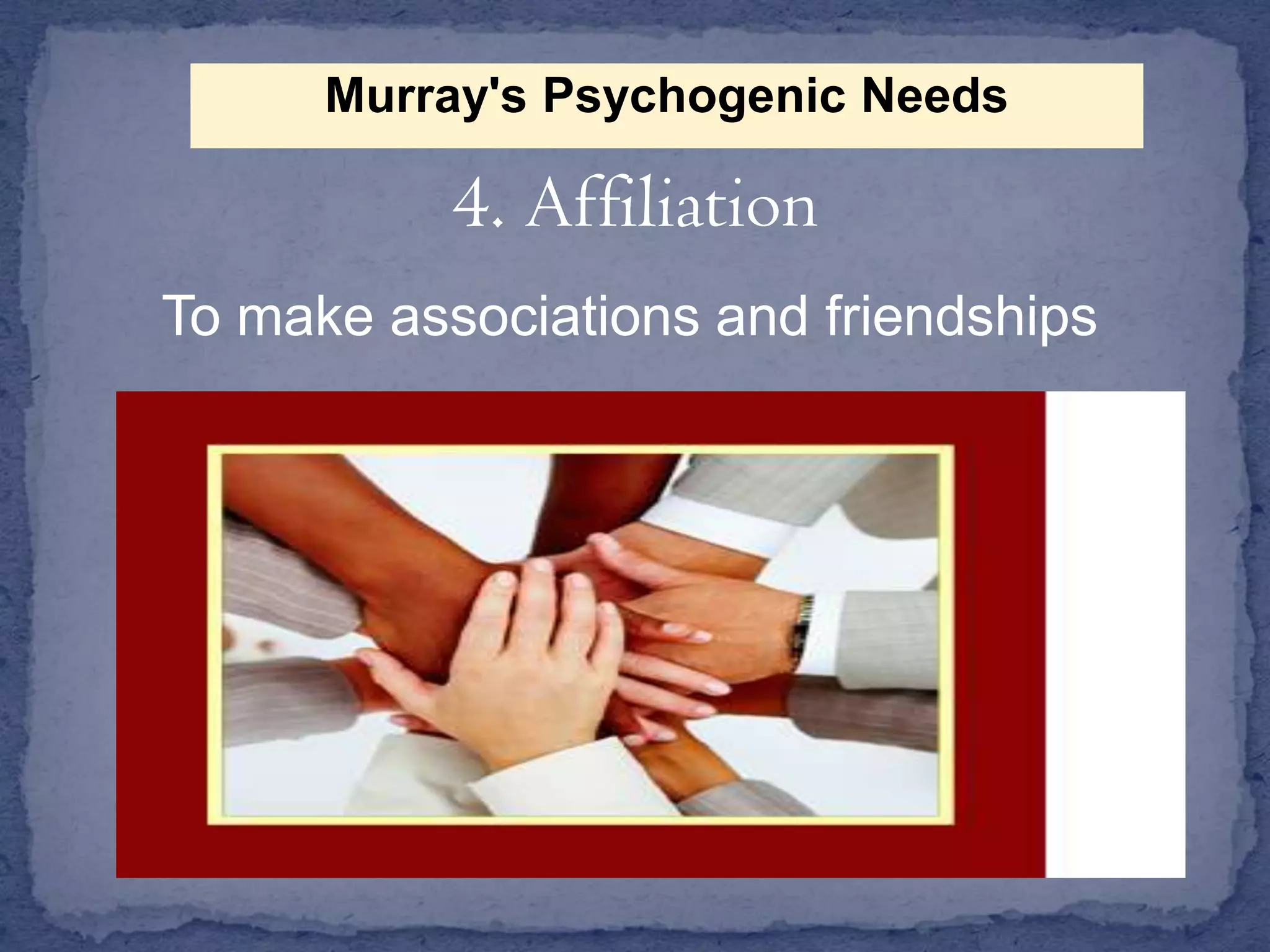
4. Affiliation
To make associations and friendships
Murray's Psychogenic Needs

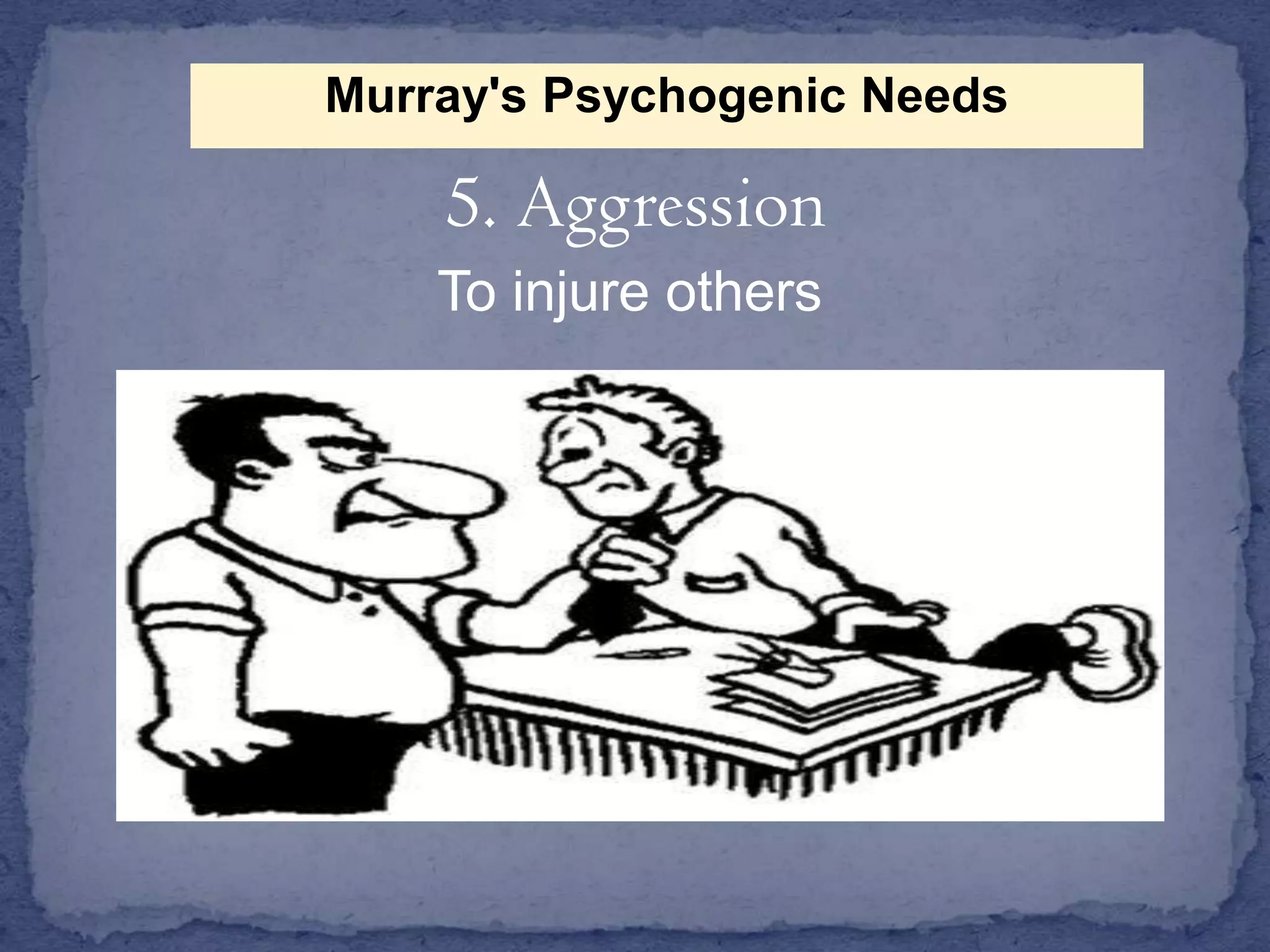
5. Aggression
To injure others
Murray's Psychogenic Needs

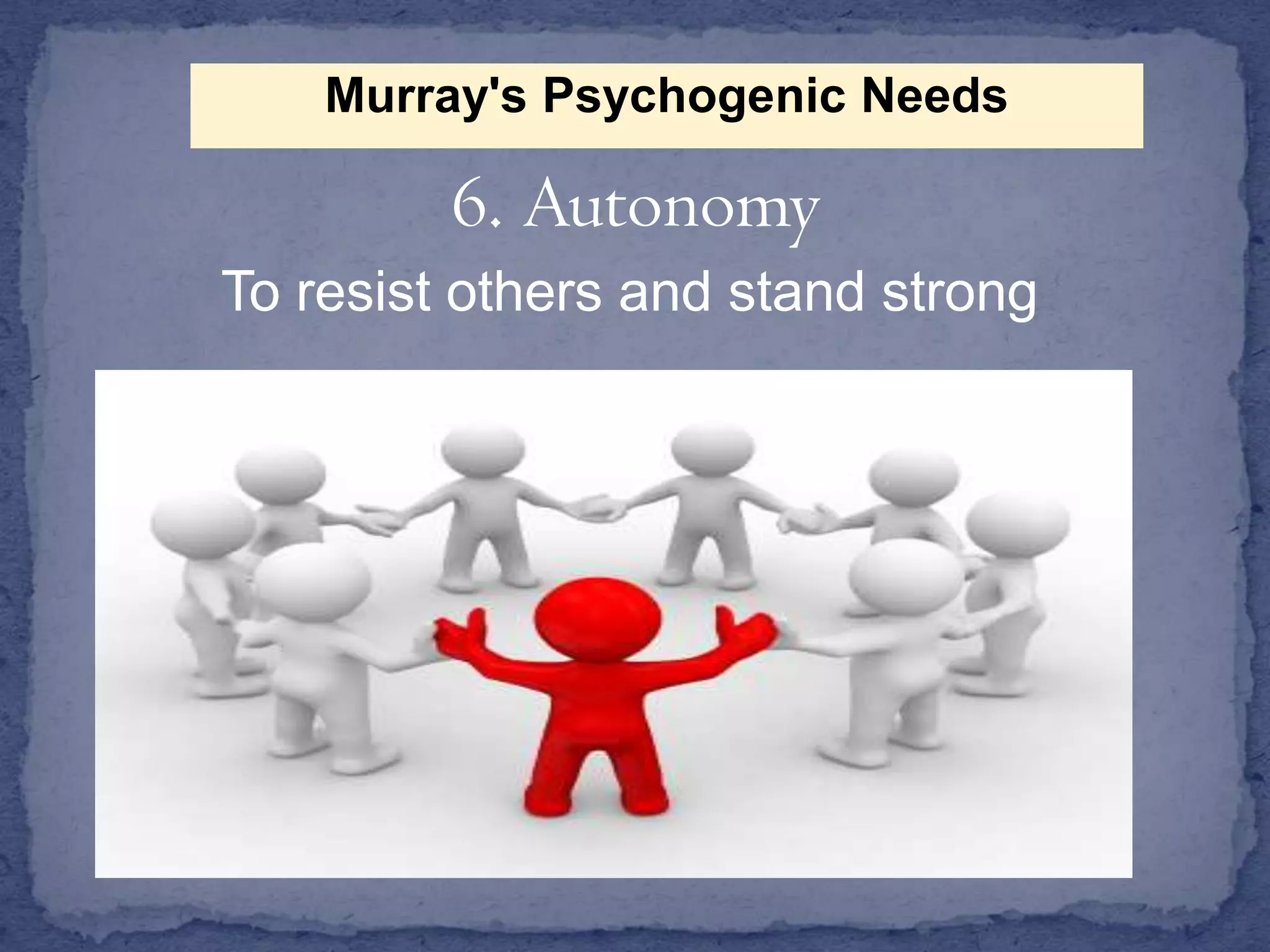
6. Autonomy
To resist others and stand strong
Murray's Psychogenic Needs

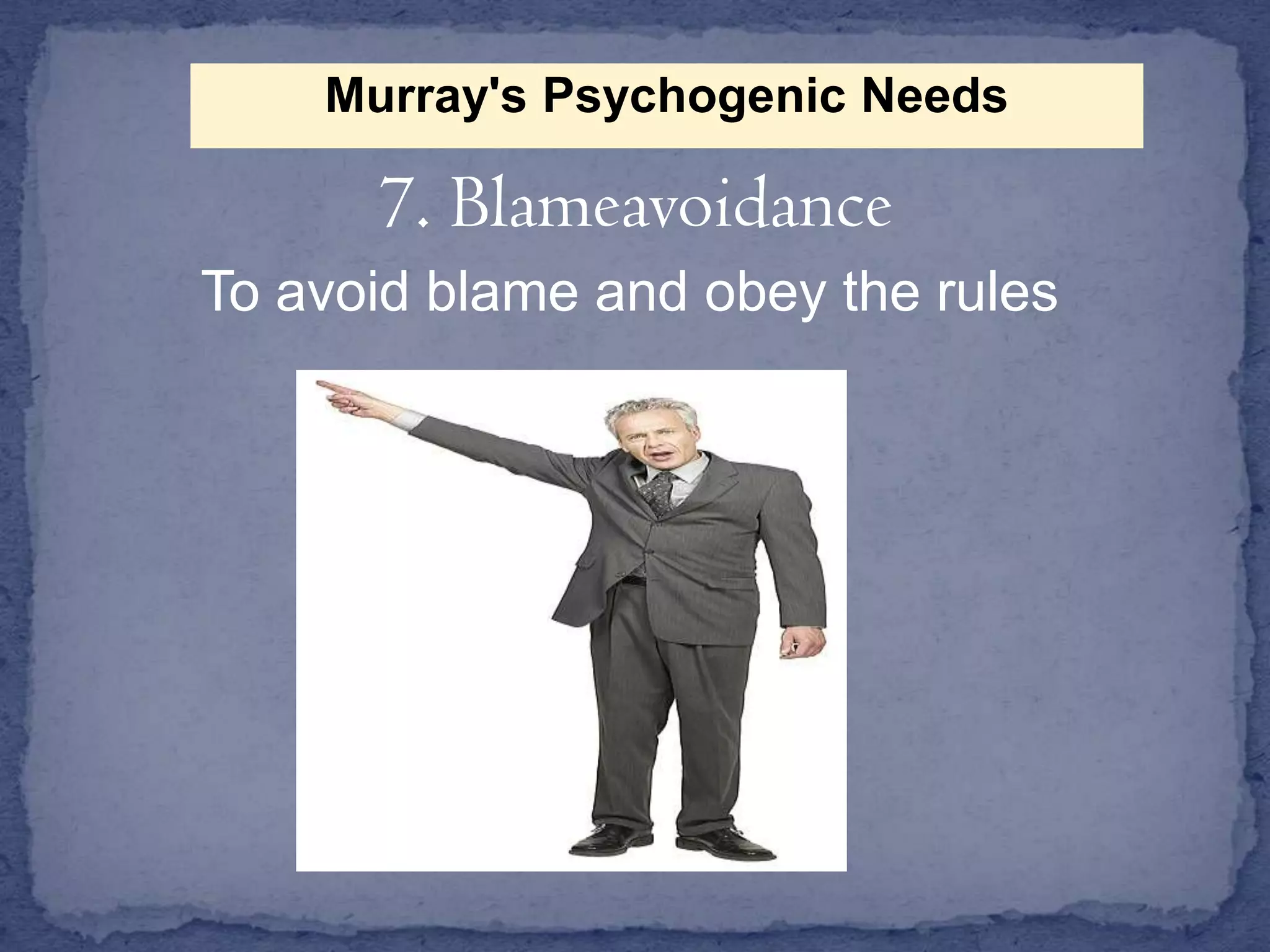
7. Blameavoidance
To avoid blame and obey the rules
Murray's Psychogenic Needs

8. Construction
To build or create
Murray's Psychogenic Needs

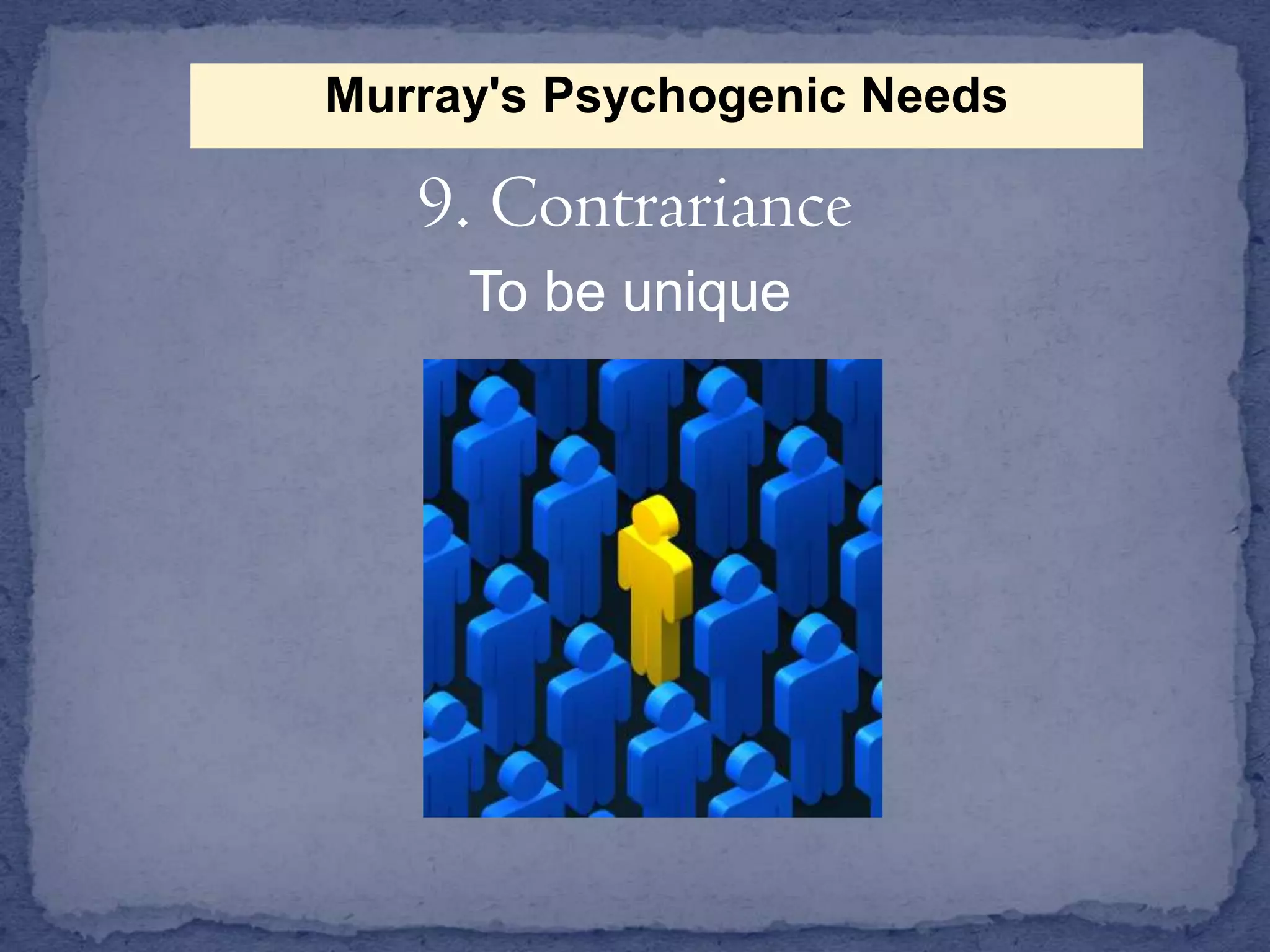
9. Contrariance
To be unique
Murray's Psychogenic Needs

10. Counteraction
To defend honor
Murray's Psychogenic Needs

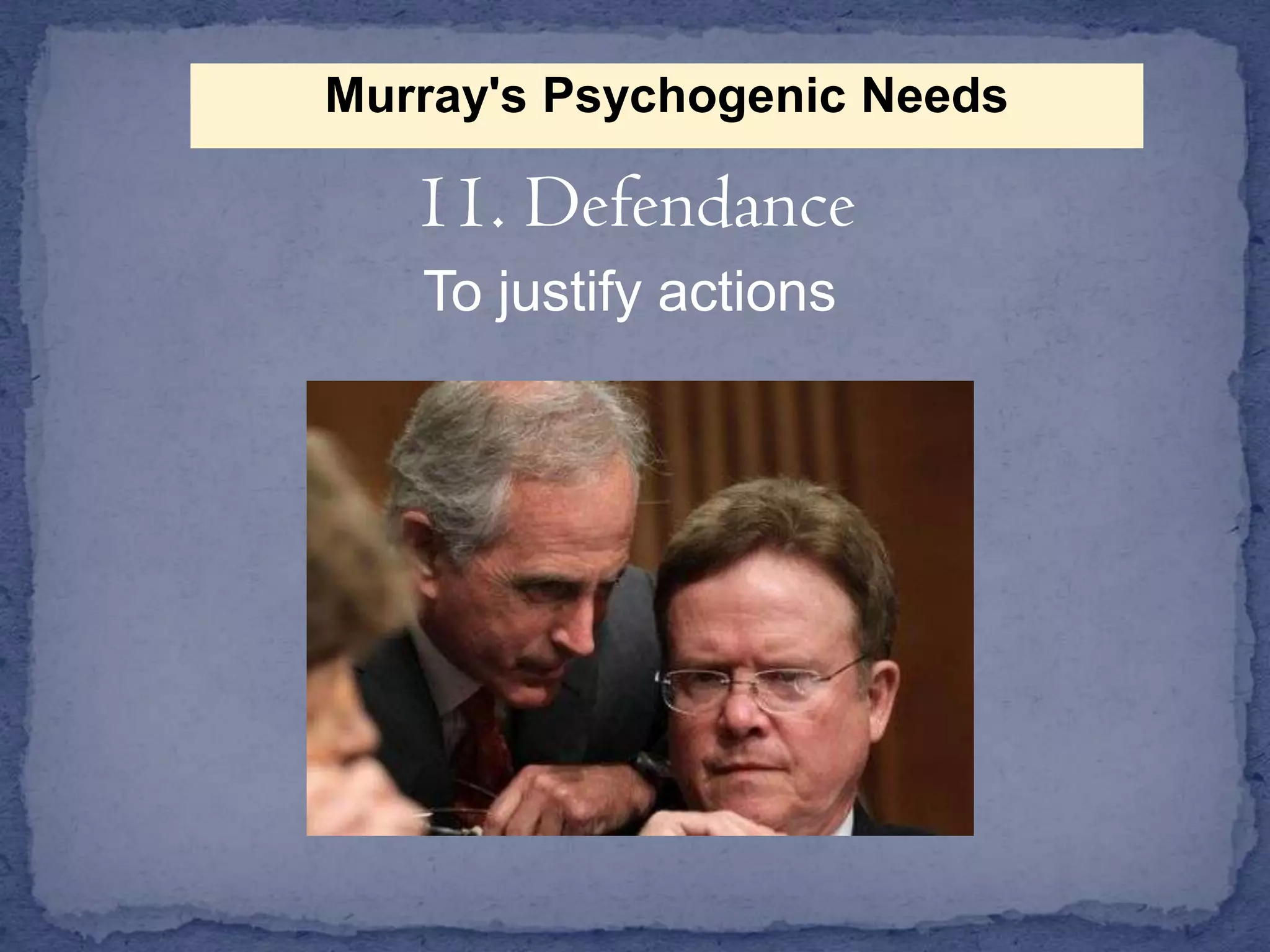
11. Defendance
To justify actions
Murray's Psychogenic Needs

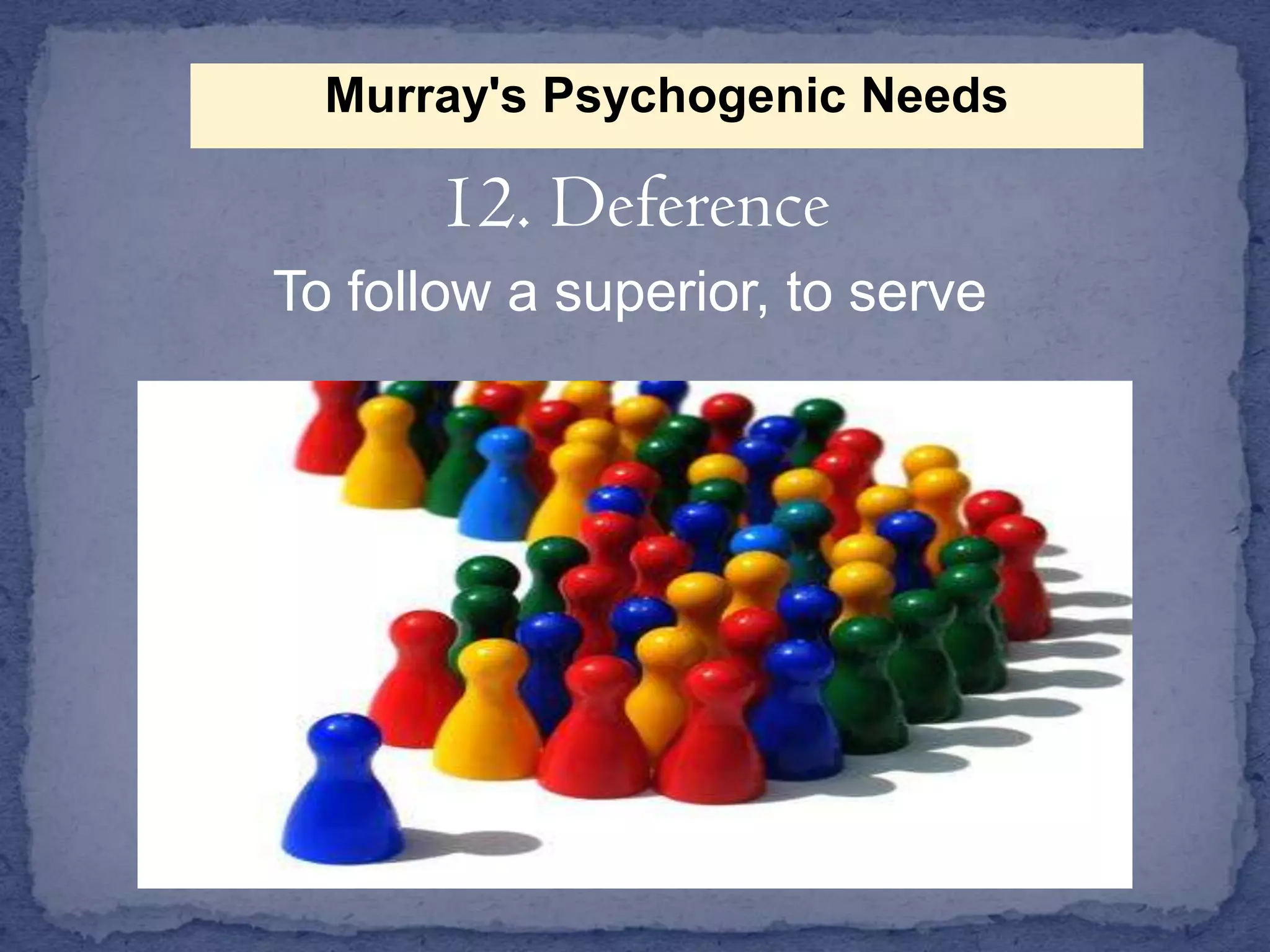
12. Deference
To follow a superior, to serve
Murray's Psychogenic Needs

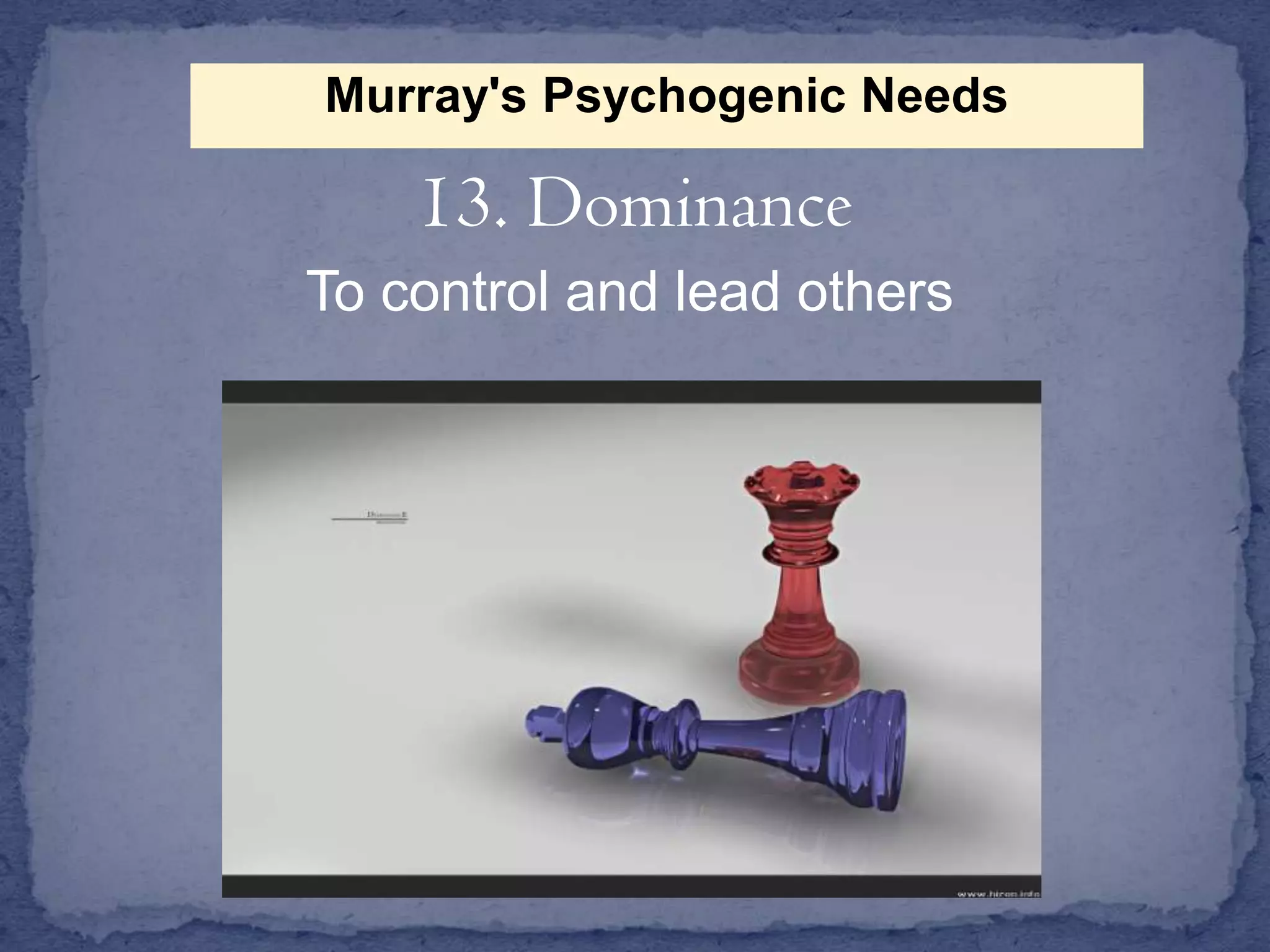
13. Dominance
To control and lead others
Murray's Psychogenic Needs

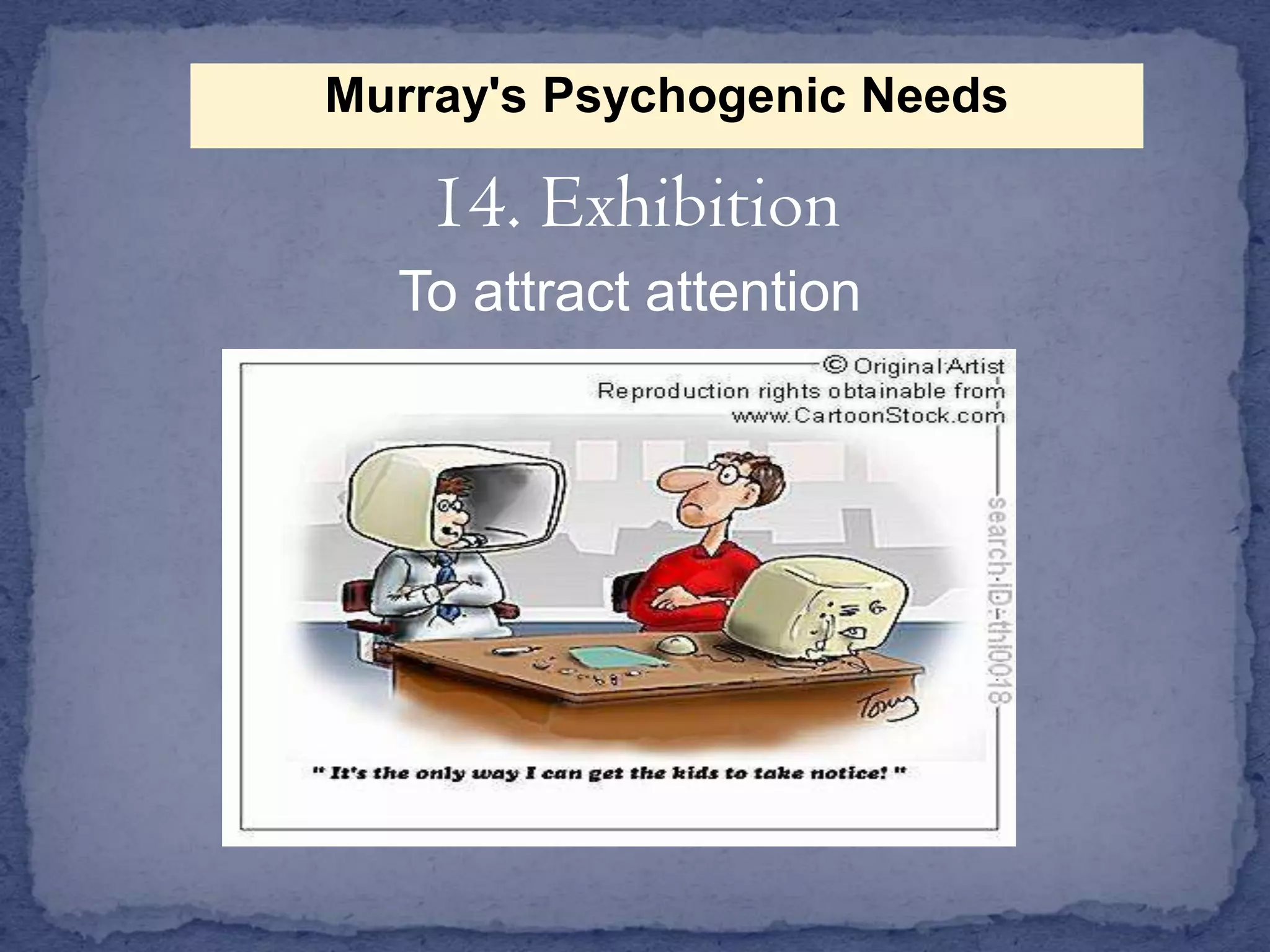
14. Exhibition
To attract attention
Murray's Psychogenic Needs

15. Exposition
To provide information, educate
Murray's Psychogenic Needs

16. Harmavoidance
To avoid pain
Murray's Psychogenic Needs

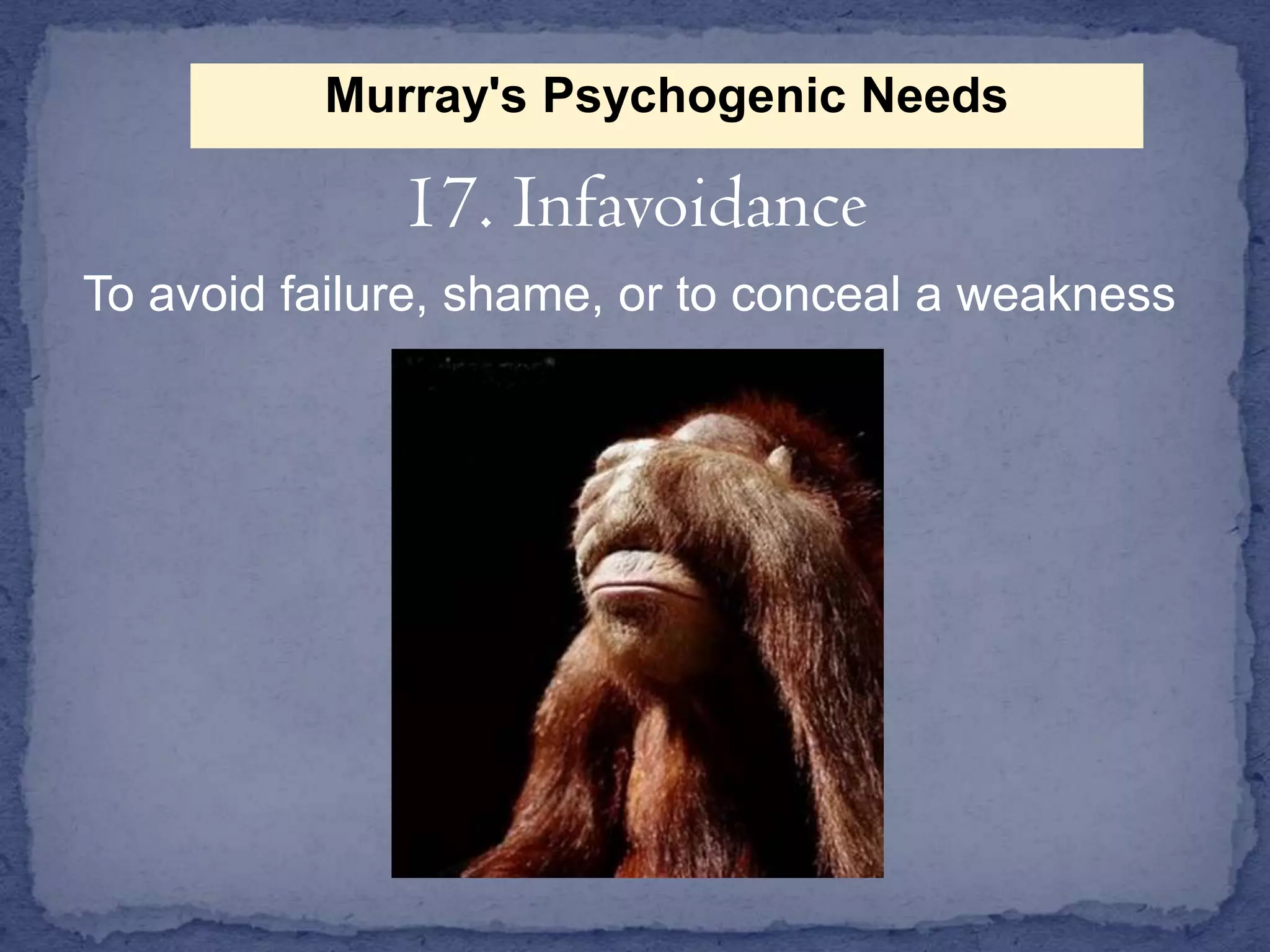
17. Infavoidance
To avoid failure, shame, or to conceal a weakness
Murray's Psychogenic Needs

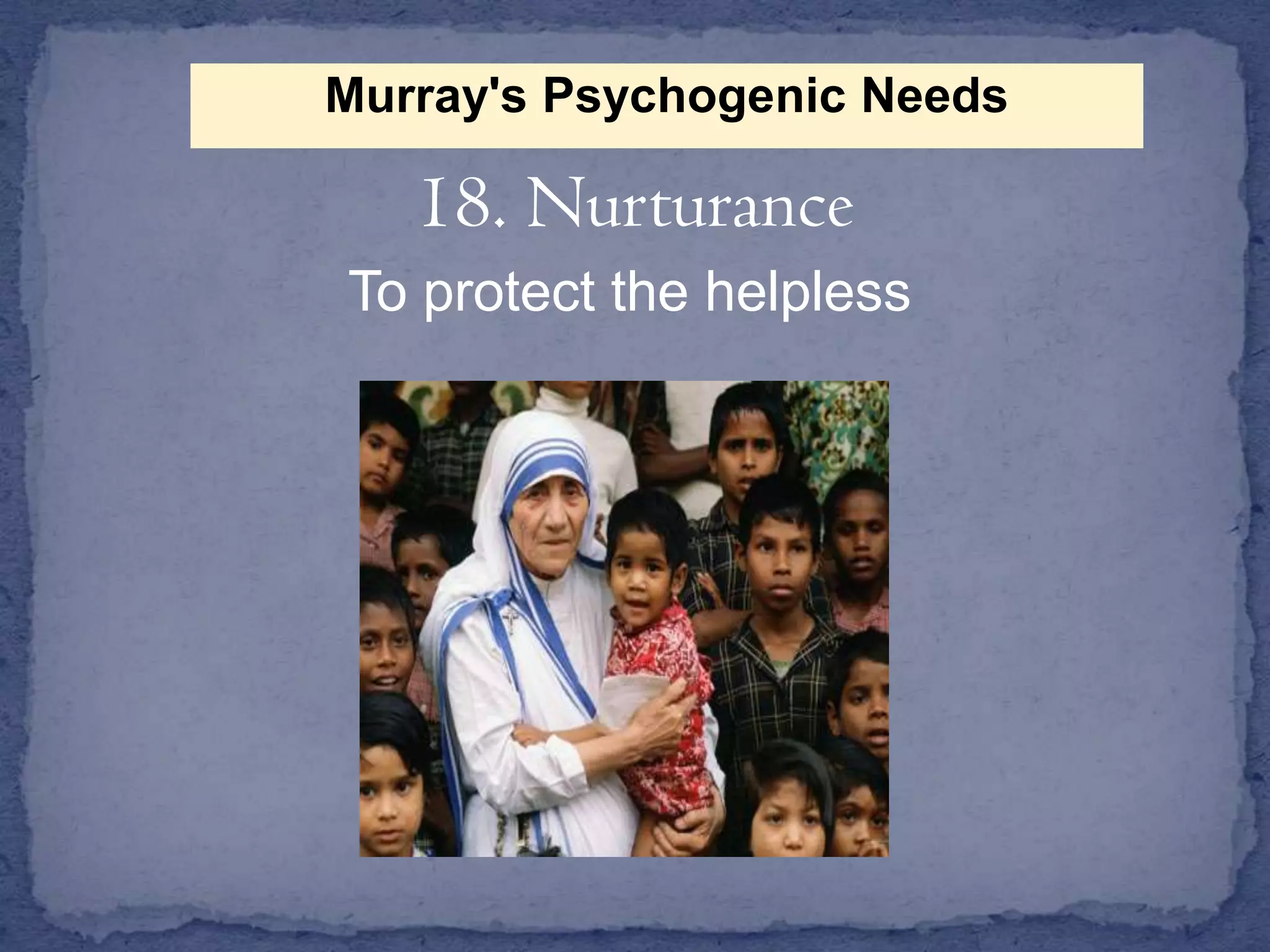
18. Nurturance
To protect the helpless
Murray's Psychogenic Needs

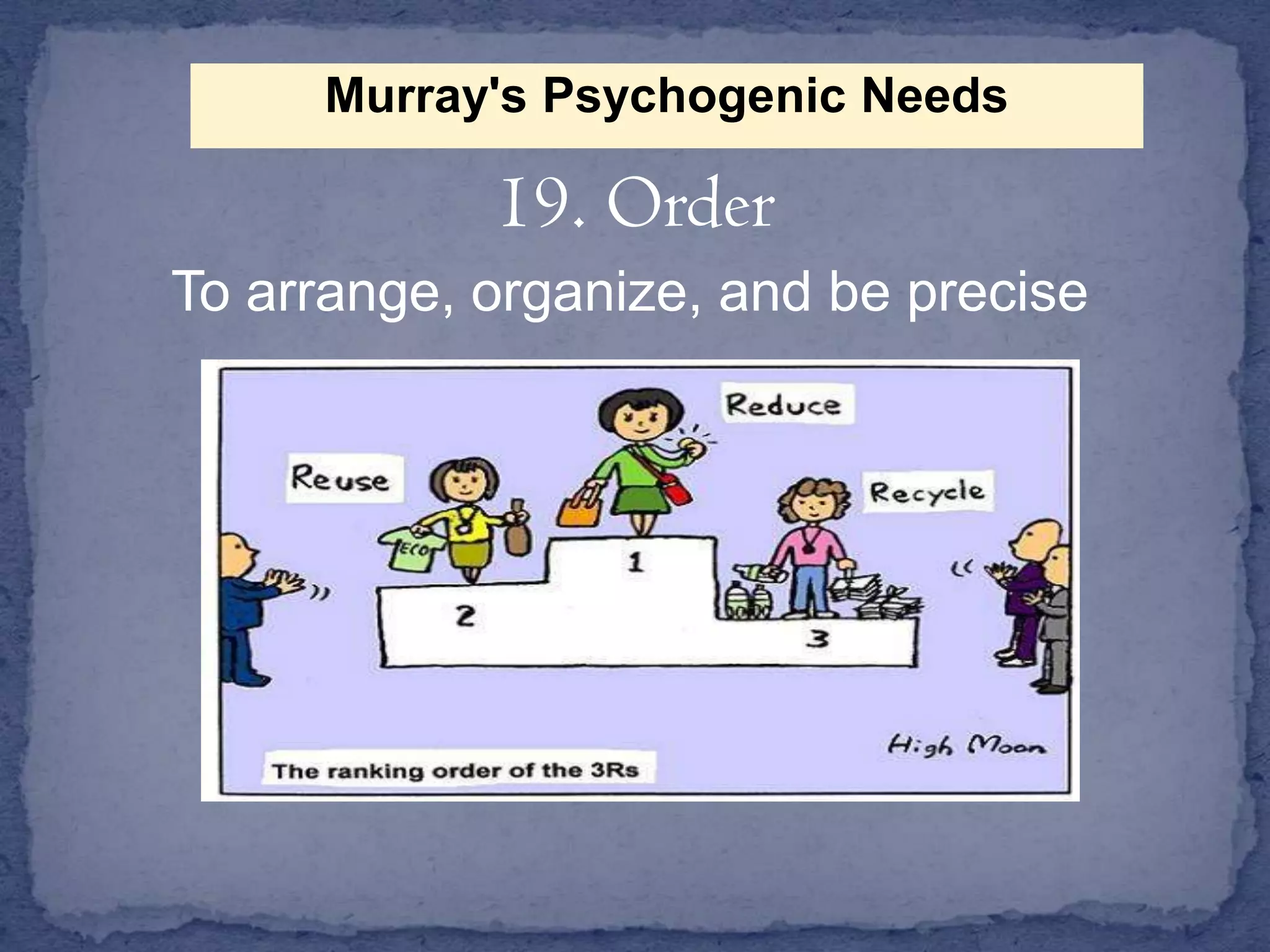
19. Order
To arrange, organize, and be precise
Murray's Psychogenic Needs

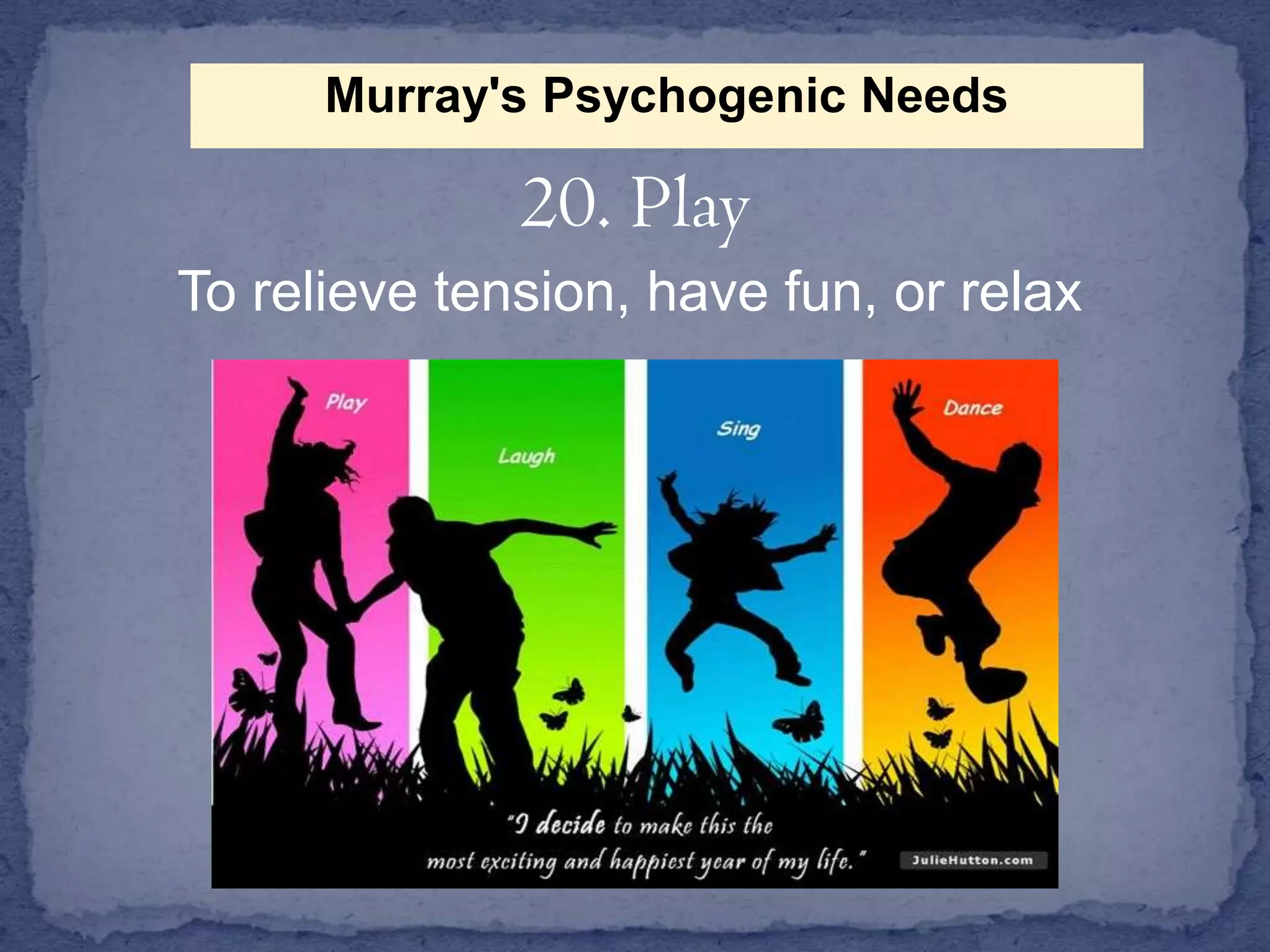
20. Play
To relieve tension, have fun, or relax
Murray's Psychogenic Needs

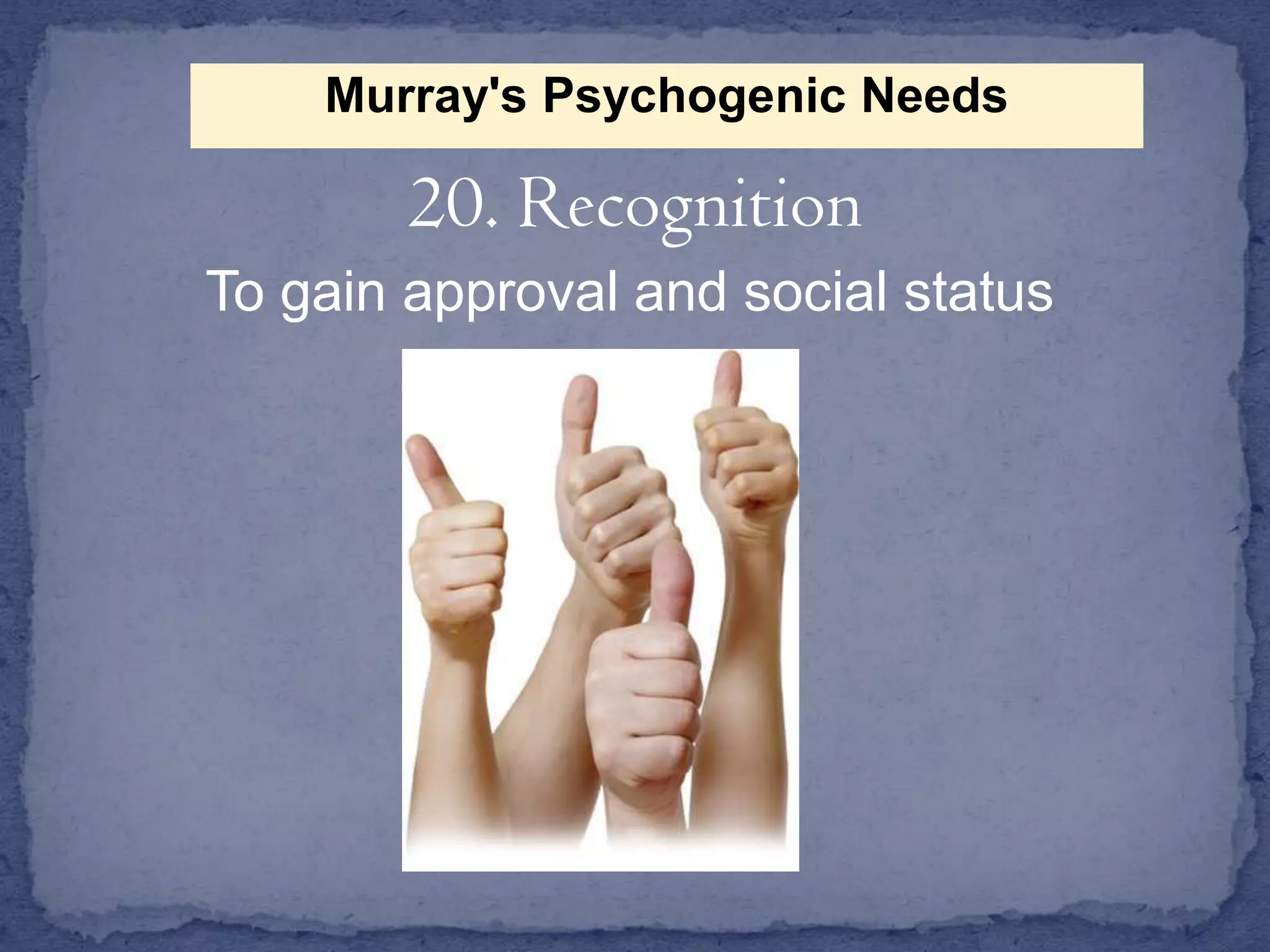
20. Recognition
To gain approval and social status
Murray's Psychogenic Needs

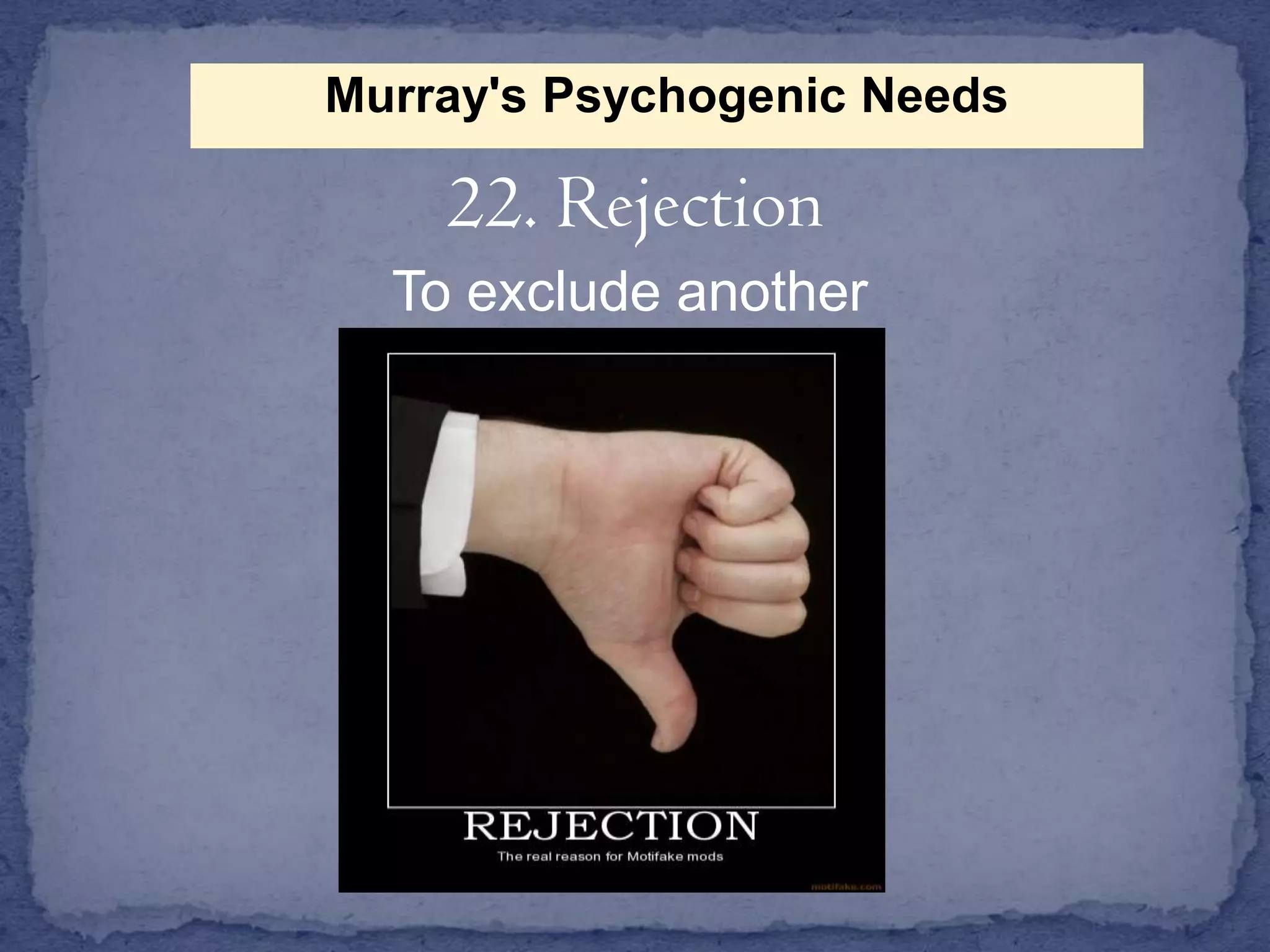
22. Rejection
To exclude another
Murray's Psychogenic Needs

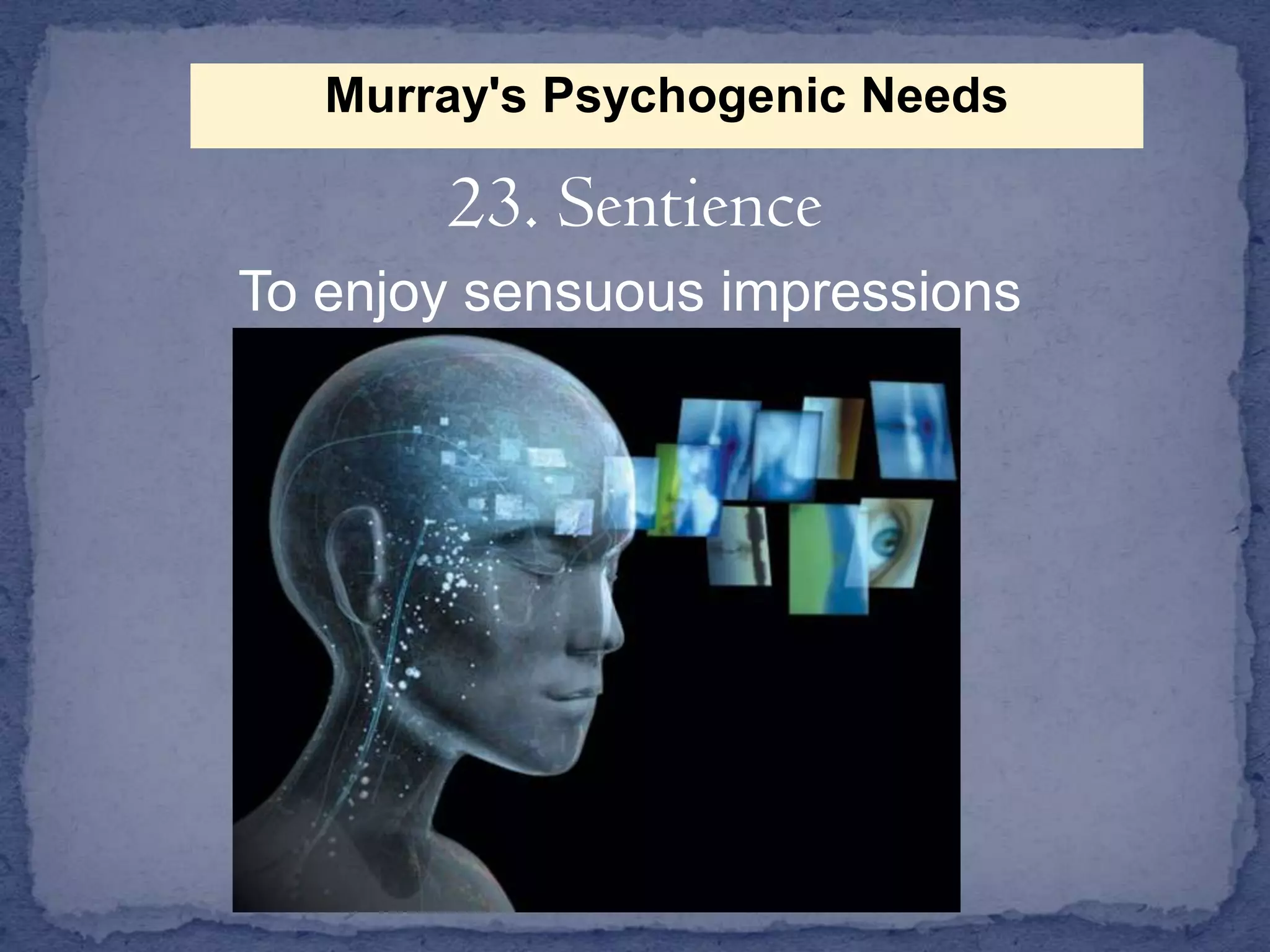
23. Sentience
To enjoy sensuous impressions
Murray's Psychogenic Needs

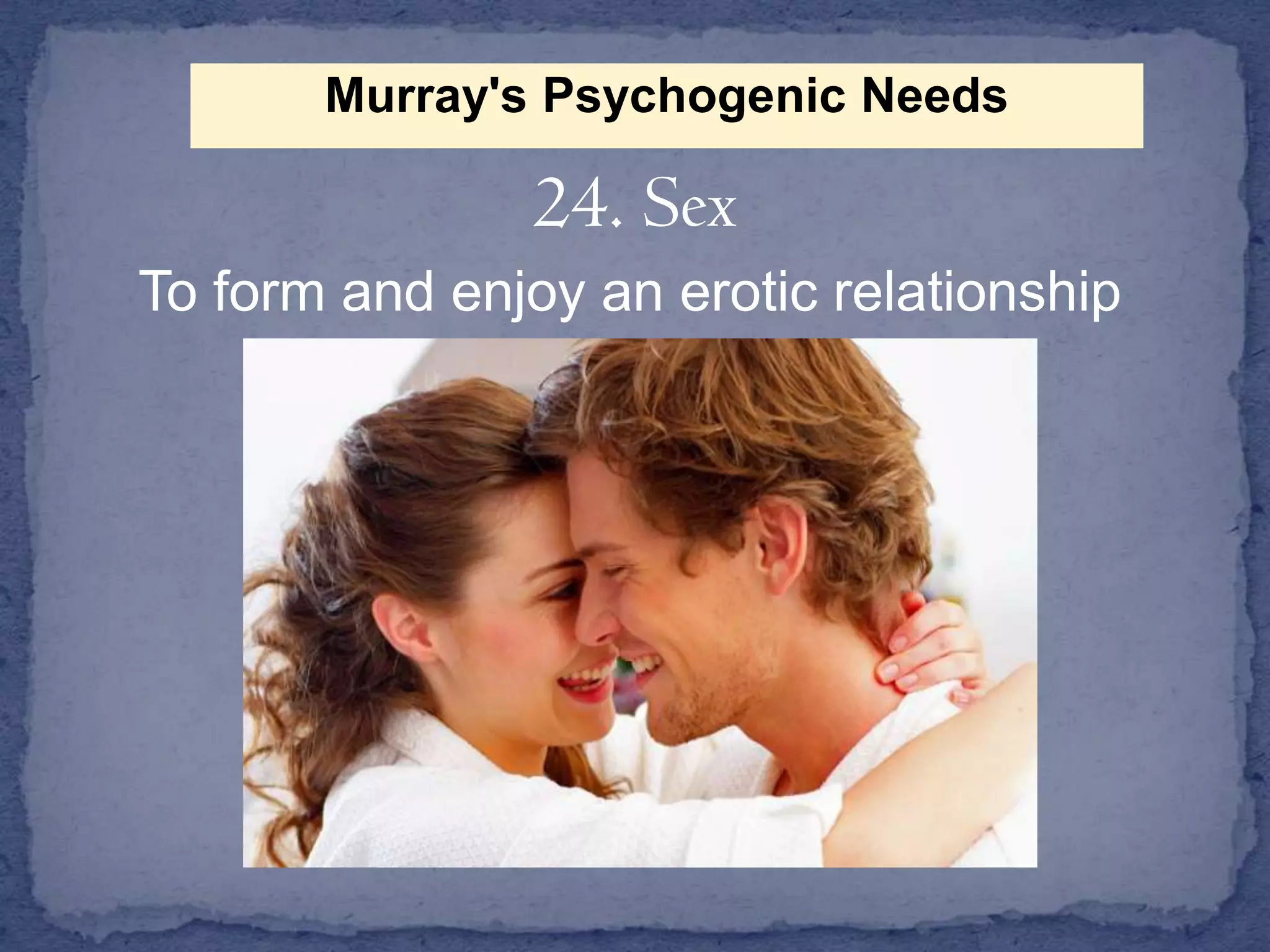
24. Sex
To form and enjoy an erotic relationship
Murray's Psychogenic Needs

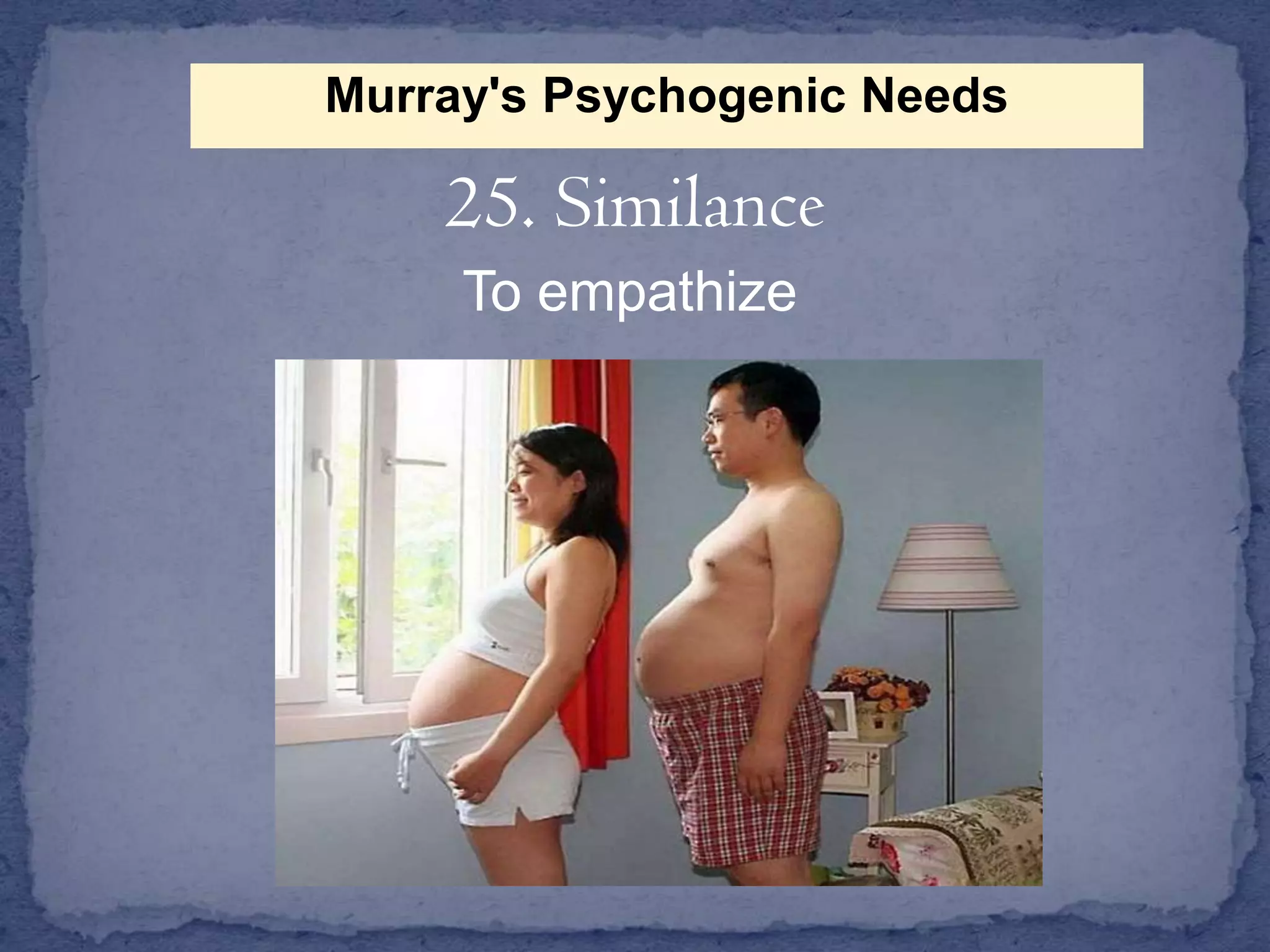
25. Similance
To empathize
Murray's Psychogenic Needs

26. Succorance
To seek protection or sympathy
Murray's Psychogenic Needs

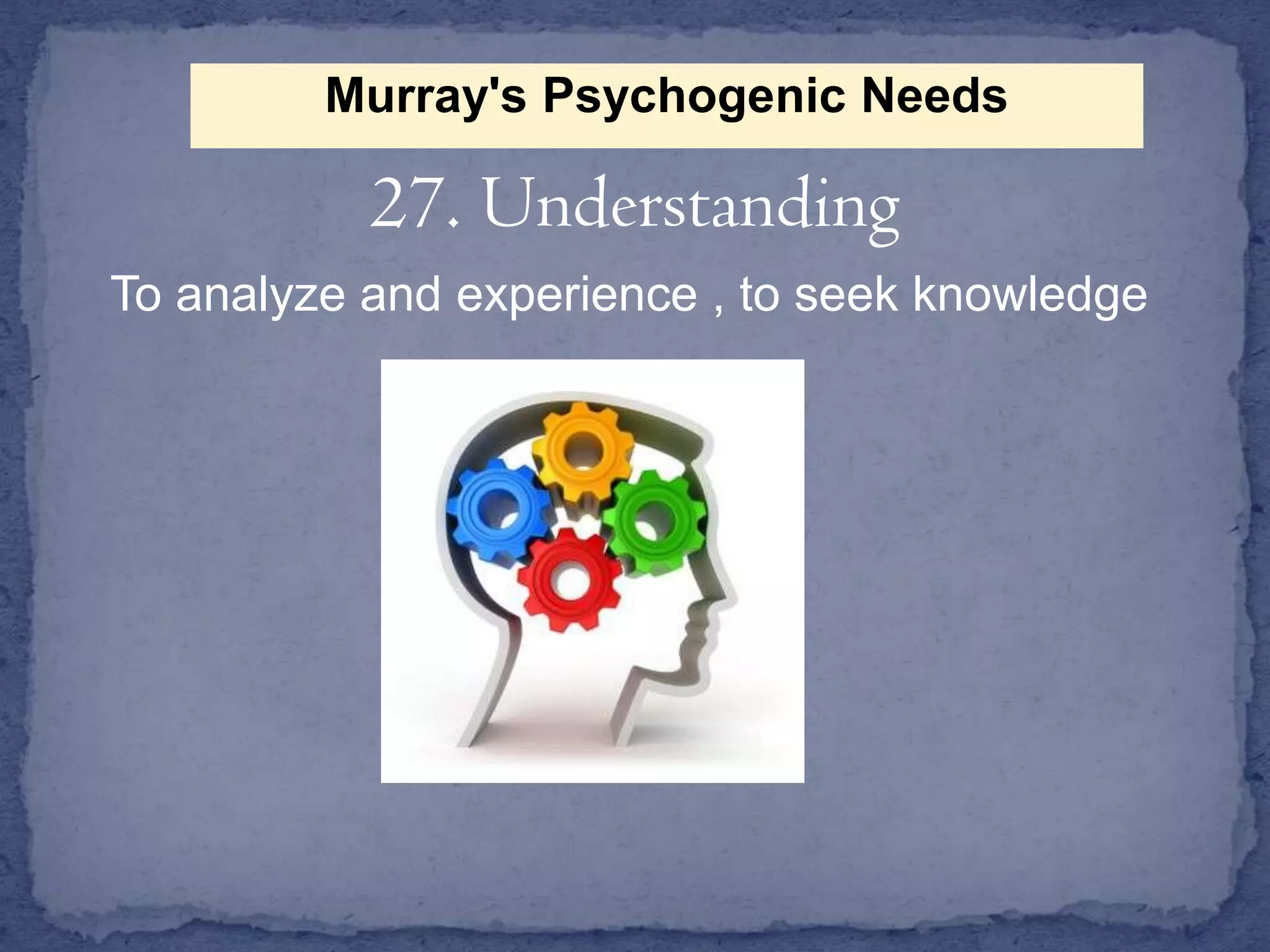
27. Understanding
To analyze and experience , to seek knowledge
Theories of
personality based
upon needs and
motives suggest that
our personalities are
a reflection of
behaviors controlled
by needs.
While some needs
are temporary and
changing, other needs
are more deeply
seated in our nature.
According to
Murray, these
psychogenic needs
function mostly on the
unconscious level, but
play a major role in our
personality.
Interrelation of Needs
Prepotency
Conflict
Fusion of needs
Concept
of
Subsidation
Henry Murray and Psychological
Needs
Murray from a Psychoanalytic Perspective
Murray used the term personology to describe
his study of human lives and individual
differences in personality
Murray described a habit system as automatic,
unconscious behaviors shaped by the id, ego,
and superego
Murray emphasized positive instincts related to
motivation and needs
American psychologist
developed a theory of personality that
was organized in terms of motives,
presses, and needs.
Murray described a needs as a,
"potentiality or readiness to respond in a
certain way under certain given
circumstances"
(1938).

Murray ian