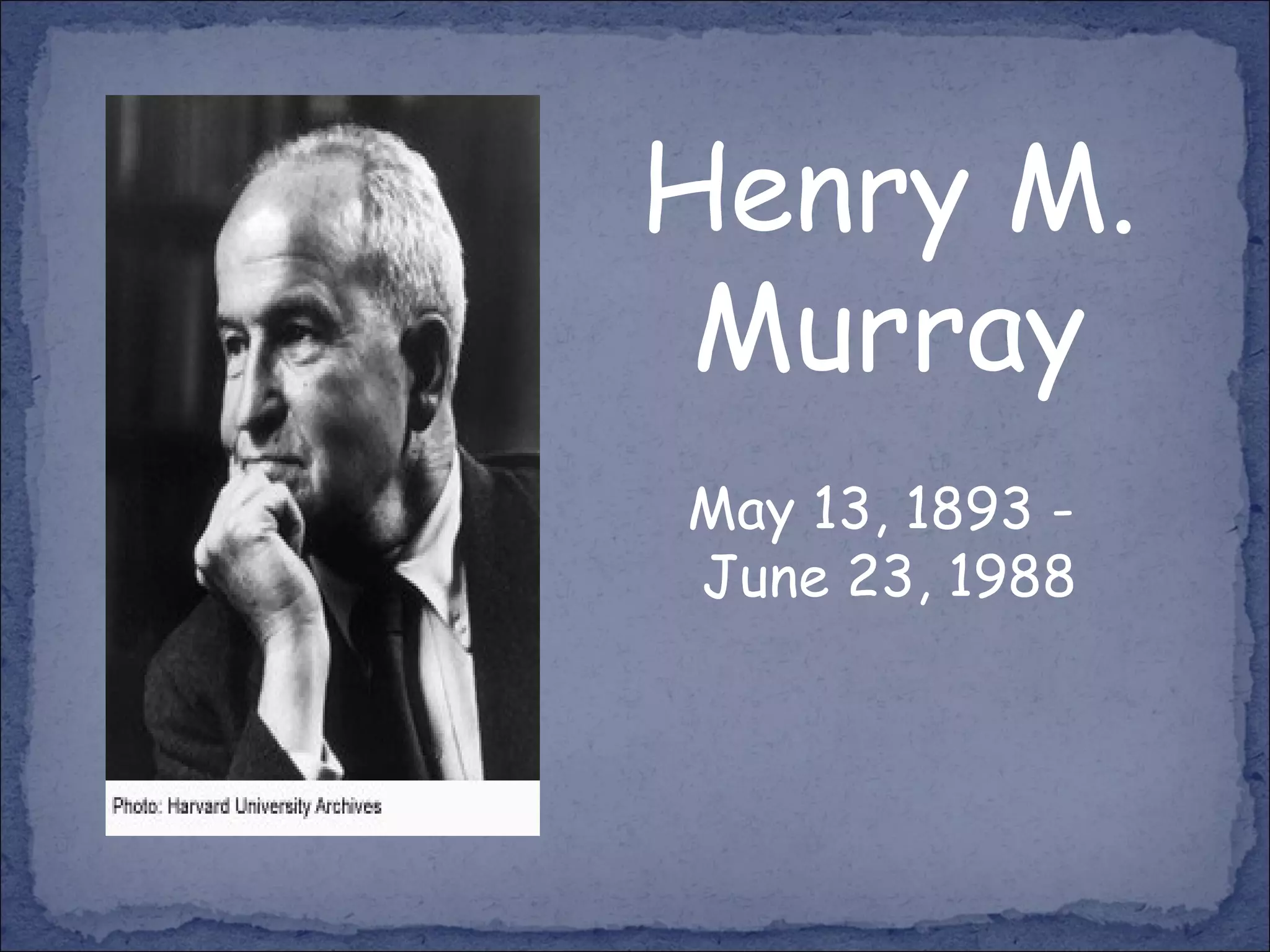
Henry M. Murray May 13, 1893 -  June 23, 1988
He earned his bachelor's degree in history in 1915,  a medical degree from Columbia in 1919  then completed a doctorate in biochemistry from Cambridge nine years later.  
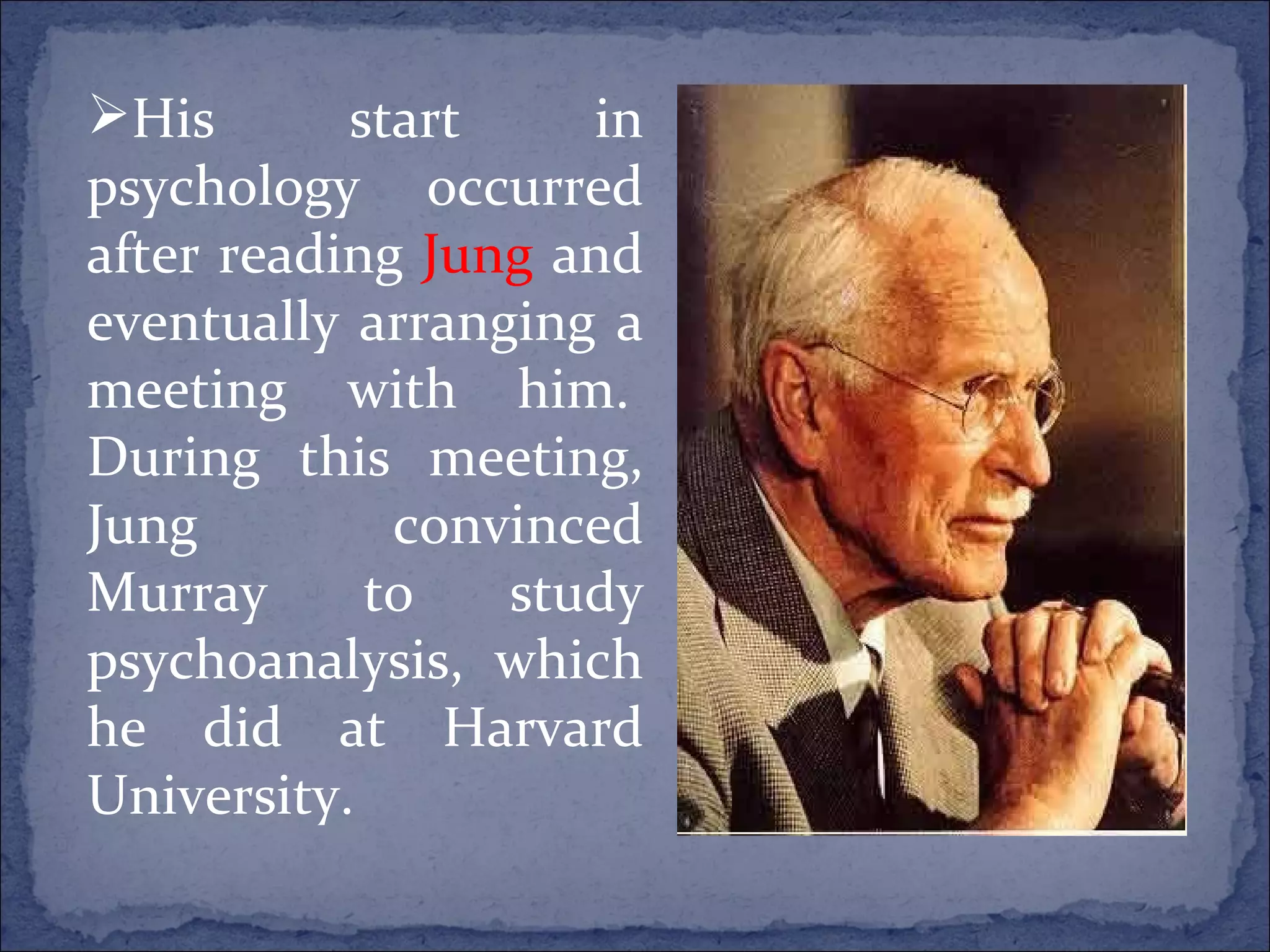
His start in psychology occurred after reading  Jung  and eventually arranging a meeting with him.  During this meeting, Jung convinced Murray to study psychoanalysis, which he did at Harvard University. 
After competing his training, Murray actually began teaching psychology and psychoanalytic theory at Harvard, and he remained there for the rest of his professional career.
Although considered a trait theorist, Murray's medical background, combined with his analytical training give a unique flair to his research and writing.   This is probably most evident in his development of the  Thematic Apperception Test (TAT),  a personality test designed to determine personality themes as well as unconscious motivation.
He was focused on basic needs in personality which he called psychogenic needs.   He believed these needs were largely at the unconscious level.   After researching this area, he narrowed these needs down to 27, although the list and names vary
Topic Outline 1.  The Structure of Personality Definition of Personality Proceedings and Serials Establishment of Personality 2. The Dynamics of Personality Need Press Tension Reduction Thema Need Integrate Unity –Thema Regnant Process Vector-Value Scheme 3. The Development of Personality Infantile complexes Genetic-Maturational Determinants Learning Socio Cultural Determinants Uniqueness Unconscious Process The Socialization Process
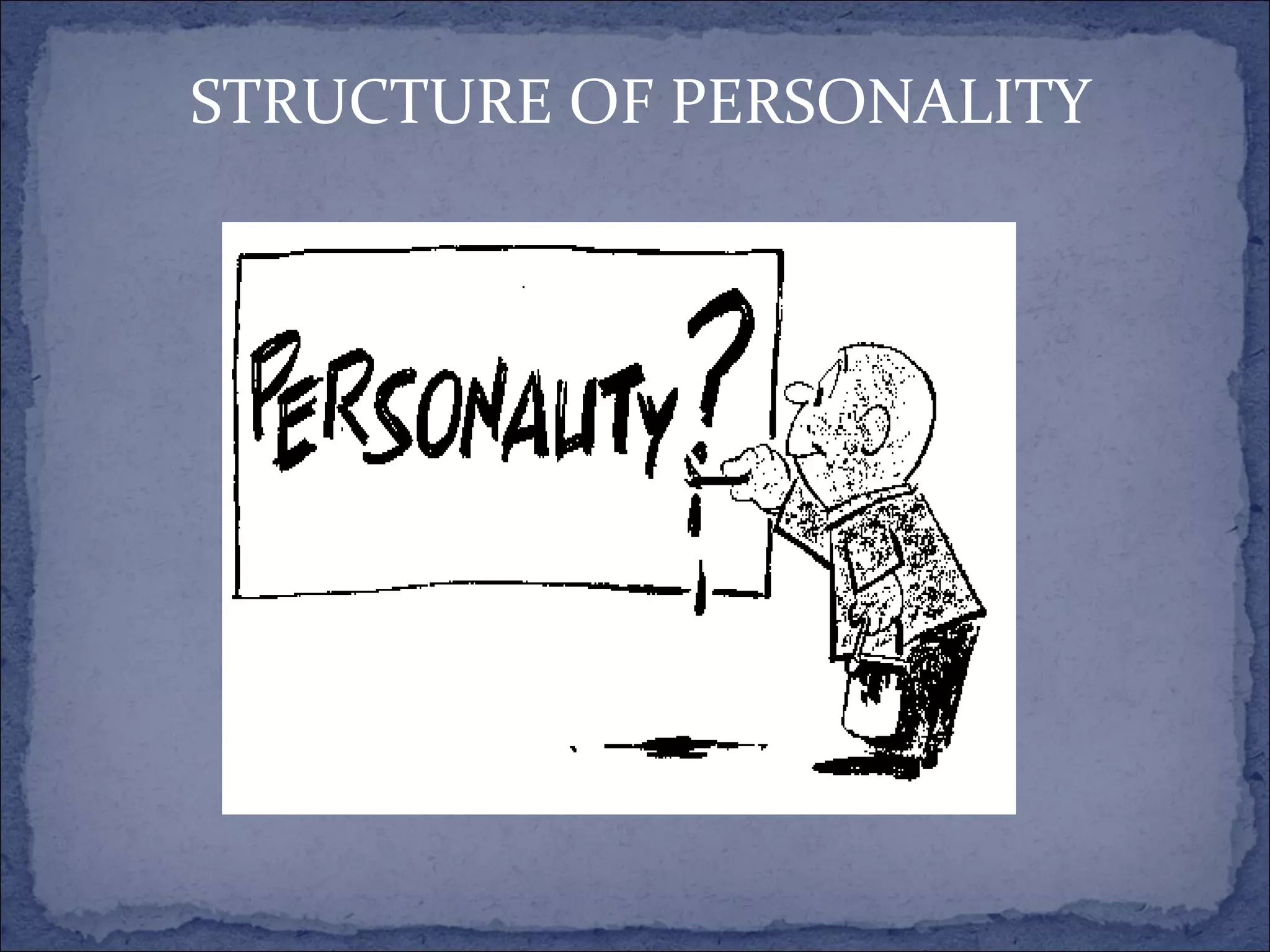
STRUCTURE OF PERSONALITY
Personality An individuals personality is an abstraction formulated  by the theorist and not merely a description of the individual’s behavior.
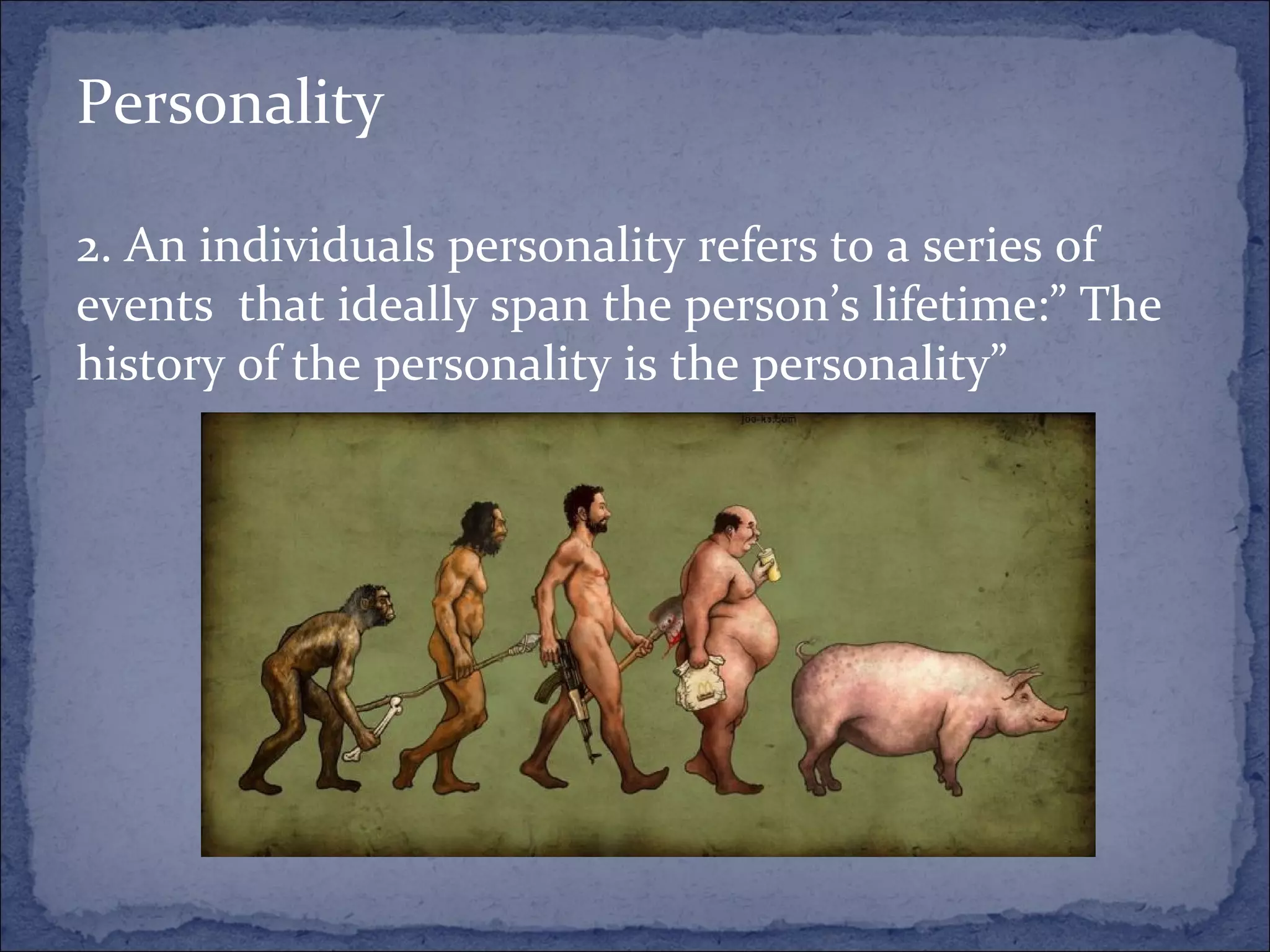
Personality 2. An individuals personality refers to a series of events  that ideally span the person’s lifetime:” The history of the personality is the personality”
Personality 3. A definition of personality should reflect the enduring and recurring elements of behavior as well as the novel and unique.
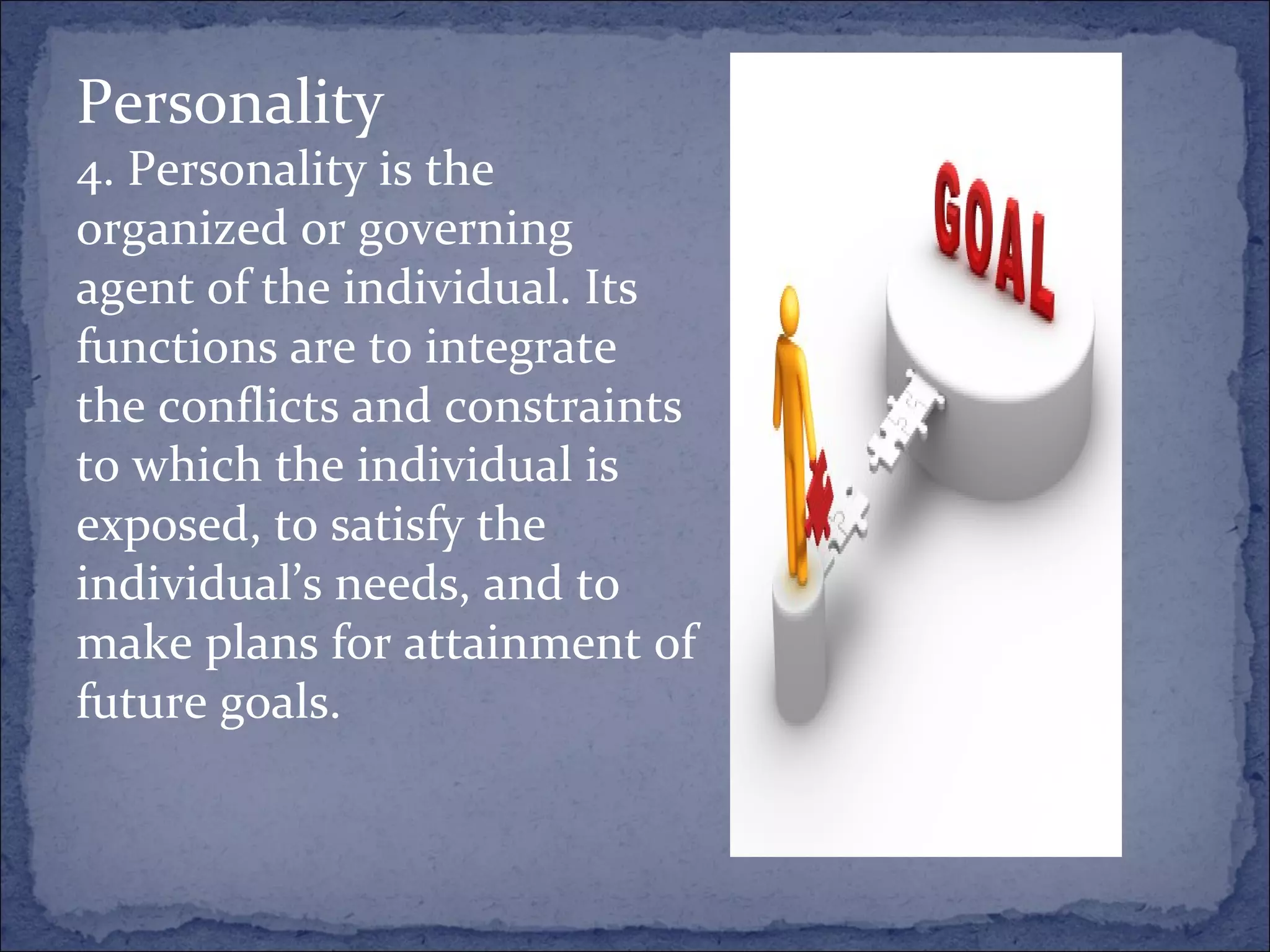
Personality 4. Personality is the organized or governing agent of the individual. Its functions are to integrate the conflicts and constraints to which the individual is exposed, to satisfy the individual’s needs, and to make plans for attainment of future goals.
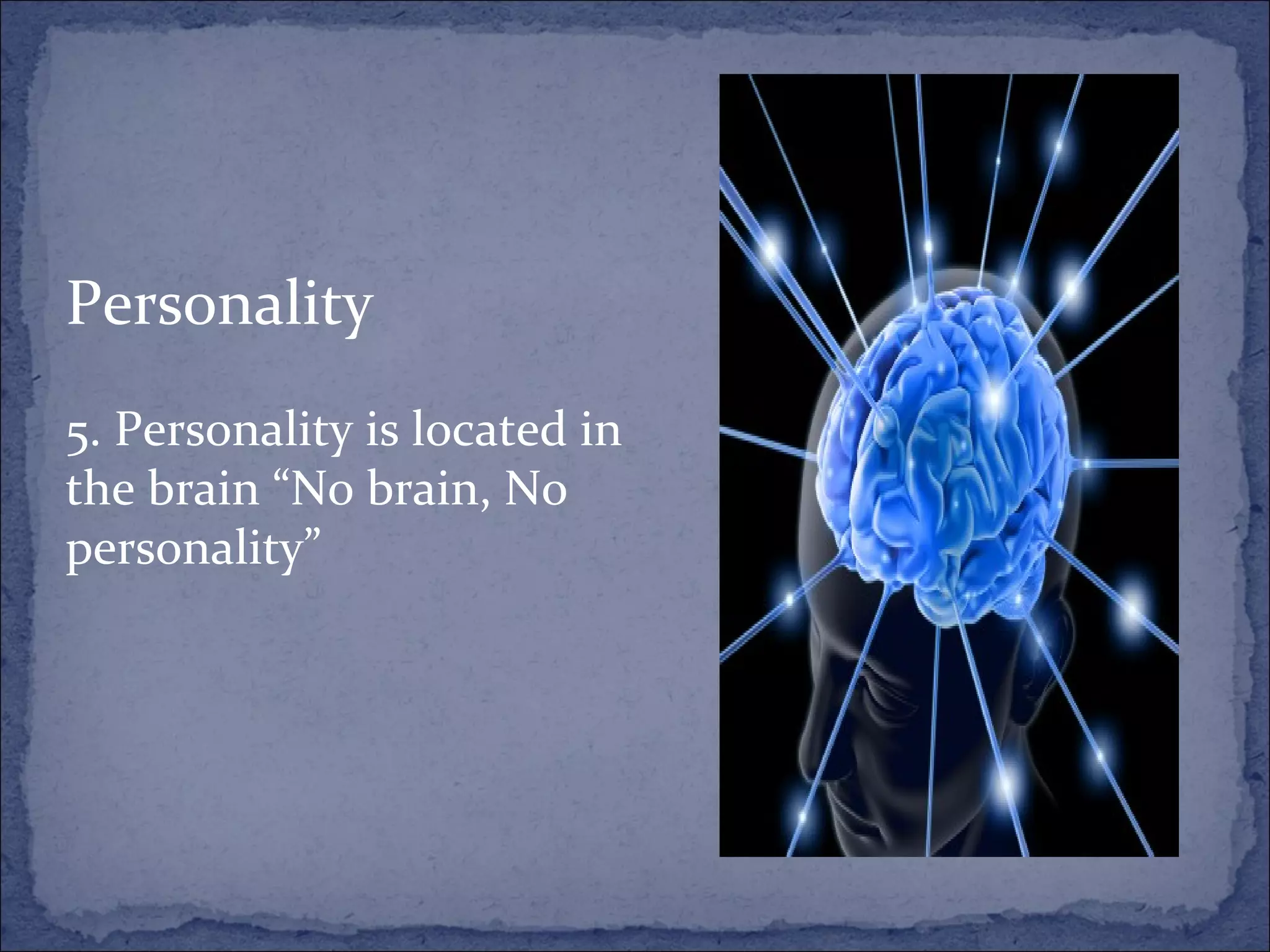
Personality 5. Personality is located in the brain “No brain, No personality”
Proceedings   are the things which we observe and try to represent with models, and to explain , the things which we attempt to predict, the facts against which we test the adequacy of our formulations (Murray, 1951) A directional organized intermittent succession of proceedings may be called a  Serial.
Establishments of Personality Murray agreed with Freud in conceiving of the  id  as the repository of primitive and unacceptable impulses The  super Ego  in Murray’s theory, as in Freud, is considered to be a cultural implant  It is important to note that Murray’s conception of the super ego and ego ideal provided more latitude for alteration and development in the years subsequent to childhood than does the orthodox psychoanalytic view.
Dynamics of Personality
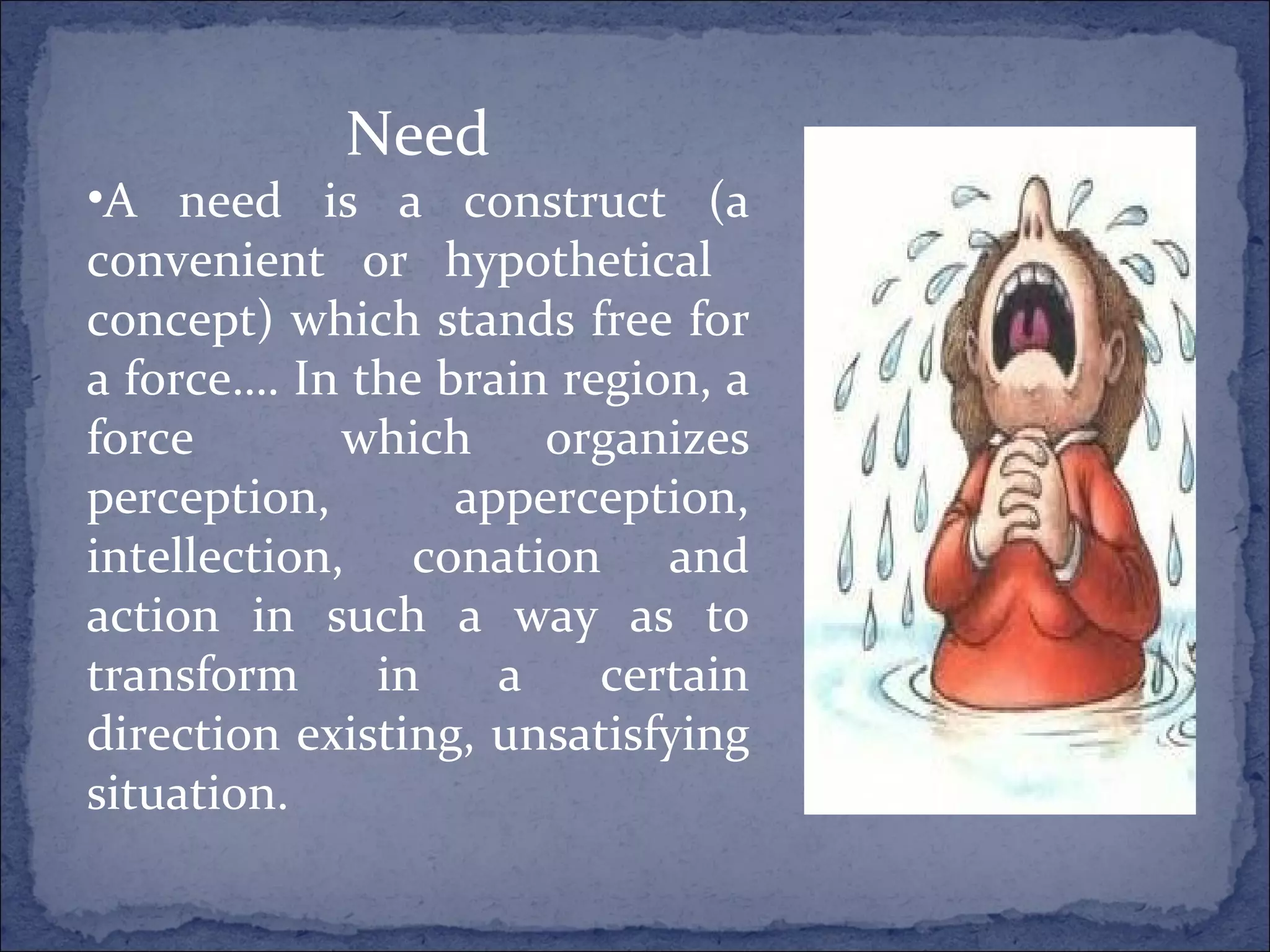
Need A need is a construct (a convenient or hypothetical  concept) which stands free for a force…. In the brain region, a force  which organizes perception, apperception, intellection, conation and action in such a way as to transform in a certain direction existing, unsatisfying situation.
Basis for Distinguishing between types of needs. Primary and Secondary Need Overt and Covert Needs Focal and Diffuse Needs Proactive and Reactive Needs Process activity, modal needs and effect needs
To surrender and accept punishment 1.  Abasement Murray's Psychogenic Needs
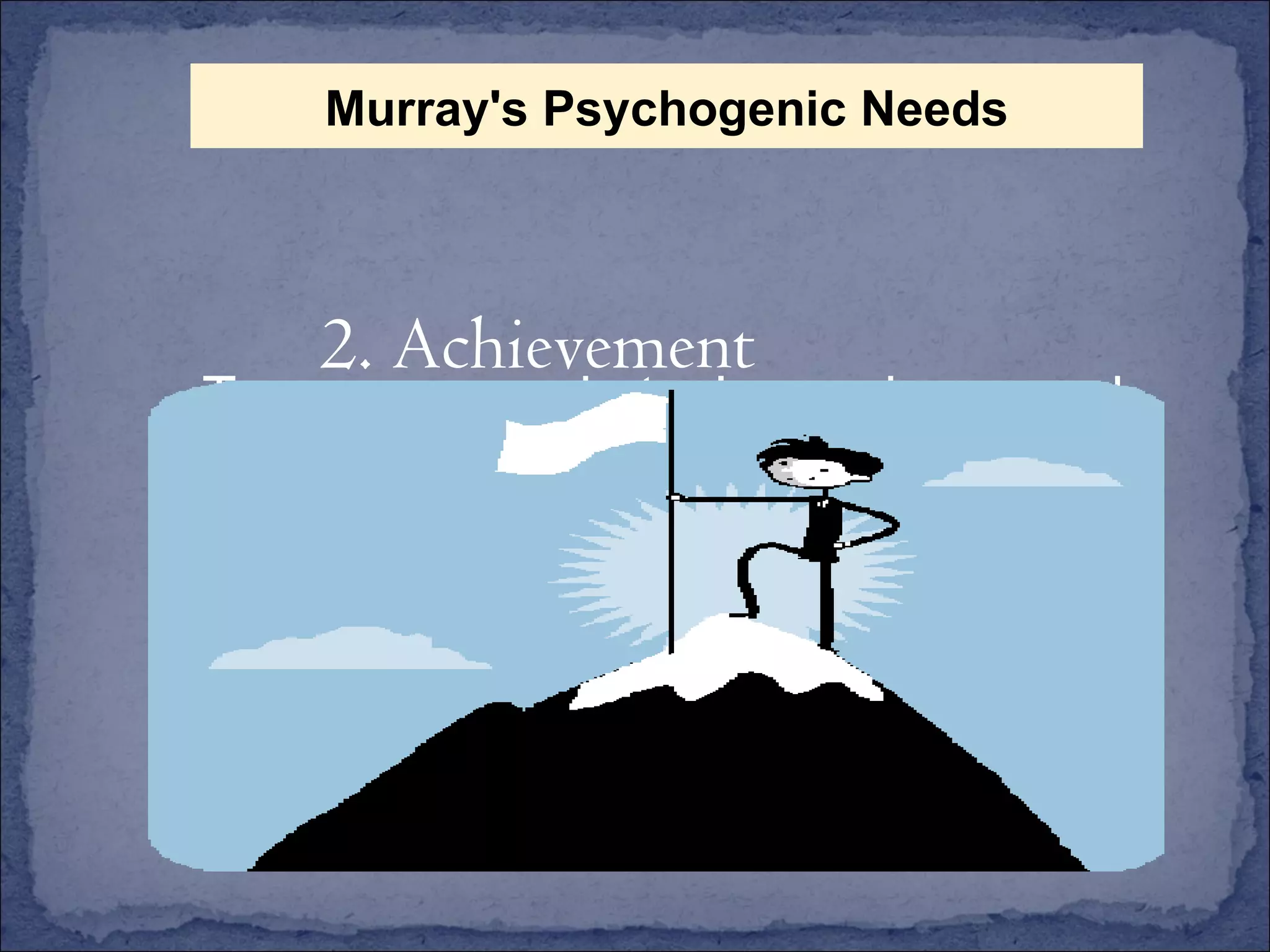
To overcome obstacles and succeed 2. Achievement Murray's Psychogenic Needs
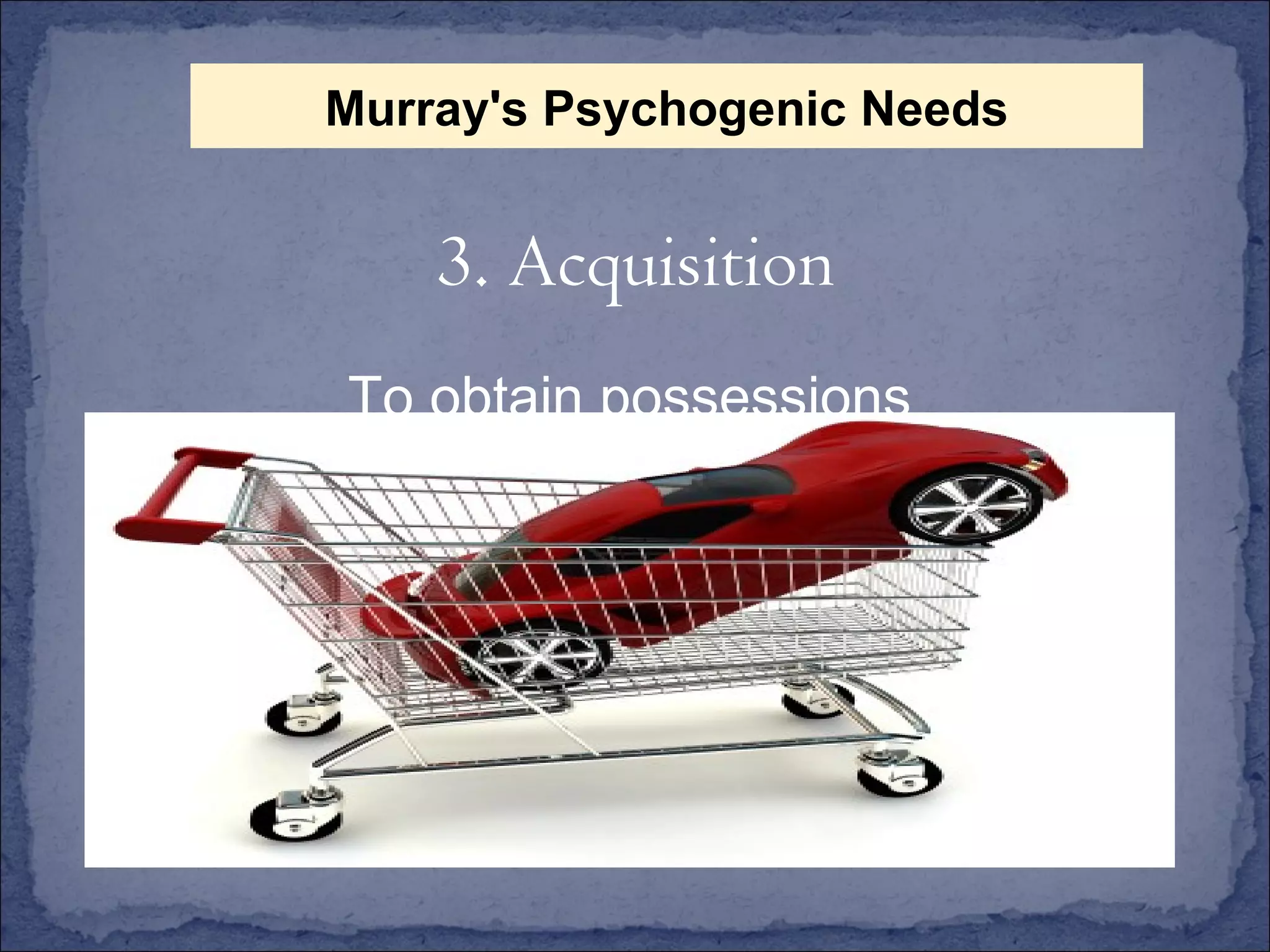
To obtain possessions 3. Acquisition Murray's Psychogenic Needs
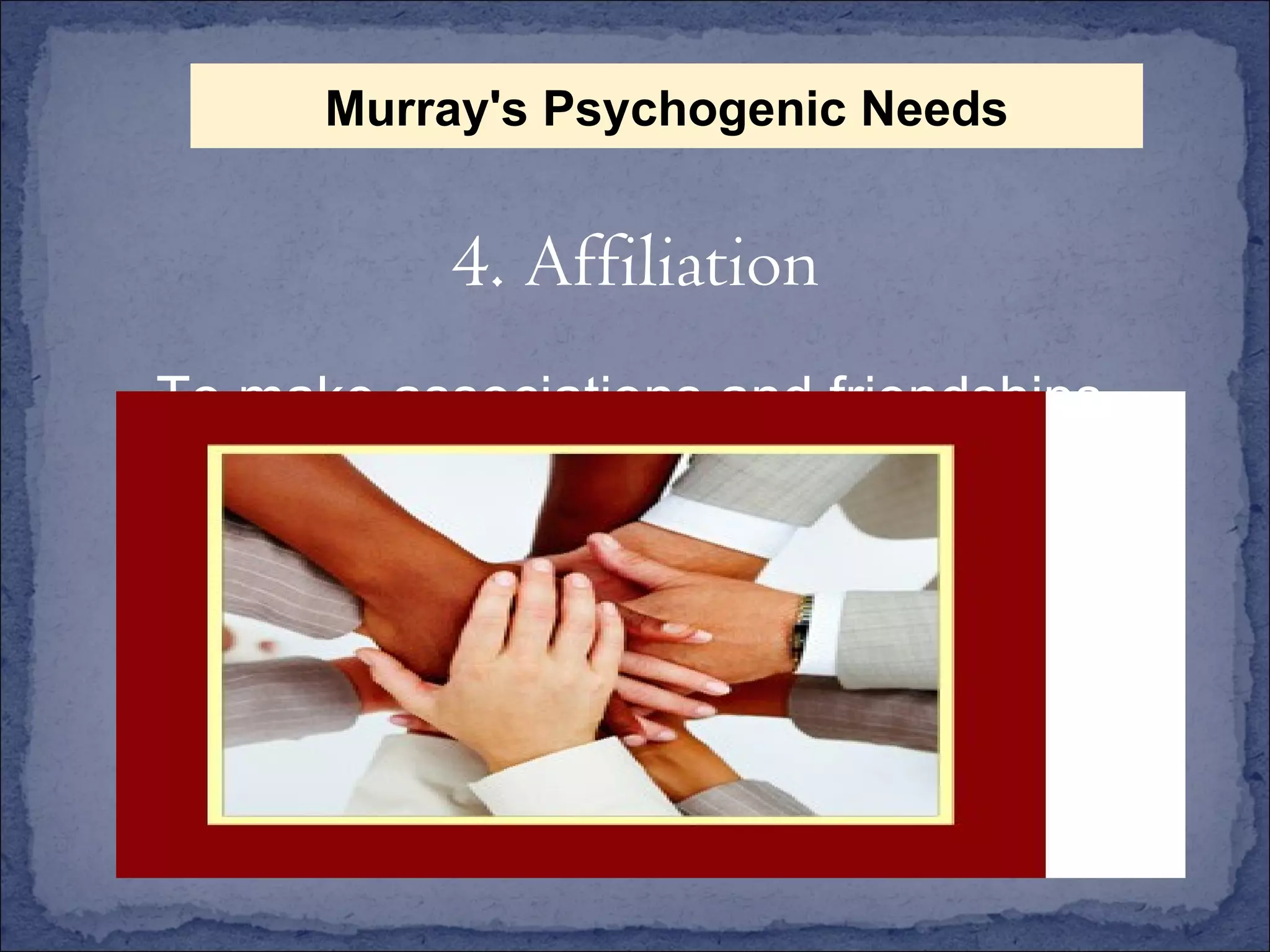
To make associations and friendships 4. Affiliation Murray's Psychogenic Needs
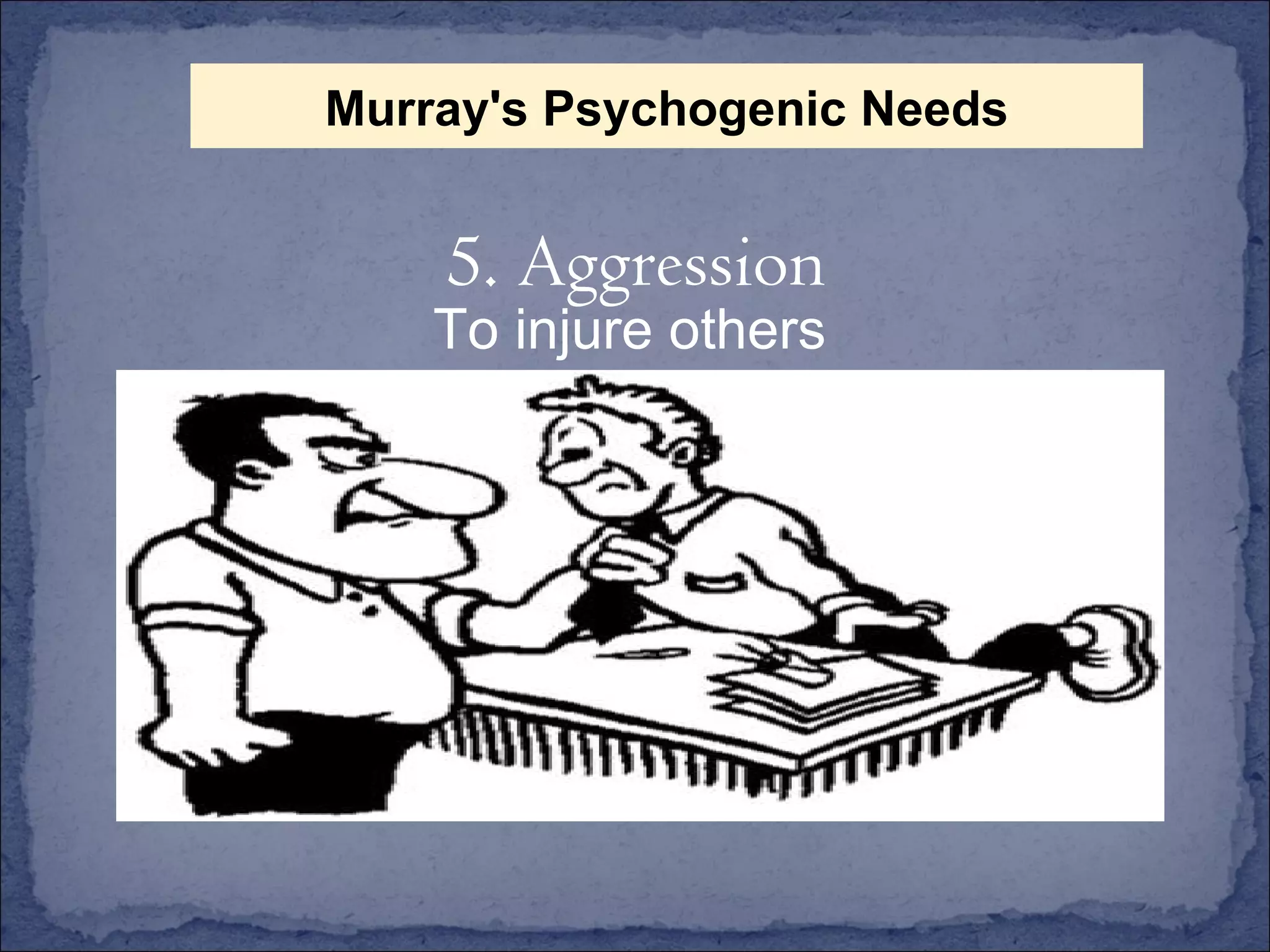
To injure others 5. Aggression Murray's Psychogenic Needs
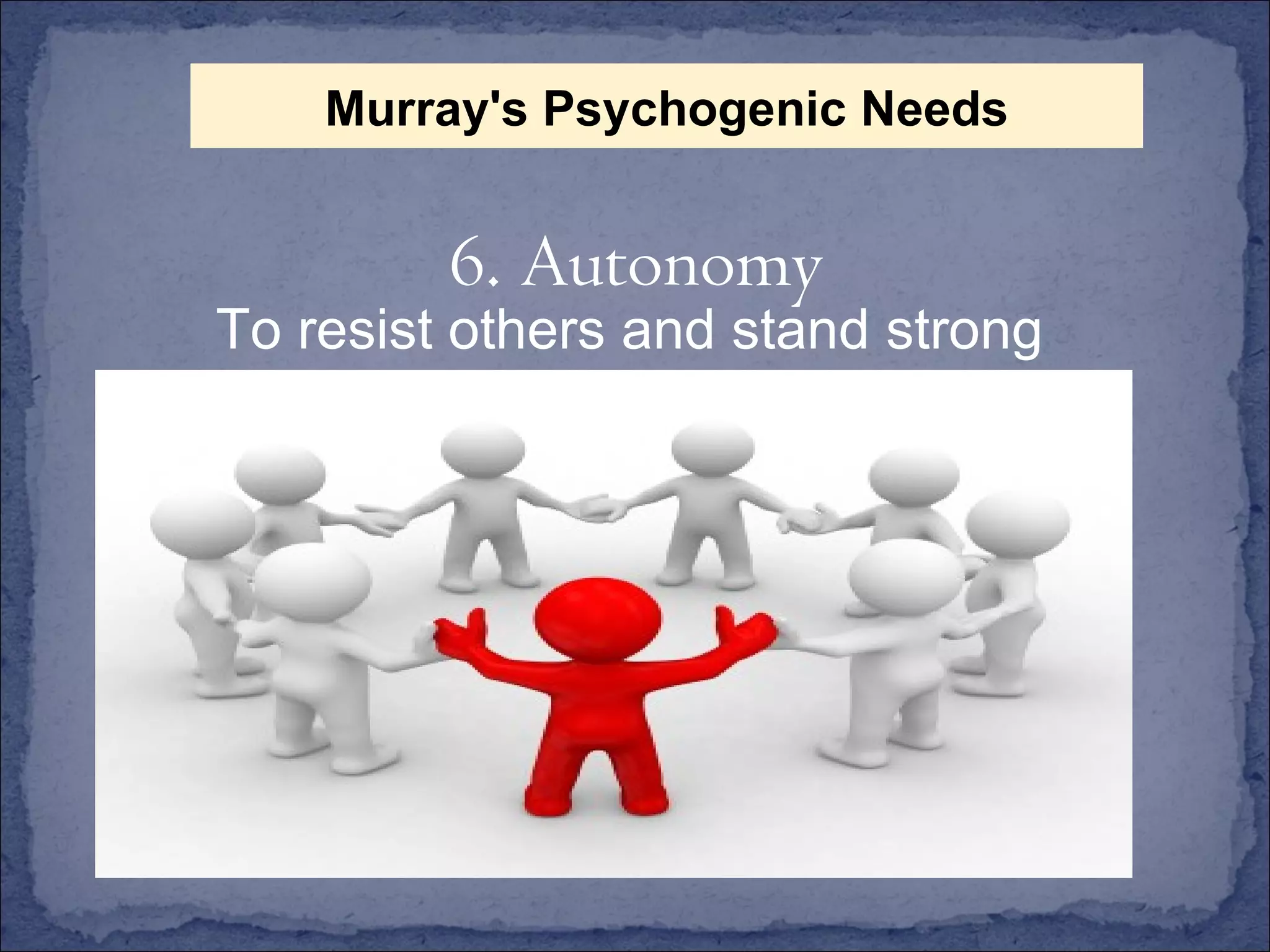
To resist others and stand strong 6. Autonomy Murray's Psychogenic Needs
To avoid blame and obey the rules 7. Blameavoidance Murray's Psychogenic Needs
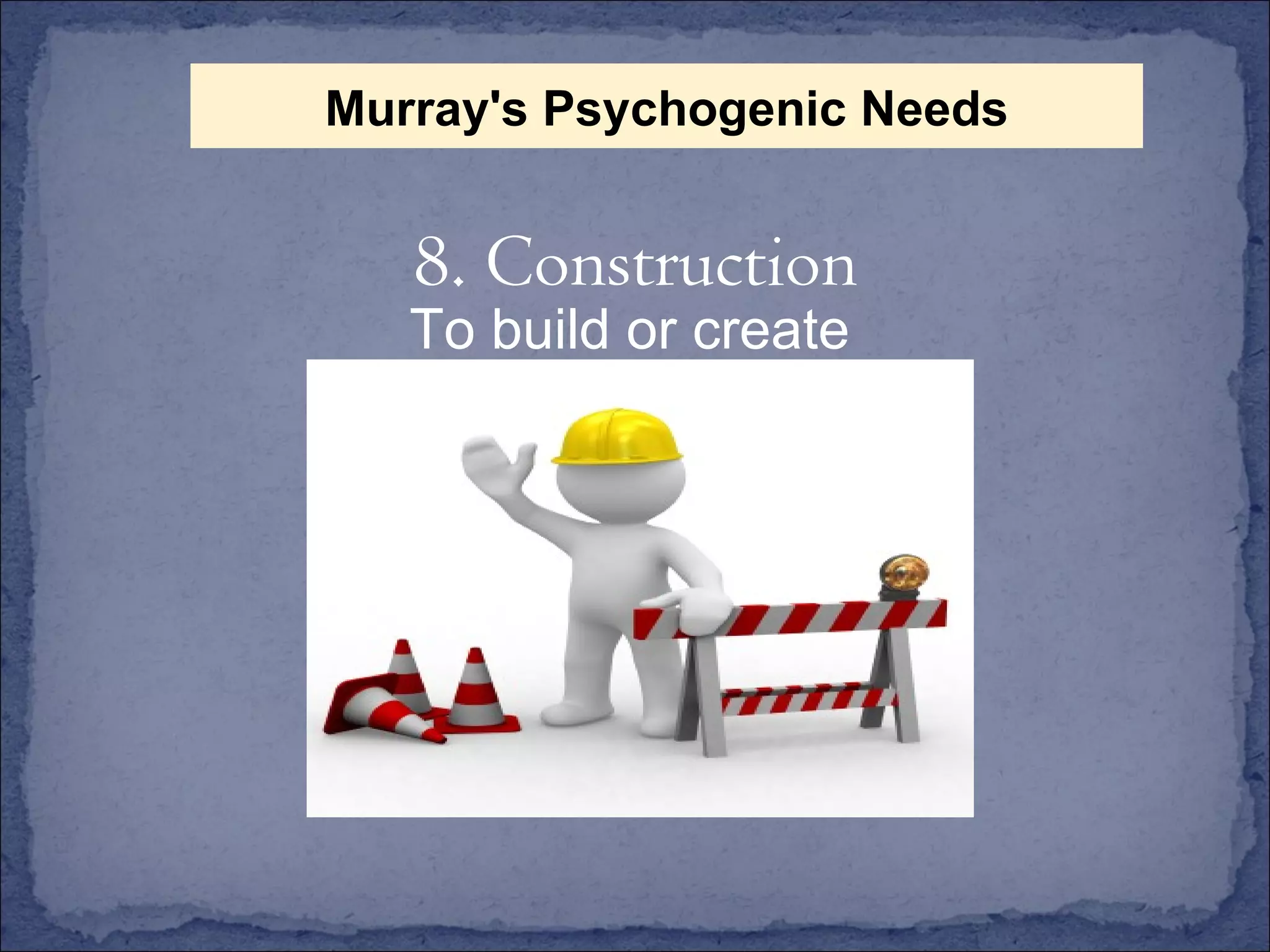
To build or create 8. Construction Murray's Psychogenic Needs
To be unique 9. Contrariance Murray's Psychogenic Needs
To defend honor 10. Counteraction Murray's Psychogenic Needs
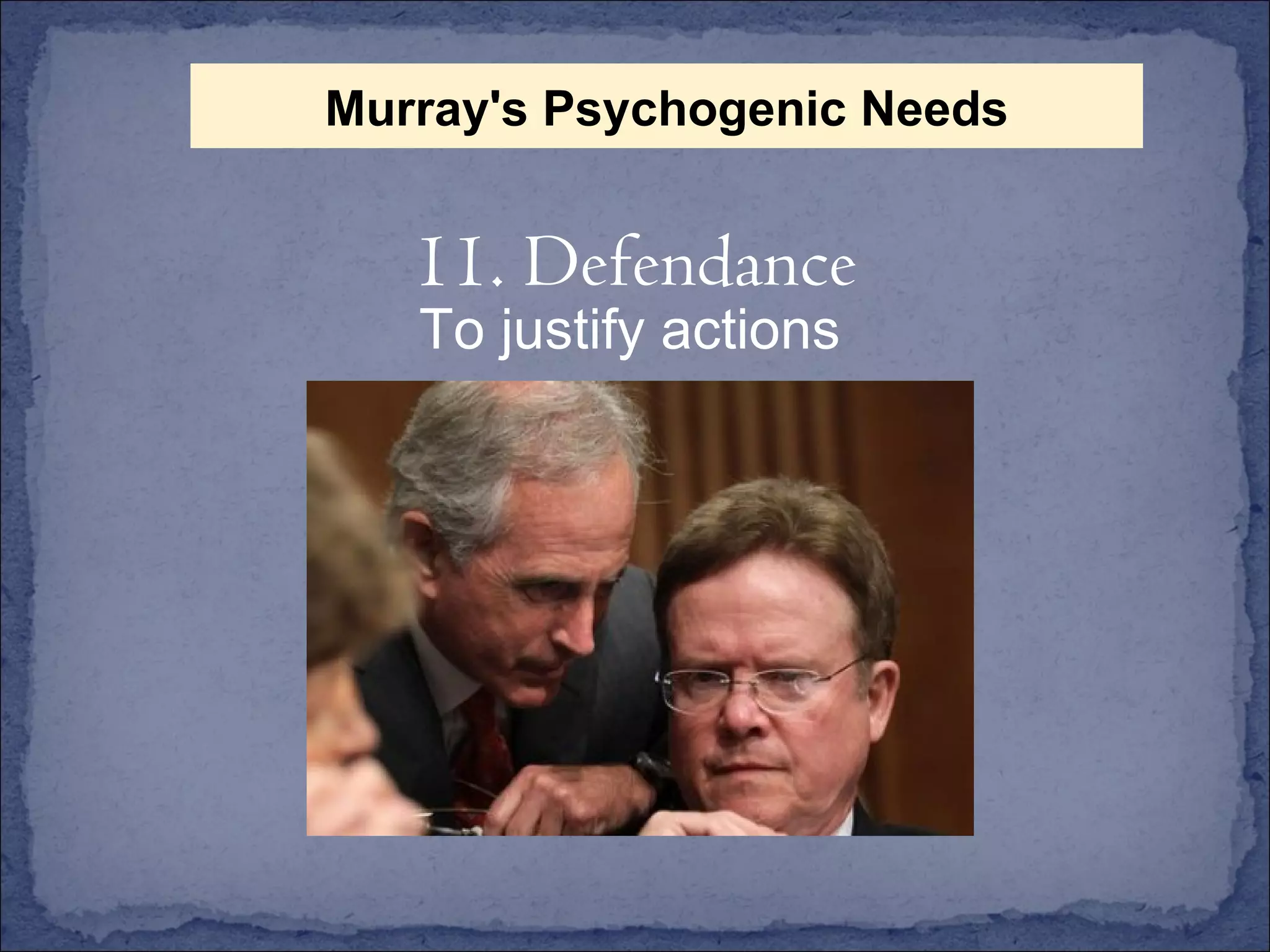
To justify actions 11. Defendance Murray's Psychogenic Needs
To follow a superior, to serve 12. Deference Murray's Psychogenic Needs
To control and lead others 13. Dominance Murray's Psychogenic Needs
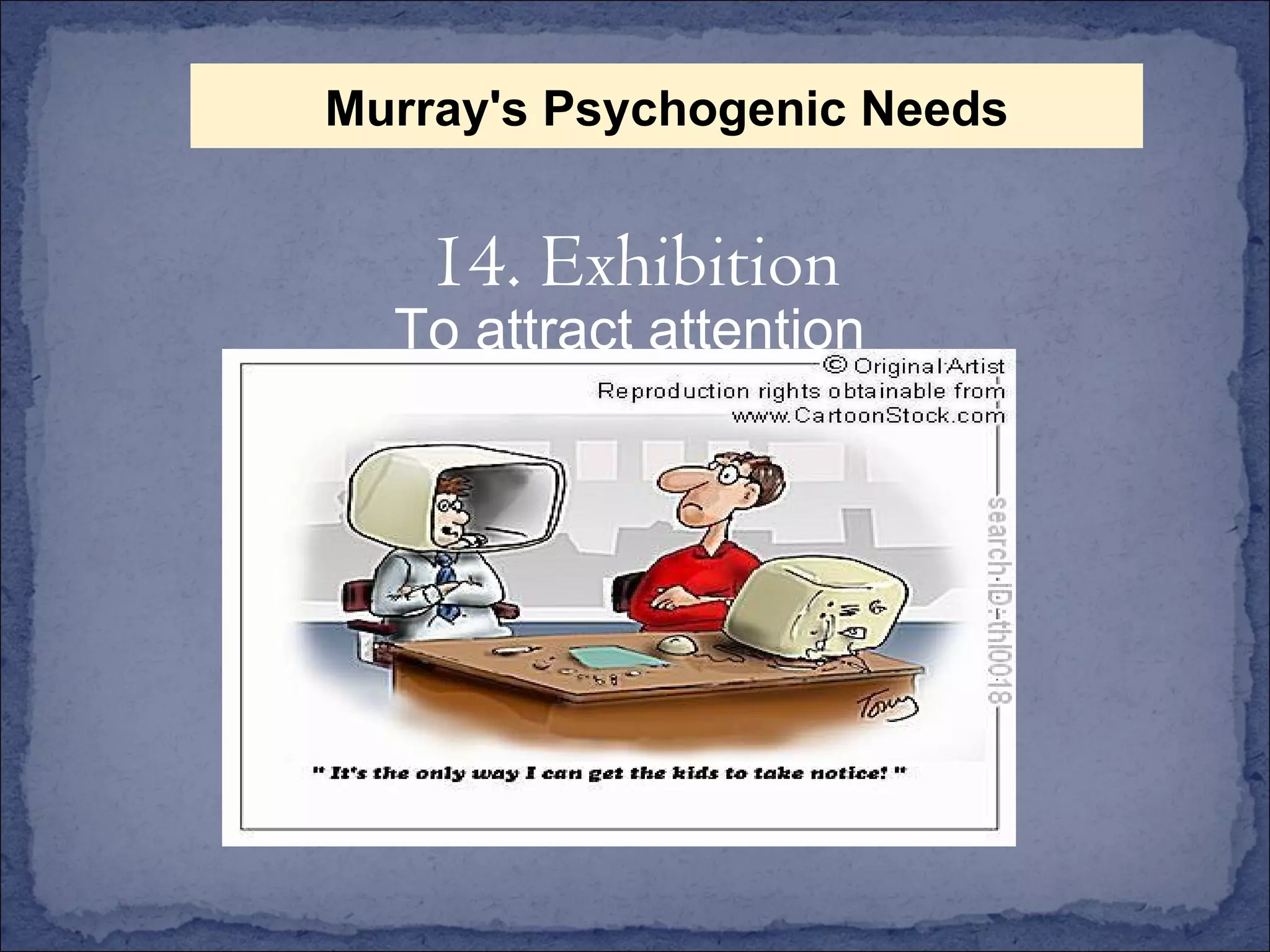
To attract attention 14. Exhibition Murray's Psychogenic Needs
To provide information, educate 15. Exposition Murray's Psychogenic Needs
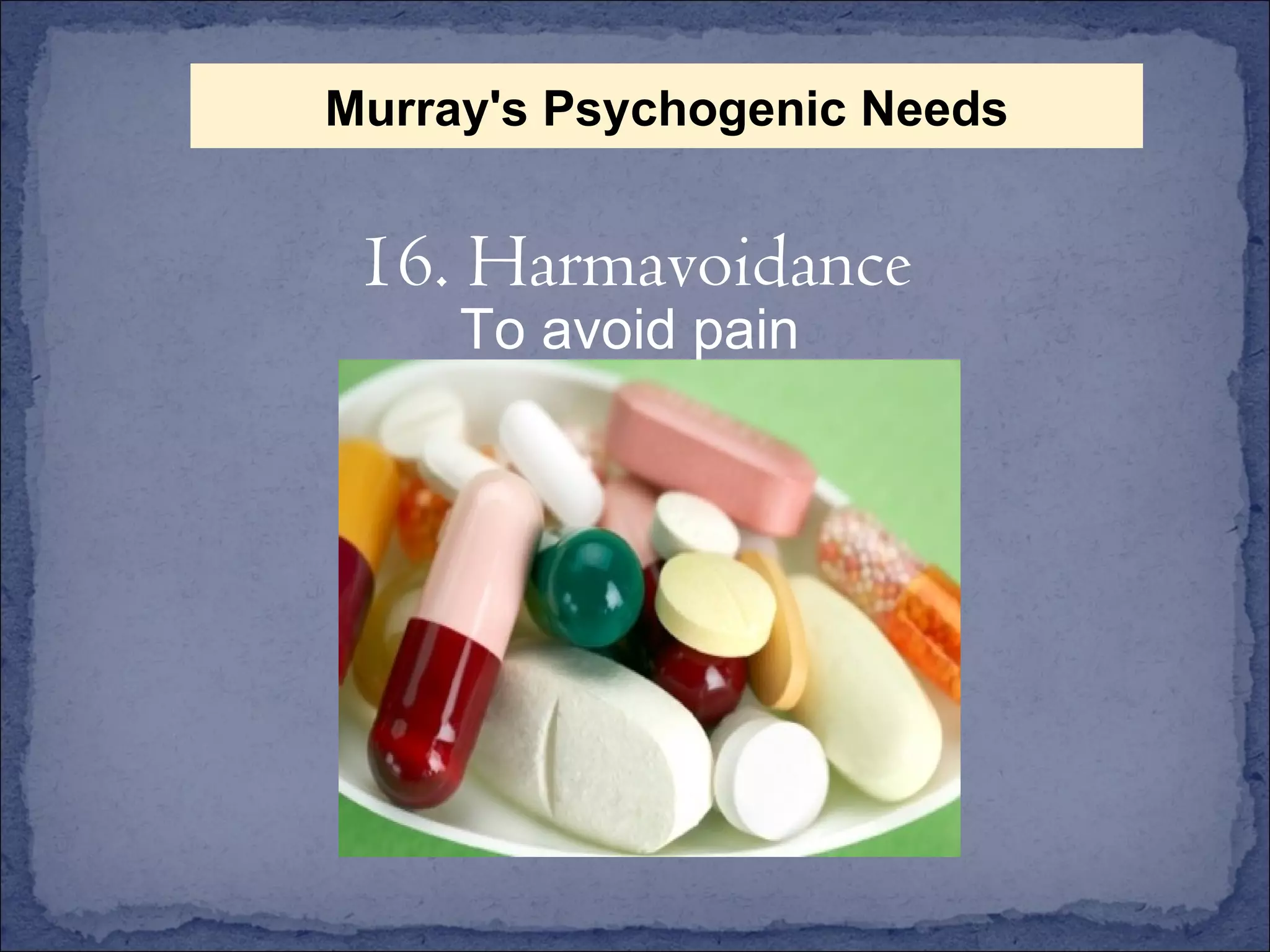
To avoid pain 16. Harmavoidance Murray's Psychogenic Needs
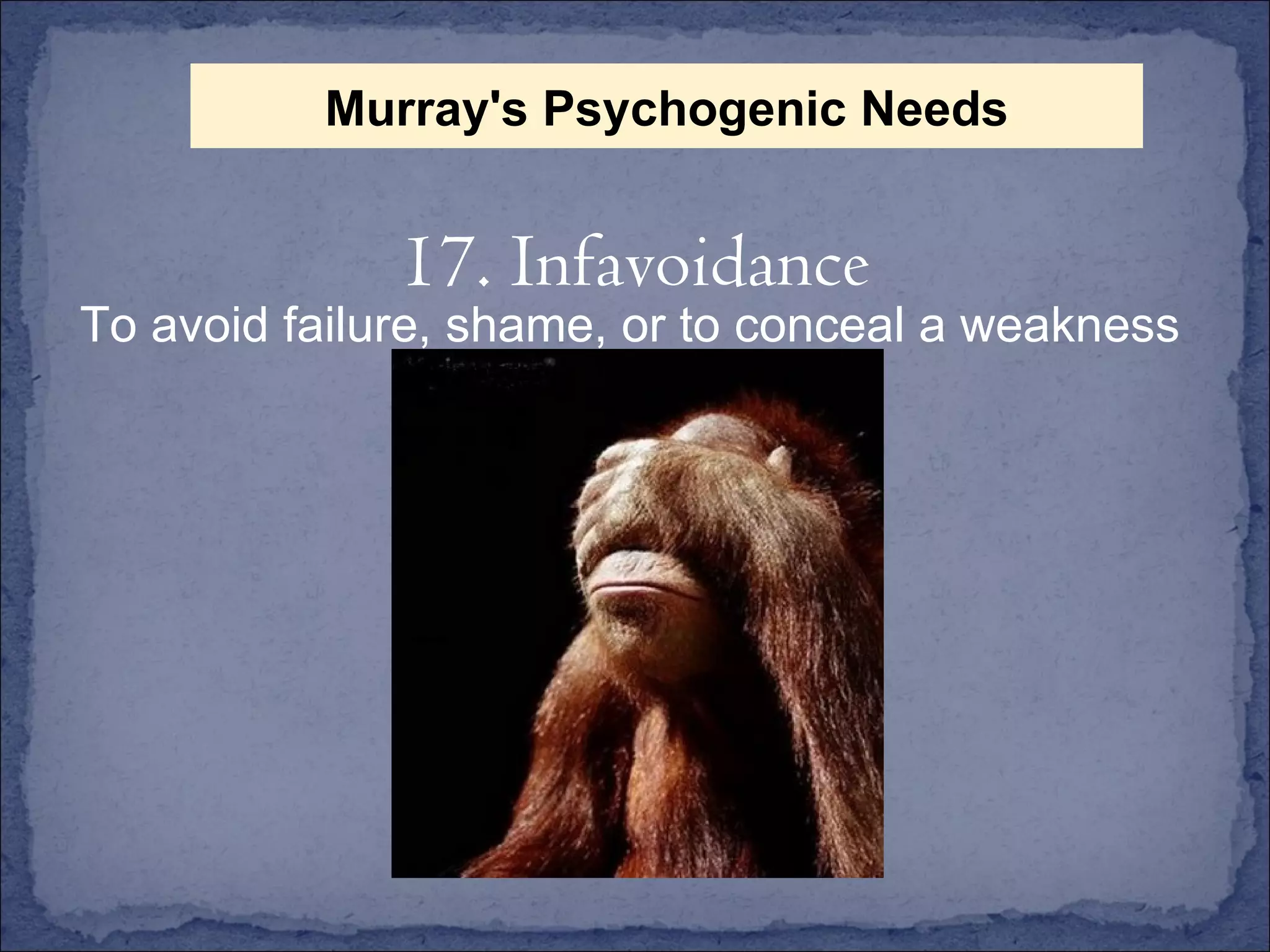
To avoid failure, shame, or to conceal a weakness 17. Infavoidance Murray's Psychogenic Needs
To protect the helpless 18. Nurturance Murray's Psychogenic Needs
To arrange, organize, and be precise 19. Order Murray's Psychogenic Needs
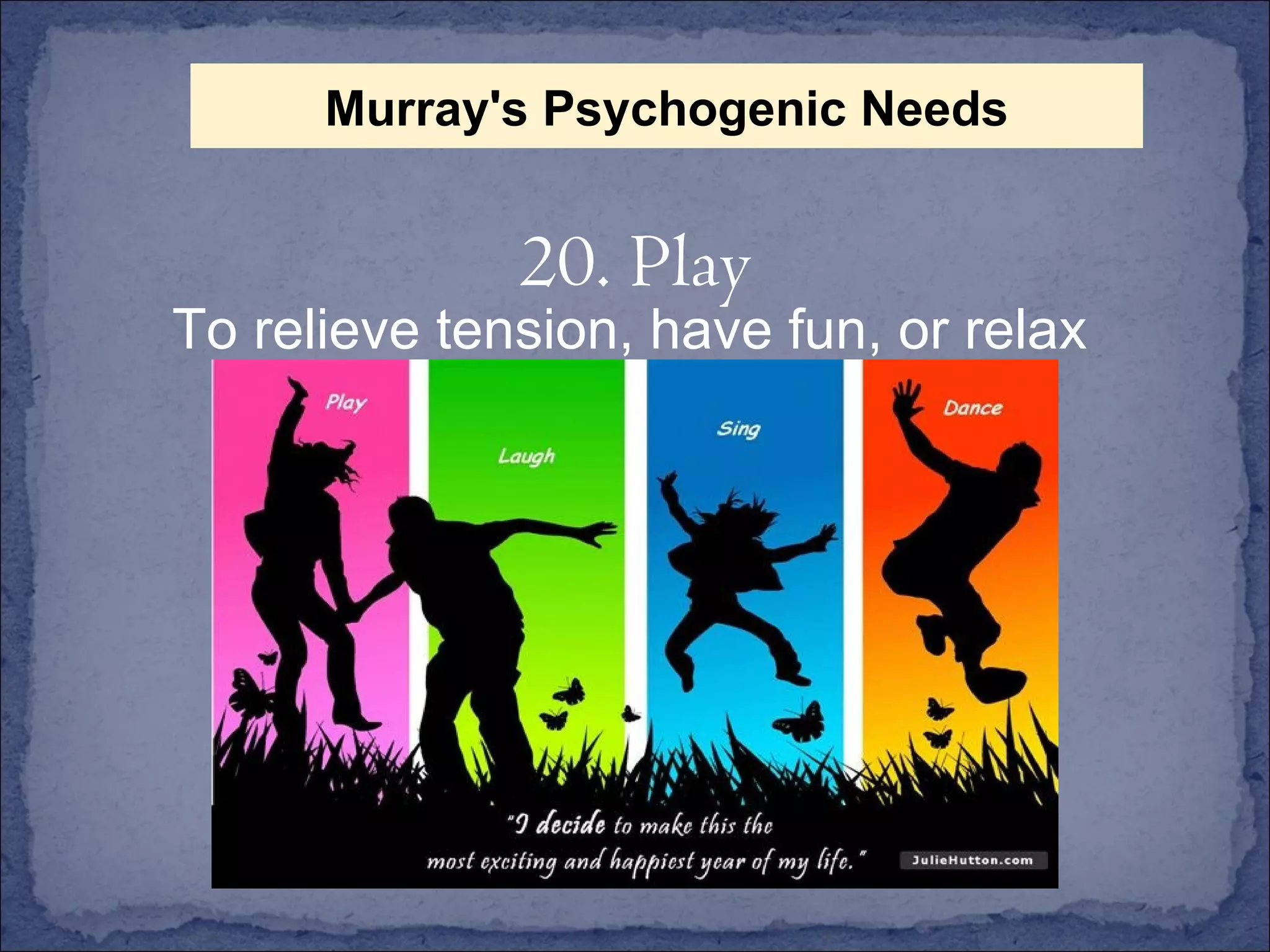
To relieve tension, have fun, or relax 20. Play Murray's Psychogenic Needs
To gain approval and social status 20. Recognition Murray's Psychogenic Needs
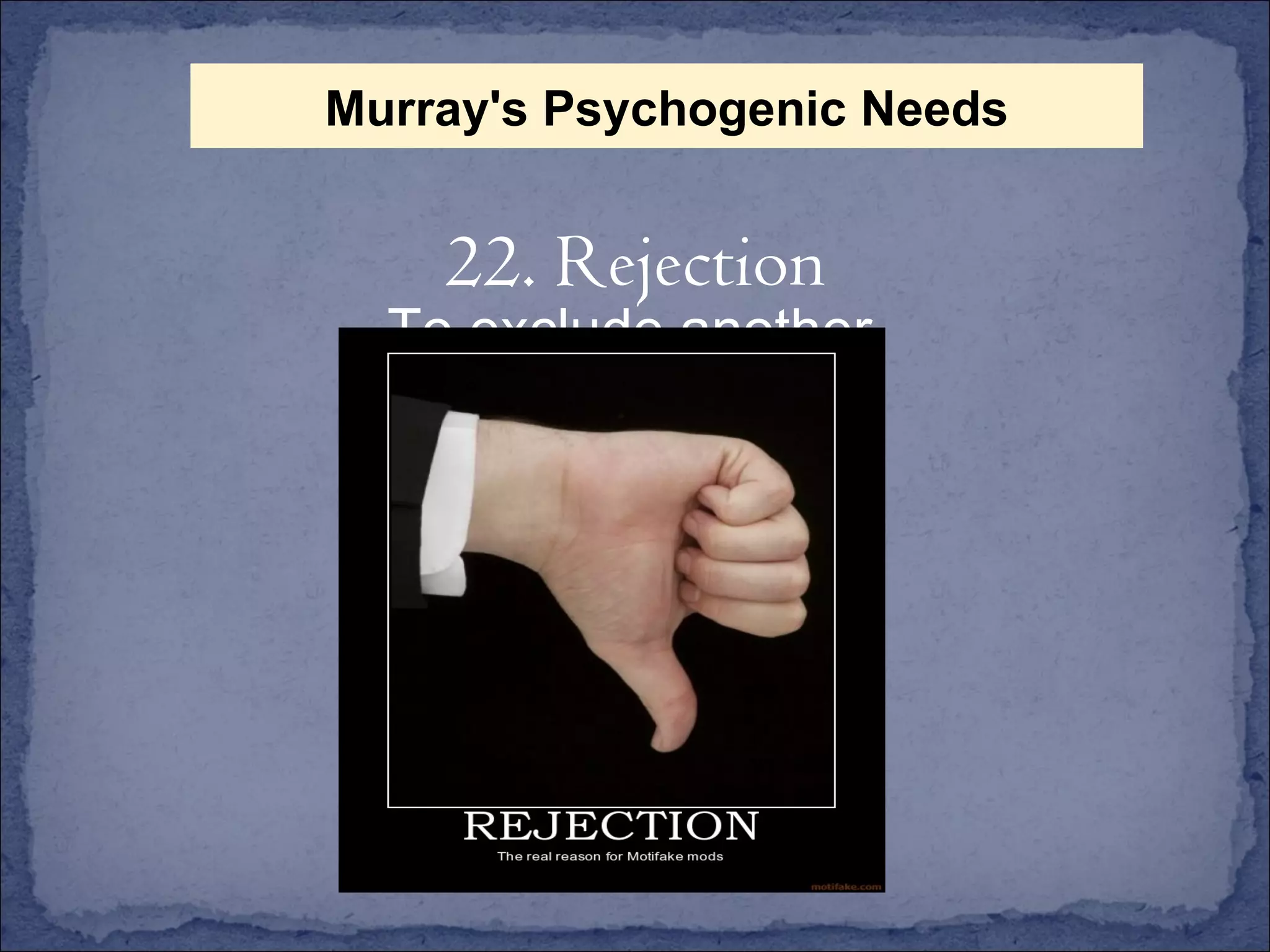
To exclude another 22. Rejection Murray's Psychogenic Needs
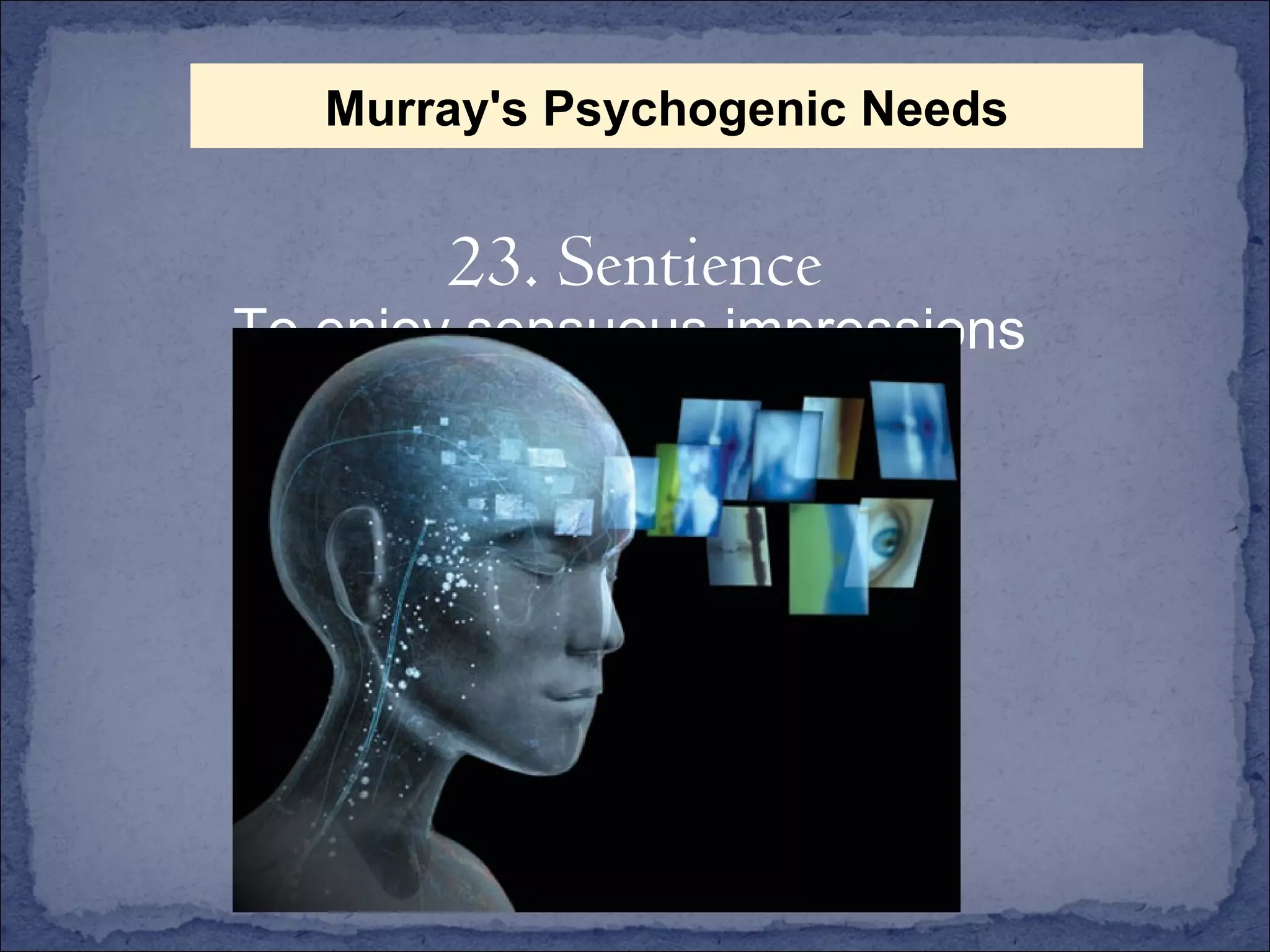
To enjoy sensuous impressions 23. Sentience Murray's Psychogenic Needs
To form and enjoy an erotic relationship 24. Sex Murray's Psychogenic Needs
To empathize 25. Similance Murray's Psychogenic Needs
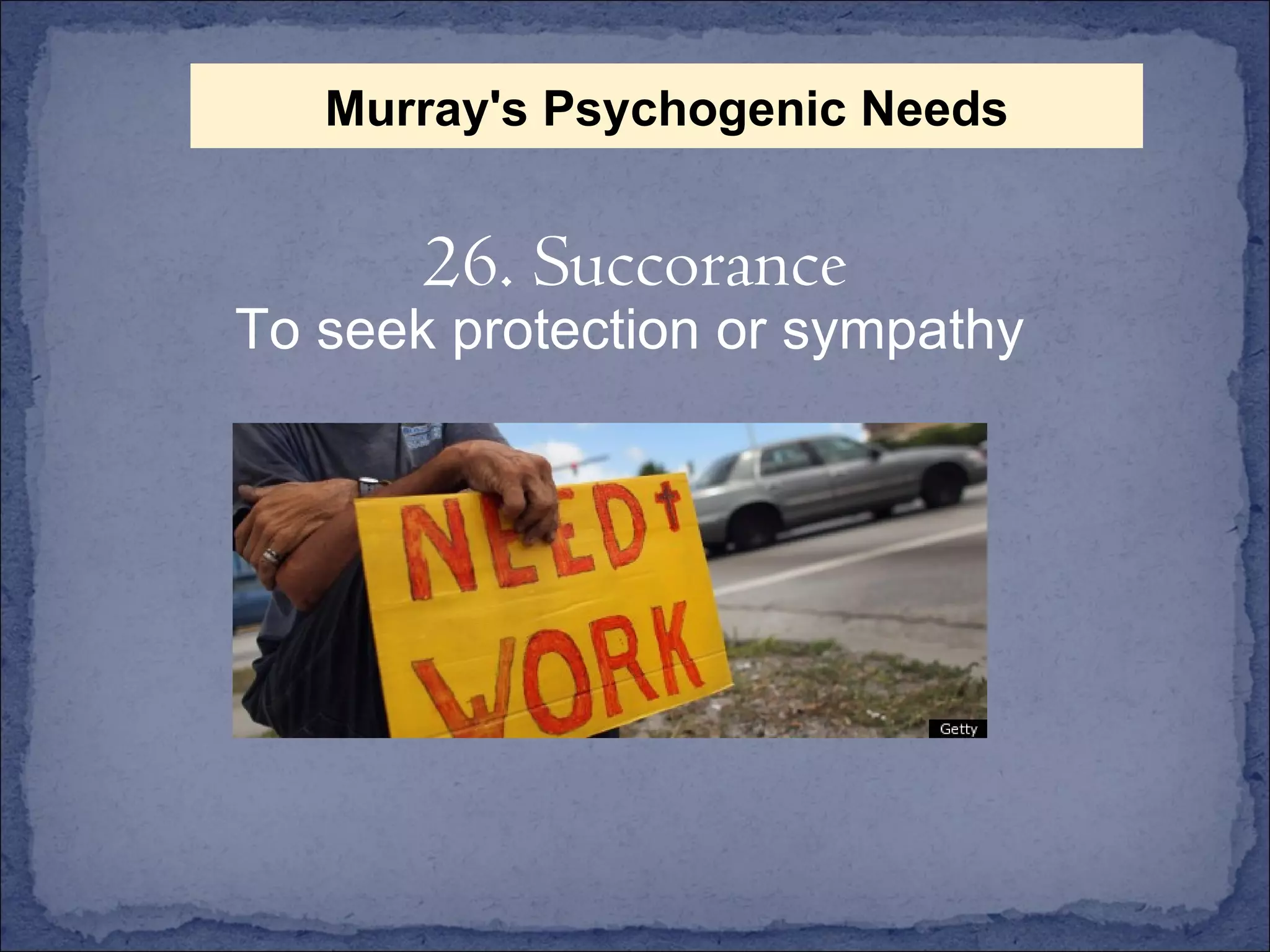
To seek protection or sympathy 26. Succorance Murray's Psychogenic Needs
To analyze and experience , to seek knowledge 27. Understanding Murray's Psychogenic Needs
Theories of personality based upon needs and motives suggest that our personalities are a reflection of behaviors controlled by needs.
While some needs are temporary and changing, other needs are more deeply seated in our nature.  According to Murray, these psychogenic needs function mostly on the unconscious level, but play a major role in our personality.
Interrelation of Needs Prepotency Conflict Fusion of needs Concept of Subsidation
Henry Murray and Psychological Needs Murray from a Psychoanalytic Perspective Murray used the term personology to describe his study of human lives and individual differences in personality Murray described a habit system as automatic, unconscious behaviors shaped by the id, ego, and superego Murray emphasized positive instincts related to motivation and needs
American psychologist  developed a theory of personality that was organized in terms of motives, presses, and needs.  Murray described a needs as a, "potentiality or readiness to respond in a certain way under certain given circumstances" (1938). 

Henry murray

  • 1.
    Henry M. MurrayMay 13, 1893 - June 23, 1988
  • 2.
    He earned hisbachelor's degree in history in 1915, a medical degree from Columbia in 1919 then completed a doctorate in biochemistry from Cambridge nine years later.  
  • 3.
    His start inpsychology occurred after reading Jung and eventually arranging a meeting with him.  During this meeting, Jung convinced Murray to study psychoanalysis, which he did at Harvard University. 
  • 4.
    After competing histraining, Murray actually began teaching psychology and psychoanalytic theory at Harvard, and he remained there for the rest of his professional career.
  • 5.
    Although considered atrait theorist, Murray's medical background, combined with his analytical training give a unique flair to his research and writing.  This is probably most evident in his development of the Thematic Apperception Test (TAT), a personality test designed to determine personality themes as well as unconscious motivation.
  • 6.
    He was focusedon basic needs in personality which he called psychogenic needs.  He believed these needs were largely at the unconscious level.  After researching this area, he narrowed these needs down to 27, although the list and names vary
  • 7.
    Topic Outline 1. The Structure of Personality Definition of Personality Proceedings and Serials Establishment of Personality 2. The Dynamics of Personality Need Press Tension Reduction Thema Need Integrate Unity –Thema Regnant Process Vector-Value Scheme 3. The Development of Personality Infantile complexes Genetic-Maturational Determinants Learning Socio Cultural Determinants Uniqueness Unconscious Process The Socialization Process
  • 8.
  • 9.
    Personality An individualspersonality is an abstraction formulated by the theorist and not merely a description of the individual’s behavior.
  • 10.
    Personality 2. Anindividuals personality refers to a series of events that ideally span the person’s lifetime:” The history of the personality is the personality”
  • 11.
    Personality 3. Adefinition of personality should reflect the enduring and recurring elements of behavior as well as the novel and unique.
  • 12.
    Personality 4. Personalityis the organized or governing agent of the individual. Its functions are to integrate the conflicts and constraints to which the individual is exposed, to satisfy the individual’s needs, and to make plans for attainment of future goals.
  • 13.
    Personality 5. Personalityis located in the brain “No brain, No personality”
  • 14.
    Proceedings are the things which we observe and try to represent with models, and to explain , the things which we attempt to predict, the facts against which we test the adequacy of our formulations (Murray, 1951) A directional organized intermittent succession of proceedings may be called a Serial.
  • 15.
    Establishments of PersonalityMurray agreed with Freud in conceiving of the id as the repository of primitive and unacceptable impulses The super Ego in Murray’s theory, as in Freud, is considered to be a cultural implant It is important to note that Murray’s conception of the super ego and ego ideal provided more latitude for alteration and development in the years subsequent to childhood than does the orthodox psychoanalytic view.
  • 16.
  • 17.
    Need A needis a construct (a convenient or hypothetical concept) which stands free for a force…. In the brain region, a force which organizes perception, apperception, intellection, conation and action in such a way as to transform in a certain direction existing, unsatisfying situation.
  • 18.
    Basis for Distinguishingbetween types of needs. Primary and Secondary Need Overt and Covert Needs Focal and Diffuse Needs Proactive and Reactive Needs Process activity, modal needs and effect needs
  • 19.
    To surrender andaccept punishment 1. Abasement Murray's Psychogenic Needs
  • 20.
    To overcome obstaclesand succeed 2. Achievement Murray's Psychogenic Needs
  • 21.
    To obtain possessions3. Acquisition Murray's Psychogenic Needs
  • 22.
    To make associationsand friendships 4. Affiliation Murray's Psychogenic Needs
  • 23.
    To injure others5. Aggression Murray's Psychogenic Needs
  • 24.
    To resist othersand stand strong 6. Autonomy Murray's Psychogenic Needs
  • 25.
    To avoid blameand obey the rules 7. Blameavoidance Murray's Psychogenic Needs
  • 26.
    To build orcreate 8. Construction Murray's Psychogenic Needs
  • 27.
    To be unique9. Contrariance Murray's Psychogenic Needs
  • 28.
    To defend honor10. Counteraction Murray's Psychogenic Needs
  • 29.
    To justify actions11. Defendance Murray's Psychogenic Needs
  • 30.
    To follow asuperior, to serve 12. Deference Murray's Psychogenic Needs
  • 31.
    To control andlead others 13. Dominance Murray's Psychogenic Needs
  • 32.
    To attract attention14. Exhibition Murray's Psychogenic Needs
  • 33.
    To provide information,educate 15. Exposition Murray's Psychogenic Needs
  • 34.
    To avoid pain16. Harmavoidance Murray's Psychogenic Needs
  • 35.
    To avoid failure,shame, or to conceal a weakness 17. Infavoidance Murray's Psychogenic Needs
  • 36.
    To protect thehelpless 18. Nurturance Murray's Psychogenic Needs
  • 37.
    To arrange, organize,and be precise 19. Order Murray's Psychogenic Needs
  • 38.
    To relieve tension,have fun, or relax 20. Play Murray's Psychogenic Needs
  • 39.
    To gain approvaland social status 20. Recognition Murray's Psychogenic Needs
  • 40.
    To exclude another22. Rejection Murray's Psychogenic Needs
  • 41.
    To enjoy sensuousimpressions 23. Sentience Murray's Psychogenic Needs
  • 42.
    To form andenjoy an erotic relationship 24. Sex Murray's Psychogenic Needs
  • 43.
    To empathize 25.Similance Murray's Psychogenic Needs
  • 44.
    To seek protectionor sympathy 26. Succorance Murray's Psychogenic Needs
  • 45.
    To analyze andexperience , to seek knowledge 27. Understanding Murray's Psychogenic Needs
  • 46.
    Theories of personalitybased upon needs and motives suggest that our personalities are a reflection of behaviors controlled by needs.
  • 47.
    While some needsare temporary and changing, other needs are more deeply seated in our nature. According to Murray, these psychogenic needs function mostly on the unconscious level, but play a major role in our personality.
  • 48.
    Interrelation of NeedsPrepotency Conflict Fusion of needs Concept of Subsidation
  • 49.
    Henry Murray andPsychological Needs Murray from a Psychoanalytic Perspective Murray used the term personology to describe his study of human lives and individual differences in personality Murray described a habit system as automatic, unconscious behaviors shaped by the id, ego, and superego Murray emphasized positive instincts related to motivation and needs
  • 50.
    American psychologist developed a theory of personality that was organized in terms of motives, presses, and needs. Murray described a needs as a, "potentiality or readiness to respond in a certain way under certain given circumstances" (1938).